SOA using SoaML”
Niels Schot
A thesis submitted for the degree of
MSc Computer Science
University of Twente
EEMCS - TRESE: Software Engineering Group
Examination committee:
Luís Ferreira Pires Marten van Sinderen
This project considers the application of Model-Driven Engineering (MDE) techniques, like metamodeling and model transformations, to Service-Oriented Architecture (SOA). SOA model-ing languages should support the specification of quality aspects, so that conditions, constraints and requirements on these aspects can be specified in service models. Examples of quality as-pects are reliability, performance, availability, security, cost and integrity. A concrete quality requirement could be that the service response time must not exceed two seconds.
The term quality of service (QoS) is often used to refer to the collection of quality require-ments on a service execution. A policy is associated with the point of view of each individual participant in service interactions. For instance, the policy of a service provider defines the qual-ity aspects of its provided service, and should be taken into consideration in the service contract between this service provider and a service consumer, in case a service consumer agrees with the policy.
During the development of a SOA application, several activities are performed by various stakeholders. For instance, a service provider needs to describe the offers of the provided ser-vice. An example of an activity for the service provider is to express the QoS offers with, for instance, a policy. Another example is the specification of service contracts which describe the agreement on QoS requirements. A lot of these activities can be optimized by the application of MDE in terms of productivity, understandability and consistency.
Preface
During the last months of my master, I have worked extensively on this thesis to finish my study at the University of Twente. Now I have completed my thesis, I would like to thank some people who helped during this period.
First, I would like to thank my supervisors Luís and Marten for their useful reviews and discussions about this project. The project offered a lot of directions and possibilities, and they helped me to choose the right approach to perform this research. The numerous meetings really helped me to distinguish the main points from the side issues of this project.
Last but not least, I would like my girlfriend Annerie, family and friends for their support and the patience they showed for me while I was working on this thesis behind my computer.
Abstract i
Preface ii
List of Figures 4
List of Tables 5
Glossary 6
1 Introduction 7
1.1 Motivation . . . 7
1.2 Problem statement . . . 8
1.3 Objectives . . . 9
1.4 Research questions . . . 9
1.5 Approach . . . 10
1.6 Scope of the research . . . 11
1.7 Structure of report . . . 11
2 Service models 13 2.1 Service life-cycle . . . 13
2.2 Stakeholders . . . 15
2.3 Service developer . . . 15
2.4 Service provider . . . 17
2.5 Service consumer . . . 19
2.6 Application provider . . . 20
2.7 Service broker . . . 20
2.8 Composition designer . . . 21
2.9 Quality aspects . . . 23
2.10 Optimizable activities . . . 25
3 SOA modeling 28 3.1 Relevant MDE principles for SOA . . . 28
3.2 PIM-level language selection . . . 29
3.3 SoaML concepts . . . 35
3.4 SoaML tooling . . . 37
3.4.1 Selection . . . 38
4 QoS specifications in SoaML 40 4.1 Case study . . . 40
4.2 The scope of SoaML . . . 41
CONTENTS
4.3.1 SoaML UML constraints . . . 42
4.3.2 QoS languages . . . 46
4.3.3 SoaML metamodel refinements . . . 50
4.4 Selection QoS modeling approach . . . 51
4.5 Implementing SoaML models . . . 52
4.5.1 Quality requirements . . . 53
4.5.2 Modeling policies . . . 53
4.5.3 Modeling QoS in service contracts . . . 55
5 PSM-level QoS modeling 57 5.1 Search scope . . . 57
5.2 Available policy languages . . . 57
5.2.1 WS-Policy . . . 58
5.2.2 UDDI . . . 59
5.2.3 Web Services Policy Language (WSPL) . . . 60
5.2.4 Other techniques . . . 61
5.3 Selection of policy language . . . 61
5.4 Available service contract languages . . . 62
5.4.1 WS-Agreement . . . 62
5.4.2 Web Service Level Agreement (WSLA) . . . 64
5.4.3 SLA* . . . 65
5.4.4 SLAng . . . 66
5.4.5 Other techniques . . . 66
5.5 Selection of service contract language . . . 67
5.6 Implementing PSM models . . . 68
6 Model transformations 72 6.1 Transformation environment . . . 72
6.1.1 Implementing the extended SoaML metamodel . . . 72
6.1.2 Rebuilding the SoaML profile models . . . 73
6.2 Mappings . . . 74
6.2.1 Policies . . . 74
6.2.2 Service contracts . . . 77
6.3 Transformation results . . . 80
6.3.1 Policies . . . 80
6.3.2 Service contracts . . . 81
7 Final remarks 83 7.1 Related work . . . 83
7.2 Research results . . . 84
7.3 Future work . . . 84
References 92 A ATL transformations 93 A.1 SoaML2WSPolicy . . . 93
1.1 Overview SOA application modeling process . . . 8
1.2 Research approach . . . 10
2.1 Terminology SOA application and service composition . . . 13
2.2 General view service of the life-cycle . . . 14
2.3 Service life-cycle service developer . . . 16
2.4 General service negotiation view . . . 17
2.5 Service life-cycle service provider . . . 18
2.6 Service life-cycle service consumer . . . 19
2.7 Service life-cycle activities application provider . . . 20
2.8 Service life-cycle service broker . . . 21
2.9 Service life-cycle service broker . . . 22
2.10 Service life-cycle service broker . . . 22
2.11 Service contract instantiation with policies . . . 24
2.12 QoS specification with policies . . . 26
2.13 Contract definition . . . 26
3.1 Example of a service interface defined in SoaML . . . 36
4.1 High-level view of the example . . . 40
4.2 Policy specification as UML constraint . . . 43
4.3 Policy specification as UML OCL constraint . . . 44
4.4 Part of the QoS&FT profile implementation in RSA . . . 46
4.5 Definition of availability characteristic . . . 47
4.6 Defining a QoS constraint with UML constraints . . . 47
4.7 Defining a QoS constraint with UML dependency and QoS value objects . . . 48
4.8 Evaluation QoS modeling techniques for SoaML . . . 51
4.9 The involved participants . . . 52
4.10 Availability and performance characteristics . . . 53
4.11 Linking QoS requirements to participant . . . 54
4.12 Nested QoS specifications . . . 55
4.13 Expressing QoS offers . . . 55
4.14 QoS specification in service contract . . . 56
5.1 Evaluation PSM-level policy languages . . . 61
5.2 Evaluation PSM-level contract languages . . . 67
5.3 Partial WS-Policy Ecore implementation . . . 68
5.4 Simple WS-Policy assertion grammar (l) and example model (r) . . . 69
5.5 Partial WS-Agreement Ecore implementation . . . 70
5.6 Structure WS-Agreement model [1] (l) and example model (r) . . . 70
LIST OF FIGURES
6.2 Partial QoS&FT Ecore implementation . . . 73
6.3 Profile-based to metamodel-based models . . . 74
6.4 Properties of QoSDimension . . . 74
6.5 Participant policy package to WS-Policy document . . . 75
6.6 Dependency to alternatives . . . 75
6.7 Separate policy subjects and nested policy . . . 76
6.8 QoS values to quality aspects . . . 76
6.9 QoS value data to quality attributes . . . 77
6.10 Contract specification to WS-Agreement document . . . 77
6.11 Service contract to context . . . 78
6.12 Dependency to alternatives . . . 78
6.13 Nested QoS specifications . . . 79
6.14 QoS value to properties and guarantee terms . . . 80
6.15 Transforming the SoaML models to WS-Policy . . . 81
3.1 SOA modeling approaches . . . 30
3.2 SoaML tool support . . . 37
4.1 Natural language UML constraints approach observations . . . 43
4.2 OCL UML constraints approach observations . . . 45
4.3 QoS&FT approach observations . . . 48
4.4 UML-Q approach observations . . . 49
4.5 Metamodel-based approach observations . . . 50
5.1 WS-Policy observations . . . 59
5.2 UDDI QoS extension observations . . . 60
5.3 WSPL observations . . . 61
5.4 WS-Agreement observations . . . 64
5.5 WSLA observations . . . 65
5.6 SLA* observations . . . 66
Glossary
ATL ATLAS Transformation Language
BPEL Business Process Execution Language
CIM Computation-independent model
EMF Eclipse Modeling Framework
MDA Model-Driven Architecture
MDE Model-Driven Engineering
OMG Object Management Group
PIM Platform-independent model
PSM Platform-specific model
QoS Quality of Service
QoS&FT OMG’s UML Profile for Modeling Quality of Service and Fault Tolerance
Charac-teristics and Mechanisms Specification
RSA IBM’s Rational Software Architect
SOA Service-oriented architecture
SoaML OMG’s Service-oriented architecture Modeling Language
UML Unified Modeling Language
WS-CDL Web Services Choreography Description Language
WSDL Web Services Description Language
XMI XML Metadata Interchange
Introduction
This chapter gives an introduction to the purpose of this document. It
explains the motivation, the objective of the research along with the
research questions, the used approach and the structure of the report.
1.1
Motivation
The software engineering domain is gradually becoming more mature but is still evolving. For instance, the relatively recent software engineering paradigms model-driven engineering (MDE) and service-oriented architectures (SOAs) have proved to be beneficial in this domain [2, 3]. Both SOA and MDE help manage and improve complex software projects in several as-pects [4].
Model-driven engineering (MDE) is a development approach based on the use of models in the software construction. These models are then leading for the development process, i.e. they can be used to understand, estimate, communicate and produce code [2]. MDE focuses on domain models, which can be used in various model transformations to produce other useful models such as code. Productivity can be improved with automated transformations.
The Model Driven Architecture (MDA) is a well-known initiative proposed by the Object Management Group (OMG) for implementing a model-driven approach by providing a set of tools that manage models [5]. It proposes a separation of the development process in three dif-ferent abstraction levels at which computation-independent models (CIMs), platform-independent models (PIMs) and platform-specific models (PSMs) are defined. For instance, a PIM abstracts from platform-specific details, which are considered in PSMs.
MDE is more comprehensive than MDA because it considers multiple modeling dimensions in addition to the platform-independent/platform-specific dimensions, such as models for dif-ferent purposes and stakeholders and organizational issues [2]. MDE is used to preserve anal-ysis, conception and development efforts, improve productivity and facilitate the migration of applications from one platform to another [2].
CHAPTER 1. INTRODUCTION
Because SOAs can consist of several artefacts such as services, contracts, participants, re-lations and quality constraints, SOAs could become complex. A good way to understand them would be to somehow model these service-oriented architectures. SOA models help explain, for-malize and understand these architectures. There are several initiatives to model SOAs [7, 8, 5]. Research work and papers shows that applying MDE to the development of SOAs is benefi-cial [9, 3, 10, 11]. A potential benefit is that the SOA application is modeled at different abstrac-tion levels, making the SOA applicaabstrac-tion more understandable for all SOA stakeholders. MDE can be used to fulfill the separation of technological from technology-independent models [12]. This can be used to increase the speed of development of SOAs, thus reducing software costs. The migration to other (possibly newer) technologies should cost less effort when following the MDE approach [2].
1.2
Problem statement
A complete service life-cycle covers all the activities SOA stakeholders have to deal with, and therefore covers all essential phases, starting from service design to service management. In order to improve the development of SOA applications with MDE, we have to apply MDE to activities of the service life-cycle.
Platform-independent level (PIM)
Platform-specific level (PSM) Computation-independent level (CIM)
SOA model
Services interfaces Participants Service contracts
Choreography Compositions
Functional functional?
Non-Specification of quality requirements in policies and
contracts
WSDL BPEL
WS-CDL
WS-*?
BPMN BMM Etc.
[image:12.595.70.535.399.659.2]Service implementation (Java)
Figure 1.1: Overview SOA application modeling process
lan-guage should allow designers to model quality aspects (also known as quality attributes), so that requirements on these aspects can be specified in the models [15]. Examples of quality as-pects are reliability, performance, availability, security, cost and integrity [14]. The term quality of service (QoS) is often used to refer to the collection of quality requirements for a service. A policy is associated with the point of view of an individual participant [16]. For instance, a service provider’s policy that defines the quality aspects which are important for this provider, may be the basis for a service provider/consumer’s contract when a service consumer agrees to the provider’s policy.
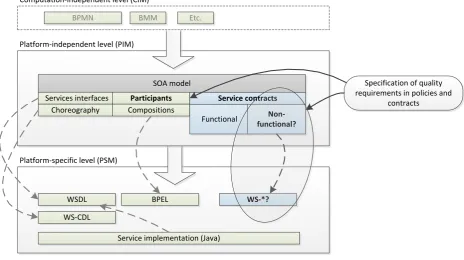
Figure 1.1 illustrates the transformation process starting from CIM to PSM models for SOA. Section 1.6 explains that this research mainly considers the PIM and PSM-level. A SOA model-ing language is needed to model the SOA applications and services at PIM-level. Specifymodel-ing quality requirements at PIM-level (i.e., they can be incorporated in the corresponding SOA models) seems to improve the understandability and completeness of SOA models and could further improve development speed [17]. In this case these quality specifications can be used in the MDE process, and, for instance, (automatically) be transformed and included in PSM models. In order to realize this, we need to sort out how to properly represent these quality constraints in SOA models.
1.3
Objectives
The objective of this research is stated as follows:
“Investigate how quality requirements of service models should be specified at both PIM and PSM level and how these PIM models should be transformed to PSM models, so that
productivity for the activities of stakeholders in the service life-cycle is improved.”
1.4
Research questions
To attain the research objective the following main research question is defined:
“How to apply MDE technologies to support the specification of QoS requirements in SOA at both PIM-level and PSM-level?”
Below, several research sub-questions have been defined that help to answer the main research question.
RQ1 Which activities of stakeholders in the service life-cycle involve the modeling of quality require-ments and can be facilitated by applying MDE?
RQ1.1 How detailed must the quality requirements be modeled in this activity?
RQ1.2 How can the productivity of this activity be improved?
RQ2 Which SOA modeling languages are available and are most suitable to model the PIM-level service models?
CHAPTER 1. INTRODUCTION
RQ2.2 How does this language support the modeling of quality requirements?
RQ3 Which platform-specific SOA techniques are available and are able to represent the quality re-quirements of the service models?
RQ4 How can we achieve transformations from the quality requirements defined in the platform-independent service models to the platform-specific models we identified?
RQ4.1 Can existing metamodels be used for the PIM to PSM transformation, and how can we map the PIM metamodel onto the PSM metamodel?
RQ5 Is productivity of the stakeholder activities improved by using model-driven engineering for the transformation of quality attributes in PIM service models to PSM techniques?
[image:14.595.72.545.365.624.2]1.5
Approach
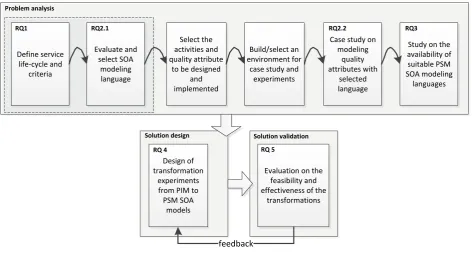
Figure 1.2 illustrates our approach. The upper left corner of each step shows a possible relation to the research questions of a step.
Define service life-cycle and criteria Evaluate and select SOA modeling language
Case study on modeling
quality attributes with
selected language
Study on the availability of suitable PSM SOA modeling languages Select the activities and quality attribute
to be designed and implemented
Design of transformation
experiments from PIM to PSM SOA
models
RQ1 RQ2.1 RQ2.2 RQ3
Problem analysis
Solution design Solution validation
Evaluation on the feasibility and effectiveness of the
transformations
RQ 4 RQ 5
feedback
Build/select an environment for
case study and experiments
Figure 1.2: Research approach
To fulfill the objectives, the following steps have been performed:
2. A selection of actual activities and corresponding quality requirements of certain stake-holders that are used in the research to define the scope of the project.
3. The development and/or selection of tooling and environment in which the SOA modeling languages are evaluated and in which the transformation experiments are performed. 4. A case study in which the selected PIM-level language has been evaluated to test its
capa-bilities to model quality requirements at platform-independent level.
5. A further study to explore suitable PSM modeling languages which are able to represent the quality requirements at the platform-specific level.
6. Design and execution of the PIM to PSM transformation of SOA models including the quality requirements.
7. A test of hypothesis to evaluate the success of the transformation experiments. In this step we check whether the transformations have improved the speed of development and correctness of SOA applications.
1.6
Scope of the research
A design always should have a purpose, for instance, generating an implementation, refining another or analysis of system properties. In this research, models are considered in which qual-ity attributes should be specified by stakeholders. The relation and transformation of these models, from PIM-level to PSM-level, is also considered in this research.
This means that this document focuses on (technical) service models rather than business models which can be considered at the CIM-level. This work is about technical (ICT) services and the corresponding SOA applications that are composed with these services.
1.7
Structure of report
The structure of the thesis resembles the research questions we have answered during our re-search. The remainder of this thesis is structured as follows:
Chapter 2 introduces the service life-cycle, and identifies the activities of stakeholders which involve modeling of quality attributes. Eventually, the chapter lists some typical optimizable activities which are used as guiding line in this research.
Chapter 3 introduces some relevant MDE concepts and explains why SoaML has been selected as the most suitable PIM-level SOA modeling language for further research. The chapter also gives a brief introduction to the language and shows which environment and tooling is used in this research.
Chapter 4 evaluates SoaML on its capabilities to model quality of service aspects. The chapter shows which techniques can be used to include quality attributes in SoaML models, and ex-plains why we have selected a QoS modeling language as our choice.
CHAPTER 1. INTRODUCTION
target models of the transformations.
Chapter 6 explains the transformation environment and how QoS-aware SoaML models can be transformed to PSM models including the quality attributes. The chapter also shows results of the transformation.
Service models
This chapter defines and explains the service life-cycle we considered
in this research. It also explains which activities of the di
ff
erent
stakeholders involve the modeling of quality requirements.
[image:17.595.76.528.435.706.2]2.1
Service life-cycle
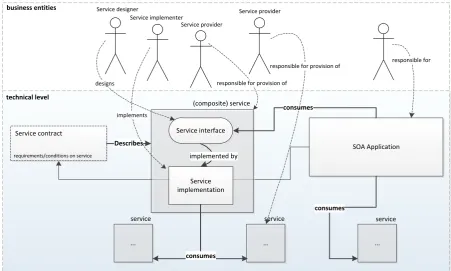
Figure 2.1 introduces the terminology used in this report. We use the term service models to denote all models of a service that describe the functionality, interface, terms, conditions and behavior of the service, i.e., the complete specification of a service. The term service description is used to denote the models needed for publishing, finding and using a service, i.e., the models needed in the service registry.
usesService implementation Service interface
implemented by (composite) service
SOA Application
consumes
... service
... service
uses consumes
... service
consumes
Service contract
requirements/conditions on service
Describes technical level
business entities
responsible for Service provider
designs Service designer
Service implementer
implements
responsible for provision of
responsible for provision of Service provider
CHAPTER 2. SERVICE MODELS
A SOA application uses services and is developed for the end-user (the potential customer). The end-user may be a company if an employee of a company uses SOA to improve the com-pany’s business. A SOA application could involve multiple services and stakeholders. Each service has a service interface, which is publicly available for others, and an implementation.
A service that is formed from other services (component services) is called a composite ser-vice. The concept of building services from other services is called service composition. The term service contract is used to describe an agreement on the requirements, criteria and/or spec-ification of the required interaction of a service. Initially we call this specspec-ification a proposed service contract or contract template. When involved parties agree to terms of the contract, we call it an instantiated (or agreed) service contract.
It is important to acknowledge the distinction between the business level and the technical level as shown in Figure 2.1. When we talk about service consumers and providers we mean the stakeholders at business level, which are responsible for the entities in the technical level. For instance, the employee responsible for the SOA application in Figure 2.1 manages a SOA application that consumes services. This employee plays the role of a service consumer, but the actual service consumption is in the application at the technical level. When we talk about the consumed/provided service or SOA application we mean the entities at the technical level.
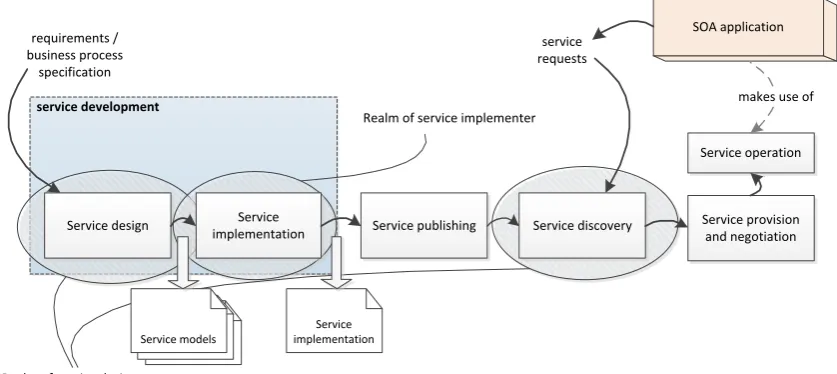
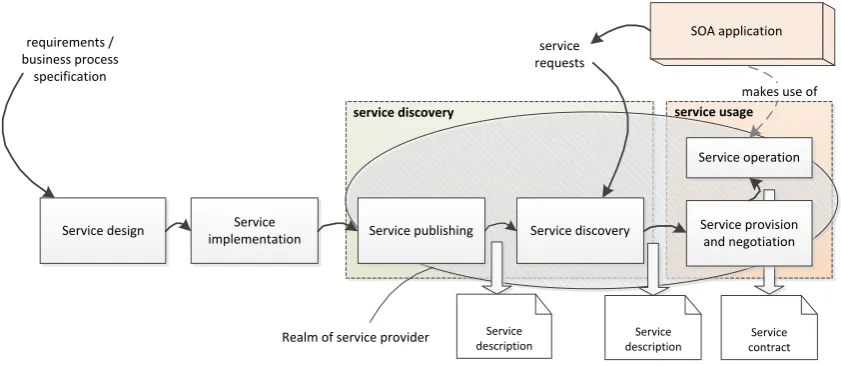
A service life-cycle describes through which phases a service goes from design to operation. Some commonly identified phases of a service life-cycle [18, 19, 20] are listed below, where the stakeholders’ points of view are not considered yet. Figure 2.2 shows the phases we have identified from the literature.
The black arrows show the sequence of phases during the development and usage of a ser-vice. The grey dashed arrows show that certain phases are related to each other, for instance, the SOA application uses services in operation.
Service design implementationService Service publishing Service provision
and negotiation requirements /
business process specification
Service operation
Service discovery service requests
service development service discovery service usage
Service models
Service implementation
Service description
Service contract Service
description
SOA application
makes use of
Figure 2.2: General view service of the life-cycle
2.2
Stakeholders
In this section we identify the stakeholders according to the service life-cycle depicted in Figure 2.2. In principle, each stakeholder is responsible for part of the service life-cycle. Stakeholders are either involved or participate in the life-cycle activities. The following list shows the diff er-ent types of stakeholders which are explained in the next sections. The composition designer subroles are explained later because separate scenarios are used as explained in the approach (see Section 1.5.
• Providing services
- Service developer - Service designer - Service implementer - Composition designer -Service provider
• Consuming services
-Service consumer
• Designing and providing SOA application
- Application provider - Composition designer
• Providing and maintaining service registry
- Service broker
For stakeholders it is important to know how to properly apply MDE to their activities in building, maintaining and using services and SOA applications. Different stakeholders with different points of view need different models for the activities of their part of the service life-cycle. Because the development and maintenance of a SOA application involves many parties, models of a certain stakeholder must be understood by other participants, stakeholders and maybe even other companies.
To achieve this, MDE should be applied to those models that can be transformed to other models, and which can then be understood by other stakeholders. It is also important to know which phases of the development can be facilitated by model transformations, such as service design to service implementation for the service developer. In principle, modeling and model transformations should be used in the life-cycle of services and in the SOA application when this is beneficial for stakeholders. Examples are the transformation of policies to service contracts and instantiating the service contract for provider and consumer.
2.3
Service developer
Figure 2.3 shows the phases that are relevant for the service developer. We distinguish the (sub)roles service designer, composition designer and service implementer since these activities can be performed by different people.
CHAPTER 2. SERVICE MODELS
aspects. The designer also needs corresponding tools which facilitate the modeling of services. When the design phase ends the service models must have been defined.
When a service requires bi-directional interaction with the consumer, i.e. the interaction is more advanced than a request-response scenario, this should be modeled by the service de-signer. When such bi-directional interaction is defined, and possibly also other criteria, a service contract is used [11] which refers to the required interaction. In that case all parties should agree on the contract before the service can be used. The actual form of the service contract is not an activity for the service developer but for the service provider.
Service design implementationService Service publishing Service provision
and negotiation requirements /
business process specification
Service operation
Service discovery service requests
service development
Service models
Service implementation
SOA application
makes use of
Realm of service designer
[image:20.595.90.509.245.432.2]Realm of service implementer
Figure 2.3: Service life-cycle service developer
During the design of the service, the designer may need service discovery to seek for ex-isting services. If certain services can be reused, service composition is used to build the new service instead of building the new service from scratch (see Section 2.9). When no services are reused, the service implementer implements the service according to the service designs by, for instance, programming code. In this life-cycle we assume that testing is part of the design and implementing activities. At the end of the testing and implementation phase the service is implemented.
The service implementer may apply MDE in the development process. Especially the tran-sition between design and implementation (and tests) can profit from MDE. In this case, the models from the design phase are transformed into more concrete models in the implementa-tion phase. This could lead to, for instance, code generaimplementa-tion of the implementaimplementa-tion and tests [12]. Languages and tools to implement the service in the service implementation phase are necessary [18]. To make use of MDE, the tool could support transformations from CIM and PIM to PSM models, for instance, facilitating the transition from design to implementation with code generation.
The service designer needs to be able to:
• [mandatory task] Specify the service interface(s) and other service models.
• [optional task] Specify the required interaction with other participants (included in
service contract template).
The service implementer needs to be able to:
• [mandatory task] Implement services according to service design models.
2.4
Service provider
When services are published, potential consumers can discover services via the service registry by looking through the service descriptions. When a suitable service is found, a contract has to define how well services are delivered in terms of costs, availability, performance, etc., by the service provider [18]. When all involved parties agree on the contract, the service can be provided according to the contract and used in a SOA application.
Consumer Provider
Requirements Offers
Service contract
Agree?
[image:21.595.164.434.340.536.2]Policy statements Policy statements
Figure 2.4: General service negotiation view
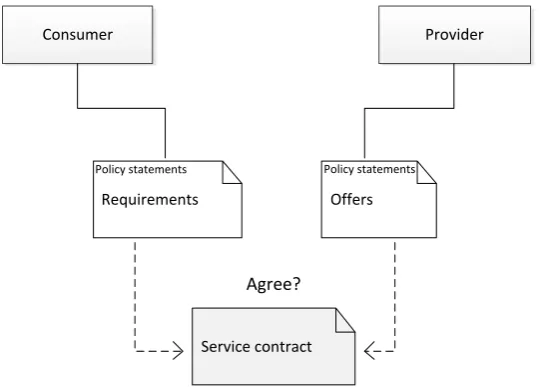
In some cases, before the service is used the consumer and provider need to negotiate in order to agree about the terms of service provisioning. Usually services are only accessible by authorized users. Figure 2.4 shows a general view of a negotiation. A consumer has certain requirements on the service to be consumed, and a provider has certain offers with respect to the provided service. These offers and requirements can relate to many aspects, such as security, privacy, availability and functionality. We denote these requirements/offers as the policy of that provider.
CHAPTER 2. SERVICE MODELS
can help to transform a policy of a provider to a contract template which can be accepted by a service consumer. Another example is the realization of an agreed service contract (enforce-ment) on a certain platform. In all these cases modeling and model transformations can help optimize the process. Preferably these policies can already be modeled at PIM-level and then be included in the transformation to PSM-level models to use the advantages of MDE.
Service design implementationService Service publishing Service provision
and negotiation requirements /
business process specification
Service operation
Service discovery service requests
service discovery service usage
Service description
Service contract
SOA application
makes use of
[image:22.595.85.506.207.390.2]Realm of service provider descriptionService
Figure 2.5: Service life-cycle service provider
Figure 2.5 shows the phases in which the service provider plays a role. The service provider publishes the service to the service registry in order to allow potential consumers to find the service. A provider should be able to define constraints/conditions on the use of the provided service [16], which should be included in a service template. In case some party wants to use the published service and agrees with the contract template, a contract is established. The service provider is then expected to provide the service in the service provision phase according to the agreed contract.
When the service is provided, monitoring is needed to check if the agreements in the contract are met. This is captured in the service operation phase. For instance, if the contract defines that the service should have an availability of 99%, then service monitoring is used to measure whether the availability of the service is sufficient.
Furthermore, changes to the service should have as less as possible impact to clients. This means that any runtime changes that occur should be handled [18], e.g., in an agreement that could be included in the service contract.
The service provider needs to be able to:
• [mandatory task] Publish services.
• [mandatory task] Provide service description for service discovery (e.g. for a register).
• [optional task] Specify a service contract template with his offers, and/or express
offers with a policy.
• [optional task] Monitor services.
• [mandatory task] Maintain services.
2.5
Service consumer
Entities that use services are service consumers, possibly after finding the services in a service registry. A service consumer often uses a service for the realization of a SOA application (as de-picted in Figure 2.1). This application also has its life-cycle phases from design to maintenance. These phases do not directly involve the service life-cycle, but modeling an SOA application can be helpful for the common understanding among all stakeholders. An IT department of a company which is responsible for building the SOA application can play the role a service consumer [11, 15, 21]. However, it is also possible that there are different service consumers involved in the SOA application, all realizing a part of the SOA application [11]. A distinction is made between the role of a service consumer and application provider (where the latter is the role of designing and maintaining the SOA application, explained in the next section).
Service design Service
implementation Service publishing Service provision and negotiation
requirements / business process
specification
Service operation
Service discovery service requests
service discovery service usage
Service description
Service contract
SOA application
makes use of
Realm of service consumer
Figure 2.6: Service life-cycle service consumer
In the service consumer role, service discovery, usage, and service composition are impor-tant. The quality of the consumed services is also important for consumers. A consumer should check the service description of a provided service to determine if its offers are sufficient. If the offers are not sufficient a consumer might start a negotiation with the provider. A consumer can also express his requirements with a policy, so that providers or possibly a broker can see them. Figure 2.6 shows that the consumer is involved in service discovery, composition, the nego-tiation and monitoring in the operation. A consumer needs service discovery to find suitable services to fulfil its requirements. When a potential service is found in the registry, a negotia-tion between provider and consumer takes place to agree on the usage of the service. In case the service is selected for usage, the result of this negotiation is an instantiated service contract.
CHAPTER 2. SERVICE MODELS
The service consumer needs to be able to:
• [mandatory task] Discover services.
• [mandatory task] Participate in the contract negotiation, e.g., by expressing requirements
with a policy.
• [optional task] Agree on the service contract and use service.
• [optional task] Monitor the consumed service.
2.6
Application provider
Service design Service
implementation Service publishing
Service provision and negotiation requirements /
business process specification
Service operation
Service discovery service requests
SOA application
makes use of Realm of application provider
Figure 2.7: Service life-cycle activities application provider
We distinguish the role of a application provider from the role of a service consumer because the activities can be performed by different people. The application provider is responsible for the SOA application, i.e., the application for the end-user that consists of several cooperating services. In many cases the application provider will also play the role of a service consumer for each of the services in the SOA application.
Modeling and maintaining an SOA application are the activities of the application provider. This stakeholder needs a language to model the SOA application. For instance, the application provider might need a language to describe the application architecture (high-level architec-ture) if this helps improve the business process and understanding for all involved stakeholders. A model of a SOA application can include participants, service contracts and the used services.
The application provider needs to be able to:
• [mandatory task] Model an SOA application.
• [mandatory task] Maintain SOA application.
2.7
Service broker
information which is contained in a service registry to support service discovery. We assume that services should be visible for consumers somehow [16, 11] because the visibility is neces-sary for service discovery. If services are not visible, consumers can not find and access services. Providers use the service registry to publish their services, while consumers use it to look up services [22, 15].
Service design implementationService Service publishing Service provision
and negotiation requirements /
business process specification
Service operation
Service discovery service requests
service discovery service usage
Service description
Service contract
SOA application
makes use of
Realm of service broker
Figure 2.8: Service life-cycle service broker
The service broker is involved in the service discovery, negotiation and management phase. This stakeholder is responsible for the functioning and maintenance of a service registry. When the registry needs maintenance this should preferably effect the other stakeholders as little as possible. The service broker facilitates the service negotiation and provision phase by making service information available for consumers.
The service broker needs to be able to:
• [mandatory task] Support service discovery (with a service registry).
• [mandatory task] Maintain the service registry.
2.8
Composition designer
Service composition can also be considered in the stakeholder activities. Two stakeholders are able to use service composition in their activities.
A service designer might reuse other services to built a new service. In this case service composition is part of the design phase of the service, e.g., the new service is obtained with composition and the developer needs to learn how other services can be used in the new service. The service designer then plays the role of a composition designer. The composition designer “implements” the service as a composition. In this case the designer does not know the actual service consumer.
The service designer as composition designer needs to be able to:
CHAPTER 2. SERVICE MODELS
Service design implementationService Service publishing Service provision
and negotiation requirements /
business process specification
Service operation
Service discovery Service composition
uses uses
service requests
service development
Service models
Service implementation
SOA application
makes use of
Realm of service designer
Realm of service implementer
Realm of composition designer
Figure 2.9: Service life-cycle service broker
The second stakeholder who might need service composition is the application provider. In this case the application provider might use other services, and thus use service composition to compose a service for its needs [20]. An application provider applies service composition to use several services in combination to fulfill a certain business goal. Since the consumer does not want to develop a new service at design time (as explained in the role of a service implementer), the consumer must be able to model this composition in the SOA application. In this case, the consumer plays the role of a service composition designer which composes new services at runtime.
Service design Service
implementation Service publishing Service provision and negotiation
requirements / business process
specification
Service operation
Service discovery Service composition
uses service requests
SOA application uses
makes use of
Realm of application provider Realm of composition designer
Figure 2.10: Service life-cycle service broker
• [optional task] Design a SOA application as a composition at runtime.
2.9
Quality aspects
When modeling SOA applications and services, often the term quality of service (QoS) is used to refer to the collection of quality requirements for a service. QoS should be modeled [14] be-cause these quality requirements can then be acknowledged by stakeholders. Different services can provide the same functionality for consumers, so QoS specifications of these services are essential in determining the most suitable services for consumers [23]. With respect to SOA QoS often covers security, performance, availability, and privacy [24]. The importance of a cer-tain quality aspect depends on the context of the project in which the SOA is designed. A SOA modeling language should be able to model quality aspects, so that requirements on these as-pects can be specified in the models [15]. In order to properly model quality requirements it should be determined at which abstraction levels these requirement are relevant, and how we can describe these requirements. Some concepts related to QoS in SOA are briefly discussed below.
Policies
Service developers, providers and consumers might need to specify the QoS of services being supported. A concept often used to specify constraints on models is a policy [11, 16]. A policy represents some constraint or condition on the use, deployment or description of an owned entity as defined by a participant. Policies allow the definition of constraints on required or supported QoS. Service policies potentially apply to many aspects of SOA, such as, for example, security, privacy and manageability [16]. For example, the service consumer may require secure interactions. A service provider might specify that his service has a minimum availability of 95%. Therefore we must investigate how to describe constraints and policies in and on the models with SOA modeling languages.
Policies relate to, but are different from, service contracts. A service contract is an agree-ment between two or more participants, while a policy is associated with the point of view of an individual participant [16]. For instance, a service provider’s policy may be fulfilled by a service contract between them when a service consumer agrees to the provider’s policy. Below we discuss some concepts related to policies.
Service negotiation
During the negotiation phase, the consumer and provider negotiate on the usage of the service. When both participants agree, the agreement is captured in the service contract. In order to enforce the contract, service monitoring is needed to check whether the agreement is violated or respected.
CHAPTER 2. SERVICE MODELS
consumer also has its constraints, which has to be fulfilled by the final service contract. The service contract reflects the agreements on the usage of the service.
Service level agreement (SLA) is the term often used in literature to denote a template for service contracts [15]. An instantiated SLA can represent the agreement on the policies as de-picted in Figure 2.11.
Proposed service contract Service description
Provider
policy Service
interface
Agreement on policy agree
Agreement on using specified interface / choreography Proposed service contract
Choreography
Optional
Provider Consumer
Consumer
policy Service
interface
Choreography
Optional
agree Negotiation
Figure 2.11: Service contract instantiation with policies
An SLA describes the intended boundaries for a service, particularly with regard to non-functional properties. SLA’s are used when a certain level of verifiable quality is required. The key to defining SLAs is to provide enough information or verifiable metrics for a service con-sumer to preselect services based on the desired level of quality [25]. Service providers instru-ment their services in such a way that measureinstru-ments are collected and then compared to the metrics specified in the SLA. A service consumer needs to agree with the SLA before the service can be consumed. An SLA is part of the service description, and could be instantiated in the service contract [15].
Aggregated QoS
When taking into account composite services we also have to consider how the QoS provided by composite services is defined, also known as the aggregated QoS. These are based on and influenced by the QoS of the component services [14]. Low quality of a component service may cause all services based on this service to degrade in quality [26]. Calculating the aggregated QoS is helpful for the provider of a composite service to define policies.
Common quality aspects in SOA applications
Availability A common quality aspect is availability. Some example metric is the availability of the service itself: availability = uptime / (uptime - downtime) [23]. A certain QoS require-ment for a consumer could be that a service to be consumed should have an availability of at least 99%, because otherwise the SOA application does not function properly.
Performance Another aspect for the consumer could be performance. One example metric is
the service response time (SRT) which can be calculated as: time when service consumer finishes sending request to the service - time when service consumer starts receiving re-sponse from the service.
Reliability A well-known example of a reliability requirement for the consumer could be that the mean time between failure (MTBF) should be lower than a certain limit. The MTBF can be calculated as: summations of time between failures / total number of failures [23].
Other example aspects Other examples of quality requirements for a provider could be the
completeness of the interface description, the maximum number of the web service re-quests served in a given period of time (throughput) and security.
2.10
Optimizable activities
The previous sections have shown which activities and models are possible for service stake-holders, and why it is necessary to model quality attributes. This section lists some typical ac-tivities that require the modeling of quality attributes and which could be optimized with MDE. The following activities are used in this research to show that modeling quality attributes at PIM-level and corresponding transformations to more detailed models are beneficial for stake-holders. This section defines the hypothesis for our transformations. We take a closer look at these activities to determine at which level and how quality attributes must be specified in the corresponding models.
Policy specifications A consumer has certain quality requirements on the service to be con-sumed. For instance, one obvious requirement would be that the service has a certain level of availability which is sufficient for the consumer. The provider also has to specify a policy on quality aspects such as availability, throughput, security and interoperabil-ity [23]. It would be beneficial to already model these policy specifications at PIM-level because these requirements, or at least the type and bounds of these requirements, are probably already known at design time of the SOA application. Otherwise these require-ments should be added later on (i.e., during the transformation to PSM-level models), which costs extra time. It would also be better to have as much as possible already speci-fied in the PIM-level model because a PIM-level model should gather all the information needed to describe the behavior of the system in a platform independent way [28].
CHAPTER 2. SERVICE MODELS
Platform-independent level (PIM)
Platform-specific level (PSM)
Policy Policy
Availability > 98% Service response time < 2s Service failure ratio < 2 ...
Availability > 99.5% Throughput > 20/s ...
Policy
Availability > 98% Service response time < 2s Service failure ratio < 2 ...
To be included in or connected to the PIM-level
models
runtime
To be expressed with PSM-level models (which are able
to represent or help to enforce the QoS
requirements)
Consumer Provider
Availability > 99.5% Throughput > 20/s ... Policy M o d el ev o lu tio n (f ro m a m o re a b st ra ct P IM to a d et ail ed P SM ) Service Service Service
Figure 2.12: QoS specification with policies
Service contracts When modeling an SOA application, service contracts can already be
mod-eled at design time to define the agreements on the usage of services [11]. The service contracts then form (a part of) the SOA application, and the modeling of these contracts is therefore part of the activities of the application provider. In order to fully model a service contract, agreements on quality attributes must be included in the service contract (as ex-plained in Section 2.9). Both the provider and consumer are involved in the instantiation of this contract, because the service contract is based on the policies of these stakehold-ers. When these contracts are defined at PIM-level it would be effective to (automatically) translate these contract models to PSM-level models which are able to express or even instantiate the contracts on that specific platform.
Platform-independent level (PIM)
Platform-specific level (PSM)
To be included in or connected to the PIM-level
models
runtime
To be expressed with PSM-level models (which are able
to represent or help to enforce the QoS
requirements) Consumer Provider M o d el ev o lu tio n (f ro m a m o re a b st ra ct P IM to a d et ail ed P SM ) Contract template Service Instantiated contract
Contains agreement on QoS requirements of service
Contains agreement on QoS requirements of service SOA application designer
Contract template Service
Service
Figure 2.13 shows how an instantiated contract can be achieved based on a PIM-level contract, which preferably, already includes as much as possible QoS information.
Chapter 3
SOA modeling
The chapter introduces some relevant MDE concepts and explains
why the SOA Modeling Language (SoaML) is selected as PIM-level
modeling language for further evaluation. It further gives a brief
introduction the SoaML.
3.1
Relevant MDE principles for SOA
MDA is by far the most well-known MDE initiative and a lot literature is devoted to it. In this report the MDA concepts are also used regularly and therefore this section briefly introduces MDA’s most important concepts. MDA defines the following models:
1. Computation-independent models (CIM) are a view of a system from the computation-independent viewpoint. The computation-computation-independent viewpoint focuses on the envi-ronment and the requirements of the system; the details of the structure and processing of the system are hidden or are yet undetermined. A CIM does not show details of the structure of systems. A CIM is sometimes called a domain model, and a vocabulary that is familiar to the practitioners of the domain in question is used in its specification [29]. 2. Platform-independent models (PIM) are a view of a system from the platform independent
viewpoint. The platform independent viewpoint focuses on the operation of a system while hiding the details necessary for a particular platform. A platform independent view shows that part of the complete specification that does not change from one platform to another. A PIM exhibits a specified degree of platform-independence so as to be suitable for use with a number of different platforms of similar type [29].
3. Platform-specific models (PSM) are a view of a system from the platform-specific view-point. A PSM combines the specifications in the PIM with the details that specify how that system uses a particular type of platform [29].
When applied to the development of SOA applications, the CIM-level could describe busi-ness models which include goals, busibusi-ness rules, busibusi-ness processes and busibusi-ness services. This could be done with for instance the Business Motivation Model (BMM) and Business Process Modeling Notation (BPMN).
The PIM-level describes SOA models which are independent of the execution platform or technology being used. It includes models of service interfaces, service contracts, service en-actments, participants, etc [11]. Models at this abstraction level are considered as software specification models.
The PSM-level describes platform models as executable artefacts. These models can be con-sidered as software realization models. If the SOA application is implemented with, for in-stance, web services, service interfaces can be represented using the Web Service Definition Language (WSDL) [31]. Another example is the Business Process Execution Language (BPEL) for specifying business process behavior based on web services [32].
Metamodels
For MDE, metamodels are an important concept. Every model in a certain modeling language conforms to that language’s metamodel. A metamodel can be considered as an explicit descrip-tion (constructs and rules) of how a model can be built.
Model transformations can be used for many MDE and SOA purposes, such as, e.g., trans-forming PIM to PSM models, generating specific models for a certain stakeholder’s viewpoint, etc. The most well-known metamodel-based model transformation languages are ATLAS Trans-formation Language (ATL) [33] and Query/View/TransTrans-formation (QVT) [34].
In order to apply MDE (and particularly MDA) to the development of SOAs, it is important to have a concrete metamodel for the SOA application to be modeled. If such a metamodel is not available it must be defined. This metamodel mechanism is needed to unambiguously define modeling languages, so that a transformation tool can then read, write, and understand the models. Transformations are defined as relations between metamodel elements the source and target models. [35].
3.2
PIM-level language selection
Several SOA reference models, reference architectures, maturity models, ontologies, modeling languages, and governance specifications have been released. Most of them come from open standards work fostered by OASIS (Organization for the Advancement of Structured Informa-tion Standards), The Open Group and OMG (Object Management Group). Because an abun-dance of specifications and standards have emerged, Kreger et al. [36] wrote an overview docu-ment that explains and positions these SOA architectural standards. Next to the open standards work, several SOA modeling initiatives come from the research community.
Role of UML
software-CHAPTER 3. SOA MODELING
intensive systems. It offers various diagrams to model the structure and behavior of software systems.
Although UML originally was developed for object-oriented system modeling, it can easily be extended to support modeling of, for instance, user interface flows, business activities, and data schemas [3]. Recent versions allow designers to describe many aspects of SOA applications [11]. However, [3] and [37] also emphasize the need to able to model a service component, which cannot be properly modeled with UML. Directly applying UML concepts for modeling SOA, although it can be regarded as a good starting point, is not an entirely convenient approach [37]. This means that with standard UML it is not possible to properly model the SOA concepts we have mentioned in our criteria [13].
Metamodel and UML profiles
UML has a built-in lightweight extension mechanism called UML profiles. With this mechanism it is possible to extend UML to match the needs of a certain domain. A set of stereotypes and constraints can be created and grouped into a profile. These stereotypes can be applied to mark up a model for a specific platform or domain.
These UML profiles are a way to implement metamodels represented in these SOA modeling specifications. Several authors defined a UML profile for their approach, such as [38], [10] and [11].
The UML profile is appropriate when the objective is to model services and SOA applications using already existing UML editors. The use of stereotypes and tagged values in these profiles preserve the UML semantics and do not create new languages.
For the transformations the metamodeling approach seems to be more suitable. In the first place, a metamodel is more convenient than UML profiles in transformation languages as ex-plained in [39] and [33]. Furthermore a metamodel can be used to extend the modeling language so that it can be used in different domains. Users can reuse metamodel implementations and extend them to create their own domain specific languages [12]. This is beneficial for possible future work.
Overview SOA modeling approaches
Table 3.1 shows a summary of several SOA modeling approaches that have been evaluated in [13]. It gives an overview of several prominent and relevant SOA modeling approaches, docu-ments and specifications. A short description and purpose of each approach is given.
Table 3.1: SOA modeling approaches
Name Description Purpose
OASIS Reference Model (SOA RM) (2006) [16]
The SOA RM is intended to capture the essence of SOA, as well as provide a vocabulary and common understanding of SOA [36]. It is writ-ten at a high abstraction level and it supports much of the SOA modeling criteria as defined in [13].
Explaining SOA core concepts
Open Group SOA Ontology (2010) [40]
This ontology extends, refines, and formalizes some of the core concepts of the OASIS Ref-erence Model. It is used for understanding the core SOA concepts and facilitates a model-driven approach to SOA development [36] [40].
Explaining SOA core concepts
Used to understand SOA concepts, no modeling language. OASIS Reference Archi-tecture (OASIS RA) (2011) [15]
OASIS RA is an abstract, foundation reference architecture addressing the ecosystem view-point for building and interacting within the SOA paradigm. It specifies three viewpoints; specifically, the Service Ecosystem viewpoint, the Realizing SOAs viewpoint, and the Own-ing SOAs viewpoint. Since it is an abstract and foundational reference architecture, it does not contain the level of specificity required to di-rectly implement SOA-based systems. It does provide metamodels and architectural implica-tions for each of the views useful in guiding other architecture work, including other refer-ence architectures [36].
Understanding SOA
from different view-points
Used to understand SOA concepts, less abstract than the reference model, no concrete modeling language. Open Group SOA Reference Architec-ture (2011) [21]
The Open Group SOA Reference Architecture is a layered architecture from the consumer and provider perspective with cross-cutting con-cerns describing these architectural building blocks and principles that support the realiza-tions of SOA. It is used for understanding the different elements of SOA, deployment of SOA in the enterprise, basis for an industry or orga-nizational reference architecture, implication of architectural decisions, and positioning of vendor products in SOA context [36]
Understanding SOA
from different view-points
CHAPTER 3. SOA MODELING Soa Mod-eling Language (SoaML) (2012) [11]
The SOA Modeling Language (SoaML) is a promising dedicated language for the model-ing of SOAs. The Object Management Group SoaML Specification supports services model-ing UML extensions. SoaML is used to rep-resent SOA artifacts in UML. It supports a lot of the SOA concepts mentioned in The Open Group SOA Reference Architecture [36]. SoaML is not a methodology for developing SOAs but purely a modeling language. It is a standard proposed by OMG. It offers intuitive and complete support for modeling services in UML [11]. It keeps the main SOA modeling principles of PIM4SOA [41]. SoaML is meant to provide a rigorous definition of service-related terms and thereby form a foundation for dia-log and common understanding in the service domain. It is focused on general service de-sign and provisioning, it is methodology agnos-tic and is not able to cover the full service life-cycle [42].
SOA modeling
lan-guage (metamodel + UML profile)
At first sight most complete language for our purposes. Satisfies most of the criteria, including all the
functional aspects. They mention that service discovery, applicability, methodologies,
deployment and runtime of services are out of scope. A Platform Indepen-dent Model for SOA (PIM4SOA) (2007) [43]
The PIM4SOA project aims to develop a meta-model for SOA. This metameta-model consists of a set of essential aspects for SOA. PIM4SOA addresses four system aspects (views): pro-cesses (logical order in terms of actions, con-trol flows and interactions between services), information (related to the messages or struc-tures exchanged by services), services (descrip-tion of services: access, opera(descrip-tions and types) and quality of service (extra-functional qual-ities that can be applied to services, informa-tion and processes). The project also provides a set of transformations that link the metamodel with specific platforms (agents, web services, etc.) following the MDA approach.
SOA modeling
lan-guage (metamodel)
CBDI-SAE Meta
Model (2011)
The CBDI-SAE Meta Model for SOA is a class model of the concepts contained in the CBDI Service Architecture & Engineering (CBDI-SAETM) Reference Framework. The authors worked on the design of SoaML [44] and men-tion that the SAE Meta Model complements SoaML by providing full lifecycle support (for their SAE methodology). They say that CBDI-SAE Meta Model supports metadata and poli-cies where SoaML does not support this. They say that SoaML is enough if additional meta-data is not needed. However, to support the full service life-cycle, they claim SoaML is not enough. CBDI-SAE Meta Model defines a map-ping to SoaML.
SOA modeling
lan-guage (metamodel + UML profile)
Commercial modeling language part of their SAE methodology. Looks complete according to our criteria, but has no service discovery and security support. Service-Oriented Modeling and Ar-chitecture (SOMA) (2004) [7]
SOMA is a modeling and design technique for defining and developing a service-based IT so-lutions proposed by IBM in 2004. It was one of the first modeling approaches for SOAs.
They describe that the main first-class con-structs in an SOA are services, service compo-nents, and process flows. These are at a higher level of abstraction than that of objects, classes, and components. Hence, there needs to be a higher level of modeling and design principles that deal with the first-class constructs of an SOA [7]. The SOMA approach is built on top of object-oriented analysis and design (OOAD) while it adds modeling and design techniques specific to SOA.
Deliverables of SOMA can be created with, for instance, the SOMA-Modeling Environment (SOMA-ME). This is a framework based on SOMA that uses UML profiles (which extend UML 2.0) to model SOAs in a model-driven way [45]. However it says that IBM’s newest version of the SOMA methodology (version 2.9) heav-ily uses SoaML and is tightly aligned with the SoaML tooling in the modeling products [5]. It is hard to find further information about the SOMA methodology because the development is closed. Documentation and their commercial tools are not freely available.
SOA-based lifecycle methodology serving as a service-modeling platform
CHAPTER 3. SOA MODELING Service-Oriented Modeling Framework (SOMF) (2008) [46] [8]
The SOMF framework is an agile model-driven engineering methodology that offers a model-ing language and best practices that can be used during various stages of the software de-velopment life cycle [46] proposed by Micheal Bell. The SOMF framework is very broad, it aims as a holistic language to design any ap-plication, business and technological environ-ment, either local or distributed.
SOMF specifies technology-neutral services. It does not assume a web service SOA-based im-plementation. The technology neutral repre-sentation of services is expressed at multiple levels of abstraction: conceptual, analysis, de-sign and architecture.
SOA-based methodol-ogy including model-ing language
Commercial modeling language included in SOMF framework. Remarkably few research papers about SOMF. Uses its own different syntax to represent SOA concepts. Includes support for standard notations such as SoaML. Modelling of Service-Oriented Archi-tectures with UML (2008) [10]
Lopez-Sanz et al. proposed a UML profile for modeling PIM level architecture. With this profile it is possible to model several types of services and contracts in UML using stereo-types at the PIM level. Lopez-Sanz et al. were working on a specification of PSM-level SOA ar-chitectural models for different service execu-tion platforms (web service, CORBA, etc.).
SOA modeling
lan-guage (metamodel)
Modeling language which satisfies all our functional criteria and some constraints at a basic level. Next to the paper, there is less information available about their metamodel. Defined before SoaML was released.
UML-S (2008) [47]
Dumez et. al proposed the UML-S (UML for Services) extension. It extends the UML 2.0 class and activity diagram to support develop-ing composite web services. In order to real-ize the model-driven vision they provide high-level UML-S models which can be transformed to platform-specific code [47].
SOA UML extension (specifically aimed at service composition, includes UML-profile)
Some SOA modeling approaches were not further evaluated because they are outdated, not complete or irrelevant. Examples are IBM’s “UML 2.0 Profile for Software Services” [48] which is deprecated (and replaced by SoaML), UML-RT, governance frameworks, maturity models and various other papers such as Zhang et. al [49] which seem to be overtaken by the SoaML standard. Also the “Web Services Architecture” from W3C [50] was not evaluated further in detail because it just focuses on characteristics of web services, and does not propose a SOA modeling approach.
When we specifically look at SOA modeling languages, the CBDI-SAE Meta Model is another interesting model. It looks very complete, but unfortunately it is not a standard and has only commercial support. However, the metamodel is freely available in various formats. They also mentioned that their metamodel will be continued (as part of their methodology) so it might be interesting to consider this work when necessary. The research work and metamodel proposed by Lopez-Sanz et al. [10] may also be worth investigating, because they support PIM-level SOA modeling that is not based on any previous modeling language or methodology.
Most of the other approaches are unfortunately commercial, limited or only focused on ex-plaining SOA concepts.
The most promising and complete SOA modeling approach is SoaML. In the recent future it is expected that SoaML becomes more and more adopted as a standard modeling language for SOA [37] [42]. Almost every well-known SOA modeling approach/company (such as OMG, OASIS, the Open Group and Everware-CBDI) have contributed to this language, apart from the fact that they already have a modeling language themselves. The language is available since 2008 and IBM’s SOMA methodology already moved to SoaML. Other methodologies such as CBDI’s SAE and SOMF support mapping and/or integration with SoaML.
3.3
SoaML concepts
SoaML is a recently proposed standard which is becoming increasingly popular for the model-ing of SOAs [37, 51]. The SoaML specification supports services modelmodel-ing with UML extensions and is used to represent SOA artifacts in UML. SoaML is not a methodology for developing SOAs but purely a modeling language. It offers intuitive and complete support for modeling services in UML [11]. SoaML is meant to provide a rigorous definition of service-related terms and thereby form a foundation for dialog and common understanding in the service domain. It focuses on general service design and provisioning, it is methodology agnostic and is not able to cover the full service lifecycle [42, 13] because certain aspects are out of SoaML’s scope.
SoaML is suitable to specify both services and SOA applications, taking into account the needs of different stakeholders. It was designed to support MDA and as such provides a baseline modeling language for the specification of services within a SOA application. The extensions to UML provide the key language constructs for specifying the structure of services. SoaML does not specify which kind of behavioral notation to use. The goal of SoaML was not to be a broad modeling language to support all aspects of SOAs, but rather to be a small core that can be extended and integrated with other modeling languages such as, e.g., BPMN for behavioral modeling [31].