A REFERENCE TEST APPROACH FOR MODERATING INTERNAL ASSESSMENT AT THE UPPER SECONDARY
SCHOOL LEVEL
A thesis
submitted in partial fulfilment
of the requirements for the Degree
of
Master of Arts in Education
in the
University of Canterbury
by
Glenn Stephen Chamberlain
University of Canterbury
To my family .... who put up with my presence a little longer than expected!
In some countries it is accepted that the teacher is likely to know more about [their] pupils than an external examiner, and that [they] can provide more information about them than a necessarily short examination can hope to do.
What [they] cannot do is to be sure that [they are] accurately assessing the standards of [their] own pupils in relation to those of other pupils in other schools; this requires either positive, widely-informed and responsible moderation, or an external examination.
ACKNOWLEDGEMENTS
First and foremost, I would like to sincerely thank Professor Warwick Elley for his dedication, guidance and encouragement as supervisor of this project. His thoughtful comments and perceptive criticisms during all stages of the project, have been of
immeasurable value.
I would also like to express my appreciation to the following people who gave of their time and effort so freely: Dr David Watkins who acted as secondary supervisor for the project; Mrs Val Elley and Brian Keeling who helped with the administration of the tests;
Hayati Abdullah who very kindly conducted a re-mark of the essays; Drs Bill Rosenberg and Alan Thompson (Computer Services Centre) who patiently debugged some of my programming efforts so the computer would do what it was meant to do; and Nick Fitzgerald who not only assisted with the administration of the tests and numerous other tasks, but was always there to bounce ideas off.
iii
TABLE OF CONTENTS
PAGE
TITLE PAGE i
ACKNOWLEDGEMENTS ii
TABLE OF CONTENTS iii
LIST OF TABLES viii
LIST OF FIGURES xiii
ABSTRAcr xiv
CHAPTER I: INTRODUCTION 1
General Background Issues . 1
Statement of the Research Problem 8
CHAPTER II: REVIEW OF THE LITERATURE AND
DEVELOPMENT OF THE RESEARCH AIMS 10
What is Moderation? 10
Is Moderation Necessary? 10
How Well Can Teachers Make Moderation Judgements? 13
Types of Moderation 18
Criteria for an Ideal Moderating Test 33 Types of Tests Suitable for Moderation 34
Moderation Through Tests of Scholastic
Aptitude 35
Moderation Through Tests of Developed
Abilities 38
Subject Areas In Moderation Tests 47
PAGE
Format of Test Items . 52
The Multiple-Choice Item 52
The Open-Ended (or Short Answer) Item 53
The Cloze Procedure 55
Why Compare Alternative Item Formats? 57
Statement of the Research Aims . 62
CHAPTER III: METHOD AND CONSTRUCTION OF TESTS 64
Sample 64
Development of the Tests 65
Rationale Underlying the Moderation Tests 66
Preparation of the Moderation Tests 68
Multiple-Matrix Sampling (MMS) . 72
Description of the Reference Tests 73
Vocabulary (English, Science and
Social Studies) 73
Comprehension (English, Science and
Social Studies) . 73
Mathematics 74
Essay . 75
General Scholastic Aptitude (GSAT) 76
Rationale Underlying the Item Types 78
Description of the Test Items 79
Mul tiple-Choice . 79
Open-Ended (or Short Answer) 79
Cloze Procedure . 80
Data Collection 81
PAGE
CHAPTER IV: RESULTS 85
Completeness of Data 85
Estimation of Scores for Incomplete Tests 86 Descriptive and Reliability Analyses of the
Test Data 87
Vocabulary (English, Science and Social
Studies) . 88
Comprehension (English, Science and
Social Studies) 91
Vocabulary and Comprehension Combined 94
Mathematics 98
Ess~ . WO
General Scholastic Aptitude Test (GSAT) 101 School Certificate Examinations 102 Conversion of Raw Scores to Standard Scores 104 Sex Differences in the Reference Tests and
School certificate Examinations 105
Predictive Validi tyof. ,the Reference Tests 107 Correlations Between the Reference Tests
and School Certificate Marks Based on
Individual Scores 108
Prediction of School Certificate Class
Parameters: Mean and Standard Deviation 113 Multiple Regression Predictions of
School Certificate Class Parameters Correction for Shrinkage in the Multiple Regression Equations .
124
PAGE
CHAPTER V: DISCUSSION OF RESULTS 138
Parallelism of Equivalent Forms of the
Reference Tests . 138
Experimental Sample 139
Sex Differences . 140
Reliability 141
Predictive Validity 146
Correlations Between the Reference Tests
and School Certificate Marks 146
Correction for Attenuation 151
Prediction of School Certificate Class Parameters .
Multiple Regression Predictions Total Score Predictions
Oomparison of Item Types
153 157 164 167 Cloze Scoring: Exact vs Synonym Replacement 169 Multiple Regression Predictions vs Simple
Correlation Predictions
CHAPTER VI: POLICY IMPLICATIONS AND CONCLUSIONS Criteria for Evaluating a Moderating Test Policy Implications and Conclusions .
Reference Test Approach to Moderation Tests of Developed Abilities
Vocabulary and Comprehension Format of Test Items .
Multiple-Matrix Sampling
Multiple Regression Predictions vs Simple Correlation Predictions . Individual Subject Reference Tests Alternative Approaches to Using Reference Test Scores
Inter-Class vs Inter-School Moderation General Concluding Remarks
Future Studies
APPENDICES:
Appendix A: letter of Invitation to Schools to Participate in the Experimental
PAGE
184 185
186 188 189 192
194
Testing Programme . 195
Appendix B: Multiple-Choice Vocabulary Test 196 Appendix C: c:pen-Ended Vocabulary Test 204 Appendix D: Multiple-Choice Oomprehension Test 212 Appendix E: c:pen-Ended/Cloze Comprehension Test 236 Appendix F: Multiple-Choice Mathematics Test 256 Appendix G: c:pen-Ended Mathematics Test . 264
Appendix H: Essay Test 272
Appendix H-l:Essay Marking Schedule . 273 Appendix 1: General Scholastic Aptitude Test 275 Appendix J: List of Item Source Materials 285 Appendix K: Administration of Form 5 Reference
Tests, Instructions for Supervisors 287 Appendix L: Intercorrelations of the Reference
Tests 289
REFERENCES: 290
LIST OF TABLES
TABLE PAGE
2.1 Teachers' Preferences for Potential Assessment Systems at the Form 6 and Form 5 Levels
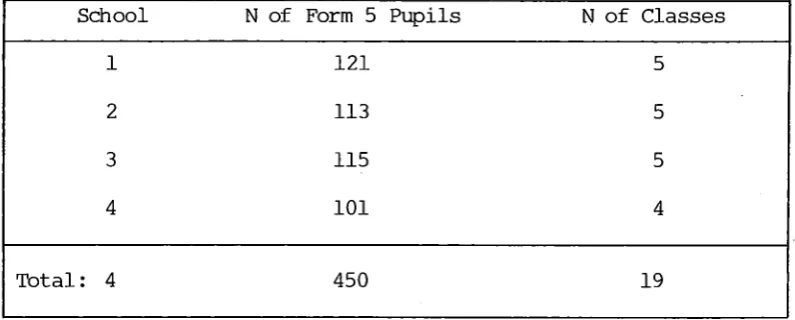
3.1 A Breakdown of the Sample by School, Total Number of Pupils and Number of Classes .
3.2 A Breakdown of the Range of Difficulty and Discrimination Indices for the Vocabulary and Comprehension Pilot-Tests
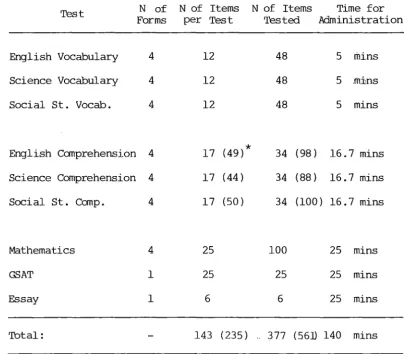
3.3 General Details for all Reference Tests
4.1 The Number of Completed Reference Tests, by School, Included in the Final Data Analysis
4.2
4.3
4.4
Descriptive Statistics of the English, Science and Social Studies Vocabulary Tests Across Item Types
Descriptive Statistics of the English, Science and Social Studies Multiple-Choice Vocabulary Tests
Descriptive Statistics of the English, Science and Social Studies Open-Ended Vocabulary Tests
4.5 Descriptive Statistics of the English, Science and
23
64
70
82
86
88
89
90
Social Studies Multiple-Choice Comprehension Tests 92
4.6 Descripti ve Statistics of the English, . Science and Social Studies Cloze Comprehension Tests
4.7 Descriptive Statistics of the English, Science and Social Studies Cloze Comprehension Tests, Using Synonym Replacement Marking
92
TABLE PAGE
4.8 Descriptive Statistics for the English, Science and Social Studies Multiple-Choice Vocabulary/Compre-hension Tests
4.9 Descriptive Statistics for the EngJish, Science and Social Studies Open-Ended Vocabulary/Cloze
Comprehension Tests
4.10 Descriptive Statistics Qf the English, Science and Social Studies Open-Ended Vocabulary/Cloze
Comprehension Tests Using Synonym Replacement MarkinJ
4.11 Descriptive Statistics of the Mathematics Tests Across Item 'TYPes
4.12 Descriptive Statistics of the Multiple-Choice Mathematics Tests
4.13 Descriptive Statistics of the Open-Ended Mathematics Tests .
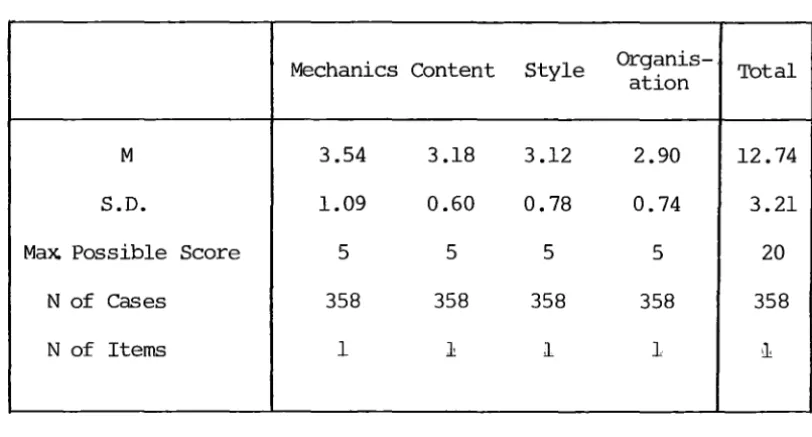
4.14 Descriptive Statistics of the Mechanics, Content, Style, Organisation and Tbtal Essay Scores
4.15 Means, Standard Deviations and Correlation of the Inter-Rater Reliability Estimate for the Essay Marking
4.16 Descriptive Statistics of the General Scholastic Apti tude Tes t
4.17 Descriptive Statistics and Percentage Pass Rate of the School Certificate Examinations
95
95
97
98
99
99
100
101
102
TABLE PAGE
4.18 Mean and Standard Deviation of the GSAT Scores for the SUb-Samples Administered the Four Multiple-Forms of the Vocabulary Test
4.19 Descriptive Statistics and t-Tests for Males and Females of Reference Tests and School Certificate Examinations
4.20 Correlations Between the Reference Tests and School Certificate Examination Marks, Based on Pupils' Individual Scores
4.21 Correlations Between the Multiple-Choice Reference Tests and School Certificate Marks, Based on Pupils' Individual Scores
4.22 Correlations Between the Open-Ended/Cloze2Reference Tests and School Certificate Marks, Based on Pupils' Individual Scores
4.23 Prediction of School Certificate Class Means Across Item Types .
4.24 Prediction of School Certificate Class Standard Deviations Across Item Types
4.25 Prediction of School Certificate Class Means Using
105
106
109
111
112
114
115
Multiple-Choice Tests. 117
4.26 Prediction of School Certificate Class Standard
TABLE PAGE
4.27 Prediction of School certificate Class Means Using
Open-Ended/Cloze Tests 119
4.28 Prediction of School Certificate Class Standard Deviations Using Open-Ended/Cloze Tests
4.29 Prediction of School Certificate Class Means Using Cloze Tests With Synonym Replacement .
4.30 Prediction of School Certificate Class Standard
120
122
Deviations Using Cloze Tests With Synonym Replacement 123
4.31 Multiple-R Predictions of School Certificate Class Means Across Item Types
4.32 Multiple-R Predictions of School Certificate Class Standard Deviations Across Item Types
4.33 Multiple-R Predictions of School Certificate Class Means Using Multiple-Choice Tests
4.34 Multiple-R Predictions of Scho61~Certificate Class
126
127
128
Standard Deviations Using Multiple-Choice Tests . 129
4.35 Multiple-R Predictions of School Certificate Class
Means Using Open-Ended/Cloze Tests 130
4.36 Multiple-R Predictions of School Certificate Class
Standard Deviations Using Open-Ended/Cloze Tests 131
4.37 Multiple-R Predictions of School Certificate Class
TABLE PAGE
4.38 Multiple-R Predictions of School Certificate Class Standard Deviations Using Cloze Tests with Synonym Replacement .
4.39 Multiple-R Predictions of School Certificate Class Means by Item Type, COrrected for Shrinkage
5.1 Summary of the Split-Half Reliability COefficients of the Reference Tests for Combined, Multiple-Choice and Open-Ended/Cloze Formats
5.2 A Comparison of Results from Related Studies Showing Correlations Between Reference Tests and School Certificate Examination Marks
5.3 A COmparison 6f Results from Related Studies Showing COrrelations Between Scholastic Aptitude Tests and School Certificate Examination Marks .
134
136
142
1~8
150
5.4 Correlations Between the School Certificate Examination Marks and Reference Tests, Corrected for Attenuation 152
5.5 A Comparison of TWo Studies Showing COrrelations Between the Class Means Gn the Reference Tests and the School Certificate Examinations
5.6 A Comparison of TWo Studies Showing COrrelations Between the Class Standard Deviations on Reference Tests and the School Certificate Examinations
5.7 SUmmary of the Multiple-R Predictions of the School Certificate Examination Class Means Across Item Types,
154
156
xiii
TABLE PAGE
5.8 Summary of the Multiple-R Predictions of the School Certificate Examination Class Standard Deviations Across Item Types, With a Comparison of Gilmore's
(1979) Data 163
5.9 Summary of the Multiple-R Predictions of School certificate Examination Class Means and Standard Deviations Using Vocabulary/Comprehension Tbtal
Scores, Across Item Types (N
=
18) 1665.10 A Comparison of Multiple-R and Simple r Correlations 171
6.1 Prediction of School Certificate Examination Class Means Using the English and Mathematics Reference
Tests Only 187
FIGURE
1.
LIST OF FIGURES
Classification of Potential Moderating Tests on a Continuum of Test-Content .
PAGE
ABSTRACT
The main purpose of this study was to investigate the suitability of reference tests for moderating internally
assessed national qualifications at the upper secondary school level. In a secondary analysis, the relative merits of two alternative item formats, the open-ended and cloze, were
compared with the multiple-choice item, which has been tradition-ally utilized in reference tests of this nature.
A series ~f short reference tests, based on the underlying construct of developed abilities, were constructed in four core subject areas (i.e. English, mathematics, science and social studies), along with an additional test of scholastic aptitude. The English r science and social studies tests consisted of a
vocabulary and reading comprehension component; while the mathematics test had a more traditional content, relating to the measure of general concepts. An essay test was added to the English test analyses. Multiple forms of the developed abilities tests were developed as separate multiple-choice and open-ended/ cloze formats, and to enable a multiple matrix sampling technique to be employed.
schools; covering a wide range of ability levels. A series of mUltiple regression analyses were conducted to provide optimal predictions of the respective class parameters.
xv
I t was found that each of the subject-based reference tests predicted class ability levels (i;e. means) on the corresponding School Certificate Examinations with a very high degree of
sensitivity. The multiple-Rls generated were 0.97 for mathematics, 0.90 for English, 0.89 for science and 0.80 for social studies. The predictions of the spread of ability for each class (i.e. standard deviation) were found to be more difficult, although the results were still sensitive enough for moderation purposes.
The addition of the mathematics or scholastic aptitude
test to the subject-based reference tests improved the multiple-Rls on both parameters.
The comparison of item types revealed no significant differ-ence in the prediction of class means. However, the open-ended/ cloze format failed to predict class standard deviations at a statistically significant level.
CHAPTER I
INTRODUCTION
The examination dictates the curriculum
and cannot do otherwise; it confines experiment, limits free choice of subjects, hampers treatment of subjects, encourages wrong values in the classroom.
Ministry of Education, London, 1960.
GENERAL BACKGROUND ISSUES
There is one important feature of our education system which has remained largely unchanged over the past 40 years and until very recently, has provided us with only limited encouragement. The problem area concerns the approach taken in our formal assessment of pupils at the upper secondary school level.
In the period since the Second World War and up until 1986, pupils and teachers have been forced to cope with a rigid three-year assessment structure, comprising four external (or national) examinations. School Certificate, a Department of Education award, is normally attempted at the end of Form 5 after three years of secondary schooling. Candidates may sit up to six subjects, with the majority attempting four or five. University Entrance - although recently abolished - has been the major Form 6 award, and was administered and controlled by the
2.
further by completing a Form 7 course. At this level two further university-based qualifications are offered, the Bursary Examination which is attempted by nearly all Form 7 pupils, and the more
demanding Scholarship Examination, generally attempted only by the more able students.
This system of examination-oriented assessment has remained virtually untouched over the years except for minor modifications, such as the introduction of single-subject passes for the School Certificate Examination in 1968. Even the arrival of the new internally assessed Sixth Form Certificate in 1968 - awarded to all pupils on the completion of any Form 6 course - had until 1986 been largely overshadowed and restricted by the more prestigious University Entrance award.
During this period, our examination system has resisted all progressive change, which has been in direct contrast to other aspects of New Zealand life. Rapid social change has made increasingly greater demands on our education system for a
In the secondary schools between 1945 and 1965 the majority of pupils left after Form 5 to obtain a job. However, by 1985 this majority was now staying on for an additional Form 6 year to increase their likelihood of obtaining a job in what is now a
highly competitive labour-market. The higher retention rate at the Form 6 level suggests this group can no longer be regarded as an "academic elite" heading for university. In fact, the most recent figures available show that only 12.5 percent of pupils leaving secondary school intend going on to university (Department of Education, 1984), and even a smaller minority of these would be doing so directly from Form 6.
The consequence of this trend has been an increasing demand for new and broader courses providing relevant knowledge and skills, which are more readily sought after by employers. However, up
until 1986, the need to expand the range of courses offered in Form 6 in the form of Sixth Form Certificate qualifications was being constrained by the continued presence of the more prestigious, but totally academically-oriented University Entrance Examination. The influence of the university-based examinations and the School Certificate Examination on the range of subject choice was becoming too great. The second Ministerial Review on CUrriculum and
Assessment, 1986 (hereinafter to be known as the Ross Report) similarly observed that,
The examination method of assessment has been firmly
entrenched in our secondary schools, partly through the influence of the Universities Entrance Board's requirements at the Form 6 am 7 level, and also partly as a "throwback" to the communi ty 's perception of accountability, maintenance of minimum standards and equality of educational opportunity. Over the years, the traditional examination has come to be accepted by the public as the only reliable and valid method of evaluation, and the mere thought of making changes can often evoke heated and emotional responses as indicated by the content of editorials and letters in the daily newspapers.
However, the continued use of external examinations in their present form must be questioned in light of their constraints on an evolving society which is demanding a longer and broader education. Their major disadvantage is the "backwash" effect in the classroom, where only the examinable syllabus material is taught. This results in a narrow focus by the teacher and pupils, directed solely at passing the examination. A further consequence is the amount of influence it has on what is taught in earlier courses.
Other disadvantages include the narrow focus on writing skills at the expense of other important skills (e.g. oral, practical, interest and attitude); the stress and chance factor associated with a one-shot-three-hour examination; the lack of detailed information about each pupil's relative strengths and
weaknesses; the weak predictive ability between external examinations and non-academic occupations; the difficulty with the development and implementation of relevant local courses; and the inconvenience for pupils wanting to plan ahead when examination results are not returned until late January.
The Post Primary Teachers' Association (PPTA) has been campaigning strongly since the early 1970's for the replacement of external examinations with internal assessment at the Form 5 and 6 level. Numerous articles have appeared in the PPTA Journal
(e.g. Bray, 1971; Bristow, 1971; Capper, 1987; Elley, 1976 and 1985; Hall, McMurray and Capper, 1985; Hogan, 1976; Hughes and Keeling, 1976a and 1976b; McGaw, 1974 and 1976) exploring the various issues with the aim of stimulating discussion among its members.
There are two major reasons which explain the sluggish progress made in reforming New Zealand's national examination system. Firstly, the effects of a lengthy period in power by
the National Government (1975-1984) produced little or no educational reform despite the many forward-thinking recommendations produced in the Educational Development Conference (EDC) Reports (1974), the McComb's Report (1976), and the general trend away from external examinations to partial or complete internal assessment in other Western nations (e.g. Australia, Canada, SWeden, UK and USA). Indeed many commentators felt education was regressing. In particular, the effects of a very conservative Minister of
arguments with the PPTA and other reforming groups. His view of assessment was staunchly in favour of full external examinations at each of the last three form levels of the secondary school.
6.
However, the election of a new Labour Government in 1984 with a greater expressed concern for the needs of pupils and teachers, eased many of the earlier tensions and allowed for the implementation of some reforms. These included the removal of the University
Entrance Examination from Form 6, thus allowing the internally assessed Sixth Form Certificate to stand alone as the major award at that level; the removal of the "pass-fail" concept from the School Certificate results; and the inception of Ministerial Reviews of the curriculum and the assessment system to produce a set of policy proposals.
The second reason relates to a serious lack of research focussing on the many assessment issues in need of investigation. Unfortunately, some of the recommendations in the Ross Report (1986), for example the intended move to achievement-based testing, are
likely to remain as proposals until much needed research has been completed to ensure a smooth transition from external examinations to ihternal assessment at the senior secondary school level. One of these recommendations, technical in nature, involves the
... urgency be given to the setting up of trials to investigate alternative moderation procedures for sixth form subjects.
As an indication of the lack of progress made, a similar recommendation was reported over a decade earlier:
Research should be initiated immediately to investi-gate the feasibility of using standardized tests and other procedures to moderate teachers' assessments in different schools. (EDC, 1974, p 13)
The current method of moderating Sixth Form Certificate is based on the marks gained by the candidates of each individual school on the previous year's School Certificate Examination.
However, the non-allowance for maturation effects in pupils and the proposed abolition of the School Certificate Examination from
Form 5 means that an alternative method of moderation at the Form 6 level must be investigated. Survey results of teachers and employers (EDC, 1974 and Elley, in progress) have clearly indicated a preference for some form of moderation, while it has been argued at some length by Elley and Livingstone (1972) that for internal assessment to operate'successfully the development of a sound moderation scheme is essential. In addition, it would seem most unfair when competition for jobs and further education is at its highest '" that a sui table method of maintaining comparable standards between schools is not implemented.
With this in mind, it is unfortunate that the sum total of major, relevant empirical studies within New Zealand can be
TWo theses by Alison Gilmore (Otago, 1979) and Murray Hulbert (Waikato, 1978) have explored some of the problems of these [moderation] approaches,
but much more research is required. (Elley, 1985, p 14)
In view of the lack of knowledge about suitable moderating procedures and its related importance for policy changes, the current study was initiated to investigate an alternative approach to moderation.
STATEMENT OF THE RESEARCH PROBLEM
The Ross Report suggested several possible approaches to
8.
moderation including the use of reference tests or achievement-based assessment (p 64). The latter method has received the greatest amount of attention, especially from the PPTA, as the assessment option for the future. However, there has been little significant research in this area and research offerings from overseas have also been limited. In addition, the research and retraining of teachers required to implement this approach will be much more than that required for the introduction of reference testing. As a short to medium term solution to the problem of moderation, the use of reference tests appears to be the most feasible option.
This method is already used to moderate mathematics and science at School Certificate level. The procedure involves all pupils sitting a common test at some point during the Form 5
~ar to produce a fair range of grades for allocation in a
use of rererence tests with an exclusively multiple choice
format. Some subject teachers, English especially, are becoming increasingly less convinced as to the validity of employing just a single objective item type. Thus, it would seem desirable to assess the accuracy of alternative item formats for use in moderating tests.
Thus, the specific focus of the current study can be viewed as a two-fold investigation:
(1) To develop and validate reference tests in four core subject areas - English, mathematics, science and social studies. With the addition of a general ability test, the aim is to assess the sensitivity, both singly and in combination, with which the class parameters (mean and standard deviation) of School Certificate Examinations may be predicted from pupil performance on the reference tests; and
(2) To assess the suitability of three different question formats - open-ended, multiple-choice and the cloze formats. An attempt was made to analyze which question types, singly and in combination,
10.
CHAPTER II
REVIEW OF THE LITERATURE AND DEVELOPMENT OF THE
RESEARCH AIMS
WHAT IS MODERATION?
As stated in Chapter I, moderation is concerned with
maintaining standards of educational achievement between different groups, such as classes, schools or subjects. Rowlands (1974, p 85) described the process quite simply as,
... a method of maintaining comparability of standards between schools [, classes, subjects or year groups] usually without prescribing detailed syllabus content or requiring students to sit for an external examination. However, the assumption of maintaining comparable standards is itself, an important consideration.
IS MODERATION NECESSARY?
This kind of standardization gave the appearance of an objective and fair form of assessment and also produced an effective means of maintaining comparable educational standards between schools, subjects and year groups.
The element of fairness and equal opportunity - that an examination mark of 85 for School Certificate English was the same whether your child attended a private single sex college or a state co-educational area school - has remained a strong feature of our education system. While there is a growing realisation today that social barriers do exist in New Zealand, and that mere opportunity is not always sufficient to achieve well at school, there still remains a strong fundamental public belief in the notions of maintaining standards and equality of opportunity. They have appeared repeatedly as arguments against the intro-ductionof internal assessmen~ in the form of public protests in the letters section of our daily newspapers, and even teachers have expressed similar fears in a national survey this year:
It is important to set a nationwide standard, or else we may get the 'good' school 'bad' school problems as seen in North America .
..• some form of national moderation will be necessary to prevent differing values/standards throughout New Zealand.
I feel the community will require the system to have some form of moderation to satisfy themselves that all awards by all schools are consistent and
hence of equal value. (Elley, in progress)
12.
any moderation and has resulted in the setting up of a complex system of standardized tests by the College Entrance Examination Board, it may be too much to expect all sectors of our community to accept such a large change at all three levels of senior school assessment. In addition, it would seem most astute to take advantage of our relative smallness by developing a feasible method of national moderation.
In accepting the assumption of educational comparability for achievement levels and Government policy to introduce internal assessment at both the Form 5 and 6 levels along with a suitable form of moderation at the latter, then there is an urgent need to look at an alternative method of moderation. In relation to this issue the Ross Report (1986, p 63) commented that:
In the absence of external examinations it would be necessary to institute a system of moderation to ensure that the quality of assessment is uniform throughout the schools of New Zealand.
Elley and Livingstone (1972), in their classic review of the subject, the EDC Report on Directions for Educational Development (1974) and the McComb's Report (1976) have also argued the
fundamental requirement of moderation in our assessment of
senior secondary school pupils. Interestingly, the recommendations have changed little in more than a decade, a sure indication of the slow response to the problem:
To permit the transition to full internal assessment to occur speedily, it is necessary to devise moderating procedures to ensure that levels of student performance are maintained under the new regime and that the
standards set by different schools are comparable.
HOW WELL CAN TEACHERS MAKE MODERATION JUDGEMENTS?
While a few secondary teachers have gained some experience wi th internal assessment "experiments" (e.g. the Canterbury
Mathematics Scheme) it is likely that for the large majority of teachers the prospect of coping with total internal assess-ment remains an unknown quantity, since in the past, all major senior school credentials have been moderated by a compulsory external examination. Even the internally assessed Sixth From Certificate has continued to be moderated by the previous year's School Certificate Examination results.
There have been a number of studies, both overseas and local, which have investigated this aspect by focussing on the reliability and validity of teachers I assessments of their pupils'
performances (McClelland, 1949; Yates and Pidgeon, 1957; Petch, 1964; Sowell, 1970; NZ Department of Education, 1971;
Hulbert, 1978; Gilmore, 1979; Murphy, 1979 and 1981; McCausland, 1981, Wilson, 1982)
An Educational Development Conference (1974) national survey - although rather dated now - included one question relevant to the issue which identified that ...
... 72 percent of teachers felt confident that their assessments were at least as valid as those of the external examinations.
important findings in their analyses of teachers' predictions of School Certificate Examination results. Included among these were: (1) that the variability in the correlations obtained showed a significant difference between subjects (highest for English and lowest for mathematics and French); and (2) that teacher's estimates displayed a marked variation in standards relative to the achievement of their individual class groups and that this trend varied from one subject to the next (the least amount of variation occurred for English and the highest for mathematics and French). Despite several encouraging results -for example, median correlations ranging from 0.72 to 0.89
(lowest for English and highest for mathematics and French) and a relatively high degree of agreement (83± percent) between teachers and examiners in classifying pupils' School Certificate total scores as pass or fail - the authors 'still felt bound to conclude that,
... for those readers with particular responsibilities in the field of examining and testing, for example, given the increasing involvement of teachers in internal assessment, the [first two findings] reaffirm dramatically the need for scaling or monitoring if the assessments of
teachers are to be linked to a common standard. (Ibid. p 91)
Mccausland and Hall's findings suggest the original claim of confidence by 72 percent of teachers may be reasonably
accurate, but the size of the discrepancy among the rest of the teachers leaves one with little confidence about the reliability of such predictions. Likewise, but in reference to Form 6
assessments, Elley and Livingstone (1972), reported a significant discrepancy in the accrediting procedure for University Entrance,
to the extent, "that over 60 percent of schools" are likely to deviate from the national norm by a greater margin than the error measurement would account for. In relation to the theme of
educational comparability the authors' concluded that: Even with a back-up examination to serve as a check on faulty estimates, it is clear that schools have difficulty in setting consistent standards when making internal accrediting decisions. Without such an aid, their problems would be even greater.
(Ibid. pp 61-2)
What can overseas research reveal about the need for moderation? As mentioned earlier, a high school leavers' assessment system without moderation, such as that in the United States, can cause a similar backwash effect in schools as one based on external examinations. The development of a national system of colLege entrance aptitude test,ing to assist in university entrance decisions, has resulted in the teachers and schools teaching towards the entrance examinations in the same way that teachers taught to external examinations in New Zealand
(Elley, 1976, P 29). This "backwash" effect into the school curriculum has certainly been prevalent in Grades 11 and 12 and to a lesser degree in Grade 10 in the USA (Keepes and
Keepes, 1974), but the parallel caused by a similar effect from our University Entrance and School Certificate Examinations is striking.
16.
Several of the Canadian provinces - British Columbia, Alberta and Ontario - introduced internal assessment without the aid
of any system of moderation. Almost immediately, the consequences were felt as some schools "inflated" their grades while other schools maintained the status-quo. For example, in ontario
when examinations ceased in 1968, the number of pupils qualifying for university admission increased by 20 percent in just the first year of the new assessment system. This increase continued in subsequent years. In British Columbia and Alberta the trends have been very similar, but with the unfortunate consequence of having external examinations reintroduced in Grade 12 to assess 50
percent of the year's work and to act as a system of moderation. A similar fate seems likely for Ontario as well:
The Canadian education authorities neglected to develop a proper moderating system, and are now going through the painful process of reint~oducing a form of examin-ations in Grade 12 ... the backward swing of the
pendulum was in my view almost entirely due to an absence of moderation. (Elley, 1985, p 11)
At the Year 11 and 12 level most of the states still retain an examination for the assessment of their more prestigious
"Group One" (Le. university entrance) subjects, although in most cases there is an internally assessed component ranging in weighting from 30 to 50 percent. 'The "Group 'TWo" subjects
(i.e. school based, non-continuing) are totally internally assessed and are moderated by either a regional approach or by using reference tests. (McGaw Report, 1984). However two states, Queensland and Australian Capital Territory (ACT), have acted in a more progressive manner by introducing internal assessment at this level also, thus removing all external examinations from their secondary schools. Initially, the Queensland educational authority continued with their regional teacher-based moderation scheme, but have now elected to use the nationally normed
Australian Scholastic Aptitude Test (ASAT) in the final year. Likewise, the ACT authorities have also chosen to use ASAT as
their major method of moderating educational standards in Grade 12.
'The final piece of evidence comes fr.om Sweden, where internal assessment has been in existence since the 1930's. There, the
National Board of Education has used standardized (or reference) tests to act as a moderating device, "to enable the teacher to compare the performance of [their] own class with that of the total population and adjust [their] marking according to the outcome of the testing" (Marklund, 1985, p 11). The basic
In the light of the evidence gathered from the overseas research, it is imperative that a suitable method(s) of
moderation be developed to maintain educational comparability between classes, schools, subjects and year groups as New Zealand makes the transition from external to internal assessment. As a confirmation of the overseas trends, one section of a 1987
national survey of 500 senior secondary school teachers on assessment policies and moderation revealed that,
... only 2 percent of teachers at the Form 5 level and only 3 percent at the Form 6 level, would prefer internal assessment without moderation.
(Elley, in progress)
The research evidence, although somewhat thin on quantity, has never-the-less been consistent and suggests but one conclusion:
If the New Zealand public and the tertiary institutions are to accept internal assessment, we too must have a system of moderation.
(Elley, 1985, p 11)
TYPES OF MODERATION
Gilmore (1979) identified two broad categories by which moderation can be classified, namely; "teacher-based" and "test-based".
Teacher-based moderation involves all methods that exclude the use of any form of common testing. The critical feature with this type of moderation is that teachers' assessments of their pupils' performances undergo adjustment based on discussions with other teachers until an agreement has been reached about common
standards of achievement to which all pu~il work is then related. 'There are various methods, or combinations of methcds, which are employed for this type of teacher or consensus based moderation. Gilmore (1979, p 12) listed some of these as:
(1) teachers adhering to a predetermined standard of marking for common tasks set for all pupils; (2) teachers remarking their own pupils' work in the
light of experience gained from evidence of other teachers' standards;
(3) reassessment of pupils'work by a group of teachers to modify individual teachers' standards; and (4) inspection of school assessment programmes by
externally employed moderators.
Teacher-based moderation is currently in use throughout Australia, in some cases as a "back-up" to test-based moderation, but more importantly as a means of moderating non-academic (or Group TWo) sUbjects which usually contain a large practical
component (e.g. art, computer science, music and physical education) and/or academic subjects which have small classes (e.g. minority ethnic languages). Several studies have evaluated this approach
(Bagnell and D'cruz, 1971; Radford, 1974; and McGaw, 1984), each noting the success of teacher-based methods within the framework described above, as a valid and reliable system of moderation.
Test-based moderation, on the other hand, involves the use of pupils' performances on a particular test, or battery of tests, as a means of indicating the range of grades to be
20.
allocated for that specific population. The various test formats and materials available to act as a moderating device can range from a traditional external examination, such as School Certificate, to a commonly used intelligence test.
Test-based moderation is currently being used in several Australian states at different year levels. For example, New South Wales and Tasmania have used this approach to standardi,ze their Year 10 School Certificate award (Elley, 1985, p 13), while more recently, Queensland and ACT have employed ASAT to moderate Group One subjects at the Year 11-12 level for their senior school leaving and teritary entrance certificates (McGaw, 1984). It seems likely test-based approaches to moderation will dominate the assessment of Group One subjects in most other states before long. As mentioned earlier, test-based moderation has also been used very successfully in SWeden (Henrysson, 1964; Marklund, 1985), over a long period of time, and without major technical problems.
So which type of moderation, teacher-based or test-based, would be most suitable for New Zealand? The one aspect which is clear from the research findings is that no one approach will be suitable to moderate all subjects. It has already been shown with the successful Australian and SWedish systems, how the more popular academic (or Group One) subjects are moderated by test-based
fewer numbers - are generally moderated by teacher-based approaches. An example of Group One subjects being moderated by the latter
approach occurred in Queensland, when their public examinations were abolished in 1970, following the recommendations of the Radford Committee. Moderation was attempted in all subjects using a
teacher-based scheme which involved the state being divided into ten moderation districts, with subject area moderators (one per school) attending district meetings and where assessment programmes and samples of pupils I work were examined and discussed (Fairburn, McBryde and Rigby, 1976).
However, despite the extensive, almost complex, nature of the system it did not appear to achieve its aim. A review study found that the majority of teachers wer.e unhappy with the moderation system, in particular they felt that it,
does not achieve comparability ... the number of variables was too great to allow meaningful comparisons between schools ... time constraints [and] a large number of scripts •.. encouraged
moderators to make superficial subjective judgements.
(Fairburn, et al. 1976, p l49) The authors went on to conclude that,
... as tertiary entrance and other selection procedures associate themselves more with ASAT and less with
semester ratings, the worthwhile elements of internal assessment will become more evident [and] moderation will fade as a significant issue. (Ibid, p l50)
What then, are the preferences of New Zealand teachers with respect to potential moderation schemes? A survey conducted by the School Certificate Examination Board in 1972 revealed that teachers clearly favoured a test-based approach to moderation, administered near the end of the school year. However, the
precise nature of the test format was hotly debated (SCEB, 1974).
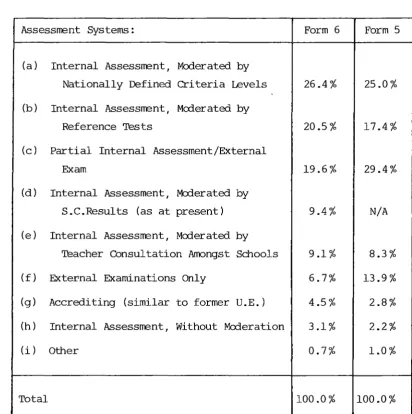
Elley's (in progress), 1987 national survey of 500 teachers on assessment policies and moderation, provides the most recent statement on this issue. Teachers were asked to rank their first three choices to indicate personal preference for separate
assessment systems in Form 6 and Form 5. The results from the survey are set out below in Table 2.1.
TABLE 2.1
Teachers' Preferences for Potential Assessment Systems at the Form 6 and Form 5 Levels
Assessment Systems: Form 6 Form 5
(a) Internal Assessment, Moderated by
Nationally Defined Criteria Levels 26.4 % 25.0 % (b) Internal Assessment, Mcderated by
Reference Tests 20.5 % 17.4 %
(c) Partial Internal Assessment/External
Exam 19.6 % 29.4%
(d) Internal Assessment, Meder ated by
S.C.Results (as at present) 9.4% N/A (e) Internal Assessment, Mcderated by
Teacher Consultation Amongst Schools 9.1 % 8.3 % (f) External Examinations Only 6.7% 13.9% (g) Accrediting (similar to former U.E. ) 4.5 % 2.8% (h) Internal Assessment, Without Mcderation 3.1 % 2.2%
(i) Other 0.7% 1.0%
Total 100.0 % 100.0 %
[image:39.598.78.491.197.611.2]25.
recommendations of the Ross Report (1986 ) to the Covernment. It is clear from Table 2.1, that criterion-referenced measure-ment is the most preferred form of assessmeasure-ment in Form 6 and the second most preferred in Form 5. However, the intended introduction of criterion-based assessment may be further away than many of its proponents envisage.
Criterion-referenced (C.R.) assessment is already well established in the us~ and has been introduced at lower year levels in Australia and Britain. Traditionally, secondary
schools have used norm-referenced (N.R.) based assessments which describe a pupil's achievement relative to others of a similar age or grade, the aim being to differentiate pupils on the basis of their relative ability and achievement. C.R. based assessment, on the other hand, is used to ascertain what pupils have learnt with respect to specified course objectives, unrelated to the achievement of others in the same age or grade group.
'Ihorndike (1971) and Nitko ~(1983), described the function of C.R. tests as that of, "yielding measurements that are directly
While the specification of criteria for practical subjects such as typing is relatively straightforward, for Group One
subjects, such as English, science and social studies, the task is proving to be rather cumbersome and time consuming. An example of some of the problems encountered can be demonstrated from a Christchurch high school, Sixth Form Certificate, geography course employing an "experimental" assessrrent scheme based on a C.R. system.
The notes to pupils and parents inform them that assessment will be made by comparing each pupil's work against a set of
"explici tly stated criteria". Furthermore, standards will be maintained by applying criteria "which describe pupil achievement at six levels", and that, "inter-school comparability" will be achieved through "teacher consensus panel meetings" where
representative samples of pupils' work will be check-marked. A review of the course criteria suggests that it would be extremely difficult for teachers to maintain even a reasonable degree of comparability when one is expected to make objective assessments using key descriptor words such as, "all", "most", "some",
"comprehensive", "wide range", "simple", "minimum", "in depth", "describe" and "explain". Two examples of the assessment
criteria are listed below:
EXAMPLE 1: The student ...
A. can recall a comprehensive range of facts in detail
EXAMPLE 2: The student ...
A. is able to recognise a range of value positions
27.
B. is aware that different value positions exist
Even within a group of highly motivated and skilled geography teachers, each teacher's interpretation and sub-sequent selection of a particular achievement level to
correspond with the assessment of their pupils' work, will be largely a subjective evaluation. One teacher's understanding of where "some" ends and "most" begins will most likely differ from that of a colleague in the same school, but will almost certainly differ from colleagues' in the neighbouring school. What would happen if two teachers from different schools awarded identical grades for their pupils' work, yet one has provided their class with a fully worked example similar to the question under assessment? Any such attempts to maintain inter-school comparability using supposedly explicit key descriptors, such as those listed above, will be fraught witn difficulties and subsequent time constraints.
A study by Archer (1984) on the introduction of C.R. assess-ment at Year 12 in Queensland only reinforces the complexity of this problem. Teachers, without adequate training, were forced to develop written objectives, review methods of assessment and define criteria for marking pupils' work resulting in rivalries and misunderstandings. Many teachers considered the
the former required a great deal more of their time, w±th much resentment among teachers. Many of these same sentiments have been expressed by New Zealand teachers in a recent survey
(Elley, in progress). A significant proportion of those teachers who favoured C.R. assessment for moderation purposes, did so only under the assumption that adequate training, resources and time would be made available:
Teachers would require a great deal of in-service training and support. C.R. is a good system, BUT again, no one recognises the huge time input required (i) initially to set up, and (ii) to test the level of each student. Teachers need to get back to teaching and leave assessment to outside agencies.
Not surprisingly, Queensland has now adopted ASAT instead, to moderate its Group One subjects.
Ebel (1972) and Power (1986), highlighted the same
dilemma from similar perspectives. £bel identified three major problems: (1) C.R. measurements do not inform us of a pupil's relative ability, whereas, norm-referenced measurements can be readily provided with equivalent content descriptions; (2) C.R. measurements are unsuitable for subjects where the emphasis is on knowledge and understanding (i.e. Group One academic subjects).
29.
Power's (1986) review of the Australian position focusses on the overdrawn distinction between norm and criterion - referenced assessment from three different perspectives - the educational, political and technological. In the latter, he identified several major difficulties that need to be confronted:
(1) Domain specification and curriculum design. "Dividing upper secondary courses into domains and specifying what is in them is not easy ... Nor does it reveal how knowledge, skill and process in a domain are integrated in such a way as to enable us to recognize different levels of competence." (Ibid, p 270);
(2) Fuzzy domains and test specifications. In the subject areas where domain criteria become difficult and results in many "fuzzy" or grey definitions, the expectations demanded by the test
constructor may be too great. Consideration should be given to a possible trade-off between the fuzziness of defining criteria and the objectivity of testing; and (3) Specifications for developing domains. Power has listed eight aspects which the development of any domain should attempt to satisfy. Included among these is the need to reflect the nature of the subject;
be capable of being identified and measured reliably; have construct validity and predictive validity; and be understandable and
acceptable to experts and to consumers. (Ibid, p 272).
The establishment of standards and the defining of grade-related criteria in a criterion-based system is a hazardous undertaking .... What counts as an appropriate standard for a grade depends on the purpose, and purposes of academics, teachers and employers are not the same. Standard setting and the award of criterion-related grade~ are matters of
judgement. (Power, 1986, P 275)
Despite the numerous problem areas to be confronted, Power still advocates further, gradual advancement towards C.R. assessment, but certainly never at the total exclusion of norm-referenced testing. Clearly, Pawer has endeavoured to produce an unbiased review, citing many of the advantages of C.R. assessment as well, yet his conclusions leave the reader with the realization that C.R. assessment cannot be implemented
overnight (nor perhaps in a decade) or in all subjects, without a massive research input:
If the impression has been created that what exactly is being called for by advocates of criterion-based assessment is unclear .... that it may not be possible to have a coherent, reliable and functional criterion-based system which is specific about what candidates have and have not achieved, that ... was intended. If, as well, it seems that we may end up not far from where we started, that too is a real possibility.
(Ibid, p 281).
teachers as suitable methods of assessment in Form 6. With about 20 percent of popular support each, option (b), Internal Assessment Moderated by Reference Tests, and option (c),
Partial Internal Assessment in combination with an External Examination stand out as the only likely alternatives. The next most attractive option could gather only nine percent of support (namely, the current system).
31.
Of these two options, the latter does not appear as a feasible system at Form 6 for three important reasons. Firstly, the recommendations of the Ross Report are for total internal assessment at Form 6. Since many of the over 400 Sixth Form Certificate courses have been developed with this in mind, it
se~ms'most unlikely that even a partial examination would be
reintroduced. Secondly, if a partial examination was reintroduced in Form 6, the problems of teachers teaching to the examination syllabus would arise again, and the internally assessed component would tend to reflect this also as teachers would be loathe to utilize content that did not assist with the examination
syllabus. Thirdly, it is likely to be viewed rather as a step backwards by the PPTA, who have fought long and hard to
introduce internal assessment. Such a move may cause more conflict than progress, as in Queensland for example.
Certificate Examination results have been used to moderate
Form 6 courses. However, this method does not take into account the maturation of pupils' work habits from one year to the next, nor does it take account of pupils' selecting new subjects in their Form 6 year. In addition, it also demands the presence of an examination at Form 5, which, according to present policies under review, is to be removed once a suitable moderation scheme is in place at Form 6. However, despite these criticisms, the basic principle has worked well in maintaining comparability between schools, subject and year groups (Ross Report, p 64).
'!he advantages of professionally-developed reference tests include a highly reliable and valid instrument, easy administration and marking, being relatively inexpensive for the school and
leaving teachers free for teaching and preparation rather than having to act as moderators. The one major disadvantage would be the danger of teachers teaching to the reference test, in the same manner they taught to examinations. However, a suitable test format, in essence a cross between an aptitude and achieve-ment test, and the use of group sampling techniques, have the potential to minimize this problem.
The final argument in favour of using reference tests is that there is already a reasonable research base to work from -the development and application of ASAT and earlier projects in Australia, achievement tests in SWeden and aptitude tests in the USA. Locally, there have been two major studies by Hulbert
CRITERIA FOR AN IDEAL MODERATING TEST
Gilmore (1979), as part of her study, conducted an extensive search of the research literature as a survey of moderation tests in current use. She identified the follOwing criteria as the most important features to consider when evaluat-ing the suitability of a moderatevaluat-ing test. Moderation tests should:
(1) be able to detect the arbitrary differences between the marking standards of different markers;
(2) be able to detect real differences in the calibre
(level and distribution of ability) of groups of pupils (classes or schools);
(3) require relatively little time to administer;
(4) cover as wide a range of curricular and behavioural objectives as possible so that a broad spectrum of pupil ability may be assessed;
(5) not place undue 'examination stress' on the pupils; (6) not be susceptible to cheating;
(7) have reasonable 'face validity', acceptability to teachers and pupils;
(8) reflect pupil skills which result from school study and are influenced by teaching quality;
(9) not be susceptible to being directly taught to, that is, it should not encourage 'coaching' by teachers [i.e. 'backwash' effects];
(10) not be based on prescribed syllabuses; and
(11) not encourage rote memorization of facts, formulae, standard procedures, etc. (Gilmore, 1979, pp 4-5)
In accepting these criteria, they will be used to assess the relative merits of the reference tests under construction in this study.
TYPES OF TESTS SUITABLE FOR MODERATION
The nature and types of test materials available to act as a moderating instrument can range from the partial use of an external examination (e.g. School Certificate) to a commonly used verbal-intelligence test, such as TOSCA. Levine (1958) for
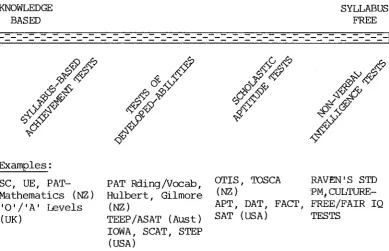
example, has suggested that the different nature of tests can best be described using a "test-content" continuum. Levine distinguishes various tests by their "degree of subject-matter generality". 'That is, the extent to which different types of tests contain specific knowledge (i.e. achievement tests) or attempt to assess general school-related skills (i.e. aptitude tests). Along such a continuum, different types of potential moderating tests can be identified, as can be seen from Figure 1.
FIGURE 1
Classification of Potential Moderating Tests on a continuum of
KNOWLEDGE BASED
Test-Content
SYLLABUS FREE E~---~---1
:$
f;,,041
~G f;,,0 ~0.p
<fy0 ~ 0~4l~4l
J)
C§
v~;t
ff;>
~<0~.fI~
o
§l'Y
&#~
~4J;;;.&
v~~4J
~~5/
o
f'y'\t.;p.:f"y@
~v§ ~ ~4J ~
08-
~-$
~~
~
~4J
'9 -<y
Examples:
SC, UE, PAT- PAT Rding/Vocab, OTIS, TOSCA RAVEN'S STD Mathematics (NZ) Hulbert, Gilmore (NZ)
PM,CULTURE-'O'/'A' Levels (NZ) APT, DAT, FACT, FREE/FAIR IQ
(uK) TEEP /ASAT (Aust) SAT (USA) TESTS
[image:49.595.96.486.514.765.2]Clearly, the two extremes of the test-content continuum would be unsui table as moderating instruments. 'Ihe fate of external am. school-based examinations has already been discussed at length, except to point out, that as examinations are largely knowledge-based, then by implication, they must be tied to very specific curricula. Therefore, as a form of assessment, the examination syllabus comes to dominate the curriculum to the extent that innovation at the classroom level is greatly inhibited. At the other extreme, non-verbal intelligence tests are virtually [email protected].;.free arid,therefore, are not related to any particular curricula. 'Ihe items are usually abstract in nature with little or no written language. Consequently, they do not reflect the kind of school-related tasks under consideration here. Although such tests still correlate reasonably highly with school achieve-ment, their poor face and content validity must render them unsuitable for moderation purposes.
Moderation 'Ihrough Tests of Sch"olastic Aptitude
Tests of scholastic aptitude (or verbal intelligence) are designed to measure a broad mixture of verbal, abstract and
numerical skills (i.e. a pupil's aptitude for learning) which are considered fum.amental in a variety of academic subjects (Elley and Livingstone, 1972, pp 100-1). Pupils who have difficulty developing these skills tend also to have trouble keeping pace with their peer group at school. 'Ihis type of test has been used extensively in New Zealand schools (e.g. Otis am. TOSCAl) as part
of the process of allocating pupils to courses, and streams upon entry to secondary school (Matthews·, 1983). 'Ihis type of test has also proved popular overseas, especially in the USA, where it is used as a mass screening and selection device for entry to tertiary institutions (Keepes and Keepes, 1974).
Tests of scholastic aptitude have two important advantages as a moaerating instrument when compared with achievement tests. Firstly, as can be seen from Figure 1, they are largely
syllabus-free, and therefore, are not susceptible to "backwash" effects, thus allowing the classroom teacher greater flexibility to develop alternative curricula; and secondly, it has been shown that coaching has only small effects on a pupil's per-formance (e.g. Yates, 1953; Frankel, 1960).
'Ihe effectiveness of scholastic aptitude tests as a moderating instrument can be demonstrated from Gilmore's (1979) study. Included among her battery of tests was a specially
constructed general aptitude test (GAT). As a predictor of class parameters the GAT produced a median correlation of 0.85 (range
A number of other studies nave investigated the predictive validity of aptitude tests in relation to examination performance at a level equivalent to Form 5 (Schools Council, 1965 , 1966 , 1972; Skurnik and Hall, 1968; Nuttall, 1971; Elley and
Livingstone, 1972; Hulbert, 1978). The two latter studies both reported median correlations for the prediction of individual scores of 0.55 (range .36-.81 and .49 - .76) between Otis and School Certificate marks, as well as median correlations of 0.44 and 0.52 (range .31 - .71 and .35 - .72) between the Differential Aptitude Test (Verbal Reasoning) and School Certificate marks. Using group discrimination procedures it should be expected that the correlations would improve significantly again. These results suggest that there is some potential for aptitude tests to act as a moderating device at this level.
However, if moderation is to be applied at the Form 6 level, as the Ross Report recommends, there is likely to be a related problem. The current retention rate at this level, although growing, is still only about 60 percent of the Form 3 intake due to the screening effect of the SChool Certificate Examination. Therefore, an aptitude test is unlikely to be able to discriminate significant differences between groups of pupils
37.
Another criticism of using scholastic aptitude tests for moderation purposes is that th~y fail to assess school-related sklls, for example, perseverance, work habits and background knowledge. In addition, such tests are also i