http://www.scirp.org/journal/ajibm ISSN Online: 2164-5175
ISSN Print: 2164-5167
A Study on the Knowledge Mapping of
Organizational Change Based on Keyword
Co-Occurrence
Yan Gao
School of Business Administration, South China University of Technology, Guangzhou, Guangdong
Abstract
The word “organizational change” was first put forward in 1947 by scholar Kurt. Before the 1990s, most of the scholars praise highly the old institutio-nalism, believing organizational change as a summary of interpretation; after the late 1990s, along with the complicated international environment, the in-creasing progress of science and technology, research on organizational change is more and more specific and concrete, and scholars view change as normal in any organization and emphasize the universality of organizational change. Although the research on organizational change is more and more deep, including the background of organization, the process of organizational change, the role of leaders in a change, the relationship between change and the environment etc., the quantitative analysis is absent. So this article uses visualization software CiteSpace and sets the keywords as nodes, observing the research hotspot and the development trend in the field of organizational change, and we find the number of literatures published is at the top in 2008. There are four keywords that have higher co-occurrence frequency and cen-trality, which are “dynamic capability”, “human resource”, “competitive ad-vantage” and “organizational structure”. Also, we will analyze literature re-lated to the four keywords that have strong centricity thoroughly.
Keywords
Organizational Change, Dynamic Capability, Competitive Advantage, Human Resource
1. Introduction
In the face of the increasingly complex operating environment, organizational
How to cite this paper: Gao, Y. (2018) A Study on the Knowledge Mapping of Orga-nizational Change Based on Keyword Co-Occurrence. American Journal of Indus-trial and Business Management, 8, 373-384. https://doi.org/10.4236/ajibm.2018.82023
Received: January 24, 2018 Accepted: February 23, 2018 Published: February 26, 2018
Copyright © 2018 by author and Scientific Research Publishing Inc. This work is licensed under the Creative Commons Attribution International License (CC BY 4.0).
http://creativecommons.org/licenses/by/4.0/
Open Access
change ability is vital to the survival and development of the organization. The study of organizational change began in the 1940s (Chen & Zhang, 2006) [1].
And with the acceleration of technological progress, market integration and globalization, more and more enterprises are facing changes such as mergers, re-structuring and business process reengineering (Rafferty et al., 2013) [2]. Tradi-tional way of thinking, organization structure, management mode, organization system, financing channels and so on has been difficult to adapt to the needs of the development of society. More and more enterprises realize that continuous reform and innovation are needed to stimulate staff’s work enthusiasm, improve the economic benefits and social influence of enterprises. Based on this, change has become a universal consciousness of the people, and occurs in a variety of organizations. It exists in state and private enterprises, and also exists in schools, hospitals, government agencies and social organizations.
Overall, this article will use CiteSpace visualization software to analyze syste-matically, through keyword co-occurrence to clarify when the research topics appeared, the frequency, and the trend of development with time. The paper studies the problems and frequency analysis of keywords and we obtain the four main research hotspots in the field of organizational change: dynamic capability, human resource, competitive advantage and organizational structure. While, there are some limitations in this paper. First, the data source is Chinese social science citation index (CSSCI), and the period is from 1998 to 2016. Therefore, the data may not be comprehensive that lead to the excellent literature of many non-core journals not included. Second, this research concentrates on the re-search hotspot in the field of organizational change and does an overall sum-mary of the important literature, and does not contain all of the theory of orga-nizational change. Whatever, I’m looking forward to make some contribution on this subject and help the further research.
2. Literature
In general, organizational change is a fundamental and radical change in the or-ganization. The research on organizational change is not a new topic in academ-ic circles, and has been continuously concerned by scholars. Overall, the study of organizational change is more sufficient in foreign countries, it focuses on the following aspects: the background of the organizational change, the process of the organizational change, the content of the organizational change and the evaluation criteria of the organizational change.
The background of organizational change is mainly divided into external and internal conditions. The drastic change of external environment is the main re-search factor, while the study of the internal conditions such as work specifica-tion and work inertia are not high. The study of the process mainly focuses on some change stage models, such as the mobile freezing process of continuous phase stated in 1947 by the father of the revolution Kurt thaw, the model laid the foundation of the research of organizational change; In 1991, Judson proposed
the five-stage model of change implementation, and Leavitt proposed three-ways model of change, which are important models for later research. The contents of organizational change mainly include factors affecting the success and failure of organizational change, organizational structure adjustment, performance incen-tive system and content model of various organizational changes. The criteria for the assessment of organizational change is mainly to evaluate organizational change activities, you can also use the emotion and behavior standard to eva-luate organizational change activities, combining these standards with viability and profitability of the traditional production standard. Domestic research on organizational change mainly focuses on the analysis of the external environ-ment of the enterprise, and the influence of the change of external environenviron-ment on the enterprise organization form, operation way and the management pat-tern, such as the study of Sui (2000), Wu Degui (2000), etc. Except the men-tioned aspects, the research on organizational change also includes transforma-tional leadership, organizatransforma-tional culture and learning organization, but the present research on organizational change mainly concentrates on some certain aspects, or from a specific content, instead viewing the topic from the whole, which appears relatively unfocused.
3. The Source of Paper and Research Method
The data source is Chinese social science citation index (CSSCI), and the period is from 1998 to 2016. For accurately collecting literature in the field of Chinese enterprise organizational change, the screening process is as follows: first, choosing “organizational change” as the keyword, “enterprise” as the abstract, both is filtered for “and” logic, and in the “subject” column to select “enterprise economy” and “management”. Second, reading literature and browsing the con-tents of the literature, removing review, conference announcement that does not meet the requirements for the analysis of the literature, such as the resulting ac-cords with the research topic of effective with 244 references.
This paper uses CiteSpace visualization software to study the 244 data based on keyword co-occurrence. Dr Chen-the software developers said a research sit-uation can be analyzed in the field of “research front” and “knowledge base” as time changes, we can get the hot words in the frontier study by recognizing the frequency of words in the title and abstract of a paper and calculating the growth rate of vocabulary. Doing clustering analysis according to the emergence of these terms in the same article can get “research front term co-occurrence network”, analyzing the co-occurrence network can learn about the current situation in the field of the study.
4. Statistical Analysis of Data
1) The annual literatures published statisticsBy doing the annual literatures published statistics (Figure 1), we can get a straight view of this field. Before 2008, the number of literatures was on the rise,
Figure 1. The annual literatures published in the field of organizational change.
and peaked in 2008. From 2008 to 2013, there were more than 15 studies on re-lated subjects each year, more than any other year.
This can be explained by the global financial crisis that erupted in 2008. Shortly after the outbreak of the financial crisis, for example, general motors had filed for bankruptcy protection to the government, and actively made strategic adjustment and changed the organizational structure, made every effort to de-crease the cost of the organizational structure and get the rebalancing of cost and profit. For an 100-year history, unwieldy massive institutions and the business enterprises, in the face of the impact of global financial crisis, it must carry on the organizational change, so for the average enterprise, you learn through orga-nizational change and the impact of the financial crisis is something urgent.
2) Literature periodical distribution statistics
After analyzing the publication of periodicals (Table 1), we find that the lite-rature in the field of organizational change appears to be more fragmented, with a total of 100 periodicals published on the subject. However, there are 13 jour-nals in which there are more than 5 published articles, and the total number of articles published in these journals is 104, accounting for about 43 percent of the total. Among them, the amount of literature published more than 10 journals are “human resources development of China”, “scientific & technological progress and policy”, “business management”, “productivity research” and “science and technology management research”, these are all bigger impact factor journals, it also ensures the quality of the selected literature and the reliability and validity of the research.
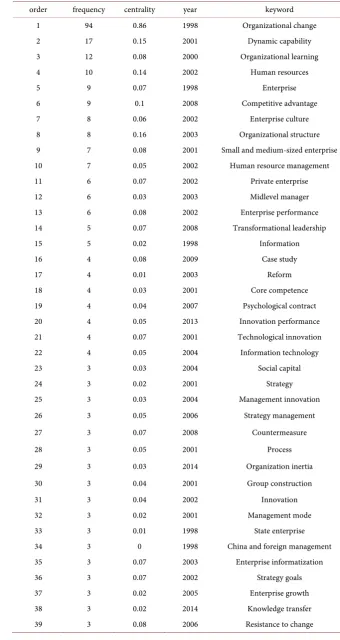
From Table 2, we find there are four keywords that have higher co-occurrence frequency and centrality. They are “dynamic capability”, “human resource”, “com-petitive advantage” and “organizational structure”. In addition, from Table 2 we find that “human resource management” has a high frequency, and the occur-ring time of it is at the same year as “human resource”, then we will not distin-guish the two concept-”human resource” and “human resource management”, so the number of documents related to “human resource” increase to 17,
4
1 3
8 12
8 16
9 15 15
26
17
21 20
17 18
13 12
9
0 5 10 15 20 25 30
1 9 9 8 2 0 0 0 2 0 0 2 2 0 0 4 2 0 0 6 2 0 0 8 2 0 1 0 2 0 1 2 2 0 1 4 2 0 1 6
Table 1. The distribution of periodicals greater than 5 in the field of organizational change.
periodical number periodical number
Human Resources
Development of China 12 Statistics & Decision 7
Science & Technology
Progress and Policy 12 Modernization of Management 6
Business Management
Journal 11 Management of S. & T. Science of Science and 6
Productivity Research 10 Management World 5
Science and Technology
Management Research 10 Modern Management Science 5
Science Research
Management 8 Soft Science 5
China Industrial
Economics 7
which is the same as “dynamic capability”. The first time four keywords emerged is in 2001, 2002, 2008 and 2003. Then we will separately analyze the literature involved in each of the keywords.
5. The Analysis of Keyword “Dynamic Capability”
There are 17 articles let “dynamic capabilities” as keywords, and 7of them also let “competitive advantage” as keywords, the seven literatures respectively ana-lyzed the relationship between dynamic capabilities and improving organiza-tional competitive advantage from the perspective of resources [3] and organiza-tions [4].
Baobao Dong (2014, 2015) [5] have studied the heterogeneity of resources within the enterprise and how the recognition of external resources has influ-ence on the enterprise to maintain its own competitive advantage. Among them, the dynamic capability has the obvious adjustment effect in the relationship be-tween resource heterogeneity and competitive advantage, namely with the aug-mentation of the enterprise dynamic ability, resource heterogeneity gradually strengthen the positive effect of competitive advantage. Entrepreneurial ability is the ability of enterprises to identify new opportunities and acquire resources to develop opportunities. It is the key determinant of the generation of entrepre-neurial enterprises [6]. For entrepreneurial enterprises, when introducing the variable of enterprise years, the entrepreneurial ability and dynamic can play a significant role in the competitive advantages of enterprises in the following six years and over six years. Further, dynamic capability plays a complete interme-diary role in the relationship between the process of knowledge taking and competitive advantage of external resources of enterprises [7]. The most impor-tant thing for a generation enterprise is the ability to generate current operating
[image:5.595.208.539.102.314.2]Table 2. Keyword co-occurrence knowledge map in the field of organizational change.
order frequency centrality year keyword
1 94 0.86 1998 Organizational change
2 17 0.15 2001 Dynamic capability
3 12 0.08 2000 Organizational learning
4 10 0.14 2002 Human resources
5 9 0.07 1998 Enterprise
6 9 0.1 2008 Competitive advantage
7 8 0.06 2002 Enterprise culture
8 8 0.16 2003 Organizational structure
9 7 0.08 2001 Small and medium-sized enterprise
10 7 0.05 2002 Human resource management
11 6 0.07 2002 Private enterprise
12 6 0.03 2003 Midlevel manager
13 6 0.08 2002 Enterprise performance
14 5 0.07 2008 Transformational leadership
15 5 0.02 1998 Information
16 4 0.08 2009 Case study
17 4 0.01 2003 Reform
18 4 0.03 2001 Core competence
19 4 0.04 2007 Psychological contract
20 4 0.05 2013 Innovation performance
21 4 0.07 2001 Technological innovation
22 4 0.05 2004 Information technology
23 3 0.03 2004 Social capital
24 3 0.02 2001 Strategy
25 3 0.03 2004 Management innovation
26 3 0.05 2006 Strategy management
27 3 0.07 2008 Countermeasure
28 3 0.05 2001 Process
29 3 0.03 2014 Organization inertia
30 3 0.04 2001 Group construction
31 3 0.04 2002 Innovation
32 3 0.02 2001 Management mode
33 3 0.01 1998 State enterprise
34 3 0 1998 China and foreign management
35 3 0.07 2003 Enterprise informatization
36 3 0.07 2002 Strategy goals
37 3 0.02 2005 Enterprise growth
38 3 0.02 2014 Knowledge transfer
39 3 0.08 2006 Resistance to change
income, so the entrepreneurial ability is not suitable for the analysis of such en-terprises. From the perspective of organizational routines, organization ability can be divided into dynamic ability and real ability, the real ability refers to the “manufacturing products in some way or a set of solution to providing services’, the dynamic capability is” “to change the product, production process, ability of the scale of production and sales, it is the enterprise extension, adjust, or the ability to create substantial ability” [8]. For the generation of processing enter-prises with typical real ability such as Chen (2012) [9] study found that based on the ability of real competitive advantage may be weakened by dynamic environ-ment, it can through high order dynamic capabilities, explore new technology or market, to create a sustainable competitive advantage.
From the perspective of organization, the perspective of the two papers is based on organizational learning, using the text analysis method to explore im-proving the dynamic capability through organizational learning, and to maintain the original competitive advantage. Huang et al. (2016) [10] concretely analyzed the effect of interactive memory system on enterprise innovation performance. Transactive memory system forms to accomplish a specific task in the process of an enterprise [11], construction and the composition of innovation ability, in-novation ability to improve enterprise performance and to maintain the original competitive advantage has been widely researched in the academia. The study found that the dynamic capabilities in the transactive memory system play a partial intermediary role in the relationship between expertise and innovation financial performance, play a completely mediating role between the relation-ship of expertise and innovation growth performance, play a completely me-diating role between the relationship of coordination and innovation growth performance.
In the ten literature of “dynamic competence” as the key word, the literatures of empirical research, case study and content analysis methods are 4, 3 and 3 re-spectively. Empirical study of the literature revealed that organizational change ability and resources conformity ability as the independent variable [12], as the intermediary variables [13] to the influence of enterprise performance, the case study mainly discusses the relationship between dynamic capabilities and enter-prise innovation in the role of innovation in different stages of the internationa-lization of enterprises [14], for the role of enterprise technology innovation strategy to build [15].
6. The Analysis of Keyword “Human Resource”
Organization development and management problem has always been impor-tant hot topic in the field of management experts, economists at home and abroad, in the early 1980s, Kimberly (1981) [16] Richard (1983) [17] put forward the concept of organization life cycle. According to the enterprise life cycle theory, the enterprise suffers from different risk factors and restriction degree in its growth stage. To guarantee its healthy and vigorous growth, an organization
must take management change measures, and human resource management ac-tivities will become the key to enterprise reform success or failure. Enterprise organizational change has experienced the evolution of the five types of organi-zational structure-linear system, unity form, linear unity form, divisional system and matrix, and after that, it is showing a new development situation, main cash for flat, flexible, and virtualization [18]. In the face of such changes, the enter-prise human resource management needs to deal with the following relations: the consistency of human resource management and corporate strategy. For example, the organization’s strategic flexibility require companies to choose strategic talents according to conception, strategic talents make strategic deci-sions between the enterprise want to do and can do [19]; the behavior consis-tency between human resource management and organizational change re-quired, such as HR department managers should strive to become change agents and innovators. According to the situation of inside and outside the organiza-tion, he should constantly update organization management approach and change management methods, process all kinds of human resources issues in the process of change, help enterprises to reduce the uncertainty of change, in order to promote organizational change process [20]; the process consistency between reengineering of human resource and organization change requires, such as e-learning is a revolutionary change in the human learning in the 21st century. Enterprises set up new concept of human resources development and change role of human resource development, which determines the quality and speed of the e-learning in an enterprise. While the transformation of concept and role requires to expand human resources development role and reshape human re-sources development [21].
7. The Analysis of Keyword “Competitive Advantage”
The literature of “competitive advantage” as the keyword is most common with “dynamic ability” or “human resources”. For companies to create wealth for their shareholders, they need to be at the core of their expertise to generate prof-its, which is to maintain their competitive advantage. The resource-based view holds that companies have the potential to gain sustained competitive advantage if they have valuable, scarce, unimitated and irreplaceable resources (Barney, 1991) [22], meanwhile, Teece (1997) [23] hold the idea that In the vague and unpredictable market environment, enterprises “integrate, build, reset its ability to reconfigure its internal and external resources is the source of enterprise sus-tainable competitive advantage”, therefore, the analysis of the enterprise com-petitive advantage when inevitably involves the content of the resource based view or dynamic capability view. Human resource as the most important re-source of enterprise, how to when making organizational change, the vigor of human resources and make human resources to adapt to and actively respond to organizational change, in order to maintain effectiveness of organizational competitive advantage are also scholars to explore. In addition to looking at its
relationship with competitive advantage from the perspective of resource ability and human resources, some scholars also discuss the pursuit relationship be-tween the first and the later enterprises in the same industry. Wang (2010) [24] analyzed the products in the international division of labor system as a new-comer striving for enterprise’s competitive advantage of enterprises of China, emphasizes the innovation of enterprise use subversion of backwardness to foster its competitive advantage different effects on different stages of the productive service.
8. The Analysis of Keyword “Organizational Structure”
Organizational structure adjustment is a part of organizational change, and or-ganizational structure change affects the way of communication of knowledge within the organization [25]. On the one hand, with the popularization of Inter-net and China’s independent innovation strategy, dealing with the relationship between the organization governance and technical innovation, solving the or-ganization structure and knowledge structure, and the problem of distribution fit between has been more and more important to scholars. The article of Zhan (2010) [26] based on organizational knowledge points out the classification and distribution of the invisible knowledge integration activities involved in the technology update need reasonable power distribution structure and organiza-tion of knowledge structure, and organizaorganiza-tional change. The new generaorganiza-tion of information technology revolution is represented by Internet technology, and the deepening of Internet application in enterprises is associated with the decline and deepening of internal hierarchical structure [27]. On the other hand, project management emphasizes knowledge as well as experience, and can effectively improve people’s work efficiency by helping enterprises to carry out new busi-ness or effectively reengineering busibusi-ness processes. Project organization struc-ture has the characteristics of flexible and flat [28], can largely avoid the asym-metric information problems in the enterprise, form effective communication system within the enterprise, and create a good environment for information sharing.9. Conclusion and Limitation
1) ConclusionThis paper uses the method of the knowledge map through the CiteSpace software to analyze the keywords of the cited paper that are the important lite-rature and works of the field of organizational change. Through the study of the frequency and the center degree of higher literature and works, combining the analysis results of the subject words, we can get the research hotspot and devel-opment trends of the field of organizational change.
First, the paper studies the problems and frequency analysis of keywords and we obtain the four main research hotspots in the field of organizational change: dynamic capability, human resource, competitive advantage and organizational
structure.
Second, analyzing these papers through the year, we can get the ideas about how the keywords change while the year changes. Before 2008, the number of li-teratures was on the rise, and peaked in 2008. From 2008 to 2013, there were more than 15 studies on related subjects each year, more than any other year. Meanwhile, we can also know when the keywords first occur in an article and analyze the reason.
2) Limitation
Although we analyze some hotspots in the field of organizational change combining qualitative analysis with quantitative analysis, there are some defi-ciencies in the research.
First, the data source is Chinese social science citation index (CSSCI), and the period is from 1998 to 2016. Therefore, the data may not be comprehensive that lead to the excellent literature of many non-core journals not included.
Second, this research concentrates on the research hotspot in the field of or-ganizational change and does an overall summary of the important literature, and does not contain all of the theory of organizational change, only for rough sketch. There must be many hotspots that are not included, just to provide a ref-erence for the researchers.
Third, this paper only studies from the perspective of literature of the organi-zational change, and it is not enough to research literature. If we want to get a full outcome, the authors, the institutions and many other aspects are also need to be included. Only so, we can get a more accurate grasp about the hotspots and development trends of organizational change, thus this study has some limita-tions.
As for the development of the study, I hope in the future more software can be developed and used in our scientific research work. We can combine keywords co-occurrence, the author lead, journals, institutions, social network analysis with other research methods of organizational change areas for further research and exploration, providing more convenience for future researchers.
References
[1] Chen, C.-H. and Zhang, C. (2006) Organizational Change “Force Field” Structure Model and Enterprise Organization Change Resistance to Overcome. Science and Technology Management Research, No. 4, 203-206.
[2] Rafferty, A.E., Jimmieson, N.L. and Armenakis, A.A. (2013) Change Readiness: A Multilevel Review. Journal of Management, 39, 110-135.
https://doi.org/10.1177/0149206312457417
[3] Dong, B.-B., Yu, D.-M. and Wang, K. (2015) The Effects of Resource Heterogeneity and Dynamic Capability on Competitive Advantage of New Ventures. Technoeco-nomics & Management Research, No. 9, 53-57.
[4] Shen, Z.H. (2010) Strategy of Dynamic Capability Cultivation Based on Organiza-tional Learning. Science &Technology Progress and Policy, No. 9, 128-132.
[5] Ma, H.-J., Dong, B.-B. and Ge, B.-S. (2014) Empirical Study on the Relationships
among Entrepreneurial Capability, Dynamic Capability and Competitive Advantage of the Firm. Studies in Science of Science, No. 3, 431-440.
[6] Arthurs, J.D. and Busenitz, L.W. (2006) Dynamic Capabilities and Venture Perfor-mance: The Effects of Venture Capitalists. Journal of Business Venturing, 21, 195-215. https://doi.org/10.1016/j.jbusvent.2005.04.004
[7] Dong, B.-B., Ge, B.-S. and Wang, K. (2011) Resource Integration Process, Dynamic Capability and Competitive Advantage: Mechanism and Path. Management World, No. 3, 92-101.
[8] Winter, S.G. (2003) Understanding Dynamic Capabilities. Strategic Management Journal, 24, 991-995. https://doi.org/10.1002/smj.318
[9] Chen, G. and Xu, Z.-L. (2012) Competitive Advantage Framework Based on Dy-namic Capabilities—Evidence of OEM/ODM Business Upgrade. Science & Tech-nology and Economy, No. 4, 101-105.
[10] Huang, H.Y. and Wu, B. (2016) An Empirical Study of the Relationship among Transactive Memory System, Dynamic Capability and Innovation Performance. Science Research Management, No. 4, 68-76.
[11] Ren, Y. and Argote, L. (2011) Transactive Memory Systems 1985-2010: An Integra-tive Framework of Dimensions, Antecedents and Consequences. Academy of Man-agement Annals, 5, 189-230.https://doi.org/10.1080/19416520.2011.590300
[12] Pang, C., Li, Y. and Duan, G. (2015) Integrative Capability and Firm Performance: The Mediating Effect of Business Model Innovation. Journal of Management Science, No. 5, 31-41.
[13] Huang, H. (2014) The Empirical Study of the Impact Path of Customer Participa-tions to New Product Performance: The Mediating Mechanism of the Dynamic Capability. Economic Management, No. 3, 87-97.
[14] Su, J. and Zhang, L. (2013) The Changing Role of Various Dimensions of Dynamic Capabilities in Different Stages of the Innovation Internationalization. Chinese Journal of Management, No. 6, 802-809.
[15] Chen, T. (2004) Technology Innovation Strategy Analysis from Dynamic Capability Framework: A Case of a Group’s Technology Innovation Strategy. Science Research Management, S1, 37-44.
[16] Kimberly, J.R. and Miles, R.H. (1981) The Organization Life Cycle. Jossey-Bass Publishers, London, 1-20.
[17] Daft, R. (1987) Organizational Theory and Design. West Publishing Company, New York, 200-230.
[18] Tan, B. and Zhao, X. (2009) The Strategy of Human Resource Management under the New Situation of Organizational Change. Human Resources Development of China, No. 9, 100-102.
[19] Peng, Y. and Yang, Y. (2009) Promoting Organizational Strategy Flexibility with Human Resources Management. Human Resources Development of China, No. 9, 33-37.
[20] Ke, J. and Pei, L. (2008) Human Resource Management Strategy in Organizational Change. Human Resources Development of China, No. 6, 10-13.
[21] Song, G. and Xie, J. (2004) The Role of Human Resources Development under e-Learning: Challenges and Responses. Nankai Business Review, No. 3, 92-97. [22] Barney, J.B. (1991) Firm Resources and Sustained Competitive Advantage. Journal
of Management, 17, 99-120.https://doi.org/10.1177/014920639101700108
[23] Teece, D.J., Pisano, G. and Schuen, A. (1997) Dynamic Capabilities and Strategic Management. Strategic Management Journal, 18, 509-533.
https://doi.org/10.1002/(SICI)1097-0266(199708)18:7<509::AID-SMJ882>3.0.CO;2-Z
[24] Wang, J. and Chen, J. (2010) Disruptive Innovation, Producer Services and the Competitive Advantage of Latecomer Firms. Studies in Science of Science, No. 3, 444-448.
[25] Barnett, W.P. and Carroll, G.R. (1995) Modeling Internal Organizational Change. Annual Review of Sociology, 21, 217-236.
https://doi.org/10.1146/annurev.so.21.080195.001245
[26] Zhan, W., Shen, Q. and Yu, Y. (2010) Synergy Analysis of Organization Transfor-mation and Technological Innovation. Forum on Science and Technology in China, No. 6, 31-36.
[27] Sun, L. and Chen, J. (2010) Research on Power Allocation of Senior Management Team. Science & Technology Progress and Policy, No. 15, 115-118.
[28] Liang, L. (2010) Application Basic Analysis of Project Management in Enterprise Management. Productivity Research, No. 1, 233-235.