A Primary Shift Protocol for Improving Availability in
Replication Systems
Almetwally M. Mostafa
CCIS, King Saud UniversityRiyadh, KSA and Faculty of Engineering Alazhar University, Cairo, Egypt
Ahmed E. Youssef
CCIS, King Saud UniversityRiyadh, KSA and Faculty of Engineering Helwan University, Cairo, Egypt
ABSTRACT
Primary Backup Replication (PBR) is the most common technique to achieve availability in distributed systems. However, primary failure remains a crucial problem that threatens availability. When the primary fails, backup nodes in the system have to elect a new primary node in order to maintain adequate system’s operation. During election, the system suffers from transaction loss, communication overhead due to messages exchange necessary to preserve data consistency, and a notable delay caused by the execution of Leader Election Algorithms (LEA). Primary failures can be unpredictable (i.e., unplanned), such as primary node crashes and network outages, or predictable (i.e., planned), such as primary’s scheduled shutdown to perform routine maintenance or software upgrade. Traditionally, PBR employ LEA to recover from both unplanned and planned outages. In this paper, we propose a novel protocol, called Primary Shift Replication (PSR), to avoid election during planned outages. PSR shifts the primary role from the current primary to another scheduled node (without election) when a planned outage is about to occur. Number of messages and communication time required to shift the primary node to another node is much less than number of messages and time required to perform leader election; therefore, PSR improves system’s availability. Moreover, PSR guarantees no transactions loss during the shift mode, hence, it preserves data consistency.
General Terms
Distributed Systems, Algorithms.
Keywords
Primary Backup Replication, Leader Election, Transaction Store, Replication Systems.
1.
INTRODUCTION
Replication is the heart of today’s emerging information technologies such as cloud computing, mobile computing, and pervasive computing. Primary Backup Replication (PBR) approach is the most common practical technique used for several distributed applications such as distributed databases, distributed white board, collaborative applications, and distributed agenda that require a high degree of consistency and availability of shared data objects. PBR approach requires one node (i.e., leader or primary) to act as an organizer for other replicas in the distributed system [1, 2, 12, 16, 17, 18]. The primary maintains object store consistency by controlling access to the shared objects and executes the transactions that clients submit at different replicas. In Chain Replication (CR) [16], the replicas are organized in a chain with a head (node
with the maximum ID) and a tail (node with the minimum ID), the head node plays the role of the primary in case of update transactions while the tail node responds to query requests, this alleviates the load on the primary node. The availability of replication services depends heavily on the availability of the primary node or the leader. If the leader fails for any reason, another node should be elected as a leader to maintain adequate system’s performance. Leader Election Algorithms (LEA) [3-6,13-15] are employed to elect a new leader to substitute the failed leader. The new elected leader must acquire information on the shared objects such as the lock table at the primary and the most recent objects’ states. However, acquiring such information is a challenging task since the previous leader crashed without delivering its own lock table and the last updated objects’ states to the new elected leader. The time taken by LEA to elect a new leader is an idle time during which there are no active transactions. In addition, the number of messages that nodes exchange to preserve object store consistency during election linearly increases with the number of nodes and objects in the system which causes a considerable communication delay. Obviously, these factors negatively affect the availability of the replication system. Moreover, the transactions that are issued just before primary failure may be lost (not committed nor aborted), since nodes are busy collecting information on objects that have been locked by the failed primary. This may render shared objects inconsistent.
42 at network level.
Traditionally, PBR systems employ LEA to recover from both planned and unplanned outages. However, we believe that planned outages can be managed in a different way that avoids election drawbacks. In this paper, we propose a novel protocol, Primary Shift Replication (PSR), that avoids election in planned outages by shifting the primary role from the current primary to another scheduled node whenever a planned outage is about to occur. In PSR, the administrator feeds the system with a schedule for the planned outages where primary shift should take place. This gives administrators more flexibility to schedule backup, upgrade software, and perform routine maintenance for the primary node. The shift time is too short compared to the election time; therefore, system’s availability is improved. Moreover, PSR guarantees no transactions loss during the shift mode, hence, it preserves consistency. If an unpredictable failure occurred during primary shift, election is employed to tolerate the failure. To the best of our knowledge, there is no work in literature that adopts primary role shift in replication systems.
In order to test the feasibility of our approach, we developed a prototype for the replication system and conducted a set of experiments to show the merits of our approach. The results are very promising in terms of avoiding election drawbacks, improving availability, and preserving consitency. The rest of this paper is organized as follows: in section 2 we review the PBR approach, in section 3, we describe our proposed primary shift protocol, in section 4, we present experimental results, and in section 5, we give our conclusions and future work.
2.
PRIMARY BACKUP REPLICATION
A replication system is composed of a set of fully connected replicas (nodes) with one replica assigned exclusively as a primary. Each replica serves a set of clients and each client can connect to only one replica at a time. In PBR approach, the primary replica accepts and executes client requests for the entire data objects and propagates the results to other replicas in the system. The enhanced and light-weight PBR approach [7,8] allows all replicas to share extra workload by executing client’s requests. However, the primary continues to play a significant role by holding the permission for accessing the shared replicated objects. The primary exclusively holds a lock table to coordinate among replicas for the purpose of concurrency control.
In a replicated object store, the object is any piece of data being shared such as counters, rectangles, files, DB records, etc [11]. Each replica maintains the following:
membership: a set of references to the connected replica, S= {s1, s2,…, sn}
local_store: a set of references to the replicated objects, O = {o1,o2, …,om}
primary: a reference to the current primary replica, i.e., primary=self or si
transaction: Ttid(Otid,Mtid) is a procedure that uses a set of methods Mtid={m1,…,mk}, to modify the states of a subset of object Otid={o1,..,oz}, where tid refers to transaction ID. A transaction state can be active (under
processing), commit (finish processing), or abort (cancel processing).
lock_table: is a three-field table at the primary node containing object_reference (oi) which refers to the object requested to be locked, replica_reference (si) which refers to the replica requested to lock the object, and tid of the active transaction.
𝒑𝒓𝒊𝒎𝒂𝒓𝒚 𝒕𝒊𝒎𝒆 𝒔𝒕𝒂𝒎𝒑: initially Tptstamp=1
In a replication system, each replica is a state machine whose transitions are triggered by the reception of an event. As described in [10], events may carry information such as a data message or a group membership in one or more attributes. An event is denoted by <EventType | att1, att2, . . >. We consider two types of events:
Request:refers to a service requested by a client from a replica such as add_object and submit_transaction or by a replica from another replica such as lock_object.
Notification: refers to a response to a request from replica to replica such as ok_lock/ko_lock or from replica to client such as and trans_abort and trans_commit. The behavior of a replication system is controlled by a protocol which includes a set of rules; each rule is triggered by an event. These rules are described in the following subsections.
2.1
Create New Object
Upon receiving add_object request from a client, the underlying replica creates a new local object in its local store and triggers other replicas to create copies of this object in their local stores. All copies (i.e., object replicas) are considered as one logical object in the system and is identified by a unique ID. Rules 1a and 1b shown below describe the object creation process. The set of actions taken during this process are the following: 1) Client, Ci, trigger a replica to create a new object, 2) The triggered replica adds new object_reference (oi) to its local store (O), 3) The replica notifies its clients with object reference, 4) The replica triggers all other replicas by add_object request, 5) Actions 2 and 3 are repeated at each other replica.
2.2
Submit Transaction
When a client submits a transaction to its connected replica, the replica takes the following actions: 1) Client, Ci, triggers the replica to submit a transaction, 2) The replica creates a
𝑂 = 𝑂 ∪ {𝑜𝑖 }
∀ 𝑠𝑖 ∈ 𝑆
Rule 1a- object creation from client to replica
Upon event < 𝑎𝑑𝑑_𝑜𝑏𝑗𝑒𝑐𝑡()|𝑐𝑙𝑎𝑠𝑠, 𝑜𝑖 | 𝐶𝑖 > do
𝑜𝑖 = 𝑛𝑒𝑤 𝑐𝑙𝑎𝑠𝑠 clientNotify <𝑛𝑒𝑤, 𝑜𝑖 >
Notify < 𝑎𝑑𝑑_𝑜𝑏𝑗𝑒𝑐𝑡()|𝑐𝑙𝑎𝑠𝑠, 𝑜𝑖 | 𝑠𝑒𝑙𝑓>
𝑂 = 𝑂 ∪ {𝑜i}
Rule 1b: object creation from replica to a replica
Upon event < 𝑎𝑑𝑑_𝑜𝑏𝑗𝑒𝑐𝑡()|𝑐𝑙𝑎𝑠𝑠, 𝑜𝑖 | 𝑆𝑖 > do
unique transaction ID (tid) and add the transaction to the active_list, 3) The replica identifies object_references (Otid) to be locked, 4) The replica sends lock_objects request to the primary. These actions are listed in rule 2.
2.3
Lock Request
When the primary node receives the lock_object request from the replica, it takes the following actions: 1) The primary receives lock_object request from a replica, 2) The primary checks to see if any object in Otid is already locked, 3) The primary responds by ko_lock if an object is already locked, 4) The primary responds with ok_lock and updates the lock_table with object_reference (oi), replica_reference (si) and tid. if all objects are free. These actions are described in rule 3.
2.4
Execute transaction rule
Upon receiving ok_lock from the primary, the underlying replica executes the following set of actions 1) Replica executes transaction procedure and updates the object in its local_store, 2) Replica triggers other replicas to update objects in their local_store, 3) Primary release locked objects, 4) Replica adds tid to commit_list and remove it from active_list, 5) Replica notifies client with trans_commit message. These are actions are shown in rule 4a.
On the other hand, upon receiving ko_lock, the underlying replica takes the following actions: 1) Replica adds tid to abort_list and removes it from active_list, 2)Replica notifies client with trans_abort message. These are actions are clarified in rule 4b.
When the primary receives update_object notification, it releases object locks from the lock_table as shown in rule 5.
3.
THE PRIMARY SHIFT PROTOCOL
[image:3.595.56.280.330.448.2]We propose a novel approach that avoid election in planned outages by shifting the primary role from the current primary to another scheduled node whenever a planned outage is about to occur. At anytime, there could be a primary outage; these outages are defined by the administrator to support operations such as scheduled backup, software upgrade, or routine maintenance for the primary node. Table 1 shows some of these outages, outage #1, for example, implies that if server (s1) was the primary at the time (12:30, 12/5/2012) then it should be replaced by server s2, because s1 is subjected to software upgrade. When the shift mode starts at t=Ts, the old primary, s1, immediately forwards the lock_table to the new primary, s2, and every other replica changes the primary identity from s1 to s2.
Table 1. a schedule of planned outages
As figure 1a illustrates, the bolded horizontal line indicates the current primary for the system. At the outage time, Ts, each node enters the shift mode, the transfer time of the lock_table is given by (Tl-Ts) where Tl denotes the time at which the lock_ table is completely received by the new primary. The the shift mode time is given by (Tn-Ts) where Tn denotes the time at which all replica return to the normal mode. The lock_ table transfer time (Tl-Ts) varies depending on the network speed between replicas and the data size in the lock-table itself. The time (Tn-Tl) is the time needed by the new primary to unlock the objects exist in the lock-table delivered by the old primary. This time depends on the arrival rate of update notification messages.
𝑐𝑟𝑒𝑎𝑡𝑒 𝑛𝑒𝑤 𝑡𝑖𝑑
𝑎𝑐𝑡𝑖𝑣𝑒_𝑙𝑖𝑠𝑡 = 𝑎𝑐𝑡𝑖𝑣𝑒_𝑙𝑖𝑠𝑡 ∪ 𝑡𝑖𝑑 #𝑝𝑟𝑜𝑐()
Rule 2: transaction request from client to replica
Upon event< 𝑡𝑟𝑎𝑛𝑠()| 𝑝𝑟𝑜𝑐(), 𝑂, 𝑀, 𝐶𝑖 ˃> do
𝑝𝑟𝑖𝑚𝑎𝑟𝑦𝑻𝒓𝒊𝒈𝒈𝒆𝒓 < 𝑙𝑜𝑐𝑘()| 𝑂, 𝑆𝑖 , 𝑇𝑡𝑖𝑑 >
𝑐𝑜𝑚𝑚𝑖𝑡_𝑙𝑖𝑠𝑡 = 𝑐𝑜𝑚𝑚𝑖𝑡_𝑙𝑖𝑠𝑡 ∪ 𝑡𝑖𝑑
𝑝𝑟𝑜𝑐() = 𝑟𝑒𝑡𝑢𝑟𝑛 𝑃 (∀ 𝑡𝑖𝑑 # 𝑃 𝜖 𝑎𝑐𝑡𝑖𝑣𝑒𝑡𝑎𝑛𝑠)
𝑐𝑜𝑚𝑚𝑖𝑡_𝑙𝑖𝑠𝑡 = 𝑐𝑜𝑚𝑚𝑖𝑡_𝑙𝑖𝑠𝑡 ∪ 𝑡𝑖𝑑 # 𝑇𝑝𝑡𝑠𝑡𝑎𝑚𝑝
𝑒𝑥𝑒𝑐𝑢𝑡𝑒 𝑃𝑟𝑜𝑐() ∀ 𝑠𝑖 ∈ 𝑆
𝑻𝒓𝒊𝒈𝒈𝒆𝒓 < 𝑢𝑝𝑑𝑎𝑡𝑒()| 𝑝𝑟𝑜𝑐(), 𝑠𝑒𝑙𝑓, 𝑡𝑖𝑑 , 𝑇𝑝𝑡𝑠𝑡𝑎𝑚𝑝 > Rule 4a: ok_lock event
Upon event< 𝑜𝑘_𝑙𝑜𝑐𝑘() | , 𝑇𝑝𝑡𝑠𝑡𝑎𝑚𝑝> do
𝑎𝑐𝑡𝑖𝑣𝑒_𝑙𝑖𝑠𝑡 = 𝑎𝑐𝑡𝑖𝑣𝑒𝑡_𝑙𝑖𝑠𝑡 − 𝑡𝑖𝑑#P
clientNotify <tid, commit>
𝑎𝑐𝑡𝑖𝑣𝑒𝑙𝑖𝑠𝑡 = 𝑎𝑐𝑡𝑖𝑣𝑒𝑙𝑖𝑠𝑡− 𝑡𝑖𝑑#𝑃
𝑎𝑏𝑜𝑟𝑡_𝑙𝑖𝑠𝑡 = 𝑎𝑏𝑜𝑟𝑡_𝑙𝑖𝑠𝑡 ∪ 𝑡𝑖𝑑# 𝑇𝑝𝑡𝑠𝑡𝑎𝑚𝑝
Rule 4b: ko_lock event
Upon event < 𝑘𝑜_𝑙𝑜𝑐𝑘() | , 𝑇𝑝𝑡𝑠𝑡𝑎𝑚𝑝> > do
𝑐𝑙𝑖𝑒𝑛𝑡 𝑵𝒐𝒕𝒊𝒇𝒚 < 𝑡𝑖𝑑, 𝑎𝑏𝑜𝑟𝑡 >
𝐔𝐩𝐨𝐧 𝐞𝐯𝐞𝐧𝐭 < 𝑢𝑝𝑑𝑎𝑡𝑒()| 𝑝𝑟𝑜𝑐(), 𝑠𝑖 , 𝑡𝑖𝑑, 𝑇𝑝𝑡𝑠𝑡𝑎𝑚𝑝 > 𝑑𝑜
𝑖𝑓 𝑝𝑟𝑖𝑚𝑎𝑟𝑦 ∀𝑜𝑖 𝜖𝑂 𝑙𝑜𝑐𝑘_𝑡𝑎𝑏𝑙𝑒 = 𝑙𝑜𝑐𝑘_𝑡𝑎𝑏𝑙𝑒 − {𝑜𝑖 , _, _}
𝑐𝑜𝑚𝑚𝑖𝑡_𝑙𝑖𝑠𝑡 = 𝑐𝑜𝑚𝑚𝑖𝑡_𝑙𝑖𝑠𝑡 ∪ 𝑡𝑖𝑑 # 𝑇𝑝𝑡𝑠𝑡𝑎𝑚𝑝
𝑒𝑥𝑒𝑐𝑢𝑡𝑒 𝑝𝑟𝑜𝑐()
𝑐𝑙𝑖𝑒𝑛𝑡 𝑵𝒐𝒕𝒊𝒇𝒚 < 𝑡𝑖𝑑, 𝑐𝑜𝑚𝑚𝑖𝑡 >
Rule 5: update event
𝑇𝑝𝑡𝑠𝑡𝑎𝑚𝑝 = 𝑇𝑝𝑡𝑠𝑡𝑎𝑚𝑝 + 1
𝑓𝑙𝑎𝑔 = 𝑡𝑟𝑢𝑒
⩝ 𝑜𝑖 𝜖 𝑂 𝑖𝑓 ⋿ 𝑜𝑖 | 𝜖 𝑙𝑜𝑐𝑘_𝑡𝑎𝑏𝑙𝑒 𝑡𝑒𝑛 𝑓𝑙𝑎𝑔 = 𝑓𝑎𝑙𝑠𝑒
𝑖𝑓 (𝑓𝑙𝑎𝑔𝑒 = 𝑓𝑎𝑙𝑠𝑒) 𝑒𝑙𝑠𝑒
∀𝑜𝑖 𝜖 𝑂 𝑙𝑜𝑐𝑘_𝑡𝑎𝑏𝑙𝑒 = 𝑙𝑜𝑐𝑘_𝑡𝑎𝑏𝑙𝑒 ∪ {< 𝑜𝑖 , 𝑆𝑖 , 𝑡𝑖𝑑 >}
Rule 3: lock request atprimary
Upon event < 𝑙𝑜𝑐𝑘()| 𝑂, 𝑆𝑖 , 𝑡𝑖𝑑> do
𝑆𝑖 Notify < 𝑘𝑜_𝑙𝑜𝑐𝑘() | 𝑡𝑖𝑑, 𝑇𝑝𝑡𝑠𝑡𝑎𝑚𝑝 >
𝑆𝑖 Notify < 𝑜𝑘_𝑙𝑜𝑐𝑘() | 𝑡𝑖𝑑 , 𝑇𝑝𝑡𝑠𝑡𝑎𝑚𝑝 >
outage # outage time (Ts) Current primary New primary
1 12:30, 12/5/2012 s1 s2
2 5:15, 5/8/2012 s2 s3
44 During the shift mode time (Ts<t<Tn), any new transaction
issued by a client is aborted, however, there are some old transactions that are in progress, (i.e., transactions started before Ts and were being handled by any replica), these transactions continue in the shift mode and are completed by cooperation between the old and the new primaries without any transaction loss as we will explain in the following cases:
Case 1: When there are lock requests which were issued before entering the shift mode (t<Ts) from replicas, such as s3 and s4 in figure 1b, and arrived at the old primary, s1, during the shift mode (Ts<t<Tn), these requests are forwarded from the old primary, s1, to the new primary, s2,. At s2 there are two possible situations:
1) The lock request arrives at s2 before transferring the lock_table (t=T1<Tl), in this situation, s2 stores this request in a queue until the lock_table is completely received.
2) The lock request arrives at s2 after transferring the lock_table (t= T2 > Tl), in this situation, s2 handles this request according to the rules presented in the previous section (subsection 2.3, rule 3).
Case 2: recall section 2, when an update notification arrives at a replica, it updates the underlying objects in its local_store. If the update notification arrived during the shift mode, there are two possible situations:
1) The update notification message arrived at the new primary, s2, before finishing lock_table transfer (t<Tl) as illustrated in figure 1c. In this case, s2 stores the update notification in a queue until the lock_table is completely transferred. When the lock_table is transferred, s2 calls the update notifications in the queue, performs the necessary updates and releases the object locks. 2) The update notification message arrived at s2 after
transferring the lock_table (t>=Tl) as depicted in figure 1d. In this case, s2 directly performs the update notification and releases the object locks.
The above cases are repeated until the new primary satisfied two conditions:
1) The lock_table is empty, which means that no locks are granted to any replica for any transaction.
2) All pending locks and updates requests in the request_queue are served and the queue is empty.
[image:4.595.59.285.85.246.2]
Fig. 1b: lock request issued before shift mode starts and arrivedbefore/after lock_table transfer completed
normal mode Lock table
transfer
T1 T2
S1
S2
S3
normal mode
shift mode S4
Tl
Ts Tn
S1
S2
S3
Normal
mode Shift mode
Normal mode
Fig. 1d: s4 sends update notifications before shift mode starts
andnotifications arrived after the arrival of lock_table at s2
S4
Lock table
transfer Tl
Ts Tn
Normal mode S1
S2
S3
Normal
[image:4.595.304.540.318.504.2]mode shift mode
Fig. 1c: s3 sends update notifications before shift mode
starts and notifications arrived before the arrival of lock_table at s2
S4
Lock table transfer
Tl
Ts Tn
[image:4.595.47.282.530.705.2]normal mode
Fig. 1a: X-primary (s1) sends local lock_table to new primary (s2) Lock table
transfer
S1
S2
S3
S4
Tl
Ts Tn
shift mode normal
[image:4.595.310.562.557.725.2]Under this protocol we guarantee that no transactions/lock requests loss since the old primary continues to forward all locking requests and transactions to the new primary until it announces its leadership to all replicas after receiving the lock_table. Moreover, the shift mode duration, Tn-Ts, is too short compared to the election time. Our suggested protocol is defined by a set of rules that apply during the primary shift mode. These rules are described below:
Rule 1: is a modified version of rule 2 in the previous section that holds on the new transaction (no lock request is issued by the replica to serve the transaction during shift mode) and is executed at all replicas. This rule is shown below.
Rule 2: is executed at all replicas in the system as follows: 1) Fire the shift mode at all replicas at the same time as a
result of the occurrence of an outage in the outage table. 2) Identify the new primary for all replica
3) Trigger the old primary to transfer the lock_table to the new primary
Rule 3: is used by the new primary as follows:
1) Construct the lock_table delivered by the old primary 2) Reply to every lock request (i.e., it replies with either
ok_lock or ko_lock messages as a response for any lock request and releases object locks as a response for update message)
3) Test if the request_queue contains pending requests, serve them as usual until the queue is empty (which means all postponed requests are served)
4) If the lock_table and the request_queue are empty, then notify all replicas to begin the normal mode which means that all normal rules shown in the previous section now apply.
Rule 4: is a modified version of rule 3 in the previous section. It works in the shift mode as follows:
1) If the node is primary and the lock_table has been received, the primary replies by ko_lock if an object is already locked, otherwise it replies by ok_lock and updates the lock_table
2) If the node is primary and the lock_table has not been received, put the request in the request_queue.
3) If the node is not primary, forward the locking requests arrived to the old primary from any replica to the new primary. This prevents loss of transactions during primary shift.
Rule 5: is a modified version of rule 5 in the previous section. It works in the shift mode as follows:
1) If the node is primary and the lock_table has been received, free the locked objects, execute update procedure, and notify client
2) If the node is primary and the lock_table has not been received, put the request in the request_queue.
3) If the lock_table and the request_queue are empty, then notify all replicas to begin the normal mode which means that all normal rules shown in the previous section now apply.
4) If the node is not primary, execute update procedure and notify client
𝑐𝑟𝑒𝑎𝑡𝑒 𝑛𝑒𝑤 𝑡𝑖𝑑
𝑎𝑏𝑜𝑟𝑡_𝑙𝑖𝑠𝑡 = 𝑎𝑏𝑜𝑟𝑡_𝑙𝑖𝑠𝑡 ∪ 𝑡𝑖𝑑 𝑐𝑙𝑖𝑒𝑛𝑡 𝑵𝒐𝒕𝒊𝒇𝒚 < 𝑡𝑖𝑑, 𝑎𝑏𝑜𝑟𝑡 >
Rule 1:
𝒖𝒑𝒐𝒏 𝒆𝒗𝒆𝒏𝒕 < 𝑡𝑟𝑎𝑛𝑠 |𝑝𝑟𝑜𝑐 , 𝑂, 𝑀, 𝐶𝑖 > 𝑎𝑛𝑑 𝑚𝑜𝑑𝑒 =
𝑠𝑖𝑓𝑡 𝑑𝑜
𝒖𝒑𝒐𝒏 𝒆𝒗𝒆𝒏𝒕 < 𝑟𝑒𝑝𝑙𝑖𝑐𝑎𝑙𝑜𝑐𝑎𝑙 _𝑡𝑖𝑚𝑒 = 𝑒𝑣𝑒𝑛𝑡_𝑡𝑖𝑚𝑒 > 𝑑𝑜
𝑚𝑜𝑑𝑒 = 𝑠𝑖𝑓𝑡
𝑛𝑒𝑤_𝑝𝑟𝑖𝑚𝑎𝑟𝑦 = 𝑔𝑒𝑡_𝑛𝑒𝑤𝑝𝑟𝑖𝑚𝑎𝑟𝑦(𝑠𝑐𝑒𝑑𝑢𝑙_𝑒𝑣𝑒𝑛𝑡) 𝑡𝑒𝑚𝑝𝑡 = 𝑝𝑟𝑖𝑚𝑎𝑟𝑦
𝑖𝑓 (𝑡𝑒𝑚𝑝 = 𝑠𝑒𝑙𝑓 )𝑡𝑒𝑛
𝑝𝑟𝑖𝑚𝑎𝑟𝑦 𝑻𝒓𝒊𝒈𝒈𝒆𝒓 < 𝑙𝑜𝑐𝑘_𝑡𝑎𝑏𝑙𝑒()|𝑙𝑜𝑐𝑘_𝑡𝑎𝑏𝑙𝑒, 𝑠𝑒𝑙𝑓, 𝑇𝑝𝑡𝑠𝑡𝑎𝑚𝑝 >
Rule 2:
𝑝𝑟𝑖𝑚𝑎𝑟𝑦 = 𝑛𝑒𝑤_𝑝𝑟𝑖𝑚𝑎𝑟𝑦
𝒖𝒑𝒐𝒏 𝒆𝒗𝒆𝒏𝒕 < 𝑙𝑜𝑐𝑘𝑡𝑎𝑏𝑙𝑒()|𝑙𝑜𝑐𝑘_𝑡𝑎𝑏𝑙𝑒, 𝑆𝑖 , 𝑇𝑝𝑡𝑠𝑡𝑎𝑚𝑝 > 𝑑𝑜
𝑙𝑜𝑐𝑘_𝑡𝑎𝑏𝑙𝑒 = 𝑙𝑜𝑐𝑘_𝑡𝑎𝑏𝑙𝑒 𝑙𝑜𝑐𝑘𝑑𝑒𝑙𝑒𝑖𝑣𝑒𝑟𝑑 = 𝑡𝑟𝑢𝑒 𝑇𝑝𝑡𝑠𝑡𝑎𝑚𝑝 = 𝑇𝑝𝑡𝑠𝑡𝑎𝑚𝑝
∀ 𝑟𝑒𝑞𝑢𝑒𝑠𝑡 𝜖 𝑟𝑒𝑞𝑢𝑒𝑠𝑡_𝑞𝑢𝑒𝑢𝑒 𝑻𝒓𝒊𝒈𝒈𝒆𝒓 < 𝑒𝑣𝑒𝑛𝑡() 𝑠𝑒𝑙𝑓 > 𝑟𝑒𝑞𝑢𝑒𝑠𝑡_𝑞𝑢𝑒𝑢𝑒 = 𝑟𝑒𝑞𝑢𝑒𝑠𝑡_𝑞𝑢𝑒𝑢𝑒 − 𝑟𝑒𝑞𝑢𝑒𝑠𝑡
𝑖𝑓( 𝑙𝑜𝑐𝑘_𝑡𝑎𝑏𝑙𝑒 𝑖𝑠 𝑒𝑚𝑝𝑡𝑦 ) 𝑎𝑛𝑑 (𝑟𝑒𝑞𝑢𝑒𝑠𝑡_𝑞𝑢𝑒𝑢𝑒 𝑖𝑠 𝑒𝑚𝑝𝑡𝑦) ∀ 𝑆𝑖 ∈ 𝑚𝑒𝑚𝑏𝑒𝑟𝑠𝑖𝑝
𝑻𝒓𝒊𝒈𝒈𝒆𝒓 < 𝑟𝑒𝑎𝑑𝑦() 𝑠𝑒𝑙𝑓 > 𝑚𝑜𝑑𝑒 = 𝑛𝑜𝑟𝑚𝑎𝑙
Rule 3:
𝒖𝒑𝒐𝒏 𝒆𝒗𝒆𝒏𝒕 < 𝑙𝑜𝑐𝑘()| 𝑂, 𝑆𝑖 , 𝑡𝑖𝑑 > 𝑎𝑛𝑑 𝑚𝑜𝑑𝑒 = 𝑠𝑖𝑓𝑡 𝑑𝑜
𝒊𝒇 𝑝𝑟𝑖𝑚𝑎𝑟𝑦 𝑖𝑓(𝑙𝑜𝑐𝑘𝑑𝑒𝑙𝑒𝑖𝑣𝑒𝑟𝑑) 𝑇𝑝𝑡𝑠𝑡𝑎𝑚𝑝 = 𝑇𝑝𝑡𝑠𝑡𝑎𝑚𝑝 + 1
𝑓𝑙𝑎𝑔 = 𝑡𝑟𝑢𝑒 𝑖𝑓 (𝑓𝑙𝑎𝑔𝑒 = 𝑓𝑎𝑙𝑠𝑒) 𝑒𝑙𝑠𝑒
∀𝒐𝒊 𝜖𝑂 𝑙𝑜𝑐𝑘_𝑡𝑎𝑏𝑙𝑒 = 𝑙𝑜𝑐𝑘_𝑡𝑎𝑏𝑙𝑒 ∪ {< 𝒐𝒊 , 𝑺𝒊 , 𝒕𝒊𝒅 >}
𝑟𝑒𝑞𝑢𝑒𝑠𝑡_𝑞𝑢𝑒𝑒 = 𝑟𝑒𝑞𝑢𝑒𝑠𝑡_𝑞𝑢𝑒𝑢𝑒 ∪ < 𝑙𝑜𝑐𝑘()| 𝑂, 𝑆𝑖 , 𝑡𝑖𝑑 >
𝒆𝒍𝒔𝒆
𝑝𝑟𝑖𝑚𝑎𝑟𝑦 𝑻𝒓𝒊𝒈𝒈𝒆𝒓 < 𝑙𝑜𝑐𝑘()| 𝑂, 𝑆𝑖 𝑡𝑖𝑑 >
Rule 4:
⩝ 𝒐𝒊 𝜖 𝑂 𝑖𝑓 ⋿ 𝒐𝒊 | 𝜖 𝑙𝑜𝑐𝑘_𝑡𝑎𝑏𝑙𝑒 𝑡𝑒𝑛 𝑓𝑙𝑎𝑔 = 𝑓𝑎𝑙𝑠𝑒
𝑺𝒊 Notify < 𝑘𝑜𝑙𝑜𝑐𝑘() | 𝑡𝑖𝑑 , 𝑇𝑝𝑡𝑠𝑡𝑎𝑚𝑝 >;
𝑺𝒊 Notify < 𝑜𝑘𝑙𝑜𝑐𝑘() | 𝑡𝑖𝑑, 𝑇𝑝𝑡𝑠𝑡𝑎𝑚𝑝 else
𝒊𝒇 𝑝𝑟𝑖𝑚𝑎𝑟𝑦 𝒊𝒇(𝑙𝑜𝑐𝑘𝑑𝑒𝑙𝑖𝑒𝑣𝑒𝑟𝑑) 𝑇𝑝𝑡𝑠𝑡𝑎𝑚𝑝 = 𝑇𝑝𝑡𝑠𝑡𝑎𝑚𝑝 + 1
∀𝑜𝑖 𝜖𝑂 𝑙𝑜𝑐𝑘_𝑡𝑎𝑏𝑙𝑒 = 𝑙𝑜𝑐𝑘_𝑡𝑎𝑏𝑙𝑒 − {𝑜𝑖, _, _} 𝑒𝑥𝑒𝑐𝑢𝑡𝑒 𝑝𝑟𝑜𝑐()
𝑟𝑒𝑞𝑢𝑒𝑠𝑡_𝑞𝑢𝑒𝑢𝑒 = 𝑟𝑒𝑞𝑢𝑒𝑠𝑡_𝑞𝑢𝑒𝑢𝑒 ∪
< 𝑢𝑝𝑑𝑎𝑡𝑒()| 𝑝𝑟𝑜𝑐(), 𝑆𝑖 , 𝑡𝑖𝑑, , 𝑇𝑝𝑡𝑠𝑡𝑎𝑚𝑝 >
𝑖𝑓( 𝑙𝑜𝑐𝑘_𝑡𝑎𝑏𝑙𝑒 𝑖𝑠 𝑒𝑚𝑝𝑡𝑦 ) 𝑎𝑛𝑑 𝑟𝑒𝑞𝑢𝑒𝑠𝑡_𝑞𝑢𝑒𝑢𝑒 𝑖𝑠 𝑒𝑚𝑝𝑡𝑦 ∀ 𝑺𝒊 ∈ 𝑚𝑒𝑚𝑏𝑒𝑟𝑠𝑖𝑝
𝑻𝒓𝒊𝒈𝒈𝒆𝒓 < 𝑟𝑒𝑎𝑑𝑦() 𝑠𝑒𝑙𝑓 > 𝑚𝑜𝑑𝑒 = 𝑛𝑜𝑟𝑚𝑎𝑙
𝒆𝒍𝒔𝒆
𝑒𝑥𝑒𝑐𝑢𝑡𝑒 𝑝𝑟𝑜𝑐()
𝑐𝑜𝑚𝑚𝑖𝑡𝑙𝑖𝑠𝑡= 𝑐𝑜𝑚𝑚𝑖𝑡𝑙𝑖𝑠𝑡∪ 𝑡𝑖𝑑 # 𝑇𝑝𝑡𝑠𝑡𝑎𝑚𝑝
𝑐𝑙𝑖𝑒𝑛𝑡 𝒏𝒐𝒕𝒊𝒇𝒚 < 𝑡𝑖𝑑, 𝑢𝑝𝑑𝑎𝑡𝑒 >
Rule 5:
𝒖𝒑𝒐𝒏 𝒆𝒗𝒆𝒏𝒕 < 𝑢𝑝𝑑𝑎𝑡𝑒()| 𝑝𝑟𝑜𝑐(), 𝑆𝑖 , 𝑡𝑖𝑑, 𝑇𝑝𝑡𝑠𝑡𝑎𝑚𝑝 > 𝑎𝑛𝑑 𝑚𝑜𝑑𝑒 =
𝑠𝑖𝑓𝑡𝑑𝑜
𝑡𝑟𝑎𝑛𝑠𝑐𝑜𝑚𝑚𝑖𝑡 = 𝑡𝑟𝑎𝑛𝑠𝑐𝑜𝑚𝑚𝑖𝑡 ∪ 𝑡𝑖𝑑 , 𝑇𝑝𝑡𝑠𝑡𝑎𝑚𝑝 𝑐𝑙𝑖𝑒𝑛𝑡 𝒏𝒐𝒕𝒊𝒇𝒚 < 𝑡𝑖𝑑, 𝑢𝑝𝑑𝑎𝑡𝑒 >
46 Finally, when the new primary notifies all nodes in the
systems by ready() message, shift mode is ended and nodes go to the normal mode again. In the normal mode, rules 1-5 are deactivated, hence, all nodes apply the PBR protocol rules again as shown in rule 6.
Rule 6: is executed at all replicas in the system
4.
SIMULATION RESULTS
In order to test the feasibility of our approach, we built a prototype that represents both PBR approach and primary shift replication (PSR) approach. The prototype comprises of the application model and the system model. These models are described below:
System model: comprises of a set of servers (replicas) that are connected to each other and communicate via message passing through a TCP/IP network and a set of clients that issue transactions.
Application model: the application is simply represented by a counter which is initiated to zero and is incremented when a transaction is committed.
4.1
Experiments Setup
We have conducted a set of experiments that show the merits of our approach. The replication system comprises of four replicas (P1, P2, P3, P4), three clients with three shared objects (each client updates only one object). Each client issues 2000 transactions with a rate of one transaction every 150 msec which represents the network delay from client to server. The transmission delay between replicas is set to 25 msec. We made the servers faster than the clients to guarantee that all issued transactions are committed. Experiments were conducted to show how the primary role is transfer (shifted) in PSR. In order to test the stability of our approach, we conducted the PSR experiments at four different values of shift time, that is PSR1, PSR2,PSR3 and PSR4 which refer to values 1,2,3, and 4 seconds for the shift time respectively.
4.2
Experimental Results
In the experiments, we record the following measurements: - Total number of committed transactions
- Total number of aborted transactions
- Number of messages (i.e., lock requests, ok_lock, ko_lock, and update notifications)
Based on these measurements, we studied the following relationships:
- The workload (i.e., total number of messages at each replica) distribution in PBR approach and in PSR - Number of aborted transactions and the time duration of
shift mode
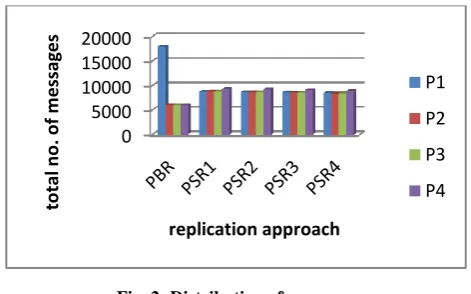
Figure 2 shows the distribution of messages on replicas in both PBR and PSR. A quick inspection for this graph revealed the balanced distribution of message for all replicas in PSR compared to imbalanced distribution in PBR approach. It’s obvious that in PBR approach that the primary (P1) is heavily
loaded by 18000 messages which represent 6000 lock requests, 6000 ok_lock, and 6000 update notifications, while other replicas are loaded only by 6000 messages which represent update notifications only since they do not receive any lock requests. On the other hand, in PSR each replica is loaded with approximately the same number of messages (9000), that is 6000 updates, around 1500 lock requests, and around 1500 ok_lock messages. This is because the primary role is distributed among all replicas.
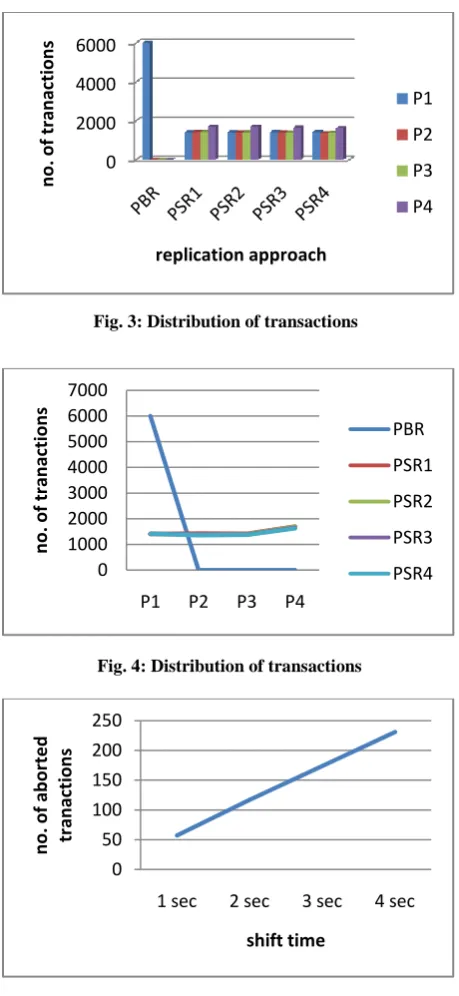
Figures 3 and 4 illustrate the distribution of transactions on all replicas in both approaches. The figures show that in PBR approach all 6000 transactions (2000 transactions for each object) are served by the primary replica (P1), while in PSR these transactions are distributed among all replicas (approximately 1500 transactions for each replica).
Figure 5 shows the number of aborted transactions as a function of the shift time. Intuitively, the number of aborted transactions increases as the shift time increases. This is due to the fact that no transactions are served during primary shift mode. Finally, it is worthy to mention that we have detected from 3 to 9 cases of forwarded lock requests from the old primary to the new primary or update notifications to the new primary inqueued since they arrived before the lock table is transferred. All of these cases are committed by the new primary.
In [15] Shirali et. al. computed the number of messages and the latency for a number of LEAs. In their results, the number of messages required to elect a new leader for 64 nodes was recorded from 128 to 176 messages. The latency ranges between from 3 to 128 time unit. In our system, we only need one message to transfer the lock_table regardless of the number of nodes in the system and the shift time is clearly much less than the recorded election time.
0 5000 10000 15000 20000
to
tal
n
o
. o
f m
e
ssag
e
s
replication approach
P1
P2
P3
P4
Rule 6:
𝒖𝒑𝒐𝒏 𝒆𝒗𝒆𝒏𝒕 < 𝑟𝑒𝑎𝑑𝑦() 𝑆𝑖 > 𝑑𝑜
[image:6.595.314.550.494.641.2]mode= normal
Fig. 2: Distribution of messages
5.
CONCLUSIONS
Traditionally, PBR systems employ Leader Election Algorithms (LEA) to recover from both planned and unplanned primary failures. During election, a replication system suffers from transaction loss, communication overhead and a notable delay time caused by the execution of LEA. In this paper, we introduced a novel protocol, called Primary Shift Replication (PSR), to manage the planned primary outages without using leader election protocol. The proposed approach shifts the primary role from the current primary to another scheduled node when a planned outage is about to occur. The no. of messages and communication time PSR is much less than the no. of messages and the election time in PBR, therefore, PSR improves systems availability.
Moreover, PSR guarantees no transactions loss during the shift mode, hence, it preserves data consistency. In the future, we plan to apply the PSR on mobile environments.
6.
REFERENCES
[1] N. Budhiraja, K. Marzullo, F. B. Schneider, and S. Toueg. 1993. The Primary-backup Approach. S. J. Mullender, editor, Distributed Systems, Addison-Wesley, (Chapter 8).
[2] Navin Budhiraja, Keith Marzullo. 1995. Tradeoffs in Implementing Primary-Backup Protocols. SPDP '95 Proceedings of the 7th IEEE Symposium on Parallel and Distributed Processing.
[3] Greg N. Frederickson and Nancy A. Lynch. 1987. Electing a Leader in a Synchronous Ring. J. ACM, 34(1):98–115.
[4] H. Garcia-Molina. Elections in a Distributed Computing System. 1982. IEEE Trans. Computers, 31(1):48–59.
[5] Suresh Singh and James F. Kurose. 1994. Electing Good Leaders. Journal of Parallel and Distributed Computing, Volume 21, Issue 2, pages 184–201.
[6] Scott D. Stoller. 2000. Leader election in asynchronous distributed systems. IEEE Transactions on Computers, 49(3):283–284.
[7]AL-Metwally Mostafa, Ilies Alouini. Fault Tolerant Global Store Module. (2004). http://www.mozart-oz.org/mogul/doc/metwally/globalstore/
[8] Valentin Mesaros , Raphaël Collet , Kevin Glynn , Peter Van Roy. 2005. A Transactional System for Structured Overlay Networks. Research Report RR2005-01, Universit´e catholique de Louvain, D´epartement INGI.
[9] E. Cecchet, G. Candea, and A. Ailamaki. 2008. Middleware-based Database Replication: The Gaps Between Theory and Practice. ACM SIGMOD Conference, Vancouver, Canada.
[10] Rachid Guerraoui and Luís Rodrigues. 2006. Introduction to Reliable Distributed Programming. Springer-Verlag Berlin Heidelberg.
[11] Y. Saito and M. Shapiro. 2002. Replication: Optimistic Approaches. Technical Report, Microsoft Research Ltd.
[12] W. Lang, J. Patel, and J. Naughton. 2009. On Energy Management Load Balancing and Replication. SIGMOD Record, Vol. 38, No, 4, 2009
[13] M. EffatParvar, N. Yazdani, Mehdi. EffatParvar, A. Dadlani, and A. Khonsari. 2010. Improved Algorithm for Leadership Election in Distributed Systems. 2nd International Conference on Computer Engineering and Technology.
[14] D.P. Gawali. 2012. Leader Election Problem in Distributed Algorithm. International Journal of Computer Science and Technology.
[15] Mina Shirali, Abolfazl HaghighatToroghi, and Mehdi Vojdani. 2008. Leader Election Algorithms: History and Novel schemes. Third 2008 International Conference on Convergence and Hybrid Information Technology.
[16] Robbert van Renesse and Fred B. Schneider. 2004. Chain Replication for Supporting High Throughput and Availability. In OSDI'04: Proceedings of the 6th conference on Symposium on Operating Systems Design 0
2000 4000 6000
n
o
. o
f tr
an
ac
tion
s
replication approach
P1
P2
P3
P4
0 1000 2000 3000 4000 5000 6000 7000
P1 P2 P3 P4
n
o
. o
f tr
an
ac
tion
s
PBR
PSR1
PSR2
PSR3
PSR4
0 50 100 150 200 250
1 sec 2 sec 3 sec 4 sec
n
o
. o
f ab
o
rte
d
tr
an
ac
tion
s
[image:7.595.54.284.66.565.2]shift time
Fig. 3: Distribution of transactions
Fig. 4: Distribution of transactions
48 & Implementation, Berkeley, CA, USA.
[17] Heutelbeck, D. and Hemmje, M. 2006. Distributed Leader Election in P2P Systems for Dynamic Sets. MDM, Page(s): 29 – 29.
[18] Zargarnataj, M. 2007. New Election Algorithm Based on Assistant in Distributed Systems”, AICCSA 07, Page(s):324 – 331.
[19] Summary of the Amazon EC2 and Amazon RDS Service Disruption in the US East Region. 2001. http://aws.amazon.com/message/65648/