A Topic-driven Summarization using K-mean
Clustering and Tf-Isf Sentence Ranking
Rajesh Wadhvani
Computer Science Department National Institute of TechnologyBhopal, India
R. K. Pateriya
Computer Science Department National Institute of TechnologyBhopal, India
Devshri Roy
Computer Science Department National Institute of TechnologyBhopal, India
ABSTRACT
Enormous online information is available due to the World Wide Web. This needed efficient and accurate summarization systems to extract significant information. Text summarization system auto-matically generates a summary of a given document and helps peo-ple to make effective decisions in less time. In this paper two meth-ods have been proposed for query-focused multi-document summa-rization that uses k-mean clustering, term-frequency and inverse-sentence-frequency method for sentence weighting to rank the sen-tences of the documents with respect to a given query. The pro-posed method finds the proximity of documents and query, and later uses this proximity to rank sentences of each document. It is as-sumed that the document which is nearer to a query might contain more meaning full sentences with respect to the information need expressed by user’s query further if a sentence contains rare query term than it is more informative than the sentences that contains fre-quent query term. Both methods first gives weights to documents according to their proximity and use these document weights to rank each of their sentences with tf-idf ranking function. A relative study for proposed methods has been done and experimental results shows that both methods are comparable because of a slight differ-ence in performance. DUC 2007 test dataset and ROUGH-1.5.5 summarization evaluation package is used for evaluation purpose.
General Terms:
Text summarization, Query-based summaries
Keywords:
Sentence Extraction, Document Clustering, F-score
1. INTRODUCTION
Summarizing the documents manually requires lots of efforts and time and thus it is very difficult. A technique is required where a computer program make a reduced version of a text while preserv-ing the content of the source, i.e, summarize document automati-cally. Automatic text summarization is not new. Work in this area originated in the 1950s, when the first breakthroughs were achieved by Luhn (1958). Despite this, most of the significant research in this area has been carried out in the last few years. The objective of automatic summarization is to take an information source, ex-tract content from it and supply the most important content to the
user in a condensed form, in a manner sensible to user’s or applica-tion’s need, see (Mani, 2001) for details. According to the function, a summary can be classified as generic or user-oriented. Generic summary present the authors viewpoint on the document. It consid-ers all the information in the document to create summary. More-over user-oriented summary consider only that information which is relevant to user query. Based on relationship that a summary has to the source document, a summary can be either abstract or ex-tract[1,2]. An extract involve selection of informaive sentences or paragraphs from source text in the summary. Moreover abstract in-volve the identification of salient concepts in the source document and rewrite them through natural language generation.
The notion of information retrieval is to locate documents that might contain the relevant information. Generally, when a user fires a query his desire is to locate relevant information rather than locate a ranked list of documents. The retrieved documents might contain the desire information and it leaves user with a massive amount of text. There is a requirement for a tool to shrink the amount of text in order to comprehend the complete text. The query focused summa-rization track at DUC aims at doing this. People often have ques-tions in their mind and they expect answers, as opposed to a set of documents as output. This motivated to focus on query based sum-marization. This paper proposed two methods for query-focused summarization based on tf-isf sentence weighting and also includ-ing the document weight to rank sentences. The thinkinclud-ing behind the document weighting is ”more closer the document to query the probability of its sentences close to query is high”. A relative for proposed methods has been done. The aim of document summa-rization is to find out the salient units of the document and rank these units according to their significance before giving the final summary to user. Automated system comprises different modules which are independent of each-other. Researcher and experts have categorized document summarization into three different stages [3]. The stages are
—Topic identification —Topic fusion
—Summary generation
the summary-length is used to form a summary. The topic identi-fication stage generates the simplest summary. On the lowest-level significant words are identified, weighted according to significance. On sentence-level, sentences are weighted according to occurrence of significant words. The words in sentence can be weighted by dif-ferent means such as word frequency, positional importance, cue words existence, words overlapping with heading, text connectiv-ity etc. InTopic fusionextracted coherent units are merged and insignificant content of text are removed.Summary generation phaseproduces the final summary based on earlier two phases in human readable form. The aim of all these phases are to conserve the salient features of original document before producing and pre-senting the relevant information to user.
This paper is organized as follows. Literature review is presented in Section 2, this chapter gives an account of previous works done in the area of text summarization. Description of the proposed work is given in Section 3, this chapter provides the detail of system ar-chitecture. It also explains the proposed work in detail. Section 4 provides the description of tools used for evaluation and also gives the detail of evaluation metrics used for evaluation purpose. Section 5 is Result and Analysis which provides the results obtained by the proposed methods. The experimental result shows the accuracy of the methods using precision, recall and F-score measures. Section 6 is the conclusion and section 7 is limitation.
2. RELATED WORK
Text comprises of paragraphs, sentences and the smallest unit is word. In literature, researchers have broken the text into number of paragraphs and sentences to achieve better performance of summa-rization system. The performance of these systems have been stud-ied in number of papers using various techniques such as statistical, graph-based, machine learning, cluster based etc. In the literature of automated text summarization varieties of approaches, either ex-tractive [1,2] or absex-tractive, have been proposed. Understanding of contents, reformulation and sentence-compression is done while abstraction [4,5] where as the sentences of text are ranked and important ones are picked-up in extraction. In extractive summa-rization, sentence/paragraph ranking [6,7,8] is the centre of atten-tion; various methods are used to rank sentences/paragraphs. In [6], compare the effectiveness of paragraph, word, and coherence based sentence ranking approaches. The best performance was accom-plished by coherence based approaches. In query-based summa-rization most sentence ranking methods are based on a usual match-ing between query and sentences. The job of the query words and the named entities seemed in the query were exclusively empha-sized in [9,10]. In [11], a topic-sensitive version of PageRank was proposed to incorporate the relevance of a sentence to the query into LexRank to get a biased PageRank ranking. The sentence-ranking score obtained by this process pointed the query biased informa-tiveness of the sentence and sentences with high ranks are selected to form the summary. In [12], regression models are employed to focus query in multi-document summarization.
3. PROPOSED MODEL
Query-based multi-document summarization generates the sum-mary by extracting a proper set of informative sentences from multiple text units based on the information need presented in query. This chapter proposes two methods for query-based multi-document summarization that uses k-mean clustering for multi-document weighting and term frequency and inverse sentence frequency for
weighting the query-term to rank the sentences of the documents with respect to a given query. These two methods are:
—ISF-D Method: Inverse-Sentence-Frequency at Document level.
—ISF-C Method:Inverse-Sentence-Frequency atCorpus level.
The ISF-D method provide tf-isf weight to query-terms at docu-ment level. In this query terms get different weights for each doc-ument associated with query where as ISF-C method provide the tf-isf weight at corpus level. These methods finds the proximity of documents and query, and provide a normalize weight to each document associated with a single query and later uses this weight to rank sentences of each document. Proposed methods takes ad-vantage of the fact that the more closer the document to query, the likelihood of its sentences to be close to query is higher, both meth-ods first give weights to query-terms, then documents according to their proximity with the query and later use both weights to rank each sentence from the multi-document set.
Both methods have five phases, which are as following:
(1) Preprocessing phase (2) Query-terms weighting phase (3) Document weighting phase (4) Sentence weighting phase (5) Summary generation phase
Phases first, third and five are common where as there is a slight difference in second and fourth phase in case of two methods.
3.1 Preprocessing phase
Preprocessing phase is divided into two phases; a cleaning phase and document presentation phase. The preprocessing phase is com-mon for both the proposed methods.
(1) Cleaning phase:This phase is for both query and documents. In this phase we remove stop words and special symbols like punctuation marks. To remove stop words we use two methods; first method removes stop-words by setting the minimum word length to three and the second method uses a precompiled list of stop words to remove them.
(2) Document presentation phase:After the raw files are pre-pared, these are passed through a structuring phase, where in all the files are structured into one unique term verses para-graph matrix. Each document Dm consist of different sen-tences named ass1, s2, ...., sn where each paragraph is
col-lection of m unique termst1, t2, t3, ...tm.
3.2 Query-terms weighting
The two proposed methods differ in this phase. Before calculating the weight for each method, term frequency is calculated, It measures the importance of a term within a document. A document or zone that mentions a query term more often has more to do with that query. Therefore weight of index term should consider term frequency. Number of occurrences of term within document is known as raw term frequency, but it is not what we want because relevance does not increase proportionally with raw term frequency.
can’t distinguish sentences therefore a low weight is assigned to it. Moreover if a query is rare a higher weight is assigned to it.
Some set notations are used are following:
Q={q1, q2, q3...qm}is set of unique query-terms.
D = {d1, d2, d3...dn} is set of documents associated with
query.
S = {s1,1, s2,1, ..., sj,1},{s1,2, s2,2, ..., sk,2},... ,{s1,n, s2,n, ..., sl,n} is the set of sets, and each set is the
sentence collection per document that is,sl,nis thelthsentence of
document n.
Based on the term frequency and inverse sentence frequency query terms are weighted using ISF-C and ISF-D methods as follows.
(1) Inverse-Sentence-Frequency atCorpus level (ISF-C)
The ISF-C method provide tf-isf weight to query terms at corpus level.
(a) For each sentencesl,n,do,
(b) For each query-term,qm, do,
i. Calculate log(tf) forqm,get term-frequency (tf) ofqm
from,sl,nsentence-count vector.
log(tfqm) = 1 + log10(count of qmf rom sl,n)
(1) ii. Calculate inverse-sentence-frequency forqmusing :
isf−Cqm =log10(N/sfqm) (2)
where N is total number of sentences in corpus and
sfqmis total number of sentences in whichqmoccur
within corpus.
iii. Calculate final query-term weight,w(qm)
ISF CWqm= log(tfqm)∗isf−Cqm (3)
where, ISF CWqm is weight of qm using ISF-C
method.
(2) Inverse-Sentence-Frequency atDocument level (ISF-D)
The ISF-D method provide tf-isf weight to query terms at document level. In this query terms get different weights for each document associated with query.
(a) For each sentencesl,n, do,
(b) For each query-term,qm, do,
i. Calculate log(tf) forqm, get term-frequency (tf) ofqm
from,sl,nsentence-count vector.
log(tfqm) = 1 + log10(count of qmf rom sl,n)
(4) ii. Calculate inverse-sentence-frequency forqmusing :
isf−Dqm =log10(N/sfqm) (5)
where N is total number of sentences in documentdn
andsfqm is total number of sentences in whichqm
occur withindn.
iii. Calculate final query-term weight,w(qm)
ISF DWqm= log(tfqm)∗isf−Dqm (6)
where, ISF DWqm is weight of qm using ISF-D
method.
3.3 Document weighting phase
Author writes a document to represent an idea, an event, and a con-cept moreover a theme. Directly or indirectly all the sentences of documents circumnavigates around author’s viewpoint. Therefore it is assumed that document is a cluster of similar sentences. Hence-forth the document shall be interchangeable used as cluster espe-cially in document weighting phase. For document weighting k-mean clustering is used; k-k-means clustering is a technique of clus-ter analysis with the aim of partition n objects into k clusclus-ters in which each object belongs to the cluster with the closest centroid (mean). For document-weighting, previously calculated, sentence-weight vector is converted into normalized sentence sentence-weight vector that is a unit-vector. Similarly query-count-vector is also converted into unit-vector. so form nowsl,nis sentence unit vector oflth
sen-tence of documentdn.
Further we use vector space model and map each document and a query into that vector-space. The number of dimensions for vec-tor space model is the cardinality of set Q (|Q|) that is number of unique query terms and query terms are dimensions. Each docu-mentdifrom D is mapped, by mapping the sentence-unit-vector of
each sentence, in|Q|-dimension vector space and in the same way query is mapped by mapping query unit vector. A specific docu-ment weight is calculated by following steps:
(1) Find centroid for each documentdi, which is a mean of each
sentence unit vector.
C(di) =
Xsl,i
n (7)
Where,C(di)is the centroid of documentdi andSl,i is the
sentence-unit-vector oflthsentence of documentd
iand, n is
the total number of sentences representingdiin|Q|-dimension
vector space.
(2) Find out the Euclidean distance (ed) between centroid of each documentdiand the query to measure the proximity between
documentdiand the query by:
edi(C(di), q) =
p
(C(d1)−q1)2+...+ (C(di)−qi)2
(8) The one more option here, we have that calculate proximity betweendiand a query by using cosine-similarity between the
centroid ofdiand the query. The result of this step is the
Eu-clidean distance (edi) between centroid of each documentdi
and the query.
(3) Calculate a normalized weight for each documentdiby,
w(di) =
edi
P
edi
(9)
Where,w(di ) is the normalized weight for documentdi,edi
is the euclidean distance betweendiand the query. The result
of this phase is the document-weight w(di) for each document
3.4 Sentence weighting phase
Weight calculated from the second phase and third phase, for each query-term using ISF-D , ISF-C method and document-weight (di
). To calculate sentence weight for each query-corpus sentence fol-lowing steps are used:
(1) Sum all the query-terms weight found in sentenceSl,n.
(2) Multiply corresponding document weight w(di).
(a) Calculate sentence-weight using query-terms weight cal-culated byISF-Dand document-weight (di):
ISF DW(sl,n) = (
X
qmsl,n
ISF DW(qm))∗w(dn) (10)
Where,ISF DWsl,nis the weight ofl
thsentence of
doc-ument n using ISF-D method.Sl,nis thelthsentence of
document (di).
(b) Calculate sentence-weight using query-terms weight cal-culated byISF-Cand document-weight (di):
ISF CW(sl,n) = (
X
qmsl,n
ISF CW(qm))∗w(dn) (11)
Where,ISF CWsl,nis the weight ofl
thsentence of
doc-ument n using ISF-C method.Sl,nis thelthsentence of
document (di).
Every sentence of the corpus now have some for both ISF-D and ISF-C method. List them into decreasing order.
3.5 Summary generation phase
From the decreasing rank list of sentences, choose a top-rank sen-tence and add to the summary for both ISF-D and ISF-C, repeat the step till summary-length reach up to 250 words. Before adding a new sentence in summary we also take care of redundancy by not including already added sentence. We have two summaries one for ISF-D method and other is for ISF-C method.
4. EXPERIMENTAL SETUP
[image:4.595.316.566.511.673.2](i) Test Dataset:For evaluation DUC-2007 dataset is used[13]. There are 45 topics in the dataset and for each topic a set of 25 relevant documents are given. Each DUC topic comprises of four part; document set number, title of topic, narration and the list of document associated with topic. In this paper, the narration part of topic is used to frame the query. Table 1 shows the description of DUC-2007 dataset.
Table 1. Dataset description
Dataset description DUC-2007 dataset
Number of topics 45 Number of collections 45 Number of documents per collections 25 Total number of documents in dataset 45∗25
Summary Length 250 words
(ii) Evaluation Metrics:The standard practice in the field of sum-marization is to have a standard reference summary based on the queries. The summaries are manually generated by human experts.
The automated summaries are then compared with the human gen-erated summaries evaluation results are normally obtained by the ROUGE (Recall-Oriented Understudy for Gisting Evaluation). It is a summary evaluation package for judging the performance of the summarization system. The ROUGE summary evaluation pack-age[14] is written in Perl.To evaluate the accuracy and relevance of the automated summary with respect to the expert summaries, three metrics are used :
(1) Recall (2) Precision (3) F-score
F-measure [3] is a measure of a system’s summary accuracy. It con-siders both the precision p and the recall r of the system’s summary to compute the score. Precision reflects how many of the system’s extracted sentences were relevant, and Recall reflects how many relevant sentences the system missed.
Given an input text, a expert’s summary, and a automated summary, these scores inform us by quantifying that how closely the system’s summary corresponds to the human one. For each unit, we let cor-rect = the number of sentences extracted by the system and the hu-man; wrong = the number of sentences extracted by the system but not by the human; and missed = the number of sentences extracted by the human but not by the system. Then
P recision=correct/(correct+wrong)
Recall=correct/(correct+missed)
F−Score=(1+Recallβ2)Recall+β2P reicision∗P recision
Where,Fβ”measures the effectiveness of system’s summary with
respect to a user who attachesβtimes as much importance to recall as precision”.
5. RESULT AND ANALYSIS
[image:4.595.67.276.578.647.2]The DUC topic and a set of 25 relevant documents are used for performing the experiment. The two proposed methods are used to create a brief, well-ordered, summary to answer the need for infor-mation expressed in the topic statement, actually narration part of topic is used as query for summarization purpose. The sentences are ranked using proposed sentence ranking techniques and top ranked sentences are collected before finally delivering the summary based on query. The summary contains 250 words only.
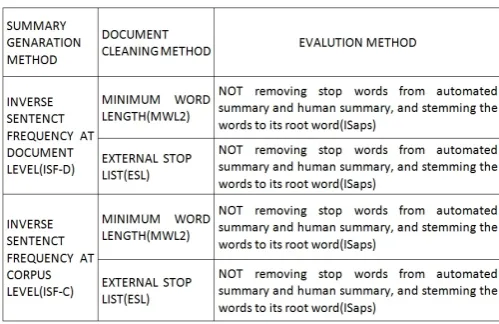
Figure 1 shows description of evaluation methods used for evaluation purpose. By default ROUGE include stopwords in (Avg Recall, Avg Precision and Avg F-score) score calculation and stemming of words not perform, to remove stopwords from au-tomated summary and human summary (reference summary), use ROUGE parameter -s and to perform word-stemming use ROUGE parameter -m. ROUGE uses Porter stemmer for word stemming.
Experiment 1: Generate summary for each available topic in the test dataset using ISF-C with MWL2 (Minimum word length 2) cleaning method, Pseudo code as:
Data: A DUC topic. Result: 250 words summary.
(1) Preprocess each document and query by settingMinimum WordLength2(MWL2).
(2) Weigth each query term using ISF-C method. (3) Weight each document using k-mean clustering.
(4) Rank sentences of each document using weight calculated in Step 2 and Step 3, in decreasing weight order.
(5) Select one by one top sentences till summary-length does not exceed 250 words.
[image:5.595.318.561.217.614.2]The automated summaries are compared with the available refer-ence summaries and evaluation results are obtained by the ROUGE (Recall-Oriented Understudy for Gisting Evaluation) summary evaluation package for judging the performance of the summariza-tion system. To compute ROUGE-Scores, ROUGE-1.5.5 will be run with the following parameters :
Table 2.
Evaluation Method Average R Average P Average F
ROUGE-1 0.36986 0.40334 0.38520 ROUGE-2 0.07493 0.07923 0.07690 ROUGE-3 0.02377 0.02507 0.02571 ROUGE-4 0.01179 0.01245 0.01210 ROUGE-L 0.33662 0.35651 0.34576 ROUGE-W-1.2 0.09671 0.19048 0.12809 ROUGE-S* 0.12908 0.15326 0.13921 ROUGE-SU* 0.13098 0.15542 0.14123
Fig. 2. Evaluation results of ISF-C method with MWL2 and ISaPs.
ROUGE-1.5.5.pl -n 4 -2 -1 -U -c 95 -r 1000 -f A -p0.5 -t 0 -s settings.xml Where, settings.xml is a xml file for specifying system summaries and corresponding reference summaries locations.
The performance of method with respect to the ROUGE-1 evaluation- in case of Average R, Average P, Average F has gone up 0.36986, 0.40334, 0.38520 respectively.
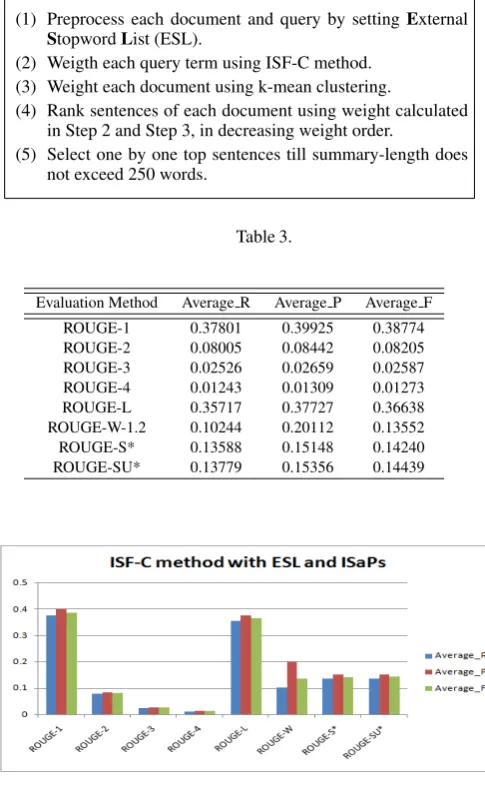
Experiment 2: Generate summary for each available topic in the test dataset using ISF-C with ESL (External Stopword List) cleaning method, Pseudo code as:
Data: A DUC topic. Result: 250 words summary.
(1) Preprocess each document and query by settingExternal StopwordList (ESL).
(2) Weigth each query term using ISF-C method. (3) Weight each document using k-mean clustering.
(4) Rank sentences of each document using weight calculated in Step 2 and Step 3, in decreasing weight order.
(5) Select one by one top sentences till summary-length does not exceed 250 words.
Table 3.
Evaluation Method Average R Average P Average F
ROUGE-1 0.37801 0.39925 0.38774 ROUGE-2 0.08005 0.08442 0.08205 ROUGE-3 0.02526 0.02659 0.02587 ROUGE-4 0.01243 0.01309 0.01273 ROUGE-L 0.35717 0.37727 0.36638 ROUGE-W-1.2 0.10244 0.20112 0.13552 ROUGE-S* 0.13588 0.15148 0.14240 ROUGE-SU* 0.13779 0.15356 0.14439
Fig. 3. Evaluation results of ISF-C method with ESL and ISaPs.
[image:5.595.54.303.418.671.2]Experiment 3: Generate summary for each available topic in the test dataset using ISF-D with MWL2 (Minimum word length 2) cleaning method, Pseudo code as:
Data: A DUC topic. Result: 250 words summary.
(1) Preprocess each document and query by settingMinimum WordLength2(MWL2).
(2) Weigth each query term using ISF-D method. (3) Weight each document using k-mean clustering.
(4) Rank sentences of each document using weight calculated in Step 2 and Step 3, in decreasing weight order.
(5) Select one by one top sentences till summary-length does not exceed 250 words.
Table 4.
Evaluation Method Average R Average P Average F
[image:6.595.320.561.85.474.2]ROUGE-1 0.36850 0.40840 0.38693 ROUGE-2 0.08242 0.09118 0.08646 ROUGE-3 0.02791 0.03084 0.02926 ROUGE-4 0.01484 0.01641 0.01556 ROUGE-L 0.34929 0.38709 0.36675 ROUGE-W-1.2 0.10062 0.20750 0.13535 ROUGE-S* 0.12848 0.15668 0.14044 ROUGE-SU* 0.13038 0.15888 0.14248
Fig. 4. Evaluation results of ISF-D Method With MWL2 and IS-aPs.
The performance of method with respect to the ROUGE-1 evaluation- in case of Average R, Average P, Average F has gone up 0.36850, 0.40840, 0.38693 respectively.
Experiment 4: Generate summary for each available topic in the test dataset using ISF-D with ESL (External Stopword List) clean-ing method, Pseudo code as:
Data: A DUC topic. Result: 250 words summary.
(1) Preprocess each document and query by settingExternal StopwordList (ESL).
(2) Weigth each query term using ISF-D method. (3) Weight each document using k-mean clustering.
(4) Rank sentences of each document using weight calculated in Step 2 and Step 3, in decreasing weight order.
(5) Select one by one top sentences till summary-length does not exceed 250 words.
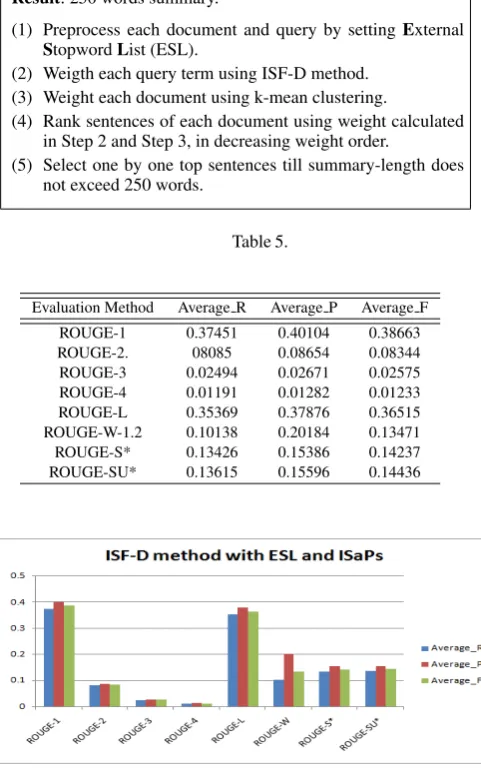
Table 5.
Evaluation Method Average R Average P Average F
ROUGE-1 0.37451 0.40104 0.38663 ROUGE-2. 08085 0.08654 0.08344 ROUGE-3 0.02494 0.02671 0.02575 ROUGE-4 0.01191 0.01282 0.01233 ROUGE-L 0.35369 0.37876 0.36515 ROUGE-W-1.2 0.10138 0.20184 0.13471 ROUGE-S* 0.13426 0.15386 0.14237 ROUGE-SU* 0.13615 0.15596 0.14436
Fig. 5. Evaluation results of ISF-D Method With ESL and Wo-SaWoSt.
The performance of method with respect to the ROUGE-1 evaluation- in case of Average R, Average P, Average F has gone up 0.37451, 0.40104, 0.38663 respectively.
6. CONCLUSION
[image:6.595.63.383.101.568.2]a need to further improve performance of existing system by incor-porating few other techniques. Initial system performance is fairly well.
7. LIMITATION:
If query terms are abbreviated in the document’s sentences then the summarizer shall not be able to extract it even though it might be quite relevant in the context of summary.
8. REFERENCES
[1] Vishal Gupta, Gurpreet Singh Lehal, ”A Survey of Text Sum-marization Extractive Techniques”, Journal of Emerging Tech-nologies in web Intelligence, Vol. 2, No. 3, 2010.
[2] K. Knight and D.Marcu, ”Summarization beyond sentence ex-traction: a probablistic approach to sentence compression”, Artefcial Intelligence, pages 91-107, 2002 Elsevier Science. [3] Eduard Hovy, ”Text Summarization”, In R. Mitkov Ed.The
Oxford Hand-book of Computational Linguistics, chapter 32 (2005) 583-598.
[4] D. Zajic, B. J. Dorr, J. Lin, and R. Schwartz, ”Multi-candidate reduction: Sentence compression as a tool for document sum-marization tasks” , Inf. Process. Manage, Volume 43, pp. 1549-1570, November 2007.
[5] H. Daume, D. Marcu, ”A noisy-channel model for document-compression”, In proceedings of the 40th Annual Meeting on Association for Computational Linguistics, Ser. ACL 02. Stroudsburg, PA, USA:Association for Computational Linguis-tics, pp. 449-456, 2002.
[6] Florian Wolf, Edward Gibson, ”Paragraph-, word-, and coherence-based approaches to sentence ranking: a compari-son of algorithm and human performance”, In proceedings of the 42nd Annual Meeting on Association for Computational Linguistics, ACL ’04, Article No. 383, 2004.
[7] Heng-Hui Liu, Yi-Ting Huang , Jung-Hsien Chiang, ”A study on paragraph ranking and recommendation by topic informa-tion retrieval from biomedical literature”, In proceeding of the International Conference on Computer Symposium (ICS), 2010, pp. 859-864, Dec. 2010.
[8] Laszlo Grunfeld, Kui-Lam Kwok, ”Sentence Ranking Using Keywords And Meta-Keywords”, Publisher Springer Nether-lands, Volume 32, pp 229-258,2006.
[9] H. Saggion, K. Bontcheva, and H. Cunningham, ”Robust generic and query based summarization”, In proceedings EACL Conf., pp. 235-238, 2003.
[10] J. Ge, X. Huang, and L.Wu, ”Approaches to event-focused summarization based on named entities and query words”, In proceedings of the 27th annual international ACM SIGIR con-ference on Research and development in information retrieval, pp. 281-288, 2004.
[11] J. M. Conroy and J. D. Schlesinger, ”CLASSY query-based multi-document summarization” In proceedings of the Docu-ment Understanding Conf. Wksp. 2005 (DUC 2005) at the Hu-man Language Technology Conf./Conf. on Empirical Methods in Natural Language Processing (HLT/EMNLP).
[12] You Ouyanga, Wenjie Lia, Qin Lua, ”Applying regression models to query-focused multi-document summarization”, In Information Processing and Management volume 47, issue 2, pp 227237, March 2011.
[13] DUC. Document understanding conference 2007 (2007), http://www-nlpir.nist.gov/projects/duc.