http://dx.doi.org/10.4236/am.2014.59125
Application of Operational Approaches to
Solving Decision Making Problem Using
Z-Numbers
Latafat A. Gardashova
Department of Computer-Aided Control Systems, Azerbaijan State Oil Academy, Baku, Azerbaijan Email: [email protected]
Received 28 February 2014; revised 28 March 2014; accepted 4 April 2014 Copyright © 2014 by author and Scientific Research Publishing Inc.
This work is licensed under the Creative Commons Attribution International License (CC BY). http://creativecommons.org/licenses/by/4.0/
Abstract
The combination of fuzzy logic tools and multi-criteria decision making has a great relevance in literature. Compared with the classical fuzzy number, Z-number has more ability to describe the human knowledge. It can describe both restraint and reliability. Prof. L. Zadeh introduced the concept of Z-numbers to describe the uncertain information which is a more generalized notion closely related to reliability. Use of Z-information is more adequate and intuitively meaningful for formalizing information of a decision making problem. In this paper, Z-number is applied to solve multi-criteria decision making problem. In this paper, we consider two approaches to decision making with Z-information. The first approach is based on converting the Z-numbers to crisp number to determine the priority weight of each alternative. The second approach is based on Expected utility theory by using Z-numbers. To illustrate a validity of suggested approaches to de-cision making with Z-information the numerical examples have been used.
Keywords
Z-Number, Decision Making, Fuzzy Set, Z-Number Based Expected Utility, Fuzzy Probability, A Priority Weight, Alternatives
1. Introduction
In such cases, linguistic assessments are alternatively used instead of numerical values to express preference [1]-[3]. In [4] a new characterization of consistency based on the additive transitivity property of fuzzy prefe-rence relations has been proposed. This new characterization allows us to easily check the consistency between the experts’ opinions. Experts’ opinions are represented by using if-then rules. In [5] one of the knowledge dis-covery approach-linguistic summarization [6]-[8] approach to generate if-then rules for causal databases is pro-posed. Both type-1 and interval type-2 fuzzy sets are considered. In a lot of technical literature [9]-[13] five- quality measures—the degree of truth, sufficient coverage, reliability, outlier and simplicity are defined. Among them the degree of reliability is especially valuable for finding the most reliable and representative rules.
In [14] Zadeh introduced the concept of Z-numbers to describe the uncertain information which is a more ge-neralized notion. A Z-number is an ordered pair of fuzzy numbers
( )
A B , . Here A is a value of some variable and B represents an idea of certainty or other closely related concept such as sureness, confidence, reliability, strength of truth, or probability. It should be noted that in everyday decision making most decisions are in the form of Z-numbers. Zadeh suggests some operations for computation with Z-numbers, using the extension prin-ciple. On Z-valuation using Zadeh’s Z-numbers problem is discussed in [15] by R. Yager. It was shown how to use these Z-numbers to provide information about an uncertain variable in the form of Z-valuations, assuming that this uncertain variable is random. Yager offers an illustration of a Z-valuation, showing how to make deci-sions and answer questions. It has also been discussed the relationship between Z-numbers and linguistic sum-maries [16]. Author of [15] has provided for a representation of Z-valuations in terms Dempster-Shafer belief structures [17], that made use of type-2 fuzzy sets. In [18] a method of converting Z-number to classical fuzzy number has been discussed. Decision making using Z-numbers under Uncertain Environment is discussed in [19]. Authors for solving multi-criteria decision making problem using Z-numbers have converted Z-numbers to clas-sical fuzzy number and a priority weight of each alternative is determined.The paper is organized as follows. Section 2 discusses required definitions. The algorithm of proposed de-cision making method is presented in Section 3. Description of portfolio selection-real-life business problem and the experimental results of calculations are described in Section 4. Section 5 gives basic steps of the op-erational approach (OA) to solving the problem selection of a vehicle. The conclusion is presented in Section 6.
2. Mathematical Definition and Notation
Definition 1. A Z-number [14]A Z-number is an ordered pair of fuzzy numbers,
( )
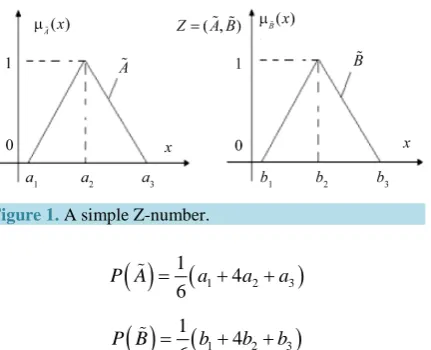
A B , . A is a fuzzy restriction on the values which a real-valued uncertain variable is allowed to take. B is a measure of reliability of the first component (Figure 1).Definition 2 [9]. A triangular fuzzy number A can be defined by a a triplet
(
a a a1, 2, 3)
, where the mem-bership can be determined as the following equation:( )
[
]
[
]
[
]
[
]
1
1 2
2 3
3 0, ,
-, ,
, ,
0, ,
1
2 1
A
3
3 2
x a
x a
x a a a a
x
a x
x a a a a
x a µ
∈ −∞
∈
− = −
∈
−
∈ +∞
Definition 3 [9]. A fuzzy set A is defined on a universe X may be given as:
( )
(
)
{
, A}
A= x µ x x∈X
where µA:X →
[ ]
0,1 is the membership function. A membership value µA( )
x describes the degree of be-longingness of x∈X in A.Figure 1. A simple Z-number.
( )
(
1 2 3)
14 6
P A = a + a +a
( )
(
1 2 3)
1 4 6
P B = b + b +b
The canonical representation of the multiplication operation on triangular fuzzy numbers A and B is de-fined as:
(
) ( )
( )
(
1 2 3)(
1 2 3)
1
4 4
36
P A⊗B =P A P B = a + a +a b + b +b
Definition 5 [19]. The priority weight of each alternative can be defined as follows:
( )
( )
priority=
∑
w Za w Zfwhere Za is the weight of the criteria, and Zj is the value of each criteria.
Definition 6. Sum of two independent normal random variables [21]. Let X and Y be two independent normal random variables with probability density functions
( )
(
)
2 2 1 , 2 2π X X X X x mp x e
σ σ
− −
= and
( )
(
)
2 2 1 , 2 2π Y Y Y Y y m
p y e
σ σ
− −
= respectively. The sum Z = X + Y of X
and Y is a random variable whose density function pZ is defined as follows:
( )
(
)
( ) ( )(
)
2 2 2 2 2 2 1 e 2π x Y X Y z m mZ
X Y
p z σ σ
σ σ − + − + = +
Definition 7. Product of two normal density functions. The product p12
( )
x = p x p1( ) ( )
2 x of two densityfunctions
( )
(
)
2 1 1 2 1 1 1 , 2 2π x m
p x e
σ σ
− −
= and
( )
(
)
2 2 2 2 2 2 1 2 2π x m
p x e
σ σ
− −
= is a normal density function with
mean and variance given by
2 2
1 2 2 1
12 2 2
2 1
m m
m
σ
σ
σ
σ
+ = + 2 2 1 212 2 2
1 2
σ σ
σ
σ
σ
= +For simplicity we will denote
( )
(
)
2 2 1 , 2 2π x m
p x e
σ σ
− −
= as p m
(
,σ)
.Definition 8. Fuzzy probability [22] [23]. Let a discrete random variable S takes a value from the set
{
S1,,Sn}
. The fuzzy numbers( )
[ ]1 0,1
i
P S ∈E are called the fuzzy probabilities of S if for any
( )
( )
1 , 2
i i i
p ∈ Pα S Pα S there exist p1 P1
( )
S1 ,P2( )
S1 , ,pi 1 P1( )
Si 1 ,P2( )
Si 1α α α α
− − −
( )
( )
( )
( )
1 1 1 , 2 1 , , 1 , 2
i i i n m m
p+ ∈Pα S+ Pα S+ p ∈Pα S Pα S such that
1
1
n
i i
p
=
=
∑
where P1
( )
Si ,P2( )
Siα α
is an α-cut of a fuzzy number P S
( )
i ∈E[ ]10,1, 1,i= , .m3. Algorithm of Decision Making Method Using Z-Numbers
Algorithm of decision making method using Z-numbers under uncertain environment is as follows: Step 1. Construct the fuzzy decision making matrix for decision making problem.
Step 2. Transform the linguistic value to numerical value. Step 3. Normalize the fuzzy decision making matrix. Step 4. Convert the Z-numbers to crisp number.
Step 5. Determine the priority weight of each alternative.
4. Statement of the Decision Problem
As it is known, portfolio selection problem is one of standard and most important problems in investment and financial research fields. Portfolio selection—real-life business problem is characterized by the following three conditions:
1. Economy declines; 2. No change; 3. Economy expands.
Let us give formal description of the portfolio selection problem as a problem of decision making with impre-cise probabilities described as Z-numbers.
1) State of nature. States of nature are represented by the three economic conditions. During the portfolio se-lection it is very important to properly identify the economic condition. Taking this into account it is adequately to describe the economic condition by using Z-numbers. The set of states of nature S=
{
s s s1, 2, 3}
described Z-numbers areEconomy declines—s1: Z P s
(
( )
1 ,B1)
=Z(
low, very high ;)
No change—s2:Z P s (
( )
2 ,B1)
=Z(
middle, very high ;)
Economy expands—s3: Z P s
(
( )
3 ,B1)
=Z(
very low, very high .)
2) Alternatives.Alternatives are represented by the three acts (selection A, B, C). 3) Utilities.
Utility of an alternativesfor each state is described by Z-numbes. So, we will formulate portfolio selection method by using Z-numbers as a determination of the priority weight of each alternative.
Portfolio Selection—Real-Life Business Problem
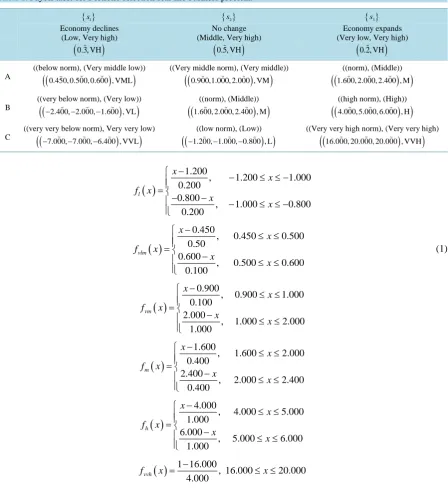
Here we give an example portfolio selection—real-life business problem. An investor has a certain amount of money available to invest now. Three alternative portfolio selections are available. The estimated profits of each portfolio under each economic condition are indicated in the following payoff Table 1 by using Z-valuation: Let A be a fuzzy set of the universe of discourse X subjectively defined as follow:
( )
6.400, 7.000 6.400
0.600
vvh
x
f x =− − − ≤ ≤ −x
( )
2.400
, 2.400 2.000 0.400
1.600
, 2.000 1.600 0.400
vl
x
x f x
x
x
−
− ≤ ≤ −
= − −
− ≤ ≤ −
Table 1.Payoff table for Portfolio selection-real-life business problem.
{ }s1 Economy declines
(Low, Very high)
(
0.3, VH)
{ }s2 No change (Middle, Very high)
(
0.5, VH)
{ }s3 Economy expands (Very low, Very high)
(
0.2, VH)
A
((below norm), (Very middle low))
(
)
(
0.450, 0.500, 0.600 , VML )
((Very middle norm), (Very middle))
(
)
(
0.900,1.000, 2.000 , VM )
((norm), (Middle))
(
)
(
1.600, 2.000, 2.400 , M )
B
((very below norm), (Very low))
(
)
(
−2.400, 2.000, 1.600 , VL − − )
((norm), (Middle))
(
)
(
1.600, 2.000, 2.400 , M )
((high norm), (High))
(
)
(
4.000, 5.000, 6.000 , H )
C
((very very below norm), Very very low)
(
)
(
−7.000, 7.000, 6.400 , VVL − − )
((low norm), (Low))
(
)
(
−1.200, 1.000, 0.800 , L − − )
((Very very high norm), (Very very high)
(
)
(
16.000, 20.000, 20.000 , VVH )
( )
1.200
, 1.200 1.000 0.200
0.800
, 1.000 0.800 0.200 l x x f x x x − − ≤ ≤ − = − − − ≤ ≤ −
( )
0.450, 0.450 0.500 0.50
0.600
, 0.500 0.600 0.100 vlm x x f x x x − ≤ ≤ = − ≤ ≤ (1)
( )
0.900, 0.900 1.000 0.100
2.000
, 1.000 2.000 1.000 vm x x f x x x − ≤ ≤ = − ≤ ≤
( )
1.600, 1.600 2.000 0.400
2.400
, 2.000 2.400 0.400 m x x f x x x − ≤ ≤ = − ≤ ≤
( )
4.000, 4.000 5.000 1.000
6.000
, 5.000 6.000 1.000 h x x f x x x − ≤ ≤ = − ≤ ≤
( )
1 16.000, 16.000 20.000 4.000
vvh
f x = − ≤ ≤x
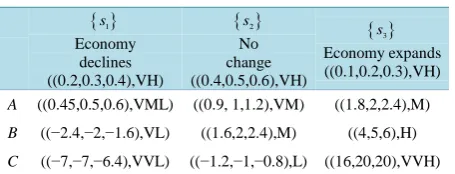
where fvvl, , , , , , , fvl f fl vlm fvm fm fh fvvh are the membership functions of the fuzzy sets. Fuzzy restriction part of Z-numbers by Scale data is given as Table 2:
The problem is to determine portfolio selection. On the basis of his own past experience, the investor assigns the following probabilities to each economic condition:
(
economy declines) {
low; very high} (
(
0.2, 0.3, 0.4 , 0.8,1,1 ;) (
)
)
P = =
(
No change) {
middle; very high} (
(
0.4, 0.5, 0.6 , 0.8,1,1 ;) (
)
)
P = =
(
Economy expands) {
very low; very high} (
(
0.1, 0.2, 0.3 , 0.8,1,1 .) (
)
)
P = =
Table 2.Scale data.
{ }s1 Economy
declines ((0.2,0.3,0.4),VH)
{ }s2 No change ((0.4,0.5,0.6),VH)
{ }s3 Economy expands ((0.1,0.2,0.3),VH)
A ((0.45,0.5,0.6),VML) ((0.9, 1,1.2),VM) ((1.8,2,2.4),M)
B ((−2.4,−2,−1.6),VL) ((1.6,2,2.4),M) ((4,5,6),H)
C ((−7,−7,−6.4),VVL) ((−1.2,−1,−0.8),L) ((16,20,20),VVH)
Alternative 1: Z A
( )
=(
(
(
0.45, 0.5, 0.6 , VML ; 0.9,1,1.2 , VM ; 1.8, 2, 2.4 , M .)
)
(
(
)
)
(
(
)
)
)
Alternative 2: Z B( )
=(
(
(
−2.4, 2, 1.6 , VL ; 1.6, 2, 2.4 , M ; 4, 5, 6 , H .− −)
)
(
(
)
)
(
(
)
)
)
Alternative 3: Z C
( )
=(
(
(
− − −7, 7, 6.4 , VVL ;)
)
(
(
−1.2, 1, 0.8 , L ; 16, 20, 20 , VVH .− −)
)
(
(
)
)
)
Take the three main criteria (Economy declines, No change, Economy expands) into consideration.At second step according to the membership function denoted by Equation (1) the linguistic variable can be converted to numerical value.
Decision variables with numerical values is described as the following form:
( ) (
1(
0.2, 0.3, 0.4 , 0.8,1,1 ;) (
)
)
Z s =
( ) (
2(
0.4, 0.5, 0.6 , 0.8,1,1 ;) (
)
)
Z s =
( ) (
3(
0.1, 0.2, 0.3 , 0.8,1,1 ;) (
)
)
Z s =
( )
s1(
(
0.45, 0.5, 0.6 , 0.26, 0.27, 0, 28 ;) (
)
)
Z A =
( )
s2(
(
0.9, 1,1, 2 , 0.28, 0.29, 0.298 ;) (
)
)
Z A =
( )
s3(
(
1.8, 2, 2.4 , 0.32, 0.33, 0.38 ;) (
)
)
Z A =
( )
s1(
(
2.4, 2, 1.6 , 0.16, 0.18, 0.2 ;) (
)
)
Z B = − − −
( )
s2(
(
1.6, 2, 2.4 , 0.32, 0.33, 0.38 ;) (
)
)
Z B =
( )
s3(
(
4, 5, 6 , 0.42, 0.44, 0.46 ;) (
)
)
Z B =
( )
s1(
(
7, 7, 6.4 , 0, 0.1, 0.15 ;) (
)
)
Z C = − − −
( )
s2(
(
1.2, 1, 0.8 , 0.20, 0.22, 0.23 ;) (
)
)
Z C = − − −
( )
s3(
(
16, 20, 20 , 0.8,1,1 .) (
)
)
Z C =
And the third step is to normalize the fuzzy data to avoid complexity of mathematical operations in the deci-sion process. The normalized data for decideci-sion variables are:
( ) (
1(
0.2, 0.3, 0.4 , 0.8,1,1 ;) (
)
)
Z s =
( ) (
2(
0.4, 0.5, 0.6 , 0.8,1,1 ;) (
)
)
Z s =
( ) (
3(
0.1, 0.2, 0.3 , 0.8,1,1 ;) (
)
)
( )
s1(
(
0.27593, 0.27778, 0.28148 , 0.26, 0.27, 0, 28 ;) (
)
)
Z A =
( )
s2(
(
0.29259, 0.2963, 0.3037 , 0.28, 0.29, 0.298 ;) (
)
)
Z A =
( )
s3(
(
0.32593, 0.33333, 0.34815 , 0.32, 0.33, 0.38 ;) (
)
)
Z A =
( )
s1(
(
0.17037, 0.18519, 0.2 , 0.16, 0.18, 0.2 ;) (
)
)
Z B =
( )
s2(
(
0.31852, 0.33333, 0.34815 , 0.32, 0.33, 0.38 ;) (
)
)
Z B =
( )
s3(
(
0.40741, 0.44444, 0.48148 , 0.42, 0.44, 0.46 ;) (
)
)
Z B =
( )
s1(
(
0, 0, 0.02222 , 0, 0.1, 0.15 ;) (
)
)
Z C =
( )
s2(
(
0.21481, 0.22222, 0.22963 , 0.20, 0.22, 0.23 ;) (
)
)
Z C =
( )
s3(
(
0.85185,1,1 , 0.8,1,1 .) (
)
)
Z C =
Values of decision variables which combine the restraint and reliability will be described as follows: Alternative 1:
( )
(
(
(
) (
)
)
(
) (
)
(
)
(
) (
)
(
)
)
0.27593, 0.27778, 0.28148 0.26, 0.27, 0, 28 ,
0.29259, 0.2963, 0.3037 0.28, 0.29, 0.298 ,
0.32593, 0.33333, 0.34815 0.32, 0.33, 0.38 ;
Z A = ⊗
⊗ ⊗
(2)
Alternative 2:
( )
(
(
(
) (
)
)
(
) (
)
(
)
(
) (
)
(
)
)
0.17037, 0.18519, 0.2 0.16, 0.18, 0.2 ,
0.31852, 0.3333, 0.34815 0.32, 0.33, 0.38 ,
0.40741, 0.44444, 0.48148 0.42, 0.44, 0.46 ;
Z B = ⊗
⊗ ⊗
Alternative 3:
( )
(
(
(
) (
)
)
(
) (
)
(
)
(
) (
)
(
)
)
0, 0, 0.02222 0, 0.1, 0.15 ,
0.21481, 0.22222, 0.22963 0.20, 0.22, 0.23 ,
0.85185,1,1 0.8,1,1 .
Z C = ⊗
⊗ ⊗
The fourth step is convert Z-number to crisp number. After normalizing the weight of criteria, we can get the final priority weight of the three Portfolio denoted by matrix 4 which is getting by using matrix 3.
By using definition 4 decision matrix with crisp number obtained with the following form:
0.29 0.48333 0.19333 0.075083 0.086006 0.112638 0.033333 0.112222 0.195556 0.00034 0.048519 0.942798
(3)
Matrix of the priority weight is represented by (4):
0.075083 0.086006 0.112638 0.088056 0.033333 0.112222 0.195556 0.105222 0.00034 0.048519 0.942798 0.212921
(4)
( )
3( ) ( )
1priority si Ai 0.088056
i
A w Z w Z
=
=
∑
=( )
3( ) ( )
1
priority si Bi 0.088056
i
B w Z w Z
=
=
∑
=( )
3( ) ( )
1
priority 0.088056
i i
s C
i
C w Z w Z
=
=
∑
=So, the best alternative is C as one with the highest priority weight.
5. Application of OA to Solving Decision Making Problem with Z-Numbers
5.1. Statement of Problem
Let S=
{
S1,,Sm}
be a set of states of nature,{
(
)
[ ]}
1 0,1
, , n,
X X x x x x
X = Z Z = A B A ∈E B ∈E be a set of Z- number-valued outcomes. Linguistic information on likelihood ZPl of the states of nature is represented by Z-valued probabilities
(
,)
l l l
P P P
Z = A B of the states Si:
1 1 2 2
l P P Pm m
P
Z =Z S +Z S + + Z S
The problem of decision making with Z-valued information on the base of EU consists in determination of an optimal act *
f ∈A:
Find f*∈A for which
( )
* max U f( )U f f A
Z Z
∈
= .
Here ZU f( ) is a Z-valued expected utility defined as
( ) X1 P1 Xn Pn U f
Z =Z Z + + Z Z , where multiplication and addition are defined as in [14].
5.2. Basic Steps of Operational Approach
Operational approach to solving decision making problem with Z-numbers is described in [22]. Basic steps of operational approach is shown below:
Step 1. Given Z-valued outcome
(
,)
, 1, , , 1, ,ij ij ij
X X X
Z = A B i= n j= m
of an alternative fi at a state of nature Sj and a Z-valued probability
(
,)
j j j
P P P
Z = A B of a state of nature j
S , calculate
(
,)
ij j
ij X P ij ij
Z =Z ⋅Z = A B
The calculation of Zij is done as follows. Step 2. Convert Z numbers
ij X
Z and j P
Z to Z+ numbers:
(
)
(
(
)
)
(
)
(
(
)
)
, ,
, , ,
, , ,
ij j ij j
ij ij ij ij ij
j j j j j
X P X P
X X X X X
P P P P P
Z Z Z Z
A B A p m
A B A p m
σ
σ
+ +
→
→
→
( )
( )
( )
( )
d d
;
d d
Xij Pj
ij j
Xij Pj
A A
X P
A A
u u u u u u
m m
u u u u
µ µ
µ µ
=
∫
=∫
∫
∫
2.1. Calculate
(
,(
,)
)
ij j
ij X P ij ij ij
Z+=Z+ ⋅Z+ = A p m σ
For calculation of Aij we have to solve the following problem:
( )
sup min(
(
( )
,( )
)
)
ij Xij ij Pj j
A aij A aX A aP
µ = µ µ ,
subject to
ij j
X P ij
a ⋅a =a
2.3. Calculate p m
(
ij,σij)
:( , ) ( , ) ( , )
ij ij j j
ij ij X X P P
p m
σ
=p mσ
p mσ
,(
,)
22 2 2 , 11 22 22ij j j ij ij j
j ij ij j
X P P X X P
ij ij ij
P X X P
m m
p m σ p m σ σ σ σ σ
σ σ σ σ
+
= = =
+ +
For simplicity, we denote pij =p m
(
ij,σij)
2.4. Calculate( )
ij p pij µ
For calculation of
( )
ij p pijµ , it is need at first to calculate the following expressions:
( )
(
,)
( )
d ,( )
(
,)
( )
dXij ij ij Pj j j
A u p mX X u u A u p mP P u u
µ σ µ σ
∫
∫
and
( )
(
)
( )
(
, d)
,(
( )
(
,)
( )
d)
Xij Xij ij ij Pj Pj j j
B A u p mX X u u B A u p mP P u u
µ
∫
µ σ µ∫
µ σThen
( )
ij p pij
µ is calculated by solving the following optimization problem:
( )
(
(
( )
(
)
( )
)
( )
(
)
( )
(
)
)
min , d ,
, d max
ij Xij Xij ij ij
Pj Pj ji j
p ij B A X X
B A P P
p u p m u u
u p m u u
µ µ µ σ
µ µ σ
=
→
∫
∫
subject to
(
,) (
,)
ij ij j j
ij X X P P
p = p m σ p m σ
2.5. Calculate Bij ij
B is calculated by solving the following optimization problem:
( )
( )
maxij ij
B w p pij
µ =µ →
subject to
( ) ( )
dij
A ij
w=
∫
µ u p u uAs a result of calculations at step 2,
(
,)
ij j
ij X P ij ij
Z =Z ⋅Z = A B is obtained.
Step 3. At this step, given Z-numbers Zij,i=1,, , 1,n j= ,m obtained at the previous step, the Z-valued
Expected Utility
( )1 Xi1 P1 Xij Pj Xim Pm U f
Z =Z Z + + Z Z + + Z Z
is calculated as it is shown below:
3.1. Convert Z numbers Zij to Z+ numbers.
(
,)
(
,(
,)
)
,ij ij
ij ij ij ij ij
Z Z
A B A p m σ
+
→ →
( )
( )
d ; d
ij
ij A ij
A
u u u m
u u
µ µ =
∫
3.2. Calculate
(
(
)
)
1 1 , ,
i ij j im m
X P X P X P i i i
Z Z + + Z Z + + Z Z = A p m σ
3.3. Calculate Ai
A is calculated by solving the following optimization problem:
( )
(
( )
)
1, ,
min max
i ij
A i A ij
j m
a a
µ
µ
=
= →
,
subject to
1
i i im
a =a + + a
3.4. Calculate p m
(
i,σi)
.(
i, i)
p m σ is calculated as follows.
(
)
(
2 2)
1 1
, ,
i i i i im i i im
p m σ = p m =m + + m σ = σ + + σ . For simplicity, we denote pi= p m
(
i,σi)
3.5. Calculate( )
i p pi
µ .
For calculation of
( )
i p piµ , we need to calculate the following values:
( ) ( )
d , 1, ,ij
A u pij u u j m
µ =
∫
And
( ) ( )
(
d)
, 1, ,ij ij
B A u pij u u j m
µ
∫
µ = Then
( )
i p pi
µ is calculated by solving the following optimization problem:
( )
(
(
( ) ( )
)
)
1, ,
min d max
i ij ij
p i B A ij
j m
p u p u u
µ µ µ
=
=
∫
→
3.6. Calculate Bi
i
B is calculated by solving the following optimization problem:
( )
( )
maxi i
B w p pi
µ =µ →
subject to
( ) ( )
di
A i
w=
∫
µ u p u u.As a result of calculations at stage 3, Z-value ( )
(
,)
i i i
U f
Z = A B of the EU for alternative fi is obtained.
5.3. Example. Selection of a Vehicle
In this section, we provide an example of selection of a vehicle for journey to illustrate application of the opera-tional approach to solving decision making problem with Z-information. Three alternatives are considered: car, taxi and train. Three states of nature are considered at which the alternatives are evaluated taking into account price, journey time, comfort. The payoff table for the considered decision problem with Z-valued information is given in Table 3.
The obtained Z-values of the utility function for alternatives f1, f2, f3 are the following:
( ) (
1(
20, 37, 55 , very small ;)
)
U
Z f =
( ) (
2(
20, 34, 6.59 , high ;)
)
U
Z f =
( ) (
3(
19.6, 32.3, 48.34 , medium)
)
U
Z f = .
6. Conclusion
Table 3. Payoff table for selection of a vehicle problem.
1
S
( ) ( )
(
)
1 0.4, 0.5, 0.6 , 0.25, 0.5, 0.75
P=
2
S
(
) (
)
(
)
2 0.2, 0.3, 0.4 , 0,1,1
P=
3
S
(
) (
)
(
)
3 0, 0.2, 0.3 , 0.75,1,1
P=
1
f ((9,10,12),(0.75,1,1)) ((70,100,120),(0.25, 0.5,0.75)) ((4,5,6),(0.5,0.75,1))
2
f ((20,24,25),(0,1,1)) ((60,70,100),(0,1,1)) ((7,8,10),(0.5,0.75,1))
3
f ((14,15,16),(0.1,0.5,0.9)) ((70,80,90),(0,5,0.75,1)) ((1,4,7),(0.5,0.75,1))
proach with detailed computational procedures is developed for this purpose. The operational approach is ap-plied to solve a problem of decision making on a selection of a vehicle for journey with Z-valued information.
References
[1] Herrera, F., Herrera-Viedma, E. and Verdegay, J.L. (1997) A Rational Consensus Model in Group Decision Making
Using Linguistic Assessments. Fuzzy Sets and Systems, 88, 31-49. http://dx.doi.org/10.1016/S0165-0114(96)00047-4
[2] Adamopoulos, G.I. and Pappis, C.P. (1996) A Fuzzy Linguistic Approach to a Multi Criteria Sequencing Problem.
European Journal of Operational Research, 92, 628-636. http://dx.doi.org/10.1016/0377-2217(95)00091-7
[3] Wang, R.C. and Chuu, S.J. (2004) Group Decision Making Using a Fuzzy Linguistic Approach for Evaluating the
Flexibility in a Manufacturing System. European Journal of Operational Research, 154, 563-572.
http://dx.doi.org/10.1016/S0377-2217(02)00729-4
[4] Herrera-Viedma, E., Herrera, F., Chiclana, F. and Luque, M. (2004) Some Issues on Consistency of Fuzzy Preference
Relations. European Journal of Operational Research, 154, 98-109. http://dx.doi.org/10.1016/S0377-2217(02)00725-7
[5] Wu, D.R. and Mendel, J.M. (2011) Linguistic summarization using if then rules and interval Type-2 Fuzzy sets. IEEE
Transactions on Fuzzy Systems, 19, 136-151. http://dx.doi.org/10.1109/TFUZZ.2010.2088128
[6] Kasprzyk, J. and Yager, R. (2001) Linguistic Summaries of Data Using Fuzzy Logic. International Journal of General
Systems, 30, 133-154. http://dx.doi.org/10.1080/03081070108960702
[7] Kacprzyk, J., Yager, R. and Zadrozny, S. (2000) A Fuzzy Logic Based Approach to Linguistic Summaries of Data-
bases. Journal of Applied Mathematics and Computer Science, 10, 813-834.
[8] Mendel, J.M. and Wu, D. (2008) A Type-2 Fuzzy Approach to Linguistic Summarization of Data. IEEE Transactions
on Fuzzy Systems, 16, 198-212. http://dx.doi.org/10.1109/TFUZZ.2007.902025
[9] Aliev, R.A. and Aliev, R.R. (2001) Soft Computing and Its Application. World Scientific.
http://dx.doi.org/10.1142/4766
[10] Yager, R.R. (2008) Human Behavioral Modeling Using Fuzzy and Dempster-Shafer Theory. Social Computing, Beha-
vioral Modeling, and Prediction, 89-99. www.springerlink.com/index/j3127j07280871v5.pdf
[11] Pedrycz, W. and Gomide, F. (2007) Fuzzy Systems Engineering: Toward Human-Centric Computing. John Wiley &
Sons, New York. http://dx.doi.org/10.1002/9780470168967
[12] Mendel, J.M. and Wu, D. (2008) Perceptual Reasoning for Perceptual Computing. Transactions on Fuzzy Systems, 16,
1550-1564.
[13] Wu, D.R. and Mendel, J.M. (2008) Perceptual Reasoning Using Interval Type-2 Fuzzy Sets: Properties. Proceedings of
the IEEE International Conference on Fuzzy Systems, China, 1-6 June 2008, 1219-1226.
[14] Zadeh, L.A. (2011) A Note on a Z-Number. Journal of Information Sciences, 181, 2923-2932.
http://dx.doi.org/10.1016/j.ins.2011.02.022
[15] Yager, R.R. (2012) On Z-Valuations Using Zadeh’s Z-Numbers. International Journal of Intelligent Systems, 27, 259-
278. http://dx.doi.org/10.1002/int.21521
[16] Neiwiadomski, A. (2008) A Type-2 Fuzzy Approach to Linguistic Summarization of Data. IEEE Transactions on
Fuzzy System, 16, 198-211.
[17] Zhang, J.S., Weerakkody, L. and Roelant, D. (2007) A Dempster-Shafer Theory Based Algorithm for Classification of
Imperfect Data. Proceedings of IADIS European Conference on Data Mining, Lisbon, 11-16.
[18] Kang, B.Y., Wei, D.J., Li, Y. and Deng, Y. (2012) A Method of Converting Z-Number to Classical Fuzzy Number.
Journal of Information & Computational Science, 9, 703-709.
[19] Kang, B.Y., Wei, D.J., Li, Y. and Deng, Y. (2012) Decision Making Using Z-Numbers under Uncertain Environment.
Journal of Information & Computational Science, 8, 2807-2814.
puters & Mathematics with Applications, 45, 1601-1610. http://dx.doi.org/10.1016/S0898-1221(03)00139-1
[21] Bromiley, P.A. Products and Convolutions of Gaussian Distributions. Tina Memo No.2003-003, Internal Report.
www.tina-vision.net
[22] Aliev, R.A., Gardashova, L.A. and Huseynov, O.H. (2012) Z-Numbers-Based Expected Utility. Proceedings of the
Tenth International Conference on Application of Fuzzy Systems and Soft Computing, Lisbon, 29-30 August 2012, 49- 56.
[23] Guo, P. and Tanaka, H. (2010) Decision Making with Interval Probabilities. European Journal of Operational Re-