© 2016, IRJET ISO 9001:2008 Certified Journal Page 540
Facial Expression Recognition
A Survey
Archana Rathi
1, Brijesh N Shah
21
M.Tech Student, Electronics And Communication, Chandubhai S. Patel Institute of Technology, Gujarat, India
2Asso.Professor, Electronics And Communication, Chandubhai S. Patel Institute of Technology, Gujarat, India
---***---
Abstract
- The automatic Facial Expression Recognitionhas been one of the latest research topic since 1990's. Face Expression plays an important role in human communication. This paper presents a high-level overview of automatic expression recognition; it highlights the main system components and some research challenges like variation in the illumination ,head pose and occlusion. Facial Expression Recognition is process performed by computer which consist of detect the face in the image and pre-process the face region, extracting facial features from image by analyzing the motion of facial features or change in the appearance of facial features and classifying this information into facial expression categories like facial action coding system or prototypic facial expression.
Key words
:
Facial expression Recognition(FER), Face detection, Feature Extraction, Feature Classification, Action units(AUs), Prototypical Facial Expression1.INTRODUCTION
Facial expression is a visible manifestation of the affective state, cognitive activity, intention, personality, and psychopathology of a person[1]; it plays a communicative role in interpersonal relations. Facial expressions, and other actions, convey non-verbal communication cues in face-to-face inter actions. These cues may likewise complement speech by helping the listener to generate the intended meaning of spoken words. Paul Ekman and Freisen have produced FACS-Facial Action Coding System for describing visually distinguishable Facial movements[7]. Using the FACS, Action Parameters are designated to each of the Expressions which classifies the Human Emotions[7]. As cited in[2], Mehrabian reported that facial expressions have a considerable impact on a listening interlocutor; the facial expression of a speaker accounts for about 55 percent of the effect, 38 percent of the latter is conveyed by voice intonation and 7 percent by the spoken words.
With the development of artificial intellect and pattern recognition, people pay more and more attentions to facial
expression recognition which is usually a significant technology of intelligent human-interactive interface[3]. Ekman and Friesen defined six basic emotions: happiness, sadness, fear, disgust, surprise, and anger[7]. Human can easily recognize a wide of different expressions. However it is a challenging task for a computer vision system to recognize an individual across different expression.
Facial expression analysis has many applications in areas such as in social psychology, video conferencing, user profiling, image retrieval, psychological area, synthetic animation[4], facial nerve grading in medicine[5]. Facial expressions help coordinate conversation, and have considerably more effect on whether a listener feels liked or disliked than the speaker's spoken words[6]. Facial expressions have been studied by cognitive psychologists, social psychologist, neurophysiologists, cognitive scientist and computer scientists. Computer vision based approaches to facial expression analysis discriminate among a small set of emotions.
In this paper , facial expression recognition system is introduced, that is, the various stages of the various methods used for which is described in section 2.Section 3 provides conclusion.
2.FACIAL EXPRESSION RECOGNITION SYSTEM
Facial Expression Recognition System consist of mainly three stages as shown in fig.1.However the specifics of the techniques utilized vary by the techniques that have been used at the different stages. In first face image is acquired and detect the face region from the images and pre-processed the input image to obtain image that have a normalized size or intensity. The 2nd stage is where the facial feature extraction . In 3rd stage extracted features are given to classifier. Recognition of facial expression to overall features are removed at the end of the last step in classification. Facial expressions of input image are then recognized[8].
© 2016, IRJET ISO 9001:2008 Certified Journal Page 541 concentrated on and mix of these two group is called
hybrid approach.
Framework can work on static images where the methodology is called face localization or video where we are dealing with face tracking. An image sequence contains potentially more information than a still image, because the former also depicts the temporal characteristics of an expression.
Fig-1: Block Diagram of Facial Expression recognition system
facial expression are formed by smallest changes in the movements of the muscles of face image and features of face(like nose, lips, eyebrows, eyes).
2.1 Face Detection and Pre-Processing
Face detection is the process of detecting face region from images or image sequence. significant issues which can be experienced at this stage are different scale and orientation of face. They are usually caused by subject movements or changes in separation from camera. Significant body movement can likewise bring about remarkable changes in position of face in back to back frames what makes tracking harder. what is more, complexity of background and variety of lightning condition can be also quite confusing in tracking. For instance, where there is more than one face in the image system should be able to distinguish which one is being tracked. Last but not least, occlusion which generally show up in unconstrained response should be taken care of also. For that pre-processing step is required.
Mainly, detection can be classified into two groups as Knowledge-Based Methods and Image-Based Methods. Knowledge-Based methods use information about Facial Features, Skin Color or Template Matching. Facial Features are used to find eyes, mouth, nose or other facial features to detect the human faces. Skin color is different from other colors and unique, and its characteristics do not change with respect to changes in pose and occlusion. Face
has a unique pattern to differentiate from other objects and hence a template can be generated to scan and detect faces. Image-Based methods use training/learning methods to make comparison between face and non-face images. For these methods, large number of images of face and non-face should be trained to increase the accuracy of the system
2.2 Expression Feature Extraction
After the face has been located in the image or video frame, it can be analyzed in terms of facial action occurrence. A facial feature extraction technique computes significant and distinctive features from the face with a purpose to shrink the amount of data to be processed. The choice(alternatives) of the feature extraction relates to the recognition quality and computational effort, several approaches to extract these facial points from digital images or video sequences of faces were proposed, which falls into two categories: geometry and appearance based techniques.
2.2.1 Geometric Features
It measure the displacements of certain parts of the face such as brows or mouth corners. The facial feature points from a feature vector that represents the face geometry. The geometric based approach calculates the geometric distance between the extracted facial action units. The significant facial features are extracted by using relative positions and sizes of the components of face. Apart from feature type, FER systems can be divided by the input which could be static images or image sequences. The task of geometric feature measurement is usually connected with face region analysis, especially finding and tracking crucial points in the face region. Examples of such algorithms are Elastic Bunch Graph Matching[9], Active Shape Model[10] and Active Appearance Model [6][27], Optical Flow[3]. AAM is statistical model of shape and gray scale information. relationship between AAM displacement and the image difference is analyzed for expression detection[11]. Developed geometric features based system in which the optical flow algorithm is performed only in 13x13 pixel surrounding facial landmarks[12].
2.2.2
Appearance Features
© 2016, IRJET ISO 9001:2008 Certified Journal Page 542 approaches to find the basic feature vectors to represent
the face.
Examples of such algorithms are Principle Component Analysis[13], Local Binary Pattern[14] , Independent Component Analysis[15], Linear Discriminate Analysis[15], Gabor Wavelets[16].
2.3 Expression Classification
The last part of the FER system is the classification based on extracted features. Expression categorisation is performed by a classifier, which often consists of models of pattern distribution, coupled to a decision procedure. A wide range of classifiers, covering parametric as well as non-parametric techniques, has been applied to the automatic expression recognition problem [17]. The input to the classifier is a set of features which were retrieved from face region in the previous stage. The set of features is formed to describe the facial expression. Classification requires supervised training, so the training set should consist of labelled data. Once the classifier is trained, it can recognize input images by assigning them a particular class label.
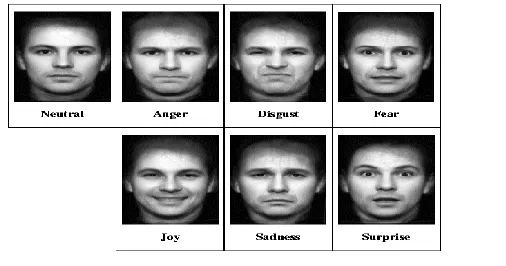
The most commonly used facial expressions classification is done both in terms of Action Units, proposed in Facial Action Coding System and in terms of universal emotions: joy, sadness, anger, surprise, disgust and fear. The two main types of classes used in facial expression recognition are action units (AUs)[18], and the prototypic facial expressions defined by Ekman [19].
2.3.1 Facial Action Coding System(FACS)
In 1978, Ekman et al. [2] introduced the system for measuring facial expressions called FACS – Facial Action Coding System. FACS was developed by analysis of the relations between muscle(s) contraction and changes in the face appearance caused by them. The Face can be divided into Upper face and Lower Face Action units[20] and the subsequent expressions are also identified. The Figures shows some of the combined action units.
Contractions of muscles responsible for the same action are marked as an Action Unit (AU). The task of expression analysis with use of FACS is based on decomposing observed expression into the set of Action Units. There are 46 AUs that represent changes in facial expression and 12 AUs connected with eye gaze direction and head orientation. Action Units are highly descriptive in terms of facial movements, however, they do not provide any information about the message they represent. AUs are labeled with the description of the action (Fig.2).
Fig 2: Action Units and combinations
2.3.2 Prototypical Facial Expression
[image:3.612.320.573.589.722.2]© 2016, IRJET ISO 9001:2008 Certified Journal Page 543 Fig 3: Six Universal Emotions
Instead of describing the detailed facial features most facial expression recognition system attempt to recognize a small set of prototypical emotional expressions.
Some facial expressions are a blend of more than one expression as, say a combination that occurs for the case of fear, sorrow and disgust. To overcome the above problem some approaches have been used. There are two main categories of Feature Classification approach:
1) Statistical non-machine learning approach such as Euclidean and linear discrimination analysis [22].
2) Machine learning approach such as Feed forward Neural Network[23], Hidden Markov Model[26], Multilayer Perception[], Support Vector Machine[25], K-Nearest Neighbours[24], etc.
2.4 Challenges in facial expression recognition
system
In spite of the fact that humans recognise facial expressions virtually without effort or delay, reliable expression recognition by machine is still a challenge. The issues that have haunted the pattern recognition community at large (see[8]) still require consideration. A key challenge is accomplishing ideal pre-processing, feature extraction or selection, and classification, especially under conditions of input data variability. To attain successful recognition performance, most current expression recognition approaches require some control over the imaging conditions. The controlled imaging conditions typically cover the following aspects.
2.4.1 View or pose of the head
In spite of the fact that limitations are frequently forced on the position and orientation of the head in respect to the camera, and the setting of camera zoom, it should be noted that some processing techniques have been developed, which have great lack of care interpretation, scaling, and in plane rotation of the head. The effect of out-of-plane pivot is more difficult to lighten, as it can achieve in wide variability of image points of view. Further research is required into change invariant expression recognition. As shown in fig 4 mage which is used for feature extraction having different pose is intricate.
Fig 4: Different Pose in an Image
2.4.2 Environment clutter and illumination
Complex image background pattern, occlusion, and uncontrolled lighting have a possibly negative effect on recognition. These factors would commonly make image segmentation more difficult to perform reliably. Hereafter, they may possibly bring about the spoiling of feature extraction by data not related(data not identified with) to facial expression. Face image taken with various lights is shown in fig 2.
Fig 5: Illuminated Image
This factor would commonly make feature extraction more hard. To repay the variation of illumination in an input image , image pre-processing techniques like DCT normalization, Histogram Equalization, Rank Normalization can be applied before feature extraction.
2.4.3 Occlusion
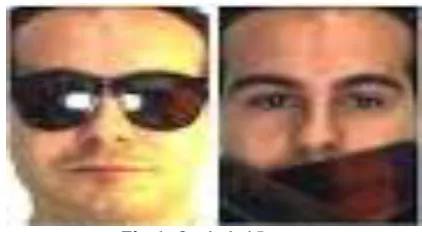
[image:4.612.335.558.253.313.2]Faces may be partially occluded by other objects. In an image if face is occluded by some other faces or objects such as mask ,hair, glasses as shown in fig 3.For that image extraction of expression features are complex.
Fig 6: Occluded Image
3. CONCLUSION
[image:4.612.343.554.485.601.2]© 2016, IRJET ISO 9001:2008 Certified Journal Page 544 characterised by partial successes, achieved at the
expense of constraining the imaging conditions, in many cases.
In this paper has brief overviewed the methodology of facial expression recognition. Feature extraction is main stage of expression recognition system. Geometric features extraction is more difficult because it depends on the shape and sizes of features so appearance base feature are easy to extract. Extracted feature aims to capture static or dynamic facial information specific to individual expression.
Extracted features are used for classification stage. Extracted features are used to detect the Action units occurrence and then AU combinations were translated into emotion categories. This process required much effort because the analysis was done manually and more training time is require for building a FACS coder. There is many techniques for develop FAC system which are easier and efficient.
REFERENCES
[1] G. Donato, M.S. Bartlett, J.C. Hager, P. Ekman, T.J. Sejnowski, "Classifying Facial Actions", IEEE Trans. Pattern Analysis and Machine Intelligence, Vol. 21, No.10, pp. 974-989, 1999
[2] M. Pantic, L.J.M. Rothkrantz, "Automatic Analysis of Facial Expressions: the State of the Art", IEEE Trans.Pattern Analysis and Machine Intelligence, Vol. 22, No. 12, pp. 1424-1445, 2000
[3] Shuai-Shi Liu, Yan-Tao Tian, Dong Li ,”New Research Advances Of Facial Expression Recognition”,IEEE Proceedings of the Eighth International Conference on Machine Learning and Cybernetics,Baoding, 12-15 July 2009
[4] J.Ostermann, “Animation of synthetic faces in Mpeg-4”, Computer Animation, pp. 49-51,Philadelphia, Pennsylvania, June 8-10, 1998
[5] 5P. Dulguerov, F. Marchal, D. Wang, C. Gysin, P. Gidley, B.Gantz, J. Rubinstein, S. Sei7, L.Poon, K. Lun, Y. Ng, “Review Of objective topographic facial nerve evaluation methods”, Am.J.Otol. 20 (5) (1999) 672–678. [6] Maja Pantic, Leon J.m. Rothkrantz, ”Automatics Analysis
of Facial Expressions: The State of the Art”, IEEE transactions on pattern analysis and machine intelligence, Vol. 22, No. 12, December 2000
[7] P.Ekman and W.V.Friesen.”Facial Action Coding System” .Consulting Pshychologists Press Inc.,577 College Avenue,Palo Alto,California 94306,1978. [8] A.K. Jain, R.P.W. Duin, J. Mao, "Statistical Pattern
Recognition: A Review", IEEE Trans. Pattern Analysis and Machine Intelligence, Vol. 22, No. 1, pp. 4-37, 2000
[9] L. Wiskott, J. M. Fellous, N. Kruger and C.V. Malsburg, “Face Recognition by Elastic Bunch Graph Matching,” IEEE Trans. Pattern Analysis and Machine Intelligence, Vol. 19, No. 7, pp.775–779, 1997.
[10] T. F. Cootes, C. J. Taylor, D. H. Cooper, and J. Graham, “Active Shape Models, Their Training and Application,”
Computer Vision and Image Understanding, Vol. 61, No.
1, pp. 38-59, 1995.
[11] G.J. Edwards, T.F. Cootes, and C.J. Taylor, "Face Recognition Using Active Appearance Models," Proc. European Conf. Computer Vision, Vol. 2, p. 581-695, 1998.
[12] J.F. Cohn, A.J. Zlochower, J.J. Lien, and T. Kanade, "Feature-Point Tracking by Optical Flow Discriminates Subtle Differences in Facial Expression," Proc. Int'l Conf. Automatic Face and Gesture Recognition, p. 396-401, 1998.
[13]Senthil Ragavan Valayapalayam Kittusamy and Venkatesh Chakrapani,” Facial Expressions Recognition Using Eigen spaces”, Journal of Computer Science 8, 2012
[14] C.Shan, S. Gong, P. McOwan, “Facial expression recognition based on Local Binary Patterns: A comprehensive study”, Image and Vision Computing, Vol. 27, p. 803-816, 2009.
[15] S. Dubuisson, F.Davoine, M. Masson, “A solution for facial expression representation and recognition”, Signal Process. Image Commun, 2002,vol. 17, no. 9, pp. 657– 673.
[16] Hong-Bo Deng, Lian – Wen Jin, Li-Xin Zhen, Jian – Cheng Huang, “A New Facial Expression Recognition Method based on Local Gabor Filter Bank and PCA plus LDA” . International Journal of Information Technology Vol. 11 No. 11 2005
[17] M. Pantic, L.J.M. Rothkrantz, "Automatic Analysis of Facial Expressions: the State of the Art", IEEE Trans. Pattern Analysis and Machine Intelligence, Vol. 22, No. 12, pp. 1424-1445, 2000
[18] G.Donato, M.S. Bartlett, J.C. Hager, P.Ekman, T.J. Sejnowski, "Classifying Facial Actions", IEEE Trans. Pattern Analysis and Machine Intelligence, Vol. 21, No. 10, pp. 974-989, 1999
[19] P. Ekman, Emotion in the Human Face, Cambridge University Press, 1982
[20] C.P. Sumathi, T. Santhanam and M.Mahadevi,” Automatic Facial Expression Analysis A survey”, International Journal of Computer Science & Engineering Survey (IJCSES) Vol.3, No.6, December2012
[21] P. Ekman, Emotion in the Human Face. Cambridge Univ. Press,1982
© 2016, IRJET ISO 9001:2008 Certified Journal Page 545
facial expression recognition, IET Image Processing, 2009.
[23]Kuan-Chieh Huang, Sheng-Yu Huang and Yau-Hwang Kuo, Emotion Recognition Based on a Novel Triangular Facial Feature Extraction Method, IEEE 2010.
[24]Ruicong Zhi, Markus Flierl, Qiuqi Ruan and W. Bastiaan Kleijn , Graph-Preserving Sparse Nonnegative Marix Factorization with Application to Facial Expression Recognition, IEEE Transactions on systems, man and cybernetics partB, Vol. 41, NO. 1 2011
[25]I. Kotsia, I. Buciu and I. Pitas, “An Analysis of Facial Expression Recognition under Partial Facial Image Occlusion,” Image and Vision Computing, vol. 26, no. 7, pp. 1052-1067, July 2008.
[26]Petar S.Aleksic, Member IEEE. Aggelos K.Katsaggelos, Fellow Member, IEEE,” Animation Parameters and Multistream HMM’s, IEEE Transactions on Information Forensics and Security”,Vol.1 No.1 March 2006.
[27]G. J. Edwards, C. J. Taylor, and T. F. Cootes, “Active Appearance Models”, IEEE Transaction on Pattern Analysis and Machine Intelligence, Vol. 23 No. 5, pp. 681-685, 2001.
.