© 2016, IRJET | Impact Factor value: 4.45 | ISO 9001:2008 Certified Journal | Page 1539
Analysis of a Sponge Rubber using FEA Method
Sukrut A. Deshmukh
1,Swapnil S. Chavan
2,Ojas S. Badgujar
3,Bhoomish D. Gandhi
41, 2, 3, 4,
Sinhgad Institute of Technology & Science, Pune, Maharashtra, India,
1, 2, 3,4
Undergraduate Scholar
1
[email protected],
2[email protected],
3[email protected],
4
[email protected]
Abstract:
The thesis defines design and development of a Pressure Actuation Mechanism for land based munitions. This mechanism employs rubber pads for actuation. A consistent and effective rubber compound needs to be used to achieve the desired mechanical properties .Therefore proper selection of rubber pads through analytical and experimental processes is proposed. In use of rubber pads for actuation, physical and chemical properties play vital role. By using Sponge Rubber (NR+SBR), the thesis aims to study the effectiveness of the developed rubber pads for the actuation mechanism to be used in land based munitions. During the research the analysis was done firstly using experimental method and then was cross checked with FEA method for confirmation of result.Keywords:
Natural Rubber (NR), SBR (StyreneButadiene Rubber), FEA (Finite Element Analysis)
INTRODUCTION
A mechanism is a defined as a mechanical device which is used to transfer or transform motion, force or energy. The actuation in this type of mechanism is pressure based actuation, the pressure pad is responsible for preventing the applied load from getting directly transferred to the actuating assembly. The pads needs to resists the applied load up to certain pre-defined value and then start compressing itself, transferring the motion to the actuating assembly. Therefore pressure pads play a very decisive role in achieving the actuation at correct pre-defined loads. The mechanism being a two stage actuation mechanism requires the rubber pads to have less assertion time. Lower re-assertion time facilitates the proper second stage actuation. Until now the pressure pads used in the actuation mechanism were of Neoprene. But the mechanisms using pressure pads of neoprene encountered a problem of higher re-assertion time making them unsuitable for the two stage actuation mechanism. Hence for the next generation of munitions having two stage actuation mechanisms, Sponge Rubber (NR+SBR) pressure pads will be used. Sponge Rubber for pads was chosen due to the less re-assertion time which is a must for the functioning of the two stage actuation system. To see that the material had suitable behavioral characteristics such as the stress-strain curve, load-
deflection curve the material sample were tested on an UTM .Based on the results a material was created in ANSYS
workbench 15.0 using the Mooney-Rivlin material model. Tensile and compression tests were performed on the sponge rubber sample in ANSYS. The sampling was done according to the ASTM standards .A dumbbell sample was used for tensile test and actual pressure pad was used for compression test. The readings obtained from UTM(Stress Vs Strain) are used to create material under Mooney-Rivlin model. Those created material properties were given to actual pressure pad which has been imported from CATIA.. The percentage error was calculated. Creation of material model in ANSYS also paved a way for simpler and faster analysis for like materials in future.
RESEARCH OBJECTIVE
© 2016, IRJET | Impact Factor value: 4.45 | ISO 9001:2008 Certified Journal | Page 1540
MATERIAL AND METHODS
Sponge Rubber (NR+SBR) a polymer of natural rubber and Styrene Butadiene Rubber was chosen particularly as the material for the pressure pad due to its very good mechanical, physical and chemical properties. Also this sponge rubber combination exhibited the required values of Reassertion and compression set which were strong requirements for the functioning of the pressure actuation mechanism. Two methods namely software based (FEA in ANSYS) and experimental (Experiments on UTM) were employed for the confirmation to the required characteristics. Axis-symmetry modelling was done for the compression analysis of the pressure pad so as to reduce the solving and simulation time in ANSYS.
Sr. No. Ingredients Name Observed Value
1 Natural Rubber % 21.40
2 Synthetic Rubber % 19.40
3 Activator % 4.04
4 Antioxidant & Antiozonent
3.87
5 Plasticizer % 20.72
6 Fillers % 25.74
7 Curing Agents % 2.23
8 Blowing agents % 2.60
[image:2.595.306.552.142.380.2]Total % 100
Table 1. Material Composition of NR+SBR
TEST OBJECT MODELS
Material is generated under Mooney Rivlin model. For Tensile:
Fig 1.CATIA model of Tensile Specimen
[image:2.595.22.549.217.566.2]© 2016, IRJET | Impact Factor value: 4.45 | ISO 9001:2008 Certified Journal | Page 1541
For Compression:
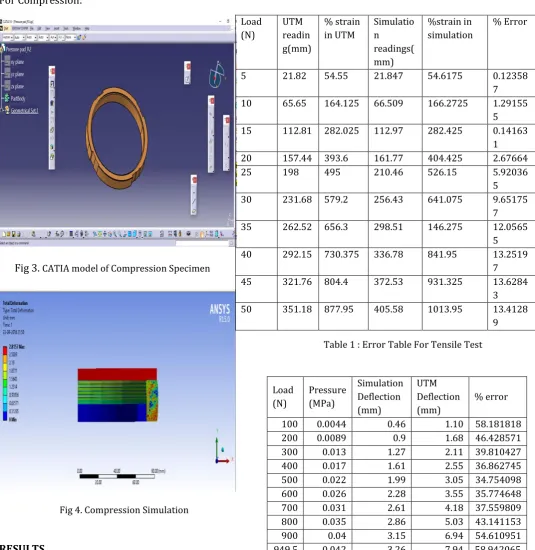
[image:3.595.37.573.106.657.2]Fig 3. CATIA model of Compression Specimen
Fig 4. Compression Simulation
RESULTS
The following table shows the values of total deformation obtained in UTM and ANSYS also the percentage error in the two values
Table 1 : Error Table For Tensile Test
Fig 5 Deviation Graph. Load
(N)
UTM readin g(mm)
% strain in UTM
Simulatio n readings( mm)
%strain in simulation
% Error
5 21.82 54.55 21.847 54.6175 0.12358
7
10 65.65 164.125 66.509 166.2725 1.29155
5
15 112.81 282.025 112.97 282.425 0.14163
1
20 157.44 393.6 161.77 404.425 2.67664
25 198 495 210.46 526.15 5.92036
5
30 231.68 579.2 256.43 641.075 9.65175
7
35 262.52 656.3 298.51 146.275 12.0565
5
40 292.15 730.375 336.78 841.95 13.2519
7
45 321.76 804.4 372.53 931.325 13.6284
3
50 351.18 877.95 405.58 1013.95 13.4128
9
Load (N)
Pressure (MPa)
Simulation Deflection (mm)
UTM Deflection (mm)
% error
100 0.0044 0.46 1.10 58.181818
200 0.0089 0.9 1.68 46.428571
300 0.013 1.27 2.11 39.810427
400 0.017 1.61 2.55 36.862745
500 0.022 1.99 3.05 34.754098
600 0.026 2.28 3.55 35.774648
700 0.031 2.61 4.18 37.559809
800 0.035 2.86 5.03 43.141153
900 0.04 3.15 6.94 54.610951
© 2016, IRJET | Impact Factor value: 4.45 | ISO 9001:2008 Certified Journal | Page 1542 Table 2 : Error Table For Compression Test.
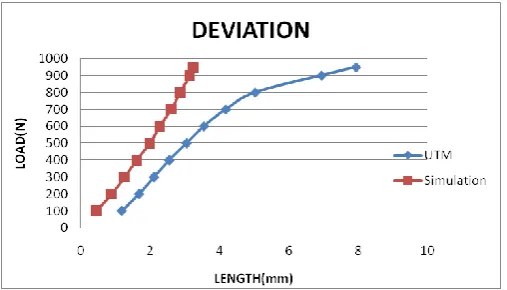
Fig 6. Deviation Graph
I.
DISCUSSION
The developed pressure pads needed to function as per as the requirements i.e. to achieve the objective of two stage actuation. For the specific combination of Natural Rubber and Styrene Butadiene Rubber there were not any established relations for reference. With this research we hope provide a brief insight into the mechanical behavior of sponge rubber (NR+SBR). Our findings are supported experimentally and by software based analysis. The results obtained from both the methods having errors in acceptable limit. The material sponge rubber being an Elastomers obeys the mooney-rivlin theory of non-linearity. Therefore the material had to be created in ANSYS under the mooney-rivlin material model by inputting the stress-strain values in the software database. These values for input were obtained from the experiments performed on UTM. The stress-strain and load deflection curve obtained from the values in the analysis report were super imposed with that of the curves obtained from the UTM.
VII.
CONCLUSION AND FUTURE WORK
This report introduces a new type of composite material for application in land based munitions as a pressure pad. We present the sampling as well as analyzing steps for the material. Tensile and Compression test are performed on the sponge rubber in order to analyze the material to be use.
The tensile result obtained from UTM and ANSYS show deviation of about 13.05 percent, which is acceptable. The combination of Natural Rubber and Styrene Butadiene Rubber in the sponge rubber compound improved the temperature operational of the pressure pad. Therefore making the pressure pad and thus the munitions effective in wide range of temperature. The new pressure pad developed facilitated the implementation of two-stage actuation mechanism possible making the land based munitions effective against the modern-counter measure systems. This was achievable only because of the re-assertion time exhibited by the sponge rubber pad, re-assertion time which natural rubber pad and neoprene pads failed to exhibit.
A material model was developed in ANSYS, which will be very helpful for carrying analysis pressure pads made up of non-linear materials. The assessment of Compression test performed on UTM and ANSYS did not yield expected results. The deflection obtained in ANSYS for maximum load is approximately 5mm less, than that of deflection on UTM. The probable cause of getting values other than expected could be incapability of the material model and failure to replicate the real life working conditions during the FEA. Though other models could be helpful and may provide better insight in analyzing the compressive behavior of similar compounds.
© 2016, IRJET | Impact Factor value: 4.45 | ISO 9001:2008 Certified Journal | Page 1543
VIII.
REFERENCES:
[1] Joseph Thomas. “Mechanical Properties and Durability of Natural Rubber Compound & Compositions”, Blacksburg, Virginia. December 2001.
[2] Matzen D. and Straube E. "Mechanical Properties of SBR-Networks: Determination of Properties by Stress-Strain-Measurements," Colloid and Polymer Science, Vol. 270, 1992. pp 1-8.
[3] Er. Kapil Soni, Dr. Y.P.Joshi, Performance Analysis of Styrene Butadiene Rubber-Latex on Concrete Mixes, ISSN : 2248-9622, Vol. 4, Issue 3(Version 1), March 2014, pp.838-844.
[4] Journal of Applied Polymer Science Volume 35, Issue 4, March 1988, pp 1003–1017.
[5] Robert A. Shanks, Ing Kong, “General Purpose Elastomers: Structure, Chemistry, Physics & Performance”, Melbourne, Australia, 2013.
[6] Z Nowak, “ConsitutiveModeling& Parameter Identification for Rubber like Materials”, Poland. 2008. [7] RakshaMantralaya Ministry Of Defence Joint Services Specification On Rubber Compound -Neoprene (Ds Cat No. 9320-000 503) JSS 9320-04:1999.
[8] RakshaMantralaya Ministry Of Defence Joint Services Specification On Rubber Compound –Neoprene II (Ds Cat No. 9320-005 665) JSS 9320-18:2003.
[9] RakshaMantralaya Ministry Of Defence Joint Services Specification On Rubber Compound –Neoprene II (Revised Edition) (Ds Cat No. 005 665) JSS 9320-18:2010.
[10] T.P.Mohan, Job Kuriakose, K Kanny , Effect of thermal and mechanical properties of natural rubber–styrene butadiene rubber (NR–SBR), Composites Research Group, Department of Mechanical Engineering, Durban University of Technology, Durban 4001, South Africa. [11] Journal of Industrial Engineering Chemistry Volume 17,
Issue 2, 25 March 2011, pp 264–270.
[12] Fauziahbinti Ahmed, Yahya K. Atemimi and Mohd Ashraf Mohamad Ismail, Evaluation the Effects of Styrene Butadiene Rubber on Geotechnical Properties. a School of Civil Engineering, University Sains Malaysia, Engineering Campus, 1430, Malaysia.
[13] K. Don Kim, Ph.D, Tibor Pernecker, Ph.D, “Styrene – Butadiene Rubber Latex Polymer with Improved Auto – Adhesion”, Omnova Solutions INC, Akron, OH, 2001. [14] Debapriya De, Debashish De, “Processing & Material
Characteristics of Reclaimed Ground Rubber Tire Reinforced Styrene Butadiene Rubber”, Kolkata, India. May 2011.
[15] Standard Test Methods for Carbon Black in SBR (Styrene-Butadiene Rubber)- Recipe and Evaluation Procedures1. Designation: D3191-10 ASTM standards.
[16] Judson T Bauman, Ph.D., Fatigue, Stress and Strength of rubber components. Guide for Design Engineers. ISBN: 978-3-446-41681-9.
[17] ASTM-D-412 Standard Test Methods for Vulcanized Rubber and Thermoplastic Elastomers – Tension (2002).