© 2016, IRJET ISO 9001:2008 Certified Journal Page 2062
An Efficient framework for E-Learning Recommendation system using
fuzzy Logic and Ontology
Shubhangi S. Tambe
1, Prof. Ganesh V. Kadam
21
Student, Department computer, JSPM NTC Pune, Maharashtra, India
2Professor, Department computer, JSPM NTC Pune, Maharashtra, India
---***---Abstract -
E- learning systems are most popular in educational establishments because of the manufacture of web-based communication technologies and information. There are many of the recommendation system are giving recommendation for the fired query. But very little are recommending by having continuous stream of exercises for the user to guide them properly. As a solution of above problem is being developed to permit learners to receive on-line learning activities, the web usage mining applications of learners in the context of e learning, learners and e-learning site designers. To enhance the process of the recommendation in E learning sector proposed system provides a best way of managing the users query to narrow down the student option to help to select his best course using fuzzy logic which powered with ontology and Tree hierarchy. So proposed methodology put forwards an idea of E learning system by M tree hierarchy which is powered with ontology for semantic relationship by using fuzzy logic.Key Words: Ontology Reasoning, Fuzzy Logic, M-Tree,
TF-IDF, Pearson Correlation.
1. INTRODUCTION
The e-learning system is most popular technique in the computer science field nowadays. Researchers are always giving their best to develop the e-learning technologies. The increasingly development of e-learning systems gives learners with better opportunities to access learning activities online, and this greatly supports learning practices and enhances. There are lots of benefits to e-learning system, it is very popular in education development because the development of web based information and knowledge in data mining. For a learner using a web-based course delivery environment, it could be better to track the activities happening in the course web site and extract patterns and behaviors prompting needs to change, improve, or adapt the course material.
Service-based architectures gain legacy application functionality and expose it to the Internet in a reliable, highly
available, scalable, flexible, manageable and protected manner, easy and reliable internet-based method to achieve and access learning. For transmitting messages that currently, the Service-based architectures are layered on the top of standard transfer protocols, the most common ones are the Discovery and Integration (UDDI), XML-based specification Simple Object Access Protocol (SOAP), Universal Description and Web Service Description Language. E-Learning is a general term used to refer to a form of learning in which the instructor and learner are separated by time or space where the gap between the two is attach through the help of online technologies.
© 2016, IRJET ISO 9001:2008 Certified Journal Page 2063 Most data mining algorithms need specific
parameters and threshold values to tune the discovery process, the users of web usage mining applications in the context of e-learning, namely educators and e-learning site designers, are not necessarily savvy in the intricate complexities of data mining algorithms. For this purpose we have tried to design new algorithms that need minimum input from the user and automatically adjust to the web log data at hand.
Ontology based semantic web services are promising solution to give an assembling learning objects and explicit definition of conceptualization on a specified domain. The ontology combine with the learner profile produce best results in an e-Learning LMS System and could be used in integrated with multi-agent technologies for deriving personalized learning paths instead of Directed Acyclic Graph. The methodology that designs ontology using Portg and content retrieval through web techniques is defined in with the drawbacks of command line interface of creation. With the rapidly demand and acceptance of ontology-based services, we have witnessed the implementation of various ontologies describing similar fractions of real world knowledge. These ontology’s,
complementary, have an impaired collaborative
functionality, because of the decentralized nature of their conception.
Ontology matching provides mechanisms for the components of different knowledge resources. The various ontology matching approaches can be divide w.r.t. the object, terminological approaches measure the equality of the concept names, structural approaches rely on the relations that hold between the various concepts and semantic approaches are based on logical methods. These various approaches are often complemented by the use of background knowledge provided by a reference ontology, Permission to deal with realistic matching cases. Another latest issue in realistic case ontology matching is the handling of the resulting matching imperfections and imprecise information.
Fuzzy Logic is a multivalued logic that permit intermediate values to be defined between conventional evaluations like true or false, yes or no, high or low, etc. Notions such as very fast can be formulated mathematically and processed by computers, in order to apply a more humanlike way of thinking in the programming of computers. The precision of mathematics owes its success in huge part to the efforts of Aristotle and the philosophers who preceded him. In their efforts to devise a concise theory
of logic, and later mathematics, the socalled ”Laws of Thought” were posited. Even when Parminedes proposed the first version of this law there were strong and immediate objections: for example, Heraclitus proposed that things could be simultaneously true and not true.
This paper can be classified as follows: Section 1 is dedicated for introduction, section 2 is reserve for literature survey, section 3 is allocated for proposed methodology, and section 4 is dedicated for result discussion finally section V is done with conclusion.
2. LITERATURE SURVEY
To put forward the idea of an efficient framework for e-learning recommendation system using fuzzy logic and ontology this paper analyze many concept of different author as mention below.
Martin Hellmann describe Fuzzy Logic offer a various way to approach a control or classification problem. This method highlights on what the system should do rather than trying to model how it works. One can focus on solving the problem rather than trying to model the system mathematically, if that is even possible. On the other hand the fuzzy technique requires a sufficient expert knowledge for the formulation of the rule base, the combination of the sets and the defuzzification. In General, the employment of fuzzy logic might be helpful, for very complex processes, when there is no easy mathematical model, for mostly nonlinear processes or if the processing of expert knowledge is to be performed.
W. Wang explains existing system works on the fact of fuzzy tree matching-based hybrid recommendation technology for an e-learning system. The approach implement both a fuzzy tree-structured learning activity model and a fuzzy tree-structured learner profile model. A fuzzy tree similarity measure is presented to evaluate the similarity between learning activities or educators. In the fuzzy tree-structured learning activity model, a fuzzy category tree is defined to specify the categories that each learning activity roughly belongs to, and the fuzzy category similarity measure is implement to establish the semantic similarity between learning activities.
© 2016, IRJET ISO 9001:2008 Certified Journal Page 2064 different learning time, different kind of language etc.)
should be implemented. After analyzing the model with the learning objects, the recommendation results should be examine. Statistical data would be gathered. However, a theoretic idea of the ontology based personalized recommendation model for learning objects in service oriented.
Architecture (SOA) e-learning system is proposed. By providing an ontology based recommendation model, it is simple for the users to discover and select the learning objects (LOs) that are suitable for them. Indirectly, it is to increase the probability of the LOs to be reused in the system. As the result, the reusability degree of the LOs will be increased in the e-learning system.
3. PROPOSED METHODOLOGY
To enhance the process of the recommendation in E learning sector proposed system provides a better way of managing the users query to narrow down the student option to help select his best course using fuzzy logic which powered with ontology and Tree hierarchy.
3.1 System Overview
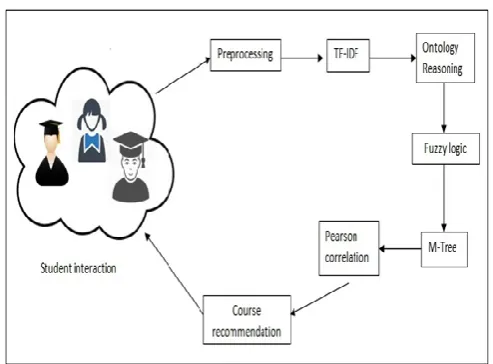
The proposed method of enhancing a framework for An Efficient framework for E-Learning Recommendation system using fuzzy Logic and Ontology matching can be describe efficiently according to this which is depicted the figure.
[image:3.595.309.556.96.278.2]It handling user query in natural narration. Student counselling using semantic questionnaires. Decision taking based on tree hierarchy and Fuzzy classification. Enhancing Recommendation using collaboration. Motivation of this is lack of adaptiveness, Lack of Semantic analysis of user query, Prolong counseling of student.
Fig-1: Overall System Diagram.
Proposed methodology put forwards an idea of E learning system by M tree hierarchy which is powered with ontology for semantic relationship by using fuzzy logic. Proposed system uses the following steps for providing recommendation for E learning:
Step 1: In proposed system preprocessing is the first step in which preprocessing the user query. Preprocessing meance when user gives input as a query then first remove words like is, was, a, an, etc. is called stopwords removal. After stopwords removal stemming is done for example going word is converted into go. Then apply tf-idf (term frequency-inverse document frequency) which is used to calculate weight frequency.
Step 2: Next step is Ontology reasoning which providing semantic for the words.
Step 3: After ontology reasoning next step is M-Tree creation in that creating a tree based on semantic relations.
Step 4: Fuzzy logic taking the decision based on fuzzy classification.
© 2016, IRJET ISO 9001:2008 Certified Journal Page 2065
Fig-2: Course Recommendation.
In proposed system course recommendation system is use. Query is input to the system and there are many user can use this system. Course recommendation system is shown in a figure 2. Proposed system successfully scrutinizing the user requirement more semantically using ontology and according to this the decisions is taking using Fuzzy tree combination. Then finally the a hybrid recommendation will be provided using collaborative filtering which is powered with Pearson correlation and content based recommendation successfully to the user with high precision results.
3.2 Algorithms
Preprocessing Algorithm: Step 0: Start
Step 1: Read string
Step 2: divide string into words on space and store in a vector V
Step 3: Remove Special Symbols
Step 4: Identify Stopwords
Step 5: Remove Stopwords
Step 6: Identify Stemming Substring
Step 7: Replace Substring to desire String
Step 8: Concatenate Strings
Step 9: stop
This preprocessing algorithm is use for removing special symbols, stopwords and for stemming.
Algorithm for creation of M-tree: Algorithm tree (Cluster Vector Fvi)
Begin:
Create an empty tree as T
Create the Root Node for first cosine similarity
Rn
For each element of clusters Fv
Compare the distance with the root node
If (Fvi Cosine Similarity ¡ Rn)
Add node as left child in T
Else
Add node as Right child in T
End For
End
Tree is created based on this algorithm. Time complexity of this algorithm is O (log (n)) where n is a number of courses.
3.3 Mathematical Model
© 2016, IRJET ISO 9001:2008 Certified Journal Page 2066
4. RESULT AND DISCUSSION
To show the effectiveness of proposed system some experiments are conducted on java based windows machine using Netbeans as IDE. Mean Absolute Error (MAE) metric is widely employed to measure the recommendation quality of collaborative filtering methods, which is defined as:
MAE= ∑ i,j | r i,j – r’i,j | / N
Where ri,j denotes the expected course j in user
recommendation choicer i, r’i,j denotes the
Recommendation value, and N denotes the number of recommended values. Since different Recommendation properties of courses have different value ranges, we use the Normalized Mean Absolute Error (NMAE) metric to measure the recommendation quality of our hybrid collaborative filtering method. We define our NMAE to be the standard MAE normalized by the mean of the expected recommended values as follows:
NMAE = MAE / (∑ i, j r i,j /N)
Where smaller NMAE value means higher
recommendation quality.
On different trials of our experiment it yields different NMAE as listed in table 1.
Table-1: Comparative NAME Values.
Chart-1: Performance Graph.
3. CONCLUSIONS
This paper successfully accumulates most of the techniques of many authors as described in section II of related work. So by analyzing all methods it seems to be like no method is perfect in providing solution for An Efficient framework for E-Learning Recommendation system using fuzzy Logic and Ontology.
As an efforts to this paper tries to improve the concept of enforcing e-learning using ontology and fuzzy tree matching by introducing Preprocessing, Ontology Reasoning, M-Tree creation, Pearson correlation.
REFERENCES
[1] J. Lu, Q. Shambour, Y. Xu, Q. Lin, and G. Zhang, “A web-based personalized business partner recommendation system using fuzzy semantic techniques”, Computational Intelligence, vol. 29, 2013.
[2] G. Adomavicius and A. Tuzhilin, “Toward the next generation of recommender systems: a survey of the state-of-theart and possible extensions”, IEEE Transactions on Knowledge and Data Engineering, vol. 17, 2005.
[3] H. W. Kuhn, Naval Research Logistics Quarterly, “The Hungarian method for the assignment problem”, vol. 2, FLEXChip Signal Processor (MC68175/D), Motorola, 1996.
© 2016, IRJET ISO 9001:2008 Certified Journal Page 2067 [5] M. Salehi and I. N. Kmalabadi, “A hybrid attribute based
recommender, system for elearning material
recommendation”, IERI Procedia, vol. 2, pp. 565-570, 2012.
[6] R. Burke, “Encyclopedia of Library and Information Systems, Knowledge-based recommender systems”, vol. 69, 2000.
[7] R. D. Lawrence, G. S. Almasi, V. Kotlyar, M. Viveros, and S. S. Duri, “Personalization of supermarket product recommendations”, Springer, 2001.
[8] J. Bobadilla, F. Serradilla, and A. Hernando,
“Collaborative filtering adapted to recommender systems of e-learning, Knowledge-Based Systems”, vol. 22, 2009.
[9] G. Zhang and J. Lu, “An integrated group decision-making method dealing with fuzzy preferences for alternatives and individual judgments for selection criteria, Group Decision and Negotiation”, vol. 12, pp. 501-515, 2003.
[10] G. Zhang and J. Lu, “Using general fuzzy number to handle uncertainty and imprecision in group decision making”, Intelligent Sensory Evaluation: Methodologies and Applications, pp. 51-70, 2004.
[11] D. Wu, G. Zhang, J. Lu, and W. A. Halang, “A similarity measure on tree structured business data, in ACIS 2012: Location, location”, location: Proceedings of the 23rd Australasian Conference on Information Systems 2012, 2012, pp. 1-10.
[12] G. Adomavicius and A. Tuzhilin, “Context-aware recommender systems, in Recommender Systems
Handbook”, F. Ricci, L. Rokach, B. Shapira, and P. B. Kantor, Eds., Ed: Springer US, 2011, pp. 217-253.
[13] S. W. Changchien and T.-C. Lu, “Mining association rules procedure to support on-line recommendation by customers and products fragmentation”, Expert Systems with Applications, vol. 20, pp. 325-335, 2001.
[14] W.-P. Lee, C.-H. Liu, and C.-C. Lu, “Intelligent agent based systems for personalized recommendations in Internet commerce”, Expert Systems with Applications, vol. 22, pp. 275-284, 2002.