© 2016, IRJET | Impact Factor value: 4.45 | ISO 9001:2008 Certified Journal | Page 2670
STABILIZATION OF MAKURDI SHALE USING LIME-GROUNDNUT SHELL ASH
Iorver, Vitalis
1Tiza Michael
2Olu Sunday
31
B.Engr. (civil engineering) Federal University of Agriculture Makurdi.
2
M. Tech Scholar
*. (civil engineering) Career Point University, India.
4
B.Engr. (civil engineering) University of Agriculture Makurdi.
---***---Abstract –
This research was carried out in other to investigate the effect of Lime (L) and Groundnut shell ash (GSA) on some geotechnical properties of Makurdi shale. In this research work, soil classification tests, Compaction test, California bearing ratio test (CBR), unconfined compressive strength test (UCS) and durability test were carried out on the natural shale as well as shale treated with combined range of 2 – 10 % lime and 4 – 20 % groundnut shell ash. Strength improvement was observed with the use of lime – groundnut shell ash combination more than when they were applied in single as the CBR value increase from 8 % to a maximum value of 67 % for the natural shale and shale treated with 10 % L, 20 % GSA respectively. 7 – day, 14 – day and 28 – day UCS increase from 286.42 kN/m2, 463.25 kN/m2 and 340.16 kN/m2 respectively for the natural shale to a maximum value of 933.73 kN/m2, 1018.62 kN/m2, 1030.74 kN/m2 at the respective day for the shale treated with 10 % L, 4 % GSA respectively and the durability value increase from 8.0 % to 43.4 % for the natural shale and shale treated with 4 % L, 16 % GSA respectively. Response of Makurdi shale to treatment clearly shows that, shale can be stabilized with lime + Groundnut shale ash for Civil engineering work.Key Words: Ground nut shell ash, California bearing ratio test, unconfined compressive strength test, foundation.
1.INTRODUCTION
1.1 Background of Study
Civil engineering structures have foundations on which they rest. These soils that support the foundation transmit load from the super structure through the sub-structure to the underlying soil. It is obvious then that, the stability of any civil Engineering structures depends solely on the stability of the underlying soil. However, in some cases, where expansive soils are encountered, they do not usually meet those requirements and this is basically as a result of the characteristic excessive swelling and shrinkage and consequently causing failure to structures on them. The soils usually absorbed water during the raining season and swells.
In the dry season, it loses water resulting to drying and contraction. When this behavior continues, it leads to the formation of cracks on buildings and roads (Warren, 1995). Makurdi town, the Headquarter of Benue State is
extensively deposited with shale (Agbede and Smart, 2008). The shale deposit like any other expansive soil has caused extensive failure of buildings and roads
constructed on and or with them. These defects are prominent on buildings in University of Agriculture, Makurdi, Wadata etc. in form of cracks ranging from fraction of millimeters to about 10 mm (plates i-iv). Thereby reducing the lifespan of these structures and posing threat to lives and properties using them.
1.2 Aim and Objectives
The study is aimed at investigating the potential of Groundnut shell ash (GSA)-lime in improving the engineering properties of shale. The specific objectives include;
1 To determine the change in swelling and shrinkage property of shale treated with GSA and lime admixture. 2 To evaluate the changes in strength properties (unconfined compression strength and California bearing ratio) of the stabilized soil.
1.3 Justification of the Study
This study is an attempt at improving the physical and strength characteristics of Makurdi shale with lime-groundnut shell ash for the purpose of flexible pavement construction.
The present of shale in Makurdi especially University of Agriculture Makurdi has caused a lot of damages, hazards and threats to most commercial, residential and official buildings in Makurdi.
© 2016, IRJET | Impact Factor value: 4.45 | ISO 9001:2008 Certified Journal | Page 2671 research on stabilization of Makurdi shale with lime-GSA
admixture. The research when completed will complement the work done by other researchers and promote the use of cheap and locally available waste like GSA in stabilization of problematic soils.
1.4 Location of the Study
Makurdi town, the study area is the Headquarter of Benue State in Nigeria. The town lies between latitude 70 and 80 N
as well as longitude 80 and 90 E. it has a total area of 25
km2 and an average relief of 120 m (Agbede and Smart,
2007).
1.5 Climate of the Study Area
Makurdi is situated in the savannah vegetation belt. The climate is tropical and alternating and distinct wet and dry season. The wet season usually starts around April and ends October. The maximum and minimum temperature of 35 0C
and 21 0C respectively. The rainfall is both convention and
tropical, it has a heavy form of high intensity between 508 to 1016 mm during rainy season and 0 to 254 mm in the dry season (Agbede and Smart, 2007).
1.7 Scope of the Study
[image:2.595.303.565.89.242.2]This work is limited to shale obtained from University of Agriculture Makurdi, Benue State Nigeria. The soil sample was treated with various percentages of 2 %, 4 %, 6 %, 8 %, 10 %, lime and 4 %, 8 %, 12 %, 16 %, 20 % of groundnut shale ash admixture. The tests to be performed on the natural shale samples treated with lime-GSA includes: natural moisture content, durability test, specific gravity test, particle size analysis, hydrometer test, swelling test, compaction test, Attergberg limit test, California bearing ratio, unconfined compressive strength, X-ray fluorescence.
2.7.0 Chemical Properties of Groundnut Shell Ash
According to Elinwa and Awari (2001) the comparison of the chemical properties of groundnut shell ash and other related materials is as shown in Table 2.0 below.Table 2.0: Comparison of Chemical Properties of Groundnut Shell Ash and other Related Materials
Constituen
ts GHA % by
weigh t
Rice husk ash % by weigh t
Bagass e ash % by weight
Ordinar y Portlan d cement weight
ASTMC61 8 Limits
SiO2 54.03 93.10 73.00 20.70 Max of 70
%
Al2O3 39.81 0.40 6.70 5.75
Fl203 4.34 0.20 6.30 2.50
CaO 1.70 0.40 2.80 64.00 -
MgO 0.004 0.10 3.20 1.00 -
Na2O 0.85 2.30 1.10 0.20 Max of 1.5
%
K2O 0.17 - 2.40 0.60 -
P2O5 0.44 - 2.09 0.15 -
MnO 0.10
- 0.26 0.05 -
SO3 0.09 2.80 2.75 Maximum
Of 5 %
Source: Elinwa and Awari (2001).
2.1.0
ORIGIN,
CLASSIFICATION
AND
CHARACTERISTCS OF SHALE
Shale, consolidated clay is derived from the weathering and degradation of igneous and sedimentary rocks. It is a variable material that exhibits behavior ranging from – consolidated clay to that of a hard, durable cemented rock. In general, Shales are highly consolidated clay, silts and sands or a mixture of all the three fractions of soil derived from the weathering of rocks, their particles get deposit in seas or rivers beds in layers, which are subjected to high overburden pressure which tends to eject water from the particles coming very close to each other. Shale is primarily produced by changes which occur in sediment between deposition and prettification under conditions of heat and pressure on the surface and the upper crust. (De Graft Johnson and others.1973)
2.2 Problems Associated with Shale
Problematic soils such as expansive soils are normally encountered in foundation engineering designs for highways, embankments, retaining walls, backfills etc. Expansive soils are normally found in semi – arid regions of tropical and temperate climate zones and are abundant, where the annual evaporation exceeds the precipitation and can be found anywhere in the world (Chen, 1975; Warren and Kirby, 2004).
© 2016, IRJET | Impact Factor value: 4.45 | ISO 9001:2008 Certified Journal | Page 2672 The mineral content of shale influences its geotechnical
properties. Underwood (1967) stated that clay fraction containing high percentages of illite and montmorillonite generally has lower strength, higher swelling potential and other undesirable properties than do shale with clay fractions consisting predominantly of kaolinite, chlorite or only low percentages of illite, montmorillonite, or other mixed layer minerals.
RESULTS AND DISCUSSION
4.1
Index Properties of Makurdi Shale
The index properties of natural Makurdi shale are as summarized in Tale 4.1. The soil was found to be an A – 7 – 6 soil by the AASHTP classification system, CH by the Unifined Soil Classification System, USCS (ASTM, 1992) and medium swell potential soil according to the NBRRI (1983). The test results showed that the natural soil was not suitable for use as sub-base or base course materials and even requires a modified layer above it as a sub-grade soil. The Oxide Composition of Groundnut Shale Ash, GSA and Makurdi shale obtained from chemical analysis is as shown in Table 4.1 below. The results showed that SiO2 (30.80 %) and Eu2O3
(0.05 %) as the least component, while Shale has SiO2 (48.00
%) as major constituents followed by Al2O3 (16.80%) and
[image:3.595.308.563.103.300.2]with ZnO (0.03 %) as the least constituent.
Table 4.1: Index Properties of Makurdi Shale
Properties Quantity
Percentage passing BS Sieve No. 200%
Natural moisture content (%) Liquid Limit (%)
Plastic Limit (%) Plasticity Index (%) Linear Shrinkage (%) Free Swell (%) Specific gravity AASHTO Classification USCS Classification
Maximum Dry Density (Mg/m3) Optimum Moisture Content (%) Unconfined Compressive Strength (KN/m2)
California Bearing Ratio, after (after 24hrs soaking)
87 30.43 46.90 31.0 14.68 12.10 30 2.42 A – 7 – 6 CH 1.49 23.50 53.52 2 i.
ii. Table 4.2: Chemical Composition of Makurdi Shale and GSA
Chemical Composition Concentration (% by weight) Makurdi Shale GSA SiO2
P2O5 48.00 - 30.80 4.45
SO3 K2O CaO TiO2 V2O5 Cr2O3 MnO Fe2O3 CuO ZnO BaO Eu2O3 Re2O7 Al2O3 MgO Na2O LOI 0.65 6.67 3.24 1.90 0.092 0.039 0.099 11.62 0.039 0.03 0.40 0.19 0.09 25.24 1.16 2.57 - 2.76 25.20 17.70 1.57 0.082 - 0.765 7.57 0.11 0.16 0.76 0.05 - - - - 25.00
4.2
Effect of Lime – Groundnut Shale Ash
(GSA) on Atterberg’s Limits of Makurdi Shale.
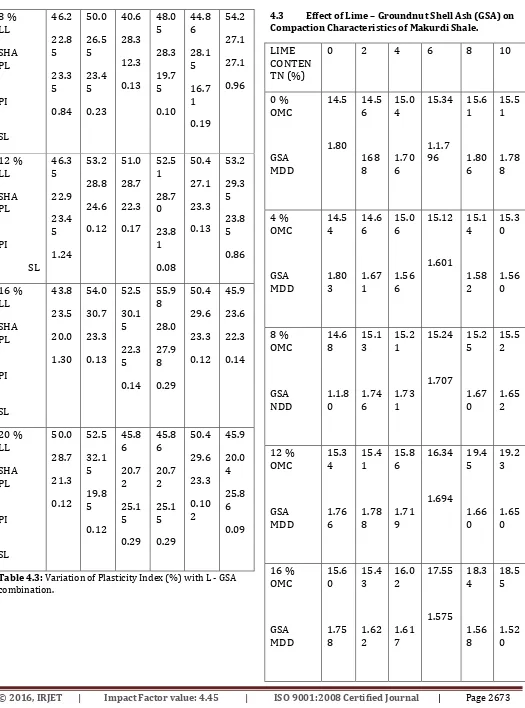
The addition of both GSA and lime to Makurdi shale improved its consistency properties, as the Plasticity Index reduced from 30.8 % for untreated Makurdi shale to 19.85 % at 4 % Lime plus 12 % GSA. This can be shown on table 4.3
LIME
CONTEN
T (%)
0
2
4
6
8
10
[image:3.595.33.567.421.791.2]© 2016, IRJET | Impact Factor value: 4.45 | ISO 9001:2008 Certified Journal | Page 2673
8 %
LL
SHA
PL
PI
SL
46.2
22.8
5
23.3
5
0.84
50.0
26.5
5
23.4
5
0.23
40.6
28.3
12.3
0.13
48.0
5
28.3
19.7
5
0.10
44.8
6
28.1
5
16.7
1
0.19
54.2
27.1
27.1
0.96
12 %
LL
SHA
PL
PI
SL
46.3
5
22.9
23.4
5
1.24
53.2
28.8
24.6
0.12
51.0
28.7
22.3
0.17
52.5
1
28.7
0
23.8
1
0.08
50.4
27.1
23.3
0.13
53.2
29.3
5
23.8
5
0.86
16 %
LL
SHA
PL
PI
SL
43.8
23.5
20.0
1.30
54.0
30.7
23.3
0.13
52.5
30.1
5
22.3
5
0.14
55.9
8
28.0
27.9
8
0.29
50.4
29.6
23.3
0.12
45.9
23.6
22.3
0.14
20 %
LL
SHA
PL
PI
SL
50.0
28.7
21.3
0.12
52.5
32.1
5
19.8
5
0.12
45.8
6
20.7
2
25.1
5
0.29
45.8
6
20.7
2
25.1
5
0.29
50.4
29.6
23.3
0.10
2
45.9
20.0
4
25.8
6
0.09
Table 4.3: Variation of Plasticity Index (%) with L - GSA combination.
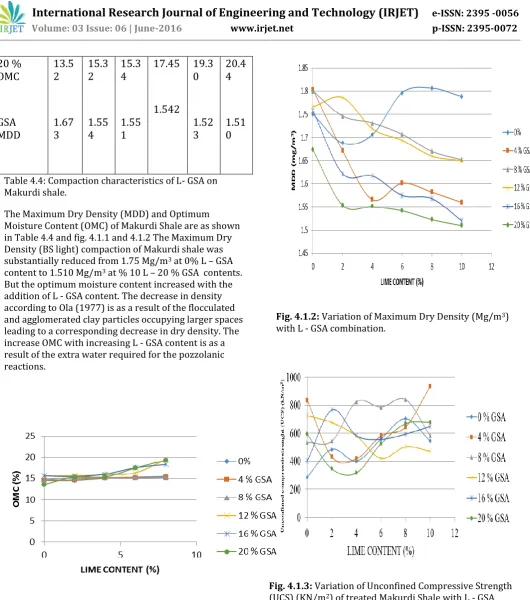
4.3 Effect of Lime – Groundnut Shell Ash (GSA) on Compaction Characteristics of Makurdi Shale.
LIME
CONTEN
TN (%)
0
2
4
6
8
10
© 2016, IRJET | Impact Factor value: 4.45 | ISO 9001:2008 Certified Journal | Page 2674
20 %
OMC
GSA
MDD
13.5
2
1.67
3
15.3
2
1.55
4
15.3
4
1.55
1
17.45
1.542
19.3
0
1.52
3
20.4
4
[image:5.595.39.570.43.644.2]1.51
0
Table 4.4: Compaction characteristics of L- GSA on Makurdi shale.
The Maximum Dry Density (MDD) and Optimum Moisture Content (OMC) of Makurdi Shale are as shown in Table 4.4 and fig. 4.1.1 and 4.1.2 The Maximum Dry Density (BS light) compaction of Makurdi shale was substantially reduced from 1.75 Mg/m3 at 0% L – GSA
content to 1.510 Mg/m3 at % 10 L – 20 % GSA contents.
[image:5.595.317.566.71.333.2]But the optimum moisture content increased with the addition of L - GSA content. The decrease in density according to Ola (1977) is as a result of the flocculated and agglomerated clay particles occupying larger spaces leading to a corresponding decrease in dry density. The increase OMC with increasing L - GSA content is as a result of the extra water required for the pozzolanic reactions.
Fig. 4.1.1: Variation of Optimum Moisture Content (%) with L - GSA combination.
Fig. 4.1.2: Variation of Maximum Dry Density (Mg/m3)
with L - GSA combination.
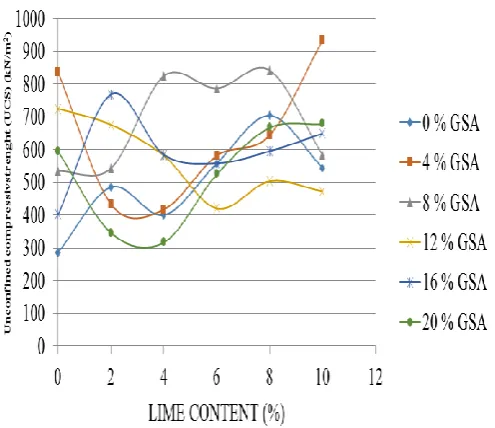
Fig. 4.1.3: Variation of Unconfined Compressive Strength (UCS) (KN/m2) of treated Makurdi Shale with L - GSA
[image:5.595.69.544.416.609.2]© 2016, IRJET | Impact Factor value: 4.45 | ISO 9001:2008 Certified Journal | Page 2675 Fig. 4.1.4(14-Days UCS): Variation of Unconfined
Compressive Strength (UCS) (KN/m2) of treated Makurdi
Shale with L - GSA content.
Fig. 4.1.5 (28 days UCS): Variation of Unconfined Compressive Strength (UCS) (KN/m2) of treated Makurdi
[image:6.595.42.290.102.316.2]Shale with L - GSA content.
Fig. 4.1.6: Variation of California Bearing Ratio (CBR) (%) of treated Makurdi Shale with L - GSA content.
[image:6.595.50.294.410.639.2]The same trend was also observed with the durability test as shown in figure 4.7, exhibiting an increase from 8.0 % for untreated Makurdi shale to 67% at a combination of 10% Lime + 20% GSA. The increase in durability showed that L -GSA combinations has a long time strength improvement capacity.
[image:6.595.45.556.417.639.2]Fig. 4.1.7: Variation of Durability (%) of treated Makurdi Shale with L - GSA content.
Fig. 4.1.7: Variation of Durability (%) of treated Makurdi Shale with L - GSA content.
5.0 CONCLUSION AND RECOMMENDATIONS
5.1 Conclusion
[image:6.595.262.563.447.600.2]© 2016, IRJET | Impact Factor value: 4.45 | ISO 9001:2008 Certified Journal | Page 2676 The use of a combination of 10 % Lime plus 20% GSA with a
CBR of 67 % to treat Makurdi shale for use as sub-base material. Using the plant mix method if economic analysis of alternatives on site or if possible, adequate manual compactive efforts if applied could justified its use.
5.2 Recommendation
It is recommended that, for stabilization of University of Agriculture Makurdi shale, an optimum of 4 – 10 % lime content be used with 20 % GSA combination. These combinations show an improvement in the engineering properties of the shale as seen in the summary work.
REFERENCE
[1] .Abayesekera, R. A., Lovell, C. W., and Wood, L. E. (1978). Stress Deformation and Strength Characteristics of Compacted Shale, Clay Fills Institution of Civil Engineers, London. Pp. 1 -14
[2] Adeniji, F. A. (1991). “Recharge Function of Vertisolic Vadose Zone in Sub-Sahelian Chad
Basin”, Proc. 1st Inter. Conf. on Arid Zone Ideology
Hydrology and Water
Resources, Maduguri, pp. 331 – 348.
[3] Adesunloye, M. O. (1987). “Investigating the Problem Soil of Nigeria”, 9th Reg. Conf. for
Africa on S.M.F.E. Lagos. Pp. 103 – 112
[4] Agbede, I. O. and Smart, P. (2007). Geotechnical Properties of Makurdi Shale and Effects on Foundation , Nigerian Journal of Technology. Vol. 26. No. 2,
[5] Agbede, I. O. and Smart, P. (2008), Geotechnical Properties of Makurdi Shale and its Effects
on Foundation, Nigerian Journal of Technology, Pp. 63 – 73
[6] Agbede, I. O. and Joel, M. (2011). Effect of Carbide Waste on the Properties of Makurdi Shale and Burnt Bricks Made from the Admixtures, American Journal of Scientific and Industrial Research. 2(4) 670 – 670 [7] Alabadan, B. A., Olutoye, M. A., Abolarin, M .S. and Zakariya, M. (2005). Partial
Replacement of Ordinary Portland Cement (OPC) with Bambara Groundnut Shell
Ash (BGSA) in Concrete. Leonard Electric Journal of Practices and Technologies.
Issues B, pp.43-48, Vol.0408.
[8] Alabadan, B. A., Njoku, C.F. and Yusuf, M.O. (2006). The Potentials of Groundnut Shell Ash as Concrete Admixture ,
Agricultural Engineering International. The CIGR Electronic Journal. Manuscript BC 05012, Vol. viii.
[9] Alabadan, B. A., Olutoye, M. A., Abolarin, M. S. and Zakariya, M. (2005). Partial
Replacement of Ordinary Portland Cement (OPC) with Bambara Groundnut Shell
Ash (BGSA) in Concrete”, Leonardo Electronic Journal of Practices and
Technologies, Issue 6, Pp. 43 – 48, Vol. 0408, American Society for Testing and
Material, Philadelphia.
[10] Braja, M. D. (2008). Advanced Soil Mechanics, 3rd ed.
Taylor and Francis; 270 Madison Ave. New York, Ny 10016, USA.
[11] BS 1377 (1990). Methods of Tests for Soils for Civil Engineering Purposes Part 2. British
Standards Institutes, London.
[12] Chabrillat, S., Geotz, A .F. H., Krosley, L. and Olsen, H. W. (2002). Uses of Hyperspectral
Images in the Identification and Mapping of Expansive Clay Soils and the Role
of Spatial Resolution, Remote Sensing of Environment, 82, pp. 431 – 445
[13] Chen, F. H. (1975). “Foundation on Expansive Soils”, Elsevier Scientific Pub. Co Amsterdam.
[14] De Graft- Johnson, j. W., Bhatia, H.S. and Yeboa, S.E. (1973). “Geotechnical Properties of Aecra Shale”, Proc. 8th
Int. Conf. Soil Mech. Found. Eng., Moscow. Vol. 2, pp. 97 – 104 [15] Elinwa, A. U and Awari, A. (2001). Ground nut Husk Ash Concrete, Nigerian Journal of
Engineering Management, Vol. 1, Pp 8 – 15. Farmer, I. W. (1968). Engineering Properties of Rocks, Spon. London.
[16] Garbar, N. J. and Hoel, L. A. (2009). Traffic and Highway Engineering, 4th ed. Hilda
Gowans, P. 1027 – 1032
[17] Gerald, J and Gromko, M. (1974). ASCE Review of Expansive Soil, Journal of Geotechnical
Engineering Division.
[18] Ingles, O. G. and Metcalf, J. B. (1972). Soil Stabilization Principles and Practice,
Butterworths, Sydney.
[19] Iorlian, A.Y., Agbede, I. O., and Joel, M. (2012). Effect of Cement Kiln Dust (CKD) on some Geotechnical Properties of Black Cotton Soil (BCS), Electronic Journal of Geotechnical Engineering, Vol. 17, Bund. G
[20] Joel, M. and Agbede, I. O. (2010). Cement Stabilization of Igumale Shale Lime Admixture for use as Flexible Pavement Construction Material, Electronic Journal of Engineering Geotechnical Engineering, Vol. 15, Bund. O [21] Johnson, W. A., Herrin, M., Davidson, T. D. and Handy, L. R. (1988). Soil Stabilization in
Highway Design, Reference Guide, ed. By Woods, K.B. and Ross, S.S. Mc Graw –
Hill Book Company. New York.
[22] Kuene, P. H. (1941). Geotechnical Calculations Concerning the Mass of Sediments of the
earth, American Journal, Science 239, pp. 161 – 1990. 17. Nigerian General
Specification for Roads and Bridgeworks. Federal Ministry of Works and Housing
Lagos.
© 2016, IRJET | Impact Factor value: 4.45 | ISO 9001:2008 Certified Journal | Page 2677 [24] Murthy, V. N. S. (2008). Soil Mechanics and Foundation
Engineering, CBS Publishers & Distributors, New Delhi. [25] Murthy, V. N. S. (2009). Soil Mechanics and
Foundation Engineering. CBS Publishers & Distributors, New Delhi.
[26] Narasimha Rao, S. and Rejasekaren, G. (1996). Reaction Products Formed in Lime Stabilized Marine Clays, Journal of Geotechnical Engineering. Geotech. Div. ASCE, 122(5), Pp. 329 – 336
[26] Nongu, S. J. (2010). “Lime-Groundnut Husk Ash Stabilization of University of Agriculture
[ 27] Makurdi Shales”, Unpublished Civil Engineering Project, Department of Civil Engineering University of Agriculture Makurdi.
[28] Nwajide, C. S. (1982). “Petrology and Peleogeography of the Makurdi Formation”,
Unpublished Ph.D Thesis, Department of Geology, University of Nigeria, Nsukka.
[29] O’Flaherty C. A. (1974). Highway Engineering, Vol 2, 2nd edition Edward Arnold, London. 1974
[30] Ola, S. A. (1974). Need for Estimated Cement Requirement for Stabilization of Laterite
Soils, Journal of Transportation Engineering. Div, ASCE, Vol. 100. No.2, pp. 379 –
388.
[31] Ola, S. A. (1978). Geotechnical properties and Behavior of some stabilized Nigerian
Laterite Soil, Q.T. J. Engrg. Geo. London Vol. III Pp. 145 - 160.
[32] Ola, S. A. (1978). The Geology and Geotechnical Properties of Black Cotton Soil of North – Eastern Nigeria, Engineers Geology, Vol. 12, pp. 375 – 391.
[33] Oriola, F. and Moses, G. (2010). Groundnut Shell Ash Stabilization of Black Cotton Soil,
Electronic Journal of Geotechnical Engineering, Vol. 15, Bund. E
[34] Osinubi, K. J. (1999). Influence of Compaction Delay on the Properties of Lime Stabilized
Lateritic Soil, Journal of Engineering Research, 7(12), Pp. 129 – 142
[35] Osula D. O. A. (1989). Evaluation of Admixture Stabilization for Problem Laterite, Journal
of Transportation Engineering Vol 115 N0. 6 Pp. 674-687
[36] Osula, D. O. (1989). “Cement Stabilization Using Hydrated Lime as an Admixture”,
Unpublished Msc. Thesis, Department of Civil Engineering, Ahmadu Bello
University, Zaria.
[37] Philbrick, J. (1969). Advanced Soil Mechanics, 3rd ed.
Tyalor and Francis 270 Madison Ave, New York. Ny 10016, USA. P. 25.
[38] Richardson, D. N. and Wiles, T. T. (1990). Shear Durability Rating System Based on Loss of Shear Strength, Journal of Technological Engineering, Vol. 116, No. 2, ASCE pp.
1664 – 1880
[39] Ruwaih, I. A. (1984). “Case Study on Swelling Soils in Saudi Arabia”, Fifth Int. Conf. on
Expansive Soils. Adelaide, South Africa, pp. 348 – 353.
[40] Terzaghi, and Peck. (1968). Soil Mechanics in Engineering Practice.
[41] Uduji, E. R., Okagdue, C. O. and Onyeobi, T. U. S. (1998). Geotechnical Properties of Soil Derived from the Awgu and Mamu Formation Angu – Okigwe of South – Eastern Nigeria and their Relations to Engineering Properties, Journal of Mining and Geology. Vol. 30 No. 1, pp. 117 – 123 [42] Underwood, I. B. (1967). Classification and Identification of Shale, Proc. American Society
of Civil Engineering, Journal of Soil Mechanics Foundation. Div. 93, SM 6, pp. 97
– 116.