© 2015, IRJET.NET- All Rights Reserved
Page 6
Improving Structural Performance Using Fibers in Concrete
Gurpuneet Singh
1, Hemant Sood
2, Harvinder Singh
31
Assistant Professor, Civil Engineering Department, Guru Nanak Dev Engineering College, Punjab, India
2Professor, Civil Engineering Department, NITTTR, Punjab, India
3
Associate Professor, Civil Engineering Department, Guru Nanak Dev Engineering College, Punjab, India
---***---Abstract -
This paper presents the results of anexperimental study conducted to examine the influence of various fiber parameters on the strength properties of the concrete when fibers are randomly mixed in it. The results indicate that the there is an improvement of the strength properties of the concrete irrespective of the concrete grade when steel fibers are added to the concrete. The post cracking strength of concrete after fiber addition was found to be enhanced manifolds along with reduction in the abrasion and permeability of the concrete.
Key Words
: Steel fiber, Compressive Strength, Flexural
Strength, Permeability, Abrasion.
1. INTRODUCTION
Concrete is a brittle material possessing very low tensile straining capacity and this inherent flaw improves greatly by the addition of randomly oriented discontinuous fibers to a concrete mix. The final composite material exhibits improved mechanical properties, such as strength, ductility, toughness, and postcracking tensile resistance (1,2). While plain concrete fails in a brittle manner at the instance of cracking, the steel fibers in fiber-reinforced concrete (FRC) continue to carry stresses well beyond cracking, thus maintaining the structural integrity. This improved behaviour is influenced mainly by the amount of fibres crossing a crack effectively, the bond/ pull-out resistance, and strength properties of the fibres along with the mechanical properties of cement matrix in a concrete. Usually, the workability of a concrete mix reduces if either a large volumn fraction of steel fibers is used in the concrete or their aspect ratio is high. The contribution of steel fibers in enhancing the shear strength of RC members has also been recognized in American Concrete Institute (ACI) 318-08 (ACI 2008) in addition to the improved post-cracking characteristics. Studies on large-scale RC specimens without transverse shear stirrups have shown that the flexural resistance, shear strength, and ductility response can be enhanced using adequate amount of steel fibers to the concrete matrix [3,4,5,6.7,]. Various shapes of steel fibres like straight, hooked end, Paddled, deformed, cramped etc are available and it was
found that SFRC containing hooked-end and deformed/wavy steel fibers has higher improvement in the properties to straight fibres. This was attributed to the improved anchorage provided and higher effective aspect ratio than that for the equivalent length of straight fibre. The presence of steel fibres was also found to improve fatigue properties [Johnston and Zemp, 1991], impact strength [8] and shear strength [9]. The reduced crack width in the section and discrete nature of steel fibers also give an add-on advantage of reduced corrosion potential and permeability in comparison to the conventional RC sections. The current paper presents a set of results from an experimental study that indicate that it is possible to enhance the structural performance of reinforced concrete sections if steel fibers are used as a reinforcing media Paragraph comes content here. Paragraph comes content here. Paragraph comes content here. Paragraph comes content here. Paragraph comes content here. Paragraph comes content here. Paragraph comes content here. Paragraph comes content here. Paragraph comes content here. Paragraph comes content here.
2. EXPERIMENTAL PROGRAM
The experimental program was planned to study the influence of fiber parameters (aspect ratio and their volume fraction) on the strength properties, abrasion value and permeability when fibers are randomly mixed in the concrete. Four-point bending tests were conducted on the full-scale beam specimens to see the improvement of the flexural strength along with any change in the post cracking characteristics. The standard cubes and cylinders were used to cast concrete specimens to investigate the role of fiber content on the compressive, splitting tensile and flexural strengths of concrete.
© 2015, IRJET.NET- All Rights Reserved
Page 7
obtained, the optimum content of steel fiber was determined. To study the improvement in flexural strength over and above the normal conventional concrete after addition of fibers at its optimum content, standard prisms (100 mm x 100 mm x 500 mm) each for M25 and M30 were cast. The beams were cured for 28 days and tested under four-point bending conditions. To study the effect of fiber hybriding by using a combination of steel and polypropylene fibers together in the concrete, the permeability of concrete and abrasion value was determined for each group at combination of 0.5% steel and 0.75% polypropylene; and 0.75% each for steel and polypropylene. The details of the material and other experimental detail are given in next section.
3. DETAILS OF MATERIALS AND CONCRETE MIX
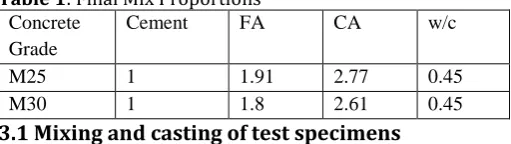
[image:2.595.37.293.560.632.2]Ordinary Portland cement conforming to IS-8112, crushed coarse aggregates (specific gravity = 2.65), fine aggregates (specific gravity = 2.63) conforming to IS-10262, and water were used in the concrete for the preparation of test specimens. Local coarse sand obtained from river bed was used. Its various physical properties were tested as per provision of IS: 383 – 1970. The coarse aggregate were crushed-angular in shape and these consist of 80% of 10 mm aggregate size and 20% was of other sizes. The aggregates were free from dust particles. End-hooked steel fibers (60-mm length with a 0.70-mm diameter; aspect ratio 85) were used. Fibrillated polypropylene fibers (Recron 3S) of length 12 mm are used. Using these aggregates, M25 and M30 grade of concrete was prepared as per provision of IS 10262. The proportions of the mix are given in the table 1.
Table 1: Final Mix Proportions Concrete
Grade
Cement FA CA w/c
M25 1 1.91 2.77 0.45
M30 1 1.8 2.61 0.45
3.1 Mixing and casting of test specimens
Materials were mixed in a linear-cross-flow mixer type ‘O’ which had a capacity of and a power driven rotating pan and paddle. This mixer is sturdy enough for fibrous mixes and a good uniformity of fiber distribution is achieved. All cubes and prismatic beams were cast in the standard metallic moulds and vibrated to obtain the required sample size. The moulds were cleaned off dust particles and mineral oil was applied on all sides of the moulds before the concreting. Thoroughly mixed concrete was
filled into the mould in three equal layers. Then, the mould was placed on the table vibrator for a small period. Excess concrete is removed with trowel and top surface is finished to a smooth level. After 24 hours protection in the moulds, the samples were demoulded and put in a curing water container with water kept at a temperature of 23 ± 2oC for 28 days.
4. TESTING
Standard cubes and prisms were tested at 28 days to determine the effect of fiber parameters on the compressive strength and flexural strength of FRC respectively. The effect of fiber parameters on the abrasion value of the concrete was also studied. This section presents the details of the tests conducted and the corresponding results.
4.1 Compressive Strength
© 2015, IRJET.NET- All Rights Reserved
Page 8
Chart-1: Compressive strength of SFRC at differentvolume fractions
4.2 Flexural Strength
Three prismatic beams of 100-mm square cross section and 500-mm length prepared using SFRC were tested under monotonic increasing loading to determine their flexural tensile strengths. The rate of load application was kept at 1.0 MPa/min in all cases. A four-point bending setup was used, in which the loading span was taken as one-third of the distance between the supports. The flexural tensile strength was calculated as PL/BD2, where
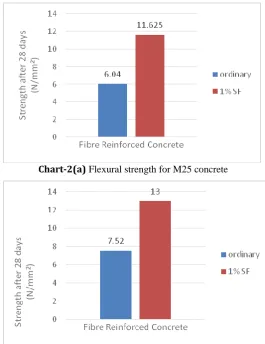
P is the failure load; L is the effective length of beam specimen; B and D are the width and depth of the beam, respectively. Fig 1 shows a typical beam specimen at the initiation of flexural cracking and at failure near the ultimate state. The fiber pull-out behavior in all SFRC specimens was observed during the testing. Chart - 2 indicates the mean values of flexural strengths of M25 and M30 concrete mixes. It is indicated in the figure that the addition of fibers improved the flexural strengths of concrete. The crack widths were also observed to be lesser and first crack occurred at higher load. The addition of steel fibers in the concrete also increased post-cracking strength and it changed the section failure from brittle to ductile mode. Chart-3 shows the enhancement of the average residual strength exhibited by different SFRC specimens at the optimum value of the fiber dosage determined from compressive strength basis for both group-1 and group-2.
Fig 1: SFRC Beam specimen: a) at initiation of cracking, b) at failure near ultimate state
Chart-2(a) Flexural strength for M25 concrete [image:3.595.306.572.266.611.2]
© 2015, IRJET.NET- All Rights Reserved
Page 9
Chart-3: Load-deflection response of SFRC prism atoptimum volume fraction Flexural strength for M25
concrete
4.3 Permeability Test
Permeability Test consists in subjecting the mortar or concrete specimen of known dimensions, contained in a specially designed cell, to a known hydrostatic pressure from one side, measuring the quantity of water percolating through it during a given interval of time and computing the coefficient of permeability as described in IS:3085 -1965(reaffirmed 2002). For carrying out the test cubes of size 150 mm were prepared. Three cubes each were prepared for plain concrete, with addition of combination of steel and reinforced fibers. The first combination consisted of 0.5% steel and 0.75% polypropylene fibers where as second combination consisted of 0.75% steel and 0.75% polypropylene fiber. Samples were prepared for both M25 and M30 grades of concrete. Sand paper was applied at top and bottom faces of cubes before placing it in permeability cell to remove any laitance. After placing the samples in permeability cell the sides of the cell was sealed first with a mixture of hot wax and sealing compound and then rubber sealant was also applied. The initial pressure applied on specimen was 5 kg/cm2 which was gradually increased to 13 kg/cm2. The flow of water through the sample was observed for 100 hours and volume of water collected was noted. It was observed that the addition of combined fibers decrease the Permeability of concrete significantly and it was least in case of first combination. (0.5% steel and 0.75% polypropylene fibers). The following results were obtained.
Chart-4: Coefficient of permeability for M25 and M30 concrete.
4.4 Abrasion
© 2015, IRJET.NET- All Rights Reserved
Page 10
Chart-5: Abrasion value for M25 and M30 concrete.5. CONCLUSION
The experimental study was carried out to study the effects of steel fibers on compressive and flexural behavior of concrete. M25 and M30 grades were selected for the purpose. While it was observed that there was enhancement of the compressive strength with the addition of steel fibers in both the grades, it was slightly higher in case of M30 grade. When the volume of steel fibers was increased from 0.5% to 1.0%, the strength of concrete increased but when the volume was further increased to 1.5% decrease in strength was observed. The flexural strength of concrete also improves with increase of the fiber volume fraction and it was almost double as compared to plain conventional concrete. The increase in ductility was also observed. The results showed that the combination of both the fibers resulted in significant decrease of permeability of concrete and it was more abrasive resistant as compared to normal concrete. Thus, in the construction practice, a percentage of costly steel fibers can be replaced by the least expensive polypropylene fibers and still obtaining a tough and durable concrete.
REFERENCES
[1] Hannant, D. J. (1978). Fiber cements and fibre concretes, Wiley- Interscience, New York
[2] Di presco, M plizzari (2009), “Fibre reinforced
concrete :New design perspective. Materials and structures”, 42,pp.1261-81.
[3] Kwak, Y.-K., Eberhard, M. O., Kim, W.-S., and Kim, J. (2002). “Shear strength of steel fibre-reinforced concrete beams without stirrups.”ACI Struct. J., 99(4), 530–538
[4] Parra-Montesinos, G. J. (2006). “Shear strength of beams with deformed steel fibres.” Concr. Int., 28(11), 57–66.
[5] de Montaignac, R., Massicotte, B., and Charron, J. (2012). “Design of SFRC structural elements: Flexural behavior prediction.” Mater. Struct., 45(4), 623–636 [6] Sahoo, D. R., and Sharma, A. (2014). “Effect of steel
fibre content on behavior of concrete beams with and without stirrups.” ACI Struct. J., 111(5), 1157–1166. [7] A.P Singh et al (2014), “Experimental Study on the
Strength Characteristics and Water Permeability of Hybrid Steel Fibre Reinforced Concrete”, Hindawi Publishing Corporation International Scholarly Research Notices, Volume 2014, Article ID 518640, [8] Banthia, N; Chokri, Trotier, J.F, “ Impact test on
Cement Based Fibre Reinforced Composites”,A.C.I. Publications ,Detroit USA, 1995, SP 155-9, PP 171-188.
[9] Jindal, R.L., “Shear and Moment Capacities of steel fibre reinforced concrete beams” , International Symposium, American Concrete Institute Detroit/usa, 1984 pp. 1-16.
BIOGRAPHIES
The author is currently Working as Assistant Professor in Civil Engg. Department of Guru Nanak Dev Engg. College Ludhiana.
The author is Currently working as Professor in civil Engg. Department at NITTTR, Chandigarh and has vast experience in field of Academics, Resarch and Consultancy.
The author is currently Working as Associate Professor in Civil Engg. Department of Guru Nanak Dev Engg. College Ludhiana and has wide experience in field of Structural design and consultancy.