© 2015, IRJET.NET- All Rights Reserved
Page
656
Smart Home System Using Service Robot and Wireless Sensor Network
1
Vrushali K. Jadhav,
2Prof. R. G. Dabhade
1
Student, Department of E&TC SNDCOERC Yeola, Maharashtra, India
2Professor, Department of E&TC SNDCOERC Yeola, Maharashtra, India
---***---Abstract
-
Engineering has always tried to developtools and techniques for smart home systems. Meanwhile, researchers are constantly looking to find very powerful and effective techniques for smart home system. The robotics and WSN have recently become more and more popular as general way in smart home system. Wireless sensor networks (WSNs) for smart home system can provide the data collection necessary after an event such as gas leakage or smoke detection or any command given by user. Technical challenges affecting deployment of such a network include ensuring power is maintained at the sensor nodes, reducing cost such as installation, maintenance and collect the data using wireless sensor network. Fast development in the field of robotics, robots are commonly use for domestic purpose. This paper gives the idea for design and implementation of a new smart home system with a robot and WSN. The sensor nodes are installed in the house to detect different parameters like gas leakage, smoke and temperature and send detection messages to the robot. The robot can go to that area and take appropriate action.
Key words: Wireless Sensor Networks (WSN), Robot, Smart Home, GSM etc....
1. INTRODUCTION
The performances of home automation systems
and indoor security systems are rapidly improving with the development of wireless communication technology.
A smart environment means a physical world that interconnected through a continuous network extremely and invisibly with sensors, actuators and the units used for computation purpose, embedded coherently in the everyday objects of our lives. A smart home is a residence in which we use computational unit to computing and information techniques apply to expect and respond to the user needs and can be used to improve the everyday life at home. In smart home system applications for smart homes can be found in following types: entertainment, prosperity, environment, security, communication, and appliances.
Wireless Sensor Networks (WSNs) and robotics have become an attractive technology for the
researchers to develop a smart home system.A WSN is a
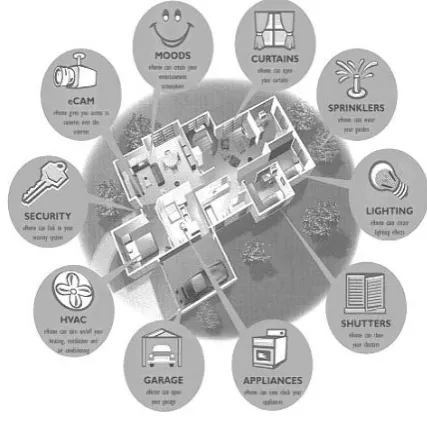
[image:1.595.334.548.305.516.2]system that consists of a distributed sensor nodes which sense the respective parameters and interconnected by wireless communication system.
Fig 1.1 Smart Home
Following factors are considered to realize the WSN for smart home:
1) Wireless technologies
Various wireless technologies are available in the market. With those technologies the rapid development of the WSN becomes practicable. The wireless technologies such as Bluetooth, IR (infrared), RF (radio frequency), ZigBee, Wi-Fi, UWB, WLAN, and NFC are commonly used.
2) Microcontroller
© 2015, IRJET.NET- All Rights Reserved
Page
657
will require at least use one or more than one robot. Itwould be possible.
3) Robots
Robots are manufactured to perform daily life house duties. Robots are use for security purpose like door open and close, alert on any emergency etc. Robots are programmed to perform predefined task. Even harder task can perform by robots with additional hardware. The growth of research in field of robotics, can use in daily life task.
This paper observes the possibility of embedding WSN and robot into a smart home system. There are two steps in the integration of WSN and robotic systems for smart home. First step is the robots can be considered to be mobiles nodes that collect information from static nodes. Second, the WSN can be considered as an extension of the sensorial capabilities of the robots and it can provide a smart environment for the robots.
2. SYSTEM ARCHITECTURE
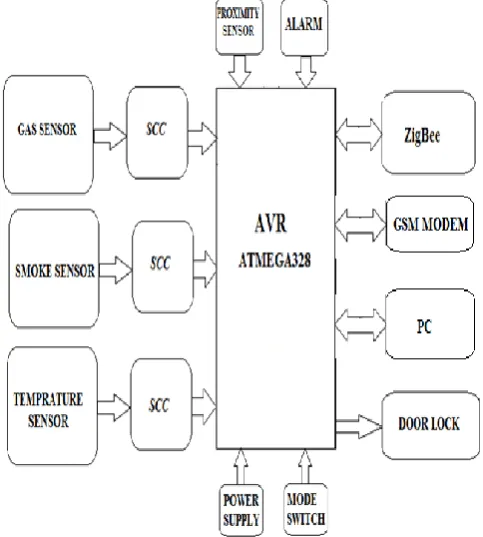
The architecture of the system is visualized in figure 2.1. Main blocks are involved: the sensors, the WSN system, Camera, and the Robot.
[image:2.595.37.273.420.624.2]Sensors: S1- Temperature sensor, S2- LPG Gas sensor, S3- Smoke sensor,
Fig- 2.1 System Architecture
The WSN system provides means to store information, monitor the sensors placed in smart home, send tasks of the user and monitor the tasks execution by the robot.
The smart home system consists of two working mode:
1) Autonomous Mode
Each room under monitoring deploys several fixed sensors, which is responsible for day-to-day information collection and reporting alarm when something emergency happens. The home server
analysis the site information and give the data to user for making decisions. When the accident occurs, the robots take the appropriate action.
A camera is used to provide a view of the smart home. Camera may cover a part of the room. Cameras are turned off in normal conditions to reduce unnecessary power consumption. At the time of the event or accident, the camera nodes focusing on the position of accident and send the pictures to the security cabin. GSM MODEM is used to send the SMS to the owner in emergency case.
2) User Control Mode
Users can control the robot by PC and perform the operation told by user. RFID reader is used to provide the service for door open system in user mode.
3. PROPOSED HARDWARE DESIGN
The hardware system is divided into 6 parts. There are microcontroller ATMEGA328, sensors like temperature sensor, smoke sensor and LPG gas sensor, robot, GSM Modem, ZigBee module and camera. The microcontroller ATMEGA328 used for monitoring and controlling action. It is used to read the measurement value of sensor, write an input to control the stepper motor and LED module, analog-digital converter and serial communication for the flow of value from sensor. The microcontroller gets the analog voltage signal from the sensor and converts it to digital signal. After
microcontroller receives the digital signal,
[image:2.595.315.557.484.753.2]microcontroller sends the value from sensor to the robot via wireless connection.
© 2015, IRJET.NET- All Rights Reserved
Page
658
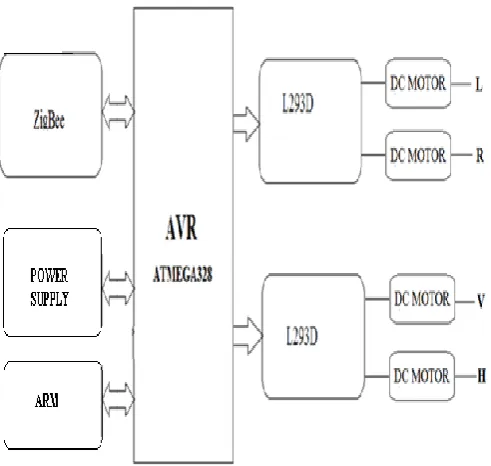
Fig - 3.2 Robot Architecture
3.1 Sensors
Low cost sensors are used to sense the parameters to reduce the cost of the system. Using ZigBee module data of all sensors are collected and send for the further process.
1. Temperature Sensor (LM35):
The LM35 is a integrated-circuit temperature sensors. Output voltage of LM35 is linearly proportional to the Celsius temperature. The advantage of LM35 over linear temperature sensors calibrated in ° Kelvin, there is no need to subtract a constant voltage from its output to get convenient (Centigrade) Celsius scaling.
The temperature sensor (LM35) do not need any external calibrator unit or trimming to provide typical accuracies of ±1⁄4°C at room temperature and ±3⁄4°C over a full −55 to +150°C temperature range. The cost of LM35 is low and it is well calibrated.
2. Smoke Sensor (MQ-2):
MQ - 2 is a combustible gas and smoke sensor, use to detect the concentrations of combustible gas or smoke in the air and outputs its reading as an analog voltage.
3. LPG Gas Sensor (MQ-6):
MQ-6 is a gas sensor use to detect liquefied petroleum gas (LPG). It also detects propane and butane concentrations in the air. The range of gas concentrations in the air are detected by MQ-6 is from 200 to 10000ppm.
High sensitivity and fast response time are the advantages of MQ-6. The output of sensor is an analog
resistance. It is a simple circuit; it requires power the heater coil with 5V, adding a load resistance in it, and then connect the output to an ADC.
4. Proximity Sensors:
Without any physical contact proximity sensor can detect the presence of nearby objects.
A proximity sensor frequently outsends an electromagnetic field or a beam of electromagnetic radiation, and waiting for changes in the field or the signal which is return by sensor. The target of proximity sensor is an object, which is detected from predefined range.
“Nominal range” is defined as the maximum distance that the sensor can detect. Proximity sensors are reliable and their functional life is long because of the no mechanical parts are use and no physical contact between sensor and the sensed object.
3.2 WSN System:
Wireless Sensor Network is used to create a smart environment. The wireless sensor nodes are embedded into smart home, and they can communicate with each other. The implementation of the system using WSN has some benefits, like high sensing capability, processing capability, distributed processing capacity; this system consists of various nodes on which sensors are connected.
1. ZigBee:
ZigBee is based on an IEEE 802.15.4 standard. ZigBee is used to create personal area network though its low power consumption limits transmission distance to 10-100 meters line-of-sight. The specifications of Zigbee are suit for high level communication protocol.
2
. GSM MODEM (SIM 900):
SIM900 is a GSM Quad-band modem, which having a frequency of 850/900/1800/1900MHz and which can be access the Internet and also used for oral communication (It provides the connection for a microphone and a loud speaker) and for SMS. The size of GSM modem is 0.94 inches x 0.94 inches x 0.12 inches with L-shaped contacts. Phone communication and data communication can control by the processor.
3.3 Robot for Smart Home System:
© 2015, IRJET.NET- All Rights Reserved
Page
659
3.4
Microcontroller (ATMEGA328):
The Atmega 328 / 328P are 8-bit CMOS microcontroller having low-power and based on the AVR enhanced RISC architecture. It executes instructions in a single clock cycle, the ATmega328 achieves throughputs approaching 1 MIPS per MHz, which is used to designed optimize power consumption versus processing speed.
4. RESULTS
5. CONCLUSIONS
The objective of this paper is to show the usability of the robots in our daily lives by constructing the smart environment for the robots using WSN. This try is expected to enable humans to concentrate on the tasks by liberating ourselves from unpleasant daily chores with the help of robots. This system is able to provide solutions for complex task in smart home system.
We have presented the design and
implementation of a smart home system with a Robotics and WSN. In this paper we depict the architecture and implementation of a smart home with WSN and robot, in which the home server acts as an intelligent collaborator between our robot and the environment. The system has successfully overcome quite a few drawbacks of the existing systems by reducing the complexity of circuit, power consumption, and maintenance, same time providing a flexible and precise form of maintaining the environment.
REFERENCES
[1] Wang Huiyong, Wang Jingyang, Huang Min,
Building a Smart Home System with WSN and Service Robot, 2013 Fifth Conference on Measuring Technology and Mechatronics Automation, IEEE Computer Society.
[2] Soares, S.G., Tak a o, T.B., da Rocha, A., Ara u jo, R.A.M., and Barbosa, T.A.: Building Distributed Soft Sensors, International Journal of Computer Information Systems and Industrial Management Applications, 2011, 3, pp. 202-209.
[3] Sharma, U., and Reddy, S.: Design of Home/Office Automation using Wireless Sensor Network, International Journal of Computer Applications, 2012, 43(22), pp. 46-52
[4] Wilson, V. Bhargava, A. Redfern, P. Wright, “A
Wireless Sensor Network and Incident Command Interface for Urban Firefighting. Mobile and Ubiquitous Systems,” Networking & Services, Volume 00. 2007: IEEE Computer Society Washington, DC, USA.
[5] S. Coradeschi and A. Saffiotti, "Symbiotic robotic
systems: Humans, robots, and smart
environments," IEEE Intelligent Systems, vol.21, no.3, pp. 82-84, 2006.
[6] VaidyanathanRamadurai, Mihail L. Sichitiu. :
Localization in WirelessSensor Networks: A Probabilistic Approach, Proceedings of the 2003 International Conference on Wireless Networks, 2003, pp.275-281.
© 2015, IRJET.NET- All Rights Reserved
Page
660
Volume 00. 2007: IEEE Computer SocietyWashington, DC, USA.
[8] LI Li, LIU Yuan-an, TANG Bi-hua: SNMS: an
intelligent transportation system network
architecture based on WSN and P2P network,” The Journal of China universities of posts and telecommunications, 2007, 14(1) pp. 65-70.
[9] R. Szewczyk, A. Mainwaring,J. Polastre,D.Culler. :An
analysis of a large scale habitat monitoring application, Proceedings of the Second ACM conference on Embedded Networked Sensor Systems (SenSys), 2004,pp.214–226.