2018 2nd International Conference on Modeling, Simulation and Optimization Technologies and Applications (MSOTA 2018) ISBN: 978-1-60595-594-0
JPEG Image Information Hiding Algorithm Based on Intelligent Agent
Adaptive Block
Ju-bao QU
*and Hong-tao LIANG
School of Mathematics and Computer Science, Wuyi University, Wuyishan, Fujian, China
*Corresponding author
Keywords: Intelligent Agent, Adaptive, Image, Information hiding.
Abstract. After analyzing and exploring a variety of image information hiding algorithms, this paper proposes a method based on intelligent multi-agent system to segment wavelet blocks adaptively according to different textures. This method can automatically adjust the embedding intensity of hidden information according to the difference of visibility JND and ensure the original image. Chip quality, and the use of chaotic sequence algorithm to properly encrypt the hidden information, so that the hidden information has better security, the design of information embedding and extraction algorithm, and on the platform of MATLAB to achieve. Simulation results show that this method not only maintains the high visual quality of JPEG images, but also has a high capacity of information hiding, which provides security for real-time image communication in the Internet environment.
Introduction
With the rapid development of information technology, information security is becoming more and more important. If important information can be hidden into the open carrier, to achieve the safe transmission of information, in the field of information security has an important role. Reference [1] proposes an information hiding algorithm based on JPEG image for steganography and digital watermarking; Reference [2] embeds secret information by modifying DC coefficients, which easily leads to image distortion and has a small hiding capacity; Reference [3] proposes a distortion measure based on structural similarity, and selects the embedding algorithm by the steepest descent method. In this method, the control parameters are adjusted after the secret information is embedded, which ensures that the embedded image has a low distortion level and balances the relationship between distortion and capacity. In this paper, a method based on intelligent multi-agent system is proposed to segment wavelet blocks adaptively according to different textures. According to the size of visibility difference JND, the embedding intensity of hidden information is automatically adjusted to ensure the quality of the original image. Chaotic sequence algorithm is used to encrypt the hidden information properly to make it hidden. Tibetan information has better security. The algorithm of information embedding and extracting is designed and simulated in MATLAB and Java-based multi-agent system development platform JADE.
Intelligent Multi Agent System MAS
Because the problem is usually very complex and difficult to solve, only one agent can't accomplish the complex problem because of its limited ability and knowledge. Different agents need to exchange information and communicate with users, resources or other agents to accomplish the common task, thus forming a multi-agent system. There are many software platforms for developing MAS systems, among which JADE (Java Agent Development Framework) is the best. The platform is a Agent abstraction based on Java language and provides a friendly API. JADE follows the FIPA specification and is written entirely in the Java language. It is a free and open source multi-agent development framework. JADE provides basic communication mechanism, yellow page service, naming service and so on, which can effectively integrate with other Java development platforms and technologies, and greatly simplifies the development of multi-agent systems.
Adaptive Multilevel Texture Block Classification Based on MAS
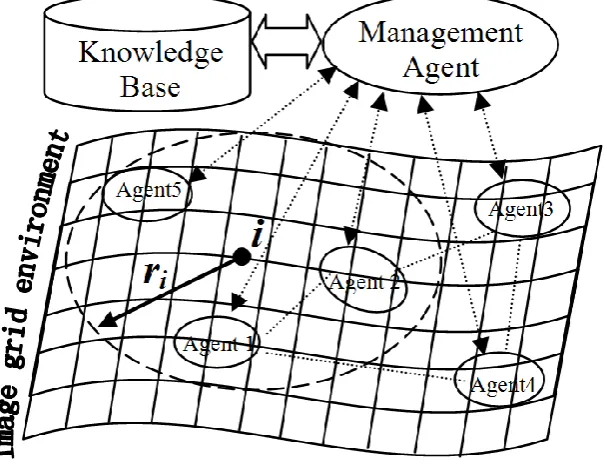
In order to hide the secret information into the image, the original image is decomposed by two-dimensional discrete wavelet transform, and the RGB wavelet decomposition approximation sub-graphs ca, ch-level, CV vertical and CD diagonal detail subgraphs are obtained respectively. Literature [4] discusses that approximation subgraph CA has a strong ability to resist external influence, but its carrier image transparency is poor; literature [5] discusses that detail subgraph CD is vulnerable to external noise, conventional image processing and other attacks, its robustness is poor, but allows higher watermark strength. In order to ensure a good balance between transparency and ro-bustness, the detail subgraphs CH and CV are selected as the information embedding region. Firstly, CH and CV are divided into n*n (n is odd) sub-block Bk, and the center point of sub-block is chosen as the embedding point of information. According to the characteristics of visual masking, for regions with different local properties, different signals can be allowed to be superimposed on the premise of ensuring the invisibility. It mainly involves JND (Just Noticeable Difference). JND should be determined according to the characteristics of HVS. Many kinds of JND calculation methods are given in [6]. However, these methods are fixed in the classification of blocks, and can not be adaptively partitioned with the image features and the embedded information, which affects the quality of information embedding. In this paper, an adaptive multilevel texture block classification method based on MAS is adopted. According to the different strength of texture block sets, different embedding intensities are adopted. The difference of visibility JND is defined for each block. The block level is adaptively divided by MAS according to the value of JND. MAS uses the "knowledge base" to guide the management agent to carry on the intelligent partition, displays the agent's autonomy, the interaction, the adaptability and the use knowledge self-solving ability, stores the knowledge which unceasingly evolves and learns in the pixel movement, the marking, the du-plication, the competition, the death and so on partition behavior, forms the knowledge base, the instruction. How other agents in the system work, coordinate the interaction, arbitrate disputes and so on, because of the use of knowledge base, avoid the drawbacks of each agent to repeat learning, improve the segmentation efficiency.
Using Agent local sensing function to calculate neighborhood wavelet texture Mean(i), Where m is the number of pixels in the neighborhood with I as the center and R as the radius (|| i-j||< r), I(j) is the JND value of the pixel J.
Agent determines the texture block level procedure as follows: JNDi(Bk)=Li×Mean(Bk)
Xm= Max(Bk)-Mean(Bk) Xn= Mean(Bk)-Min(Bk)
if Xm>JND(1,Bk) && Xn>JND(1,Bk)
JND (1,Bk) is a 1 level texture block with an embedded intensity of R1. else if Xm>JND(2,Bk) && Xn>JND(2,Bk)
JND (1,Bk) is a 3 level texture block with an embedded intensity of R1. else ……
Among them, Li is constant {i=1,2,3,... }; Mean (Bk) denotes the mean wavelet coefficients of Bk blocks; Max (Bk) and Min (Bk) denote the maximum and minimum wavelet coefficients of Bk blocks, respectively. The value of L1 is the largest and the L3 value is the smallest. The R4 value is the largest and the R1 value is the smallest.
[image:3.595.147.451.197.433.2]The adaptive multilevel texture block classification process based on MAS is illustrated in Figure 1.
Figure 1. Adaptive multilevel texture block classification process map based on MAS.
Embedding and Extracting Algorithm of Information
Information Embedding Algorithm
The information embedded in the image can be all kinds of bit stream data. Take Word document as an example to illustrate the process of information hiding algorithm. In order to achieve better information encryption effect, the word bit stream data is encrypted by chaotic sequence before information hiding. The carrier is a color 32 bit JPEG image, which embeds information into three planes of RGB. The implementation steps of the algorithm are as follows:
(1) First, the hidden information Word document is converted into a one-dimensional array Wtb (n), and the Wtb (n) is converted into bit stream data: m={m1,m2,m3,}, mi {0,1}. Then select x0, μ to generate chaotic sequence xi, and then add module 2 with bit stream data m to get the encrypted binary stream data: z={zi|zi=mi xi i=1,2,3,}.
(2) The RGB plane of the original image is decomposed by a layer of two-dimensional discrete wavelet, and the level of the wavelet decomposition of RGB and the vertical of CV are obtained as the information embedding region respectively. The information embedding region is divided into blocks.
(3) Calculate the JND value of each block, determine the level of the block according to the JND value, and determine the strength of the embedded information by the level of the block.
(4) the embedding method of information is: if z(k)==1 f(i,j)=mean(Bk)+r
Among them, f (I, J) is the wavelet coefficient of the Bk block central point; R is determined by the level of the block.
(5) Repeat steps (3) and (4) until all the data are embedded, and then use image wavelet inverse transform function IWDT transform to generate the carrier image containing information.
Information Extraction Algorithm
The process of information extraction is the inverse process of embedding information process. In order to extract information, x0 and μ values must be generated for generating chaotic sequences.
(1) The dense image is decomposed by a layer of two-dimensional discrete wavelet decomposition, and the wavelet decomposition quantities of RGB, ch level and CV vertical detail subgraphs, are obtained respectively.
(2) Mas inverse texture partitioning of CH and CV detail sub-images is performed to determine the relationship between the center wavelet coefficients of Bk blocks and the mean of Bk blocks to determine the hidden information.
if f(i,j)>mean(Bk) z(k)=1 else z(k)=0
(3) using x0,μvalue to generate chaotic sequence xi, using Xi to decrypt Z (k): m={mi|mi=zixi, i=1,2,3,}, to get the Word document data M.
(4) transform m into one-dimensional array Wm2 (x) and then revert to Word document.
Experimental Results
The simulation experiment is implemented on the platform of MATLAB2015. The intelligent MAS system of image segmentation is implemented on the Java-based software platform JADE.
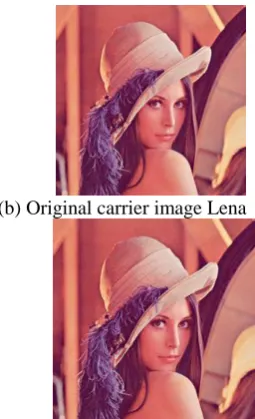
In order to verify the performance of the algorithm, Hibiscus (256*256) and Lena (400*300) with different amount of embedded information and different JPEG color carrier images are selected for the experiment of algorithm hiding effect. The results before and after hiding are compared with those in Figure 2. Compared with figure 2, it is difficult to distinguish the difference between the naked eyes and the hidden ones.
(a) Original carrier image Hibiscus (b) Original carrier image Lena
(c) Carrier image Hibiscus after embedding Word
document
[image:4.595.354.482.463.673.2](d) Carrier image Lena after embedding Word document
Figure 2. Carrier image contrast before and after information hiding.
Usually when the PSNR is greater than 36 dB, the human eye will not observe the image changes; when NC=1, the extracted information document will not appear scrambling. It can be seen from Table 1 that the PSNR results are different when the amount of embedded information is different, but all of them are more than 50, and the NC values are "1", which shows that the technology used in this paper is reasonable, and the algorithm has strong concealment and robustness.
Table 1. Quantitative analysis of different information embedding and PSNR and NC.
Information content (B) 25360 16365 5842 9635
PSNR(Db) 58.248 60.024 51.706 56.523
NC 1.000 1.000 1.000 1.000
Summary
Aiming at image information hiding technology, this paper proposes an intelligent multi-agent based adaptive multi-level texture block classification algorithm. According to the different texture strength of the image, the agent calculates the difference of visibility value JND. According to the value of JND, the MAS adaptively divides the level of the block, and adaptively adjusts the embed-ding strength of the hidden information according to different blocks. Therefore, it can solve the problem that the fixed classification can not be adaptively partitioned with the image features and the embedded information, which affects the quality of information embedding and the hiding effect. The simulation results show that this method is correct, information security, large amount of hiding, and has good robustness and invisibility. It has a good application prospect and value in Inter-net communication.
Acknowledgement
This work was partially supported by Fujian Provincial Higher Education Innovation and Entre- preneurship Education Reform Project (sjzy2017002), Fujian Provincial University "Curriculum Thought" Education and Teaching Reform Project (KC18087), Fujian Provincial Natural Science Foundation Project(2017J01406).
References
[1] Boyle M. The Effects of Capture Conditions on the CAMSHIFT Face Tracker[R]. Alberta, Canada: Department of Computer Science, University of Calgary, 2001: 45-47.
[2] Wong PHW, AU OC, Wong JWC. A data hiding technique in JPEG compressed domain [C]//Proc of SPIE Security and Water-marking of Multimedia Contents III. California: SPIE Press, 2001: 309-320.
[3] Nouar Ould-Dris, Ali Ganoun, Raphael Canals. Improved Object Tracking with CamShift Algorithm[C]. IEEE International Conference on Acoustics, Speech and Signal Procession, 2006: 165-167.
[4] Allen J G. Object tracking using CamShift algorithm and multiple quantized feature space [C]// Proceedings of 2003 Pan-Sydney Area Workshop on Visual Information Processing. Darlinghurst, Australia: Australian Computer Society, 2004: 3-7.
[5] Wong PHW, AU OC, Wong JWC. Data hiding and watermar-king in JPEG compressed domain by DC coefficient modification [C]//Proc of SPIE Security and Watermarking of Multimedia Con-tents. California: SPIE Press, 2000: 237-244.