R E S E A R C H A R T I C L E
Open Access
Decline in lumbar extensor muscle strength in
older adults: correlation with age, gender and
spine morphology
Devinder Kaur Ajit Singh
1*, Martin Bailey
2and Raymond Lee
3Abstract
Background:Muscle morphology, age and gender may be determinants of muscle strength in older adults. However, very few research studies have directly examined such correlation in the ageing spine. The aim of the study was to examine the correlation between lumbar extensor muscle strength, its muscle fibre angles, thoracolumbar curvature, age and gender in the older and younger adults.
Methods:Muscle fibre angles of lumbar extensor muscles, thoracolumbar curvature and lumbar extensor
muscle strength were examined in 26 young (mean age 27.9, SD 5.2) and 26 older (mean age 72.1, SD 5.9) participants. Pearson’s correlation was employed to determine the association among lumbar extensor muscle fibre angle, thoracolumbar curvature, age, gender and lumbar extensor muscle strength. Multiple stepwise linear regression analysis was used to identify significant determinants of lumbar extensor muscle strength.
Results:The results demonstrated a significant correlation between lumbar extensor muscle strength, muscle fibre angle, age and gender. In the step wise regression analysis, both gender and age were identified as the most robust determinant for lumbar extensor muscle strength in older adults. However, gender was the only determinant of muscle strength in the young.
Conclusion:These results suggest that the decline in the lumbar extensor muscle strength in older adults was more dependent on age when compared to younger adults.
Keywords:Lumbar extensor muscle strength, Thoracolumbar curvatures, Muscle fibre angles
Background
Muscle strength declines and accelerates further with age [1,2]. Previous studies recorded an approximately 50% decline in lumbar extensor muscle strength from the third to sixth decade of life [3]. Trunk extensor muscle strength is greater in males and reported to de-cline more with ageing in males [4]. Both age and gender have also been found to be correlated with trunk exten-sor muscle strength in previous studies of different groups of participants [5,6]. Poor physical performance; increased risk of falls, fractures and disability; increased
mortality and poor quality of life; fear induced inactivity are associated with a decrease in muscle strength in older adults [7-12].
Alterations and adaptations in lumbar spine morph-ology that includes lumbar extensor muscle fibre angles [13] and thoracolumbar curvatures [14] may lead to de-terioration in lumbar extensor muscle strength [15]. Pre-vious studies have examined the inter relationship between trunk extensor muscle strength with anthropo-metric measurements such as age, gender, body mass index, upper and lower limb strength together with psy-chosocial factors and predicting the trunk extensor mus-culature strength from these variables [4,6,16,17]. Lumbar extensor muscle fibre angles and thoracolumbar curva-tures changes in ageing may interact with age and gender. However, no study has been directed to examine this and * Correspondence:[email protected]
1
Faculty of Health Sciences, Jalan Raja Muda Aziz, Universiti Kebangsaan Malaysia, Kuala Lumpur 50300, Malaysia
Full list of author information is available at the end of the article
at predicting lumbar extensor muscle strength from these morphological indices. It is clinically important to examine the relationship between lumbar extensor muscle strength, lumbar extensor muscles fibre angles and thoracolumbar curvature since this relates to mechanisms of muscle force production and may help to explain how muscle function deteriorates with age in the spine.
Lumbar extensor muscle strength is dependent on many factors [18] and accurate strength prediction so far has not been completely accounted for. In addition, predictors of trunk extensor muscle strength have either been carried out for a younger group or on patients with low back pain. Some of the indices used to predict trunk extensor muscle strength presently such as body mass index and body circumference may change in older adults so the prediction equation may become inaccur-ate for use with older adults.
Lumbar musculature strength is also desirable if a defi-ciency from the normal is to be recognised in older adults. Furthermore, it is important for the assessment of func-tional performance capacity of older adults in daily living activities. However, performing lumbar strength measure-ments presents some challenges. Lumbar extensor muscle strength testing poses difficulty with muscle isolation and fixation. Occasionally, it cannot be performed because the physical health of older adults does not allow it and their motivation may be affected. Hence, it will be useful to ap-proximate lumbar extensor muscle strength of older adults from a regression model.
The aim of this study was to examine the correlation between lumbar extensor muscle strength, lumbar ex-tensor muscle fibre angles, thoracolumbar curvature, age and gender in the older and younger adults.
Methods
Participants
Fifty two participants (26 younger participants aged 20 to 35 and 26 older participants, aged 65 to 84) participated in the study from a local community area. Prior to the tests, partici-pants were assessed against the following exclusion criteria: had any history of current back pain, or back pain requiring medical attention in the last 6 months; serious trauma lead-ing to fractures or dislocations of the spine; prior surgery to the back; x-ray of the spine revealing underlying pathologies such as tumours, spinal infections, tuberculosis; any known inflammatory joint diseases, rheumatological condi-tions, spinal deformities such as scoliosis, spondylolisthesis, spondylolisis; any neurological deficits, and were taking prescribed drugs that potentially affect muscle strength, such as corticosteroids. Ethical approval was obtained from the Faculty Research Ethics and Governance Commit-tee of The University, and informed written consent was obtained from all participants.
Lumbar extensor muscle fibre angles
Both left and right lumbar extensor muscles were im-aged at 3rdlumbar spinous level in erect standing using a linear array probe of an ultrasound machine (Titan™, Sono Site UK, Hitchin, Herts, UK). Saved captured im-ages were then analysed using Matlab (Version 1.9.1 MathWorks, Inc., Natrick, MA, USA). Muscle fibre an-gles of mid-substance of the muscles were determined. Details of the procedures were as presented in our earlier study [13].
Thoracolumbar curvature
This procedure has been reported in Singh et al. (2010) [14]. Briefly, measurements of thoracolumbar curvature were performed with an electromagnetic tracking device (Fastrak Polhemus, 40 Hercules Dr, Colchester, VT 05446) by tracing the whole spinous processes of the thoracolumbar spine. Both the left and right posterior iliac spine; 1stand 8th thoracic; 1stand 5thlumbar spin-ous levels were digitized. The thoracolumbar curvature angles were determined using a pre written software using Matlab (Version 1.9.1 MathWorks, Inc., Natrick, MA, USA).
Lumbar extensor muscle strength
Lumbar extensor muscle strength was measured using a load cell (LCM 200, 1112N; Futex Advanced Sensor Technology, Inc., Irvine, California), connected to the upper trunk with the participants standing in a restraining frame. Participants did three five seconds sustained maximum voluntary contraction (MVC) with a 5 minutes rest in between. Muscle strength was calcu-lated as moments generated by the product of highest force MVC value with the moment arm. This procedure has been reported in our earlier study [15].
Statistical analysis
included in the regression to account for the potential effect of BMI on lumbar extensor muscle strength. Step-wise multiple linear regression analysis was used to iden-tify significant predictors of lumbar extensor muscle strength, using lumbar extensor muscle strength as the dependent variable and lumbar extensor fibre angles, thora-columbar curvature, BMI, age and gender as independent variables. The model was checked for multicollinearity problems using the tolerance (proportion of variability not explained) and VIF (variance inflation factor) values. A tol-erance value of less than .10 and a VIF value that is above 10, indicates multicollinearity problems in the model [19].
Results
The younger group were aged from 20 to 35 (10 males, 16 females), and the older group were aged 65 and above (10 males, 16 females). The mean age and associated standard deviations (SD) of the younger and older age groups were 27.9 (SD 5.2) and 72.1 (SD 5.9) respectively. The older age group had a mean BMI that was 1.6 kg/m2 higher than the younger age group which was determined to be a statistically significant difference (p = 0.03).
Correlations
The combined results of 2 tailed Pearson correlations for both older and younger adults were as presented in Table 1. Age was negatively correlated with lumbar ex-tensor muscle strength. Lumbar extensor muscle strength was positively associated with fibre angles and significantly larger in males. Similarly, the relationship between lumbar extensor muscle strength and the thor-acic kyphosis was low and non significant. These results indicate that lumbar extensor muscle strength and fibre angles decrease with age. These results also suggest that lumbar trunk extensor muscle strength were greater with larger muscle fibre angles and in males.
Multiple linear regression
[image:3.595.56.540.111.249.2]BMI did not appear to be a predictor for lumbar exten-sor muscles strength for both younger and older adults. As the factors that can be fitted into a regression equa-tion are limited based on the sample size, BMI was not included in the final regression analysis. The stepwise multiple linear regression analysis results for the youn-ger and older group are as shown in Table 2. The step-wise multiple linear regression analysis indicated that in older adults, only age and gender were selected as pre-diction variable of lumbar extensor muscle strength. Gender accounted for 53% of the variance, whilst gender and age combined accounted for 64% of the variance in the lumbar extensor muscle strength. For the younger adults, lumbar extensor muscle strength was only signifi-cantly predicted by gender which accounted for 21% of the variance. The standardized beta value (β) for gender is higher in the model for older adults (−.68) compared to younger adults (−.46), indicating that gender is a more important variable in strength prediction for older Table 1 The combined results of 2 tailed Pearson correlations (r) between lumbar extensor fibre angles, lumbar moments, thoracolumbar curvature, age and gender for both older and younger adults
Age Lumbar moment Fibre angles Thoracic kyphosis Lumbar lordosis Gender 1 = male, 2 = female
Age 1 -.45** -.50** .38** -.21 -.01
Lumbar moments - 1 .40** -.19 -.07 -.49**
Fibre angles - - 1 -.17 .03 -.24
Thoracic kyphosis - - - 1 .15 .12
Lumbar lordosis - - - - 1 .38**
Gender - - - 1
1 = male,
2 = female
[image:3.595.306.539.568.715.2]** = p < 0.01.
Table 2 Stepwise multiple linear regression analysis of the significant independent variables on lumbar moment
Younger (10 males, 16 females)
Older (10 males, 16 females)
B SE B β SEE B SE B β SEE
Step 1
Constant 85.21 16.31 23.98 63.75 7.81 11.48
Gender −24.23 9.67 -.46* −23.87 4.63 -.73***
Step 2
Constant - - - 130.19 25.19 10.18
4.14 -.68***
Gender −22.45 0.35 -.34*
Age −0.95
Note: younger R2= .21, older R2= .53 for step 1,ΔR2= .64.
adults. In comparison to gender, age (β=−.34) has a lower degree of importance in the model for older adults. Age does not appear to be a variable in the lum-bar extensor muscle strength prediction model for youn-ger adults.
Thus, the regression equations established were: For the older adults:
Lumbar extensor muscles strength (Nm) = 130.19 -22.45 × gender (1 = male, 2 = female)–0.95 × age
For the younger adults:
Lumbar extensor muscles strength (Nm) = 85.21 -24.23 × gender (1 = male, 2 = female)
The regression model, as predicted by the stepwise procedure, is shown in Table 3. The tolerance and VIF values in the present model indicated that there was no multicollinearity problem. The shrinkage of adjusted R2 from the actual R2was small, indicating that there were not an excessive number of variables in the model and that the sample size was sufficient.
Discussion
It is well documented in the literature that trunk muscle strength decreases in older adults [3,5,20]. However, the correlation between the decline in strength and spine morphology such as muscle fibre angles and thoracolumbar curvatures has not been examined adequately, especially in the older adults.
Thoracic kyphosis and lumbar lordosis angles showed only small inverse correlations with lumbar muscle strength which were not significant. The correlation of trunk extensor muscle strength with thoracic kyphosis in the earlier studies has been found significant inverse correlation in some studies [21,22] or no correlation [5]. A novel finding of this present study was that age was negatively correlated with fibre angles of the trunk ex-tensor muscles (r = .40, p < 0.01). The spines of adults are normally able to withstand and absorb normal spinal forces even when the spines are subjected to sudden or unexpected changes as in falls and lifting. However, it may be argued that spines in older adults may not have the same ability due to changes in both the fibre angles and thoracic kyphosis as observed in this study. These changes in mechanics may be related to the occurrence of vertebral fractures in older adults’ spines which are osteoporotic [23].
As age was strongly associated with lumbar extensor muscle strength, the multiple linear regression analysis was performed separately for younger and older adults. From the stepwise regression analysis results, gender manifested as the most robust predictor of lumbar ex-tensor strength, accounting for 53% and 21% of the vari-ation in lumbar muscle strength of older and younger adults respectively. However, when considering the pre-diction of lumbar extensor muscle strength of older adults, age becomes another strong factor to be in-cluded. These results are expected, because a greater de-cline in trunk extensor muscle strength occurs from the fourth decade of life [4] and younger adults in this study were between the ages from 20 to 35. These results sug-gest that age affects lumbar extensor muscle strength in older but not younger adults.
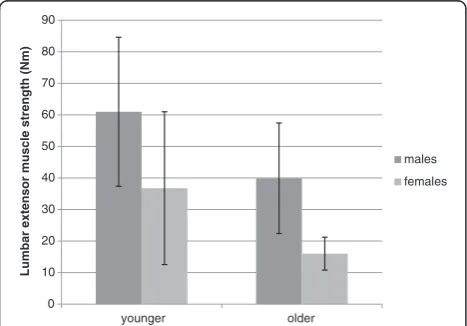
[image:4.595.57.540.100.165.2]The decrease in trunk muscle strength is believed not to occur in a linear pattern with age. Moreover, it has been demonstrated that trunk muscle strength declines at a higher percentage in older adults [3,20]. The results from the regression analysis in the present study confirm this observation since in younger adults, gender appeared to be the only predictor for lumbar extensor muscle strength, while it was gender and age in older adults. The estimated rate of decline of lumbar extensor muscle isometric strength per decade from the sixth to eight decade in this study is approximately 40% and 81% Table 3 Summary of the regression model
Variables in equation
Younger (10 males, 16 females)
Older (10 males, 16 females)
Adjusted R2 Tolerance VIF Adjusted R2 Tolerance VIF
Gender .17 1.00 1.00 .52 1.00 1.00
Age .61 .98 1.01
Tolerance (proportion of variability not explained). VIF (variance inflation factor values).
0 10 20 30 40 50 60 70 80 90
younger older
Lumbar extensor
muscle
strength
(Nm)
males
females
[image:4.595.57.291.542.705.2]in females and 21% and 41% in males. These results sug-gest that the rate of decline of lumbar extensor muscle strength in older women is approximately two times higher than that among older men. The results also demonstrate that there is a larger difference in lumbar extensor muscle strength between genders among older adults compared to younger adults (Figure 1).
From the regression analysis, thoracolumbar curvature and lumbar extensor muscle fibre angles did not emerge to be predictors of lumbar extensor strength. Although there was significant correlation of lumbar extensor muscle strength and fibre angles, it did not appear to be a strong predictor of strength. It can be deduced that some spine morphological factors are related to lumbar extensor muscle strength. However, it does not appear in the regression equation for both older and younger populations, probably because age or gender has accounted for such effects. Trunk extensor muscle strength has been reported to be based on the muscle area parameters such as cross sectional area and fat free mass [6,16]. Examination of the relationship between lumbar extensor muscle strength and a combination of the whole lumbar extensor muscle architectural pa-rameters, including fascicle length and physiological cross sectional area that were not examined in this study could also possibly explain why lumbar extensor muscle fibre angles did not appear as a strong predictor.
The stepwise linear regression met the normal distri-bution and linearity assumptions. The adjusted R2 (coef-ficient of determination) were .17 and .61 (with two predictors) for the younger and older adults model re-spectively. These differences from the R2 are approxi-mately 3%. Hence the lumbar moment strength prediction in this study can be generalised to the general population with a small variance in the equation results. The R2 in other back strength prediction models with younger par-ticipants were reported to be .39 [16] and .45 [6]. The lumbar strength prediction model of the older adults in this study showed a better lumbar strength predictability for older adults (R2= .64, p < 0.001).
Future studies should consider including the other indices of muscle architectural properties such as fibre length to further understand the relationship. This study is limited to only two age groups, includ-ing a middle age group could have provided a data set that might help to demonstrate the relationships be-tween some of the variables. Moreover, a longitudinal study could provide a definitive trend and the degree of the problem that can inform the rehabilitation team regarding at what stage of life intervention should be provided and would be beneficial. This is because there are many other factors besides ageing that influences muscle strength.
Conclusion
In conclusion, significant correlations were found be-tween age, thoracic kyphosis and fibre angles of the lum-bar muscles and lumlum-bar muscle strength; fibre angles of the lumbar extensors muscles with their strength. How-ever, only age and gender appeared in the regression analysis in older adults. In the regression equation for younger adults, gender was the only predictor for lum-bar extensor muscles. These results suggest that the de-cline in the lumbar extensor muscle strength might depend on different factors across the ages and different models are required for older adults.
Quantitative assessment of lumbar extensor muscle strength in older adults can be difficult and may be influenced by many factors. The regression analysis equation in the study could become a useful clinical tool after it has been refined through gathering of more nor-mative data to predict lumbar extensor muscles strength, in situations where direct measurement of muscle strength would be inappropriate. This regression equa-tion can also be used to compare normative data with the clinical population such as low back pain, osteopor-osis and spinal deformities. Thus, it provides an estimate for the clinical judgment of the amount of lumbar exten-sor muscle deficit present.
Competing interests
The authors declare that they have no competing interests.
Authors’contributions
All authors developed the protocol and interpreted the data. DKAS conducted data collection and data entry. DKAS wrote the manuscript and both RL and MB edited the manuscript. All authors contributed to and have approved the final manuscript.
Acknowledgements
The authors acknowledge Professor Ann Moore and all the staff at Clinical Research Center, University of Brighton for providing the support in carrying out this study.
Author details
1Faculty of Health Sciences, Jalan Raja Muda Aziz, Universiti Kebangsaan
Malaysia, Kuala Lumpur 50300, Malaysia.2Chelsea School, University of Brighton, Hillbrow Denton Road, Eastbourne BN20 7SR, UK.3Roehampton University, Roehampton Lane, SW15 5PU, London, UK.
Received: 4 February 2013 Accepted: 12 July 2013 Published: 22 July 2013
References
1. Doherty TJ:Physiology of aging. Invited review: aging and sarcopenia. J Appl Physiol2003,95:1717–1727.
2. Frontera WR, Hughes VA, Fielding RA, Fiatarone MN, Willaim JE, Roubenoff R:Aging of skeletal muscle: a 12-yr longitudinal study.J Appl Physiol2000, 88:1321–1326.
3. Limburg PJ, Sinaki M, Rogers JW, Caskey PE, Pierskalla BK:A useful technique for measurement of back strength in osteoporotic and elderly patients.Mayo Clin Proc1991,66:39–44.
4. Sinaki M, Nwaogwugwu NC, Philips BE, Mokri M:Effects of gender, age and anthropometry on axial and appendicular muscle strength.Am J Phys Med Rehabil2001,80(5):330–338.
6. Keller A, Johansen J, Hellesnes J, Brox JI:Predictors of isokinetic back muscle strength in patients with low back pain.Spine1999,24(3):275–280. 7. El Haber N, Erbas B, Hill KD, Wark JD:Relationship between age and
measures of balance, strength and gait: linear and non-linear analyses. Clin Sci (Lond)2008,114(12):719–727.
8. Lauretani F, Russo RC, Bandinelli S, Bartali B, Cavazzini C, Di Iorio Rantanen T, Guralnik JM, Ferucci L:Age associated changes in skeletal muscles and their effect on mobility: an operational diagnosis of sarcopenia.J Appl Physiol2003,95:1851–1860.
9. Rolland Y, Lauwers-cances V, Cesari M, Vellas B, Pahor M, Grandjean H: Physical performance measures as predictors of mortality in a cohort of community–dwelling older French women.Eur J Epidemiol2006,21:113–122. 10. Sayer AA, Syddal HE, Martin HJ, Dennison EM, Roberts HC, Cooper C:Is grip strength associated with health–related quality of life findings from the Hertfordshire cohort study.Age Ageing2006,35:409–415.
11. Rantanen T, Guralnik JM, Foley D, Masaki K, Leveille S, Curb JD, White L: Midlife hand grip strength as a predictor of old age disability.J Am Med Assoc1999,281:558–560.
12. Hernandez ME, Goldberg A, Alexander NB:Decreased muscle strength relates to self-reported stooping, crouching, or kneeling difficulty in older adults.Phys Ther2010,90:67–74.
13. Singh DKA, Bailey M, Lee R:Ageing modifies the fibre angles and biomechanical role of the lumbar extensor muscles.Clin Biomech2011, 26:543–547.
14. Singh DKA, Bailey M, Lee R:Biplanar measurement of thoracolumbar curvature in older adults using an electromagnetic tracking device.Arch Phys Med Rehabil2010,91:137–142.
15. Singh DKA, Bailey M, Lee R:Strength and fatigue of lumbar extensor muscles in older adults.Muscle Nerve2011,44:74–79.
16. Larivière C, Gravel D, Gragnon D, Arsenault AB, Loisel P, Lepage Y:Back strength cannot be predicted accurately from anthropometric measures in subjects with and without chronic low back pain.Clin Biomech2003, 18:473–479.
17. Wang M, Legar AB, Dumas GA:Prediction of back strength measurements in healthy females.Clin Biomech2005,20:685–692.
18. Pope MH, Goh KL, Magnusson ML:Spine ergonomics.Annu Rev Biomed Eng2002,4:9–68.
19. Pallant J:SPSS survival manual: a step by step guide to data analysis using SPSS for windows (version 10).Open University Press; 2001.
20. Sinaki M, Khosla P, Limburg PJ, Rogers JW, Murtaug PA:Muscle strength in osteoporotic versus normal women.Osteoporos Int1993,3:8–12. 21. Mika A:Is there any relationship between decrease in bone mineral
density in women and deterioration in quality of life?Med Rehabil2005, 9(2):15–19.
22. Sinaki M, Brey RH, Hughes CA, Larson DR, Kaufman KR:Balance disorder and increased risk of falls in osteoporosis and kyphosis: significance of kyphotic posture and muscle strength.Osteoporos Int2005,16:1004–1010. 23. Sinaki M, Itoi E, Rogers JM, Bergstralh EJ, Wahner H:Correlation of back
extensor strength with thoracic kyphosis and lumbar lordosis in estrogen-deficient women.Am J Phys Med Rehabil1996,75(5):370–374.
doi:10.1186/1471-2474-14-215
Cite this article as:Singhet al.:Decline in lumbar extensor muscle strength in older adults: correlation with age, gender and spine morphology.BMC Musculoskeletal Disorders201314:215.
Submit your next manuscript to BioMed Central and take full advantage of:
• Convenient online submission
• Thorough peer review
• No space constraints or color figure charges
• Immediate publication on acceptance
• Inclusion in PubMed, CAS, Scopus and Google Scholar
• Research which is freely available for redistribution