14th International Conference on Wireless Communications, Networking and Mobile Computing (WiCOM 2018) ISBN: 978-1-60595-578-0
_____________
1National Time Service Center, Chinese Academy of Sciences, Xi’an 710600, China 2
Research on Rubidium Atomic Clock Disciplined Method Based
on LabWindows/CVI
Ran Yan1,2, Jianfeng Wu1,2,3,4, Yonghui Hu1,2,3 and Xu Liu1,2,4
ABSTRACT
With the increasing demand for stable, accurate and reliable frequency standard sources in the field of measurement and control, rubidium atomic clocks with strong environmental adaptability and low price are widely used but are limited by long-term frequency drift. In this paper, 1PPS signal as the reference signal provided by the National Time Service Center, and a rubidium atomic clock frequency automatic calibration system was designed and implemented. Experimental results show that, the clock difference is less than 8ns between the rubidium atomic clock and the master clock of the NTSC, the Modified Allan Deviation is 1.83E-12@100s, and 2.70E-13@10000s. The experiment proves that the self-calibrating frequency system gives rubidium atomic clock a good accuracy and long-term stability.
Keywords:LabWindows/CVI; rubidium atomic clock; time and frequency
INTRODUCTION
Many measurement and control devices in the field of measurement and control are based on the unified reference time to complete the collaborative work, so the stable, accurate and reliable frequency standard source is very critical. In general, the good temperature characteristics of the crystal oscillator can be used as a good choice for time-frequency reference, the accuracy of which is up to 10-7~10-9 magnitude [1]. With the improvement of the accuracy requirements, small size, low power consumption, strong environmental adaptability the rubidium atomic clock are widely used, and the accuracy of which is up to 10-10 magnitude. Using crystal oscillator or rubidium atomic clock as frequency reference devices, they all share a common problem that is the long-term frequency drift.
concept and describes disciplined rubidium atomic clock that can potentially be locked to any reference time scale.Rubidium atomic clocks whose frequency is controlled by an external reference signal are known as disciplined rubidium atomic clock.
One potential rubidium atomic clock application is to lock a frequency standard at a calibration laboratory to the time scale of a national metrology institute, such as the National Time Service Center NTSC in China. The calibration laboratory could then locally generate time and frequency signals that are locked to the national standard and that are traceable to the International System of units.
THE DISCIPLINED PRINCIPLE OF RUBIDIUM ATOMIC CLOCK
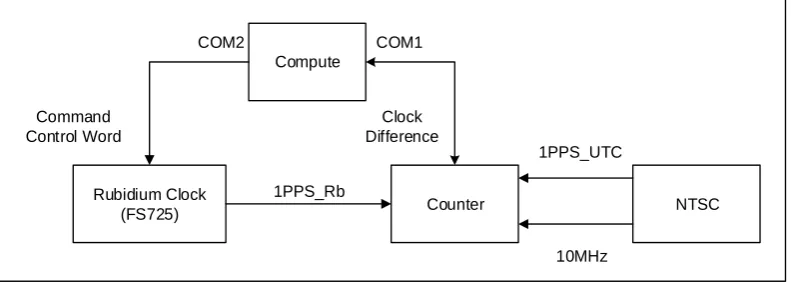
The system adopts the standard 1PPS signal as the reference provided by the National Time Service Center and adjusts the frequency of rubidium atomic clock. Block diagram of the rubidium atomic clock control system as shown in Figure 1. Time interval counter measures the clock difference between the reference standard 1PPS and the 1PPS of the rubidium atomic clock. The measurements of the time interval counter are collected by the computer serial port 1 and the frequency adjustment value of the rubidium atomic clock is calculated according to the effective clock difference. Then send the frequency control word to the rubidium atomic clock to control the frequency by serial port 2.
COM1
Command Control Word
Compute
Rubidium Clock
(FS725) Counter
1PPS_Rb
Clock Difference
10MHz
NTSC COM2
[image:2.612.102.498.433.574.2]1PPS_UTC
Figure 1. Block diagram of the rubidium atomic clock control system.
1 2
2
T t a bt ct t (1)
Where, a is the initial clock difference between rubidium atomic clock and reference signal; b is the initial rubidium atomic clock frequency deviation corresponding the reference frequency. c is the frequency drift that is aging rate.
t is other error including environmental error and measurement error between 1PPS_Rb and 1PPS_UTC [3].
Generally,
t appears the normal distribution. Most of the errors can be eliminated by smoothing over an extended period of time but the environmentalerror can not to be eliminated. However, 1 2
2
bt ct can not to be eliminated by
the average method. It can only reduce b or c to reduce the clock difference,
c is usually very small, and bt will accumulate over time, so it is necessary to eliminate or weaken the effects of b. In this way, the rubidium atomic clock frequency can be corrected to an acceptable range, while maintaining 1PPS_Rb and 1PPS_UTC clock difference as small as possible.
According to the definition of frequency:
1
1
f t
t
(2)
Differentiate (2) from the time:
2
dt dt
df f
t t
(3)
Which is:df dt
f t , When changes are small, can be write:
f t
f T
, According
to the frequency of the trend can be judged:
2 1
t t
f t
f T T
(4)
(4) is the basic formula of rubidium atomic clock frequency calibration [4], where, f f represents the relative frequency offset, T is the calibration time,
1
ensure the rubidium atomic clock output phase is continuous, but also compensate the phase from the rubidium atomic clock.
SOFTWARE DESIGN AND ALGORITHM IMPLEMENTATION
After the rubidium atomic clock is stabilized, and the clock difference data returned by the serial port 1 in real-time. According to the specific circumstances, the computer send frequency control word or phase control word to the rubidium atomic clock through the serial port 2 to realize the frequency of calibration.
Software Design
SERIAL PORT COMMUNICATION
In the LabWindows/CVI, special RS-232 communication function library is provided, and the data is received through the serial port callback function.
In this system, the measurements returned in real time by serial port 1 in 1s, so call the serial port callback function in 1s. Through the serial port callback function, the real-time display, save, waveform drawing and other functions are completed.
MULTI-THREADED PROGRAMMING
Parameter setting (Port number、 File storage path)
Mode Selection (Automatic calibration)
Function realization
Data Storage
Data Display Main panel display Drawing Waveform Data Analysis
[image:5.612.101.499.86.271.2]Main panel operation
Figure 2. Software design general block diagram.
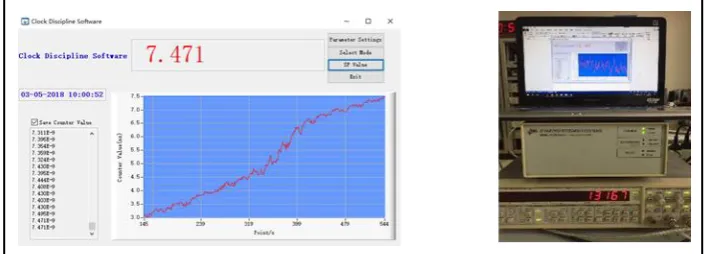
The system uses asynchronous timer to realize another four different sub-threads. Asynchronous timer is asynctmr which toolslib.fp resource file will be found in the CVI installation directory. Resource file is added to the corresponding project directory, and then the header file is loaded in the project file. The function of need to execute the sub-thread and the scheduled time as parameters are passed to the NewAsyncTimer function. When the scheduled time is up, the program will call the function of the TIMER_CB automatically. In this system, the measurements returned in real time by serial port 1 in 1s, so the asynchronous timer timing time is 1s. Multi-threaded programming is well solved by using asynchronous timer. The final real-time data acquisition software and field test are shown in Figure 3.
[image:5.612.115.468.489.616.2]The Control Algorithm of Rubidium Atomic Clock
The least square method is used to estimate the parameters of rubidium atomic clock. With the combination of the least squares method and the ping-pong algorithm, the rubidium atomic clock is well controlled between the two set values that is -1ns and 9ns.
THE LEAST SQUARE METHOD
According to the least squares method to calculate the performance parameters of rubidium atomic clock.
2 1 1 1 2 1 1 2 1 1 2 n n n t ta T t
b
c T t
t t (5)
It is assumed that T t
1 is the clock difference measured at t1 ,…, T t
n isthe clock difference measured at tn. These values are related to rubidium atomic
clock parameters, which can be expressed as (5).
Whenn3, (5) and (6) are equivalent. According to (6), the parameters of the rubidium atomic clock a ,b ,c can be calculated and then the clock difference between the rubidium atomic clock and the master clock of NTSC can be predicted.
2
1 1 1 1
2 3
1 1 1 1
2 3 4 2
1 1 1 1
1 1
2 1 2
1 1 1 1
2 2 4 2
n n n n
i i i
i i i i
n n n n
i i i i i
i i i i
n n n n
i i i i i
i i i i
t t T t
a
t t t b T t t
c
t t t T t t
(6) PING-PONG ALGORITHMCounter Value
Least-Squares a,b,c,
The clock difference prediction
Diff Value = Counter Value - Predicted value
lower limit<Diff Value<upper limit
-3σ<Diff Value<3σ
Diff Value>upper limit
Reduction of SF Value Increment of SF Value
Original SF Value Diff Value>3σ
Reduction of SF Value
Original SF Value
End Start
Diff Value<lower limit
Y
N N
Y N Diff Value<-3σ N
Original SF Value
Increment of SF Value
[image:7.612.101.495.84.336.2]Original SF Value
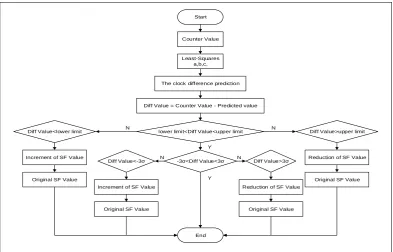
Figure 4. The flow chart of ping-pong algorithm.
The clock difference between the measurements and the predicted value returned through the serial port 1 in real-time, which is controlled strictly between set values that is -1ns and 9ns. According to the literature [6], the measurements have the same absolute error, which corresponds to the normal distribution whose average is zero. According to the principle of the normal distribution, when the deviation between the actual measurements and the predicted value beyond
3 ,3
, the accuracy of the predicted values is not enough, so need to make the right adjustments.TEST RESULTS AND ANALYSIS
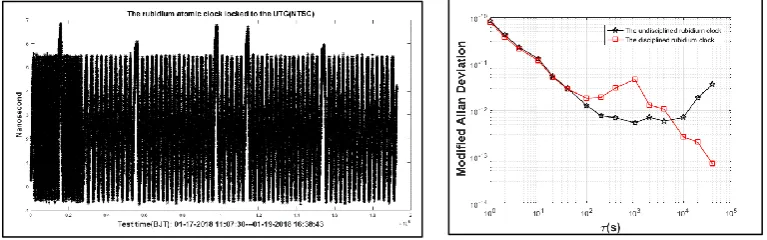
Figure 5. Performance of rubidium atomic clock locked to UTC-NTSC.
Figure 6. Frequency stability of rubidium atomic clock compared to undisciplined rubidium atomic clock.
TABLE I. THE MODIFIED ALLAN DEVIATION OF RUBIDIUM ATOMIC CLOCK COMPARED WITH UNDISCIPLINED
RUBIDIUM ATOMIC CLOCK.
(s) Undisciplined rubidium atomic clock
Disciplined rubidium atomic clock
1 8.47E-11 7.91E-11
10 1.29E-11 1.18E-11
100 1.28E-12 1.83E-12
1000 5.34E-13 4.61E-12
10000 7.00E-13 2.70E-13
20000 1.86E-12 2.10E-13
40000 3.56E-12 7.00E-14
atomic clock diverges from the undisciplined rubidium atomic clock is near 1h. Detailed comparison data that the modified Allan deviation of rubidium atomic clock compared with undisciplined rubidium atomic clock in TABLE I.It can be seen from TABLE I that the long-term stability of rubidium atomic clock is improved without destroying short-term stability.
CONCLUSION
This paper mainly designed and implemented the rubidium atomic clock self-calibrating frequency system based on LabWindows/CVI. The parameters of rubidium atomic clock are estimated by using the least square method. Meanwhile, the paper realized the compensation for the frequency offset and phase deviation of rubidium atomic clock through the automatic calibration method. The clock difference is less than 8ns between to the rubidium atomic clock and the master clock of the NTSC, the Modified Allan Deviation is 1.83E-12@100s, and 2.70E-13@10000s. The results show that the rubidium atomic clock can potentially be locked to any time scale. This unique instrument makes it possible to maintain a group of rubidium atomic clocks that are synchronized and syntonized to the same reference source, such as UTC (NTSC), the national standard for frequency and time interval in China.
ACKNOWLEDGEMENTS
The author thank Professor Wu, Researcher Zhai, and Researcher Zhang for giving valuable advice and providing test equipment during the testing process and grateful to all concerned for the support during compilation of the paper.
REFERENCES
1. Baojian C, Dehai Z, Dazhi X. 2010. “An Improved Time Synchronous System Based on GPS
Disciplined Rubidium,” International Conference on Intelligent Computation Technology & Automation.
2. Fan D, Shi S, Xiao-Hui L. 2015. “An Algorithm for the Rubidium Atomic Clock Control Based on the Kalman Filter,” Journal of Astronautics, 36(1):90-95.
3. Fan D, Shi S, Li X. 2013. “Research on rubidium atomic clock disciplined method based on
GPS receiver,” Journal of Electronic Measurement & Instrument, 27(10):980-985.
4. Xuhai Y, Huisheng Z, Yonghui H, et al. 2005. “Study on GPS Disc iplined Rb Clock Based
on New Frequency Accuracy Measurement Algorithm,” Chinese Journal of Scientific Instrument, 26(1):41-44.
5. Zilong Z, Zhaofeng W, Shuhong W. 2013. “Data Acquisition System Based on LabWindows
/CVI,” Electronic Sci. & Tech, 26(6):107-110.
6. Cheng-you L, Yong D. 2012. “Comparison of two parameter estimation methods for relative
error linear regression model,” Chinese Journal of Health Statistics, 29(6):905-907.