2018 3rd International Conference on Computational Modeling, Simulation and Applied Mathematics (CMSAM 2018) ISBN: 978-1-60595-035-8
Factor Endowment, Institutional Constraints and Regional Economic
Development Potential—Empirical Analysis Based on the
Perspective of New Structural Economics
Feng LI and Cheng-gang LI
Faculty of Finance, Guizhou University of Finance and Economics, Guiyang 550025, China
Keywords: New structural economics, Factor endowment, Institutional constraints, Regional economic development.
Abstract. The new structural economic theory holds that the factor endowment structure has an important relationship with economic development, but a country must be accompanied by institutional constraints in the process of industrial upgrading and economic restructuring. Therefore, this paper divides the factors affecting China's regional economic development into two parts:
factor endowment and institutional constraint. By constructing a panel stochastic frontier model,
this paper explores the impact of factor endowment and institutional factors on China's regional
economic development. The empirical results show that: (1) China's economy cannot exert its
maximum development potential in the presence of institutional constraints, and foreign direct investment, infrastructure construction, marketization and foreign trade can alleviate the inherent
constraints of China's current economic development to a certain extent. (2) There are great
differences in the economic development patterns among the eastern, central and western regions. The western regions depend on government expenditure to some extent, while the eastern regions pay more attention to the role of foreign trade in promoting economic development.
Introduction
In 2007, the US subprime mortgage crisis ignited the global financial crisis, which had a huge
impact on the US economy and the global economy. China's economic growth rate has changed
from the previous high-speed growth to the medium-high speed growth. In order to cope with the impact of the international financial market, China has also launched various macroeconomic measures such as the "four trillion" investment plan, expanding government expenditure to stabilize economic growth. However, the decay of the main driving forces supporting China's economic development in the past few years has undoubtedly proved that the impact of economic
development in China is not only from foreign factors, but also from domestic factors. What
internal factors will have an impact on China’s economic development? For a long period of time, a country's economic growth depends mainly on three factors, capital, labor and technology. Therefore, economic growth is largely determined by the scale of input of factor endowments.
A country's economic growth will also be affected by domestic institutional factors, such as foreign investment, infrastructure conditions, government fiscal expenditures, domestic marketization levels, and foreign trade, all of which have obvious economic policy characteristics. The imbalance of regional development is a typical feature of China's economic development.
There is a clear trend of “club convergence” in the eastern, central and western regions. The
characteristics of China's economic transformation have made the regions show institutional differences. Although China has achieved good economic results in recent years, the existence of
institutional constraints still hinders China's economic development. How to deal with the
relationship between institutional constraints and economic development, and to achieve sustained economic growth is the focus of this paper.
Literature Review
economics favored the strict control of all forms of international financial flows. It also believes that foreign direct investment is a form of foreign capital flow that is most beneficial to developing countries, and that foreign direct investment generally brings technology, management, market channels and social networks, which will be beneficial to industrial upgrading in developing
countries (Lin 2011)[1]. Infrastructure construction is the general material condition for social
development. It enlarges the possible boundary of social production by providing better services and facilities for the private sector and the public, and promotes the productive efficiency of all sectors of society. Infrastructure construction under the new structure economic theory has become a way
for government departments to stabilize economic development. As a non-market behavior,
government expenditure can influence economic growth by influencing the efficiency of factor use. Rao and Liu (2014)[2] through the establishment of a dynamic stochastic general equilibrium model to study the relationship between government expenditure and economic fluctuations in China, pointed out that government expenditure will cause the externality of production, and the impact of government productive expenditure on consumer consumption and private investment will cause
short-term crowding-out effect. A notable feature of marketization is the extent to which
non-state-owned enterprises play a role in the market. Liu and Zhang (2007)[3] pointed out that the development of China's non-state-owned economy has promoted the quantitative expansion of economic growth. The main reason is that the non-state-owned reform as a system innovation makes the interests within the system achieve Pareto-type growth.
Variable Selection and Data Sources
Variable Selection
(1) Output variables
Actual gross domestic product (RGDP). Based on the nominal GDP of various regions in China,
this paper uses the GDP reduction index to discount the real GDP, and the base period is 2006. (2) Input variables
Technological innovation (Z). The neoclassical economic growth theory points out that the
fundamental driving force of economic growth comes from technological progress and technological innovation.
Labor force (L). This paper selects the number of employed people at the end of each year as the
representative labor force.
Capital stock (K). This paper uses the perpetual inventory method to measure the capital stock,
the base period is 2006. (3) Institutional constraints
Foreign investment (FINV). Reflecting the openness of China's domestic market to foreign
investors and the ability to attract foreign investors.
Infrastructure (INFA). Infrastructure construction reflects a country's public services for residents
and enterprises, which is used to ensure the orderly social and economic activities of the country and region.
Government expenditure (GOVE). Government expenditure includes two parts: government
purchase and transfer payment. As China's economic development is faced with many uncertainties, the government plays a great role in economic and social development, allocating resources and maintaining social stability.
Marketization (MARK). The level of marketization reflects the institutional reform of China's
transition from a planned economy to a market economy, including economic, social, and legal changes.
Foreign trade (TRAD)This paper uses the proportion of total import and export trade to actual
GDP to reflect China's foreign trade.
Data Source
data mainly comes from China National Bureau of Statistics, China Statistical Yearbook and EPS database. For a few missing data, the moving average method is used to make up.
Panel Stochastic Frontier Model Setting
This paper adopts a panel stochastic frontier model containing technological innovations, which are as follows:
( ) exp( )
it it it it it
Y A t K L Z u v (1)
Among them, Yitrepresents the actual GDP; A(t) represents total factor productivity; Kit
represents capital stock which is calculated using perpetual inventory method; Litrepresents labor
input; Zitrepresents technological innovation; represents the output elasticity of capital;
represents labor output elasticity; represents the output elasticity of technological innovation;
it
u obeys a standard normal distribution. vitrepresents output inefficiency term, assuming a
semi-normal distribution.
The above formula (1) only gives the production relationship between factor input and economic output, and does not reveal which institutional factors will affect the output efficiency. Considering the factors affecting output efficiency, it also includes institutional factors such as foreign investment, infrastructure construction, government budget, marketization level and foreign trade. Therefore, the expectation of the inefficiency term is taken as the independent variable, and the institutional factors affecting the inefficiency are taken as the independent variable to model. Supposing the inefficiency function form is as follows:
0 1 2 3 4 5
exp( )
it b FINV INFA GOVE MARK TRAD
(2)
The conditional expectation of the inefficiency term can be expressed as:
0 1 2 3 4 5
( it it) exp( )
E z b FINV INFAGOVE MARKTRAD (3)
In the above formula, b0 represents a constant term, and Zi t represents an institutional factor
affecting inefficiency. Here, it refers to foreign investment, infrastructure, government expenditure,
marketization, and foreign trade; represents the parameter to be estimated. If the estimated
coefficient is positive, it has a negative impact on output efficiency. If the estimated coefficient is negative, it has a positive impact.
Empirical Analysis
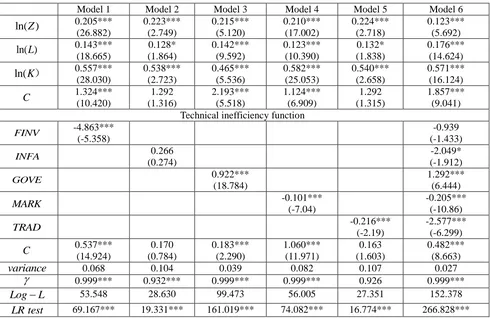
The model was estimated using Frontier 4.1 software. The estimated results are shown in Table 4. Model 1-Model 5 respectively incorporates foreign investment, infrastructure, government expenditure, marketization and foreign trade into the regression model. Model 6 is the regression
result obtained by adding all factors to the model at the same time. The output elasticity of
technological innovation in model 1-6 is between 0.123 and 0.224, the output elasticity of labor force is between 0.128 and 0.176, the output elasticity of capital is between 0.465 and 0.571, and the output elasticity of capital is obviously greater than that labor force and technological innovation, which indicates that China's economic development mainly depends on capital at this stage. This is consistent with the reality of China's economic development.
Table 4 shows that the inefficiency is mainly caused by the inefficiency term, while the contribution of the random error term to the total inefficiency is small. Therefore, technical inefficiency can be regarded as an important factor hindering economic output. At the same time, the likelihood ratio test shows that the test results significantly reject the null hypothesis. This shows that institutional constraints will have a significant impact on China's economic development.
level of 1%, indicating that foreign investment will have a positive impact on China's economic
efficiency. In Model 2, the estimated coefficient of the infrastructure is 0.266, but the estimation
results are not significant. However, from the estimation results of Model 6, the infrastructure has a significant positive impact on economic efficiency, which shows that infrastructure construction will play a certain role in promoting economic development. In Model 3, the estimated coefficient of government expenditure is 0.922, and it is significant at the level of 1%, indicating that the current government fiscal expenditure will have a certain inhibitory effect on the improvement of
economic efficiency. In model 4, the estimated coefficient of marketization is -0.101, and it is
significant at the level of 1%, indicating that the improvement of marketization level will have a positive effect on economic efficiency. In Model 5, the estimated coefficient of foreign trade is -0.216, which is significant at the level of 1%, indicating that foreign trade will have a positive
impact on China's economic efficiency. Model 6, as a robustness test, is the regression result of
[image:4.595.55.545.285.603.2]incorporating all institutional constraints into the model at the same time. From the estimation results, the conclusion is basically consistent with the model 1-Model 6.
Table 4. Panel random frontier model estimation results.
Model 1 Model 2 Model 3 Model 4 Model 5 Model 6
ln( )Z 0.205*** (26.882) 0.223*** (2.749) 0.215*** (5.120) 0.210*** (17.002) 0.224*** (2.718) 0.123*** (5.692)
ln( )L 0.143*** (18.665) 0.128* (1.864) 0.142*** (9.592) 0.123*** (10.390) 0.132* (1.838) 0.176*** (14.624)
ln(K) 0.557***
(28.030) 0.538*** (2.723) 0.465*** (5.536) 0.582*** (25.053) 0.540*** (2.658) 0.571*** (16.124)
C 1.324*** (10.420) (1.316) 1.292 2.193*** (5.518) 1.124*** (6.909) (1.315) 1.292 1.857*** (9.041)
Technical inefficiency function
FINV -4.863*** (-5.358) -0.939 (-1.433) INFA 0.266 (0.274) -2.049* (-1.912) GOVE 0.922*** (18.784) 1.292*** (6.444)
MARK -0.101*** (-7.04) -0.205*** (-10.86)
TRAD -0.216***
(-2.19)
-2.577*** (-6.299)
C 0.537***
(14.924) 0.170 (0.784) 0.183*** (2.290) 1.060*** (11.971) 0.163 (1.603) 0.482*** (8.663)
variance 0.068 0.104 0.039 0.082 0.107 0.027
0.999*** 0.932*** 0.999*** 0.999*** 0.926 0.999***
LogL 53.548 28.630 99.473 56.005 27.351 152.378
LR test 69.167*** 19.331*** 161.019*** 74.082*** 16.774*** 266.828***
Note: () represents t-value; *, * * , * * * respectively indicates significant at 10%, 5% and 1% levels.
Conclusions and Implications
Based on the new structural economic theory and the panel stochastic frontier model, this paper examines the impact of factor endowments and institutional constraints on regional economic
development potential. The empirical results show that foreign direct investment, infrastructure
construction, marketization and foreign trade will have a significant positive impact on economic development, and government fiscal expenditure will have a negative impact on economic development efficiency. Based on the above conclusions, this paper has the following implications for improving China's economic output efficiency and institutional constraints.
(1) Improve foreign business environment and promote foreign investment. (2) Optimize the structure of foreign trade and promote industrial upgrading.
(4) The government's primary responsibility should be to make good rules and supervise economic activities, and to encourage technological progress and private investment to achieve a reasonable allocation of resources by creating strong external conditions.
Reference
[1] Y Lin. New Structural Economics—Reconstructing the Framework of Development Economics [J]. Economics (Quarterly), 2011, 10 (01): 1-32.
[2] X Rao, F Liu. Government Productive Expenditure and China's Real Economic Fluctuation [J].Economic Research, 2014, 49 (11): 17-30.