
2018 International Conference on Computer, Communication and Network Technology (CCNT 2018) ISBN: 978-1-60595-561-2
An Intelligent Smoke Detector System
Based on LoRa and Indoor Positioning
Xin-hui XIE
*,
Yue-fei LV, Zheng-yang MU, Peng-xin BIAN,
Jie JI, Lian-ming XU and Neng WAN
Beijing University of Posts and Telecommunications Beijing, 100876, China *
Corresponding author
Keywords: Lora, IBeacon, Smoke detector, Indoor positioning.
Abstract. This paper presents an intelligent smoke detector system based on LoRa and indoor positioning to achieve low cost and high maneuverability. The system uses the LPWAN technology to remove the cable connecting each sensor and the server by using a LoRa module with a long distance (urban test 3 - 5km) and low power consumption (approximately 100mw). Transform network cable-used conventional smoke sensor into a Wireless smoke sensors. And match single smoke sensor module with indoor positioning device (iBeacon). The unique UUID of iBeacon help trapped people and firefighters in the fire field to locate their position, which can greatly increase the efficiency of the rescue.
Introduction
With the increasing floors and density of modern urban buildings, the occurrence of indoor fire incidents has become increasingly frequent. Once a fire incident occurs in a high-rise building, evacuation and rescue will become very difficult. Therefore, how to detect and locate the fire source and how to ensure the safety and property of people have become problems that needs to be solved urgently. Installing an indoor positioning system for smoke alarm devices is an effective solution. The accuracy of traditional positioning technology is about 10 meters[4], and GPS can locate a large range with errors. Therefore, iBeacon is used for indoor positioning in this system. Its accuracy can range from one meter to tens of meters, and the use of iBeacon can determine if the user is near a location and approximate distance. By using iBeacon module, the trapped people and firefighters can obtain the location information of themselves when the visibility is low, so it improves rescue efficiency.
The conventional smoke sensing system has the disadvantages of low intelligence, low degree of networking, and low reliability of component connection methods. It is easy to cause the control system to fail because of the network cable blown. Therefore, using wireless transmission can be more reliable. Short range networking such as ZigBee and WiFi has many practical limitations. The most prominent is the distance limitation. Routers or communication repeaters must be added in suitable locations. Furthermore, WiFi may cause high maintenance costs due to power consumption. In contrast, LoRa's maximum transmission distance can reach up to 20km. [1] It usually sleeps and only consumes energy when it periodically reports status to servers. This feature gives the wireless smoke sensor the advantage of low power consumption. Therefore, even if the entire building is powered off due, the smoke sensor can with a backup battery for a long time.
From the above, the paper design an intelligent smoke detector system based on LoRa and indoor positioning.
System Design
mobile terminals such as mobile phones to implement alarming, query the current location and achieve other functions. In the background, remote monitoring alarm application servers are connected with the database to update real-time alarm information and smoke data. The server page makes the data visible, and the administrator can view the alarm information in Lora communication range. Figure 1 shows the overall structure of the system.
[image:2.612.91.518.140.240.2] [image:2.612.87.526.468.620.2]
Figure 1. The structure of Smoke Detector System. Figure 2. LoRa base stations and sub-modules.
Substratum - Hardware
LoRa Base Stations and Sub-modules. The system uses LoRa technology -- one of LPWAN technology. LoRa is a super long-distance wireless transmission scheme based on spread spectrum technology. [2] The system uses several LoRa modules with UART interfaces, one of which is regarded as a base station and the others are sub-modules.
According to the function difference, the channel, address and working mode of base station and sub-modules are configured, which forms a master-slave communication mode.
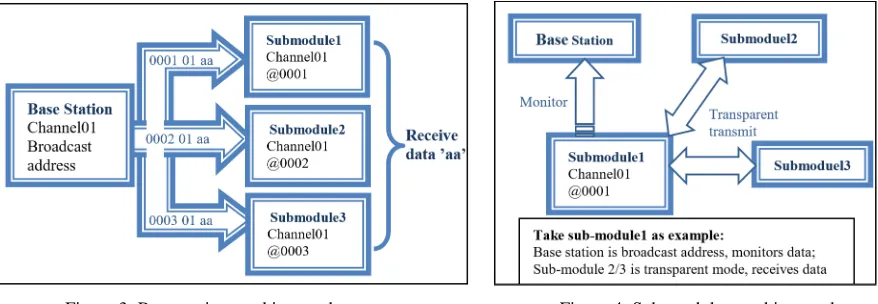
In this system, the LoRa module can be set to two working modes: fixed-point transmission and transparent transmission. In the fixed-point transmission mode, the sender can transmit data to the receiver with the specified address and channel. In the transparent transmission mode, modules in the same channel are both sender and receiver, so the data transmission is transparent. And then, there is a broadcast address in each channel. The module with the broadcast address can monitor all transmissions in this channel.
Figure 3. Base station working mode. Figure 4. Sub-modules working mode.
The system establishes the communication network between Lora modules through the following configuration methods:
First, all modules in the smoke detector system applied in one region are set to the same channel; Second, the address of the base station is set to be broadcast address, and the working mode is fixed-point transmission mode; Third, the addresses of sub-modules are different from each one, and the working mode is transparent transmission mode.
according to the address of the sub-modules. The sub-modules receive the instructions and broadcast the returning data. The base station with the broadcast address monitors the returning data. Figure 3 and Figure 4 are schematic diagrams of the case using this communication mode.
Smoke Sensor Module. The smoke sensor module uses MQ-2 gas sensor. The material of gas sensor is Tin dioxide (SnO2) with low conductivity in the clean air. MQ-2 gas sensor is highly
sensitive to LPG, Propane and Hydrogen, also could be used to Methane and other combustible steam, it is with features of low cost, long life and suitable for detecting smoke. [3, 5]
[image:3.612.106.506.577.692.2]When the target combustible gas exists, the sensor’s conductivity is higher along with the gas concentration rising. The circuit converts change of conductivity to correspond output signal of gas concentration. Figure 5 shows the data transmission between sensor module and Lora module.
Figure 5. The communication between sensor module and Lora module.
In this system we choose Z-MQ-2 module which is combined by a MQ-2 gas sensor and an 8-bit microcontroller. AD value is collected internally. The returned 10-digit AD value represents the AD value of the load resistance voltage, which can be a symbol of gas concentration. The AD values are sent to LoRa module, and the server can transfer AD value to concentration finally. The relationship of gas concentration and AD value is showed in part 4.
Software Upper Section
The software upper section includes three parts: server, database, and alarm application. LoRa module directly communicates with the server through the base station. The iBeacon module can communicate with the application through the mobile terminal, thus alarm can be performed. The application program updates the alarm information to the database. The server updates the database according to the received smoke data, and periodically detects the data. And display room states information and alarm information.
It can be seen that there are two communication routes in the system: "LoRa - Server" and "iBeacon - Alarm Application - Server". The former reflects the indoor smoke density situation in time, while the latter supports the user actively report emergency situation to make the system more secure and more humane.
Alarm Application. The alarm application is one of the most scalable parts of the system, and it allows further development and implements multiple functions. For example: positioning emergency area function, route planning function, property monitoring function, etc.
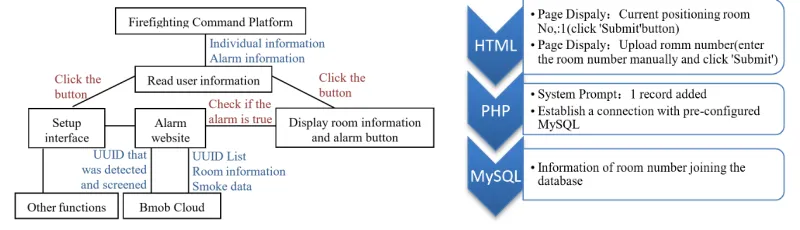
Figure 6. Flow Chart of Alarm Application. Figure 7. Date Transmission in Cloud Server.
will apply to the server for the UUID (Unique Device Identification Code) of all registered ibeacon devices owned by the user's building and use this as the target to search all ibeacon devices in the range. Detect signal strength. Through the RSSI value, the UUID with the strongest signal is filtered out to obtain the user's accurate location information.
The application uses a cloud database to store the ibeacon and corresponding room information. The UUID of the ibeacon owned by each room in the building, the room location, the room id, and the real-time room smoke density are stored in the background database and the network data can be easily accessed, stored and downloaded. When the user presses the emergency button, the alarm data information will be written in the cloud database and the alarm will be known to the fire command server.
Cloud Server. The system selects the cloud virtual host to deploy the alarm web page and the database. The cloud virtual host has a highly available cloud architecture and can store the site data in the cloud storage via FTP. At the same time, this kind of cloud server supports MySQL, PHP and Tomcat environment. Moreover, the cloud server can receive messages from the controlling terminal and make changes in the database.
In this system, the cloud server-related web pages are divided into three layers: html, PHP and MySQL to realize the function of recording the user's current location into the database.
In the html layer, the room number detected by the indoor positioning module is displayed to the user terminal, so that the user can easily check whether the location information is genuine. If it is true, submit it directly. If it is not true, enter the room number manually and submit it.
In the PHP layer, the room number submitted on the html page is added to the database. After the user’s submission, PHP uses the mysqli_query() function to connect the database insert statement with MySQL to insert the room number into the database. The information in the database can be integrated with geographic information and displayed intuitively on the server interface.
Server Software. A sophisticated and easy-to-use GUI was designed in the system to visualize the alarm data. For example, the GUI is developed by java. When the software starts to run, the user must select the USB port to which the aggregation node is connected. The GUI will test the communication between the USB port and the LoRa module by sending some commands in the background. Once the communication is established, the GUI can receive data from the remote sensor module. When the port receives data, the data will be processed and displayed.
Therefore, the server implements the following two functions:
Firstly, receive smoke concentration data in real time, monitor the fire conditions in each room, and issue an alarm if there is a fire. The server communicates the timing orientation with every LPWAN submodule, sends a command to read the AD value of the sensor (ie, data 1 in FIG. 3) and accepts the AD value for analysis. Secondly, querying alarm information in real time. By querying the database regularly, the user's alarm information will be obtained.
Lora and iBeacon Technology
LoRa
With the development of science and technology, traditional wired smoke alarm systems receive more and more restrictions in real-life scenarios, the low transmission rates is difficult to maintain, which makes the utilization of traditional smoke alarm systems very low. By combining the LoRa and the smoke sensor in the LPWAN subdivision, the network cable connects each sensor and the server, which can avoid the shortcomings of the traditional smoke alarm system.
LoRa and NB-IoT currently serve as two of the most promising low-power wide area network communication technologies in the LPWAN technology, and they also represent two major categories of LPWAN. Both of them use a star network topology through a gateway or base station. The network signal can be covered in a wide range. However, NB-IoT operates in the licensed band, which is based on the market of operators. The base station equipment is generally provided by communication equipment service providers. LoRa works in an unlicensed band. Any company can design and develop its own gateway and build its own network. Table 2 compares the parameters of NB-IOT and LoRa.
Table 2. Comparison of LoRa and NB-IoT[8].
Name NB-IoT LoRa
Network deployment Utilize existing cell sites Use Independent station
Frequency <1GHz Frequency bands used by
mobile operators
150MHz~1GHz
Transmission distance 1~20km 1~20km
Whether Implement two-way communication
No Yes
Number of connections 200000/cell 200000~300000/hub
Battery 10 years 10years
cost 5~10dollar <5 dollar
As a low-power wide-area IoT module, Lora has the advantages such as long distance, low power consumption, anti-interference and high sensitivity. For end nodes, the LoRa protocol is simpler than NB-IoT.[7] LoRa is easier to develop and process. The applicability and compatibility of the device are better. Although it cannot provide the quality of service as same as the cellular protocol, using LoRa is still a better choice in smoke alarm systems that require low cost and large amounts of connection, which makes it possible for alarm signals to be transmitted accurately and work for long periods. In harsh fire conditions, it can still work with the battery power.
iBeacon
iBeacon's low-power Bluetooth technology can effectively reduce the transmission power consumption between the hardware part of the smoke sensor and the terminal server to extend the life of the hardware part. Compared with the traditional timing maintenance sensors, the repaired frequency can be reduced. The number of smoke sensor modules installed in the room is quite large and constitutes a certain scale. iBeacon can make up for the lack of navigation GPS technology and provide users with a low-cost and energy-efficient indoor location tracking technology, which is more helpful to obtain and develop the indoor map. Users can connect to the nearest iBeacon base station to obtain the GPS location information of the base station. In this system, the smoke senses and alarms when the fire is detected. On the other hand, people in the room send location information to the server through indoor positioning. So that firefighters can determine the location of the fire quickly. Firefighters can be positioned by iBeacon-based equipment in the fire and ensure their safety.
Algorithm of Smoke Concentration
The relationship between the resistance R and the concentration C of the gas in the air: [5]
logR = mlogC +n (1) The constant n: Related to the sensitivity of the gas detection. The constant m: Indicates the sensitivity of the sensor that varies with the gas concentration.
Sensor resistance calculation:[5, 6]
(3)
Vc: The total voltage of the circuit, which is the operating voltage loaded by pin1 and pin4. Vrl: The output voltage of sensors pin2 and pin3. Rl: The load resistance.
If the Detectable smoke concentration is 300~10000ppm.After the AD conversion, the obtained data is digital signal. The 10-bit AD value (resolution is 1/1024) conversion in the system [6]. The corresponding value of 300-10000PPM (0-5V) is 0-1024, which has a proportional relationship. When the digital signal is 0, the correspondence is 300, 1024 is 10000, the equation is obtained:
(4)
(5)
Y: Smoke concentration. X: AD value
Summary
Using LPWAN technology and low-power positioning technology, we achieve a smart and energy-efficient sensor system that solves the traditional smoke Sensing system’s problems. Due to the modular feature of this system, the combined mode of LPWAN and ibeacon positioning can be applied including but not limited to smoke alarm systems.
Location-based sensing systems can be used in many emerging IoT applications. A excellent indoor positioning can be used for monitoring objects, for example: Finding the right route to a destination in a building through indoor positioning. The ibeacon-based indoor positioning is an economical, energy-saving solution. The analysis of people's behavior based on indoor positioning is of great significance to all businesses.
Acknowledgement
We would like to express our deepest gratitude to all the teachers and classmates who have worked hard for this project! We are especially grateful to our instructor, Lianming Xu, and Neng Wan! They worked tirelessly and gave us patient guidance. These effective suggestions point the way to system design. At the same time, we are very grateful for the reference papers which give us a hand!
References
[1]Sujuan Liu, Chuyu Xia. A Low-power Real-time Air Quality Monitoring System Using LPWAN based on LoRa. 978-1-4673-9719-3/16/ (2016).Reference to a book
[2]Information on https://en.wikipedia.org/wiki/LoRa
[3]Information on https://www.pololu.com/file/0J309/MQ2.pdf
[4]Information on https://blog.csdn.net/huayucong/article/details/51463057
[5]Information on https://wenku.baidu.com/view/d643116f52d380eb62946da3.html
[6]Information on http://home.elecfans.com/jishu_310075_1_1.html
[7]Information on http://fiber.ofweek.com/2016-07/ART-210022-8300-30014454.html
![Table 2. Comparison of LoRa and NB-IoT[8].](https://thumb-us.123doks.com/thumbv2/123dok_us/269319.1027184/5.612.86.526.193.311/table-comparison-of-lora-and-nb-iot.webp)