The University of Salford
College of Science & Technology
School of the Built Environment
Development of a Framework to Enhance Communication Practice for
Site-based Construction Workers in The Kingdom of Saudi Arabia
Naif Sultan Mesfer Alaboud
I.D. @00252253
II
Table of Content
Table of Tables ... VIII Tables of Figures... X Acknowledgements ... XII Declaration ... XIII Abbreviations ... XIV Publications Arising from this Thesis ... XV
Chapter 1: Introduction ... 1
1.1. Chapter Overview ... 1
1.2. Research Background ... 1
1.3. Background of Saudi Construction Industry... 4
1.4. Process Innovation Using Mobile Computing ... 6
1.5. Research Rationale... 8
1.6. Research Aim, Objectives & Outline Method ... 10
1.7. Limitations ... 11
1.8. Research Scope ... 13
1.9. Expected Contributions to Knowledge ... 13
1.10. Primary Research Areas ... 14
1.11. Outline of Research Methodology ... 15
1.12. Organisation of Thesis’ Primary research areas ... 16
Chapter 2: Key Challenges in On-Site Construction Management within the Saudi Construction Industry... 18
2.1 Introduction ... 18
2.2. Overview of Saudi Arabia ... 18
2.3. The Saudi Construction Sector ... 19
III
2.4.1. Delays to Public Construction Projects... 21
2.4.2. Key Characteristics Of Saudi Construction Workforce ... 22
2.4.3. Communication Differences Between Multi-Cultural Workforces ... 23
2.4.4. Implementation of ICT in Saudi Construction... 24
2.5. Summary ... 25
Chapter 3: State of the art review of Use of Mobile Computing within the Construction Industry 28 3.1. Introduction ... 28
3.2. Background to Mobile Computing ... 29
3.3. The Development of the Mobile Industry ... 33
3.4. Communication and Information Needs of Site-based Construction Workers ... 37
3.4.1. Overview ... 37
3.4.2. Traditional Means of On-Site Communication... 37
3.4.3. Information Needs ... 42
3.5. The Viability of Mobile Computing in Construction Site ... 47
3.5.1. The Characteristics of Mobile System for Managing Site Information ... 48
3.5.2. The Development of Proposed Models and Systems for Mobile Computing on the Construction Site ... 53
3.5.3. The Benefit of Using Mobile Computing in Construction Site ... 65
3.5.4. The Barriers and Challenges of Using Mobile Computing on the Construction Site ... 69
3.6. Summary ... 87
Chapter 4: Research Methodology ... 88
4.1. Introduction ... 88
4.2. Research Design... 89
IV
4.3.1. Epistemology ... 91
4.3.2. Ontology ... 93
4.3.3. Axiology ... 94
4.4. Research Approach ... 95
4.5. Research Choices ... 98
4.6. Research Strategy... 101
4.6.1. Case studies ... 102
4.6.2. Survey strategy... 103
4.7. Time Horizons ... 105
4.8. Data Collection Methods ... 105
4.8.1. Literature Review... 105
4.8.2. The Questionnaire Method ... 106
4.8.3. Case Studies ... 109
4.8.4. Focus Group (Validation) ... 113
4.9. Data Analysis ... 113
4.10. Summary ... 116
Chapter 5: Quantitative Data Results ... 117
5.1. Chapter Overview ... 117
5.2. Reliability ... 117
5.3. Descriptive Analysis ... 118
5.3.1. Respondent Background ... 119
5.3.2. Factors Related to Construction Sites ... 121
5.3.3. The Information Requirements that Exchange On-site Construction (At The Point of Work) ... 125
V 5.3.5. The Suggested Mobile Devices to be Used for On-site Construction
Communication ... 132
5.4. Factor Analysis: The Challenges Affecting the Adoption of Mobile Computing Technology ... 132
5.4.1. Factor Extraction ... 133
5.4.2. Varimax Rotation ... 136
5.5. Summary ... 137
Chapter 6: Qualitative Data Results ... 139
6.1. Chapter Overview ... 139
6.2. Introduction ... 139
6.3. Profile of Projects and Interviewees ... 140
6.4. Findings... 141
6.4.1. Construction Communication ... 141
6.4.2. Communication Processes and Key Information Requirements ... 144
6.4.3. Mobile Computing Technology ... 150
6.4.4. The Key Challenges to the Implementation of Mobile Computing ... 152
6.5. Summary ... 161
Chapter 7: Discussion of Key Data Requirements ... 162
7.1. Overview ... 162
7.2. Introduction ... 162
7.3. The Existing Technology Usage in Saudi Arabia ... 163
7.4. Key Information Requirements ... 166
7.5. Key Challenges Facing Mobile Computing ... 170
7.5.1. Management Challenges ... 171
7.5.2. Usability Challenges ... 182
VI
7.5.4. Cultural Challenges ... 193
7.6. Summary ... 197
Chapter 8: Framework Development and Validation ... 199
8.1. Introduction ... 199
8.2. ISM Methodology ... 199
8.3. Development of the Implementation Model ... 200
8.3.1. Structural Self-Interaction Matrix ... 201
8.3.2. Reachability Matrix ... 205
8.3.3. Factors’ Levels ... 207
8.3.4. Building the ISM-based model (Digraph) ... 211
8.3.5. MICMAC Analysis – Classification of Implementation Items ... 213
8.4. Summary ... 215
Chapter 9: Conclusions and Recommendations ... 216
9.1. Introduction ... 216
9.2. Key Research Findings Related to Objective 1 ... 216
9.3. Key Research Findings Related to Objective 2 ... 217
9.4. Key Research Findings Related to Objective 3 ... 218
9.5. Key Research Findings Related to Objective 4 ... 220
9.6. Key Research Findings Related to Objective 5 ... 222
9.7. Key Research Findings Related to Objective 6 ... 222
9.8. Contribution of this Study to Practice and Knowledge ... 223
9.9. Research Limitations ... 224
9.10. Conclusion ... 224
9.11. Recommendations for Practice ... 226
VII
The Appendices ... 248
Appendix A: Ethical Approval ... 249
Appendix B: Root Cause Analysis of Key Factors Causing Project Delays in Saudi Arabia ... 251
Appendix C: Semi-structured Interview ... 255
Appendix D: The Survey Questionnaire ... 260
Appendix E: Descriptive Statistics ... 265
VIII
Table of Tables
IX
memorandums factor ... 128
Table 5-7: Resource and inventory logs, including tracking of labourers, equipment, and materials factor... 128
Table 5-8: Quality control and assurance records factor ... 129
Table 5-9: Change order and submittal requests ... 129
Table 5-10: The percentages, mode, median and rank of barriers to the adoption of on-site mobile computing in construction ... 130
Table 5-11: KMO and Bartlett's Test ... 133
Table 5-12: The eigenvalue for each factor (component) ... 134
Table 5-13: Factor analysis ... 136
Table 6-1: The interviewees’ information ... 141
Table 6-2: The management issues ... 152
Table 6-3: Technology issues ... 155
Table 6-4: Usability issues ... 156
Table 6-5: Culture issues ... 159
Table 7-1: The information requirements of site engineers and managers ... 169
Table 7-2: The challenges related to the management factor ... 171
Table 7-3: Challenges related to usability factor ... 182
Table 7-4: Challenges related to the technology factor ... 189
Table 7-5: The challenges related to the cultural factor ... 193
Table 8-1: The Challenges Variables ... 201
Table 8-2: Structural Self-Interaction Matrix (SSIM) ... 203
Table 8-3: Structural Self-Interaction Matrix (Initial and Final) ... 204
Table 8-4: Initial Reachability Matrix ... 205
Table 8-5: Final Reachability Matrix ... 206
Table 8-6: Partition of reachability matrix: interaction 1 ... 208
Table 8-7: Item Levels ... 210
X
Tables of Figures
Figure 1-1:Estimated construction growth in Saudi Arabia (Deloitte & Touche, 2013). ... 4
Figure 1-2: The research area ... 14
Figure 3-1: Presents the use and desired use of Smartphone features among all mobile users (TNS, 2012) ... 34
Figure 3-2: Capital expenditure across a selection of industries (GSMAK & Kearney, 2013) ... 35
Figure 3-3: Mobile-enabled products and services in the developing world (GSMA, 2013a) ... 36
Figure 3-4 On-site information management tools (Nourbakhsh et al., 2012a). ... 38
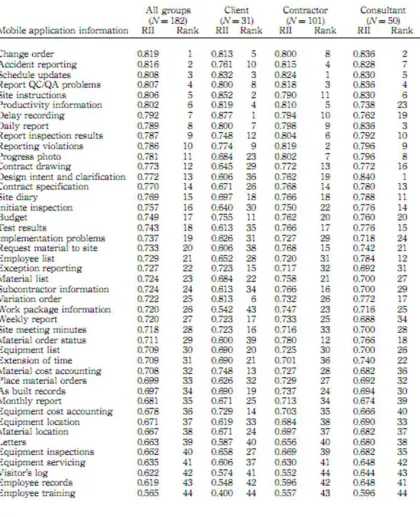
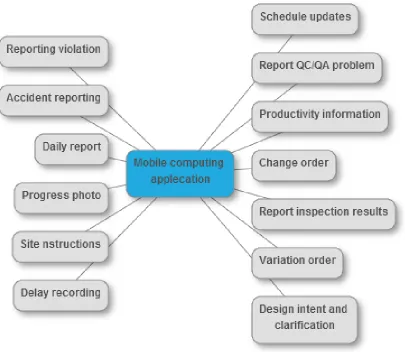
Figure 3-5: The selected on-site information to build a mobile computing applecation (Nourbakhsh et al, 2012a) ... 46
Figure 3-6: Application model for using mobile computing in information management on construction sites (Chen & Kamara, 2011). ... 49
Figure 3-7: The process of selecting mobile computing technologies from the construction information factor perspective (Chen & Kamara, 2008a) ... 51
Figure 3-8: The process of selecting mobile computing technologies from the User perspective (Chen & Kamara, 2011) ... 52
Figure 3-9: Framework for using mobile computing for information management on construction sites (Chen & Kamara, 2011). ... 54
Figure 3-10: The user interface flow (Kim et al., 2013). ... 56
Figure 3-11: The proposed Construction Mobile Application (CMA) (Nourbakhsh et al., 2012a). ... 60
Figure 3-12: The components of site BIM systems (Davies & Harty, 2013). ... 64
Figure 4-1: The key steps in the research process ... 88
Figure 4-2: The Research Onion model (Saunders et al., 2012) ... 90
Figure 4-3: The research philosophy (Sexton, 2003)... 95
Figure 4-4: The inductive logic of research (Creswell, 2003) ... 96
XI
Figure 4-6: Research choices (Saunders et al., 2009) ... 99
Figure 4-7: The key steps in the research processes. ... 113
Figure 5-1: The percentages of answers of the area of work ... 119
Figure 5-2: The percentages of answers on the original field of specialisation ... 120
Figure 5-3: The percentages of answers regarding the level of education ... 121
Figure 5-4: The frequency of answers describing collaboration levels ... 122
Figure 5-5: The frequency of answers that related to the communication satisfaction .. 123
Figure 5-6: The severity index (SI) equation (Elhag et al., 2005; Ji and Domingo, 2014) ... 124
Figure 5-7: The weight for rating (Elhag et al., 2005; Ji and Domingo, 2014) ... 124
Figure 5-8: The suggested mobile devices to be used ... 132
Figure 5-9: The scree plot ... 135
Figure 6-1: Organisational Breakdown Structure for Case Study A ... 145
Figure 6-2: Organisational Breakdown Structure for Case Study B... 146
Figure 6-3: Organisational Breakdown Structure for Case Study C... 147
Figure 7-1: Four key dimensions of the framework strategy ... 198
Figure 8-1: Final diagram of the relationships among the challanges ... 211
XII
Acknowledgements
This research study would not have been possible without the support and assistance of a number of people who have showed me their kindness and generosity.
First, I would like to take this opportunity to express my deepest gratitude to my supervisor Dr. Aziz Zeeshan, for his invaluable guidance, patience and encouragement throughout the preparation of this thesis.
Secondly, I would like to thank the people and organisations that contributed to the case studies, giving their precious time and providing much valuable information from the construction industry in Saudi Arabia to assist in the completion of this research.
Thirdly, I would like to thank my family, for their patience, sacrifice and encouragement. Without the support of my family, this thesis would not have been completed. Special thanks to my father, mother and my wife who always prays for me and encouraged me in achieving my goals.
XIII
Declaration
XIV
Abbreviations
KSA Kingdom of Saudi Arabia
ICT Information and communication technology IT Information technology
SAGIA Saudi Arabian General Investment Authority SR Saudi riyal
MC Mobile computing IS Information System MC Mobile Computing
XV
Publications Arising from this Thesis
Conference Papers
1. Alaboud, N., & Zeeshan, A. (2014). Development of a Framework to Enhance Information Provisioning Support for Site-based Construction Workers in The Kingdom of Saudi Arabia. In Proceedings of the Global Conference on Engineering and Technology Management “Gaining Competitive Edge through Engineering and Technology Management” (GCETM): 23–26 June 2014, (pp.160-166). Istanbul, Turkey.
2. Balgheeth, Y., Alaboud, N., & Zeeshan, A. (2014). Enhancing Health & Safety Management in Construction Sites by Using Mobile Computing in Saudi Arabia.
In Proceedings of the Global Conference on Engineering and Technology
Management “Gaining Competitive Edge through Engineering and Technology
Management” (GCETM): 23–26 June 2014, (pp.301-307). Istanbul, Turkey.
Book Chapter
Aziz, Z, Harun, A. N. and Alaboud, N. (2015) “Mobile Computing Applications within Construction” in “Advances in Construction ICT and e-business” and jointly edited by the TG83 coordinators (Prof Srinath Perera, Northumbria University; Dr Bingu Ingirige, University of Salford; Dr Kirti Ruikar, Loughborough University; Dr Esther Obonyo, University of Florida). (accepted)
Workshop Paper
Alaboud, N., Cooney, J, C., & Zeeshan, A. (2013). Using a Mobile BIM Based Framework to Enhance Information Provisioning Support in Healthcare Projects. In Proceeding of the Association of Researchers in Construction Management (ARCOM) Doctoral Workshop on Building Information Modelling (BIM) Management and
XVI
Abstract
1
Chapter 1:
Introduction
1.1. Chapter Overview
This chapter presents the research and sets out background information, focusing on the need to improve communication at construction sites in the Saudi context. This chapter begins by presenting an overview of the Saudi construction industry. Key challenges affecting the management of construction projects within Saudi Arabian public sector projects are also analysed. Then follows a description of the nature of the research problem, illustrating key research aims and objectives. The scope and limitations of the research are also presented, alongside a discussion of the expected contributions of the study to knowledge. The research methodology is then outlined and finally, the structure of the thesis is presented.
1.2. Research Background
2 To address some of these issues, Information and Communication Technologies (ICT) has been extensively been applied within the industry to address communication and coordination challenges and enhance productivity, performance and quality in the design and delivery of construction projects. In comparison with other industries, ICT adoption in the construction sector is generally perceived as limited; however, predictions for future adoption are optimistic (Brandon et al., 2005). The vast majority of construction work takes place on construction sites, which are typically hazardous and dynamic environments. In fact, ILO (2005) attributes 25-40% of fatalities in the occupational setting worldwide to the construction industry. Furthermore, Anumba and Wang (2012) indicate that the fragmented nature of construction site conditions inhibits the free flow of information, to and from construction operatives. Despite the increased development of ICT in recent years, the benefits of such technology have typically been limited to office-based staff.
3 Many construction projects have failed to meet cost, time and quality targets, having been disadvantaged by poor communication and coordination problems between site-based and office-based staff. The subsequent literature review, demonstrates that a need for innovative tools and processes to address construction communication and coordination challenges has long been highlighted (e.g. Latham 1994; Egan 1998; Government Construction Strategy, 2013). Therefore, for effective communication and coordination, it is important to manage construction information flow proficiently. Recent developments in technologies have facilitated improvements to construction methods and processes, enabling firms to overcome various communication and co-ordination challenges. In recent years, public owners, contractors, consultants and designers have shown a growing interest in the utility of both Information Systems (IS) and Building Information Modelling (BIM), to assist both organisation and collaboration. Alongside these remarkable developments, construction industry growth has created a direct interest in their use to enhance construction production. In addition to IS and BIM, there have been parallel developments in the areas of cloud computing, wireless networking and mobile technologies. The increased computational power available on mobile devices, and improved connectivity solutions, mean it is possible to extend the benefits of various collaboration technologies such as BIM and IS to the point of work.
4 rates, delays in completion, and the poor quality of completed work, have been the subject of several studies on construction productivity. Therefore, there is good scope for mobile computing to play a pivotal role in benefitting the management of construction project information to improve existing processes (Anumba & Wang, 2012; Kim et al., 2013; Son et al., 2012).
1.3. Background of Saudi Construction Industry
This research focuses on the construction industry in the Kingdom of Saudi Arabia (KSA), addressing some of the key communication and coordination dilemmas faced by the industry by proposing the use of mobile computing tools and processes. The KSA’s development plans and large-scale investment in infrastructure, reflect its strong economy. Investment in the country has led to an extensive network of trains, roads, bridges, dams, airports, ports, facilities for electricity, and desalination, with more projects underway. The KSA construction industry has become the “largest construction sector in the Middle East and remains a ‘construction safe haven’ amid both wider political and financial turmoil” (Deloitte & Touche, 2013). Figure 1-1 illustrates the development of the construction industry, which is largely sourced and driven by the government.
Figure 1-1: Estimated construction growth in Saudi Arabia (Deloitte & Touche, 2013).
C o n str u ctio n in d u str y % o f G D P C o n str u ctio n in d u str y v alu e U SD b n
Construction industry value USD bn Construction industry % of GDP Note: “e”: estimate, “f”: forecast
5 However, with this growth, the industry is confronting a variety of challenges related to systemic shortcomings associated with cost, time management, and quality targets. Generally, as Deloitte and Touche (2013) indicated that in 2012, the total value of delayed projects was USD 146 bn, as estimated by Saudi Arabian contractors. The industry suffers from delays for various reasons, including “poor project management, low labour productivity, communication and coordination problems” (Alsuliman et al., 2012; Albogamy et al., 2012). Sidawi (2012) conducted a survey of construction companies in the KSA, which revealed that 89% of respondents use traditional communication systems and tools such as fax machines, mobile phones (voice and texts), site visits, weekly/monthly reports, and face-to-face meetings to manage projects. Furthermore, it found that 93% of survey respondents use no forms of mobile computing, aside from mobile phones for voice communication (Sidawi, 2012, p.10).
A wide body of literature is focusing on productivity improvements at construction sites. However, the majority of this literature pertains to western developed countries. There is considerable variation between construction sites in KSA and those in the West. Specifically, the KSA construction industry is characterised by cultural, multi-language, low and semi-skilled labour, and very low adoption of technology, coupled with a heavily subsidised AEC sector, which fuels various process inefficiencies (Alsehaimi, 2011). All of these factors combine to complicate the implementation of new and unfamiliar technologies and processes.
6 autocratic behaviours. The goal is to investigate the viability of extending mobile computing, and to construct a framework for the successful implementation of technological solutions to serve the continual need for information within Saudi construction practice.
The Saudi construction industry must be aware of the market and its likely transformation over the next ten years. In Western countries, governments have intervened to assist the delivery of declared policy aims, such as the incorporation of new digital technologies into the business environment, helping to establish certainty in the market by ameliorating the risk associated with investing in innovative technology. An example is how BIM is becoming increasingly relevant in other countries (Hore and Thomas 2011). In 2010, 50% of the industry in the US and 36% in the UK, Germany and France were reportedly using BIM (McGraw Hill Construction, 2010, quoted in Hore and Thomas 2011, p2). Similar trends are evident in Canada, Australia, Asia, and Scandinavia. In these settings, designers and contractors collaborate to make efficient use of these processes. At present, the threat from the perspective of the Saudi construction industry is that it will fall behind other countries adopting technologies and the updated working procedures associated with them, with the result that it will be unable to compete in terms of efficiency. This research will look into some of these challenges and investigate possible solutions.
1.4. Process Innovation Using Mobile Computing
7 potential for commercial applications. Such powerful devices, coupled with increasingly sophisticated software, offer genuine opportunities for enhanced communication.
The ubiquity, multi-functionality, and connectivity associated with digital mobility, offers access to a new and potentially powerful networked commercial environment. The smart-phone, initially seen as a phone with added-on computing capability is now akin to a mini-computer, which incidentally, can also make phone calls. The new generation of smart-phones prioritises continuity and spontaneity across different contexts of use, while offering innovative ways of communicating. The influence and impact of this capacity to be informed and connected has migrated beyond the personal lives of smart phone users into everyday commercial transactions, where industries and professions are feeling it. Historically, the way people work and function has always altered as new tools become available. This brief introduction highlights the changes, which have taken place over a relatively short period, in terms of how people communicate within the work environment. Not only are transactions being digitised as data is generated and analysed in new ways, but previously unconnected objects, people, and activities are being connected in the new context of mobility. Adapting to ubiquitous digital connectivity is now essential to promote competitiveness in most sectors of the world’s developed economies (Iansiti and Lakhani 2014).
8 defend against late entrants to the digital market, and increase their productivity (Iansiti and Lakhani 2014). Organisations must adapt and evolve or be left behind. The vision of ubiquitous mobile digital technology, affording almost instantaneous access to information has become a reality.
The pervasive and universal ownership of Smartphones has acquainted construction personnel at all levels with the skills and capacity to manage and retrieve information via digital means. This familiarity offers huge potential to improve the construction project delivery process. In addition to allowing the capture and delivery of real time data from site operations, pervasive mobile digital technology offers a potential training medium, improves collaboration, benefits the safety and security of the workforce, offers context aware information and service delivery, improving construction site management, design collaboration, and up to the minute visualisation, sensing and tracking (Anumba and Wang, 2012). A key to obtain maximum benefits is effective integration of emerging technologies with existing process and practices.
1.5. Research Rationale
9 from discussions concerning potential, to practical considerations of how and in what contexts to apply technology to improve onsite communication processes. The general tone of contemporary research promotes a direction of change in the 21st century that will involve technological innovation bringing about a wave of automation in labour intensive industries.
The Saudi government acknowledges that it currently faces two “great challenges”; firstly, “the rapid growth in population”, and secondly, to “equip its young people with the skills needed to enable them to find gainful jobs in an increasingly integrated and competitive global economy” that relies on “science, information and technology” (KSA -Human Development Report, 2003, p67). However, in recent years, construction industry, despite being major employer, has attracted workforce from overseas and failed to attract local well-educated Saudi workforce. There is need to modernise the Architecture and Construction industry so that it could attract local well-educated Saudi workforce.
10 In order merely to sustain current low productivity levels, and to overcome some of the intrinsic weaknesses of the Saudi construction industry in the medium term, new technologies and processes must be implemented. This research will describe how adopting a structured and more formal use of mobile computing will modify and streamline work practices, potentially increasing onsite collaboration, and reducing the more traditional management styles. There is need to address both socio-technical approaches. There is dire need to increase capacity of Saudi work force.
1.6. Research Aim, Objectives & Outline Method
This research aims to develop a strategy for the successful implementation of mobile computing to enhance information provisioning support for the contractors’ site-based workers on construction projects in the Kingdom of Saudi Arabia.
Key research objectives include:
1. To develop an understanding of the literature in the area of the mobile computing applications for site-based construction workers;
2. To identify the benefits and challenges in providing timely and relevant information to site-based construction workers engaged in public sector construction projects in KSA;
3. To determine key information requirements for mobile construction workers in KSA.
4. To explore existing technology usage among the Saudi site-based construction workforce;
5. To develop a strategy for the successful implementation of the provision of pervasive mobile digital technology to support the information needs of site-based construction workers; and
11
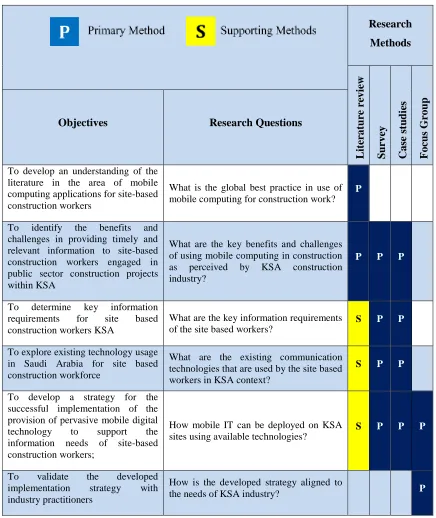
Table 1-1Summary of the key research methods, research questions and research methods adopted
Research Methods L it er at ur e r evi ew Su rve y C ase st u die s Focus G roup
Objectives Research Questions
To develop an understanding of the literature in the area of mobile computing applications for site-based construction workers
What is the global best practice in use of mobile computing for construction work?
P
To identify the benefits and challenges in providing timely and relevant information to site-based construction workers engaged in public sector construction projects within KSA
What are the key benefits and challenges of using mobile computing in construction as perceived by KSA construction industry?
P P P
To determine key information requirements for site based construction workers KSA
What are the key information requirements of the site based workers?
S P P
To explore existing technology usage in Saudi Arabia for site based construction workforce
What are the existing communication technologies that are used by the site based workers in KSA context?
S P P
To develop a strategy for the successful implementation of the provision of pervasive mobile digital technology to support the information needs of site-based construction workers;
How mobile IT can be deployed on KSA sites using available technologies?
S P P P
To validate the developed implementation strategy with industry practitioners
How is the developed strategy aligned to
the needs of KSA industry? P
1.7. Limitations
[image:27.612.77.513.96.614.2]12 company size and ambition, the skills of the workforce, and attitudinal factors. However, much of the data collected by previous researchers was swiftly superseded by technological developments, making it out of date.
The literature covering the Saudi construction industry typically focuses on project delays, diagnosing the problems leading to delays at the expense of finding solutions to overcome them. There is also a limited amount of literature on the topic of construction communication. The published literature is focusing on a particular type of project, which is constructed in the remote areas in Saudi. In addition, in the research worldwide, many scholars have discussed the potentials and the benefits of using mobile computing in construction projects but few have developed IT prototypes. However, there is some very limited literature, which focuses on the actual implementation of mobile technology at construction sites. Thus, the conclusions drawn within this thesis must take the constrictions on available data and focus into account, especially when extrapolating conclusions reached in one country’s construction industry to that of another.
The goal of this qualitative research is to understand the communication and information needs of site-based workers in an on-site setting. The research therefore relies on compiling an understanding of the needs of on-site managers, by listening to and interpreting interview data, to understand the meanings they associate with their experiences. In addition to interviews, the researcher observed workers onsite to deepen understanding of the communication processes of workers, within the context of their everyday lives.
13 organisational change and the attitudes of the managers and workers involved. However, the results of this research can be applied to other settings, providing a flexible and adaptable strategy that can take account of, and understand the limitations of the role that technology plays in our ways of working, and how we communicate with others in the workplace.
1.8. Research Scope
This research focuses on mobile computing, Saudi construction sites, information requirements of construction site personnel, on-site information, and the interrelationships and interactions between workers, aiming to provide solutions to support them. The scope of this research will highlight and cover the following points:
1. A strategy for construction management, particularly at the contractor level. 2. The opinions of practitioners using the strategy on the contractor’s team such as
project manager, site supervisors, site managers, etc.
3. A sample of Saudi construction organisations, selected based upon the size and complexity of ongoing projects and deliberate targeting of contractor firms classified as top three in the category of buildings and roads (determined according to the Saudi Agency for contractor classification in the Ministry of Municipal and Rural Affairs (MACC, 2013).
1.9. Expected Contributions to Knowledge
This research will develop a strategy for the practical use of mobile technology to enhance information provisioning among the site based workers in KSA, which requires:
1. In depth understanding of the key benefits and challenges for providing timely and relevant information;
2. Prioritisation of site based worker’s needs; 3. Identification of key information needs;
14 1.10. Primary Research Areas
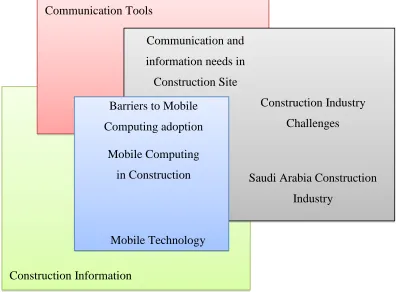
According to the research aim and objectives, questions, and research scope, the primary research goal is the implementation of mobile computing at Saudi construction sites to assist site-based workers. Figure (1-2) presents the research areas that overlap to meet this research goal, which must be viewed within a broader context. The information that is generated by the construction site, the information that is directed to the site, and the information exchanged between project team members must all be covered, as this represents the base that must be served by the communication tools. Communication tools is another research area that specifically relates to the tools utilised to link the site and the onsite office. The construction industry in Saudi Arabia must also be discussed, as it is the main aim of this research to understand current communication practice in this industry and explore the drivers for and barriers to utilising advanced mobile technology in order to best implement it. All these research areas, alongside an exploration of the literature regarding the use of mobile technology on a construction site need to be discussed. However, the primary research areas are discussed in detail in the following chapters.
Saudi Arabia Construction Industry
Communication and information needs in Construction Site
Mobile Computing in Construction Barriers to Mobile Computing adoption
Construction Information
Mobile Technology ITTechnologies Communication Tools
[image:30.612.108.504.423.715.2]Construction Industry Challenges
15 1.11. Outline of Research Methodology
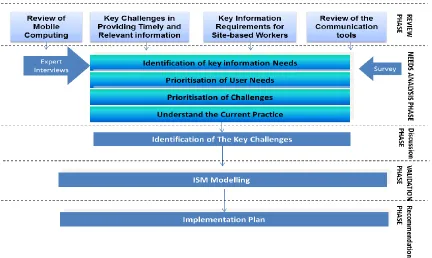
[image:31.612.89.521.375.633.2]The purpose of a research methodology is to collect data, answer research questions and clarify key steps informing research processes (see Table 1-1). The research methodology employed here can be first represented by the research Onion Model (Saunders et al., 2012), and then by a detailed description of different research strategies, approaches, methods, etc. The research strategy used in this research uses Case study methods (Interviews and Observations) as the primary data collection method and the Survey Questionnaire as the secondary method. Figure 1-3 presents the road map for the research stages, which contains several key stages, which will assist the researcher to obtain a comprehensive understanding of the information requirements, current practices and the surrounding issues that are essential to develop the strategy. Furthermore, a focus-group interview is conducted, using Interpretive Structural Modelling (ISM) to validate the findings with six practitioners.
16 1.12. Organisation of Thesis’ Primary research areas
This section illustrates the structure of the thesis, which is organised into eight chapters described below:
Chapter 1: Introduction
This chapter presents the research background, provides an overview of the general subject area and discusses the drivers towards mobile computing use in construction. It also identifies the study’s aims and objectives, justifies the research rationale, and sets the background context for Saudi construction, while stating the aims, objectives and key research questions.
Chapter 2: The Saudi Arabian Construction Industry
This section discusses the strong economic standing of Saudi Arabia, which drives its construction industry, and discusses the current states of the construction industry and the issues affecting construction projects.
Chapter 3: Mobile Computing and Construction Industry
Chapter three considers the benefits, and solutions provided by mobile computing, the motivation for automating construction tasks, and the issues related to construction information and communication. It also discusses the implementation of mobile computing in construction, and demonstrates how this research project builds on the studies which preceded it.
Chapter 4: Research Methodology
This chapter describes and explains the chosen research methodology, commencing with a description of the research design, followed by a description of the different research stages, to address the key steps in the research process. It presents and justifies the methods adopted to gather the data and its analysis methods.
Chapter 5: The Quantitative Data Results
17 research, which helped in developing a comprehensive understanding of the information required, the communication tools used, and surrounding issues related to mobile computing usage in Saudi Construction Sites.
Chapter 6: The Qualitative Data Results
This chapter details the simple features of the data, delivering a summative assessment about the case studies.
Chapter 7: The Discussion
This chapter discusses the results of the case studies and questionnaire, summarising the study findings and discusses it with the literature based on the research objectives and questions.
Chapter 8: Framework Development and Validation
This chapter validate the results from questionnaires and case studies using Interpretive Structural Modelling (ISM) through a focus group. Looking at the challenges that affect the implementation of mobile computing for managing and controlling construction sites within the Saudi construction industry, and their level of importance while assessing the relationship between factors.
Chapter 9: Conclusions
This chapter concludes this study based on the main findings from questionnaire and case studies also from the Interpretive Structural Modelling (ISM). Recommendations are delivered in the context of Saudi Arabia in order to implement and use mobile computing.
18
Chapter 2:
Key Challenges in On-Site Construction Management
within the Saudi Construction Industry
2.1 Introduction
To reveal more information about the study context, this Chapter describes both the general and the specific setting, in order to provide an overview of Saudi Arabia by outlining background information concerning the Saudi Construction Industry. Then, the key challenges faced by the industry (Section 2.4.1, 2.4.2 and 2.4.3) are highlighted and analysed, and the underlying causes and conditions contributing to poor construction management practices within KSA discussed as driven by Objective 2. Subsequently, moving to the key point (Objective 4), the obstacles to good communication and onsite co-ordination between interested parties, i.e. consultants, owners and contractors are introduced and evaluated, and the various reasons behind it in recent literature reviewed (Section 2.4.4). Finally, a summary is drawn, which confirms the problem that this research will solve.
2.2. Overview of Saudi Arabia
19 around the country; for example, the “King Abdullah University of Science and Technology that opened in 2009 and cost $2.7 US Billion Dollars” (Alwatan, 2009).
2.3. The Saudi Construction Sector
The Saudi Arabian Government currently plays a central role in industrial and economic development; having set economic growth priorities in ten successive development plans. The Ministry of Economy and Planning has also set out long-term economic and social development plans to achieve continuity of development in areas affecting education, health and the family, and more specifically, these development plans determine the economy’s infrastructural, industrial, commercial and agricultural needs, aiming to deliver clearly defined national objectives (MOP, 2009). However, Saudi Arabia, continues to be a developing nation, and also one that remains over-reliant on state intervention for large construction projects (Zuhur, 2011, p.161).
Development plans that support the non-oil sectors’ contributions to economic development, and the aim of developing a strong and independent private sector that does not rely on government spending and government projects, are legitimate strategies to employ to build a diversified economy (Albassam 2015). In an era of falling oil prices, the private sector’s declining share of GDP does not bode well for the state’s policy of economic diversification. In the development plan of 1985–1989, the private sector accounted for almost 49% of the GDP, whereas by 2010–2013, this had fallen, and it accounted for 35% of GDP (Mahran 2012, p.630). Mahran (2012, p.638) states that “the high dependence of the economy on oil, together with the dominant role of the public sector, leaves little room for the private sector to play a significant role in the economy”.
20 productivity had fallen to 0.3% (International Monetary Fund 2012, p.16). The construction sector’s increasing share of the employed workforce was cited as a cause of the drop in productivity growth in the 2000’s (International Monetary Fund 2012, p.17). From the Saudi perspective, the noticeable decline over time of the construction sector’s share of bank credit indicates that construction is part of the non-oil sector that does not have a competitive advantage in the Saudi economy (Albassam 2015). The decline in construction’s share of bank credit from 11.65% in 1999, to just 7.3% in 2010, is another indication that investments in construction promise an uncertain future (Mahran, 2012, p. 630). According to Samargandi et al. (2013), bank credit extended to the private sector construction sector fell from 8.2% in 2006, to 7.5% in 2010. The difference of 0.2 percentage points is immaterial, but the falling trend in construction investment is clear.
2.4. The Saudi Construction Industry’s Characteristics
21 2.4.1. Delays to Public Construction Projects
Internationally, Governments are the biggest clients of the construction industry, as they sponsor huge infrastructure projects. A detailed analysis by Alkharashi el at (2009) of Saudi public sector construction projects cited five principal causes for owner-related delays. These included delays revising and approving design documents, lack of contact between construction parties and Government authorities, slow decision making by the owner, delayed progress payments, and owners’ slow delivery of the site to contractors. Final payments are also apparently “notorious for not arriving”, and companies must therefore, either make a provision for such costs up front, or wait several years for a court appearance (Overdahl, 2013). As evident from this analysis by Overdahl (2013), poor communication is a key contributor to project delays, and improving site communication processes would be one way of addressing some of these concerns.
In a similar study by Al-Kharashi el at (2009), five principal reasons for contractor-related delays were identified as, ineffective scheduling of projects by contractors, lack of qualified builders, poor site management and supervision, and ineffective management of project progress. Al-Kharashi et al. also isolated the causes of delays linked to consultants; as inflexibility, late review and approval of design documents, delays in completing inspections, uncertainty when approving major changes in the scope of work, and the overall inadequate experience of consultants (Al-Kharashi el at 2009). The above analysis also indicated the importance of effective site based communication for enhancing overall construction management.
22 (owners, contractors and consultants), as “changed orders”. Alsuliman et al. (2012) outlined that adapting to and effecting changes to orders is a process not fully understood, nor well managed within the Saudi construction industry.
However, as this study will illustrate, access to regularly updated real-time information should alleviate this widespread cause of delay. Assaf and Al-Hejji (2006) indicated a number of other contractor related factors as contributing to project delays including; intermittent and unreliable progress payments, ineffective project planning and scheduling, poor site management and supervision and a paucity of skilled labour and contractors experiencing difficulties financing projects or parts thereof. In addition, all three parties agreed that “changes in government regulations and laws, traffic control and restrictions at job site, the effect of social and cultural factors and accidents during construction” were the least important causes of delay (Assaf and Al-Hejji, 2006).
2.4.2. Key Characteristics Of Saudi Construction Workforce
A key focus of this research effort is on enhancing on-site communications to better integrate a mobile construction workforce with back office processes. From this perspective, this section reviews key characteristics of the Saudi Construction workforce. As discussed in previous sections, construction is an important contributor to the Saudi national economy. In view of the huge investment in infrastructure construction projects, it is unsurprising that forecasts predict the largest growth in private sector employment in Saudi Arabia will take place within the building and construction sector (Ramady 2010, p.8).
23 workforce (Saudi Arabian Monetary Agency, 2013). According to the International Monetary Fund (2013, p.14), construction has not contributed to an increase in Saudi employment and is “not expected to do so” (Alsheikh, 2015, p.10).
There is limited absorption of Saudi workers into high-wage private sector jobs, and Saudis associate construction with low paid low semi-skilled work. To date, within the construction sector, few jobs have gone to Saudis (International Monetary, Fund 2013, p22), and penalties from the Government’s Saudisation policy, favouring the employment of Saudis in the private sector, has pushed up the average cost of foreign labour by 21% (Trenwith, 2013). At present the Saudi construction industry, which employs 45% of public sector workers, is characterised by multi-cultural, multi-language, low and semi-skilled labour and very low adoption of technology coupled with heavily subsidised AEC sector, fuelling various process inefficiencies (Alsehaimi, 2011). The vast majority of the disparate construction workforce within KSA have different levels of education, language usage, training, knowledge. Of the 170,000 certified engineers working in Saudi, only 30,000 are Saudis, whilst 140,000 are non-Saudis (Anaween, 2013), from a variety of different countries and cultures.
2.4.3. Communication Differences Between Multi-Cultural Workforces
24 components of effective multicultural project teams. Different cultures tend to develop different rules regarding how a person in a particular position should act, and this determines the interpretation of communications with people in positions of power and influence (Loosemore and Lee, 2001, p.518).
Cultural attitudes are multifaceted and multi-layered, with the result that messages can often be misinterpreted, or interpreted differently by individuals from different cultures. Arguably, the adoption of digital technology in the workplace could have a role in reducing this misunderstanding (Loosemore and Lee, 2001, p.518). Effective communication is key to managing expectations, misunderstanding, and misgivings in multicultural project teams. For a multicultural project team to be fully integrated, all team members need to trust and understand one another (Ochieng and Price 2010, p.460). Trust is fragile and difficult to quantify, but is essential to the success of multicultural teamwork. It can be cultivated in settings where good interpersonal skills and mutual respect exists between project leaders and team members.
2.4.4. Implementation of ICT in Saudi Construction
A 2012 survey of Saudi construction companies by Sidawi showed the majority (89%) used traditional communication systems and tools, such as fax machines, mobile phones, site visits, weekly/monthly reports and face-to-face meetings. Even in 2012, it was found that aside from voice calls on mobile phones, 93% of respondents did not use mobile systems or tools to manage or record site related information. These percentages describe an almost uniformly traditional approach to communication and information sharing, suggesting that users feel most content and secure communicating verbally, either face-to-face or by phone.
25 formation of a community of techno-efficient users, and aside from the issue of availability, there may be a lack of motivation to substitute unfamiliar technology for tried and tested modes of social exchange implicit to verbal engagement, which have functioned well in the past.
Regardless of the reasons, Sidawi (2012) states that Saudi construction companies communication system are undoubtedly predominantly ‘pre-digital’; with the exception of the two–thirds of companies which use e-mail. If these figures are accurate, one-third of companies are not using email to communicate during the course of conducting their business. This situation would be untenable in most modern construction companies. The picture portrayed here is one of a digitally averse business community, which values face-to-face vocal exchange, and written exchange, as a validation of trust. Moreover, writing is a less expressive and more time-consuming medium than the ease, expressiveness and immediacy speech.
Within KSA context, a key barrier to adoption of electronic information management is a slow moving organisational structure and conservative business practices (Sidawi, 2012; p110). Also, Sidawi highlighted technical issues such as cost, maintenance, technical and management support; rigid and inflexible organisational structures resistant to change, and the level of staff IT skills. In a similar study, Sidawi and Al-Sudairi (2014) indicated that the traditional management practices are realised as a barrier to the full utilisation of Advanced Computer based Management Systems (ACMS).
2.5. Summary
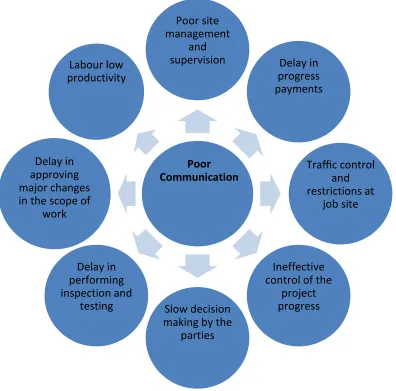
26 contractor project teams as discussed in Section 2.4.1. Thus, it will attempt to elaborate on a potential catalyst for changes to communication processes, i.e. mobile computing, to establish the evolution of a formalised, structured and transparent work record as discussed in Section 2.4.4, and as will be highlighted in Section 3.5.3. However, further to Section 1.5, a review of the literature on Saudi project management practices that regarding Objectives 3 and 4 reveals a reliance on outdated and inaccurate data, and excessive and superfluous information, resulting from an information overload that leads to ineffective communication (Figure 2-1).
27 Poor
Communication
Poor site management
and supervision
Delay in progress payments
Traffic control and restrictions at
job site
Ineffective control of the
project progress Slow decision
making by the parties Delay in
performing inspection and
testing Delay in
approving major changes in the scope of
work
Labour low productivity
Figure 2 1: Summary of the key problems afflicting the Saudi Construction Industry
(adapted from Assaf and Al-Hejji, 2006 and Al-Kharashi al et., 2009; Albogamy et al., 2012;
[image:43.612.116.512.84.475.2]28
Chapter 3:
State of the art review of Use of Mobile Computing
within the Construction Industry
3.1. Introduction
Chapter 2 revealed the research problem, which is that Saudi construction projects currently rely heavily upon a document centric communication model and traditional management methods, supplemented by basic communication tools, such as voice calls and paper-based documents. This makes information outdated, inaccurate, excessive, and superfluous, and causes an overload that leads to ineffective communication. The nomadic and fragmented nature of site-to-site work requires that strategies need to be put in place to enable construction workers be able to communicate effectively and access up-to-date project information while remaining mobile.
29 3.2. Background to Mobile Computing
Davies and Harty (2013, p 16) provide a contemporary and balanced assessment of the application of digital technology in the construction industry, stating that, although its most vocal adherents have been disappointed by its progress, mobile computing is growing. They argue that, notwithstanding the benefits it delivers, IT adoption is still generally thought to be limited, and predictions regarding its future adoption have proven optimistic (Davies & Harty, 2013, p.16). Nevertheless, Chen and Kamara (2007) recognise that, “Advances in affordable mobile devices, increases in wireless network transfer speeds and improvements in mobile application performance, give mobile computing technology a powerful potential to enhance on-site construction information management” (2007).
Son et al. (2012) argue that by using the latest smartphones to capture and transmit information, mobile computing will help eliminate the errors and delays usually associated with manual approaches. Setting aside the considerable challenge of keeping up to date with, “Advances in affordable mobile devices” (Son et al., 2012), any generalised assessment of the viability of implementing mobile computing, must address the difficulty of accommodating the different needs of separate organisations within countries. More importantly, generalisations in the literature must account for differences between countries, which could influence the success of IT implementation.
30 countries have developed well-equipped technological infrastructures and consolidated repositories of IT expertise (Arnorsson, 2012). By contrast, companies in Saudi Arabia have difficulty filling IT and skilled labour vacancies (Competitiveness Review, 2008, p.50). These small but important differences between countries help inform conclusive, across the board judgements regarding the viability of mobile computing hosting in changing circumstances and specific conditions. What may work in Scandinavia might not in Saudi Arabia; each context must be assessed on its merits and reference to its own background circumstances.
Due to these wide variations in the spread and the acceptance of IT culture across different countries, and the changing technology that supports its implementation, the literature has generally restricted comments on universal application to comments on its possibilities and potential. For instance, “Extending communication technology to onsite activities has the potential to change how the construction industry operates” (Anumba & Wang, 2012), or, “The emergence of new Information Technology, such as mobile computing and mobile sensors, has great potential to enhance information management on construction sites” (Chen & Kamara, 2008b, p.2).
31 Complexity, rapidly changing technology and a variety of contextual backgrounds influences attitudinal resistance, are some of the aspects that the literature relies upon when describing mobile computing. However, as will be shown in this paper, generalisations in the literature are themselves particularly vulnerable to technological advances and therefore, broad based assessments, particularly those made before 2010, are redundant, as new devices and platforms have emerged. Chen and Kamara implicitly acknowledge literature’s limitations when they state that most research focuses either, “on a detailed aspect” or a, “single facet of mobile computing” (2011, p.777).
The literature published in the last five years has been more confident in its assessments of the feasibility of onsite mobile computing because the now almost universal ownership of smartphones means that at all levels, construction sector workers have become acquainted with the managing and retrieval of information via digital means (Pierce et al., 2011). By 2013, Kim et al. (2013) indicated that the advent of smartphones, in tandem with mobile computing technology, was providing construction personnel with “unprecedented opportunities” to improve traditional management processes on-site. This familiarity with constantly improving and more user-friendly software shifted the discussion from consideration of the potential for improving onsite communication, toward how this can be achieved. Kim et al. are confident that the mobile computing potential of smartphone technology can be expected to lead to a, “Paradigm shift of the conventional construction management practices” (2013, p.422). In the course of this change of emphasis, technological change and the wisdom of hindsight has exposed as premature some of the assessments made in extant literature.
32 of, “Screen size, screen visibility, processing capability, and input methods” have largely been overcome. What the present research cannot do is predict the improvements in hardware that will emerge in coming years; however, it can anticipate that it is very likely that there will be further improvements. Saidi et al. (2002) also identified limitations inherent in the characteristics of the construction industry; these intrinsic barriers are less subject to accelerated change and have been widely cited: the physical jobsite conditions associated with extreme temperatures, humidity, dust, the dislocation and fragmentation associated with the project-based nature of the construction industry, its low tolerance to risk, its organisational culture, how its internalised beliefs, attitudes and behaviours accommodate or resist change, and the generally conservative culture within construction firms.
The passage of time and advances in mobile hardware and software since the 2006 publication of ‘Communication in Construction: Theory and Practice’ (Dainty, Moore & Murray, 2006) have exposed the pre-digital mindset, which informed the assumptions underlying their conclusions. Research in general has largely concerned itself with design work in the office environment (Davies & Harty, 2013, p.16). Up to approximately 2010, Dainty et al. (2006) and the literature in general, focused on IT’s potential and the industry’s resistance to it, rather than acceptance of it. Attitudinal changes brought about by mobile device ownership have largely submerged these notions of ‘resistance’ and ‘potential’.
33 innovations discussed today as hypothetical or ‘having potential’ may, in a few years, become commonplace and enter widespread use. On the other hand, the emergence of unforeseen new technology could mean contemporary technology becomes obsolete quickly. The intended purpose of Dainty et al.’s quotation was to explain, “The reasons as to why (ICT’s) application often fails” (Dainty et al., 2006, p.193). In fact, with the passage of time, Bunn’s (1997) statement has instead evidenced how unforeseen technological innovation can help consolidate the successful application of mobile computing, if certain other factors are in place.
In the eighteen years that have passed since Bunn (1997) expressed scepticism, all of his ‘beliefs’ about multimedia communications have become reality. More generally, literature that pre-dates 2010 could never have anticipated how the multiple functions and applications offered by today’s mobile devices would change people’s expectations. In particular, this earlier literature generally cannot explain how these technological developments have changed attitudes to mobile devices in construction. Everyday experiences of capturing, storing and re-using information has increased acceptance of the role of IT in the workplace. As technology has developed, the challenge in terms of its implementation becomes less associated with its flaws, and more to do with organisational and management resistance to its use.
3.3. The Development of the Mobile Industry
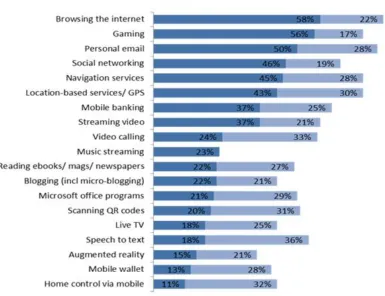
34 Figure 3-1: Presents the use and desired use of Smartphone features among all mobile users (TNS,
2012).
35
Note: Capex as a % of revenues, 2012
Figure 3-2: Capital expenditure across a selection of industries (GSMAK & Kearney, 2013)
36 Figure 3-3: Mobile-enabled products and services in the developing world (GSMA, 2013a)
However, for other industries, there is still a general lack of understanding, despite the growth of mobile adoption. According to GSMA (2013a), this lack of understanding can be characterised according to three general areas:
● Lack of defined value chain, which is the proven value proposition for participants at each stage of the value chain, for example service providers, vendors, and mobile operators.
● A sustainable business model with the potential to become self-sufficient.
● Visibility across markets and sectors; the knowledge of participants adjacent to the sector and their ability to collaborate in areas that expand the reach or value of the service.
37 3.4. Communication and Information Needs of Site-based Construction Workers
3.4.1. Overview
As previously discussed, the construction project is characterised by a heavy workforce and generates huge amounts of information, which requires effective project management. Löfgren (2005) suggests that the poor productivity figures in the construction industry could be partly explained by the fact that the information needs and communication behaviours in the production at construction sites are not adequately met. Moreover, managing information in construction is the main success factor for performance. This section will review the communication technologies in use onsite and identify the different types of construction information exchanged on site.
3.4.2. Traditional Means of On-Site Communication
Throughout the execution of a project, a large amount of data is produced, transferred, and stored. Also, construction projects involve a large number of participants, whose aim is to exchange information to increase productivity and support decision-making. Information that is paper-based is less reliable than the almost instantaneous alternative of digitally exchanged information, as it is not automatically updated, and workers therefore have no way of knowing if amendments to the document have been updated. Nevertheless, most construction projects rely on, “Manual processes and traditional methods of communication, such as phone calls, faxes and emails to obtain such information” (Dave et al., 2010). Anumba and Wang (2012), agree that in most construction organisations, a field team’s project information access and retrieval, information editing and decision-making, are restricted to 2D paper-based technical drawings.
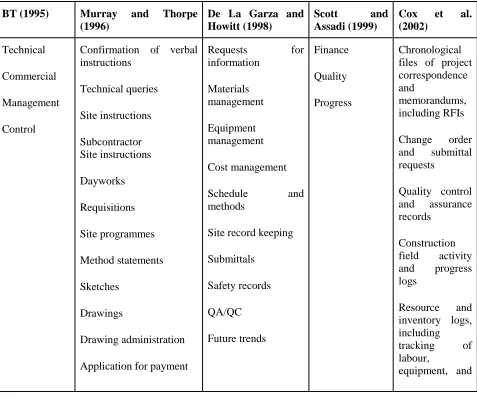
38 usage, personal digital assistants were used by 23.2%, and computers were used by 15.2% of respondents for information management purposes. Other tools, such as cameras, voice recorders, walkie-talkies, and so on made up a further 22.2%. Nourbakhsh et al. conclude that there were “no significant differences” between the information requirements of respondents from different countries. Although there were variations in the volume of data shared, and the intensity of the demand for it to be shared and made available immediately, the nature of the information and the means of sharing it were similar (Nourbakhsh et al., 2012a, p.491).
[image:54.612.211.401.461.641.2]It is not surprising, therefore, that similar results emerged from a 2012 survey of the information management practices of Saudi construction companies, where 70% to 89% of respondents reported that they use, “traditional communication systems such as fax machines, mobile phones, site visits, weekly/monthly reports and meetings” (Sidawi et al., 2012, p.110). They do not use mobile systems apart from mobile phones, which are used by 93% of the respondents to make voice calls. Neither Nourbakhsh et al. (2012a) nor Sidawi et al. (2012) encountered the use of web cams.
39 Bowden (2005) identifies the most common paper-based tasks carried out in the construction industry to be: the completion of data collection forms at 25%, dealing with correspondence at 18%, viewing and reviewing drawings at 13%, and reading and writing specifications at 6%. Bowden et al. (2004) conclude that paper-based files limit and delay on-site communication and information exchange. According to Bowden (2005), they provide no way of filtering the excessive volumes of information, nor do they provide any means of information feedback. Even before the advent and spread of smartphones, Chen and Kamara saw the “limitation of paper-based files” as a “major constraint in on-site information communication and exchange” (2008b, p.4). Similarly, Bringardner and Dasher describe paper-based documents as “expensive, heavy, inaccessible, difficult to update and quickly outdated” (2011, p.2).
Real time computerised information facilitates two-way communication in the form of instant feedback in a way that paper-based systems do not. Bowden (2004), concludes that the lack of feedback associated with traditional asynchronous communication methods contributes to its three principal shortcomings: message distortion, gate-keeping and information over-load. Information over-load arises when information is presented in a fixed format, such as a hard copy of the printed page, which requires the reader to waste time scanning the document to search for the relevant passage, file, or sequence of pages.