International Journal of Emerging Technology and Advanced Engineering
Website: www.ijetae.com (ISSN 2250-2459,ISO 9001:2008 Certified Journal, Volume 4, Issue 9, September 2014)
331
Shape & Texture Based Image Retrieval from Fuzzy Clustered
Data
Shubhangi Redekar
1, Nilesh Bhosale
2
Dept. of Electronic & Telecommunication Engineering, Dnyanganga College of Engineering and Research, Pune, India.
Abstract— The large amount of image database, as well as its enormous deployment in various applications, the need for Content Based Image Retrieval (CBIR) development arose. This is an effective tool for search and retrieval of images. Color, shape and texture are primary low level image features exploited in CBIR. This paper presents a strategy for shape and texture based image retrieval from Fuzzy clustering. The combination of both extracted feature is used for image retrieval from the database. Firstly, a fuzzy clustering process is used to discover a set of images of semantic categories. Then the shape of the object contained in an image is extracted using Canny edge detector. The texture feature is calculated by applying GLCM matrix on a transformed image. The derived set of image features is used in order to retrieve images similar to a query image submitted by the user. The result shows that combination of image features for retrieval of images improves the efficiency of the system.
Keywords— Content Based Image Retrieval (CBIR), Fuzzy clustering, Canny edge detection, GLCM matrix, Low level image feature.
I. INTRODUCTION
Content based image retrieval is a process of searching images from a database and retrieval of images similar to a query image submitted by the user. Content based image retrieval (CBIR) uses the primary low level image features such as color, shape and texture to represent and index the image [1]. The combination of various content features represents images more effectively than individual features [2].
Shape is one of most significant feature that confirms with the way human being interprets and interacts with the real world object. Different shape based image retrieval techniques have been proposed which are divided into two categories: counter-based and region-based. The first technique considers information about the contour of object shape and completely ignores its internal details. On other hand, region based approach takes into account internal details [3] [4].
Texture is also one of the important characteristic used in identifying a region of interest in an image.
Gray level Co- occurrence matrix (GLCM) and Color co-occurrence matrix (CCM) are most commonly using techniques to extract the texture feature of object in an image [5] [6].
However, all these techniques are based on the process of comparing each database image against the query image. In such process, a large number of unnecessary comparisons are required. The clustering technique is used to avoid such expensive comparisons in which database images are divided into different clusters according to their similarity. Each cluster that is represented by a prototype, act as a filter to reduce a required search and retrieval time [7] [8].
In this paper, the proposed approach is based on the shape and texture based image retrieval from fuzzy clustered data. The fuzzy clustering process is applied to a database images to discover a group of images of semantic categories. The canny edge detector is used to detect a shape of the object into an image using a multistage algorithm. The use of canny edge detection reduces the large number of processing data. The area is calculated of extracted shape which is used for searching and retrieval process. For the texture feature extraction, Gray level Co-occurrence matrix (GLCM) is calculated of transformed image which help to calculate the properties of the images such as contrast, energy, homogeneity and correlation. The stationary wavelet transform is used to transform the original image. The query image features are compared with all the prototypes and the features belonging to categories corresponding to the most similar prototypes.
The rest of the paper is organized as follows. Section 2 discusses proposed approach in detail. Section 3 shows experimental results. In section 4 conclusion and future work are discussed.
II. PROPOSED APPROACH
International Journal of Emerging Technology and Advanced Engineering
Website: www.ijetae.com (ISSN 2250-2459,ISO 9001:2008 Certified Journal, Volume 4, Issue 9, September 2014)
332
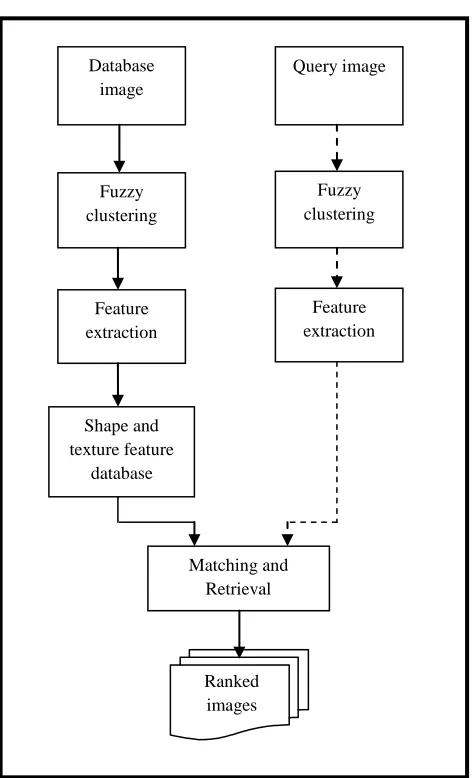
[image:2.612.47.285.148.537.2]The following Figure 1 provides the overview of the proposed approach.
Figure 1: Architecture of Proposed Approach
The input query image is applied at runtime to get the shape and texture feature of images. The database image features are extracted and saved in a feature database. Whenever a query image is applied, the query image features compare with the database image features.
A. Image Clustering
The present image retrieval system describes the solution to the problem of retrieving the query image from huge image database using Fuzzy C-mean clustering. This step automatically discovers a set of images by grouping together images of the same categories.
The clusters are formed according to the distance between data points and the cluster centers are formed for each cluster [9]. It is based on minimization of the following objective function:
[image:2.612.324.563.289.498.2]= 2, 1 m ∞ (1)
Where, || ||is the Euclidean distance between ith
data and jth cluster center. Fuzzy clustering is carried out
through an iterative optimization of the objective function
shown above, with the update of membership and the
cluster centers .
Following Figure 2 shows the image after application of fuzzy clustering.
Figure 2: Segmented Image using FCM
The algorithm consists of following steps:
1. Initialize U=[ ] matrix, U(0)
2. At k-step: calculate the centers vectors C(k) =[cj]
with U(k)
cj = / (2)
3. Update U(k), U(k+1)
2/m-1
(3)
4. If || U(k+1) – U(k) || < then STOP; otherwise return
to step 2.
B. Shape Feature Extraction
In the proposed approach, the Canny edge detection process is used.
Database image
Query image
Fuzzy clustering
Matching and Retrieval Fuzzy
clustering
Feature extraction
Shape and texture feature
database
Ranked images
International Journal of Emerging Technology and Advanced Engineering
Website: www.ijetae.com (ISSN 2250-2459,ISO 9001:2008 Certified Journal, Volume 4, Issue 9, September 2014)
333
The process is used to simplify the exploration of images by reducing the large amount of processing data while at the same time preserving useful structural information [10]. The canny edge detection algorithm runs in a 5 steps as follow:
1.Smoothing: Blurring of the image to remove noise. 2.Finding gradients: The edges should be marked
where the gradients of the image have large magnitudes.
3.Non-maximum suppression: Only local maxima should be marked as edges.
4.Double thresholding: Potential edges are determined by thresholding.
5.Edge tracking by hysteresis: Final edges are determined by suppressing all edges that are not
connected to a very certain (strong) edge.
Once the shape feature of an image is extracted, the area of the extracted shape is calculated [11] using the following formula:
Size of image, S= [( )* 0.264] mm2 (4)
Where, P= number of white pixels.
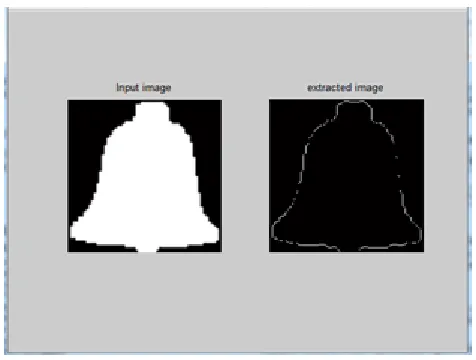
Figure 3(a) and (b) shows the input image and shape feature extracted image using Canny edge detection.
Figure 3: (a) Input image and (b) Shape extracted image
C. Texture Feature Extraction
The Gray Level Co-occurrence Matrix is applied to the transformed image to calculate the texture feature such as contrast, energy, homogeneity and correlation. The Stationary Wavelet Transform (SWT) is used to transform the input image. Gray Level Co-occurrence Matrix (GLCM) method is based on the conditional probability density function.
GLCM introduced by Haralick, it contains the information about the positions of pixels that having similar gray level values [6].
Following figure 4(a) and (b) shows the test image and transformed image using SWT.
Figure 4: (a) Test image and (b) Transformed image using SWT
The GLCM matrix is calculated of this transformed image to calculate the contrast, energy, homogeneity and correlation of test image.
D. Matching & Retrieval
To retrieve a group of images from the available database, we perform a matching process among the query image features and the database image feature. To perform the matching we implement the Euclidean distance method for similarity measure. Other matching measure techniques, such as a cosine similarity measure, could be considered without altering the proposed approach. But the result of both the technique is same [12].
Following equation shows the formula for calculation of Euclidean distance:
d = (5)
Where,
Fq(i) is the ith feature vector of the query image
Fd(i) is the i
th
feature vector of the database image.
[image:3.612.322.567.183.363.2] [image:3.612.49.287.413.593.2]International Journal of Emerging Technology and Advanced Engineering
Website: www.ijetae.com (ISSN 2250-2459,ISO 9001:2008 Certified Journal, Volume 4, Issue 9, September 2014)
334
Figure 5: Retrieval result for Bell image
III. SIMULATION RESULT
To evaluate the suitability of proposed approach, the database used in this MPEG-7 Core Experiment CE-Shape-1. The image collection contains 720 binary images grouped into 4 clusters. To calculate the performance of the proposed approach, Precision (P) and Recall (R) parameters were measured using following formula:
P = r / n1
Where,
r- Number of relevant images
n1- Number of retrieved images
R = r / n2
Where,
r- Number of relevant images
n2- Total number of relevant images in database.
After completion of shape matching process, the images with highest matching degrees are provided as a result. The prototype act as a filter that reduces the retrieval time since query image features are only matched against the prototypes.
[image:4.612.57.277.123.293.2]The following Table I shows the precision and recall result calculated for 4 test images for shape based image retrieval.
Table I
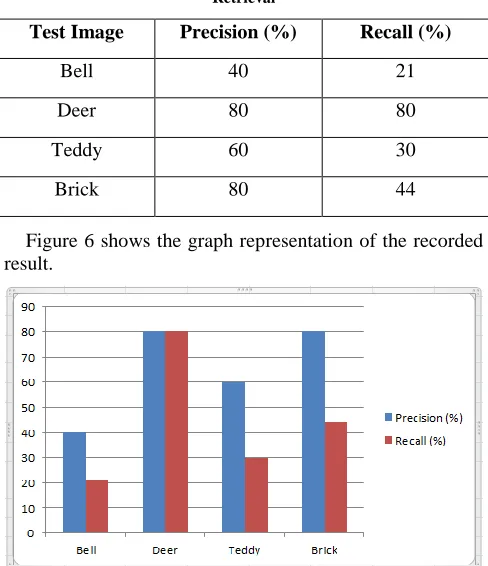
Precision And Recall Result For Shape Feature Based Image Retrieval
Test Image Precision (%) Recall (%)
Bell 40 21
Deer 80 80
Teddy 60 30
[image:4.612.322.566.146.429.2]Brick 80 44
Figure 6 shows the graph representation of the recorded result.
Figure 6: Precision & Recall graph for shape based image retrieval
The following Table II shows the precision and recall result calculated for 4 test images for shape and texture based image retrieval and Figure 7 shows the graph representation of the recorded result.
TableIII
Precision and Recall Result for Shape and Texture Feature based Image Retrieval
Test image Precision (%) Recall (%)
Bell 58 35
Deer 63 60
Teddy 80 80
[image:4.612.320.569.512.654.2]International Journal of Emerging Technology and Advanced Engineering
Website: www.ijetae.com (ISSN 2250-2459,ISO 9001:2008 Certified Journal, Volume 4, Issue 9, September 2014)
[image:5.612.50.292.87.289.2]335
Figure 7: Precision & Recall graph for shape and texture based image retrieval
The result shows that, the combination of shape and texture based image retrieval improves the efficiency of the system.
IV. CONCLUSION
Proposed approach uses different shape and texture feature descriptors for retrieval purpose. For shape descriptor we have used Canny edge detection technique. Gray Level Co-occurrence Matrix (GLCM) has been used for texture descriptors.
In general, the efficient implementation of CBIR system is difficult. Experimental results showed that use of only one descriptor in an image retrieval process is not sufficient. Hence, the combination of both shape and texture features gives better retrieval result. The use of fuzzy clustering technique helps to reduce the unnecessary comparisons. As a future work we try to compare the proposed approach with other techniques to improve the performance of the system.
REFERENCES
[1] S. Shambharkar and S. Tripude, ―Fuzzy C-Means clustering for content based image retrieval system‖, International Conference on Advancements in Information Technology, vol.20, pp. 148-152, 2011.
[2] D. Zhang and G. Lu, ―A Comparative Study on Shape Retrieval Using Fourier Descriptors with Different Shape Signatures‖, Journal of Visual Communication and Image Representation, vol. 14, no. 1, pp. 41-60, 2003.
[3] C. Shahabi, and M. Safar, ―An experimental study of alternative shape-based image retrieval techniques‖, Multimedia Tools and Applications, vol. 32, no.1, pp.29-48, 2007.
[4] L.J. Latecki, R. Lakamper, T. Eckhardt, ―Shape descriptors for non-rigid shapes with a single closed contour‖, Computer Vision and Pattern Recognition, Proceedings. IEEE Conference on, vol.1, pp.424-429, 2000.
[5] R. M. Haralick, K. Shanmugam, Its'Hak Dinstein, ―Textural Features for Image Classication‖, Systems, Man and Cybernetics, IEEE Transactions on, vol. 3, no. 6, pp.610-621, 1973.
[6] J. Prabhu and J. S. kumar ― Wavelet based content based image retrieval using color and texture feature extraction by gray level co-occurrence matrix and color co-co-occurrence matrix‖, Journal of Computer Science, vol. 10, no. 1, pp. 15-22, 2014.
[7] G. Castellano, A.M. Fanelli, F. Paparella, M.A. Torsello. ―Fuzzy Shape Clustering for Image Retrieval‖, System Sciences (HICSS), 46th Hawaii International Conference on, pp.1423-1428, 2013. [8] N. Xing and I.S. Ahmad. ―Fuzzy Clustering Paradigm and the
Shape-Based Image Retrieval.‖ In Proc. of the 21st International FLAIRS Conference, pp. 121-122, 2008.
[9] W. Pedrycz, A. Amato, V. Di Lecce, V. Piuri, "Fuzzy Clustering with Partial Supervision in Organization and Classification of Digital Images‖, Fuzzy Systems, IEEE Transactions on, vol.16, no.4, pp.1008-1026, 2008.
[10] J. CANNY, ―A Computational Approach to Edge Detection‖, Pattern Analysis and Machine Intelligence, IEEE Transactions on, vol.8, no.6, pp.679-698, 1986.
[11] J. Selvakumar, A. Lakshmi, T. Arivoli, ―Brain tumor segmentation and its area calculation in brain MR images using K-mean clustering and Fuzzy C-mean algorithm‖, Advances in Engineering, Science and Management (ICAESM), 2012 International Conference on , pp.186-190, 2012.