International Journal of Emerging Technology and Advanced Engineering
Website: www.ijetae.com (ISSN 2250-2459,ISO 9001:2008 Certified Journal, Volume 5, Issue 5, May2015)167
Design and Simulation of H-Bridge Converter with Additional
Switch Legs Using Different Control Techniques
Meghana A. Deshpande
1, Sahebrao N. Patil
21,2
Department of Electrical Engineering, Savitribai Phule Pune University, Pune, India
Abstract— This paper presents the design and implementation of H-bridge converter with additional switch legs (HA converter) which acts as AC-DC rectifier as well as DC-AC inverter. In this topology a solid connection is provided between the grounds of the input and output terminals, which reduces common mode noise and makes the converter suitable for PV PCS in dc distribution system or stand-alone power system. This paper presents the comparative evaluation of the performance of the two main control techniques for H-bridge converter with additional switch legs for reducing THD by reducing the common mode noise. Common-mode noise signals are high frequency signals which are created as a result of different voltage levels of input and output terminal with respect to ground terminal. SPWM voltage controller and average current controller are considered here. Harmonic analysis of these two control techniques is performed using FFT analysis of Simulink in MATLAB. Lower order harmonics are reduced using sinusoidal PWM technique. EMI filtering circuits are also used to get better results. As unwanted EMI is at much higher frequencies than normal signals, the EMI filter blocks or shunts unwanted higher frequencies. The main objective of this scheme is to reduce total harmonic distortion at the input side of the rectifier and output side of the inverter. The simulation results of both the techniques have been demonstrated.
Keywords—H-bridge converter, average current control, Sinusoidal pulse width modulation (SPWM), common mode current, Total harmonic distortion (THD)
I. INTRODUCTION
Global energy consumption is increasing continuously. Due to depletion of conventional, fossil resources the renewable energy sources are becoming more popular to satisfy the demand for electric power [1]. The power converters in DC distribution system such as ac-dc rectifiers and dc-ac inverters play an important role in optimizing the use of the renewable energy and improving system stability. The outputs of the renewable energy sources are fluctuating. To make these outputs stable and to achieve proper cooperation with the conventional ac utility grid, various power conversion topologies are employed. Transformers less topology of converters are becoming more popular because of their greater efficiency, smaller size, and lower costs [2].
This converter topology uses the grid connected converter without the use of galvanic isolation.
In case PV power conditioning system is employed to inverter, stray capacitance between the PV panel and the earth ground affects the common mode noise [2] [5]. The common mode current reduces the efficiency of power conversion stage, affects the quality of grid current, deteriorate the electric magnetic compatibility and give rise to the safety threats.
Converter circuits consist of semiconductor switching devices which produce significant harmonic voltages as they chop voltage waveforms during the transition between the conducting and cutoff stages [6]. The bridgeless boost rectifiers consist of semiconductor switching devices between the grounds of input and output terminals [4] [5] [6]. They are considered as a major contributor to the power system harmonics because of high common mode voltage [7]. The common mode current in any converter is produced when the voltage levels of the input and output terminals with respect to the earth ground are not same. Therefore by making the voltage levels of the input and output grounds same it is possible to reduce common mode current and consequently common mode noise by connecting input and output terminals by solid connection[3].
In the proposed study the triggering signals to H-bridge converter are designed by using the Sinusoidal Pulse Width Modulation (SPWM) technique to reduce the common mode noise [8]. The main focus of this paper is on the H-bridge converter with different control techniques including average current control [9] and Sinusoidal Pulse Width Modulation (SPWM) control. These control techniques are studied and compared with each other based on Total Harmonic distortion (THD).
II. H-BRIDGE CONVERTER
International Journal of Emerging Technology and Advanced Engineering
Website: www.ijetae.com (ISSN 2250-2459,ISO 9001:2008 Certified Journal, Volume 5, Issue 5, May2015)168
This H-Bridge converter can handle the bidirectional power flow shown in fig.1.The power flows from source v1
[image:2.612.56.277.177.303.2]to v2 and also from v2 to v1 by proper selection of switches.
Fig 1.H-bridge converter for bidirectional flow
III. PRINCIPLE OF OPERATION
The operation of the H-Bridge converter with four switches as shown in fig.1 is explained below. It consists of four states of operation for each ac line voltage polarity. During positive voltage polarity, in the first state of operation, only switches Q1 and Q4 operates and energy is stored in the inductor from voltage source v1. In the second state of operation, Q1 and Q3 operate and in this state energy is transferred from v1 to v2 through the inductor. In the third state, Q2 and Q4 operate and the energy stored in the inductor is discharged to the load v2.In the fourth state of operation only the switches Q2 and Q3 operates. Energy in the inductor is circulated. For negative ac voltage, the H-bridge converter has similar four modes such as modes 5, 6, 7, and 8 except that the direction of the inductor current is reversed.
A.AC-DC Rectifier
During the positive half cycle, states 1 and 2 are selected and during negative half cycle, states 5 and 3 are selected so that the power from the ac voltage source is rectified and delivered to the dc voltage source. By choosing this combination of states unnecessary switching of Q1 and Q4 can be avoided that reduces switching losses.
B.DC-AC Inverter
During the positive half cycle, states 6 and 5 are selected and during negative half cycle, states 7 and 1 are selected when the power flows from dc to ac voltage source
.
IV. AVERAGE CURRENT MODE CONTROL
Average current mode control is used to shape the ac line current to minimize its distortion.
The relationship between the average line current and the average inductor current per switching cycle is used to generate control signal.
During the states 1 and 2 combination i.e. during positive half cycle of input ac voltage, the average inductor current in a unit switching cycle, is equal to the average line current because the inductor is connected in series with the ac voltage source. But during negative half cycle, the average line current is not equal to the average inductor current but equal to the average switch current of Q2. Therefore, coefficient change or correction factor should be multiplied to the control loop to properly shape the line current. Therefore during states 1 and 2 combination inductor current is
Sin wt
I
=
I
=
I
L12 L m (1)Where IL12=Inductor current during states 1 and 2
IL= Average line current
And during states 5 and 3 combination,
Sinwt
I
V2
V1
1
=
I
=
I
L53 L
m
(2)Where IL53=Inductor current during states 5 and 3.
IL= Average line current
V1 = Supply voltage
V2 = Output voltage
[image:2.612.328.556.324.663.2]International Journal of Emerging Technology and Advanced Engineering
Website: www.ijetae.com (ISSN 2250-2459,ISO 9001:2008 Certified Journal, Volume 5, Issue 5, May2015)169
V. SINUSOIDAL PULSE WIDTH MODULATION
Pulse width-modulation (PWM) converters in distribution systems are very effective in terms of performance, for elimination of harmonic distortion, power factor correction, voltage regulation and flicker compensation. Sinusoidal PWM is a technique where the sinusoidal waveform or modulation signal is compared with a very high frequency triangular or carrier signal to obtain the switching pulses for the device.
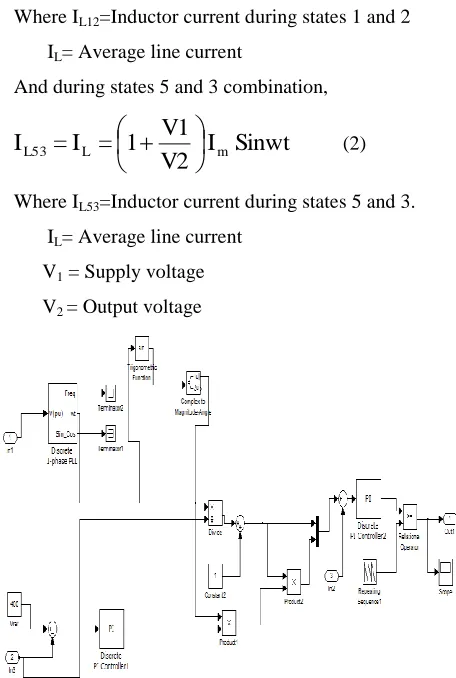
In this control technique the load voltage is compared with the reference voltage and error obtained is fed to PI controller. Then the signal generated from PI controller which is sinusoidal reference signal is compared with high frequency triangular signal to generate gating signals.
Fig- 3.Simulation model of Sinusoidal pulse width modulation
VI. SIMULATION RESULTS
Simulation of single phase H-bridge converter using average current mode control and sinusoidal pulse width modulation is carried out with the help of MATLAB/SIMULINK. Comparison of harmonic analysis of average current mode control and sinusoidal pulse width modulation are carried out to observe the improvement in input current of rectifier and output voltage of inverter.
Table-I
RECTIFIER PARAMETERS
Parameters Values
Input AC voltage 230V
Supply Frequency 60Hz
Common mode capacitor 330nF
Switching Frequency 36kHz
Table-II
INVERTER PARAMETERS
Parameters Values
Input AC voltage 400V
Supply Frequency 60Hz
Common mode capacitor 330nF
Switching Frequency 20kHz
Fig- 4. Simulation model of H-bridge rectifier with additional switch legs using average current mode control
International Journal of Emerging Technology and Advanced Engineering
Website: www.ijetae.com (ISSN 2250-2459,ISO 9001:2008 Certified Journal, Volume 5, Issue 5, May2015)170
Fig-6.Input current waveform for the average current mode controller
Fig-7. Harmonic spectrum of input current for average current mode controller
Fig-8.Simulation model of H-bridge rectifier with additional switch legs using sinusoidal pulse width modulation
Fig-9.Input voltage of rectifier for the sinusoidal pulse width modulation
Fig-10.Input current of rectifier for the sinusoidal pulse width modulation
Fig-11..Harmonic spectrum of input current for sinusoidal pulse width modulation
International Journal of Emerging Technology and Advanced Engineering
Website: www.ijetae.com (ISSN 2250-2459,ISO 9001:2008 Certified Journal, Volume 5, Issue 5, May2015)171
Fig-13.Output voltage of inverter for the average current mode controller
Fig-14. Harmonic spectrum of output voltage for average current mode controller
Fig-15.Simulation model of H-bridge inverter with additional switch legs using sinusoidal pulse width modulation
Fig-16.Output voltage of inverter for the sinusoidal pulse width modulation
Fig-17.Harmonic spectrum of output voltage for sinusoidal pulse width modulation
TABLE-III:
Comparison Of Control Techniques for rectifier
H-bridge rectifier
Control method % Current THD
Average current control
4.21
Sinusoidal pulse width modulation
2.86
TABLE-IV:
Comparison Of Control Techniques for inverter
H-bridge inverter
Control method %Voltage THD
Average current control
0.08
Sinusoidal pulse width modulation
International Journal of Emerging Technology and Advanced Engineering
Website: www.ijetae.com (ISSN 2250-2459,ISO 9001:2008 Certified Journal, Volume 5, Issue 5, May2015)172
VII. CONCLUSION
The harmonic spectrums for the two control methods are compared for input current of H-bridge rectifier and output voltage of H-bridge inverter. From simulation results it is observed that sinusoidal PWM technique is more effective in reducing the common mode noise which in turn reduces harmonics in supply current in case of rectifier and in output voltage in case of inverter as compared to average current mode control technique. This reduces electromagnetic interference, reduces harmonic distortions and improves the quality of waveform.
REFERENCES
[1] M. Carrasco, L. G. Franquelo, J. T. Bialasiewicz, E. Galvan, R. C. Portillo Guisado, M. A. M. Prats, J. I. Leon, and N.Moreno-Alfonso, ―Powerelectronic systems for the grid integration of renewable energy sources: A survey,‖ IEEE Trans. Ind. Electron., vol. 53, no. 4, pp. 1002–1016, Jun.2006.
[2] Y.Gu, W.Li, Yi Zhao, Chushan Li, Xi. He,‖ Transformerless Inverter with Virtual DC Bus Concept for Cost-Effective Grid-Connected PV Power Systems", IEEE TRANS. ON POWER ELECTRONICS, VOL. 28, NO. 2, FEBRUARY 2013
[3] Jong-Won Shin, Hojoon Shin, Gab-Su Seo, Jung-Ik Ha, and Bo-Hyung Cho, ―Low-Common Mode Voltage H-Bridge Converter with additional Switch Legs,‖ IEEE Trans.Power Electron, vol. 28, no.4, APR. 2013.
[4] Haoyu Wang, Yichao Tang, Alireza khaligh, ―A bridgeless boost rectifier for low voltage boost rectifier for low voltage energy harvesting applications,‖ IEEE Trans. on Power Electron., vol. 28, no. 11, pp. 5206-5214,Nov 2013.
[5] P. Kong, S.Wang, and F. C. Lee, ―Common mode EMI noise suppression for bridgeless PFC converters,‖ IEEE Trans. Power Electron., vol. 23, no. 1, pp. 291–297, Jan. 2008.
[6] A.F.de Souza and I. Barbi, ―High power factor rectifier with reduced conduction and commutation losses,‖ in Proceedings of the 21st International Telecommunications Energy Conference, 1999, Paper 8-1.
[7] Zhu Guangyong, Huai Wei, Chris Iannello, and Issa Batarseh. "A study of power factor and harmonics in switched-mode power supplies." InSoutheastcon'99. Proceedings. IEEE, pp. 278-283. IEEE, 1999.
[8] A.M.Gole 2000 ―power electronics‖ Sinusoidal Pulse Width Modulation