DEVELOPMENT OF A
FRAMEWORK FOR MINIMISING
ERRORS IN CONSTRUCTION
DOCUMENTS IN NIGERIA
Elijah Olusegun AYODELE
DEVELOPMENT OF A
FRAMEWORK FOR MINIMISING
ERRORS IN CONSTRUCTION
DOCUMENTS IN NIGERIA
Elijah Olusegun AYODELE
School of the Built Environment
The University of Salford
Manchester, UK
19
thMay 2017
i
TABLE OF CONTENTS
TABLE OF CONTENTS ... i
LIST OF TABLES ... v
LIST OF FIGURES ... viii
ABSTRACT ... ix
DEDICATION ... xi
ACKNOWLEDGEMENTS ... xii
CHAPTER ONE ... 1
INTRODUCTION ... 1
1.0 Introduction ... 1
1.1 Background to the Study ... 1
1.2 Research Problem ... 2
1.3 Statement of the Research Problem ... 6
1.4 Research Justification ... 8
1.5 Research Aim and Objectives ... 11
1.6 Research Scope and Limitation ... 11
1.7 Research Methodology ... 12
1.8 Research Outcomes ... 13
1.9 Structure of the Thesis ... 18
CHAPTER TWO ... 21
LITERATURE REVIEW ... 21
2.0 Introduction ... 21
2.1 Definition of Error ... 21
2.2 Types of Construction Document Error ... 23
2.3 Causes of construction document error ... 35
2.4 Effects of Construction Documentation Error ... 57
2.4.1 Quantitative Effects ... 57
2.4.2 Qualitative Effects ... 61
2.5 Discussion ... 67
2.6 Summary ... 69
CHAPTER THREE ... 70
CONCEPTUAL FRAMEWORK ... 70
ii
3.1 Definition and Significance of conceptual framework ... 70
3.2. Previous Similar Studies on Error Reduction in the Construction Industry. ... 71
3.3 Development of conceptual framework for this current research ... 76
3.4 Summary ... 80
CHAPTER FOUR ... 81
RESEARCH METHODOLOGY ... 81
4.0 Introduction ... 81
4.1 Research Methodological Models... 81
4.2 Research Philosophies ... 85
4.2.1 Ontological Philosophy ... 85
4.2.2 Epistemological Philosophy ... 88
4.2.3 Axiological Philosophy ... 90
4.3 Research Approach ... 92
4.4 Research Strategy ... 94
4.5 Research Choice ... 98
4.6 Research Time Horizons ... 101
4.7 Research Techniques (Data Collection Methods)... 102
4.8 Target Population ... 108
4.9 Samples and Sampling Techniques ... 109
4.10 Reliability of Instruments ... 109
4.11 Validity of Instrument ... 111
4.12a Administration of Questionnaire ... 113
4.12b Data collection and Research Objectives ... 114
4.13 Sequence of Data Collection and analysis ... 115
4.14 Periods for data collection ... 117
4.15 Research techniques for data analysis... 125
4.16Definitions of Statistics Used: Content Analysis, Severity Index and Relative Importance Index ... 126
4.17 Statistics for Validation of Research Results ... 127
4.18Summary ... 130
CHAPTER FIVE ... 131
DATA ANALYSIS, RESULTS AND DISCUSSION ... 131
5.0 Introduction ... 131
5.1 Data Presentation ... 131
iii
5.2.2Types of Error on Construction Documents ... 142
5.2.3Causes of Error on Construction Documents ... 144
5.2.4The Effects of Errors on Construction Documents ... 150
5.2.5:Mapping of the Causes to Types of Error ... 163
5.2.6Frequencies of occurrences of types of error. ... 170
5.2.7Development of Construction Document Error Minimisation Framework. ... 172
5.3 Validation of Research Results ... 175
5.3 Revised Conceptual Framework ... 178
5.4 Types of errors in construction documents in Nigeria ... 180
5.4.1 Unnecessary Additions (Over-Design) ... 181
5.4.2 Non Conformance to Client’s Requirements ... 181
5.4.3 Non-conformance to Design Code/SMM ... 182
5.4.4 Absence of Specifications / Schedules ... 182
5.4.5 Dimensional Error ... 183
5.4.6 Miscalculation ... 184
5.4.7 Scanty Specifications / Schedules ... 184
5.4.8 Wrong Specifications / Schedules ... 185
5.4.9 Omission of Necessary Items ... 185
5.4.10 Incorrect Details ... 186
5.5 Causes of Error in construction documents in Nigeria. ... 187
5.5.1 Non-availability of Information ... 187
5.5.2 Poor Communication... 188
5.5.3 Inadequate Project Brief ... 189
5.5.4 Poor Salary of Professionals Engaged by Consultants ... 189
5.5.5 Non-identification of Project Risks ... 190
5.5.6 Inadequate Consultant’s Professional Education ... 190
5.5.7 Inadequate Consultant’s Professional Experience ... 191
5.5.8 Inadequate Project Manager Experience ... 192
5.5.9 Time Scheduled Pressure ... 193
5.5.10 Inadequate Project Planning ... 193
5.5.11 Size and Complexities of projects ... 194
5.5.12 Concurrent Documentation ... 195
5.5.13 Heavy workload of Consultants ... 195
iv
5.5.15 Inadequate Documentation Time ... 196
5.5.16 Inadequate Documentation Manager’s Experience... 197
5.6.1 Quantitative effects of error in construction documents with respect to cost and time. ... 198
5.6.2 Quantitative effects of documentation error on building occupants / site workers. ... 199
5.6.3 Qualitative Effects of Error in Construction Documents on projects and economy ... 200
5.7. Explanation on the Construction Documents Error Minimisation Framework. ... 202
5.7 Summary ... 208
CHAPTER SIX ... 209
CONCLUSIONS AND RECOMMENDATIONS ... 209
6.0 Introduction ... 209
6.1 Conclusions ... 209
6.2 Development and implementation of Framework supported with guidelines for minimisation of errors in construction documents in Nigeria. ... 216
6.3 Recommendation ... 221
6.4 Contribution of the study to practice ... 221
6.5 Contribution of the study to theory ... 222
6.6 Limitation and Scope ... 223
6.7 Suggestions for Future Research ... 224
6.8 Summary of Chapter Six ... 224
6.9 Summary of the Thesis ... 224
REFERENCES ... 226
APPENDIXES ... 244
Appendix 1: Questionnaire ... 244
Appendix 2: Guide for Semi Structured Interview ... 269
v
LIST OF TABLES
Table 1.1: Percentage of Projects completed within and above contract sum
(Source: Alutu & Ayodele, 2006) ... 5
Table 1.2: Percentage of projects completed within and above agreed delivery periods (Source: Alutu & Ayodele, 2006) ... 5
Table 1.3: Comparative unit cost of building and civil engineering projects between Nigeria,\ Algeria and Kenya (Source: Ajanlekoko, 2001,cited in Alutu, 2006). ... 5
Table 2.1: Definitions of Construction Documents Error ... 22
Table 2.2: Classification of the types of errors (source: Mohammed, 2007) ... 23
Table 2.3: Extent of utilisation of specification (Source: Ayodele & Ayodele, 2011b) ... 26
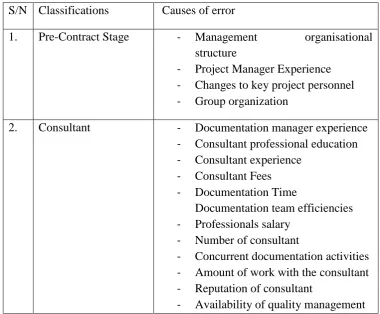
Table 2.4:Classifications of Causes of errors (Source: Mohammed 2007) ... 36
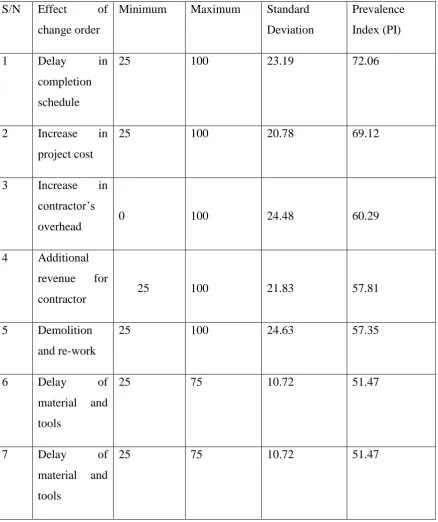
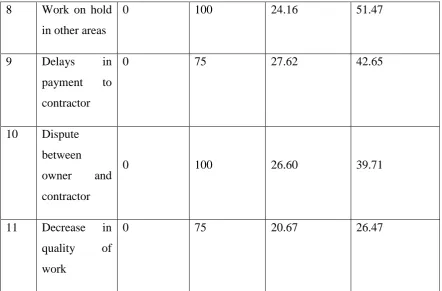
Table 2.5: Prevalence Indexes of Effects: Contractor View (Source: Al- Dubaisi, 2000) ... 62
Table 2.6: Prevalence Indexes of Effects – Consultants View (Source: Al- Dubaisi, 2000) ... 64
Table 4.2:Research objectives and methodology of data collection ... 114
Table 4.3: Responses to semi structured interview on definition of document error. ... 118
Table 4.4: Administration of Questionnaires on types, causes and effects of document error .. 119
Table 4.5: Percentages of retrieved questionnaire with respect to participants on types and causes of document errors ... 121
Table 4.6: Response of participants to effects of errors on cost and time ... 122
Table 4.7a: Percentages of retrieved questionnaires from participants on mapping of causes to types of error. ... 123
Table 4.7b: Percentages of retrieved questionnaire with respect to participants on frequencies occurrences of types and causes of errors on construction documents ... 124
Table 4.8:Selection of experts for validation exercise ... 128
Table 4.9: Experts Rating for Research Result 1 ... 129
Table 5.1: General information on respondents ... 132
Table 5.2:Definitions of Construction Document Error from literature survey ... 135
Table 5.3: Definitions of Construction Documents Error from semi structured interview ... 137
vi
Table 5.5: Meeting points of types of error determined in this research and findings on
types of error of Dosumu & Adenuga (2013) ... 144
Table 5.6b: Causes of documentation error: Summary and ranking... 145
Table 5.7: Meeting points of causes of error determined in this research on findings on causes of error of Dosumu & Adenuga (2013) ... 147
Table: 5.8 Comparison of causes of error determined in this research with findings of Ebekozein, Uwaida & Usman (2015) ... 148
Table: 5.9 Comparison of causes of error determined in this research with findings of Dosumu & Iyagba (2013) ... 149
Table 5.10:Total Error Cost ... 151
Table 5.11:Total Error Time ... 152
Table 5.12: Some Selected Reported Incidents of Building Failures/Collapses in Nigeria from1974 to 2001 (Source: Fadamiro, 2012)... 153
Table 5.13: Reported cases of building collapse in Nigeria from 2007-2011(Source: Akinjogbin & Balogun 2013) ... 156
Table 5.14: Summary of loss of lives as a result of building collapse occasioned by documentation error ... 160
Table 5.15: Qualitative Effects of Documentation Error on Projects ... 161
Table 5.16 Comparison of qualitative effects of document error determined in this research with findings of Dosumu & Adenuga (2013 ... 162
Table 5.17: Mapping Causes of Error to Types of Error ... 165
Table 5.18: Mapping of Types of Error to their Causes ... 168
Table 5.19: Frequencies of occurrences of types of error ... 171
Table 5.20Reported Cases of Occurrences and Causes of Building Collapse in three nations of the world from 1968 -2010 (Source: Alabi, 2013). ... 199
Table 5.4a: ... Analysis of the types of documentation error by RII ... 269
viii
LIST OF FIGURES
Figure 3.1:Map of research: culled from Atkinson (1999)………...……….75
Figure 3.2: Conceptual Framework……….………80
Figure 4.1:Research model [nested methodology research model………...…...83
Figure 4.2:Research model (Onion methodology research model……….84
Figure 4.3: Flow Chart for sequence of data collection………...117
Figure 4.4: Chart of the origin of causes of error……….………173
Figure 4.5: Revised Conceptual Framework……….179
Figure 6.1: Chart of the origin of causes of error……….219
ix
ABSTRACT
Many of the causes of poor project performance which result in cost and time overruns, and poor quality can be traced to some types of errors during the design process. It is discovered that design errors add 5.9% of the contract value and rework, which is a corrective work, has been estimated to be as high as 20% of the design consultant’s fee for a given project. These errors should be eliminated to allow sound project performance. The aim of this research is to develop a framework supported with guidelines for the minimisation of errors in construction
documents in Nigeria. The study was carried out by means of literature survey, questionnaire survey and semi structured interviews. Literature survey was used to discover the various definitions of errors and the general types, causes and effects of errors in construction documents. Semi structured interviews were made use of, to elicit the definitions of document error from the respondents. Questionnaires were distributed to construction professionals in south western states and the federal capital territory of Nigeria to determine the types and causes of errors specific to Nigeria and also the effects of document errors on construction cost, time, quality and building occupants. Content analysis, relative importance index, kendall’s coefficient of concordance, severity index, and percentages were used to analyse the
data collected. The study showed the causes of errors in construction documents to be: non – availability of information, poor communication, inadequate project brief, poor salaries of professionals, non – identification of project risks, inadequate consultant professional education, inadequate consultant professional experience, inadequate project manager experience, time scheduled pressure, inadequate project planning, complexity of project, concurrent documentation, heavy work load of consultant, poor consultancy fees, inadequate document preparation time and inadequate document manager experience. The study also identified the various types of error in construction documents specific to Nigeria which are: unnecessary additions, non – conformance to client requirement, non – conformance to design code/ SMM, absence of specifications, dimensional error, miscalculation, scanty
x
DECLARATION
This thesis is presented as an original contribution based on Doctor of Philosophy research at
the University of Salford, Manchester, United Kingdom and has not been previously
submitted to meet requirements for an award at any higher educational institution under my
name or that of any other individual. To the best of my knowledge and belief, the thesis
contains no previously published or written work by another person except where due
reference is made.
……… (Signed)
xi
DEDICATION
This thesis is dedicated first to God Almighty through Jesus Christ for making me a
beneficiary of His mercies and grace. Then, to my beloved wife, my Best, Victoria Ayodele
xii
ACKNOWLEDGEMENTS
Praises be to the almighty and wonderful God the author and the finisher of my faith, the
owner of my life and to whom I belong, for leading me to this path of self-discovery and
experience. I will like to express my heartfelt gratitude and appreciation to my University of
Salford based supervisors, Dr Song Wu who started me on the programme and Dr Chaminda
Pathirage who completed the programme with me, for their utmost patience, kindness,
motivation and support throughout my entire PhD journey. Their invaluable insights, critical
comments and exceptional guidance have brought out the researcher that I have never known
exists in me. I say thank you sirs, may the God of heaven bless you always. I also thank my
local advisor Prof. K. T. Odusami of the University of Lagos Nigeria, who has always been
there for me; thank you very much sir.
I am also very grateful to Prof. Vian Ahmed, the Director of the School of Built Environment,
the research administration staff Moira Mort, Rachel Lilley and Cheryl Batley, for their
unrelenting support and kindness during my PhD studies at Salford. I thank you all.
I will also like to express my utmost gratitude to my beloved parents Late Pa Zaccheus
Ayodele Oduola and Late Madam Julianah Tinuade Ayodele - Oduola; who have been my
twin pillar of strength throughout my entire life and have taught me courage, faith, love and
perseverance. Thank you for your efforts.
I am equally very grateful to my precious children Timothy, Lois and Daniel; for their good
conduct even during my absence from home. I am forever indebted to my amazing wife
Victoria. I say thank you for your love, humour and also for your assistance in vetting the
1
CHAPTER ONE
INTRODUCTION
1.0 Introduction
This chapter commences with the background to the study. It also introduces the research
problem, statement of the problem, research justification, research aim and objectives,
research scope and limitations, research methodology, research outcome, the structure of
thesis and ends with the summary.
1.1 Background to the Study
For any construction project, the three performance parameters of cost, time and quality are
very significant (Hackett et al, 2007; Brandon, 1995). Generally, these three parameters are
attached to each type of contractual arrangement and have been recognised as established
norms in the construction industry. Clients want to receive completed projects that are of high
quality, within budget and on time. Construction professionals such as Architects, Engineers,
Quantity Surveyors, and also Contractors have no option than to comply with the clients
desires. The ability of the project team to meet these conflicting but basic requirements under
the uncertain project environment is always a challenge. It is therefore required of the project
team to show adequate care and expertise for the project economy of scale starting from the
completion time, economy of expenditure and optimum quality of the finished product
(Andravei, 2003). According to Stewart (1992) error is defined as ‘an event or process that
departs from commonly accepted competent professional practice’. Edmonson (2002) also
defined error as ‘the execution of a task that is either unnecessary or incorrectly carried out’.
According to Reason (1990), errors relate to those occasions in which a planned sequence of
2
cannot be attributed to the intervention of some chance agency. Furthermore, Busby (2001)
defines errors as the occurrences which were unexpected, involve surprise and which could
not be attributed entirely to chance or circumstance. Errors are unintended deviations from
correct and acceptable practice that are avoidable (Love et al, 2008). While Reason (2006)
sees design error as an error that relates to those occasions in which a planned activity fails to
achieve it’s intended outcome, and when these failures cannot be attributed to the intervention
of some chance agency. Love & Smith (2003) defined design error ‘as unintended deviations
from correct and acceptable practice that are avoidable’. The definition of error considered
within this research can therefore be summarised as something that causes deviation from
correctness or standard, which makes the document not being able to achieve its intended
purpose. Construction documents on the other hand are the drawings, design specifications,
quality control reports, and others (Hajjar & AbouRizk, 2000). Furthermore, Murdoch &
Hughes (1997) defined contract documents as the means by which designers’ intentions are
conveyed to the client, the statutory authorities, the quantity surveyor, the contractor and
sub-contractors. Mohammed (2007) asserts that it is during the preparation of construction
documents that most of the parameters that influence construction works are established.
That is, if there are costs and time overruns on a project, some of the problems; that is, errors
that will lead to these must have been erroneously included in the construction documents.
Some researchers have revealed that most of the construction costs, to the level of 75% have
been committed during the product design process (Weustink, et al, 2000). Having discussed
background to this study, next section will focus on research problem.
1.2 Research Problem
Construction industry; be it building or other types of infrastructure goes through certain
stages before construction is completed. The first of the stages is that of the designs and the
3
have to be properly taken care of. Mistakes, such as unnecessary additions or omissions
during the design stages often lead to enlarged problems later (Williams, 2010). Many of the
causes of poor project performance, that is, cost, time and quality, can be traced to some types
of errors during the design process (Williams (2010). According to Mohammed (2007), it
costs more to solve problems that emerge during construction process. This is because the
design documents have to be re-visited and amended appropriately. Many of these errors
unwanted by the design team members, unforeseen but avoidable, could throw construction
work off-balance. To achieve the project objectives, errors must be eliminated from the
designs during the design process. In the UK, Hibberd (1980) cited in Mohammed (2007), it
is discovered that the major source of variation on construction sites is the lack of adequate
design at design stage which occurred in 25% of projects. Some researchers in the UK
(Langford, et al, 1986) found out that 72% of variations were caused by the design team –
obviously through the designs they produced. In Saudi Arabian construction industry,
Al-Ghafly (1995) discovered that most changes that cause time overruns during construction
result from the poor design of the project. Al-Subaiey (1997), in his survey, discovered that
there were many errors and omissions of specifications, which ordinarily resulted into claims
by contractors during the construction process. According to the Construction Industry
Institute (1986) cited in Mohammed (2007) a savings on the order of 2-6% of original
estimate is achievable through adequate constructability reviews only. Supporting the above
view is a discovery from a study by Stassiowski & Burstein (1994) that variation order cost,
reduces from 7% to 3% of the project cost, by the use of a system called REDICHECK
method for conducting design reviews.
In Nigeria, Alutu & Ayodele (2006) discovered that 92% of respondents accepted “changes as
a result of error in design” as one of the reasons for cost overruns. While in Alutu & Ayodele
(2008), 94% of the respondents agreed with “changes as a result of error in design” as one of
4
discovered that design changes accounted for 67-90% of the total number of changes on the
project and that the design deviations generally accounted for the greatest increase in total
contract sum ranging from 0.4% to 20.6%. Researchers (Alabi, 2013; Williams, 2010;
Akindoyeni, 2002; Bolaji, 2002; Dare, 2002; Fadamiro, 2002; and Ogunsemi, 2002 &
Olusola, 2002) in Nigeria have indicated that poor quality work that had resulted to building
collapse have one of its causes to be errors in designs; which are errors in architectural,
structural, electrical and mechanical designs and the bill of quantities. Fadamiro (2002) gave a
list of 20 building collapses in Nigeria (1974-2001), while Dare (2002) also listed 35
collapsed buildings and all these have resulted to loss of lives and properties. Building
collapses occur almost on monthly basis in Nigeria. Ashworth & Hogg (2002) stated that the
construction industry has a poor reputation that is due mainly to its perceived inability to meet
the need of clients in achieving project completion dates, completing project within budget
and providing a high quality product. This, they linked to the complexity and scope of many
building projects which are full of risks. Some of such risks are errors on construction
documents, which is the subject of this thesis. Consultants, namely Architects, Civil
Engineers, Electrical Engineers, and Mechanical Engineers, and Quantity Surveyors have
contributed a great deal to cost overrun of projects because of inadequate information by them
(Mohammed, 2007). They have also contributed to errors in contract documentation (Kirby,
1988; Love, Mandal, et al, 2000) and poor quality of construction documents (Stassiowski &
Burstein, 1994; Tilley, et al, 1999).
It is unfortunate that because of documentation error, the Nigerian construction industry has
performed badly in terms of cost, time and quality, in other words cost overrun, time overrun
and poor quality jobs are prevalent. For example a research in Nigerian tertiary institutions
building projects, conducted by Alutu & Ayodele (2006), showed that only 4.3% out of 141
projects were completed within budget while 95.7% had cost overrun (please refer to Table
5
stakeholders in the Nigerian economic system. It is worrisome and indeed embarrassing when
it is reported that construction cost in Nigeria are among the highest in the world. A report by
Ajanlekoko (2001) cited in Alutu (2006) shows that an industrial building, office block and a
3-star hotel can be built in South Africa at $201/m2, $575/m2,and $37,855/m2 respectively, whereas in Nigeria, these projects will cost 50%, 150% and 130% more respectively. The
situation is slightly better in Ghana where the projects will cost `6%, 98% and 37% more
respectively. The problem of cost overrun in Nigeria has been a great dissatisfaction to the
clients.
Table 1.1: Percentage of Projects completed within and above contract sum (Source: Alutu & Ayodele, 2006)
Number of projects Percentage completed within tender sum
Percentage completed above tender sum
141 4.3% (6) 95.7% (135)
Table 1.2: Percentage of projects completed within and above agreed delivery periods (Source: Alutu & Ayodele, 2006)
Number of projects Percentage completed within agreed period
Percentage completed after agreed period
141 3% (6) 95% (137)
Table 1.3: Comparative unit cost of building and civil engineering projects between Nigeria, Algeria and Kenya (Source: Ajanlekoko, 2001,cited in Alutu, 2006).
Project type Nigeria
N
Algeria
N
Kenya
N
Residential Building 350/m2 313/m2 132/m2
Multi storey Office Block 450m2 - 207/m2
6 Dual Carriage road (4 lanes) 800,000 -
1200000/km
587015/km 278961/km
From Table 1.3, cost per metre square of residential building in Nigeria was 10.57% higher
than in Algeria and 33.71% higher than in Kenya. In Nigeria to build a multi storey office
block is 51.78% higher than in Kenya. To construct single carriage road (2 lanes) in Nigeria
was 49.23% higher than in Algeria and 63.96% higher than in Kenya. The report also showed
that a dual carriage road (4 lanes) in Nigeria is 41.3% higher than in Algeria and 72.1% higher
than in Kenya. A recent report on the cost of construction related project across the globe
revealed that the cost of constructing a kilometer of asphaltic road in Nigeria happens to be
the highest in the world compared to what is obtainable in other nations of the world (NIQS,
2003). In Nigeria, and in a study of delivery periods of building projects in Nigerian tertiary
institutions conducted by Alutu & Ayodele (2008) on 141 building projects, 3% of the
projects studied were completed within the initially agreed period while 97% were completed
after agreed delivery periods (please refer to Table 1.2). One of the major reasons stated for
the elongated completion of project was the occurrences of errors in construction documents.
Research problem has been discussed in this section next section will state the research
problem.
1.3 Statement of the Research Problem
Walker (1994) worked on different factors that cause errors in construction documents in
general, but not on the mechanism of such influence. Atkinson (1999) in his doctoral research
extensively worked on the management of errors in construction projects in the UK. He
examined the defects problem during the construction phase from the viewpoint of human
error. Atkinson’s qualitative research drew causes of error from available literatures and
7
in construction documents and their effect on the project but did not work on the causes of
such errors. Mohammed (2007) in his doctoral research extensively researched on the
relationship between errors that occur in construction design documents in Saudi Arabia and
their possible causes, which resulted in an exploratory system dynamics model to reduce the
occurrence of errors in design documents.
The types of design errors (Atkinson, 1998; Love et al, 2011; Chapman, 1991), factors
responsible for design errors (Palaneeswaran, et al, 2007; Shelton, 1999; Endsley, 1999,
Barkow, 1995) and effects of design errors (Love et al, 2008, Oyewobi, et al, 2011;
Mohammed, 2007) on construction projects have been studied by authors outside the Nigerian
construction industry. The causes and qualitative effects of construction documentation errors
by Dosumu & Adenuga (2013) were carried out in Lagos state of Nigeria. Dosumu & Iyagba
(2013) compared the responses of consultants and contractors on causes of errors in
construction documentation and also in Lagos state of Nigeria. Ebekozien, Uwadia &Usman
(2015) examined the causes and qualitative effects of construction documentation errors were
carried out in Edo state of Nigeria. This research work has the objectives to investigate on a
larger area of Nigeria in seven states, the robust definition, types, causes, qualitative and
quantitative effects of construction documentation error, in addition to mapping of causes to
types of error, the frequencies of occurrences of types of error and developing a framework
supported with guidelines for the minimisation of errors in construction documentation in
Nigeria. Nigeria is a nation with thirty six states. The earlier studies in Nigeria (one state each
in Southern Nigeria) may not be able to produce enough strength to curb documentation
errors in Nigeria because of the small area of coverage. This work covers a good portion of
the Southern and Northern Nigeria. This current work which takes care of many sides of
documentation error and on a larger scale and area will produce overall better results. The
effects of errors in construction documents are both numerous and devastating on construction
8
(Love, 2002; Love et al., 2008), propagation of failure (Vrouwenvelder, et al., 2009),
structural collapse, financial loss, inconvenience, deterioration of buildings, personal injury
and sickness, time delay, damaged equipment (Barkow, 1995), defects, wastages and
inconveniences (Palaneeswaran, et al., 2007), conflicts and ambiguities (Olatunji, 2011).
Others are cost overrun (Mohammed, 2007), procurement systems problems (Rashid, et al.,
2006), incomplete designs, change order, rework, construction delay, etc (Alarcon &
Mardones, 1998). As a result of the adverse effects of errors in construction documents, it is
important to identify factors that are responsible for them so that the professionals involved in
the preparation of the documents and other stakeholders can be aware of them and work
against them. There is therefore, the need to develop an intervention strategy that will tackle the causes of errors in construction documents in Nigeria, so that the appearances of all types
of error, qualitative and quantitative effects of errors in Nigeria can be greatly minimised. The
intervention strategy is the development of framework that will minimise the documentation
error, which this study seeks to achieve. Statement of the problem was discussed in this
section next section will focus on justification for the research.
1.4 Research Justification
The effects of errors in construction documents have devastating effects on construction
economy in Nigeria. This is because the presence of error in construction documents has
strong links to cost overrun, time overrun and poor quality job (Williams, 2010). The
potential of the construction industry in generating employment is enormous; it is estimated to
be responsible for about 7% of global employment. Construction industry contributes about
10% to the world’s GDP. The industry consumes about 40% of total energy consumed around
the globe, thus making it one of the largest energy consuming sector in the world. Resource
allocation in the construction sector amounts to 50% of the total resources utilised in the
9
probably exceeds that of tragic failure (Rollings & Rollings, 1991). Researchers have
indicated that a 10% improvement in construction activities will lead to a 2.5% in Gross
Development Product GDP (Stockel & Quirke, 1992). In Nigeria, construction industry
contributes about 4% to the Gross Development Product (Moneke, 2014). Minimising errors
in construction document will minimise cost overrun and time overrun. When cost overrun is
minimised there will be more money to invest and therefore the GDP will increase, thereby
raising the conditions of living of the nation’s populace. In this respect the attempt to
minimise errors in construction documents is justified.
Rework involves re-doing a work that was incorrectly executed because of the earlier faulty
documentation. Rework is the necessary activity that takes place, when the earlier design is
incorrectly done. This is an endemic feature of the project procurement process and is one of
the primary causes of cost and time overruns (Mohammed, 2007). The direct cost of rework
in the construction industry is considerable and has been found to be 10-15% of the contract
sum (Burati, et al, 1992; Construction Industry Development Agency 1995). Rework which
is a corrective work has been estimated to be as high as 20% of the design consultant’s fee for
a given project (Gardiner, 1994). Josephson (1998) showed that design errors result to 4.4%
of the contract sum. Barber et al, (2000) also discovered that design errors add 5.9% of the
contract value. Rework takes a good time and elongates delivery period by 7.1% of the
normal time (Josephson, 1998). Rework which results into cost and time overruns will greatly
reduce if such errors are minimised. All these unnecessary extra cost and time can be avoided
if construction documents’ errors are minimised, which this research seeks to achieve.
Project cost arrived at by the Quantity Surveyor from cost calculations of the various designs
and drawings became unrealistic because of the errors embedded in the designs. Observations
have shown that the contingency sums included in the bills of quantities most times, cannot
10
Ayodele & Alabi (2011) unrealistic estimate many times, results into abandonment of
building projects and this is very rampant in Nigeria. Reduction of errors emanating from
construction documents ordinarily will result to realistic estimate all things being equal. When
errors are minimised in construction documents, realistic estimate will emerge.
Construction clients want to obtain their quality project at the normal cost and time. Any
increase as a result of errors in construction documents will alter their desire. Reduction of
errors in construction documents will make them stay within the limits of cost and time, and
may result into being able to make more investments in the future. Occurrence of errors in
construction documents creates a poor impression of the consultants and possible loss of
future business (Mohammed, 2007). Developing framework for the reduction of errors in
construction documents will increase reputation of consultants, as they may likely be invited
for future jobs. Contract claims on building projects always lead to cost overrun and at times
disputes, often times these are unsatisfactory to the clients. If errors are reduced in
construction documents, claims also may be reduced in the future. Defects in buildings,
certain times, lead to collapse of such buildings. Farrington (1987) discovered in his study of
nine projects that design errors accounted for 79.1% of the total cost of quality defects.
Josephson (1998) revealed that 42% of the defects were caused by errors in Architects
designs. Defects with respect to design error will be greatly minimised if design errors do not
occur or rarely occur. Buildability refers to the possibility of construction of the element of
work to make it fulfil the desired goal. Errors in designs can result into an element not
buildable. When such element is not buildable, the aspect has to be re-designed. Redesigning
add to more time and money to the project design and construction. When errors in designs
are minimised, buildablility can also be made effective. Having discussed the justification for
11
1.5 Research Aim and Objectives
Aim of the Research
The aim of this research is to develop a framework supported with guidelines for
minimisation of errors in construction documents in Nigeria by exploring causes and effects
of errors.
Research Objectives
The research aim will be achieved through the following objectives:
1) To document a robust definition of construction documentation error
2) To determine the common types of errors in construction documentation in Nigeria
3) To identify the causes of errors in construction documentation specific to Nigeria
4) To examine the quantitative and qualitative effects of construction documentation
errors on construction projects and economy in Nigeria
5) To explore causes to the common types of error in construction documentations in
Nigeria
6) To critically analyse the frequencies of occurrences of the common types of errors in
construction documentation in Nigeria
7) To develop a framework supported with guidelines for minimization of errors in
construction documents in Nigeria.
1.6 Research Scope and Limitation
The problems raised in this study i.e. errors in construction documents, is international in
nature. This research work is limited to the Federal Republic of Nigeria because of the
significant scale of errors in construction documents in Nigerian construction industry. As
obtained in the other parts of the world, Nigerian construction industry can be divided into
12
The study is limited to building industry projects because of availability of data, limited time
and fund for the study. This research concern is focused on building (construction) documents
produced by Nigerian professionals; that include architectural drawings, specifications /
schedules; structural drawings, specifications / schedules; electrical drawings, specifications /
schedules; mechanical drawings, specifications / schedules and the bills of quantities /
preambles to trades. This study will cover construction documents preparation from inception
to feasibility, outline proposal, sketch design, detail design, and bill of quantities stages and
also include the specifications and preambles to trades. In other words documentation from
inception up to, just before the contract is signed, is examined in this study. The study will be
limited to the six states of south western Nigeria (Ondo, Ekiti, Osun, Oyo, Ogun and Lagos
states) and Federal Capital Territory (located in Northern Nigeria) because of the large
volume of building construction work being executed there. The study area is limited to the
areas mentioned because of limited time and fund for the study and because the areas are free
from security breach.
1.7 Research Methodology
This research aims to develop a framework supported with guidelines for minimising the
occurrences of errors in construction documents in Nigeria. The onion research model
consisting of six layers was adopted for use in the methodology of this research. The six
layers are: research philosophy, research approach, research strategy, research choice,
research time and research techniques and procedures. On research philosophy; the
subjectivism option of ontological stand point was utilised. Also the Interpretist option of
epistemological stand point was made use of. The value-laden option of axiological stand
point of research philosophy was adopted. Research approach adopted deductive reasoning,
research strategy made use of survey method, research choice adopted the multiple method.
13
literature survey, interview and questionnaire. The research procedures adopted the use of
statistics as – content analysis, relative importance index, severity index and percentages to
analyse data because they were best suited for it. The literature is utilised to survey the
definitions of error from different authors and determine the general causes, types and effects
of errors in construction documents in Nigeria. The structured questionnaires were used to
evaluate the common causes, types and effects of errors in construction documents in Nigeria.
The questionnaires data were used to map the causes to types of error and to determine the
percentage occurrence of each of the types of error. The questionnaires were distributed to
architects, civil engineers, electrical engineers, mechanical engineers, quantity surveyors and
contractors that had practised in the six states of south western Nigeria and Federal Capital
Territory and have had at least seven years professional experience. The samplings of
construction professionals were determined through purposive and random samplings. The
questionnaire data collection for research objectives 2, 3 and 4 were first collected and
analysed. Thereafter data collection for research objectives 5 and 6 were done. This is because
they are based on the findings of research objectives 2, 3 and 4. Methodology for this research
will be fully discussed in chapter four of this thesis.
1.8 Research Outcomes
The outcome of the study is the development of a framework with the support of guidelines
that will help in minimising errors in construction documents in Nigeria. All the activities that
led to achieving the research objectives were very useful in the development of the
framework. The activities that led to achieving the research objectives and including the items
on the framework are very important and will be discussed in this section. The framework is
presented by a flowchart. The outcomes:
1) Exposed the common causes of errors in construction documents in Nigeria. Problems
14
causes of documentation errors will help to remove the errors by working against the
causes. The common causes errors in construction documents in Nigeria are: non –
availability of information, poor communication, inadequate project brief, poor
salaries of professionals, non – identification of project risks, inadequate consultant
professional education, inadequate consultant professional experience, inadequate
project manager experience, time scheduled pressure, inadequate project planning,
complexity of project, concurrent documentation, heavy work load of consultant, poor
consultancy fees, inadequate document preparation time and inadequate
documentation manager experience. When these causes are worked against all types of
errors that appear in construction documents disappear with all the attendant effects.
2) Exposed the common types of errors in construction documents in Nigeria. This will
identify the errors that exist in construction documents by name. The names of
common documentation errors in Nigeria are: unnecessary additions, non –
conformance to client requirement, non – conformance to design code/SMM, absence
of specifications, dimensional error, miscalculation, scanty specification, wrong
specification, omission of necessary item and incorrect details. All these types of error
will disappear in documents when the causes of errors are worked against.
3) Showed the qualitative and quantitative effects of documentation errors in Nigeria.
Qualitative effects will create the awareness of the social and economic negative
effects of documentation errors on building owners / occupants, which are: defects,
building collapse, loss of human lives, financial wastage, material wastage, cost
overruns, time overruns, abandonment of project, rework, dis-satisfaction to clients,
bad reputation of consultants, loss of confidence in consultants and deterioration to
buildings,. Quantitative effects will create the awareness of percentage increase in
contract sum and also percentage increase in delivery period which have been
15
qualitative and quantitative effects of documentation errors will instigate stakeholders
to quickly get rid of errors in construction documents in Nigeria. It will also make
stakeholders to always want to construct building projects with error free
documentations. All these qualitative and quantitative effects will disappear when
causes of error are worked against.
4) Showed the origins of documentation errors as Government, Client and Consultant.
Having known the specific origins of causes of documentation errors,
recommendations can directly be made to each of them to work against causes of
errors. Causes of errors from ( a) Government is poor consultancy fees, (b) Client are:
inadequate education of consultants, inadequate experience of consultants, inadequate
experience of project manager, inadequate experience of documentation manager,
inadequate documentation time, inadequate construction time and inadequate project
brief, and ( c) Consultant are: concurrent documentation, heavy work load, non-
identification of risks, non- availability of information, poor communication, project
complexities, inadequate project planning and poor salary of professionals.
Knowledge of the causes of document errors and their origins will make the origins ie
government, clients and consultants act swiftly to stop causes of error that originate
from them.
5) Mapped causes to types of documentation errors. This creates the awareness of the
types of errors that are associated with certain causes of errors. One of the objectives
of this research is the mapping of causes to types of document error. Being aware of
the types of error will help stakeholders concentrate minimization efforts on certain
causes that go with the type of error concerned. It also enables professionals to
understand the types of errors that are eliminated by dealing with certain causes of
16
6. Assessed the frequencies of causes and types of errors. This has given the knowledge
that some errors occur more than others in construction documentation in Nigeria. Having
the knowledge of this will make the stakeholders concentrate their minimisation efforts on
the types of error with very high frequency and then move on in descending order. The
frequencies of types of error in this study are in descending order as follows; Scanty
specification as a type of error occurs in 99.24% of projects executed within the last 10
years by respondents. Omission of necessary items occurs in 92.62% of past projects, non-
conformance to design code / SMM in 85.31% of projects, incorrect details in 85.26% of
projects; non- conformance to client’s requirement in 82.53% of projects; miscalculation
in 76.93% of projects; absence of specification in 67.79% of projects; dimensional error in
60.89% of projects; unnecessary additions in 55.69% of projects and wrong specifications
in 53.91% of projects. In this practical sense, stakeholders will put more efforts, first on
eliminating scanty specification, then omission of necessary items and so on.
6) Stated a robust definition of construction documentation error. The contents of the
definition showed the kind of error referred to, in this research. It has also added to the
definitions of design errors in literatures. The definition of error considered within this
research can therefore be summarised as something that causes deviation from
correctness or standard, which makes the document not being able to achieve its
intended purpose with respect to any of cost, time and quality.
7) Explained the implementation of the documentation error minimization process. This
section will help stakeholders to propose solutions for minimization of documentation
errors, step by step and in good detail. This is referred to as guidelines.
The framework developed in this study is different from error reduction technique of
Mohammed (2007), this is because that study took place in Saudi Arabia and took into
consideration the type of errors that appear most among other errors on a particular
17
because that study took place in UK and it examined the management of error during
construction stage.
The framework developed in this study is also different from other design error
reduction techniques known around the world such as: taguchi approach, redicheck
method, red-green-yellow checking technique, design review management, value
management, activity based, failure mode and developing a corporate memory.
Taguchi Approach is a method where designs pass through three steps of quality,
namely, system design, parameter design and tolerance design. Through this method
the occurrences of types of error are minimised (Bendell, 1998). Redicheck Method,
has a methodology that involves setting up of design documentation reviewers
charged with the responsibility of reviewing the already produced designs to point out
types of errors for removal (Statiowski & Burstein, 1994). Red- Green- Yellow
method creates a situation where designs are reviewed by key design members, after
which the reviewed designs are sent to the team leader who will either approve or
disapprove the earlier recommendations on review (Statiowski & Burstein, 1994).
Development of corporate memory which needs to do with learning from mistakes on
previous projects so that they will not re-occur in future projects (Stassiowski &
Burstein, 1994). Design Review Management creates a situation where technical
reviews, constructability and operability reviews take place. This method points out
the types of errors to be removed (Kirby et al, 1988; CII, 1986). Value Management
creates a situation for elimination of unnecessary items, thereby minimising design
changes and design errors (Mc Gregor et al, 1997). Failure Mode and Effect Analysis
is a situation where a team of professionals are charged with the responsibility to
identify all possible failures that could occur (Ledbetter & Burati, 1989). Activity
18
and non- value- added activities in an organisation. This is also to remove occurrences
of errors in designs (Gunasekaran & Sarhdi, 1998).
All the error reduction techniques mentioned above handles removal of types of errors
which is on the surface, while document error minimising framework developed from
this research will remove the causes. Removing the causes means pre- empting the
occurrences of all types of errors from the roots. This is based on Juran’s philosophy
of quality management that in solving quality problems deal with the problems from
the roots (Stassiowski & Burstein, 1994). Research outcomes have been discussed in
this section next section will discuss the structure of the thesis.
1.9 Structure of the Thesis
This thesis is divided into six chapters. A brief breakdown of the chapters and what the
researcher seeks to address in each chapter are as follows:
Chapter One: This chapter commences with the background to the study. It also introduces the research problem, statement of the problem, research justification, research aim and
objectives, research scope and limitations, research methodology, research outcomes, thesis
structure and ends with the summary.
Chapter Two:This chapter commences with the definitions of errors from different authors. It progresses into discussions on general types of errors under erroneous, omission, non-
conformance, process, coordination and other classifications from literature survey. The
chapter explains the general causes of errors with respect to pre- contract, consultant, client
and project character classifications. It ends with discussions on the general qualitative and
quantitative effects of documentation errors on the economy, project, humans and social life.
19
industry as formulated by two previous doctoral theses. The chapter closes by stating the
conceptual framework for the current research work.
Chapter Four: This chapter on research methodology centres on the onion research methodological model. The chapter begins with the types of research methodological models
and continues with discussions on research philosophies, research approaches, research
strategies, research choices, research time horizons and research procedures (data collection).
The chapter continues with discussions on sampling, validation and reliability of instruments
and administration of questionnaire. The chapter states the general information on the
respondents, statistics for data analysis and validation of results.
Chapter Five: The chapter shows the presentation and the analysis of data. Data presentation in this chapter consists of analysis of the definitions of construction document error, types of
error in construction document, causes of error in construction document, effects of error in
construction document, effect of error in construction document on humans, mapping of
causes to types of error, frequencies of occurrences of types of error and the development of
guidelines that will support the framework for minimising errors in construction documents.
This chapter also provides discussions on the types, causes and effects of error identified in
the construction documents with respect to similarities and/or dissimilarities with findings of
past authors and researchers. It provides explanations on the causes of document error with
respect to the current situations that led to negative effects and the suggested situations as a
way out of the problems.
Chapter Six: This chapter reflects on the aim and objectives of this study to see how they have been achieved. The documentation error minimisation framework supported with
guidelines is also presented and recommendation follows. The chapter also discusses the
contribution of the study to knowledge, application of the study and suggestions for future
research. Having discussed the structure of this thesis, it necessary to summarise this chapter
20
1.10 Summary
This chapter has provided a brief introduction and background of this research. The research
problems, statement of the problem, research justification, research aim and objectives,
research scope and limitations, research methodology and the research outcomes have also
been provided. The chapter closes with the structure of the thesis and the summary. It is
crucial for any research that extensive literature review need be conducted to ensure that a
thorough understanding of the research area is obtained. Therefore, the following chapter will
21
CHAPTER TWO
LITERATURE REVIEW
2.0 Introduction
This chapter commences with the definitions of errors from different authors. It progresses
into discussions on general types of errors under erroneous, omission, non- conformance,
process, coordination and other classifications. The chapter explains the general causes of
errors with respect to pre- contract, consultant, client and project character classifications. It
ends with discussions on the general qualitative and quantitative effects of documentation
errors on the economy, project, humans and social life.
2.1 Definition of Error
There is no such a thing as a perfect design in construction projects. Therefore
professionals must expect some design faults and that those design problems will
translate into construction problems (Acharya, et al, 2004). An error is a deviation
from accuracy or correctness, while a mistake is an error caused by a fault: the fault
being misjudgement, carelessness or forgetfulness (Acharya, et al, 2004). It can
therefore be said that mistake is a sub-set of error. One of the objectives of this
research is to document a robust definition for construction documentation error but
before this is done it is necessary to survey the different definitions of design error in
literatures. The definitions of design error from authors of different backgrounds are
22
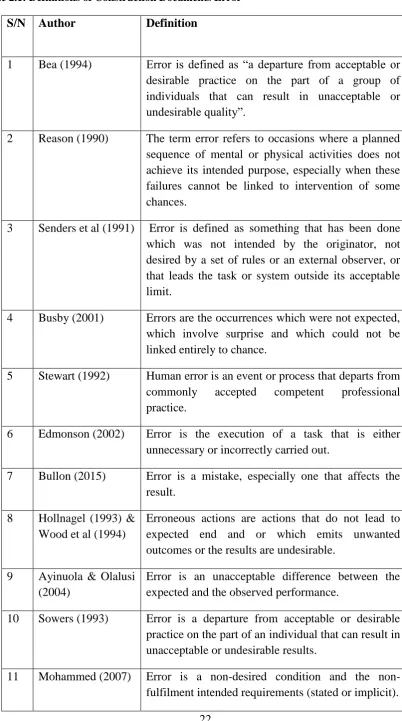
Table 2.1: Definitions of Construction Documents Error
S/N Author Definition
1 Bea (1994) Error is defined as “a departure from acceptable or desirable practice on the part of a group of individuals that can result in unacceptable or undesirable quality”.
2 Reason (1990) The term error refers to occasions where a planned sequence of mental or physical activities does not achieve its intended purpose, especially when these failures cannot be linked to intervention of some chances.
3 Senders et al (1991) Error is defined as something that has been done which was not intended by the originator, not desired by a set of rules or an external observer, or that leads the task or system outside its acceptable limit.
4 Busby (2001) Errors are the occurrences which were not expected, which involve surprise and which could not be linked entirely to chance.
5 Stewart (1992) Human error is an event or process that departs from commonly accepted competent professional practice.
6 Edmonson (2002) Error is the execution of a task that is either unnecessary or incorrectly carried out.
7 Bullon (2015) Error is a mistake, especially one that affects the result.
8 Hollnagel (1993) & Wood et al (1994)
Erroneous actions are actions that do not lead to expected end and or which emits unwanted outcomes or the results are undesirable.
9 Ayinuola & Olalusi (2004)
Error is an unacceptable difference between the expected and the observed performance.
10 Sowers (1993) Error is a departure from acceptable or desirable practice on the part of an individual that can result in unacceptable or undesirable results.
23
12 researchClue.com Design error is a deviation from drawing or specification also including omissions and ambiguities.
From the above, it is obvious that each of the definitions in Table 2.1 reveals that:
(1) There is a standard to be followed in order to achieve a purpose.
(2) The standard is either discarded or not completely conformed with.
(3) The gap between (1) and (2) above is the error.
Having defined what constitute error in this section, next section will explore the different
types of document errors.
2.2 Types of Construction Document Error
One of the objectives of this thesis is to identify types of documentation errors specific to
Nigeria but before this is done it is very necessary to identify the different types of error
through literature survey. Types of error according to Mohammed (2007) are classified into
six categories (please refer to Table 2.2). They are: erroneous, omission, non-conformance,
process, coordination and others will be discussed in detail with respect to the types of errors
under each of them.
Table 2.2: Classification of the types of errors (source: Mohammed, 2007)
S/No Classifications Types of error
1. Erroneous - Designer error
- Errors in bills of quantities - Error in specifications - Miscalculation
2. Omission - Additional views/detail needed
24
drawings
3. Non-Conformance - Non- conformance of document to vendor data
- Non- conformance of document to design calculations
- Non- conformance of document to clients criteria
- Non- conformance of document to code/SMM
- Non- conformance of document to law (e.g. conformance to Nigeria products) - Non- conformance of document to
building regulation
4. Process - CADD problems
- Document does not conform to drafting standard
- Dimensional errors
- Errors in symbols and abbreviations
5. Coordination - Coordination problem between disciplines - Coordination problem within the same
discipline
6. Others - Operability problem
- Constructability problem
1. Erroneous: The types of error here are errors that occur when an aspect on design is based on wrong information. These include designer error, omission in bills of quantities,
miscalculation and error in specifications.
a) Designer error
Nikkie Construction (2001) reported some examples of designer errors. Also, Kirby et al
(1988) and Morgen, (1986) discovered that 56% of all contract modifications are made to
design deficiencies. These types of errors are considered to be the most serious by
25
lack of education, knowledge or experience. These errors are in form of missing items and
missing consideration of some important items in the design. These errors may cause the
documents not to be able to deliver the purpose of the project. Also, this type of error leads to
claims for extension of time and compensation of costs as a result of the extra time required to
correct the errors. Designer error as a type of error is common in documents produced in
Lagos state of Nigeria (Dosumu & Adenuga, 2013).
b) Errors and omission in the bills of quantities
The practice of pricing the project in most contract procurements is dependent on the bills of
quantities. Researchers have identified errors and omissions in the bills of quantities as a main
source of variations in the construction projects (Choy & Sidnell, 1991). According to
Dosumu & Adenuga (2013) omissions and ambiguities type of error are very common in
construction documentation in Lagos state of Nigeria. However, the influence of this type of
errors on the project depends on the procurement of the contract selected for the execution of
the project. The main types of errors found under this heading according to Mohammed
(2007) are: wrong description of items, missing items in the bills of quantities, wrong
measurement, items included in the bills but not shown in the drawings and wrong unit of
measurement. The emergence of these errors will ordinarily create very bad impression on the
professionals and reduce their reputation.
c) Error in specification
Error in specification can be in the form of absence of specification, scanty specifications or
wrong specifications. According to AIA (1994), the specifications present “written
requirements for materials, equipment, construction system as well as standards for products,
workmanship and the construction services required to produce the work’’. Errors in this
regard include missing items in the specification, items included in the drawings but not in the
specification or vice versa, items that do not conform to the client’s criteria, the list of
26
errors are discovered during the construction stage claims will be raised for either cost or time
extension, or both. Scott (1990) opines that the object of specification “is to communicate to
someone on how something is to be done, so that specifier’s intention is clearly understood
without doubt or ambiguity in order that there will be no confusion in the mind of the person
who is to perform specified tasks”. Jagboro (1996) pointed out that specification breaks down
the interrelated information shown on drawings into separate organised orderly units of work
and generally describes the followings: type of quality of materials, equipment and fixtures,
quality of workmanship, methods of fabrication, installation and erection, test and
requirements of British Standard, codes of procedures and catalogue references for
manufacturer’s equipment. In a study on Nigerian environment on the utilisation of
specifications please refer to Table 2.3.
Table 2.3: Extent of utilisation of specification (Source: Ayodele & Ayodele, 2011b)
S/N Content of Specification Severity Index
1 Type and quality of materials 42.0
2 Type and quality of workmanship 42.0
3 Methods of fabrication and erection 6.46
4 Test and requirement of BS and code of procedure 0
5 Catalogue references for manufacturers equipment 0
From Table 2.3, type and quality of materials, and type and quality of workmanship are
reflected on construction documents to a level below average (42.0 for each of them). For
these first two items, specification is partially or scantily utilised. Item number 3 is almost
absent in designs. Items 4 and 5 are absent in construction documentations. These and the
assertion of Olotuah (2009) that designs are not accompanied by specification, and Aqua