Mainstreaming ecosystem science in
spatial planning practice : exploiting a
hybrid opportunity space
Scott, AJ, Carter, C, Hardman, M, Slaney, T and Grayson, N
http://dx.doi.org/10.1016/j.landusepol.2017.10.002
Title
Mainstreaming ecosystem science in spatial planning practice : exploiting
a hybrid opportunity space
Authors
Scott, AJ, Carter, C, Hardman, M, Slaney, T and Grayson, N
Type
Article
URL
This version is available at: http://usir.salford.ac.uk/43889/
Published Date
2017
USIR is a digital collection of the research output of the University of Salford. Where copyright
permits, full text material held in the repository is made freely available online and can be read,
downloaded and copied for noncommercial private study or research purposes. Please check the
manuscript for any further copyright restrictions.
Mainstreaming ecosystem science in spatial planning practice:
1exploiting a hybrid opportunity space
2Abstract
3
This paper develops a framework for improved mainstreaming of ecosystem science in policy and 4
decision-making within a spatial planning context. Ecosystem science is advanced as a collective 5
umbrella to capture a body of work and approaches rooted in social-ecological systems thinking, 6
spawning a distinctive ecosystem terminology: ecosystem approach, ecosystem services, ecosystem 7
services framework and natural capital. The interface between spatial planning and ecosystem 8
science is explored as a theoretical opportunity space to improve mainstreaming processes adapting 9
Rogers’ (2003) diffusion model. We introduce the twin concepts of hooks (linking ecosystem science 10
to a key policy or legislative term, duty or priority that relate to a particular user group) and ‘bridges’ 11
(linking ecosystem science to a term, concept or policy priority that is used and readily understood 12
across multiple groups and publics) as translational mechanisms in transdisciplinary mainstreaming 13
settings. We argue that ecosystem science can be embedded into the existing work priorities and 14
vocabularies of spatial planning practice using these hooks and bridges. The resultant framework for 15
mainstreaming is then tested, drawing on research funded as part of the UK National Ecosystem 16
Assessment Follow-On programme (2012-2014), within 4 case studies; each reflecting different 17
capacities, capabilities, opportunities and barriers. The results reveal the importance of leadership, 18
political buy in, willingness to experiment outside established comfort zones and social learning as 19
core drivers supporting mainstreaming processes. Whilst there are still significant challenges in 20
mainstreaming in spatial planning settings, the identification and use of hooks and bridges 21
collectively, enables traction to be gained for further advances; moving beyond the status quo to 22
generate additionality and potential behaviour change within different modes of mainstreaming 23
practice. This pragmatic approach has global application to help improve the way nature is 24
respected and taken account of in planning systems nationally and globally. 25
Key Words: Ecosystem Science; Ecosystem Approach; Spatial Planning; Nature; Ecosystem Services; 26
Environmental Governance; Natural Capital 27
1.Introduction
28
Ecosystem Services (ES) are widely used to identify and assess the value of the natural environment 29
through the quantification and qualification of the multiple societal benefits from finite stocks of 30
Natural Capital (NC) (Bateman et al., 2013; Likens, 1992; Hubacek and Kronenberg, 2013; Raffaelli 31
and White, 2013). They have gained increasing traction as a policy-shaping framework, largely 32
through the Millennium Ecosystem Assessment (MEA) (2003), TEEB (2010) and Ecosystem Services 33
Poverty Alleviation (ESPA) programme which all have exposed significant and ongoing declines in 34
most ES as a consequence of human interventions and actions (see also Constanza et al., 2014; 35
Douglas and James, 2014; Guerry et al., 2015; WWF 2016). This has catalysed significant global, EU 36
and national responses with ES mainstreaming increasingly evident within dedicated national 37
ecosystem assessments (e.g. Schroter et al., 2016; UKNEA, 2011); new environmental markets in the 38
assessments to inform strategic policy guidance and priority setting (e.g. Bryan et al., 2011); green 40
accounting methods (e.g. World Bank, 2010) and improved communication on the importance of 41
ecosystems and biodiversity to human well-being (e.g. Luck et al., 2012). 42
43
Mainstreaming can be defined as a process that “involves taking a specific objective of one issue 44
domain and declaring that this objective should be integrated into other issue domains where it is 45
not (yet) sufficiently addressed.” (Karlsson-Vinkhuyzen et al., 2017: 145). For example, there was 46
clear evidence from the UKNEA (2011) that government departments did not explicitly consider ES 47
and their values in policy appraisal processes. Hence mainstreaming implies a process requiring 48
improved translation, acceptance and usage of new idea(s) in line with classic diffusion of innovation 49
theory (Rogers, 2003). 50
51
In contemporary spatial planning practice signs of mainstreaming are evident in developing ES 52
mapping and baseline indicators as part of evidence bases for plans and programmes (Gómez-53
Baggethun and Barton, 2013; Söderman et al., 2012). However, as Posner et al. (2016) note, there is 54
limited research demonstrating how policy- and makers use such evidence in their decision-55
making processes. Indeed, tracing the impact of ES and their additionality remains an unexploited 56
research gap (see also Daily and Matson, 2008; Laurans et al., 2013). 57
58
Within this paper we propose the term “ecosystem science” to capture the collective body of work, 59
approaches and tools located within a social-ecological systems perspective. It is an ‘umbrella term’ 60
incorporating Natural Capital (NC), Ecosystem Approach (EcA), Ecosystem Services (ES), Ecosystem 61
Services Framework (ESF) and Ecosystem Services approach. These terms are often used 62
interchangeably, uncritically and applied selectively ignoring the inter-relationships, thresholds and 63
dependencies that position nature as a complex social-ecological system (Jones et al., 2016; Spash, 64
2008) although ideally these concepts should help to highlight those interdependencies and 65
complexities. Within ecosystem science we contend that the EcA, with its 12 principles, offers a 66
potential framework for improved sustainable use and management of nature (Waylen et al., 2014). 67
Yet it has become increasingly marginalised and overlooked in favour of NC and ES, and associated 68
market-based instruments and policy tools within a dominant neoliberal narrative of nature 69
(Buscher et al., 2012; Jackson and Palmer, 2015). Waylen et al. (2014) speculate that this may, in 70
part, be due to the intangibility of some EcA principles and the lack of guidance and case studies 71
73
Furthermore, ecosystem science has only gained partial traction in spatial planning processes and 74
outcomes (UKNEA, 2011: McKenzie et al., 2014), partly due to an artificial separation between the 75
governance for the built and natural environment; each with its own policy and legislative 76
frameworks which arguably creates a wider ‘disintegrated development’ narrative leading to 77
unnecessary duplication, inefficiency and conflict (Scott et al., 2013). There is, however, a 78
pioneering strand of interdisciplinary research working at the interface between ecosystem science 79
and spatial planning that has tried to exploit their potential synergies (e.g. Douvere, 2008; Scott et 80
al., 2013; Mckenzie et al., 2014; Cowell and Lennon, 2014; Ruckelshaus et al., 2015). 81
82
In this paper we undertake further exploration in order to develop stronger theoretical, policy and 83
practice foundations for mainstreaming robust ecosystem science in spatial planning practice 84
arguing, in particular, that the ECA - SP interface is key for effective ecosystem science knowledge 85
integration across planning and environmental governance domains (Natural Capital Committee, 86
2015; Ruckelshaus et al., 2015; Dennis et al., 2016; Jones et al., 2016). Table 1 exposes this potential 87
through a preliminary mapping exercise of the 12 Malawi principles (EcA) against six spatial planning 88
principles advanced by the UNECE (2008). This reveals significant points of intersection with 89
opportunities to maximise social learning and knowledge exchange across the built and natural 90
environment divides. 91
92
Similarly, when definitions for the EcA and spatial planning are compared, the synergies become 93
apparent. For example, the UN Convention of Biological Diversity’s definition of the EcA (CBD, 2010: 94
12) as ‘‘a strategy for the integrated management of land, water and living resources that promotes 95
conservation and sustainable use in an equitable way’’, accords with Allmendinger and Haughton’s 96
(2010: 83) definition of SP as “shaping economic, social, cultural, and ecological dimensions of 97
society through `place making' with a shift towards more positive, integrated and resource-based 98
contexts”. Both EcA and SP are rooted in social-ecological systems thinking within an 99
interdisciplinary human-centred perspective crossing environmental, social, economic, political and 100
cultural contexts and sectors (Gomez-Baggethum and Barton, 2013; Jansson, 2013). Both require 101
the adoption of participatory approaches incorporating equity and shared values (e.g. Bryden and 102
Geisler, 2007; Reed et al., 2013). Both involve a change in values and thinking from the negative 103
associations of protection based on policies of control and restraint towards more holistic, proactive 104
106
This convergence of definitions and principles can be taken a step further. Rather than maintaining 107
separate narratives and audiences for ‘built’ and ‘natural’ environment domains, which have typified 108
their evolutions to date, there could be added value from exploring mechanisms that facilitate their 109
integration to support ecosystem science mainstreaming and knowledge transfer (Cowell and 110
Lennon, 2014; Karlsson-Vinkhuyzen et al., 2017). Indeed, Cowell and Lennon (2014) stress the 111
importance of using social learning and methodological approaches that better incorporate and 112
integrate competing theories and ideas rather than producing yet more complexity and competition 113
through creeping incrementalism. How we might address this challenge becomes the central theme 114
of this paper. 115
116
Spatial Planning Principles
Ecosystem Approach Principles
The Governance Principle (e.g. authority. legitimacy,
institutions power; decision making)
(e.g. Tewdwr Jones et al., 2010; Kidd, 2007),
1 The objectives of management of land, water and living resources are a matter of societal choice.
3 Ecosystem managers should consider the effects (actual or potential) of their activities on adjacent and other ecosystems.
9 Management must recognize the change is inevitable.
The Subsidiarity Principle (e.g. delegation to lowest level; shared responsibility; devolution)
(e.g. Haughton and Allmendinger, 2014)
2 Management should be decentralized to the lowest appropriate level.
The Participation Principle (e.g. consultation; inclusion; equity; deliberation)
(e.g. Albrechts, 2015; Gilliland and Laffoley, 2008)
11 The ecosystem approach should consider all forms of relevant information, including scientific and indigenous and local knowledge, innovations and practices. 12 The ecosystem approach should involve all relevant sectors of society and scientific disciplines.
The Integration Principle (e.g. holistic; multiple scales and sectors; joined up)
(e.g. Low, 2002; Mommas and Jansen, 2008)
3 Ecosystem managers should consider the effects (actual or potential) of their activities on adjacent and other ecosystems.
5 Conservation of ecosystem structure and functioning, in order to maintain ecosystem services, should be a priority target of the ecosystem approach. 7 The ecosystem approach should be undertaken at the appropriate spatial and temporal scales.
8 Recognizing the varying temporal scales and lag effects that characterize ecosystem processes, objectives for ecosystem management should be set for the long term. 10 The ecosystem approach should seek the appropriate balance between, and integration of, conservation and use of biological diversity.
The Proportionality Principle (e.g. deliverable viability; pragmatism; best available information)
(e.g. Nadin, 2007)
4 Recognizing potential gains from management, there is usually a need to understand and manage the ecosystem in an economic context.
The Precautionary Principle (e.g. adaptive management; limits; uncertainty; risk) (e.g. Counsell, 1998)
6 Ecosystem must be managed within the limits of their functioning,
8 Recognizing the varying temporal scales and lag effects that characterize ecosystem processes, objectives for ecosystem management should be set for the long term. 10 The ecosystem approach should seek the appropriate balance between, and integration of, conservation and use of biological diversity,
Table 1: The 12 principles of the ecosystem approach (CBD, 2010: 12) mapped against spatial planning principles as defined 117
by UNECE (2008) 118
119
The research presented in this paper originates from and builds upon workpackage 10 of the United 120
Kingdom National Ecosystem Assessment Follow-On (UKNEAFO) research programme between 121
2012-2014 which developed a framework to improve the understanding and mainstreaming of 122
ecosystem science across different spatial planning settings1. The paper proceeds by illuminating 123
the SP: ecosystem science interface as a conduit for mainstreaming processes, adapting Rogers’ 124
(2003) diffusion theory. Within this adaption we introduce the twin concepts of “hooks” and 125
“bridges” as mechanisms to help ecosystem science infiltrate policy and decision-making contexts, 126
priorities and vocabularies. Hooks are defined as key policy or legislative terms, duties or priorities 127
that relate to a particular user group (i.e. spatial planners) into which ecosystem science 128
mainstreaming efforts can then be positioned. Whereas bridges are defined as terms, concepts or 129
policy priorities that are used and readily understood across multiple groups and publics, thereby 130
functioning as integrating mechanisms. We then use four different participant-led narratives of 131
mainstreaming to show the interplay of hooks and bridges in improving SP practice. The 132
commonalities and issues raised within these experiences are then discussed with regard to 133
facilitating wider mainstreaming opportunities and additionality, also paying attention to likely 134
challenges at both national and global scales (Posner et al., 2016). 135
136
2.Methodology
137
The UKNEAFO (2014) was charged with the translation and mainstreaming of the emerging science 138
from the UKNEA (2011) into policy and decision making processes. To do this a transdisciplinary 139
research team of academics, policy and practice participants was established championing a co-140
production ethic across 10 work packages. This paper draws primarily from intelligence gained 141
within work package 10 from three deliberative partner workshops in 2012-2014. Our partners 142
1 Work Package Report 10: Tools – Applications, Benefits and Linkages for Ecosystem Science (TABLES) The
included key players who were actively involved as innovators in trying to mainstream ecosystem 143
science within particular policy and practice settings. This necessarily shaped the case studies 144
selected. Workshop 1 reported on partners’ experiences of ecosystem science mainstreaming 145
practice to identify the barriers and opportunities affecting progress. Workshop 2 then devised an 146
analytical framework for tools and techniques as part of ecosystem science mainstreaming. Finally, 147
workshop 3 developed a resource kit to help integrate guidance, tools and case studies as part of an 148
ecosystem science mainstreaming web platform for wider policy and practice impact and 149
dissemination (NEAT tree2). 150
151
The method was rooted in a managed and deliberative process championing social learning, 152
enabling partners to work collectively and openly to share problems from their ongoing initiatives 153
and use joint problem-solving to build both conceptual and practice-led innovation. We are thus 154
reporting on core workshop outcomes, participant-led assessments of ecosystem science 155
mainstreaming from which our purposive case studies were selected as well as our own post project 156
reflexivity3. 157
3. Building our conceptual framework
158
Our theoretical focus on mainstreaming is centred on ecosystem science knowledge flows and 159
exchange within policy and decision-making processes. Roger’s (2003) contribution on the diffusion 160
of innovation provides a useful theory catalyst for considering how any new 161
innovation/knowledge/idea evolves from initial discovery through to implementation and 162
acceptance involving key stages of knowledge generation, persuasion, decision (adoption/rejection), 163
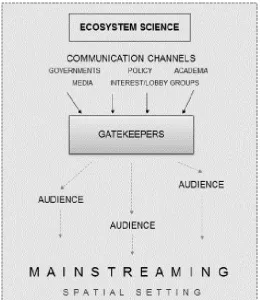
implementation and confirmation (Figure 1). Given that mainstreaming involves the active diffusion 164
of a specific idea from one domain to another where it has not been sufficiently addressed, 165
attention necessarily needs to be focussed on the ways (mechanisms or tools) the 166
innovation/knowledge is spread; partly through the different communication channels and time but 167
also through the prevailing governance frameworks. However, change is not just confined to users 168
modifying or adapting their behaviour, it also is shaped by the emerging science, nature and 169
progress within the idea/innovation/knowledge itself. 170
2 The NEAT tree http://neat.ecosystemsknowledge.net/ [accessed 5th July 2017]
3 This was particularly important for incorporating Rogers 2003 theory of innovation diffusion into the paper to
171
We have applied this thinking to characterise the current state of ecosystem science mainstreaming 172
in Figure 1, which exposes the difficulties in securing sufficient traction with ecosystem science ideas 173
for further diffusion in SP practice. The following persuasion “barriers” were evidenced from 174
workshop 1 and reflect the innovative nature of ecosystem science itself in SP theory and practice 175
(Scott et al., 2013); its technocentric diffusion (Fish and Saratsi, 2015); its complex language and 176
multiple terms (Jordan and Russel, 2014); its requirement for advanced skills to 177
understand/use/access many of the tools available (McKenzie et al., 2014); its lack of exemplars and 178
social learning platforms (Dunlop, 2014; Posner et al., 2016 ) and its lack of champions and local-179
scale information (Burke et al., 2015). Crucially, it is the cumulative impact of these barriers that 180
hinder its acceptance and integration within decision-making processes in spatial planning. 181
182
A further barrier identified related to key gatekeepers who control the flow of “acceptable” 183
knowledge based on their values and how well ‘new’ ideas and ways of thinking fit their own 184
narrative and agendas (Scott et al., 2013; Jordan and Russel, 2014). Complicating this picture is the 185
wider stakeholder audience, in a given spatial planning setting, each with their own priorities and 186
capabilities. Thus the consequential policies, plans and agendas that emerge often reflect the 187
pragmatic and politically acceptable with only piecemeal ad-hoc (faint arrows) progress indicating 188
limited mainstreaming successes (Turnberry et al., 2014). The complexity and diversity of the spatial 189
planning context makes it difficult to trigger any meaningful conceptual change (McKenzie et al., 190
192
[image:9.595.228.489.85.386.2]193
Figure 1. The current model of mainstreaming ecosystem science within the EcA. (adapted from Rogers (2003)) 194
In order to breach the “persuasion” stage successfully (Rogers, 2003), mechanisms need to be 195
identified that enable the necessary ecosystem science traction in a given SP setting thus gaining the 196
support and involvement of the gatekeepers and other stakeholders. It is important that any 197
mechanisms should use and work with familiar terms but also allow deliberation and a change in 198
perspective to move beyond knowledge simply being absorbed into existing systems to actually 199
influence and change values and behaviours (McKenzie et al., 2014). Communication and diffusion 200
of ecosystem science through ES jargon and applications to date has largely been in the hands of 201
natural science experts although there is an increasing move towards more public-led deliberative 202
exercises (e.g. Fish and Saratsi, 2015). Consequently, we argue that more attention needs to be paid 203
on identifying and developing mechanisms that appeal to, and engage with, broader SP audiences, 204
politicians and publics who are not familiar with ecosystem science. It is from this logic that we 205
advance the twin notions of hooks and bridges as mechanisms to facilitate and engineer diffusion 206
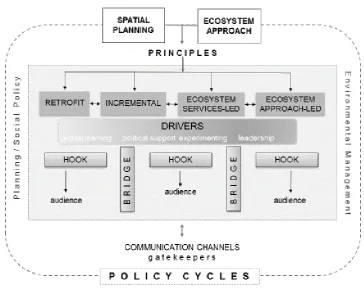
and change (Figure 2). 207
Hooks are defined as key policy or legislative terms, duties or priorities that relate to a particular 209
user group or professional network that are used in regular practice whereas bridges are defined as 210
terms, concepts or policy priorities that are readily understood and used across multiple groups and 211
publics, functioning as integrating mechanisms enabling more holistic and integrative thinking and 212
actions across different sectors and policy goals. Using the example of ecosystem science, ideally 213
the 12 EcA principles should be realised within any potential bundle of hooks and bridges to enable 214
optimal ecosystem science mainstreaming. 215
216
Figure 2 conceptualises how hooks and bridges when applied in tandem enable ecosystem science to 217
be mainstreamed without the dilution evident in Figure 1. Having secured the necessary initial 218
traction through the identification and usage of relevant hooks and bridges, knowledge/innovation 219
can then flow through the Ecosystem Science and SP interface within the existing governance 220
system(s), engaging gatekeepers and relevant audiences (e.g. public agencies, private and voluntary 221
sectors and publics). The hooks and bridges facilitate the adoption of innovation pragmatically; 222
appropriate to the socio-political context and capabilities of participants with changes in 223
values/rationality occurring through social learning and/or inspired by innovator case studies and 224
individual champions/leaders. This, ideally, creates a virtuous circle leading to further exploration of 225
innovation (applying ecosystem science to inform policy- and decision-making). 226
228
[image:11.595.107.503.82.394.2]229
Figure 2: Desired model for mainstreaming showing ‘persuasion’/acceptability through use of hooks and bridges. Drawing 230
on Rogers (2003) 231
232
However, different target audiences require different hooks; meaning that the most influential 233
hooks need to be identified in conjunction with the needs, priorities and remits of that audience at 234
that particular time in that SP setting (Douglas and James, 2016). Equally important, is ensuring the 235
selection of bridges that are intelligible as mechanisms to engage multiple audiences and publics to 236
progress ecosystem science ideas. Thus it is the communication, adaption, use and impact of the 237
hooks and bridges cumulatively that will determine mainstreaming success. In the next section, we 238
identify and unpack how specific hook and bridge ‘bundles’ have been used within four case studies 239
from the UKNEAFO work in different SP contexts. However, the general process of embedding 240
ecosystem science through the interface of EcA and SP principles and identifying suitable hooks and 241
bridges is directly transferable to other countries considering or already working on mainstreaming 242
ecosystem science within their own built environments (see e.g. Brink and Ketunen, 2016; Posner et 243
al., 2016; McKenzie et al., 2014). 244
Table 2 locates the four case studies in relation to their spatial planning challenge and context. 246
Case Study Spatial Planning Challenge (framed by participants)
Approach to Ecosystem Science Mainstreaming
DRAFT North Devon/Torridge Joint Local Plan
How can we recognise the value of ES in a local plan? How can we adapt local policies to maintain/improve benefits from nature?
Used the biosphere reserve concept to frame the ES narrative.
Developed an ES policy within the environment chapter of the plan Mapping ES and doing a ES assessment of housing masterplans.
South Downs National Park SDNPA DRAFT Local Plan
How can the EcA be used within a park local plan to improve policy and decision making?
EcA principles rewritten in SDNPA setting. Using framework from Park Management plan and developing an ES policy as one of 4 core polices pervading across all plan areas. Mapping ecosystem services.
Green infrastructure workshops and strategy. Cotswolds Area of
Outstanding Natural Beauty (AONB) management plan review
How can we review our AONB management plan mindful of the benefits offered by ES?
Management plan created with an ES framework imported in the action plan.
Post adoption consideration of using ES to evaluate the plan and to develop PES schemes for flood management.
Birmingham City Council non statutory Green Living Spaces Plan 2014
What is the value of green infrastructure to the residents and businesses of the city? How can the council embed this information to improve its policies, plans and investment opportunities?
ES assessment of green infrastructure. Created green commission at Cabinet level. Used ES data sets to create demand and supply maps showing areas requiring ES investment.
[image:12.595.62.525.96.397.2]Used as evidence base to support other statutory (Birmingham Local Development plan) and non-statutory plan. Created 7 principles as proxy for EcA.
Table 2 : Spatial challenges of the case studies and approaches to mainstreaming 247
[image:12.595.68.429.550.758.2]248
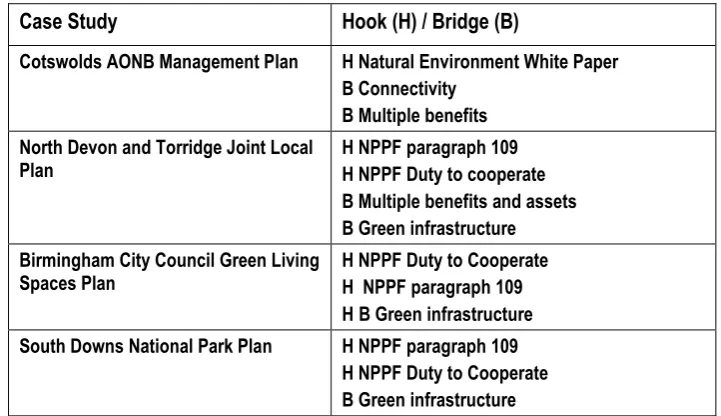
Table 3 identifies the principal hooks and bridges evident within the four case studies detailing their 249
different approaches to ecosystem mainstreaming. The hooks were identified primarily from 250
UKNEAFO stakeholder workshops and, given the English SP context, were heavily focussed towards 251
the National Planning Policy Framework. 252
253
Case Study Hook (H) / Bridge (B)
Cotswolds AONB Management Plan H Natural Environment White Paper B Connectivity
B Multiple benefits North Devon and Torridge Joint Local
Plan
H NPPF paragraph 109 H NPPF Duty to cooperate B Multiple benefits and assets B Green infrastructure Birmingham City Council Green Living
Spaces Plan H NPPF Duty to Cooperate H NPPF paragraph 109 HB Green infrastructure South Downs National Park Plan H NPPF paragraph 109
B Multiple benefits
254
Table 3: Hooks and Bridges within the NEAFO case studies (detailed case studies in bold) 255
256
Hook 1: NPPF Paragraph 109 - Value Ecosystem Services
257
“The planning system should contribute to and enhance the natural and local environment by:
258
protecting and enhancing valued landscapes, geological conservation interests and soils;
259
recognising the wider benefits of ecosystem services;
260
minimising impacts on biodiversity and providing net gains in biodiversity where possible, contributing to the
261
Government’s commitment to halt the overall decline in biodiversity, including by establishing coherent
262
ecological networks that are more resilient to current and future pressures”
263
(DCLG, 2012: paragraph 109)
264
Paragraph 109 of the National Planning Policy Framework (NPPF) is significant in English planning 265
policy as for the first time explicit reference is made to ES. However, the relatively weak wording of 266
“recognising” imposes limitations as to its influence in policy and decision-making processes. It 267
does, however, provide an opportunity for using ES as part of an evidence base from which to inform 268
policy. Thus it has commonly involved identifying, mapping and modelling the amount, spatial 269
distribution and quality of ES and NC in a given area, identifying opportunitiesfor enhancing 270
particular services, analysing trade-offs and alternatives and targeting policy interventions (Baker et 271
al., 2012; Attlee et al., 2015). 272
273
Hook 2: Duty to Cooperate - NPPF paragraph 158 and Localism Act 2011
274
The Duty to Cooperate (DTC) is a legal requirement within the NPPF, enshrined within the Localism 275
Act 2011, requiring all development plans to demonstrate active co-operation on strategic matters 276
in their process of plan formation. This is tested legally at an examination in public by government-277
appointed planning inspectors (HM Government, 2011a; DCLG, 2012). DTC depends on the extent 278
to which a planning authority has “engaged constructively, actively and on an ongoing basis to 279
maximise the effectiveness of Local Plan preparation in the context of strategic cross boundary 280
matters” (HM Government, 2011a; our emphasis). These strategic cross boundary matters dovetail
281
with the integration principle (Table 1), in theory. However, at the present time, ministerial advice 282
and national practice policy guidance (NPPG) has exclusively focussed on securing housing need 283
assessments for plan approvals/rejections. 284
Hook 3: Natural Environment White Paper
286
The Natural Environment White Paper (NEWP) entitled The Natural Choice: Securing the Value of 287
Nature (HM Government, 2011b) is signed up to by all UK government departments, representing a 288
powerful hook. It includes principles towards the improved valuing of nature in policy and decisions, 289
recognising the intrinsic value of nature and the key role the planning system has in protecting 290
biodiversity (although framed largely within a human-environment duality and no-net-loss neoliberal 291
narrative). However it has become evident that the NPPF trumps NEWP in policy and decision 292
making considerations (House of Lords Built Environment Committee, 2016). Still, the NEWP is 293
probably the most important policy document in terms of capturing and promoting ecosystem 294
science thinking. 295
“We need a more strategic and integrated approach to planning for nature within and across local 296
areas […] We want the planning system to contribute to our objective of no net loss of biodiversity” 297
(HM Government 2011b:2.37) 298
As part of the approach there is endorsement of ES as a key concept: 299
“Taking account of all the economic and non-economic benefits we get from these (ecosystem) 300
services enables decision-makers to exercise judgement about how we use our environment”. (HM 301
Government, 2011b: 11). 302
303
Bridge 1: Green Infrastructure (GI)
304
GI is a term that seems to be widely used by built and natural environment professionals and also 305
understood by many publics. GI is explicitly addressed in the Natural Environment White Paper (HM 306
Government, 2011b) and NPPF/National Planning Policy Guidance (NPPG)4 and is a term widely used 307
in public policy discourses globally (Mell , 2014). The NPPF recognises the value of GI within the 308
concept of ecological corridors, improved connectivity and the multiple benefits it delivers in 309
(re)development projects. NPPF Annex 2 defines GI as “[…] a network of multi-functional green 310
space, urban and rural, which is capable of delivering a wide range of environmental and quality of 311
life benefits for local communities”. National Planning Guidance has also been recently updated to 312
include specific guidance to help with defining GI scope and extent; “As a network it includes parks, 313
open spaces, playing fields, woodlands, but also street trees, allotments and private gardens” (NPPG: 314
par 27). The explicit mention of gardens helps it have relevance at the individual household level 315
4 National Planning Practice Guidance http://planningguidance.communities.gov.uk/ [accessed 1 September
which is important in terms of public engagement and appeal but is a largely neglected dimension in 316
mainstreaming efforts (Dewaelheyns et al., 2016). The NPPG also recommends embedding GI into 317
the development process at an early stage linking it explicitly to ES. “Green infrastructure provides 318
multiple benefits, notably ecosystem services, at a range of scales, derived from natural systems and 319
processes, for the individual, for society, the economy and the environment.” (NPPG: par 27). 320
321
Bridge 2: Multiple benefits/assets
322
Multiple benefits language has been used to secure initial public and/or political support for 323
ecosystem science particularly where ecosystem terminology was unfamiliar (Fish and Saratsi, 2015). 324
The term has been used on its own but has also been linked to environmental assets. This helps 325
challenge perceptions of nature as a constraint to development and economic growth with the 326
multiple benefits being presented as financial values to help highlight nature’s value to society 327
(Baker et al., 2012). 328
329
Bridge 3: Connectivity
330
331
Connectivity was often encountered when dealing across complex spatial geographies associated 332
with political and administrative boundaries meeting natural boundaries. The idea of connections is 333
important in allowing multiple audiences to understand the flows of ES between one place and 334
another and to understand the interrelationships between these interactions (provider and 335
beneficiary); for example, in water management (flood and drought management). It also enabled 336
an understanding of winner and losers when ES flows of benefits are mapped (Scott et al., 2013). 337
338
4.Mainstreaming Ecosystem Science in
339
Spatial Planning Practice
340
This section provides a commentary on four UKNEAFO project participant self-assessment narratives 341
illuminating how specific hooks and bridges were used in response to particular 342
opportunities/challenges and how they influenced the mainstreaming process and resulting 343
outcomes in different SP settings. The case study narratives are summarised in Table 4 exposing the 344
and precautionary principles were less evident perhaps reflecting the quasi-judicial nature of English 346
spatial planning practice. It also suggests a wider challenge that there are inherent problems in 347
trying to capture all 12 EcA principles simultaneously. 348
SP Principles
EcA Principles
Governance
1 3 9
Subsidiarity
2
Participation
11 12
Integration
3 5 7 8 10
Proportionality
4 9
Precautionary
6 8 10
Cotswolds ++ - + - ++ 0
North Devon ++ - ++ - ++ -
Birmingham ++ + ++ ++ ++ +
South Downs ++ + ++ ++ + +
Table 4. Case Study summary impact analysis in relation to EcA / SP principles (++ very positive; + 349
positive; 0 not evident; - negative; - - very negative ) 350
351
Cotswolds AONB Management Plan
5352
Governance and Participation Principles: The Cotswolds Area of Outstanding Natural Beauty 353
(AONB) is designated for its high quality landscape. A statutory Conservation Board across seven 354
local authorities is charged with ensuring that the landscape is conserved, enhanced, better 355
understood and enjoyed. The Board’s Management Plan is updated every five years and provides a 356
statutory document which all relevant public agencies must take into account in their decisions and 357
operations. The Plan is also a crucial communication tool helping to inform land managers, 358
stakeholders and wider publics about the value of the AONB. It is subjected to formal public 359
consultation processes. 360
361
Ecosystem science did not feature at all in the initial development and discussions of the plan 362
review. There were differing levels of knowledge about ES across the members of the Board but the 363
AONB officers did have a working knowledge. The priority in the plan review process was to address 364
criticism of the previous management plan for being too complex and too generic and for a failure to 365
engage partners, public bodies or parish councils sufficiently. 366
367
5 Participant led report adapted from http://neat.ecosystemsknowledge.net/cotswolds.html [accessed 6 July
Proportionality and Integration Principles: The publication of the Natural Environment White Paper 368
(hook) helped re-invigorate the ecosystem science discussions within an AONB plan workshop in 369
2011. The officers shifted from the traditional ‘exploitative’ view of natural resources using the 370
bridge of the environment as an asset with multiple benefits. A Strategic Environmental Assessment 371
(SEA) was undertaken to inform the plan making process using ES explicitly. However, the draft plan 372
presented them as an add-on benefit alongside scenic beauty, cultural heritage, economic 373
development and GI. At the final stages of plan preparation ES did not feature at all, but pressure 374
from some board members, drawing on their own experience in the NEAFO research process, 375
persuaded the Board to retrofit ES into the draft plan. Consequently, the final Cotswolds AONB 376
Management Plan for 2013-18 presents ES as one of five multiple benefits for society delivered by 377
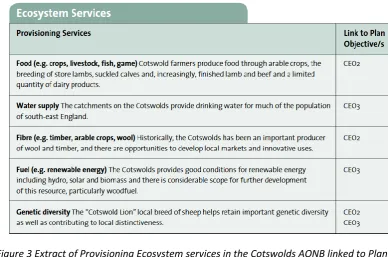
good management and conservation measures (Figure 3: provisioning services shown as an 378
example). 379
[image:17.595.76.467.326.583.2]380
Figure 3 Extract of Provisioning Ecosystem services in the Cotswolds AONB linked to Plan Objectives 381
(Source Cotswolds AONB management Plan 2013-2018 (2013:10) 382
383
The final plan identified the main ES flowing from the AONB area and links them to individual plan 384
objectives to show how they will be secured and/or enhanced. This retrospective mapping approach 385
directly replicated the Exmoor National Park Plan6 model which was used as an exemplar within a 386
6 Exmoor National Park Partnership Plan 2012-2017 http://www.exmoor-nationalpark.gov.uk/?a=260857
UKNEAFO workshop in demonstrating how an ESF could be embedded pragmatically into a 387
management plan setting. This partial mainstreaming provides an initial foundation for further 388
progress as the management plan is reviewed. Also, discussions have taken place over the 389
development of a Payment for Ecosystem Service scheme regarding improved management of the 390
upper catchment of the River Thames within the AONB. 391
392
North Devon and Torridge (Draft) Joint Local Plan
7393
Governance Principle: The development of the North Devon and Torridge Joint Local Plan (North 394
Devon and Torridge District Councils, 2014) involved a statutory development plan process crossing 395
two local authority areas in a bold joint working endeavour. The lead planning officer was familiar 396
with ecosystem science, having had extensive working relationships with academics and research 397
communities, as well as being a member of the NEAFO research team. However, there were 398
significant internal and external challenges (and thus learning spaces needed) for all planning 399
officers, elected councillors across both authorities as well as their wider publics to understand and 400
accept ecosystem science thinking in the plan. 401
402
Proportionality and Integration Principles: The mainstreaming process was framed using ES within a 403
pragmatic understanding of the national and local political discourses dealing with the peripherality, 404
world-class environment assets (UNESCO Biosphere Reserve) and economic challenges of the joint 405
council area. Paragraph 109 of the NPPF was used as a key hook by the lead planning officer as part 406
of the political persuasion process to legitimise ES thinking internally across both planning teams and 407
elected members. This secured resources for mapping the different ES across the area as an 408
evidence baseline for future monitoring and evaluation of plan policies. The outputs were translated 409
into a strategic aim within the draft local plan promoting the environment as an asset intimately tied 410
up with the development of the area and with ES as adaptable outcomes responding to changing 411
needs. This is now under consideration by a government appointed planning inspector. 412
“Aim 2: A World Class Environment – where important assets are valued and enhanced for future 413
generations […]. (c) land is used efficiently and effectively – optimise how ecosystem services provide 414
7 Participant led report adapted from http://neat.ecosystemsknowledge.net/devon.html [accessed 6 July
and result in productive living landscapes and townscapes that adapt to our changing needs”. This 415
shaped a more detailed but isolated local plan policy ST14. 416
“Policy ST14: Enhancing Environmental Assets: 417
The quality of northern Devon’s natural environment will be protected and enhanced by ensuring 418
that development contributes to: 419
(a) providing a net gain in northern Devon’s biodiversity where possible , through positive 420
management of an enhanced and expanded network of designated sites and green infrastructure, 421
including retention and enhancement of critical environmental capital; […] 422
(h) conserving and enhancing the robustness of northern Devon’s ecosystems and the range of 423
ecosystem services they provide;” 424
425
The ES policy, although innovative, was in addition to the existing suite of environmental policies 426
rather than integrated or aligned to other policies and chapters of the plan. Importantly, there were 427
few cross-references to ecosystem science outside the environmental chapter itself. However, this 428
was seen as a necessary and proportional compromise to the local political and public mindset that 429
was unfamiliar with ecosystem science. This led to the sole use of the ES term in the plan rather 430
than wider ecosystem science terms. At the time of writing (March 2017) the plan is awaiting 431
examination in public and it remains to be seen how accepting the inspector and wider public are of 432
this approach. 433
434
Participation Principle: The local plan process was able to build upon a foundation of ecosystem 435
science knowledge from a number of other work streams which recognised the value of 436
environmental assets in the area and their multiple benefits for the local economy. These included 437
participation as a pilot authority in a county-wide biodiversity offsetting programme; involvement in 438
the Ecosystems Knowledge Network8; and contribution towards other spatial strategies such as for 439
the UNESCO Biosphere Reserve at Braunton Burrows9 and the Nature Improvement Area on the 440
culm measures10. The cumulative impact of these joint endeavours created the necessary social 441
capital to advance ecosystem science into their local plan using the global importance of the natural 442
environment as an asset for growth. The plan had been consulted upon as part of its statutory duty. 443
In general there was support for the approach to ecosystem science diffusion taken by the council as 444
8 Ecosystem Knowledge network http://ecosystemsknowledge.net/ is a UK based knowledge exchange
network to promote improved understanding and use of the ecosystem approach
9http://www.northdevonbiosphere.org.uk/ Braunton Burrows Biosphere Reserve
10http://www.northerndevonnia.org/culm-grassland Nature Improvement Area Culm Measures Devon
stated in the response to the public consultation document par 343 “The plan’s ecosystem approach 445
is supported”11. However, issues of scale were raised resulting in a change to the plan to “19. 446
recognise the importance of protecting ecosystems and ecosystem services at an ecosystem scale” 447
(p89). 448
449
Birmingham City Council’s Green Living Spaces Plan (GLSP)
12450
451
Governance Principle: The establishment in 2013 of a Green Commission, a cabinet level body 452
involving experts, influencers and decision-makers with its ambition and vision to make Birmingham 453
a leading global green city was influential in obtaining higher level political support for ecosystem 454
science ideas and initiatives. The multiple benefits (bridge) was embedded into the city’s 455
governance framework through a suite of strategic planning processes and associated documents 456
including the statutory local plan (Birmingham City Council, 2014). Key policy-related hooks were 457
the climate change related national performance indicators against which local authorities had to 458
report in England between 2008 and 2010, the Lawton Review (2010), the Natural Environment 459
White Paper (HM Government 2011b), the UKNEA (2011) report and the NPPF’s paragraph 109. The 460
city council’s (GLSP) initiative has evolved over time with the environmental and sustainability 461
sections of the council driving the organic and pragmatic research and local policy-making process, 462
adjusting to changes/opportunities in national policies and planning frameworks as they presented 463
themselves. 464
465
Participation Principle GI was used as a policy bridge to engage stakeholders from different 466
departments across the council as well as external stakeholders around common goals and interests. 467
A key output of that process was the publication of the GLSP (Birmingham City Council, 2013) where 468
its non-statutory status provided much needed flexibility, but with the necessary elected member 469
and officer buy in to inform future policies and decision-making across the council It also was 470
championed as an exemplar for other urban areas nationally and globally (UKNEAFO, 2014). The 471
GLSP process involved the formation of a cross-disciplinary working group involving both internal 472
11 North Devon and Torridge Local plan Consultation Document Response (2014)
http://consult.torridge.gov.uk/file/3001633 par 343 p87 accessed 8 April 2017
12 Participant led report adapted from http://neat.ecosystemsknowledge.net/birmingham2.html [accessed 6
and external members from Climate Science; Water; Biodiversity; Green Infrastructure; Sustainable 473
Transport/Mobility; Planning; Community & Resilience; Business and Public Health, each bringing 474
their evidence bases, policies and delivery plans to the shared table. The bridges of multiple benefits 475
and risk were used to help secure greater buy in across these stakeholder communities. Collectively 476
they were able to agree seven cross cutting key principles13, each with associated outcomes/targets 477
that now form the backbone of the GI policy. 478
479
These seven principles have then informed the statutory planning framework for the city; i.e. the 480
Birmingham Local Plan as well as the Sustainable Development Plan Your Green and Healthy City. 481
Direct engagement with community representatives and third sector organisations broadened the 482
democratic nature of the policy which has led to further developments with natural capital involving 483
working with planners, developers and industry consultants on a toolkit (RICS, 201514) to help 484
further mainstream nature into planning decision making. 485
486
Integration and Precautionary Principles: The NPPF (par 109) hook helped persuade the council to 487
fund a series of research studies applying the ES methodology to six dominant urban issues 488
(aesthetics and mobility, flood risk, urban heat island effect (local climate), educational 489
attainment/provision, recreation and biodiversity) with each displayed as Geographic Information 490
System maps of the city (BUCCANEER, 2010; Scott et al., 2014). These individual maps depicted 491
areas of high and low demand/supply of each ES. The maps were then integrated into a single multi-492
layered challenge map for Birmingham which could be interrogated at different scales for use by 493
residents, community groups, non-governmental organisations, strategic planners and elected 494
members (Figure 415). These maps provide a powerful link between ES and social/environmental 495
justice considerations acting as an evidence base for place-specific policy interventions. In addition, 496
they also provide a baseline for climate change mitigation and adaptation priorities and actions, 497
revealing areas at risk from flooding and urban heat island effect. 498
13 7 principles; An Adapted City; The City’s Blue Network; A Healthy City; The City’s Productive Landscapes;
The City’s Greenways; The City’s Ecosystems; and The City’s Green Living Spaces
14 Natural Capital Planning Tool
http://www.rics.org/uk/knowledge/research/research-reports/natural-capital-tool-planning-/ accessed 8 April 2017
15 This map represents a city as depicted by its relationship with its ecosystem. GIS layers of data are combined
499
Figure 4: ES Multi challenge map. Source: Birmingham City Council (2013 [f]) 500
501
Ecosystem Approach-led: South Downs National Park Authority Local Plan
16502
503
Governance Principle: The South Downs National Park Authority (SDNPA) was created in 2011 and 504
manages one of the newest UK National Parks. The SDNPA has statutory responsibilities for the 505
protection of the national park’s natural beauty and special qualities and the promotion of informal 506
recreation. As a new national park it positioned itself as an innovator and champion in ecosystem 507
science planning and delivery seeking to mainstream ecosystem science into all its plans and policy 508
processes. This meant that all staff and board members were actively involved in the mainstreaming 509
process. The NEA (2011); NEWP (2011) and NPPF (2012) were used as highly influential hooks to 510
facilitate this. Its first park management plan (SDNPA, 2013) set out the statutory framework for the 511
protection of the park and its special qualities using the ESF. The park authority also developed and 512
16 The participant led report has been provided by Tim Slaney Director of Planning South Downs National Park
approved its own papers highlighting the relationship between ES and NC which further 513
consolidated their own particular way of mainstreaming ecosystem science17. 514
515
The draft local plan (preferred options document18) builds on the statutory Park Management plan 516
(SDNPA, 2015) providing the legal planning policy framework and area plans for deciding planning 517
applications within the park boundary. It also set out to incorporate EcA at its heart drawing on its 518
fast growing national network of ecosystem science practitioners and experience in the UKNEAFO 519
project. 520
521
Participation Principle: Initially there was a targeted strategy of consultation and awareness-raising 522
of ecosystem science amongst its members, partnership board and 15 planning districts through a 523
number of meetings and workshop events. This helped build capacity and support for the statutory 524
management plan to incorporate ecosystem science at its heart. This then was translated to the 525
planning team as part of its local plan process and, to help maximise social learning and knowledge 526
exchange, close relationships were formed with research communities during and after the 527
UKNEAFO work to help facilitate local plan related workshops within which key hooks and bridges 528
were identified. The draft plan was sent out for consultation and the dedicated ES policy SD2 was 529
broadly welcomed and supported within the 52 responses received. However East Hampshire 530
District Council submitted a response that they “consider that this policy duplicates other policies 531
and makes the policy repetitive and whole document unnecessarily long”.19
532
533
Integration and Proportionality Principles: The SDNPA translated the 12 EcA principles into the 534
South Downs context in keeping with their statutory objectives and vision (Box 1). This provided a 535
powerful sense of ownership; translating the EcA language to their own setting and priorities and 536
thus creating a useful umbrella within which to position the local plan process as well as helping to 537
inform new ways of internal thinking across the staff. 538
17 Committee Paper
https://www.southdowns.gov.uk/wp-content/uploads/2015/02/pp_2014Jul24_Agenda-Item-10.pdf (approved) [accessed 1 June 2016]
18 The preferred options stage is part of the formal stages that all development plans have to go through.
When compared with North Devon and Torridge draft local plan this is an earlier phase of plan development as it has yet to go formally to a planning inspector. The usual stages include an options document; preferred options; local plan submission; examination in public; modifications and approved document.
19 SDNPA (2015) South Downs Local Plan Preferred Options Consultation Responses page 27
1. Be based upon the public interest both inside and outside the plan area, including in particular, the opportunities 539
for recreational activities and learning experiences and conserving the diverse, inspirational landscapes, breath-taking 540
views and tranquillity. 541
2. Delegate decision making to the most appropriate level, particularly for the communities with pride in their 542
distinctive towns and villages 543
3. Identify and assess adjacent effects at different scales, in particular taking into account, views, priority habitat 544
connectivity, rare and internationally important species, river and water catchment issues and the associated flooding, 545
water quality and supply issues. 546
4. Understand the economic context and aim to reduce market distortion, particularly to enable farming to enhance 547
the environment and continue to embrace new enterprise. 548
5. Support the enhancement of Natural Capital, historic features and rich cultural heritage so it can be enjoyed by 549
future generations 550
6. Respect known environmental limits using best available evidence but develop flexible policies to respond to 551
issues of uncertainty 552
7. Operate at appropriate spatial and temporal timescales, linking in particular with partnership landscape-scale 553
approaches, the National Character Assessment and local data and evidence 554
8. Manage for the long-term, considering lagged effects 555
9. Accept and manage change as inherent and inevitable, particularly considering recreation, housing, farming and 556
land management as significant aspects of this change 557
10. Deliver the National Park’s two purposes as a priority and whilst doing so, the Authority duty using the Sandford 558
Principle in case of conflict between purposes (Partnership Management Plan / Delivery Framework reference) 559
11. Use a robust evidence base and the sustainable development precautionary principle where the data or evidence 560
is not complete 561
12. Maximise and maintain stakeholder engagement. 562
Box 1 SDNPA Ecosystem Approach Principles (SDNPA, 2014) 563
564
The NPPF (par 109) hook helped justify the involvement of the entire planning team (strategic and 565
development management) in the local plan process with the thought-leadership and enthusiasm of 566
the director of planning. It created a bridge to communicate and work jointly with other section 567
leads in the park (e.g. landscape and park management). This collaborative working also enabled 568
the park to secure resources for mapping ecosystem services (ECOSERV20); using this data as an 569
evidence base to inform subsequent policy development. The cumulative social learning resulted in 570
draft policy (SD2) which sits as one of only four higher-level policies that all other policies in the plan 571
are subservient to. 572
573
Draft Core Policy SD2: Ecosystems Services SDNP 2015 Local Plan Preferred Options document 574
1. Proposals that deliver sustainable development and comply with other relevant policies will be permitted provided that they do not have
575
an unacceptable adverse impact on the natural environment and its ability to contribute goods and services. Proposals will be expected, as
576
appropriate, to:
577
a. provide more and better joined up natural habitats;
578
b. conserve water resources;
579
c. sustainably manage land and water environments;
580
d. improve the National Park’s resilience to, and mitigation of, climate change;
581
e. increase the ability to store carbon through new planting or other means;
582
f. conserve and improve soils;
583
g. reduce pollution;
584
h. mitigate the risk of flooding;
585
i. improve opportunities for peoples’ health and wellbeing;
586
j. stimulate sustainable economic activity; and
587
k. deliver high-quality sustainable design
588 589
Unlike many planning policies for conservation, the positive framing of this policy, with a 590
presumption in favour of development, enables, in theory, some beneficial ES/NC outcomes to be 591
achieved from all planning applications. Crucially, the policy becomes a negotiating tool for 592
planners to have a dialogue about securing positive ES and NC outcomes. It is also important to note 593
how ES language is used explicitly in headline form but then translated into plain English concepts in 594
categories (a-k) which improve accessibility and intelligibility to planning applicants and wider 595
publics thus engaging the public in meaningful ecosystem science dialogues. 596
597
This thinking has also shaped the newly emerging GI framework and roadmap (SDNPA, 2016) which 598
collectively now provides a strong suite of plans and policies all with ecosystem science at their 599
heart. 600
601
Subsidiarity Principle: Under the NPPF and Localism Act 2011, the park is carrying out its DTC 602
function to ensure that ES are protected and enhanced. From their interim statement on DTC 603
(SDNPA, 2015: 4.2) the following strategic principles are identified for collaborative work with the 604
surrounding 15 district authorities: 605
Conserving and enhancing the natural beauty of the area
606
Conserving and enhancing the region’s biodiversity (including GI issues
607
The delivery of new homes, including affordable homes and pitches for Travellers
608
The promotion of sustainable tourism
609
Development of the rural economy
610
Improving the efficiency of transport networks by enhancing the proportion of travel by sustainable
611
modes and promoting policies which reduce the need to travel. 612
613
The translation of DTC within SDNPA priorities has necessitated the forging of new dialogues and 614
partnerships with the surrounding authorities, forcing their planning staff outside usual DTC 615
The legal obligation to cooperate under the Localism Act helps the SDNPA engage with other 617
planners providing the initial traction to what are likely to be challenging discussions. 618
619
At the time of writing (April 2017) the local plan is going through a formal consultation process with 620
an impending examination in public for approval in 2017 which will be its ultimate test. In addition 621
there is ongoing collaboration as part of the NEAFO legacy process and new work on NC to 622
undertake ES assessments of major developments to improve ES/NC outcomes. 623
624
Summary
625
Together these case studies reveal the combined influence of hooks and bridges in progressing 626
ecosystem science mainstreaming beyond the persuasion barrier in different ways that suit specific 627
contexts set within the political realities. Each case study showed some progress and initial traction 628
in ecosystem science mainstreaming. These processes have and will evolve differently over time and 629
whilst all our case studies are front runners, or champions, acting at an early stage of ecosystem 630
knowledge diffusion, they represent innovators with important lessons to be learnt for future 631
ecosystem science diffusion. It is to this that attention now turns. 632
633
634
5.Discussion and Conclusions
635
Realising ecosystem science mainstreaming in spatial planning practice
636
637
The diverse approaches to mainstreaming ecosystem science encountered within our four case 638
study narratives reflect different capabilities, vulnerabilities and pragmatism required when trying to 639
introduce new ideas within policy and decision-making processes. This finding is important as it 640
suggests that mainstreaming is an evolutionary and dynamic process which can be conceptualised as 641
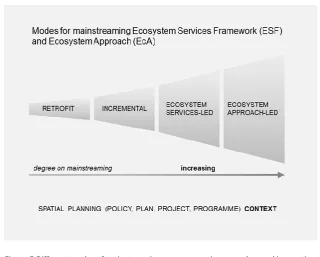
different modes of ecosystem science mainstreaming (Figure 5). 642
644
Figure 5 Different modes of mainstreaming ecosystem science as observed in practice. (adapted UK NEAFO 2014:11) 645
646
The Cotswolds AONB case study conforms to the ‘Retrofit’ mode where ecosystem science is bolted-647
on to a management plan retrospectively without influencing the rest of the plan process or 648
document itself. The lack of knowledge of ES, together with other policy priorities emerging from 649
critiques of the previous management plan were crucial barriers to further progress. But the linking 650
of ES to the management plan objectives, allows, in theory, future progress to be made in 651
subsequent plan reviews. 652
653
The Torridge and North Devon local plan case study conforms to the ‘Incremental’ mode where 654
ecosystem science largely through ES and critical natural capital were incorporated into the plan 655
within an overall Aim 2 and as part of a dedicated policy (ST11). Although having a ES evidence base 656
to inform the policy it currently sits as an extra layer with limited integration across other economic 657
or social policies in the plan. 658
659
The Birmingham GLSP case study conforms to the ‘Ecosystem Services led’ mode where ES have 660
been embedded in the process from the outset as evidence bases and subsequently incorporated 661
into outputs (challenge maps) that can help target interventions. With bespoke ES participation 662
using the 9 piece jigsaw with stakeholders across Birmingham the plan was able to inform other 663
The South Downs National park draft local plan conforms to the ’Ecosystem Approach led’ stage 665
where the EcA principles and associated ecosystem science concepts were embedded in the process 666
from the start and inform successive stages. Crucially the management plan was championing an 667
ecosystem approach as a statutory framework for delivery within which the local plan process could 668
fit. The wholesale involvement of the planning team in this reflected a cultural buy in to the idea in 669
a way that the previous stages were unable to secure. 670
671
In each case study hooks and bridges provide evidence of getting through the persuasion phase 672
(Rogers, 2003) within ecosystem science mainstreaming (Figure 2). Here hooks and bridges provide 673
important mechanisms using the vocabularies and work priorities of particular target groups to 674
secure traction but with wider potential to embed ecosystem thinking and conceptual/behaviour 675
change. In the SDNPA case there is clear evidence of a culture change within the planning 676
department as they embrace ecosystem thinking in their local plan and suite of documents that 677
drive the national park’s core work. Crucially, it is not confined to one champion or sector of the 678
authority. However, each of the four case studies captured a particular stage of mainstreaming at 679
the time of the research. The dynamic nature of ecosystem science mainstreaming diffusion will 680
enable future progression or regression depending on their particular experiences, learning and 681
external drivers of change. Here the role of gatekeepers (influenced by local / national / 682
international changes or challenges) become critical in their future evolutions in terms of restricting, 683
enabling or supporting change of ecosystem science ideals. 684
685
For example, the Birmingham example shows that mainstreaming processes can move negatively in 686
responses to external drivers. Progress has now stalled with the transformational change in 687
governance with the establishment of a Mayor and a new combined authority model which has 688
relegated environmental considerations in favour of an agenda focused on jobs and growth21. 689
Within the South Downs and North Devon and Torridge case studies, the government-appointed 690
planning inspectorate has the role to approve or reject both local plans following their examination 691
in public in late 2017/2018. If approved, they will provide the much needed exemplar case studies 692
to help legitimatise and catalyse the diffusion of ecosystem science policies in other local plans 693
(Posner et al., 2016); but equally, the converse applies. Indeed, it is only when other policy makers 694
21 See the prospectus for the WMCA https://www.wmca.org.uk/media/1383/sep-executive-summary.pdf

![Figure 4: ES Multi challenge map. Source: Birmingham City Council (2013 [f])](https://thumb-us.123doks.com/thumbv2/123dok_us/8690308.876976/22.595.73.313.68.415/figure-es-multi-challenge-source-birmingham-city-council.webp)