Performance measurement and
management in construction : a conceptual
framework
Sonson, SJ, Kulatunga, U and Pathirage, C
Title Performance measurement and management in construction : a conceptual framework
Authors Sonson, SJ, Kulatunga, U and Pathirage, C
Type Conference or Workshop Item
URL This version is available at: http://usir.salford.ac.uk/43860/
Published Date 2017
USIR is a digital collection of the research output of the University of Salford. Where copyright permits, full text material held in the repository is made freely available online and can be read, downloaded and copied for noncommercial private study or research purposes. Please check the manuscript for any further copyright restrictions.
516 ID 059
PERFORMANCE MEASUREMENTAND MANAGEMENT IN
CONSTRUCTION: A CONCEPTUAL FRAMEWORK
S. Sonson, U. Kulatunga and C. Pathirage
School of the Built Environment, University of Salford, Salford, M5 4WT, UK
Email: [email protected]
Abstract: The dynamic and competitive business environment has motivated and compelled construction firms to implement contemporary performance measurement and management (PMM) systems and frameworks to generate more comprehensive information on their performance. The aim of this research is to develop a conceptual framework to better measure and evaluate the performance of construction firms. The methodology of this research is based on a comprehensive literature review of PMM in general, and in construction. This research discusses performance measurement concepts, key PMM frameworks in general use and in construction, and also presents the salient components of the proposed conceptual framework. The research findings reveals the relevance of PMM to the construction industry and show seven generic perspectives that can cover all facets of construction firms’ performance. The critical success factors and related key performance measures that reflect the circumstances of construction firms and the industry were also identified for the framework. This research contributes to the body of knowledge in the area of PMM by proposing a conceptual framework, and developing an understanding of the need for PMM in construction. This research is part of ongoing research study being undertaken in Saint Lucia on PMM in construction.
Key words: critical success factors, construction firm, conceptual framework, performance measurement and management, performance measures.
1. INTRODUCTION/BACKGROUND
517
Scorecard (BSC) were developed and diffused over the years to evaluate organisations’ performance (Baird, 2017; Micheli and Mura, 2017).
The PM revolution has moved to the construction industry but at an incremental pace (Deng and Smyth, 2014). In light of this, CPMM frameworks have been adapted and implemented by a number of construction organisations to drive performance improvement (Horta et al., 2012). Over the past few decades, there are many studies on PMM in construction (Yang et al., 2010) and most of these studies have focused on the evaluation of project-level performance (Ali et al., 2013; Jin et al., 2013). In recent years, however, studies on PMM in construction at organisational level has increased (Yu et al, 2007; Jin et al., 2013). A few previous studies have attempted to develop conceptual frameworks for the performance evaluation of construction organisations, and there have been few follow-up studies (Yu et al., 2007). Furthermore, there is a paucity of papers that attempt to critically review the extant literature on PMM in construction (Yang et al., 2010). In response to the above gaps in the literature, this research aims to provide a critical review of PMM literature to develop a conceptual framework that will better measure and evaluate the performance of construction firms with a view of improving their success.
2 LITERATURE REVIEW
2.1 Performance measurement and management in General
In the context of organisations, performance measurement refers to as “a systematic process for obtaining valid information about the performance of an organisation and the factors that affect performance” (Yaghoobi and Haddadi, 2016, p.960), whereas performance management involves the use of the information generated through performance measurement (PM) to manage performance (Saunila, 2016). Organisational PM can be classified as traditional PM and contemporary performance measurement and management (CPMM). The traditional PM focuses solely on financial performance measures (Yaghoobi and Haddadi, 2016) such as profit, cash flow and return on investment. Many researchers and practitioners have criticised the exclusive use of financial performance measures because of their shortcomings. Financial performance measures are no longer adequate to evaluate organisations’ performance in today’s rapid changing business environment (Munir and Baird, 2016). They are lagging indicators, in that they provide information on the results of management actions already taken (Ali et al., 2013). To overcome these criticisms, a proliferation of CPMM systems/frameworks were subsequently developed that comprise both non-financial and financial performance measures, representing different perspectives to evaluate organisations’ performance (Silvi et al., 2015; Baird, 2017). Some other salient attributes of a CPMM systems/frameworks include inter alia: they contain both internal and external performance perspectives, measure short-term and long-term performance, comprise forward and backward- looking measures, are characterized by causal relationships among the different measures and perspectives (Silvi et al., 2015); and link performance measures with strategy and/or value drivers (Baird, 2017).
518
al., 2014). CPMM systems play an integral part in all the fundamental components of management practice including strategic management (Jin et al., 2013), for example by facilitating the execution of strategy (Niven, 2014; Micheli and Mura, 2017); performance management (Bititci et al., 2012), for instance by influencing people’s behaviour (Yuliansyah et al., 2017); and risk management for example by identifying and managing key risk factors in an organisation (Moullin, 2017).
2.2 CPMM frameworks
The literature identifies various key CPMM frameworks that can be adopted by business organisations (Baird, 2017). The life cycle stages of a new PMM system/framework entails design, implementation, and use and review (Gutierrez et al., 2015). Some well-known CPMM frameworks include but are not limited to the Balanced scorecard (Kaplan and Norton, 1992), Results and Determinants Framework (Fitzgerald et al 1991), Performance Pyramid (Lynch and Cross, 1991), Performance Prism (Neely et al., 2001); EFQM business excellence model (EFQM, 2017). Folan and Browne (2005) differentiate between structural and procedural frameworks. The BSC, which is a structural framework, is now discussed below.
The BSC has evolved over time (Sigalas 2015), and is the most widely used, universally accepted PMM framework (Lueg, 2015). Typically, it contains performance measures from four distinct perspectives, namely, financial, customer, internal business process, and learning and growth to evaluate an entity’s performance (Sigalas, 2015; Baird, 2017). The BSC can help organisations to link and align financial and non-financial performance measures with their strategy (Behery et al., 2014), and thereby monitor their performance in line with their strategy and vision (Mehralian et al., 2017). Business organisations can use the BSC to translate their strategic objectives into a coherent set of performance measures and targets (Moullin, 2017). It enables organisations to link together their performance measures across the different perspectives through strategy maps, which reflect the cause-and-effect relationships with the view of meeting their strategic goals (Francioli and Cinquini, 2014; Perkins et al., 2014). It can also be deployed for organisational decision making (Hoque, 2014), and for management and organisational change (Pimentel and Major, 2014). Lueg (2015, p.35) suggests that the BSC provides organisations a comprehensive view of their business model, and helps managers focus on what really matters to the organisations’ business model by using a set of suitable measures.
519
2.3 Performance measurement and management (PMM) in construction Overview of PMM in construction
PMM in the context of construction is typically centred at three different levels, namely: project, organisation and industry levels (Elyamany et al., 2007; Chan, 2009; Deng et al., 2012). Previous studies on PMM in construction have focused on evaluating project performance (Lin and Shen, 2007; Ali et al., 2012). In the last few decades, however, PMM in construction at the organisation level has received growing attention in the literature (Ali et al., 2012; Jin et al., 2013). More specifically, there has been a plethora of studies conducted in construction (e.g. El-Mashaleh et al., 2007; Yu et al., 2007; Bassioni et al., 2008; Luu et al., 2008; Jin et al., 2013; and among others) that examine the importance of PMM, and the application of CPMM frameworks to construction organisations in order to measure, evaluate and manage their performance.
The need for PMM in construction
There is growing recognition of the need for CPMM systems/frameworks within construction organisations to provide information to meet their strategies and objectives. They can deploy CPMM frameworks to achieve continuous improvement (Meng and Minogue, 2011; Halman and Voordijk, 2012), including project management improvement (Haponava and Al-Jibouri, 2012) and improvement in their competitiveness (Oyewobi et al., 2015). According to Yu et al. (2007), construction organisations can adopt CPMM systems for evaluating management performance, managing human resources, and formulating corporate strategy (p.131). Effective CPMM frameworks enable construction firms develop strategies to improve their competitiveness, support their decision making process, to perform benchmarking (Ali et al., 2013; Ercan and Koksal, 2016); to achieve profitability and sustainable growth (Horta et al., 2013); and to capture the interests of all their key stakeholders (Cheng et al., 2014). Furthermore, CPMM frameworks can improve the budgeting process for construction projects and organisations (de Azevedo et al., 2013), and can support and improve collaborative design in construction (Ren et al., 2013).
PMM frameworks in construction
The three main CPMM frameworks that have been proposed, adapted and applied in construction to measure project, organisational and industrial performance are the balanced scorecard (BSC) model, key performance indicators (KPIs) model, and European Foundation for Quality Management (EFQM) excellence model (Yang et al., 2010; Meng and Minogue, 2011; Oyewobi et al., 2015. In addition to EFQM model, the Malcolm Baldrige National Quality Award (MBNQA) is another business excellence model, which is based on the seven criteria (i.e. leadership, strategy, customers, measurement, analysis, and knowledge management; workforce; operations; and results), that has been widely applied in construction in the USA and many other countries to evaluate performance (Oyewobi et al., 2015; NIST, 2017).
520
Following the Egan's (1998) Rethinking Construction Report, Constructing Excellence plays a central role in the UK construction industry PMM by continually developing and annually publishing the main sets of industry Key Performance Indicators (KPIs) covering the three aspects of sustainability – economic, social and environment performance of firms and projects (Constructing Excellence, 2016). Examples of economic KPIs include client satisfaction, contractor satisfaction, and productivity; social (people) KPIs include staff turnover rate, sickness absence, and training; and environment KPIs include energy use, mains water use, and waste (Constructing Excellence, 2016). The KPIs allow firms to measure and benchmark their performance as well as their project performance (Constructing Excellence, 2009; Haponava and Al-Jibouri, 2012).
Meanwhile, the EFQM Excellence Model can be used for “enabling an organisation to gain a holistic overview of their current level of excellence and prioritise their improvement efforts to maximise their impact” (EFQM, 2017, p.7). This Model uses nine criteria of performance. Five of these criteria are ‘enablers’ which measure what an organisation does and how it does it, and four criteria are ‘results’ measuring what an organisation achieves (EFQM, 2017). Leadership, people, strategy, partnerships and resources, and processes, products and services are the five ‘enablers’ criteria; while people results, customers results, society results and business results are four ‘results’ criteria of the Model (EFQM, 2017). An EFQM based model was proposed by Mohamed and Chinda (2011), and Shanmugapriya and Subramanian (2016) to evaluate the safety practices and safety performance improvement in construction organisations.
3 RESEARCH METHODOLOGY
The aim of this research, which is part of a larger research, is to develop a conceptual framework for evaluating the performance of construction firms. A comprehensive literature review was conducted to investigate PMM in general and in construction to inform the development of the conceptual framework. This research articulates and discusses the key components of the framework including the perspectives, critical success factors and performance measures that are applicable to construction organisations. Construction firms were selection in this research because they play a pivotal role in the national and global economy. Bassioni et al. (2004) refer to construction firms as “firms that undertake construction of civil or building facilities and can include a design function” (p.42). In this research, construction firms are entities that undertake the construction of civil and/or building works, and construction related services. The literature review provides information on well-established CPMM frameworks such as the BSC that are used to measure and evaluate the performance of organisations, in particular construction organisations. The proposed conceptual framework is based on BSC because it is found to improve organisational performance and climate (Molina et al., 2016) and it is the most widely used and diffused PMM framework (Lueg, 2015), which is now discussed below.
4 DEVELOPMENT A CONCEPTUAL FRAMEWORK
521
customers, suppliers, and the environment/community which were often ignored in most previous PMM frameworks (Chan, 2009). Its development involves providing a definition of conceptual framework, formulation of strategy and description of its components, which are now discussed below.
4.1 Definition of conceptual framework
Shanmugapriya and Subramanian (2016) define a conceptual framework “a process comprising of concepts and causal relationship between these concepts”. A conceptual framework intends to achieve desired goals for an organisation. In this study, the proposed PMM conceptual framework encapsulates the key components of PMM, and attempts to demonstrate the interaction between them to produce the desired results or outcomes for a business entity.
4.2 Strategy-driven
Construction organisations should ensure that every key component of their PMM framework should be derived or translated from their strategy (Niven, 2014). This view is supported by many authors (e.g. Soderberg et al., 2011). They need first to formulate their strategy and then establish the linkage between strategy formulation processes and PMM framework as articulates by some authors (Gimbert et al., 2010; Micheli and Mura, 2017). Gimbert et al. (2010, p.479) define strategy formulation as “the process through which a firm defines its overall long-term direction and scope” to create value. In a study on PM of construction firms, Lu et al. (2008) found that performance measures were derived directly from corporate strategy formulation using a strategic map.
4.3 Identification of the key components of the conceptual framework
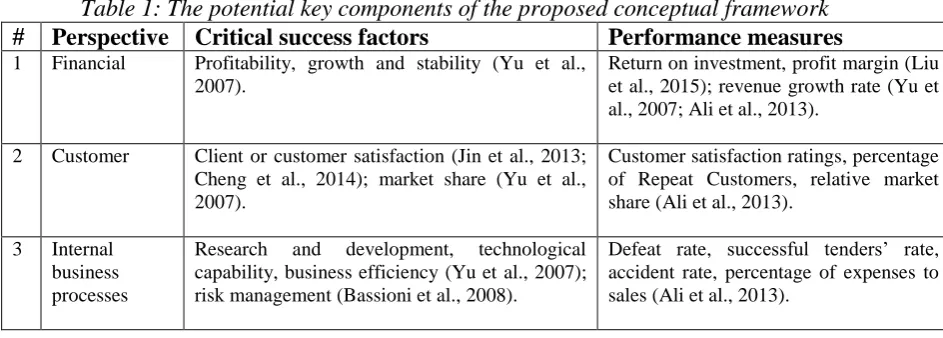
[image:7.595.70.542.558.727.2]The proposed conceptual framework comprises the following potential key components: BSC perspectives, critical success factors (performance criteria), and corresponding performance measures that are relevant the construction industry, which is exhibited in Table 1 below.
Table 1: The potential key components of the proposed conceptual framework # Perspective Critical success factors Performance measures
1 Financial Profitability, growth and stability (Yu et al., 2007).
Return on investment, profit margin (Liu et al., 2015); revenue growth rate (Yu et al., 2007; Ali et al., 2013).
2 Customer Client or customer satisfaction (Jin et al., 2013; Cheng et al., 2014); market share (Yu et al., 2007).
Customer satisfaction ratings, percentage of Repeat Customers, relative market share (Ali et al., 2013).
3 Internal business processes
Research and development, technological capability, business efficiency (Yu et al., 2007); risk management (Bassioni et al., 2008).
522
4 Learning and growth
Organisational competency (Yu et al., 2007); employee development, and technology competency (Luu et al., 2008).
Employee productivity (Yu et al., 2007); Employee satisfaction survey (Jin et al., 2013); investment in IT for construction (Luu et al., 2008).
5 Supplier Supplier management (Bassioni et al., 2008). Materials return rate, supplier on-time delivery, quality of purchased goods (Halman and Voordijk, 2012).
6 Project Project management (Cserháti and Szabó, 2014). Safety, cost, time, quality, client’s satisfaction (Yeung et al., 2013).
7 Environment & community
Sustainability (Jin et al., 2013). Energy and water consumption; waste and scrap level, contribution to the community (Parmenter, 2015).
The following sub-sections describe the key components of the proposed conceptual framework.
Step 1: identification of perspectives
It is imperative for construction organisations to identify their performance perspectives that represent a comprehensive coverage of all pertinent aspects of their business model. Some authors have proposed the use of the original perspectives of BSC to evaluate the performance of construction organisations (Yu et al., 2007). However, Lueg (2015) suggests that the original BSC ignores developments in the industry-specific, social and natural environments (p.37). Accordingly, some other authors have added relevant perspectives to the original perspectives of the BSC to evaluate the performance of construction organisations (Jin et al., 2013; Ali et al., 2013) or have replace existing perspectives of original BSC with new ones (Ozorhon et al., 2011). The conceptual framework proposed in this research includes three additional performance perspectives to the four original perspectives of the BSC namely project perspective (Kagioglou et al. 2001); supplier perspective (Kagioglou et al. 2001); and environment & community perspective (Parmenter, 2015; Björklund and Forslund, 2013) to reflect the distinct characteristics of the construction industry. The proposed conceptual framework therefore attempts to include the triple bottom line aspects of sustainability, namely economic, social and environmental performance (Yadav-Sushil and Sagar, 2013). The seven potential interrelated performance perspectives are now briefly discussed.
(1) Financial perspective: The financial perspective focuses on providing more value to the shareholders of construction organisations in terms of improvements in the bottom line results (Chan, 2009). Construction organisations can use this perspective to demonstrate their financial accountability and stewardship through the production and validation of financial statements.
(2) Customer perspective: PMM in construction is usually client-driven. Therefore the customer perspective is critical for construction organisations to assess their customers’ requirements (Oyewobi et al., 2015) and hence increase customer value, which can lead to close customer relationships and high-quality in their operations (Jin et al., 2013).
523
(3) Internal business processes: This perspective requires construction organisations to place emphasis on integrating and improving the internal efficiency of their business processes to achieve excellence (Ali et al., 2013; Jin et al., 2013).
(4) Learning and Growth: This perspective requires construction organisations to invest in their human resources development, their competency, and informatization (Yu et al., 2007), in order to manage their business and improve their performance and ability to adapt to change (Perkins et al., 2014).
(5) Project perspective: The construction industry is mainly project based (Ozorhon et al., 2011; Keung and Shen, 2013). Therefore, this perspective requires construction organisations to drive focus on evaluating the successfully achievement of project performance. Project performance is the realization of predefined project objectives (Ozorhon et al., 2011) and hence project success.
(6) Supplier perspective: The supplier perspective requires construction organisations to evaluate and monitor suppliers’ performance in term of service quality and speed of service delivery, flexibility, and the relationships and partnerships with them.
(7) Environment & Community perspective: The importance of environmental and community perspective and its corresponding measures within CPMM frameworks is growing (Björklund and Forslund, 2013) in order to manage the environmental impact on organisational activities. These authors further suggest that an improvement in community/environmental performance will increase the focus on customers and suppliers, and it is an important source of competitive advantage for organisations.
Step 2: identification of CSFs and performance measures
Some construction researchers (Kulatunga et al., 2011; Cheng et al., 2014) have underscored the importance of identifying organisational critical success factors (CSFs) that are aligned with each perspective within the CPMM framework. CSFs are a number of important factors on which organisations should direct and concentrate their limited resources in order to achieve success (Yong and Mustaffa, 2013). Construction organisations also need to identify an appropriate set of performance measures and associated targets for each of the identified CSFs (Toor and Ogunlana, 2010; Parmenter, 2015) to monitor the achievement of their mission, strategy, goals and objectives. The proposed conceptual framework uses both financial and non-financial measures of performance to reflect the holistic coverage of an organisation’s business model.
Step 3: definition of a framework review procedure
524
Step 4: diagrammatical representation of the conceptual framework
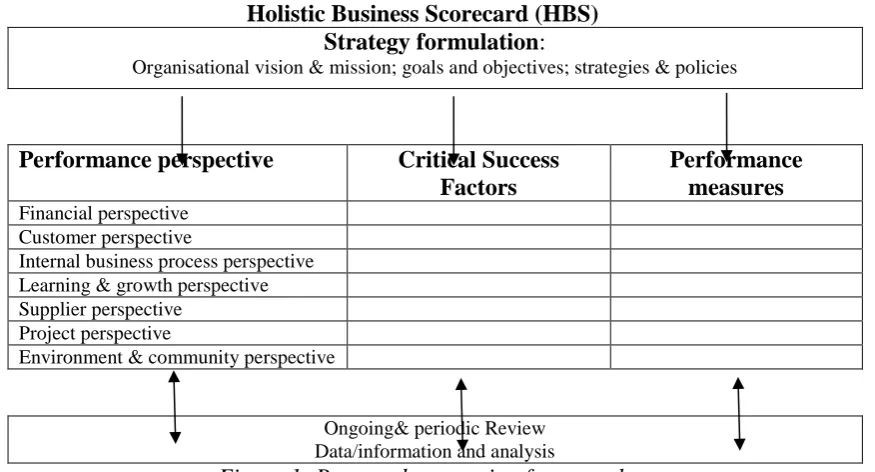
Figure 1 exhibits the initial conceptual PMM framework for evaluating the performance of construction firms. This initial proposed conceptual framework, called the Holistic Business Scorecard (HBS), focuses on specifying the key components required for evaluating the performance of construction organisations, which are also link to strategy formulation. It includes a component to perform review procedures that will ensure its relevance to strategy and the changing business environment as suggested by Gutierrez et al. (2015). It is important to note that the presented conceptual BSC framework is developed only from the literature. Primary data are currently being collected from a questionnaire survey amongst industry practitioners, and detailed case studies including semi-structured interviews with practitioners within case study firms in Saint Lucia to empirically test and further develop the conceptual framework. Furthermore, the proposed BSC conceptual framework will be validated with some semi-structured interviews with practitioners in the construction industry. Consequently, the conceptual framework will undergo revisions or refinements after gathering and analysing the data from the empirical investigation stage of the research. The conceptual BSC framework will provide a structured way for construction firms to better measure and evaluate their performance, and assess the contribution of key stakeholders. Consistent with prior studies (Ali et al., 2013; Ercan and Koksal, 2016), the conceptual framework can facilitate benchmarking of performance within each construction organisation, and among the organisations in the construction industry. Furthermore, it has the potential to be tailored to different organisational needs and contexts.
Holistic Business Scorecard (HBS) Strategy formulation:
Organisational vision & mission; goals and objectives; strategies & policies
Performance perspective Critical Success Factors
Performance measures
Financial perspective Customer perspective
Internal business process perspective Learning & growth perspective Supplier perspective
Project perspective
Environment & community perspective
[image:10.595.86.524.376.612.2]
Ongoing& periodic Review Data/information and analysis
Figure 1: Proposed conception framework
5. CONCLUSION
525
compare their performance to others in the industry by using benchmarking. In this research, a PMM framework based on the theoretical underpinnings of the BSC has been conceptualized for construction firms to better measure and evaluate their performance. Using the literature review, seven perspectives with associated critical success factors and performance measures that are applicable to the construction industry are identified for the proposed conceptual framework. In particular, the identified core components of the proposed BSC framework are capable of capturing the performance of the key business areas of construction firms. Ongoing research is currently being undertaken in the construction industry in Saint Lucia to empirically test the proposed BSC conceptual framework using questionnaire surveys and case studies, and then validate it with some semi-structured interviews. Finally, the findings from this research provide preliminary insight on the development and synthesis process of the conceptual BSC framework for the performance evaluation of construction firms.
6. REFRENCES
Akhtar, M. and Mittal, R.K. (2015), Implementation issues and their impact on strategic performance management system effectiveness – an empirical study of Indian oil industry, Measuring Business Excellence, 19(2), 71 – 82.
Almahmoud, E.S., Doloi, H.K. and Panuwatwanich, K. (2012), Linking project health to project performance indicators: multiple case studies of construction projects in Saudi Arabia, International Journal of Project Management, 30(3), 296-307.
Baird, K. (2017), The effectiveness of strategic performance measurement systems, International Journal of Productivity & Performance Management, 66(1), 3-21.
Barnabè, F. (2011), A system dynamics‐based Balanced Scorecard to support strategic decision making: Insights from a case study, International Journal of Productivity & Performance Management, 60(5), 446-473.
Bassioni, H.A., Price, A.D.F., and Hassan, T.M. (2004), Performance measurement in construction, Journal of Management in Engineering, 20(2), 42–50.
Bassioni, H.A., Hassan, T.M., and Price, A.D.F. (2008), Evaluation and analysis of criteria and sub-criteria of a construction excellence model, Engineering, Construction & Architectural Management, 15(1), 21– 41. Behery, M., Jabeen, F. and Parakandi, M. (2014), Adopting a contemporary performance management system,
International Journal of Productivity & Performance Management, 63(1), 22 – 43.
Bititci, U., Garengo, P., Dörfler, V. and Sai Nudurupati, S. (2012), Performance Measurement: Challenges for Tomorrow, International Journal of Management Reviews, 14(3), 305–327.
Björklund, M. and Forslund, H. (2013), The purpose and focus of environmental performance measurement systems in logistics, International Journal of Productivity & Performance Management, 62(3), 230 – 249. Chan, T.K. (2009), Measuring performance of the Malaysian construction industry, Construction Management
& Economics, 27(12), 1231-1244.
Cheng, L., Wen, D and Hong-Chang Jiang, H. (2014), The performance excellence model in construction enterprises: an application study with modelling and analysis, Construction Management & Economics, 32(11), 1078-1092.
Constructing Excellence (2009), Constructing Excellence in partnership with Department of Business Enterprise and Regulatory Reform, UK Industry Performance Report 2009. London. Retrieved on May 18, 2007, from http://constructingexcellence.org.uk/wp-content/uploads/2014/10/Industry_Performance_Report_2009.pdf Constructing Excellence (2016), Constructing Excellence in partnership with Department for Business,
Innovation and Skills, Glenigan, and CITB, UK Industry Performance Report 2016, London. Retrieved on May 18, 2017, from http://constructingexcellence.org.uk/kpi-reports/
Cserháti, G. and Szabó, L. (2014), The relationship between success criteria and success factors in organisational event projects, International Journal of Project Management, 32(4), 613–624.
Deng, F., Smyth H.J. and Anvuur A.M. (2012), A critical review of PMS in construction: Towards a research agenda, Paper presented in the 28th Annual ARCOM Conference, Association of Researchers in
Construction Management, 3-5 September 2012, Edinburgh, UK, , 807-816.
526
European Foundation for Quality Management [EFQM] (2017), An overview of the EFQM excellence model, Brussels: EFQM. Retrieved on May 18, 2017 from http://www.efqm.org
Egan, J. (1998), Rethinking construction: Construction Task Force report for Department of the Environment, Transport and the Regions, London: Her Majesty’s Stationery Office.
El-Mashaleh, M.S., Minchin, R.E. Jr., and O’Brien, W. J. (2007), Management of construction firm performance using benchmarking, Journal of Management in Engineering, 23(1), 10–17.
Elyamany, A., Basha, I. and Zayed, T. (2007), Performance Evaluating Model for Construction Companies: Egyptian Case Study, Journal of Construction Engineering & Management, 133(8), 574-581.
Ercan, T. and Koksal, A. (2016), Competitive Strategic Performance Benchmarking (CSPB) Model for International Construction Companies, KSCE Journal of Civil Engineering, 20(5), 1657-1668.
Fitzgerald, L., Johnson, R., Brignall, S., Silvestro, R. and Vos, C. (1991), Performance Measurement in Service Businesses, London: The Chartered Institute of Management Accountants.
Folan, P. and Browne, J. (2005), A review of performance measurement: Towards performance management, Computers in Industry, 56(7), 663–680.
Francioli, F. and Cinquini, L. (2014), Exploring the blurred nature of strategic linkages across the BSC: The relevance of “loose” causal relationships, Journal of Accounting & Organizational Change, 10(4), 486-515. Gimbert, X., Bisbe, J. and Mendoza, X. (2010), The role of performance measurement systems in strategy
formulation processes, Long Range Planning, 43(4), 477-497.
Gutierrez, D.M., Scavarda, L.F., Fiorencio, L. and Martins, R.A. (2015). Evolution of the performance measurement system in the Logistics Department of a broadcasting company: An action research, International Journal of Production Economics, 160, 1–12.
Halman, J.I.M and Voordijk, J.T. (2012), Balanced Framework for Measuring Performance of Supply Chains in House Building, Journal of Construction Engineering & Management, 138(12), 1444-1450.
Haponava, T. and Al-Jibouri, S. (2012), Proposed System for Measuring Project Performance Using Process-Based Key Performance Indicators, Journal of Management in Engineering, 28(2), 140-149.
Hoque, Z. (2014), 20 years of studies on the balanced scorecard: Trends, accomplishments, gaps and opportunities for future research, The British Accounting Review, 46(1), 33-59.
Horta, I., Camanho, A. & Moreira da Costa, J. (2012), Performance assessment of construction companies: A study of factors promoting financial soundness and innovation in the industry, International Journal of Production Economics, 137(1), 84–93.
Horta, I.M., Camanho, A.S., Johnes, J. and Johnes, G. (2013), Performance trends in the construction industry worldwide: an overview of the turn of the century, Journal of Productivity Analysis, 39(1), 89–99 Jin, Z., Deng, F., Li, H. and Skitmore, M. (2013), Practical Framework for Measuring Performance of
International Construction Firms, Journal of Construction Engineering & Management, 139(9), 1154-1167. Kagioglou, M., Cooper, R. and Aouad, G. (2001), Performance management in construction: a conceptual
model, Construction Management and Economics, 19(1), 85-95.
Kaplan, R.S. and D.P. Norton (1992), The Balanced Scorecard: Measures that Drive Performance, Harvard Business Review, and (January-February), 71-79.
Keung, C.C.W. and Shen, L. (2013), Measuring the Networking Performance for Contractors in Practicing Construction Management, Journal of Management in Engineering, 29(4), 400-406.
Kulatunga, U., Amaratunga, D. and Haigh, R. (2011), Structured approach to measure performance in construction research and development: Performance measurement system development, International Journal of Productivity & Performance Management, 60(3), 289 – 310.
Lin, G. and Shen, Q. (2007), Measuring the Performance of Value Management Studies in Construction: Critical Review, Journal of Management in Engineering, 23(1), 2-9.
Lueg, R. (2015), Strategy maps: the essential link between the balanced scorecard and action, Journal of Business Strategy, 36(2), 34 – 40.
Luu, T., Kim, S., Cao, H. and Park, Y. (2008), Performance measurement of construction firms in developing countries, Construction Management & Economics, 26(4), 373-386.
Lynch, R.L., & Cross, K.F. (1991), Measure Up! Yardsticks for Continuous Improvement, Oxford: Basil Blackwell.
Mehralian, G., Nazari, J. A., Nooriparto, G. and Rasekh, H. R. (2017), TQM and organizational performance using the balanced scorecard approach, International Journal of Productivity & Performance Management, 66(1), 111-125.
Meng, X. and Minogue, M. (2011), Performance measurement models in facility management: a comparative study, Facilities, 29(11/12), 472-484.
Micheli, P. and Mura, M. (2017), Executing strategy through comprehensive performance measurement systems, International Journal of Operations & Production Management, 37(4), 423-443.
527
Molina, M.Á.C., Florencio, B. P., González, J.M.H. & González, J.L.G. (2016), Implementing the balanced scorecard: its effect on the job environment, Total Quality Management & Business Excellence, 27(1-2), 81-96.
Moullin, M. (2017), Improving and evaluating performance with the Public Sector Scorecard, International Journal of Productivity & Performance Management, 66(4), 442-458.
Munir, R. and Baird, K. (2016), Influence of institutional pressures on performance measurement systems, Journal of Accounting & Organizational Change, 12(2), 106 – 128.
National Institute of Standards & Technology (NIST, 2017), Baldrige Excellence Builder: Key questions for improving your organization’s performance, Retrieved on July 14, 2017, from www.nist.gov/baldrige Neely, A. (1999), The Performance Measurement Revolution: Why Now and What Next?, International
Journal of Operations & Production Management, 19(2), 205–228.
Neely, A., Adams, C., and Crowe, P. (2001), The performance prism in practice. Measuring Business Excellence, 5(2), 6-12.
Niven, P.R. (2014), Balanced Scorecard Evolution: A Dynamic Approach to Strategy Execution, New Jersey: John Wiley & Sons, Inc.
Nørreklit, H., Nørreklit, L., Mitchell, F and Bjørnenak, T. (2012), The rise of the balanced scorecard! Relevance regained?, Journal of Accounting & Organizational Change, 8(4), 490-510.
Oyewobi, L.O., Windapo, A.O. and Rotimi, J.O.B. (2015), Measuring strategic performance in construction companies: a proposed integrated model, Journal of Facilities Management, 13(2), 109 – 132.
Ozorhon, B., Arditi, D., Dikmen, I., and Birgonul, M. T. (2011), Toward a Multidimensional Performance Measure for International Joint Ventures in Construction, Journal of Construction Engineering & Management, 137(6), 403-411.
Parida, A., Kumar, U., Galar, D. and Stenström, C. (2015), Performance measurement and management for maintenance: a literature review, Journal of Quality in Maintenance Engineering, 21(1), 2 – 33.
Parmenter, D. (2015), Key Performance Indicators Developing, Implementing, and Using Winning KPIs (3th Ed.), New Jersey: John Wiley & Sons.
Pekkola, S., Saunila, M. and Rantanen, H. (2016), Performance measurement system implementation in a turbulent operating environment, International Journal of Productivity & Performance Management, 65(7), 947-958.
Perkins, M., Grey, A. and Remmers, H. (2014), What do we really mean by “Balanced Scorecard”?, International Journal of Productivity & Performance Management, 63(2), 148 – 169.
Pimentel, L. and Major, M. J. (2014), Quality management and a balanced scorecard as supporting frameworks for a new management model and organisational change, Total Quality Management & Business
Excellence, 25, 7-8.
Ren, Z., Anumba, C.J. and Yang, F. (2013), Development of CDPM matrix for the measurement of collaborative design performance in construction, Automation in Construction, 32, 14 – 23.
Saunila, M. (2016), Performance measurement approach for innovation capability in SMEs. International Journal of Productivity & Performance Management, 65(2), 162-176.
Shanmugapriya, S. and Subramanian, K. (2016), Developing a PLS Path Model to Investigate the Factors Influencing Safety Performance Improvement in Construction Organizations, KSCE Journal of Civil Engineering, 20(4),1138-1150.
Sigalas, C. (2015), Empirical investigation of balanced scorecard’s theoretical underpinnings, Journal of Accounting & Organizational Change, 11(4), 546 – 572.
Silvi, R., Bartolini, M., Raffoni, A. Visani, F. (2015), The practice of strategic performance measurement systems, International Journal of Productivity & Performance Management, 64(2), 194 – 227.
Soderberg, M., Kalagnanam, S., Sheehan, N.T. and Vaidyanathan, G. (2011), When is a balanced scorecard a balanced scorecard?, International Journal of Productivity & Performance Management, 60(7), 688-708. Taticchi, P., Balachandran, K. and Tonelli, F. (2012), Performance measurement and management systems:
state of the art, guidelines for design and challenges, Measuring Business Excellence, 16(2), 41- 54. Toor, S.R. and Ogunlana, S.O. (2010), Beyond the ‘iron triangle’: Stakeholders perception of key performance
indicators (KPIs) for large-scale public sector development projects, International Journal of Project Management, 28(3), 228-236.
Upadhaya, B. Munir, R. and Blount, Y. (2014), Association between performance measurement systems and organisational effectiveness, International Journal of Operations & Production Management, 34(7), 853 – 875.
Yadav- Sushil, N. and Sagar, M. (2013), Performance measurement and management frameworks, Business Process Management Journal, 19(6), 947 – 971.
528
Yaghoobi, T. and Haddadi, F. (2016), Organizational performance measurement by a framework integrating BSC and AHP, International Journal of Productivity & Performance Management, 65(7), 959-976. Yang, H., Yeung, J.F.Y., Chan, A.P.C., Chiang, Y.H. and Chan, D.W.M. (2010), A critical review of
performance measurement in construction. Journal of Facilities Management, 8(4), 269-284. Yeung, J. F.Y., Chan, A. P. C., Chan, D. W.M., Chiang, Y. H. and Yang, H. (2013), Developing a
Benchmarking Model for Construction Projects in Hong Kong, Journal of Construction Engineering & Management, 139(6), 705-716.
Yong, Y.C. and Mustaffa, N.E. (2013), Critical success factors for Malaysian construction projects: an empirical assessment, Construction Management & Economics, 31(9), 959-978.
Yu, I., Kim, K., Jung, Y., and Chin, S. (2007), Comparable performance measurement system for construction companies, Journal of Management in Engineering, 23(3), 131–139.