http://dx.doi.org/10.4236/ojog.2014.46045
External Cephalic Version: A Single Centre
Experience
Kassam Mahomed1,2,3, Poornima Amaranarayana1, Ibinabo Ibiebele3
1Department of Obstetrics and Gynaecology, Ipswich Hospital, Ipswich, Australia 2University of Queensland, Brisbane, Australia
3Mater Research Institute, South Brisbane, Australia Email: [email protected]
Received 26 February 2014; revised 22 March 2014; accepted 29 March 2014
Copyright © 2014 by authors and Scientific Research Publishing Inc.
This work is licensed under the Creative Commons Attribution International License (CC BY). http://creativecommons.org/licenses/by/4.0/
Abstract
Incidence of caesarean section for breech presentation has increased markedly. External cephalic version (ECV) is effective in reducing non cephalic presentation at births and caesarean section (CS) for breech presentation. Success rates are good but there is increasing need for induction of labour (IOL) as well as for intrapartum CS for reasons that are not clear. The aim of this study was to report the experience with ECV at a single centre where ECVs were performed by or under the guidance of one senior clinician. This was a 7-year retrospective audit of 147 ECVs at a single cen-tre in Queensland. ECV was successful in 53.7%, 34% in nulliparous and 69% in multiparous women. Of the few variables explored, nulliparity was the only variable that was associated with poor success. Among those with successful ECV, 32 (40.5%) had IOL. Intrapartum CS rate in wo- men who had had a successful ECV was 16.5% compared to 11% for the hospital. There was no difference in early neonatal outcome between the groups. We have confirmed a success rate that is comparable with many other studies. Mothers with successful ECV do have a higher IOL and a higher CS rate especially in women whose labour is induced. We suggest a need to look at some novel methods to increase uptake further and to improve success rates in nulliparous women.
Keywords
ECV, Breech, Labour, Caesarean, Predictors
1. Introduction
is effective in reducing non cephalic presentation at births as well as reducing the need for CS for breech pres-entation. Current guidelines [5]-[7] therefore recommend that ECV should be offered to all women with breech presentation at term. Success rates of ECV vary between 40% - 60% [5] with it being more successful if multi-parous, breech is not low in the pelvis, uterus not tense, easily palpable fetal head, and maternal weight less than 65 kg [8]. It is also likely that adequate amounts of amniotic fluid, non-frank breech, non-anterior placenta and anterior fetal back also improve success rate [9] [10].
The aim of this retrospective audit was to report the experience with ECV at a single centre where ECVs were performed by or under the guidance of one clinician with much experience with ECVs.
2. Patients and Methods
This was a retrospective audit of all ECVs performed at Ipswich Hospital, Ipswich during the period 2006 to Dec 2012. All ECVs were performed in birth suite. Women had cardiotocography (CTG) performed before and after the procedure. Tocolysis using 500 mcg salbutamol by slow intravenous infusion was the routine. Ultra-sound scan was used to assess fetus and to confirm presentation. Talcom powder was applied over the abdomen after which the version was by either a forward or a backward somersault. Procedure was abandoned at her re-quest at any time during the procedure if discomfort was not tolerable. The procedure usually lasted no more than 5 minutes. Anti-D immunoglobulin was administered prophylactically to all Rhesus-negative women.
Data on demographics and on the ECV procedure and pregnancy outcome were extracted from the charts and entered into an excel spreadsheet. Data were analysed using Stata/SE 9.0 for Windows (StataCorp LP 2005). All variables were treated as categorical; continuous variables were classified into categories and treated as categor-ical variables. Maternal and pregnancy characteristics were compared between women with successful and un-successful ECV procedure using Chi squared test or Fisher’s exact test, where appropriate. The association be-tween maternal and pregnancy characteristics and successful ECV was explored using univariate logistic regres-sion.
The study was approved by the West Moreton Hospital and Health service HREC.
3. Results
A total of 147 external cephalic versions (ECVs) were performed. Sixty four women (43.5%) were in their first pregnancy. Mean (SD) BMI was 27.2 (6.4). Fifty four (36.7%) women had a BMI of <25 kg/m2, 24 (16.3%) were obese (BMI 30 - 34.9) and 22 (15.0%) were morbidly obese (BMI 35 and above). Seven women (4.8%) had had one previous caesarean section. ECV was successful in 4 of these 7 women. Eighty four (57%) women were <37 weeks pregnant at the time of the ECV.
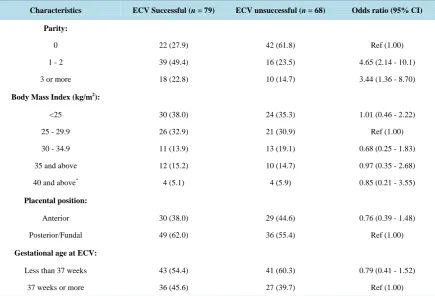
Overall ECV was successful in 79 (53.7%) of women. Success rate was 34% in nulliparous and 69% in mul-tiparous women. None reverted back to breech after a successful ECV but two women with failed ECV had spontaneous version to cephalic before birth.
In Table 1 we looked at the effect of parity, BMI, placental position and gestational age on the success rate of ECV. Nulliparity was the only variable that was associated with poor success. Gestational age <37 weeks, ante-rior placenta and maternal body mass index were not associated with failure to turn the baby in our experience.
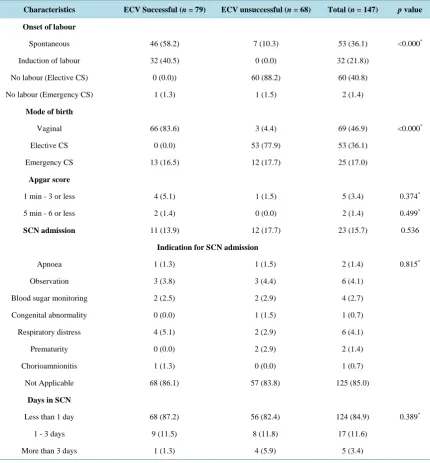
In Table 2we looked at some of the pregnancy outcomes in the women who had an attempt at ECV. Among
those with successful ECV, 32 (40.5%) had induction of labour (IOL), in 17 (22% of the women with successful ECV) it was for post dates. Other indications included prelabour rupture of membranes at term (5), gestational diabetes (3), pre eclampsia (2), unstable lie (1) and maternal medical concerns (4). No adverse events were rec-orded and no woman needed to be delivered as a result of fetal concern at the time of the ECV.
Majority of the women (83.6%) had a vaginal birth. Intrapartum caesarean section rate in women who had had a successful ECV was 16.5%. This rate was 6.5% if they went into spontaneous labour as opposed to 28% if they had IOL. Indication for caesarean section was failure to progress in two thirds of these cases. In terms of neonatal outcome there was no significant difference between the groups in terms of low Apgar score or need for admission and duration of admission into special care unit. Number of neonates with these events were however small.
4. Discussion
Table 1. Univariate association between maternal and pregnancy factors and ECV outcome.
Characteristics ECV Successful (n = 79) ECV unsuccessful (n = 68) Odds ratio (95% CI)
Parity:
0 22 (27.9) 42 (61.8) Ref (1.00)
1 - 2 39 (49.4) 16 (23.5) 4.65 (2.14 - 10.1)
3 or more 18 (22.8) 10 (14.7) 3.44 (1.36 - 8.70)
Body Mass Index (kg/m2):
<25 30 (38.0) 24 (35.3) 1.01 (0.46 - 2.22)
25 - 29.9 26 (32.9) 21 (30.9) Ref (1.00)
30 - 34.9 11 (13.9) 13 (19.1) 0.68 (0.25 - 1.83)
35 and above 12 (15.2) 10 (14.7) 0.97 (0.35 - 2.68)
40 and above* 4 (5.1) 4 (5.9) 0.85 (0.21 - 3.55)
Placental position:
Anterior 30 (38.0) 29 (44.6) 0.76 (0.39 - 1.48)
Posterior/Fundal 49 (62.0) 36 (55.4) Ref (1.00)
Gestational age at ECV:
Less than 37 weeks 43 (54.4) 41 (60.3) 0.79 (0.41 - 1.52)
37 weeks or more 36 (45.6) 27 (39.7) Ref (1.00)
*Referent category―less than 40 kg/m2
.
rate was 34% in nulliparous versus 69% in mulitiparous women. The success rate in nulliparous women was not significantly better if ECV was performed before 37 weeks as compared to 37 weeks and above, 33% and 36% respectively. The lower success rate in nulliparous women as been noted by others [4] [8] [11] and is thought to be due to a more tense uterus in such women [8]. It is also ones impression that nulliparous women tend not to tolerate much discomfort. Several strategies to improve success of ECV have been tested. The EECV2 Multi-centre RCT [12] reported a better success rate when ECV was performed between 34 - 36 weeks compared to at 37 weeks and above but was associated with an increased risk of preterm birth and many ECVs in that study were performed nearer to 34 than to 36 weeks. We now recommend ECV at 360 weeks in nulliparous women. Another strategy that is promising is the use of regional block. None of our cases were done with regional block. Meta analysis of several RCTs reported a better success rate (59.7% compared with 37.6% without analgesia; pooled relative risk 1.58; 95% confidence interval 1.29 - 1.93) and no increase in adverse events, with the use of spinal or epidural for ECV [13].
It is of note that in women with successful ECV, vaginal birth rate was high. This supports the women’s deci-sion to undergo the ECV procedure in the first instance. Women who have spontaneous vaginal birth after suc-cessful version tend to be more satisfied with childbirth than women with planned c/section [14]. We were sur-prised to record a high induction of labour rate of 40.5% in the women who had had a successful ECV (our hos-pital overall IOL rate is around 21%). Many of these inductions were for post dates, 53% of women who had IOL it was for post dates, a much higher rate than that in our unit where post dates accounts for 32% of all in-ductions. Parity did not seem to contribute to this high IOL rate as only 22% of our nulliparous women needed IOL. This was in contrast to IOL rates of 49% in nulliparous and 30% in multiparous women reported recently in a unit in Japan [10].
Table 2. Pregnancy outcome by success of external cephalic version.
Characteristics ECV Successful (n = 79) ECV unsuccessful (n = 68) Total (n = 147) p value
Onset of labour
Spontaneous 46 (58.2) 7 (10.3) 53 (36.1) <0.000*
Induction of labour 32 (40.5) 0 (0.0) 32 (21.8))
No labour (Elective CS) 0 (0.0)) 60 (88.2) 60 (40.8)
No labour (Emergency CS) 1 (1.3) 1 (1.5) 2 (1.4)
Mode of birth
Vaginal 66 (83.6) 3 (4.4) 69 (46.9) <0.000*
Elective CS 0 (0.0) 53 (77.9) 53 (36.1)
Emergency CS 13 (16.5) 12 (17.7) 25 (17.0)
Apgar score
1 min - 3 or less 4 (5.1) 1 (1.5) 5 (3.4) 0.374*
5 min - 6 or less 2 (1.4) 0 (0.0) 2 (1.4) 0.499*
SCN admission 11 (13.9) 12 (17.7) 23 (15.7) 0.536
Indication for SCN admission
Apnoea 1 (1.3) 1 (1.5) 2 (1.4) 0.815*
Observation 3 (3.8) 3 (4.4) 6 (4.1)
Blood sugar monitoring 2 (2.5) 2 (2.9) 4 (2.7)
Congenital abnormality 0 (0.0) 1 (1.5) 1 (0.7)
Respiratory distress 4 (5.1) 2 (2.9) 6 (4.1)
Prematurity 0 (0.0) 2 (2.9) 2 (1.4)
Chorioamnionitis 1 (1.3) 0 (0.0) 1 (0.7)
Not Applicable 68 (86.1) 57 (83.8) 125 (85.0)
Days in SCN
Less than 1 day 68 (87.2) 56 (82.4) 124 (84.9) 0.389*
1 - 3 days 9 (11.5) 8 (11.8) 17 (11.6)
More than 3 days 1 (1.3) 4 (5.9) 5 (3.4)
*Fisher’s exact; p value for t-test.
ECV.
It is also of note that we safely performed an ECV in women with one previous CS. Another study [19] also reported similar success rates in women with one previous CS compared to no previous CS. Concern about pro-cedural success or adverse effect in women with a previous CS is unwarranted and should not deter from rec-ommending an ECV in such women.
We provide a proactive approach to women noted to have a breech presentation during the antenatal period. ECVs were performed or supervised by a senior Obstetrician. Trainees and other colleagues could also assist or perform ECV under direct supervision and guidance. As more than 90% of ECVs were performed or supervised by a single clinician, the procedure entailed considerable homogeneity, although admittedly less generalisability.
We need to have any data regarding uptake of ECV in our unit but it has been reported to be as low as 18% [12]. We need to prospectively look at possible barriers towards ECV, including the ability or otherwise of clini-cians to fully inform and consent women. Fear of pain does influence women’s willingness to have ECV and whilst we promote a proactive approach when consenting we always reassure women that unbearable pain is always a reason to stop procedure. We do however emphasise that vast majority of women report that the expe-rienced pain is bearable. Use of videos as part of the information on ECV is another area that needs further re-search. If women with breech presentation have a primary caesarean section in the first pregnancy a large num-ber will have an elective repeat procedure in their second pregnancy. Data [20] regarding increased risk of pla-centa accrete after CS are concerning.
5. Conclusion
We have confirmed that ECV is a safe procedure with a success rate that is comparable to many other studies but suggested more research into other novel methods to increase uptake further and to improve success rates espe-cially in nulliparous women. Mothers with successful ECV do have a higher IOL and a higher CS rate espeespe-cially in women whose labour is induced.
Acknowledgements
We would like to acknowledge the help of the medical records Unit at Ipswich hospital for identification and re-trieval of charts and to Donna Mason to assist with data cleansing.
References
[1] Hickok, D., Gordon, D., Milberg, J., Williams, M.A., et al. (1992) The Frequency of Breech Presentation by Gesta-tional Age at Birth: A Large Population-Based Study. American Journal of Obstetrics & Gynecology, 166, 851-852. http://dx.doi.org/10.1016/0002-9378(92)91347-D
[2] Hannah, M.E., Hannah, W.J., Hewson, S.A., Hodnett, E.D., et al. (2000) Planned Caesarean Section versus Planned Vaginal Birth for Breech Presentation at Term: A Randomised Multicentre Trial. Term Breech Trial Collaborative Group. Lancet, 356, 1375-1383. http://dx.doi.org/10.1016/S0140-6736(00)02840-3
[3] Hutton, E.K., Hannah, M.E. and Barrett, J. (2002) Use of External Cephalic Version for Breech Pregnancy and Mode of Delivery for Breech and Twin Pregnancy: A Survey of Canadian Practitioners. Journal of Obstetrics and Gynae-cology Canada, 24, 804-810.
[4] Hofmeyr, G.J. and Kulier, R. (2005) External Cephalic Version for Breech Presentation at Term. Cochrane Database of Systematic Reviews, 1, CD000083. http://dx.doi.org/10.1002/14651858.CD000083
[5] Royal College of Obstetricians and Gynaecologists (2006) The Management of Breech Presentation. Guideline No. 20b. Royal College of Obstetricians and Gynaecologists Clinical Green Top Guidelines.
[6] External Cephalic Version and Reducing the Incidence of Breech Presentation (2006) Green Top Guidelines No.20a. RCOG Press, London.
[7] American College of Obstetrics and Gynecology (ACOG) (2000) Clinical Management Guidelines for Obstetrician- Gynecologists: External Cephalic Version. ACOG Practice Bull, 13, 380-385.
[8] Kok, M., Cnossen, J., Gravendeel, L., Van Der Post, J.A.,et al. (2008) Clinical Factors to Predict the Outcome of Ex-ternal Cephalic Version: A Metaanalysis. American Journal of Obstetrics & Gynecology, 199, 630.e1-630.e7. http://dx.doi.org/10.1016/j.ajog.2008.03.008
http://dx.doi.org/10.1080/14767050802244938
[10] Cho, L.Y., Lau, W.L., Lo, T.K., Tang, H.H.,et al. (2012) Predictors of Successful Outcomes after External Cephalic Version in Singleton Term Breech Pregnancies: A Nine Year Historical Cohort Study. Hong Kong Medical Journal, 18, 11-19.
[11] Obeidat, N., Lataifeh, I., Al-Khateeb, M., Zeyed, F., et al. (2011) Factors Associated with the Success of External Ce-phalic Version of Breech Presentation at Term. Clinical and Experimental Obstetrics and Gynecology, 38,386-389. [12] Hutton, E.K., Hannah, M.E., Ross, S.J., Delisle, M.F.,et al. (2011) Early External Cephalic Version (ECV) 2 Trial: An
International Multicentre Randomised Controlled Trial of Timing of ECV for Breech Pregnancies. British Journal of Obstetrics and Gynaecology, 118, 564-577. http://dx.doi.org/10.1111/j.1471-0528.2010.02837.x
[13] Goetzinger, K.R., Harper, L.M., Tuuli, M.G., Macones, G.A.,et al. (2011) Effect of Regional Anesthesia on the Suc-cess Rate of External Cephalic Version: A Systematic Review and Meta-Analysis. Obstetrics & Gynecology, 118, 1137-1144. http://dx.doi.org/10.1097/AOG.0b013e3182324583
[14] Bogner, G., Hammer, B.E., Schausberger, C., Fischer, T., et al. (2013) Patient Satisfaction with Childbirth and Exter-nal Cephalic Version. Archives of Gynecology and Obstetrics, 289, 523-531.
[15] Kabiri, D., Elram, T., Aboo-dia, M., Elami-Suzin, M. et al. (2011) Timing of Delivery after External Cephalic Version and the Risk for Cesarean Delivery. Obstetrics & Gynecology, 118, 209-213.
http://dx.doi.org/10.1097/AOG.0b013e31822545a9
[16] Clock, C., Kurtzman, J., White, J. and Chung, H. (2009) Cesarean Risk after Successful External Cephalic Version: A Matched, Retrospective Analysis. Journal of Perinatology, 29, 96-100. http://dx.doi.org/10.1038/jp.2008.227
[17] Chan, L., Tang, J., Tsoi, K., Fok, W.Y., et al. (2004) Intrapartum Cesarean Delivery after Successful External Cephalic Version: A Meta-Analysis. Obstetrics & Gynecology, 104, 155-160.
http://dx.doi.org/10.1097/01.AOG.0000129240.54949.d2
[18] Kuppens, S.M.I., Hutton, E.K., Hasaart, T.H.M., et al. (2012) Mode of Delivery Following Successful External Cepha- lic Version: Comparison with Spontaneous Cephalic Presentations at Delivery. Journal of Obstetrics and Gynaecology Canada, 35,883-888.
[19] Abenhaim, H.A., Varin, J. and Boucher, M. (2009) External Cephalic Version among Women with a Previous Cesar-ean Delivery: Report on 36 Cases and Review of the Literature.Journal of Perinatal Medicine, 37, 156-160.
http://dx.doi.org/10.1515/JPM.2009.006