A Platform Supporting Coordinated Adaptation in Mobile Systems
Christos Efstratiou
1, Adrian Friday
1, Nigel Davies
1,2and Keith Cheverst
1 1Computing Department
Lancaster University
Lancaster, LA1 4YR
United Kingdom
{
efstrati,adrian,nigel,kc
}
@comp.lancs.ac.uk
2
Department of Computer Science
University of Arizona
Tucson, Arizona 85721
USA
[email protected]
Abstract
Mobile environments are highly dynamic, characterised by frequent and sudden changes in resource availability. As a consequence, adaptive mobile applications need to be ca-pable of adapting their behaviour to ensure they continue to offer the best possible level of service to the user. Our experience of developing such applications has led us to believe that existing mobile middleware platforms fail to consider adaptive applications on a host as an ensemble of entities competing for the same resources; instead, fo-cusing on the requirements of each application in isolation. A new approach is required which offers the mechanisms to support coordination of the adaptive behaviour of multi-ple applications in order to achieve a common goal. In this paper, we present a platform designed to meet this objec-tive. Our platform is based on the notion of the definition of system-wide flexible adaptation policies written using a form of Kowalsky’s event calculus, that may be adapted ac-cording to user needs. Moreover, we also believe that by using our approach it will soon be possible to identify and resolve conflicts caused by the need to adapt to multiple contextual triggers.
1. Introduction
Mobile environments are characterised by frequent and sudden change in both context and resource availability. As a consequence, mobile applications need to be capable of adapting to these changes to ensure they offer the best pos-sible level of service to the user [10, 14].
Early adaptive systems have tended to focus on the spe-cific limitations introduced by wireless connectivity [13, 21, 10]. However, more recently there has been an increasing interest in applications that adapt to a wider range of gen-eral environmental and contextual triggers, e.g. changes in a system’s physical location or based on a set of personal
preferences. The GUIDE system [1, 2] for example, sup-plies users with information tailored to their current location and individual profile. The combination of resource driven adaptation, together with context-aware adaptation presents us with a new set of requirements for mobile applications; such applications must be capable of adapting to multiple adaptive stimuli.
The majority of current middleware platforms aiming to support adaptation tend to focus on limited sets of triggers, e.g. based on network Quality-of-Service. Such platforms would require the integration of separate adaptation mech-anisms in order to achieve the necessary multi-triggered adaptation. In this paper we argue that this approach can
causeconflicting adaptationor suboptimal operation of the
system as a whole. We believe there is thus a require-ment for a platform that supports multiple adaptation trig-gers, allowing for resolution of conflicts and system-wide behavioural optimisation.
In this paper we present a new middleware platform that provides such support for coordinated adaptation triggered by multiple adaptive and contextual attributes. Our platform is based on an event calculus based policy specification lan-guage [8], which allows the coordination and arbitration of adaptive actions on a system-wide level. More specifically, section 2 illustrates the shortcomings of existing adaptive approaches using a number of example scenarios. An anal-ysis of existing adaptive systems is provided in section 3 which feed into a set of general architectural requirements for future mobile support platforms. The design of our plat-form is detailed in section 4 and section 5 gives a descrip-tion of our current implementadescrip-tion status. Finally, secdescrip-tion 7 contains our concluding remarks.
2. Identifying the Problem Domain
cur-rent adaptive systems provide limited support for adaptive applications by notifying them when certain “interesting” changes in these attributes occur. For example, if the band-width falls below some specified minimum threshold, it is then the responsibility of the application to adapt in an ap-propriate way. As we highlight in the following sections, such approaches can be shown to lead to inefficient overall behaviour due to the lack of coordination between the adap-tation policies of multiple simultaneously executing appli-cations. Furthermore, these approaches do not allow suffi-cient control over the implications of having multiple, and possibly conflicting, attributes triggering adaptation. In the following sections we presenting a set of scenarios illustrat-ing these problems.
2.1. Scenarios
Coordinated application adaptation for power manage-ment. In this scenario we consider the case where a user is running several applications, each incorporating a periodic ‘auto-save’ feature (which, as we shall see, has an associ-ated effect on the power consumption of the system).
Existing power managements systems e.g. the ACPI [12] model, enable the switching of hardware into a low power mode when not in use. For savings in power consumption to be made, applications should attempt to keep the hardware resources in an idle state for as long as possible so that the time spent in low power mode is maximised. In the case of the ‘auto-save’ facility, the level of power optimisation is proportional to the time intervals of consequent hard-disk accesses. If each application periodically checkpoints it’s state in isolation, then the disk will be accessed arbitrarily. In contrast, if applications are able to coordinate their auto-save processes such that the disk writes are clustered, longer periods of inactivity will result, allowing the disk to remain spun down for longer. Such an approach would clearly be more power efficient.
Conflicting adaptation. In this scenario we illustrate an example of potentially conflicting adaptation to network re-sources. Consider a mobile system with limited available power resources running several adaptive network-based applications. When the battery level falls below some speci-fied threshold, one of the applications is triggered to reduce its power consumption by reducing utilisation of the net-work interface. However, as the first application adapts and relinquishes some of its share of the overall bandwidth, this action may be interpreted independently by the other
appli-cations as anincreasein available network bandwidth and
may consequently increase their use of the network. In this
case the request to utilise available bandwidth isin direct
conflict with the initial goal of reducing power consump-tion.
Sharing demand for network bandwidth. In this sce-nario, we consider the case of two applications; an adaptive web browser and an adaptive video stream player, compet-ing for the same network resources. Followcompet-ing a drop in available bandwidth the two applications could react in a number of possible ways:
1. The web browser could stop downloading in order to dedicate its portion of bandwidth to the other applica-tion.
2. Both applications could adapt and share the available bandwidth equally.
3. The video stream viewer could adapt by reducing its bandwidth requirements, e.g. by reducing its frame rate, in order to allow the web browser to increase its share of the available bandwidth (an important down-load might be taking place.)
The reaction that would be most appropriate clearly de-pends on attributes such as the total network bandwidth, but also crucially, the user’s requirements. In order for the two applications to adapt in a coordinated manner there
is a basic requirement forsystem-wide adaptation policies.
Such policies would be responsible for coordinating the be-haviour of adaptive applications considering both the appli-cations’ interdependencies and user specified requirements, such as the priority to be given to individual applications. Without such policies, coordinated adaptation between ap-plications is difficult as each application is only capable of independent action.
A more detailed discussion of adaptation scenarios and the associated potential pitfalls and resulting outcomes can be found in [6, 7].
2.2. Analysis
The scenarios we have identified above illustrate a range of potential issues that are not addressed in current adaptive systems and middleware platforms. Moreover, based on our experience in this area we believe that these are not excep-tional cases, but general problems inherent in considering adaptation on a per application basis.
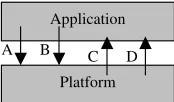
Examining current adaptive architectures has allowed us to a develop a framework for analysing the architectural model of such systems. The framework comprises two lay-ers; the upper represents the application, the lower the adap-tation support platform. Between these two layers we can identify four distinct flows of control and information (Fig. 1).
adap-Application
[image:3.612.124.211.72.123.2]Platform A B C D
Figure 1. Directed flows between applications and platform.
tation this flow would represent the application’s net-work QoS requirements.
Flow B: Represents the ability of the application to control the functionality of the underlying infrastruc-ture. For example, in the case of accessing a GPS de-vice this flow could represent the frequency the dede-vice is polled for new position readings.
Flow C: Represents an information flow from the plat-form to the application. This is provides the notifi-cation mechanism informing the applinotifi-cation when its requirements cannot be met. Such notifications are in-tended to trigger the application to adapt.
Flow D: Represents the ability of the underlying plat-form to control the operation of the application. For instance, this flow could be an pro-active request from the system for the application to perform a specific adaptive behaviour, e.g. the application might be re-quested to reduce its demand for network bandwidth or disk usage.
Consideration of this framework enables a classification of current systems according to the types of flows sup-ported. For example, network based adaptive systems such as BAYOU[25], Odyssey [21], MOST [10] and Rover [13] support flows A and C.
Context aware applications like GUIDE [1, 2], Stick-e Notes [22] and Cyberguide [18] are based on flow B, repre-senting the access to the ‘context-sensors’, and flow C rep-resenting the information flowing from the sensors to the application.
Provision of a flow of control has not been widely ex-ploited by mobile adaptive systems. Some distributed sys-tems platforms, such as ISIS-META [19], do provide such a flow, but have not been adapted for mobile environments or context-aware application development. One more recent and notable exception is the Puppeteer system [5]; which provides support for mobile environments through control of non-adaptive applications by the platform. However, Puppeteer does not currently support application aware adaptation or system-wide coordinated action.
3. Architectural Requirements
The previous sections have identified the limitations of current approaches in supporting adaptive mobile applica-tions. These approaches lack the appropriate support for enabling applications to adapt to multiple adaptive stim-uli in an efficient and coordinated way. A new approach is therefore required which provides a common space for the coordinated, systemwide interaction between adaptive applications and the complete set of attributes that could be used to trigger adaptation.
In this section we provide a set of requirements that are used to develop an appropriate architecture for supporting adaptive mobile applications.
3.1. Sharing of adaptation attributes
The first key requirement of the architecture is to provide mechanism for sharing the adaptation attributes used by the system between applications. By sharing information about adaptive stimuli and application state we are able to con-struct applications that coordinate their adaptive strategies. Such support would also provide a platform for constructing applications that adapt to multiple adaptive stimuli.
3.2. Multiple adaptation attributes
Current research has already clearly identified the need to provide adaptive solutions based on the combination of different attributes [4, 9, 16]. It is important, however, that new attributes can be introduced dynamically into the sys-tem when they become significant, e.g. the cost of specific services to mobile users or information about human physi-ology for wearable computers. The fact that new contextual attributes for triggering adaptation can arise implies that:
1. The set of attributes that can trigger adaptation needs to be extensible.
2. The characteristics of all these attributes vary.
3.3. Application Control and Coordination
A second requirement is the need to be able to control
adaptation behaviour acrossall componentsin the system.
As described earlier, one of the main limitations of current approaches is the fact that the applications themselves are responsible for triggering an adaptive mechanism when the underling infrastructure notifies them about any changes. In order to support flexible and coordinated adaptation there is a requirement for triggering adaptation on a system-wide level. Given this approach, the decision about when and how an application should adapt is pushed into an external entity, with cross-application knowledge, while the adaptive behaviour is still a part of the application’s characteristics.
3.4. Support for System-Wide Adaptation Policies
A further requirement for our system is to support the no-tion of system-wide adaptano-tion policies. Such coordinano-tion would require the externalisation of policies to some coordi-nating entity or set of entities. We believe this requirement to be best supported through a dedicated human-readable
policy languagewhich should also satisfy the following re-quirements:
1. Provide a flexible syntax for defining rules that can take into account an arbitrary number of factors af-fecting each adaptation decision. The policy language
should not be bound to a specific adaptation domain (e.g. network-based adaptation).
2. The policy specification and evaluation should incor-porate as a central tenet the fact that the triggering of adaptation is inherently event based.
3. The specification of policy rules should allow the spec-ification of fine grained temporal relationships be-tween events. In most cases conflicts or instabilities in adaptive systems occur due to a lack of considera-tion of time or temporal dependencies between invok-ing adaptive mechanisms, e.g. waitinvok-ing for the system to stabilise after changes are made or detected. The policy language should allow the fine tuning of adap-tation mechanism to allow the resolution of such types of conflict.
3.5. User Awareness and Interaction
A final requirement that is often neglected in current
adaptation platforms is the involvement of the userin the
whole process of adaptation. Adaptation is usually an ac-tion that affects the Quality of Service that the user experi-ences. Moreover, it is often only the user that can determine the relative merits of a given tradeoff – for example, the sys-tem might atsys-tempt to optimise the running configuration of
applications to make best use of the available resources, yet in the same situation a user might choose to pause or stop an application that they deem insignificant to their current ob-jectives. It is through promotion of awareness of the conse-quences of resource limitations and the actions of adaptive strategies, that the most profound adaptive effects can be achieved. Thus, there is a requirement that the user can in-trospect the adaptive behaviour of their system to determine and affect their desired outcomes. Furthermore, it should be possible to explicitly involve the user (as appropriate) when a pivotal adaptation decision has to be made.
The requirement to provide user awareness in adaptive systems can be further divided in to the following set of goals:
1. Explicit notification of the user when adaptation takes place. This notification should also provide informa-tionabout the reasons whythis adaptation took place. As we have stated, the provision of detailed explana-tion to the user could allow them to alter his/her be-haviour in order to avoid results that can cause adapta-tion that degrades the quality of an important applica-tion. This characteristic of the user’s behaviour could allow us to consider the user as part of the whole adap-tation cycle. While there is research suggesting that it is possible to model the behaviour of the user with suf-ficient accuracy to modify the system’s operation en-tirely automatically [11], we do not plan to support this in our platform, since we believe that it is non-trivial to correctly predict how users behave in all situations. Nevertheless, we acknowledge that user awareness can be of great benefit to the operation of the whole system.
2. Involvement of the user in the adaptation decisions. The definition of system wide adaptation policies is one aspect of user involvement. Though this mecha-nism is the most important tool for controlling the op-eration of all parts of an adaptive system, dynamic in-volvement of the user is necessary in order to fine-tune the behaviour of the system according to their specific needs at a given time. Dynamic interaction of the user could allow the injection of policies into the platform and/or alteration of existing ones. Such functionality becomes highly desirable when the platform faces a conflicting situation. There may for instance, be cases that the currently defined policies cannot resolve. In such a case user interaction might be the best strategy in order to achieve the appropriate adaptive behaviour.
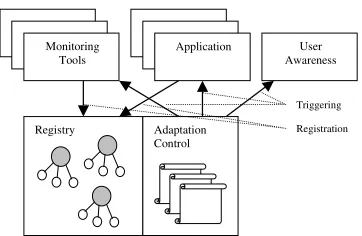
Application Monitoring
Tools
Registry Adaptation
Control
User Awareness
[image:5.612.79.260.69.187.2]Triggering Registration
Figure 2. The overall architecture
4. Architecture
4.1. Structure of the Platform
In order to realise the requirements described in the pre-vious section, we believe a platform should be developed in which adaptive mechanisms and policies are decoupled. In such a platform adaptive mechanisms can be exposed and externalised in order to enable control by independent enti-ties.
Figure 2 illustrates the design of our platform. The ar-chitecture is dependent on two key attributes, namely:
1. the provision of a meta-layer holding the representa-tion of the funcrepresenta-tionality offered by the applicarepresenta-tions.
2. the coordination of the behaviour of the applications according to the user defined policies.
More specifically, the operation of the platform is as fol-lows. The platform allows applications and tools that mon-itor changes in the systems’ environment to provide a de-scription of their functionality, including the kinds of infor-mation that they can offer and actions that they can perform. These descriptions are collated by the platform’s ‘registry’. The ‘adaptation control’ is responsible for making decisions about the appropriate adaptive actions that each application should take. This component is driven by the policies ex-ported by each application (defined by the application au-thor) and augmented or redefined by the systems’ user. The active participation of the user in the adaptation process is achieved by the ‘user awareness module’. This module notifies the user of the adaptive decisions being made by the platform, and allows the dynamic resolution of potential conflicts.
4.2. Application Registration
Adaptive applications must register with the platform when they start up. The registration includes an XML de-scription of the different adaptation modes implemented by
the application and the set of ‘state variables’ that can be ac-cessed by the platform in order to identify the internal state or attributes of the application.
The application developer must implement a set of adtation modes appropriate to the type of service that the ap-plication offers. This process is intrinsic to the implementa-tionof anyadaptive application, and must occur irrespective of the chosen support platform.
The first part of the application’s registration notifica-tion presents the platform with XML describing the name of each adaptation mode and the set of parameters that can be passed into and out of each method by the platform.
The second part of the registration identifies the state variables that affect the current state of the application. Each state variable has a name and a ‘basic type’ (e.g. in-teger, string, etc.) The application is required to generate events informing the platform when one or more of its state variables have changed. For variables that generate contin-uous values, the platform can specify activation thresholds on each event (based on the policy specification).
The last part of the application’s registration includes a set of default policy specifications. These policies are specified in accordance to the policy language described in section 4.4 and describe the default adaptive behaviour of the application as intended by the application developer. This behaviour however could be altered either by the ac-tive modification of the default policies or the introduction of new policies by the user.
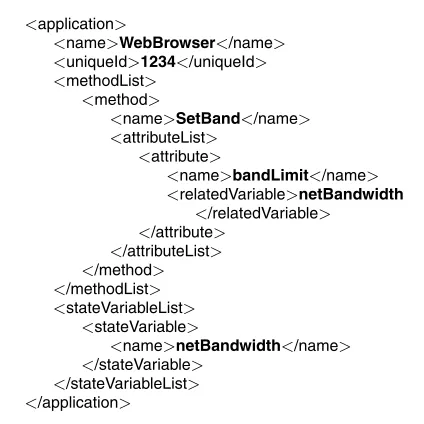
An example of a typical application registration can be seen in figure 3. The design of the registration information has been highly influenced by the UPnP protocol [3].
4.3. Registry
The registry component operates as the repository of all of the adaptive applications operating within the system, ag-gregating details of their adaptive mechanisms and current execution status.
As described in the previous section, during start-up each application establishes a communication channel with the platform registry and issues its XML description (a library for communicating with the platform is used to reduced the burden on the application developer). Using this informa-tion, the registry constructs a stub object to manage interac-tions with the associated adaptive application, tracking the state of the adaptation modes and state variables. When a change occurs, the stub can forward events to the adaptation controller in order to decide whether a specific adaptive re-action is required.
enti-<application>
<name>WebBrowser</name> <uniqueId>1234</uniqueId> <methodList>
<method>
<name>SetBand</name> <attributeList>
<attribute>
<name>bandLimit</name> <relatedVariable>netBandwidth
</relatedVariable> </attribute>
</attributeList> </method> </methodList> <stateVariableList>
<stateVariable>
<name>netBandwidth</name> </stateVariable>
[image:6.612.52.264.74.286.2]</stateVariableList> </application>
Figure 3. Sample XML description of an adap-tive web browser.
ties that behave as both adaptive modules and information providers allows more flexibility for the implementation of coordinated adaptations. The reason for this is two-fold:
1. In most cases a monitoring tool represents a specific hardware device within the system, such as a wireless network interface. This means that a monitoring tool could also provide adaptation mechanisms relating to the specific device, e.g. a tool that monitors the activity of the wireless network interface could also provide a mechanism for putting that device into a low power consumption mode.
2. Applications can be the source of information that can trigger adaptation. The fact that one application enters a specific state can be used as the trigger for the adap-tation of another application. A simple example might be when one application receives the user focus, this information can trigger other applications to reduce the use of resources because they are not as important for the user.
The second point also implies that the platform provides a mechanism for sharing of application context and state between applications on the system. This is clearly an im-portant mechanism for addressing the shortfall in system-wide knowledge identified in section 2 (and could be used to solve the auto-save scenario in particular).
eventlowBand :- NetworkInterface.availableBandwidth>19200 eventhighBand :- NetworkInterface.avilableBandwidth<=19200 fluentinLowBand{
initiates(lowBand) terminates(highBand) }
condition{
initiates(lowBand, inLowBand, t1)and not clipped(t1, inLowBand, t2)and t2 = t1 + 30
}
action{
[image:6.612.307.553.79.245.2]WebBrowser.LowBand() }
Figure 4. A sample policy rule.
4.4. Policies
A central concept within our architecture is the ability to specify policies using a policy description language. In order to satisfy the requirements specified in section 4.4 we have chosen to use an event-driven policy language derived from the event calculus logic programming formalism [15, 24].
The event calculus provides a framework in which it is possible to reason about the effects of events in an event-based system. More specifically, event calculus defines two distinct entities: events and fluents. An event is something that takes place at a specific point in time. A fluent can describe anything that has a time duration and can be de-scribed as a situation within the system that is initiated and terminated by an event. For example, a fluent could repsent the condition “Battery is low”, initiated by the event re-porting that the battery has dropped below a specific thresh-old and terminated by an event reporting that the battery level is above that threshold (e.g. during charging). The event calculus allows the specification of propositions us-ing a set of predicates defined as follows:
• Initiates(e, f, t): eventeinitiates fluentfat timet.
• Terminates(e, f, t): eventeterminatesf at timet.
• Happens(e, t): eventetakes place at timet.
• Holdsat(f, t): fluentf holds at timet.
• Clipped(t1, f, t2) : fluentf is terminated some time
betweent1andt2.
• Declipped(t1, f, t2): fluent f is initiated some time
betweent1andt2.
• Logical expressions of the formt1ϑt2wheret1andt2
are time points or expressions of the same type andϑis
Based on this framework we have defined an event calcu-lus derived policy language [8]. The policy language allows specification of rules of the form:
event definition1... event definitionn fluent definitions1... fluent definitionm
condition{condition body} action{action1... actionk }
An event definition describes when a specific event is considered to have taken place. Each policy defined event is specified in accordance to the values of the application state variables known within the system. Each event is assigned a logical expression in terms of the values of application state variables. The event is considered to take place at the instant that this logical expression transits from false to true.
In figure 4, the eventlowband takes place at the time the
available bandwidth of the network interface drops below 19.2Kbps.
The definition of a fluent provides a list of all the events that can initiate and terminate it. This definition is used by the evaluation mechanism implemented in the adapta-tion control module to derive the actual value for a fluent (whether it holds or does not hold at any given time).
The condition body is a logical expression that is con-structed using the event calculus predicates. By combining the predicates we have described, a condition rule can spec-ify when specific events take place and reason about the du-ration of the conditions identified by fluents. For example
in 4, the condition is true only when the fluentinLowBand
has been initiated and not been terminated (i.e. holds) for 30 seconds. Thus, the rule evaluates to true if the available bandwidth has dropped below the low bandwidth threshold and remained there for 30 seconds.
The action body is a list of adaptive method calls that should be made when the condition body evaluates to true.
4.5. Adaptation Control
As introduced in section 4.1, the adaptation controller is responsible for monitoring the state of the whole system and making decisions about which applications are required to adapt in order to overcome a problem or to achieve a designated goal.
The functionality of the adaptation control is driven by policies defined by the user and the default policies exported by the applications. The module evaluates the policy rules and triggers the appropriate application adaptation mecha-nisms. The evaluation of policy rules is performed incre-mentally as the values of the applications’ state variables change. Whenever a state variable takes a value that corre-sponds to the occurrence of a policy event, the appropriate predicates are evaluated and the relating fluents take their
values (either holding or not holding). This process con-tinues until all predicates within the rules body have been evaluated and the whole condition evaluated to true. At this point the adaptation control triggers the appropriate appli-cation methods as defined by the policy rules.
The fact that default adaptation policies exist outside the adaptive applications allows for their dynamic modification by the user. For example, a policy rule defining how a network application should respond to changes in network quality can be modified in order to take into consideration the conditions of other applications or triggers within the system.
An issue that requires further investigation is to what ex-tent the system can automate policy modification in order to overcome conflicting conditions or the introduction of new policies. More details about the policy language specifica-tion and evaluaspecifica-tion can be found at [8].
4.6. User Awareness Support
The user awareness module is implemented as a separate application that registers with the platform. The adaptation controller uses this tool in order to notify the user of adap-tation decisions or to request assistance when conflicting situations are detected.
The fact that the user awareness module operates as stand-alone application allows the user to define the oper-ations of the user awareness tool as part of a policy action. In the policy, the user has complete control over the type of message that will be presented by the awareness module and at what level of intrusion. Currently the level of intru-sion can be set at:
• Low intrusion: animating an icon on the system tray,
not actually giving information about the specific ac-tion, but letting the user know that an action has taken place.
• Medium intrusion: showing a balloon notification on
the system tray informing the user about the action that has been taken.
• High intrusion: presenting a popup window with
infor-mation about the adaptation action.
As the user awareness module is just application soft-ware an advanced user could write their own asoft-wareness sys-tem that is more closely integrated with their needs or work-ing practices. For example, to use less intrusive interaction mechanisms, such as audio [20].
5. Prototype
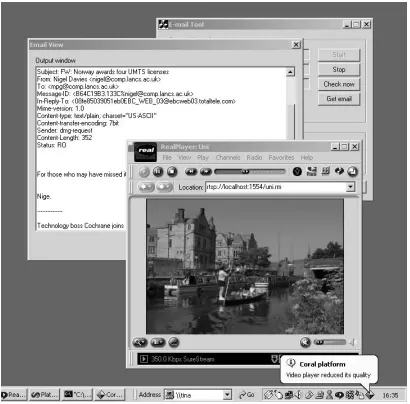
Figure 5. The platform in action.
in Microsoft Visual C++ and provides a full implementation of the registry and partial implementation of the adaptation control module. Currently the policy evaluation mechanism is capable of accepting policies specified according to the event calculus policy language presented in section 4.4. The evaluator is not yet capable of reconciling conflicts between the policies. Early indications are that the platform does al-low us to achieve system-wide coordinated action and may provide the necessary underpinnings for identification of potential conflicts between adaptive applications. This is the key area of our future work.
In addition to the prototype platform, we have imple-mented a small set of adaptive applications that comply with our architecture in order to perform some experiments. In more detail:
• An adaptive video streaming tool has been developed
based on the RealPlayer video client. This application allows the platform to request specific streaming adap-tations including switching between different quality streams or the bit-rate that it is delivered.
• We have developed an adaptive e-mail client. This
client provides status information about all its activ-ities (polling the pop server for new e-mails, down-loading e-mails, showing e-mails, etc.). These activ-ities can become triggers for adaptation of other ap-plications in the system, or can be coordinated by the platform according to the user policies.
• An adaptive web browser has been developed that can
perform simple network adaptations. More specifi-cally, the web browser utilises an intermediate proxy in order to perform network specific adaptation, e.g.
it can filter images from web pages in order to speed up the download of web pages and it can control the transfer rate of data over the network.
In order to be able to monitor the system resources two monitoring tools have been developed:
• A network monitor that can check the available
band-width of the system’s connection.
• A power monitor that reports the percentage of the
bat-tery power remaining.
A snapshot of the operation of the prototype is shown in figure 5. This figure illustrates the video player being trig-gered to reduce the use of bandwidth in order to allow the e-mail client to download a large e-mail within the timeli-ness requirements specified by the user.
6. Influential Work
In this section we briefly discuss related systems that have been directly influential on our work. ISIS/META [19] provides an infrastructure for reactive management of distributed systems. It introduces the concepts of sensors and actuators that provide information about the operation of applications and allow control by external entities. The functionality of these elements can by viewed as similar to the state variables and adaptation methods defined by our platform. The fact, however, that the META system targets the domain of reactive control imposes certain burdens in its applicability for coordinated adaptation of mobile applica-tions. In particular the NPL language used by META for the specification of guarding commands is quite limiting since it does not allow the specification of time dependencies be-tween events received by multiple applications.
The Puppeteer system supports the introduction of non-mobile aware applications into a non-mobile system. Puppeteer follows a similar approach to ours with externalisation of application mechanisms through XML descriptions. How-ever, Puppeteer does not currently provide mechanisms for dealing with the issues of coordinated adaptation and flict resolution of multiple adaptive applications; a key con-tribution of our platform.
In terms of policy systems, the event calculus policy
lan-guage follows a common approach to thePDL language
[17] used for policy based network management.PDL
fol-lows the same model of event-condition-action rules as the
event calculus policy language. PDLhowever does not
vocabulary for the definition of policy rules, which is im-portant in order promote user involvement in policy defini-tion. There are clearly other calculi with sufficient support for temporal relations (such as the Situation Calculus [23]) that may be candidates for the specification of similar policy rules as ours.
7. Conclusions
In this paper we have argued that flexible architecture supporting system-wide coordinated adaptation is required to appropriately support context-aware adaptive applica-tions. We have identified the shortcomings of current ap-proaches and have presented our own architecture that we believe meets the following set of requirements:
1. mechanisms to support coordination between multiple adaptive applications.
2. mechanisms to support the control of an application’s adaptation.
3. support for user defined adaptation policies.
4. support for a common contextual space capable of re-trieving, maintaining and sharing contextual informa-tion.
One of our goals for the future is to provide support for distributed adaptation coordination across and between communicating hosts. Such an approach would allow end-to-end policy negotiation for the adaptation of network ap-plications. Another trend in our research is to enhance the user involvement in the adaptation process with different in-teraction methods and measure the effect of user awareness in the behaviour of adaptive systems.
References
[1] K. Cheverst, N. Davies, K. Mitchell, and A. Friday. Expe-riences of developing and deploying a context-aware tourist guide: The GUIDE. InProceedings of the 6th ACM
In-ternational Conference on Mobile Computing (MOBICOM) 2000, Boston, 2000. ACM Press.
[2] K. Cheverst, K. Mitchell, and N. Davies. Design of an object model for a context sensitive tourist GUIDE.Computers and Graphics, 23(6):883–891, Dec. 1999.
[3] M. Corporation. Universal plug and play device architecture, version 1.0, June 2000. http://www.upnp.org/.
[4] N. Davies, S. Wade, A. Friday, and G. Blair. L2imbo: a tuple space based platform for adaptive mobile applications.ACM Mobile Networks and Applications (MONET): Special Issue on Protocols and Software Paradigms of Mobile Networks, 3(2):143–156, 1998.
[5] E. de Lara, D. S. Wallach, and W. Zwaenepoel. Puppeteer: Component-based adaptation for mobile computing. In Pro-ceedings of the 3rd USENIX Symbosium on Internet Tech-nologies and Systems, San Francisco, California, March 2001.
[6] C. Efstratiou, K. Cheverst, N. Davies, and A. Friday. Archi-tectural requirements for the effective support of adaptive mobile applications. Work in progress paper presented in Middleware2000, (USA:New Yort), April 2000.
[7] C. Efstratiou, K. Cheverst, N. Davies, and A. Friday. An architecture for the support of adaptive context-aware ap-plications. In Proceedings of Mobile Data Management (MDM‘01), Hong Kong, January 2001.
[8] C. Efstratiou, A. Friday, N. Davies, and K. Cheverst. Utilis-ing the event calculus for policy driven adaptation on mobile systems. InProceedings of the 3rdInternational Workshop on Policies for Distributed Systems and Networks (POLICY 2002), Monterey, California, June 2002.
[9] J. Flinn and M. Satyanarayanan. Powerscope: A tool for profiling the energy usage of mobile applications. In Pro-ceedings of the Second IEEE Workshop on Mobile Comput-ing Systems and Applications, 1999.
[10] A. Friday, N. Davies, G. Blair, and K. Cheverst. Develop-ing adaptive applications: The MOST experience. Journal of Integrated Computer-Aided Engineering, 6(2):143–157, 1996.
[11] J. M. III.Cognitive Radio: An Integrated Agent Architecture for Software Defined Radio. PhD thesis, Royal Institute of Technology, Sweden, May 2000.
[12] Intel/Microsoft/Toshiba. Advanced configuration and power interface specification, revision 1.0, 1999.
[13] A. Joseph, J. Tauber, and F. Kaashoek. Mobile computing with the Rover toolkit. IEEE Transactions on Computers: Special issue on Mobile Computing, 43(3), 1997.
[14] R. Katz. Adaptation and mobility in wireless information systems.IEEE Personal Communications, 1(1):6–17, 1994. [15] R. Kowalsky. Database updates in event calculus. Journal
of Logic Programming, 12:121–146, 1992.
[16] R. Kravets and P. Krishnan. Application-driven power man-agement for mobile communications. InProceedings of the 4th ACM International Conference on Mobile Computing and Networking (MOBICOM ’‘98), 1998.
[17] J. Lobo, R. Bhatia, and S. Naqvi. A policy description lan-guage. InProceedings of AAAI, Orlando, FL, July 1999. [18] S. Long, R. Kooper, G. Abowd, and C. Atkenson. Rapid
prototyping of mobile context-aware applications: The Cy-berguide case study. InProceedings of the 2nd ACM In-ternational Conference on Mobile Computing (MOBICOM), 1996.
[19] K. Marzullo, R. Cooper, M. Wood, and K. Birman. Tools for distributed application management. IEEE Computer, 24(8), 1991.
[20] E. D. Mynatt, M. Back, R. Want, M. Baer, and J. B. El-lis. Designing audio aura. InProceedings of CHI’98, pages 566–573, Los Angeless, CA, April 1998.
[22] J. Pascoe. The Stick-e note architecture: Extending the in-terface beyond the user. InProceedings of the 1997 Interna-tional Conference on Intelligent User Interfaces, Short Pa-pers, pages 261–264, 1997.
[23] J. Pinto and R. Reiter. Temporal reasoning in logic program-ming: A case for the situation calculus. InProceedings of the International Conference on Logic Programming, pages 203–221, 1993.
[24] M. Shanahan. The event calculus explained. In M. J. Wooldridge and M. Veloso, editors,Articial Intelligence To-day, Vol. 1600 of LNCS, pages 409–430. Springer, 1999. [25] D. Terry, M. Theimer, K. Petersen, and A. J. Demers.