Single and Multi Frame Image Super-Resolution and its
Performance Analysis: A Comprehensive Survey
P B Chopade
PhD Research Scholar Sinhgad College of EngineeringPune-411041, India
P M Patil
Joint Director KJ’s EducationalInstitutePune-411048, India
ABSTRACT
Super-resolution is the process of combining one or more low –resolution images to obtain a high –resolution image. It has been a very interesting topic for the research over the last few years. It is used for practical applications in more realistic problems faced in different areas, which range over satellite and aerial imaging of biomedical image processing as well as in daily routine life like different biometrics in offices and industries. In this survey article, more focus is given on basic algorithms and their classification based methodology used to implement it. Due to its vast scope of applications researchers are developing a novel suerresolution algorithm for a specific intention based on single and multiframe image resolution. The proposed comprehensive survey gives an overview of most of published works based on its performance analysis. In this survey, the basic concepts of the algorithms are explained and then their performance analyses through which each of these methods have developed are mentioned in detail. Furthermore, different issues in superresolution algorithms for single and multiframesuch as models and registration algorithms, optimization of the deployment of methods, improvement in quality of image .
Keywords
Single and multi frame superresolution, Image registration, wavelet transform, Assessment of SR algorithms.
1.
INTRODUCTION
Super-resolution (SR) is a process of combining one or more low resolution images to obtain high resolution image. It has been used in for many various applications such as Satellite and Aerial imaging, Medical image processing, automated mosaicking, sign and number plate recognition and ultrasound imaging.
Super-resolution is an algorithm that provides details finer than a sampling grid of a given imaging device by increasing the number of pixels per unit area in an image. We need to understand about the hardware limitationof increasing the number of pixels per unit area. Resolution can be increased in hardware approach by i) decreasing the pixel size and ii) increasing the sensor size. This hardware approacheshave limitation like decreasing pixel size, will increase shot noise and increasing the sensor size will increase the capacitance of the system. The hardware approach is highly costly for large scale imaging. Therefore, algorithm-based approaches are preferred to the hardware based approach
Classification of super-resolution is based on differentparameters.These parameters include domain deployed,the number of low resolution images involved and
input. The single frame based algorithms mostly applied some learning methods and hallucinate the missing data of the high-resolution images establishing relationship between low resolution and high resolution images from a standard database. In multi frame based super-resolution algorithms,we establish relation between targeted high resolution image and the low resolution images having some relative geometric or photometric motions from the targeted high resolution image. These algorithms used the differences between the low resolution images and hence are referred to as reconstruction based super-resolution algorithms. Before going into the details of the SR algorithms, the most common imaging modes are described in the next section.
2.
IMAGING MODELS
The imaging model of reconstruction based super-resolution algorithms gives a procedure by which the observed images have been obtained. In easiest way, this process can be modelled as
g(m,n)=1/𝑞2 f x, y ---( 1) q+1 n−1
y=qn q+1 m−1
x=qm
Where g is a low resolution image, f is a high resolution image, q is decimation factor. The imaging model in Eq, (1) states that the low resolution image has been obtained by averaging the high resolution pixel values over neighborhood of 𝑞2pixels. This model is very basic and is very easy to understand, but realistic model can be obtained by adding different parameters like blurring, warping and noise. Adding these parametersin Eq(1),results as
g(m,n)=d(h(w(f(x,y))))+ὴ(m,n) ---(2)
Where w is a warping function,h is a blurring function ,d is decimation operator and ὴ is an additive noise.
If the number of low resolution images is more than one,the imaging model of Eq.(2) becomes:
𝑔𝑘(m,n)=d(𝑘(𝑤𝑘(f(x,y))))+ὴ(m,n) ---(3)
Imaging model consist of:
Wraping:It stands for any transformations between observed low resolution image and original high resolution image.
Blurring: The blurring function models any blurring effect that is imposed on the LR observed image, for example by the optical system or by atmospheric effects
Sampling: It provides down or up sampling of image.
3.
FREQUENCY DOMAIN
Algorithms from this domain can be further classified as into two groups: Fourier-Transform based and Wavelet-Transform based methods, which are briefed in the following subsections.
3.1
Fourier Transform
Gerchberg [1] (1974) and then Santis and Gori [2] introducedthefirst SR algorithms. They had used iterative methods in the frequency domain, based on the Fourier transform [3], which could extend the spectrum of a given signal beyond its diffraction limit and therefore increase its resolution. Tsai and Huang's system [4] (1984) was the first multiple-image SR algorithm in the frequency domain. In thesealgorithms, different translated (shifted) images, gk of same area are used of continuous scene, f. Here we can defined gk(m,n)=f(x,y),where x=m+ ⩟mkand y=n+⩟nk.These shifts or translations between the low resolution images are considered by shifting property of the Fourier transform:
𝐹𝑔𝑘 m, n = ej2pi ⩟mkm+⩟nkn 𝐹𝑓 m, n − − − − − − 5
Where Fgkand 𝐹𝑓 are the Fourier transforms of the kth low resolution image and the high resolution scene respectively.
Low resolution images are the discrete version of continuous scene. Therefore
𝑔𝑘 𝑚, 𝑛 = 𝑓 𝑚𝑇𝑚 + 𝑚𝑘, 𝑛𝑇𝑛 + 𝑛𝐾 − − − − − − 6
Where Tm and Tn are the sampling periods of low resolution image along columns and rows. If we Fourier transform of the above equation, we will get a discrete Fourier Transform Gk, and its continuous Fourier transform, Fgk are related such as
𝐺𝑘 𝑚, 𝑛 =
1
𝑇𝑚𝑇𝑛 𝐹𝑔𝑘
∞
𝑝2=−∞ ∞
𝑝1=−∞
𝑚
𝑀𝑇𝑚+
𝑝1 𝑇𝑚,
𝑛 𝑁𝑇𝑛
+𝑝2
𝑇𝑛 − − − − 7
Where M and N are the maximum values of the dimensions of low resolution images m,n, respectively. Combining eq(5)into eq(7) and writing the results in matrix forms, gives us
𝐺 = ∅𝐹𝑓− − − − − 8
in which ∅ relates the discrete Fourier transform of the LR images G to the continuous Fourier transform of the HR scene𝐹𝑓. SR here is therefore reduced to finding Ffin Eq. (8) which is usually solved by a Least Squares (LS) algorithm.
3.2
Wavelet Transform
The wavelet transform as an alternative for the Fourier transform has been widely used in frequency-domain based superresolution algorithms. Wavelet Transform is used to decompose the input image into structurally correlated sub-images. This gives us the self-similarities between local neighboring regions [5], [6]. For example, in [6] the input image is first decomposed into subbands. Then, the input image and the high-frequency subbands are both interpolated. The results of a Stationary Wavelet Transform of the high-frequency subbands are used to improve the interpolated subbands. Then, the super-resolved image is generated by combining all of these subbands using an inverse Discrete Wavelet Transform (DWT). Similar methods based on the
DWT have been developed for SR in [7] , [8], [9], [10], [11]. In [12], [13], [14], [15] the results obtained by DWT are used as a regularization term in Maximum a Posteriori (MAP) formulation of the problem. In [16], [17] they have been used with Compressive Sensing (CS) methods and in [18] within a PCA-based face hallucination algorithm. Wavelet based methods may have difficulties in efficient implementation of degraded convolution filters, while they can be done efficiently using the Fourier transform. Therefore, these two transforms have sometimes been combined together into the Fourier-Wavelet Regularized Deconvolution [19]. In addition to the above mentioned methods in the frequency domain, some other SR algorithms of this domain have borrowed the methods that have been usually used in the spatial domain; among them are: [20], [21], [22] which have used a Maximum Likelihood (ML) method , [23], [24] which have used a regularized ML method, [25], [26] which have used a MAP method , and [27], [28] which have implemented a Projection Onto Convex Set (POCS) method.
Chopade and Patil[29] have proposed a wavelet baesd super resolution technique which is discussed here in brief. Existing algorithms of super resolution is depends on the interpolation techniques. The interpolation technique has its own limitation that it generate image contained blurred effect in the edges. To preserve edges of image multi resolution analysis (MRA) is useful technique.In discrete wavelet transform (DWT), MRA technique used properly.The power of DWT is to give good time resolution for high frequencies and good frequency resolution for low frequencies. But in DWT, down sampling is present due to which the information loss in the respective sub-bands is bound to happen. Hence, in order to mitigate this effect, the three detail sub-bands without down-sampling factor (called as stationary wavelet transform) has been introduced in the interpolated detail sub-bands to obtain super-resolved image [30]. However, such type of wavelet based super-resolution algorithm introduced the spatial domain noise. This type of noise can be reduced with the help of wavelet-coefficient based thresholding technique. Thus, Chappalli and Bose [31] investigated the effect of soft-thresholding level on the reconstructed image quality by the use of existing wavelet based on the two-step lifting step. However, these algorithms required the irrational coefficients based wavelet filters that lead to increase the hardware computational complexity. In order to reduce this issue, a wavelet filter based on dyadic-integer coefficient is proposed to reduce the hardware complexity in the field of super-resolution.
First, the two low-resolution images I1 and I2 are obtained
4.
SPATIAL DOMAIN
Depending on the number of available low resolution images, superresolution algorithms can be classified into two groups: single image based and multiple image based algorithms. The algorithms included in these groups are explained in the following subsections.
4.1
Multiple Image based SR Algorithms
Multiple image (or classical) SR algorithms are mostly reconstruction-based algorithms, i.e., they try to figure out the aliasing artifacts that is present in the observed low resolution images due to under-sampling process. A few algorithms are studied in the following subsections.Following are the few algorithms based on multiple image based super resolution algorithms.
Iterative Back Projection Iterative Adaptive Filtering
Directs Methods
Projection onto Convex Sets
Maximum Likelihood Maximum A Posteriori
4.2
Iterative Back Projection
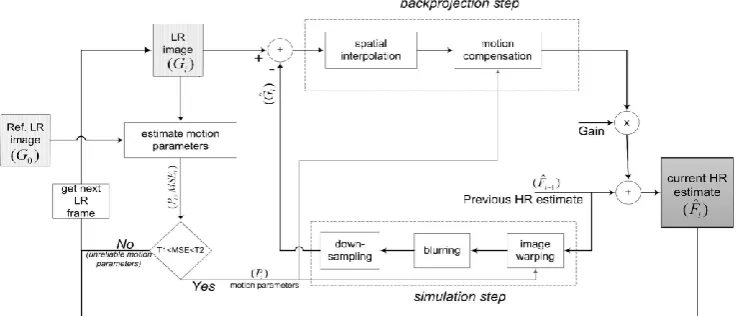
Iterative Back Projection (IBP) methods were among the first methods developed for spatial-based super resolution. We defined the imaging model given in Eq. (3). In iterative back projection, we try to minimize degradation factor d. To do so, usually an initial guess for the HR targeted image is generated and then it is refined. Such a guess can be obtained by registering the LR images over an HR grid and then averaging them [32], [33], [34], [35]. To refine this initial guess f, the imaging model given in Eq. (3) is used to simulate the set of the available LR observations, gk.where.k = 1:k. The error between the simulated LR images and the observed ones, which is computed by
1/𝑘 (𝑔𝑘 − 𝑔𝑘 𝑡 )^2 𝑘
𝑘=1
(Here t is thenumber of iterations)and then these error is back-projected tothe coordinates of the HR image to improve the initialguess [36]. This process is either repeated for a specific number of iterations or until no further improvement can be achieved in high resolution image. To do so, usually the followingRichardson iteration is used in this group of algorithms:
𝑓(𝑡+1)=𝑓 𝑡 𝑥, 𝑦 + 1/𝑘 𝑤
𝑘−1 𝑔𝑘 − 𝑔𝑘 𝑡 𝑑 ∗ 𝑘
𝑘=1
In which t is an iteration parameter,𝑤𝑘−1 is the inverse of the warping kernel,d is decimation operator,h is a debluring kernel. The block diagram of example algorithm based on iterative back projection is given in fig.2.
4.3
Maximum Likelihood
If we consideredthe noise term in the imaging model given in Eq. (5) is a Gaussian noise with zero mean and variance 𝜎 as well as if estimation of the super-resolved image is given as𝑓 , the total probability of an low resolution image gkis
𝑃(𝑔𝑘 ⋮ 𝑓) = ∀𝑚 ,𝑛1/2√𝜋exp(-(𝑔𝑘 − 𝑔𝑘)^2/2𝜎^2)
Maximum likelihood concepts used to get high resolution image from low resolution images, But it is sensitiveto small disturbances, such as noise or errors in the estimation of the imaging parameters. It is also gives distorted result ifthe number of LR images is less than the square of theimprovement factor. This meansthat there might not be a unique solution. To deal with these problems, there is needof some additional informationto constrain the solution. Such information canbe collected from a priori knowledge of desired image. The apriori term can prefer a specific solution over other solutionswhen the solution is not unique. The involvementof that a priori knowledge can convert the ML problemto a MAP problem.If the number of LR images over-determines thesuper-resolved images, the results of ML and MAP arethe same and since the computation of ML is easier, it ispreferred over MAP. However, if the number of the LRimages is insufficient for the determination of the super-resolvedimage, the involvement of a priori knowledgeplays an important role and MAP outperforms ML [42]
5.
SINGLE IMAGE BASED SR
ALGORITHS
In the process of sub-sampling or decimation of an image, the high frequency information may gets lost. In ML and MAP algorithms the generic smoothness priors can regularize the solution but cannot help recover the lost frequencies, especially for high improvement factors [43]. In single image based super resolution algorithms, these generic priors are replaced by more meaningful and class wise priors like. This is because images from the same class have similar statistics and the accuracy of multiple-image based SR algorithms is highly dependent on the estimation accuracy of the motions between the LR observations, which gets more unstable in real world applications where different objects in the same scene can have different and complex motions. In situations like these, single image based SR algorithms may work better [44]. There algorithms are either reconstruction based (similar to multiple image based algorithms) or learning based. These are described in the following two subsections.
Learning based Single Image super resolution Algorithms
Reconstruction based Single Image SR algorithms
5.1
Learning based Single Image SR
Algorithms
6.
ASSESSMENT OF SR ALGORITHMS
For the assessment of the results of super resolution algorithms both subjective and objective methods have been used. In the subjective method, usually human observers assess the quality of the produced image. In few articles the results of the SR algorithms are presented in the form of Mean Opinion Scores (MOP) and Variance Opinion Score (VOP) [47]. In objective methods, the results of SR algorithms are usually compared against the ground truth using measures like MSE and (Peak) Signal to Noise Ratio (PSNR).MSE isdefine as:
1 0 1 0 2 1 0 1 0 2))
,
(
(
))
,
(
)
,
(
ˆ
((
N k M K N k M Ky
x
f
y
x
f
y
x
f
MSE
The value of MSE is smaller, the closer the result is to theground truth.
PSNR is defined:
RMSE
PSNR
20
log
10255
where RMSE is the square root of the MSE .Though these two measures have been very often used by SR researchers, they do not represent the Human Visual System sass(HSV) very well [48]. Therefore, other measures, such as the Correlation Coefficient (CC) and Structural Similarity measure (SSIM) have also been involved in SR algorithms [49], [50]. CC is defined by:
1 0 1 0 1 0 1 0 1 0 1 02
1
2
1
N k M K N k M K N k M Kd
d
d
d
CC
Where, fy
x
f
d
1
(
,
)
&f
y
x
f
d
2
ˆ
(
,
)
ˆf
andfˆ
are the mean of f andf
ˆ
, respectively. The maximum value of CC is one which means a perfect match between the reconstructed image and the ground truth. The other measure, SSIM, is defined by:) )( ( ) 2 )( 2 ( 2 2 ˆ 2 1 2 ˆ 2 2 ˆ 1 ˆ C C C C SSIM f f f f f f f f
where C1 and C2 are constants,
f andf
ˆ
are thestandard deviations of the associated images, and
f fˆ
is defined by:
1 0 1 0 2 1 ˆ1
1
N k M k ff
d
d
N
M
To use SSIM, the image is usually first divided into sub-images, and then Eq. (67) is applied to every subimage and the mean of all the values is used as the actual measure between the super-resolved image and the ground truth. A mean value of SSIM close to unity means a perfect match between the two images. It is discussed in that SSIM favors blur over texture misalignment, and therefore may favor algorithms which do not provide enough texture details. Beside these assessment measures, some authors have shown that feeding some real world applications by images that are produced by some SR algorithms improves the performance of those applications to some degree.
7.
CONCLUSION
This survey paper reviews most of the papers published on the topic of super-resolution and proposes a broad classification for these works. Besides giving the details of most of the methods, we mention the basic ideas of the methods when they've been available in the reviewed papers. Furthermore, it highlights the most common ways for dealing with problems like the number of LR images, the assessment of the algorithms developed. Comparing the frequency domain methods against the spatial domain methods, the former are more interesting from the theoretical point of view but have many problems when applied to real world scenarios, e.g., they mostly have problems in the proper modeling of the motion in real world applications. Spatial domain methods have better evolved for coping with such problems.
Among these methods, the single-image based methods are more application-dependent while the multiple image based methods have been applied to more general applications. The multiple-image based methods are generally composed of two different steps: motion estimation, then fusion. These had and still have limited success because of their lack of robustness to motion error. This survey papers definitely will helpful to beginners who are interested to research in super resolution domain.
8.
ACKNOWLEDGMENTS
[image:4.595.63.493.625.736.2]The author P B Chopade is working as an Assistant Professor at MES’s College of Engineering, Pune, India. Also we would like to thank the institute.
Figure 2: Block diagram of an example algorithm based on iterative back-projection
9.
REFERENCES
[1] R.W. Gerchberg, "Super-resolution through error energy reduction," Journal of Modern Optics, vol. 21, no. 9, pp.709-720, 1974.
[2] P. D. Santis and F. Gori, "On an iterative method for super-resolution," Journal of Modern Optics, vol. 22, no.8, pp. 691-695, 1975.
[3] F. Champagnat and G.L. Besnerais, "A Fourier inter-pretation of super-resolution techniques," Proceedingsof IEEE International Conference on Image Processing, vol.1, pp. 865-868, Italy, 2005.
[4] R. Tsai and T. Huang, "Multiframe image restoration and registration," In R. Y. Tsai and T. S. Huang, editors,Advances in Computer Vision and Image Processing, vol. 1, pp. 317-339, JAI Press Inc., 1984.
[5] V.H. Patil, D.S. Bormane, V.S. Pawar, "Super-resolution using neural network," Proceedings of IEEE2nd Asia International Conference on Modeling and Sim-ulation, Malaysia, 2008
[6] H. Demirel and G. Anbarjafari, "Image resolution en- hancement by using discrete and stationary wavelet de-composition," IEEE Transactions on Image Processing vol. 20, no. 5, pp. 1458-1460, 2011.
[7] S. Zhao, H. Han, and S. Peng, "Wavelet-domain HMT- based image super-resolution," Proceedings of IEEE In-ternational Conference on Image Processing, vol.2, pp.953-656, Spain, 2003.
[8] N.K. Bose, S. Lertrattanapanich, and M.B. Chappali "Super-resolution with second generation wavelets," Sig-nal Processing Image Communication, vol. 19, pp. 387-391, 2004.
[9] M. Chappalli and N. Bose, "Simultaneous noise _ltering and super-resolution with second-generation wavelets,"Signal Processing Letters, vol. 12, pp. 772-775, 2005.
[10]H.E. Sankaran, A. Gotchev, and K. Egiazarian, "Ef-_cient super-resolution reconstruction for translationalmotion using a near least squares resampling method,"Proceedings of IEEE International Conference on ImageProcessing, pp. 1745-1748, USA, 2006.
[11]M. Iiyama, K. Kakusho, and M. Minoh, "Super-resolution texture mapping from multiple view im-ages," Proceedings
[12]C.V. Jiji, M.V. Joshi, and S. Chaudhuri, "Single-frame image super-resolution using learned wavelet coef-_cients," International Journal of Imaging Systems and Technology, vol. 14, no. 3, pp. 105-112, 2004.
[13]S. Lui, J. Wu, H. Mao, and J. J. Lien, "Learning-based super-resolution system using single facial imageand multi-resolution wavelet synthesis," Proceedings of Asian Conference on Computer Vision, vol. 4884, pp. 96-105, Japan, 2007.
[14]F. Li, X. Jia, and D. Fraser, "Universal HMT basedsuper resolution for remote sensing images," Proceedingsof IEEE International Conference on Image Processing, pp. 333-336, USA, 2008.
[15]H. Ji and C. Fermuller, "Robust wavelet-based super-resolution reconstruction: theory and algorithm," IEEETransactions on Pattern Analysis and Machine Intelli-gence, vol. 31, no. 4, pp. 649-660, 2009.
[16]N. Fan, "Super-resolution using regularized orthogonal matching Pursuit based on compressed sensing theory inthe wavelet domain," Proceedings of International Con- ference on Computer Graphics, Imaging and Visualiza-tion, pp.349-354, China, 2009.
[17]P. Sen, S. Darabi, "Compressive image super- resolution," Proceedings of 43rd IEEE Asilomar Confer-ence on Signals, Systems and Computers, pp. 1235-1242, USA, 2009.
[18]H. Shen, S. Li, "Hallucinating faces by interpolation and principal component analysis," Proceedings of Inter-national Symposium on Computational Intelligence and Design, pp. 295-298, China, 2009.
[19]N. Fan, "Super-resolution using regularized orthogonal matching Pursuit based on compressed sensing theory inthe wavelet domain," Proceedings of International Con- ference on Computer Graphics, Imaging and Visualization, pp.349-354, China, 2009.
[20]J. Abad, M. Vega, R. Molina, and A.K. Katsaggelos, "Parameter estimation in super-resolution image recon-struction problems," IEEE International Conference on Acoustic, Speech and Signal Processing, vol. 3, pp. 709-
[22]P. Vandewalle, L. Sbaiz, J. Vandewalle, and M. Vetterli, "Super-resolution from unregistered and totally aliasedsignals using subspace methods," IEEE Transactions on Image Processing, vol. 55, no. 7, pp. 3687-373, 2007.
[23]G. Zweig, "Super-resolution Fourier transform by op-timization, and ISAR imaging," IEE Proceedings onRadar, Sonar and Navigation pp. 247-252, 2003.
[24]F. Champagnat and G.L. Besnerais, "A Fourier inter-pretation of super-resolution techniques," Proceedingsof IEEE International Conference on Image Processing,vol.1, pp. 865-868, Italy, 2005.
[25]M.K. Ng and A.C. Yau, "Super-resolution image restoration from blurred low-resolution images," Journalof Mathematical Imaging and Vision, vol. 23, no. 3, pp 367-378, 2005.
[26]N.K. Bose, M.K. Ng, and A.C. Yau, "A fast algorithm for image super-resolution from blurred observations,"EURASIP Journal on Advances in Signal Processing, 14 pages, Article ID 35726, 2006.
[27]P. Vandewalle, S. E. Susstrunk, and M. Vetterli, "Super-resolution images reconstructed from aliased images,"Proceedings of SPIE Conference on Visual Communi- cations and Image Processing, vol. 5150, pp. 1398-1405,Switzerland, 2003.
[28]T. Akgun, Y. Altunbasak, and R. M. Mersereau,"Super-resolution reconstruction of hyperspectralim-ages," IEEE Transactions on Image Processing, vol. 14,pp. 1860-1875, 2005.
[29]P B Chopade and P M Patil,”Design of dydic-integer coefficient based bi-orthogonal wavelet filters for image super-resolution using image sub-pixel image”ICTACTJournals,vol. 04,Issue 04,May 2014.
[30]H. Demirel and G. Anbarjafari, "Image resolution en- hancement by using discrete and stationary wavelet de-composition," IEEE Transactions on Image Processing vol. 20, no. 5, pp. 1458-1460, 2011.
[31]M. Chappalli and N. Bose, "Simultaneous noise _ltering and super-resolution with second-generation wavelets,"Signal Processing Letters, vol. 12, pp. 772-775, 2005.
[32]M. Irani and S. Peleg, "Super-resolution from image se- quences," Proceedings of IEEE International Conferenceon Pattern Recognition, pp. 115-120, USA, 1990.
[33]M. Irani and S. Peleg, "Improving Resolution by Image Registration," CVGIP: Graphical Models and Image Pro-cessing, vol. 53, pp. 231-239, 1991.
[34]M. Irani and S. Peleg, "Image sequence enhancement using multiple motions analysis," Proceedings of Inter-national Conference on Computer Vision and Pattern Recognition, pp. 216-222, 1992.
[35]M. Irani and S. Peleg, "Motion analysis for image enhancement: resolution, occlusion, and transparency,"Journal of Visual Communication and Image Represen- tation, vol. 4, pp. 324-335, 1993.
[36]P. Cheeseman, B. Kanefsky, R. Kraft, and J. Stutz, "Super-resolved surface econstruction from multiple im-ages," Technical Report FIA9412, NASA, 1994.
[37]D. Capel and A. Zisserman, "Automated mosaicing with super-resolution zoom," Proceedings of the InternationalConference on Computer Vision and Pattern Recogni-tion, pp. 885-891, 1998.
[38]M. Elad and Y. Hel-Or, "A fast super-resolution recon- struction algorithm for pure translational motion andcommon space-invariant blur," IEEE Transactions on Image Processing, vol. 10, no. 8, pp. 1187-1193, 2001.
[39]S. Farsiu, D. Robinson, M. Elad, P. Milanfar. 2004, "Fast and robust multi-frame super-resolution," IEEETransactions on Image Processing, vol. 13, no. 10, pp. 1327-1344, 2004.
[40]L.C. Pickup, D.P. Capel, S.J. Roberts, and A. Zisser- man, "Bayesian image super-resolution, continued," Neural Information Processing Systems, vol. 19, pp. 1089- 1096, 2006.
[41]P. Cheeseman, B. Kanefsky, R. Kraft, and J. Stutz, "Super-resolved surface reconstruction from multiple images," Technical Report FIA9412, NASA, 1994.
[42]Q.Wang, X. Tang, and H. Shum, "Patch based blind im-age super-resolution," proceedings of 10th InternationalConference on Computer Vision, vol. 1, pp. 709-716,China, 2005.
[43]D. Kong, M. Han, W. Xu, H. Tao, Y. Gong, "A con-ditional random _eld model for video super-resolution"Proceedings of IEEE International Conference on Pattern Recognition, China, 2006.
[44]E. Mjolsness, "Neural networks, pattern recognition, and _ngerprint hallucination," PhD thesis, California Insti-tute of Technology, 1985.
[45][45]. X. Li, K.M. Lam, G. Qiu, L. Shen, and S. Wang, "Example-based image super-resolution with class-speci_c predictors," Journal of Visual Communication and Image Representation, vol. 20, no. 5, pp. 312-322,2009.
[46]L. Tian, A. Suzuki, and H. Koike, "Task-oriented evalu-ation of super-resolution techniques," Proceedings of In-ternational Conference on Pattern Recognition, pp. 493-496, Turkey, 2010.
[47]M. Elad and A. Feuer, Super-resolution reconstruction of continuous image sequences," Proceedings of Interna-tional Conference on Image Processing, vol. 3, pp. 459-463, Japan, 1999.
[48]I. Begin and F.P. Ferrie, "comparison of super-resolution algorithms using image quality measures,"Proceedings of 3rd Canadian Conference on Computer and Robot Vision, pp.72, Canada, 2006.
[49]A.R. Reibman, R.M. Bell, and S. Gray, "Quality assess-ment for super-resolution image enhanceassess-ment," Proceedings of IEEE International Conference on Image Process-ing, pp. 2017-2020 , USA, 2006.
![Fig. 1 The imaging model used in most superresolution algorithms[51]](https://thumb-us.123doks.com/thumbv2/123dok_us/8024186.766939/4.595.63.493.625.736/fig-imaging-model-used-superresolution-algorithms.webp)