Optimization of
Brucella abortus
Protocols for Downstream
Molecular Applications
Noah Hull,aJonathan Miller,a*David Berry,a*William Laegreid,a,bAshley Smith,aCallie Klinghagen,aBrant Schumakera,b
aDepartment of Veterinary Sciences, University of Wyoming, Laramie, Wyoming, USA
bWyoming State Veterinary Laboratory, University of Wyoming, Laramie, Wyoming, USA
ABSTRACT We compared the performances of various DNA extraction kits for their ability to recover Brucella abortus strain 19 inoculated into Brucella-free bovine tis-sues. Tissues were homogenized in a FastPrep bead homogenizer and extracted in triplicate by using one of five kits (Qiagen DNeasy, GE Illustra, Omega Bio-tek E.Z.N.A., Quanta Extracta, and IBI Science DNA Tissue kit). Whole blood was also taken from animals prior to chemical euthanasia, aliquoted, and then fractioned into buffy coat, red blood cells, and plasma. DNA was extracted from whole blood, buffy coat, and plasma by using four kits (Qiagen DNeasy, Omega Bio-tek E.Z.N.A., IBI Sci-ence DNA Blood kit, and 5PRIME PerfectPure). Previously reported primers targeting strain 19 were used to amplify extracted DNA and identify the optimal extraction kit. Real-time PCR was performed, and kits were compared for statistical differences by using quantification cycles as an outcome measure. Omega Bio-tek E.Z.N.A. was su-perior (P⬍ 0.0068) in its lower quantification cycle values across all tissue kits. The IBI Science DNA Blood kit was superior to Qiagen DNeasy, 5PRIME PerfectPure, and Quanta Extracta (P⬍0.0001,P⫽0.0004, andP⫽0.0013, respectively) but was not different from Omega Bio-tek E.Z.N.A. (P⫽1.0). In summary, the optimal extraction kit for B. abortus strain 19 for tissues is Omega Bio-tek E.Z.N.A., and that for blood and its fractions is the IBI Science Mini Genomic DNA kit. Eluted DNA was also con-centrated by using the Zymo Research DNA Clean & Concentrator-25 kit. Concen-trated eluted DNA with the target was superior (P ⫽ ⬍0.0001) to unconcentrated eluted DNA.
KEYWORDS brucellosis, DNA concentration, DNA extraction, epidemiology, PCR, molecular methods
W
hile primer and/or probe identification for specific genomic targets in PCR assays is important, the processing of samples, particularly whole tissues, from suspect animals for downstream molecular diagnostics is equally important. The peer-reviewed literature contains multiple studies assessing extractions from “difficult” samples, such as feces and soil, but no data comparing various extraction techniques utilizing commercial kits for Gram-negative bacteria in tissue matrices have been reported (1–3). Our model organism isBrucella abortus, a Gram-negative, nonmotile, facultative, intra-cellular coccobacillus that is the etiological agent of brucellosis (4). Brucellae are organisms that are known to invade host tissue and reside intracellularly in low numbers (5, 6). RecentBrucella reports have focused on DNA extraction from whole blood, serum, and milk (6, 7). Notably, studies detailing whole-blood and serum extractions are based on human populations. Efficient and relatively inhibitor-free extraction of DNA is critical for use in downstream PCR assays.Most PCR applications for brucellosis focus on testing postculture isolates from suspected tissues and not directly from tissues of infected animals in the field (8, 9). Most applicably, a study was conducted to determine optimal DNA extraction kits for
Received1 December 2017Returned for modification21 December 2017Accepted2 February 2018
Accepted manuscript posted online7 February 2018
CitationHull N, Miller J, Berry D, Laegreid W, Smith A, Klinghagen C, Schumaker B. 2018. Optimization ofBrucella abortusprotocols for downstream molecular applications. J Clin Microbiol 56:e01894-17.https://doi.org/10 .1128/JCM.01894-17.
EditorBrad Fenwick, University of Tennessee at Knoxville
Copyright© 2018 Hull et al. This is an open-access article distributed under the terms of theCreative Commons Attribution 4.0 International license.
Address correspondence to Noah Hull, [email protected].
*Present address: Jonathan Miller, Washington State University, Pullman, Washington, USA; David Berry, Wyoming State Veterinary Laboratory, University of Wyoming, Laramie, Wyoming, USA.
crossm
on May 16, 2020 by guest
http://jcm.asm.org/
human serum samples that were spiked withBrucella melitensisvaccine strain Rev 1 (6). However, those spiked human serum samples contained a different, albeit related, organism. Another report details procedures for DNA extraction from laboratory mice challenged withFrancisella tularensis(10). That experiment was done with a challenge dose of 100 CFU, where challenged animals were allowed to develop clinical signs prior to euthanasia, sampling, and subsequent DNA extraction. Unfortunately, data from laboratory challenge studies are not analogous to those for clinical specimens typically received in diagnostic laboratories. There is no overlap in kits evaluated in the previous studies and kits evaluated in this study.
According to the World Health Organization, brucellosis is the most widespread zoonosis and is classified as one of the seven most neglected diseases worldwide (11, 12). In the United States, bovine brucellosis, predominantly caused byB. abortus, is the disease of concern due to implications for public health and national and international trade. In the United States, cattle can be infected withB. abortusandBrucella suis. There are no reservoirs ofBrucella melitensis (13, 14). Given its proclivity as an intracellular pathogen,B. abortusis well documented for its evasion of the host immune system (15). Bacterial cells are voluntarily sequestered in regional lymph nodes and modulate host immune factors to decrease immune responses (16). Moreover, in infections not temporally concentrated around parturition,B. abortusbacteria persist in low num-bers in lymph nodes and lymphoid tissues (17). Thus, bacteriological isolation of this Gram-negative, intracellular pathogen for diagnostics is hampered by this low bacterial burden.
Diagnostic testing for animal brucellosis relies on the “gold standard” of bacterio-logical culture. Culture is typically carried out on animals that have tested positive upon antemortem assays (i.e., serology). Presumptively positive animals are culled from their respective groups and subjected to necropsy or sampled at slaughter facilities. How-ever, while culture is very specific, it has a low sensitivity.B. abortuscan be cultured from only 30 to 50% of seropositive animals, leaving the true status of 50 to 70% of seropositive animals unknown (13). It is unclear whether (i) these 50 to 70% of animals are animals that have cleared the infection and have a long-lasting antibody titer, (ii) these 50 to 70% of animals have been infected with one of several serological cross-reacting organisms, or (iii) culture is unable to detect these low-copy-number organisms in tissues. Therefore, there is a need for diagnostics to move toward more sensitive methods such as PCR. However, preparation of samples for downstream molecular applications is heavily dependent on sample processing and the ability to obtain a target-rich, relatively inhibitor-free template.
Therefore, our objectives were to (i) identify the optimal commercial DNA extraction method for B. abortus and (ii) show DNA concentration methods that increase the quantity of available target DNA for downstream PCR amplification.
MATERIALS AND METHODS
Bacterial strains.Brucella abortusvaccine strain 19 (S19) was used in this study (18). This strain was obtained from the Wyoming Game and Fish Department Wildlife Disease Laboratory (Laramie, WY, USA). Strain 19 was grown on Colombia blood agar plates (Hardy Diagnostics, Santa Maria, CA, USA) at 37°C with 10% CO2for 5 days. Colonies were aseptically collected from the plate and diluted in 4.8 ml of
nuclease-free water.
Blood preparation.Five 10-ml Vacutainers containing EDTA (Becton Dickinson, Franklin Lakes, NJ, USA) were filled with 7 ml of venous blood (after sedation and before chemical euthanasia, via jugular venipuncture). Blood was spiked with 1 ml of an S19 suspension at 1.87⫻107CFU/ml and incubated for
24 h at 39°C. Afer incubation, 400l of whole blood was aliquoted and used for DNA extraction. The remaining blood in the Vacutainers was then centrifuged at 3,000 rpm at 20°C for 15 min in a Beckman Coulter Allegra 6R centrifuge (Beckman Coulter, Brea, CA, USA). Plasma, buffy coat, and red blood cells (RBCs) were aliquoted following centrifugation, and 400-l aliquots each were subsequently taken in triplicate for extraction.
Tissue preparation.Spleen, cervix, uterus, placentome, and supramammary, prescapular, internal iliac, and medial retropharyngeal lymph nodes from cattle (Bos taurus) were aseptically acquired at the Wyoming State Veterinary Laboratory from diagnostic cases originating outside the region where brucellosis is endemic. Lymph nodes were left intact, while other tissues were taken in 100-g samples. Tissues were inoculated with S19 (1.87⫻107CFU/ml) by using a 22-gauge needle with a 3-ml syringe.
Ten 100-l injections of the inoculum were made in different locations of the intact tissue, for a total
on May 16, 2020 by guest
http://jcm.asm.org/
inoculation volume of 1 ml. Tissues were incubated in a humidified incubator at 39°C for 24 h prior to homogenization. Tissues were incubated for 24 h to allow the bacterial cells to infect the tissues in an intracellular manner, analogous to naturalBrucellainfection. In a biosafety cabinet, three⬃1-g tissue pieces were aseptically collected and placed into 2.0-ml FastPrep tubes (MP Biomedicals, Santa Ana, CA, USA). Included in the tube were 0.10 g of 0.1-mm zirconia-silica beads, 0.28 g of 0.5-mm zirconia-silica beads, and 0.30 g of 1.0-mm zirconia-silica beads (Biospec Products, Bartlesville, OK, USA) in addition to 250l of 1⫻phosphate-buffered saline (pH 7.4). Tubes were placed into the Thermo Savant FastPrep FP120 instrument and run for two 30-s intervals at a speed setting of 4.5. Tubes were then centrifuged in an Eppendorf 5415D microcentrifuge (Eppendorf, Hamburg, Germany) at 12,000⫻gfor 3 min. After centrifugation, 400 l of the supernatant from the homogenate was placed into a sterile 1.5-ml microcentrifuge tube and extracted with one of the commercial DNA extraction kits. Tissues were processed in triplicate for each kit. All animal work was approved by the University of Wyoming Institutional Animal Care and Use Committee (protocol no. 20140424BS00094-02), and all laboratory work was approved by the University of Wyoming Institutional Biosafety Committee (registration no. 20140630-60).
DNA extraction kits.Kits were differentiated based on suggested matrices (tissue or blood). Tissue kits included the Qiagen DNeasy (catalog no. 69506; Qiagen, Hilden, Germany), GE Illustra (catalog no. 28904275; GE, Boston, MA, USA), Omega Bio-tek E.Z.N.A. Tissue (catalog no. D3396-02; Omega Bio-tek, Norcross, GA, USA), Quanta Extracta DNA Prep for PCR (catalog no. 95091-250; Quanta Biosciences, Beverly, MA, USA), and IBI Science Mini Genomic DNA Tissue (catalog no. IB47222; IBI Science, Peosta, IA, USA) kits. Blood kits included the Qiagen DNeasy kit (catalog no. 69506; Qiagen, Hilden, Germany) for whole blood, plasma, buffy coat, and RBCs; the 5PRIME GmbH PerfectPure DNA kit (catalog no. 2302100; 5PRIME GmbH, Hilden, Germany) for whole blood, plasma, buffy coat, and RBCs; Quanta Extracta DNA Prep for PCR (catalog no. 95091-250; Quanta Biosciences, Beverly, MA, USA) for plasma and buffy coat; the IBI Science Mini Genomic DNA Blood kit (catalog no. IB47202; IBI Science, Peosta, IA, USA) for whole blood, plasma, buffy coat, and RBCs; and the Omega Bio-tek E.Z.N.A. Blood DNA minikit (catalog no. D3392-02; Omega Bio-tek, Norcross, GA, USA) for whole blood, plasma, buffy coat, and RBCs. All blood and tissue extraction kits, except for Quanta Extracta, were based on silica spin column technology; Quanta Extracta DNA Prep for PCR is an enzyme digestion extraction kit. Quanta Extracta was indicated for use with buffy coat and plasma samples only. Blood samples, in addition to tissue samples, were run in triplicate. All sets of extractions were run with an extraction control consisting of kit reagents with no biological sample. This served to indicate either kit or environmental contamination. The manufacturers’ protocols were followed for each kit, and eluted DNA was stored at⫺20°C for further analysis.
Quantification of DNA concentration and purity.Each triplicate of eluted DNA from the respective kits was assessed for concentration (A260; bichromatic absorbance correction of 320 nm) and purity (by
measure of theA260/A280ratio) on a NanoDrop 2000C instrument (Thermo Fisher Science, Waltham, MA,
USA). The NanoDrop 2000C instrument was rezeroed against the elution buffer after triplicates for each kit were analyzed. Interpretation of DNA purity was based on an optimalA260/A280ratio of 1.8 (19).
Real-time PCR amplification.Since the samples were spiked bovine tissues and blood, total S19 DNA was not quantifiable by the NanoDrop instrument, as host genomic DNA was also purified. Therefore, S19-specific quantification was required to elucidate optimal extraction kits. Extracted DNA from S19 was amplified by using previously reported primers targeting the erythritol catabolism (eryC) gene (20, 21). TheeryCgene contains a 702-bp deletion in S19 and produces a 361-bp amplicon specific for S19. Primers were ordered from Integrated DNA Technologies (Coralville, IA, USA) and were forward primer 5=-TTGGCGGCAAGTCCGTCGGT-3=and reverse primer 5=-CCCAGAAGCGAGACGAAACG-3=. A Bio-Rad CFX 96 Touch quantitative PCR (qPCR) thermocycler (Bio-Bio-Rad, Hercules, CA, USA) was used to amplify target DNA under the following conditions: an initial denaturation step at 98°C for 5 min, a denaturation step at 95°C for 15 s, an annealing step at 60°C for 15 s, and an extension step at 60°C for 45 s for 40 cycles. The reaction mixture was composed of 1l of 20M each forward and reverse primer (final concentration of 1M each), 2⫻(10l) Bio-Rad iTaq Universal SYBR green mix (Bio-Rad, Hercules, CA, USA), 1l of the DNA template, and 7l of nuclease-free water for a total reaction mixture of 20l. Extraction controls (absence of the biological homogenate) were run with the extraction kits to ensure that the kit components were not contaminated. No-template controls using nuclease-free water as the template were used in the PCR to ensure the absence of environmental or PCR reagent contaminants. DNA extracted from S19 colony isolates was used as a positive control. qPCR thresholds were automat-ically determined by using Bio-Rad CFX Manager software (version 3.1), utilizing a single threshold mode. Melting curve analysis was performed after amplification. The hold time prior to melting curve analysis was 95°C for 5 s, followed by 65°C for 5 s, with an increase to 95°C in 0.5°C increments. SYBR green fluorescence curves were analyzed with Bio-Rad CFX Manager software (version 3.1). The melt peak was confirmed based on the melt peak of the positive control, S19.
DNA concentration/enrichment. Strain 19 was grown on Colombia blood agar plates (Hardy Diagnostics, Santa Maria, CA, USA) at 37°C with 10% CO2for 5 days. Colonies were aseptically collected
from the plate and diluted in 4.8 ml of nuclease-free water. The strain 19 culture suspension aliquot was vortexed, and 400l was pipetted into 1.5-ml Eppendorf microcentrifuge tubes (Eppendorf, Hamburg, Germany). This suspension was extracted with the Omega Bio-tek E.Z.N.A. kit with a final elution volume of 400l. Eluted DNA from extraction kits was purified and concentrated by using the Zymo Research DNA Clean & Concentrator-25 kit (Zymo Research, Irvine, CA, USA). Two hundred fifty microliters of the eluted DNA was concentrated to 25l. All sets of eluted DNA were run with a concentration control, to indicate either kit or environmental contamination. The manufacturers’ protocols were followed, and concentrated DNA was stored at⫺20°C for further analysis.
on May 16, 2020 by guest
http://jcm.asm.org/
Statistical analysis.Extraction kits were compared by quantification cycle (Cq) values, with lowerCq values indicating more-efficient amplification, which, in this design, we interpreted as an effect of the extraction method. Mean values were calculated based on triplicate runs after confirmation of amplicon size by melting curve analysis. All statistical tests were performed by using JMP Pro version 12.0.1 (SAS Institute, Cary, NC, USA). Statistically significant differences between tissue values were determined by a Kruskal-Wallis test at an alpha value of 0.05. For blood, Kruskal-Wallis statistics included a blocking factor of replicate number. The differences between unconcentrated and concentrated DNAs by the Zymo Research DNA Clean & Concentrator-25 kit were compared by a Wilcoxon signed-rank test. Statistical significance was determined as aPvalue of⬍0.05.
RESULTS
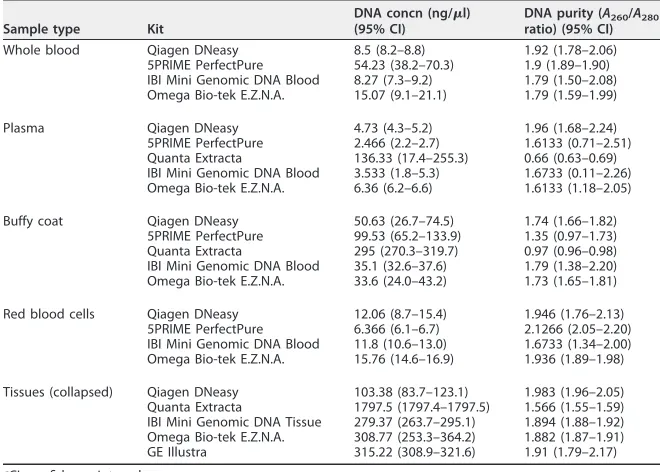
Performance of blood DNA extraction kits.The DNA concentrations (A260), DNA
purities (A260/A280ratios), and 95% confidence intervals for blood kits are presented in
Table 1. For whole blood, 5PRIME PerfectPure had the highest concentration of DNA (54.23 ng/l), with an acceptable purity value of 1.90. In the plasma fraction of spiked samples, Quanta Extracta had a high DNA concentration (136.33 ng/l) but poor purity (A260/A280ratio of 0.66), indicating protein contamination. This trend was also seen for
the buffy coat sample, with Quanta Extracta having the highest DNA concentration (295 ng/l) but poor purity (A260/A280ratio of 0.97). The second best commercial kit for buffy
coat, when prioritizing DNA purity, was the IBI Science Mini Genomic DNA Blood kit, which had a purity value of 1.79 and a DNA concentration of 35.1 ng/l. For red blood cells, Qiagen DNeasy appeared to be optimal, with the second highest DNA concen-tration (12.06 ng/l) and a purity value of 1.946.
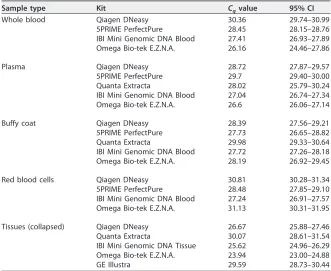
[image:4.585.40.370.93.329.2]Real-time PCR was performed by using S19-specific primers to elucidate which kit yielded the lowest Cqvalues in a SYBR green real-time PCR format. These data are included in Table 2. For buffy coat, the sample that contains the highest concentrations of target phagocytes ofBrucella, the best-performing kit based onCqvalues was the IBI Science Mini Genomic DNA Blood kit (Cqvalue of 27.72), closely followed by 5PRIME PerfectPure (Cqvalue of 27.73). For whole blood, the Omega Bio-tek E.Z.N.A. kit had the lowest averageCq(26.16), followed by the IBI Science Mini Genomic DNA Blood kit (Cq of 27.41). For plasma, Omega Bio-tek E.Z.N.A. was superior (Cqof 26.6), followed by the IBI Science Mini Genomic DNA Blood kit (Cqof 27.04). For red blood cells, the IBI Science Mini Genomic DNA Blood kit was optimal (Cqof 27.24). All extraction controls were negative by PCR (Cqof⬎40).
TABLE 1DNA concentrations, DNA purities, and 95% confidence intervals for blood, plasma, buffy coat, red blood cells, and tissuesa
Sample type Kit
DNA concn (ng/l) (95% CI)
DNA purity (A260/A280 ratio) (95% CI)
Whole blood Qiagen DNeasy 8.5 (8.2–8.8) 1.92 (1.78–2.06)
5PRIME PerfectPure 54.23 (38.2–70.3) 1.9 (1.89–1.90) IBI Mini Genomic DNA Blood 8.27 (7.3–9.2) 1.79 (1.50–2.08) Omega Bio-tek E.Z.N.A. 15.07 (9.1–21.1) 1.79 (1.59–1.99)
Plasma Qiagen DNeasy 4.73 (4.3–5.2) 1.96 (1.68–2.24)
5PRIME PerfectPure 2.466 (2.2–2.7) 1.6133 (0.71–2.51) Quanta Extracta 136.33 (17.4–255.3) 0.66 (0.63–0.69) IBI Mini Genomic DNA Blood 3.533 (1.8–5.3) 1.6733 (0.11–2.26) Omega Bio-tek E.Z.N.A. 6.36 (6.2–6.6) 1.6133 (1.18–2.05)
Buffy coat Qiagen DNeasy 50.63 (26.7–74.5) 1.74 (1.66–1.82)
5PRIME PerfectPure 99.53 (65.2–133.9) 1.35 (0.97–1.73) Quanta Extracta 295 (270.3–319.7) 0.97 (0.96–0.98) IBI Mini Genomic DNA Blood 35.1 (32.6–37.6) 1.79 (1.38–2.20) Omega Bio-tek E.Z.N.A. 33.6 (24.0–43.2) 1.73 (1.65–1.81)
Red blood cells Qiagen DNeasy 12.06 (8.7–15.4) 1.946 (1.76–2.13) 5PRIME PerfectPure 6.366 (6.1–6.7) 2.1266 (2.05–2.20) IBI Mini Genomic DNA Blood 11.8 (10.6–13.0) 1.6733 (1.34–2.00) Omega Bio-tek E.Z.N.A. 15.76 (14.6–16.9) 1.936 (1.89–1.98)
Tissues (collapsed) Qiagen DNeasy 103.38 (83.7–123.1) 1.983 (1.96–2.05) Quanta Extracta 1797.5 (1797.4–1797.5) 1.566 (1.55–1.59) IBI Mini Genomic DNA Tissue 279.37 (263.7–295.1) 1.894 (1.88–1.92) Omega Bio-tek E.Z.N.A. 308.77 (253.3–364.2) 1.882 (1.87–1.91) GE Illustra 315.22 (308.9–321.6) 1.91 (1.79–2.17)
aCI, confidence interval.
on May 16, 2020 by guest
http://jcm.asm.org/
There were no statistical differences in the fractions of blood. Therefore, blood and its fractions were concatenated, and a Kruskal-Wallis test was run with the blocking factor of individual replicate. For the concatenated blood, the IBI Science Mini Genomic DNA Blood kit was superior to all other kits (P⫽0.0013), except for the Omega Bio-tek E.Z.N.A. kit, which showed no difference (P⫽1.0).
Performance of tissue DNA extraction kits.The DNA concentrations (A260), DNA
purities (A260/A280ratios), and 95% confidence intervals for tissue kits are presented in
Table 1. Quanta Extracta appeared to be inferior when evaluating DNA purity. However, the Omega Bio-tek E.Z.N.A., IBI Science Mini Genomic DNA Tissue, Qiagen DNeasy, and GE Illustra kits were similar within individual tissues (P⫽0.83). Therefore, to increase power, all tissues were collapsed and evaluated as a whole. Quanta Extracta had the highest average DNA concentration (1,797.5 ng/l) but the lowest purity (A260/A280
ratio of 1.566). GE Illustra had the second highest DNA concentration (315.22 ng/l), with a purity of 1.91. This was followed by similar quantification with the Omega Bio-tek E.Z.N.A. kit, with a DNA concentration of 308.77 ng/l and a purity of 1.882.
Real-time PCR was performed by using S19-specific primers to elucidate which kit yielded the lowestCqvalue in a SYBR green real-time PCR format. Tissue types were concatenated by kit. The optimal kit byCqvalue was the Omega Bio-tek E.Z.N.A. kit (Cq of 23.94), followed by the IBI Science Mini Genomic DNA Tissue kit (Cqof 25.62), Qiagen DNeasy (Cqof 26.67), GE Illustra (Cqof 29.59), and Quanta Extracta (Cqof 30.07). All extraction controls were negative by PCR (Cqof⬎40).
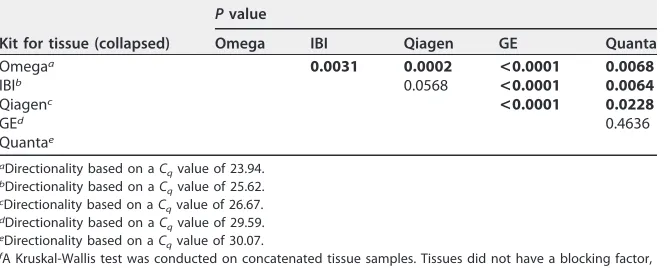
For concatenated tissues, a Kruskal-Wallis test without a blocking factor was run to determine the likelihood of a type I error. Statistical associations are represented in Tables 3 and 4. For concatenated tissues, the Omega Bio-tek E.Z.N.A. kit was superior to all kits against which it was tested (P⫽0.0068).
[image:5.585.40.371.92.363.2]Performance of DNA concentration/enrichment. Preconcentrated DNA had a mean concentration of 1.32 ng/l with a purity of 1.66. After concentration using the Zymo Research DNA Clean & Concentrator-25 kit, the mean concentration was 13.37 ng/l, with a purity of 1.92. Before concentration, the average Cq value was 37.33,
TABLE 2PCR assay withCqvalues of kits based on various matrices and 95% confidence
intervals
Sample type Kit Cqvalue 95% CI
Whole blood Qiagen DNeasy 30.36 29.74–30.99 5PRIME PerfectPure 28.45 28.15–28.76 IBI Mini Genomic DNA Blood 27.41 26.93–27.89 Omega Bio-tek E.Z.N.A. 26.16 24.46–27.86 Plasma Qiagen DNeasy 28.72 27.87–29.57 5PRIME PerfectPure 29.7 29.40–30.00 Quanta Extracta 28.02 25.79–30.24 IBI Mini Genomic DNA Blood 27.04 26.74–27.34 Omega Bio-tek E.Z.N.A. 26.6 26.06–27.14 Buffy coat Qiagen DNeasy 28.39 27.56–29.21 5PRIME PerfectPure 27.73 26.65–28.82 Quanta Extracta 29.98 29.33–30.64 IBI Mini Genomic DNA Blood 27.72 27.26–28.18 Omega Bio-tek E.Z.N.A. 28.19 26.92–29.45 Red blood cells Qiagen DNeasy 30.81 30.28–31.34 5PRIME PerfectPure 28.48 27.85–29.10 IBI Mini Genomic DNA Blood 27.24 26.91–27.57 Omega Bio-tek E.Z.N.A. 31.13 30.31–31.95 Tissues (collapsed) Qiagen DNeasy 26.67 25.88–27.46 Quanta Extracta 30.07 28.61–31.54 IBI Mini Genomic DNA Tissue 25.62 24.96–26.29 Omega Bio-tek E.Z.N.A. 23.94 23.00–24.88 GE Illustra 29.59 28.73–30.44
on May 16, 2020 by guest
http://jcm.asm.org/
which was reduced to 32.54 after concentration using the Zymo Research kit. Results are shown in Table 5. Postconcentration Cq values were lower (P ⬍ 0.0001) than preconcentrationCqvalues, indicating that there was more target DNA in the template. This was consistent with the DNA concentration being higher (P⬍0.0001) in postcon-centration samples than in preconpostcon-centration samples. All conpostcon-centration controls for the Zymo Research kit were negative by PCR (Cqof⬎40).
DISCUSSION
Due to the possibility of a low bacterial burden of brucellae, efficient capture of target genomes in various clinical samples is needed to achieve the highest possible sensitivity in diagnostics while avoiding false-negative results that can confound diag-nostics. The main objectives of this study were to identify optimal commercial DNA extraction kits for use withB. abortusand to identify a DNA concentration method that could capture low-copy-number infections by molecular diagnostics. We quantitatively assessed DNA extraction kits based on DNA concentration (A260), DNA purity (A260/
A280), andCqvalues on a real-time PCR SYBR green platform. However, since commer-cial extraction kits indiscriminately purify both pathogen and host genomic DNAs, measurement of the crude DNA concentration is not an ideal metric for selection of the optimal extraction kit. Therefore, direct quantification of S19 target DNA utilizing Cq values determined by PCR was used as the determining factor for kit selection.
[image:6.585.41.368.91.240.2]The Omega Bio-tek E.Z.N.A. kit is the optimal kit, of those tested, for the extraction of DNA from spiked bovine tissue samples. The Omega Bio-tek E.Z.N.A. kit was the optimal kit for the extraction of DNA from whole blood. For buffy coat, the IBI Science Mini Genomic DNA Blood kit proved to be optimal for the extraction of high quantities of relatively pure DNA. Emphasis was placed on whole blood and buffy coat, as
TABLE 3Kit-versus-kit statistical analysis to determine the optimal extraction kit for bloodf
Kit for blood (collapsed)
Pvalue
IBI Qiagen 5PRIME Omega Quanta
IBIa <0.0001 0.0004 1 0.0013
Qiagenb 0.0689 0.0782 0.7506
5PRIMEc 0.2145 0.0193
Omegad 0.0997
Quantae
aDirectionality based on aC
qvalue of 27.35. bDirectionality based on aC
qvalue of 29.57. cDirectionality based on aC
qvalue of 28.59. dDirectionality based on aC
qvalue of 28.02. eDirectionality based on aC
qvalue of 29.32.
fA Kruskal-Wallis test was conducted on concatenated blood. For blood, a blocking factor on replicate
number was employed.Pvalues in boldface type indicate significance at aPvalue of⬍0.05.
TABLE 4Kit-versus-kit statistical analysis to determine the optimal extraction kit for tissue samplesf
Kit for tissue (collapsed)
Pvalue
Omega IBI Qiagen GE Quanta
Omegaa 0.0031 0.0002 <0.0001 0.0068
IBIb 0.0568 <0.0001 0.0064
Qiagenc <0.0001 0.0228
GEd 0.4636
Quantae
aDirectionality based on aC
qvalue of 23.94. bDirectionality based on aC
qvalue of 25.62. cDirectionality based on aC
qvalue of 26.67. dDirectionality based on aC
qvalue of 29.59. eDirectionality based on aC
qvalue of 30.07.
fA Kruskal-Wallis test was conducted on concatenated tissue samples. Tissues did not have a blocking factor,
as all samples were independent.Pvalues in boldface type indicate significance at aPvalue of⬍0.05.
on May 16, 2020 by guest
http://jcm.asm.org/
[image:6.585.42.374.598.732.2]brucellae are known for intracellular infection of phagocytes and thus would be more readily found in these samples than in plasma or red blood cells (22). Additionally, in previous studies, whole blood and buffy coat were found to be optimal clinical samples for culture and PCR for human patients with brucellosis (23). While this is not directly related to chronically infected cattle, no studies have been undertaken to assess the sensitivity of PCR using whole-blood or buffy coat samples to identify infected animals. Additionally, differences in Cqvalues are directly applicable to veterinary diagnostic laboratory assays. Typically, a delta value of 3 forCqvalues roughly corresponds to a log difference of amplicon target numbers (24, 25). Therefore, for kits that have lowerCq values, this would increase the sensitivity of a given PCR assay. In situations where expected target DNA could be present in low copy numbers, concentration of eluted DNA is achievable with the Zymo Research DNA Clean & Concentrator-25 kit. This kit achieved a 10⫻concentration of the eluted DNA; thus, 1l of the template postcon-centration is equivalent to⬃10l of the original elution volume.
Interestingly, Quanta Extracta consistently had the highestA260yet suffered from
low DNA purity. This was consistent with real-time PCR results, where samples extracted by Quanta Extracta consistently had the highestCqvalues. This kit does not make use of a silica spin column. Therefore, there is no true purification of the sample by this methodology, explaining the protein contamination seen in purity measurements.
Previous studies found that phase separation techniques that rely on protein precipitation followed by DNA precipitation are not optimal (6, 26, 27). Additionally, it is well documented that traces of phenol can completely inactivateTaqpolymerase, thus complicating downstream applications (28). Phase separation can also be highly dependent on the technical skills of the individuals performing the extraction. The kits evaluated in this study utilized digestion with proteolytic enzymes (proteinase K) to achieve cell lysis. In comparison to phase separation techniques, commercial kits do not utilize hazardous chemicals and can be highly adoptable to a laboratory setting. All spin column kits in our experiment utilized a silica membrane. This technique utilizes enzyme digestion to release nucleic acids from cells, followed by nonspecific nucleic acid absorption to the silica fibers within the membrane. Washes of the spin column with high-salt-concentration buffers strip away low-molecular-weight compounds and residual proteins. Extraction is completed with a low- or no-salt elution buffer, which reverses the nonspecific absorption of nucleic acids from the silica fibers and into the eluate. It was reported previously that a drawback of spin column extraction kits is the potential for cross-contamination due to the aerosolization of other samples during centrifugation steps (6, 29). In our study, we ran extraction and Zymo Research concentration controls on PCR, which allowed us to evaluate cross-contamination, either by aerosolization (centrifuge and pipette, etc.) or by contamination of kit components. All extraction and concentration controls were negative by PCR (Cqof
⬎40).
[image:7.585.38.372.94.152.2]While the kits tested in this study have not been extensively compared and reported, they have been widely utilized in a variety of studies. The Omega Bio-tek E.Z.N.A. kit was used previously for sampling a multitude of biological samples (30–32). Additionally, the same is true for the IBI Science Mini Genomic DNA Blood and Tissue kits (33, 34). Much has been reported on DNA extraction techniques. Unfortunately,
TABLE 5DNA concentration and DNA purity before concentration versus after concentration with the Zymo Research DNA Clean & Concentrator-25 kita Parameter
Value (95% CI)
Pvalue Preconcentration Postconcentration
DNA concn (ng/l) 1.32 (1.22–1.43) 13.37 (9.08–17.66) ⬍0.0001 DNA purity (A260/A280ratio) 1.66 (1.49–1.82) 1.92 (1.81–2.03) ⬍0.0001
Cq 37.33 (36.67–37.98) 32.54 (30.16–34.91) 0.0155 aA Kruskal-Wallis test was performed on DNA concentration (A
260), DNA purity (A260/A280ratio), and real-time
PCRCqvalues with 95% confidence intervals preconcentration versus postconcentration. AllPvalues are
significant at aPvalue of⬍0.05.
on May 16, 2020 by guest
http://jcm.asm.org/
many of those studies dealt with methodologies that predate commercial DNA extrac-tion kits. More recent studies evaluating commercial DNA extracextrac-tion kits have focused on fungal DNA or “difficult” samples, such as soil, feces, or paraffin-embedded tissues (1, 3, 35, 36). This is the first study to assess the optimal DNA extraction kits for use on a Gram-negative intracellular bacterium from multiple matrix types.
While the capture of target DNA is vital for downstream molecular applications, protocols for the homogenization of tissues for use in commercial DNA extraction kits are equally important. In this study, we used spiked tissue samples, 3 g of which was placed into a FastPrep homogenization tube for bead beating. However, in challenge studies, the bacterial burden within lymph nodes can be as low as 17 bacterial cells per lymph node (17). Therefore, subsampling of 3 g of tissue from a lymph node introduces the risk of missing these bacterial cells for extraction. Newer technologies such as the Omni Bead Ruptor allow the homogenization of whole lymph nodes in 50-ml conical tubes. However, one would have to consider homogenization media for the use of this platform. Certain media, such as garnet-sharp particles, can have a shearing effect on bacterial cells and potentially DNA and can result in a lower sensitivity of bacteriological culture or downstream molecular diagnostic methods (37).
In summary, these results demonstrate that the Omega Bio-tek E.Z.N.A. kit was optimal for whole blood and tissues, while the IBI Science Mini Genomic DNA Blood kit was optimal for buffy coat samples. These kits showed optimal capture of target-specific DNA across inoculated matrices. These kits are easily adoptable within most laboratories and require standard equipment found in most microbiology laboratories. These kits provide high-quality eluates that can then be concentrated by using other commercial kits such as the Zymo Research DNA Clean & Concentrator-25 kit. The most efficient DNA capture methods use commercial kits, followed by concentration of the eluted DNA, which assists in increasing the sensitivity of molecular diagnostics for these intracellular, low-copy-number infections.
ACKNOWLEDGMENTS
We thank members of the Wyoming State Veterinary Laboratory (T. Cornish, B. Bonner, J. Henningsen, and numerous undergraduate necropsy technicians) for the procurement of samples used in this study. Additionally, we thank the Wyoming Game and Fish Department Wildlife Disease Laboratory (W. H. Edwards, J. Jennings-Gaines, and H. Killion). Finally, we thank John Lopez (high school rotation student through the Wyoming Summer Research Apprentice Program) for his technical work on the project. We declare that the research was conducted in the absence of any commercial or financial relationship that could be construed as a potential conflict of interest.
This project was funded by the Institute for Infectious Animal Diseases from the U.S. Department of Homeland Security (cooperative agreement no. DHS 2010-ST-061-AG0002); a Western Sustainable Agriculture Research and Education grant from the U.S. Department of Agriculture (award no. GW16-038); an IDeA Networks for Biomedical Research Excellence (INBRE) grant from the National Institutes of General Medical Sciences of the National Institutes of Health (grant no. P20GM103432); the Wyoming NASA Space Grant Consortium (grant no. NNX15AI08H); the Wyoming Department of Agriculture-Agriculture Producer Research Grant Program and Wyoming Wildlife Live-stock Disease Research Partnership (UW-AG grant no. 155131); a National Science Foundation EPSCoR grant; the Agriculture Experiment Station, U.S. Department of Agriculture-National Institute of Food and Agriculture; and University of Wyoming College of Agriculture and Natural Resources-State of Wyoming Brucellosis funds.
The funders had no role in the study design, data collection, interpretation, or the decision to submit the work for publication. The views and conclusions contained in this document are those of the authors and should not be interpreted as necessarily representing the official policies either expressed or implied of the U.S. Department of Homeland Security, the U.S. Department of Agriculture, or the National Institutes of Health.
All authors contributed to the design of the study. N.H., J.M., D.B., A.S., and C.K.
on May 16, 2020 by guest
http://jcm.asm.org/
contributed to data gathering, cleaning, interpretation, and validation. B.S. supervised the study and contributed to the interpretation of the data. All authors contributed to the critical discussion of results and reviewed and edited the final manuscript.
REFERENCES
1. McOrist AL, Jackson M, Bird AR. 2002. A comparison of five methods for extraction of bacterial DNA from human faecal samples. J Microbiol Methods 50:131–139.https://doi.org/10.1016/S0167-7012(02)00018-0. 2. Dauphin L, Stephens K, Eufinger S, Bowen M. 2010. Comparison of five
commercial DNA extraction kits for the recovery of Yersinia pestis DNA from bacterial suspensions and spiked environmental samples. J Appl Microbiol 108:163–172.https://doi.org/10.1111/j.1365-2672.2009.04404.x.
3. Whitehouse CA, Hottel HE. 2007. Comparison of five commercial DNA extraction kits for the recovery of Francisella tularensis DNA from spiked soil samples. Mol Cell Probes 21:92–96.https://doi.org/10.1016/j.mcp .2006.08.003.
4. Boone DR, Castenholz RW, Garrity GM (ed). 2001. Bergey’s manual of systematic bacteriology, 2nd ed. Springer, New York, NY.
5. Gamazo C, Vitas AI, Lopez-Goñi I, Diaz R, Moriyon I. 1993. Factors affecting detection of Brucella melitensis by BACTEC NR730, a nonra-diometric system for hemocultures. J Clin Microbiol 31:3200 –3203. 6. Queipo-Ortuno M, Tena F, Colmenero J, Morata P. 2008. Comparison of
seven commercial DNA extraction kits for the recovery of Brucella DNA from spiked human serum samples using real-time PCR. Eur J Clin Microbiol Infect Dis 27:109 –114.https://doi.org/10.1007/s10096-007-0409-y. 7. Leal-Klevezas DS, Vázquez IO, Lopez-Merino A,
Martínez-Soriano JP. 1995. Single-step PCR for detection of Brucella spp. from blood and milk of infected animals. J Clin Microbiol 33:3087–3090. 8. Yu WL, Nielsen K. 2010. Review of detection of Brucella spp. by
poly-merase chain reaction. Croat Med J 51:306 –313.https://doi.org/10.3325/ cmj.2010.51.306.
9. Bricker BJ, Halling SM. 1994. Differentiation of Brucella abortus bv. 1, 2, and 4, Brucella melitensis, Brucella ovis, and Brucella suis bv. 1 by PCR. J Clin Microbiol 32:2660 –2666.
10. Versage JL, Severin DD, Chu MC, Petersen JM. 2003. Development of a multitarget real-time TaqMan PCR assay for enhanced detection of Francisella tularensis in complex specimens. J Clin Microbiol 41: 5492–5499.https://doi.org/10.1128/JCM.41.12.5492-5499.2003. 11. Corbel MJ. 2006. Brucellosis in humans and animals. World Health
Organization, Geneva, Switzerland.
12. Mustafa A, Nicoletti P. 1993. FAO, WHO, OIE, guidelines for a regional brucellosis control programme for the Middle East. World Health Orga-nization, Geneva, Switzerland.
13. Cheville NF, McCullough DR, Paulson LR, National Research Council Board on Agriculture, National Research Council Board on Environmen-tal Studies and Toxicology. 1998. Brucellosis in the greater Yellowstone area. National Academy Press, Washington, DC.
14. Anonymous. 2017. Revisiting brucellosis in the greater Yellowstone area. National Academies Press, Washington, DC.
15. Kulakov YK. 2016. Molecular aspects of Brucella persistence. Mol Genet Microbiol Virol 31:1– 8.https://doi.org/10.3103/S0891416816010067. 16. Barquero-Calvo E, Chaves-Olarte E, Weiss DS, Guzmán-Verri C,
Chacón-Díaz C, Rucavado A, Moriyón I, Moreno E. 2007. Brucella abortus uses a stealthy strategy to avoid activation of the innate immune system during the onset of infection. PLoS One 2:e631.https://doi.org/10.1371/ journal.pone.0000631.
17. Meador V, Deyoe B, Cheville N. 1989. Pathogenesis of Brucella abortus infection of the mammary gland and supramammary lymph node of the goat. Vet Pathol 26:357–368.https://doi.org/10.1177/030098588902600501. 18. Buck J. 1930. Studies of vaccination during calfhood to prevent bovine
infectious abortion. J Agric Res 41:667– 689.
19. Warburg C, Christian W. 1941. Determination of DNA content. Biochem Z 310:384.
20. Sangari FJ, Aguero J. 1994. Identification of Brucella abortus B19 vaccine strain by the detection of DNA polymorphism at the ery locus. Vaccine 12:435– 438.https://doi.org/10.1016/0264-410X(94)90121-X.
21. Sangari FJ, García-Lobo JM, Agüero J. 1994. The Brucella abortus vaccine strain B19 carries a deletion in the erythritol catabolic genes. FEMS
Microbiol Lett 121:337–342. https://doi.org/10.1111/j.1574-6968.1994 .tb07123.x.
22. Fitzgeorge R, Solotorovsky M, Smith H. 1967. The behaviour of Brucella abortus within macrophages separated from the blood of normal and immune cattle by adherence to glass. Br J Exp Pathol 48:522–528. 23. Mitka S, Anetakis C, Souliou E, Diza E, Kansouzidou A. 2007. Evaluation
of different PCR assays for early detection of acute and relapsing bru-cellosis in humans in comparison with conventional methods. J Clin Microbiol 45:1211–1218.https://doi.org/10.1128/JCM.00010-06. 24. Amoroso MG, Salzano C, Cioffi B, Napoletano M, Garofalo F, Guarino A,
Fusco G. 2011. Validation of a real-time PCR assay for fast and sensitive quantification of Brucella spp. in water buffalo milk. Food Control 22: 1466 –1470.https://doi.org/10.1016/j.foodcont.2011.03.003.
25. Han HS, Jo YN, Lee JY, Choi SY, Jeong Y, Yun J, Lee OJ. 2014. Identifi-cation of suitable reference genes for the relative quantifiIdentifi-cation of microRNAs in pleural effusion. Oncol Lett 8:1889 –1895.https://doi.org/ 10.3892/ol.2014.2404.
26. Yang DY, Eng B, Waye JS, Dudar JC, Saunders SR. 1998. Improved DNA extraction from ancient bones using silica-based spin columns. Am J Phys Anthropol 105:539 –543. https://doi.org/10.1002/(SICI)1096-8644(199804) 105:4⬍539::AID-AJPA10⬎3.0.CO;2-1.
27. Mygind T, Ostergaard L, Birkelund S, Lindholt JS, Christiansen G. 2003. Evaluation of five DNA extraction methods for purification of DNA from atherosclerotic tissue and estimation of prevalence of Chlamydia pneu-moniae in tissue from a Danish population undergoing vascular repair. BMC Microbiol 3:19.https://doi.org/10.1186/1471-2180-3-19.
28. Wiedbrauk DL, Werner JC, Drevon AM. 1995. Inhibition of PCR by aqueous and vitreous fluids. J Clin Microbiol 33:2643–2646.
29. Merk S, Meyer H, Greiser-Wilke I, Sprague L, Neubauer H. 2006. Detection of Burkholderia cepacia DNA from artificially infected EDTA-blood and lung tissue comparing different DNA isolation methods. J Vet Med B Infect Dis Vet Public Health 53:281–285.https://doi.org/10.1111/j.1439 -0450.2006.00956.x.
30. Peng XM, Gu L, Huang YS, Ma HH, Xie QF, Li G, Gao ZL. 2005. Simulta-neous detection of two major lamivudine-resistant mutants using com-petitively differentiated-PCR. J Virol Methods 128:168 –175.https://doi .org/10.1016/j.jviromet.2005.04.014.
31. Hovda MB, Lunestad BT, Sivertsvik M, Rosnes JT. 2007. Characterisation of the bacterial flora of modified atmosphere packaged farmed Atlantic cod (Gadus morhua) by PCR-DGGE of conserved 16S rRNA gene regions. Int J Food Microbiol 117:68 –75. https://doi.org/10.1016/j.ijfoodmicro .2007.02.022.
32. Fahlgren C, Hagström Å, Nilsson D, Zweifel UL. 2010. Annual variations in the diversity, viability, and origin of airborne bacteria. Appl Environ Microbiol 76:3015–3025.https://doi.org/10.1128/AEM.02092-09. 33. Silva LP, Lorenzi PL, Purwaha P, Yong V, Hawke DH, Weinstein JN. 2013.
Measurement of DNA concentration as a normalization strategy for metabolomic data from adherent cell lines. Anal Chem 85:9536 –9542. https://doi.org/10.1021/ac401559v.
34. Mandal M, Banerjee PS, Kumar S, Ram H, Garg R, Pawde AM. 2015. Development of loop-mediated isothermal amplification (LAMP) for de-tection of Babesia gibsoni infection in dogs. Vet Parasitol 209:50 –55. https://doi.org/10.1016/j.vetpar.2015.02.008.
35. Fredricks DN, Smith C, Meier A. 2005. Comparison of six DNA extrac-tion methods for recovery of fungal DNA as assessed by quantitative PCR. J Clin Microbiol 43:5122–5128.https://doi.org/10.1128/JCM.43 .10.5122-5128.2005.
36. Cao W, Hashibe M, Rao J-Y, Morgenstern H, Zhang Z-F. 2003. Compar-ison of methods for DNA extraction from paraffin-embedded tissues and buccal cells. Cancer Detect Prev 27:397– 404.https://doi.org/10.1016/ S0361-090X(03)00103-X.
37. Burden DW. 2012. Guide to the disruption of biological samples—2012. OPS Diagnostics, Lebanon, NJ.