Complementary Tree Domination number and
Distance two Complementary Tree Domination
number of Cartesian Product of Graphs
S. Muthammai1, G. Ananthavalli2
1
Government Arts and Science College, Kadaladi,Ramanathapuram-623703, India.
2
Government Arts College for Women (Autonomous),Pudukkottai-622001, India.
Abstract: A set D of a graph G = (V, E) is a dominating set, if every vertex in V(G) – D is adjacent to some vertex in D. The domination number
γ
(G) of G is the minimum cardinality of a dominating set. A dominating set D
V(G) is said to be acomplementary tree dominating set (ctd-set), if the induced subgraph<V(G) - D>is a tree. The minimum cardinality of a ctd-set is called the complementary tree domination number of G and is denoted by
γ
ctd(G)
.A dominating set D is called a distance two complementary tree dominating set, if for each u ∈V(G) – D, there exists a vertex v ∈ D such that d(u,v) ≤ 2 and also <V(G) – D> is a tree. The minimum cardinality of a distance two complementary tree dominating set is said to be distance two complementary tree domination number of G and is denoted by (G).In this paper, complementary tree domination numbers and distance two complementary tree domination number of cartesian product of some standard graphs are found. Key words: Domination number, complementary tree domination number, distance two complementary tree domination number, Cartesian product.I. INTRODUCTION
Graphs discussed in this paper are finite, undirected and simple connected graphs. For a graph G, let V(G) and E(G) denote its vertex set and edge set respectively. A graph G with p vertices and q edges is denoted by G(p, q). The concept of domination in graphs was introduced by Ore[5]. A set D ⊆V(G) is said to be a dominating set of G, if every vertex in V(G) −D is adjacent to some vertex in D. The cardinality of a minimum dominating set in G is called the domination number of G and is denoted by
(G).Muthammai, Bhanumathi and Vidhya[5] introduced the concept of complementary tree dominating set. A dominating set D
V(G) is said to be a complementary tree dominating set (ctd-set), if the induced subgraph <V(G) - D >is a tree. The minimum cardinalityof a ctd-set is called the complementary tree domination number of G and is denoted by
γ
ctd(G)
.The cartesian product of two graphs G1 and G2 is the graph, denoted by G1 x G2 with V (G1× G2) =V (G1) × V (G2) (where x
denotes the cartesian product of sets) and two vertices u = (u1, u2) and v = (v1, v2) in V (G1× G2) are adjacent in G1× G2 whenever
[u1 = v1 and (u2, v2) ∈ E(G2)] or [u2 = v2 and (u1, v1) ∈ E(G1)].
The concept of distance two complementary tree dominating set is introduced in [4]. A dominating set D is called a distance two complementary tree dominating set, if for each u ∈V(G) – D, there exists a vertex v ∈ D such that d(u,v) ≤ 2, and also <V(G) – D> is a tree. The minimum cardinality of a distance two complementary tree dominating set is said to be distance two complementary tree domination number of G and is denoted by γ (G).
In this paper, complementary tree domination number and distance two complementary tree domination number of Km x Kn, Km x
Pn, Km x Cn, C3 x Pn, C4 x Pn, C5 x Pn, C6 x Pn, C3 x Cn, C4 x Cn, C5 x Cn and C6 x Cnare found.Any undefined terms in this paper may
be found in Harary[2].
II. COMPLEMENTARY TREE DOMINATION NUMBER OF CARTESIAN PRODUCT OF GRAPHS
A. Theorem 2.1
If G ≅ Km x Kn(m, n ≥ 3 and m ≤ n), thenγ (G) =
Let G ≅ Km x Kn .
Let V(G) =⋃ {v , v , … , v } such that < {v , v , … , v } > ≅ K , i =1,2, …, m and < v , v , … , v > ≅ K , j=1,2, …,
n, where K is the ith copy of Kn and K is the jth copy of Km in Km x Kn. |V(G)| = mn.
C. Case 1: m = n.
et D′ = ⋃ v , v
, ∪ v , and D = V(G) –D′. Then V(G) – D =D′and |D′| = 2(m – 1) +1= 2m – 1. For i =1, 2,3, …, m-1, the verticesv , v, in V(G) – D are adjacent to vi1inD, and the vertex vmm is adjacent to vm1 in D. Therefore D is a dominating set of
G. <V(G) –D> ≅ P2(m-1) + 1 = P2m – 1. SinceD is a ctd-set of G. Henceγ (G)≤ |D|=|V(G)| – |D′| = mn–(2m – 1) = m(n – 2) + 1.
It is to be noted that, any tree in G is a path. Let D′ be a γ -set of G. The longest path that can be obtained from the subgraph of G
induced by the vertices of V(G)–D′is P
2m–1.That is,<V(G)–D′> ≅ P2m– 1.D′ contains atleast mn – (2m – 1) = m(n – 2) + 1 vertices.
Thereforeγ (G) = |D′| ≥m(n – 2) + 1.
Hence γ (G) = m(n – 2) + 1.
D. Case 2: m < n. Let D′ = ⋃ v , v
, and D = V(G) – D′. Then V(G) – D = D′and |D′| = 2m. The vertices v , v are adjacent to v and
v , v, (i = 2, 3, …, m) are adjacent to vi1, (i = 2, 3, …, m) in D. Therefore D is a dominating set of G. Since <V (G) – D > ≅ P2m,D
is a ctd-set of G. Therefore γ (G)≤ |V(G)| – |D′| = mn – 2m = m(n – 2).
As in case 1, any tree in G is a path. Let D′ be γ -set of G. The longest path that can be obtained from the subgraph of G induced
by the vertices of V(G) – D′
is P2m.
That is<V (G) –D′> ≅ P
2m.Therefore D′ contains atleast mn – 2m = m(n – 2) vertices. Thereforeγ (G) = |D′| ≥m(n – 2).
Thereforeγ (G) = m(n – 2) .
Hence γ (G) = m(n−2) + 1, if m = n m(n−2), if m < n.
E. Remark 2.1
The set D defined in Case 1 and Case 2 is also a d2ctd-set of G. Since any vertex u in D which is at distance two from a vertex of D, <(V (G) – D) ∪ {u}> either disconnected or contains cycle.
F. Example 2.1
For the graph G given in Figure 1.a and Figure 1.b, the set of vertices marked with is a minimum ctd-set of Km x Knand γ (K4 x
K4) = 9 and γ (K4 x K5) = 12.
G. Theorem 2.2.
If G ≅ Km x Pn(4≤ m ≤ n), then γ (G) = n (m – 2). 1) Proof.
Let G ≅ Km x Pn, m,n ≥ 4.
Figure 1.a Figure 1.b
Let V(G) = ⋃ {v , v , … , v } such that < {v , v , … , v } > ≅ K , i =1, 2, …, m and < v , v , … , v > ≅ P , j = 1, 2, …,
n, where K is the ith copy of Kn and P is the j th copy of Pm in Km x Pn.
Let D′
= {v }∪[⋃ {v }]∪[⋃ {v , ,v , }], if n is odd
[⋃ {v , }]∪[⋃ {v , ,v, }], if n is even .
Then |D′| = 2n. If D = V(G) - D′, then D is a dominating set of G. Also <V(G) – D > = < D′> ≅ P
n°K1. Therefore D is a ctd-set of G
and γctd(G) ≤|D| = mn – 2n = n(m – 2). Hence γctd(G) ≤ n(m – 2).
Let D′ be a γctd-set of G. Since D′ is a ctd-set of G, D′ contains atleast (m – 2) vertices in each of n copies of Km. Hence D′ contains
atleast n(m – 2) vertices. Therefore γctd(G) =|D′| ≥n(m – 2). Hence γctd(G) = n (m – 2).
H. Example 2.2.
For the graph G given in Figure 2, the set of vertices marked with is a minimum ctd-set of Km x Knand γctd(K4 x K9) = 18.
I. Theorem 2.3.
G ≅ C3 x Pn, then γctd(G) = n , n ≥ 1. 1) Proof.
Let G ≅ C3 x Pn.
Let V(G) = ⋃ni 1{v1i,v2i,v3i} such that < {vi1,vi2, … ,vin} > ≅ Pn i
,i =1,2,3 and < v1j,v2j,v3j > ≅ C3 j
, j=1,2, …, n, where Pn i
is the
ith copy of Pn and C3 j
is the j th copy of C3 in C3 x Pn.
Let D = {v1n}∪[⋃ {v1,2i 1,v3,2i
n 1
2
i 1 }],ifnisodd
⋃ {v1,2i 1,v3,2i
n
2
i 1 },ifniseven
Then D is a dominating set of G. Also <V (G) – D >≅ Pn° K1.Therefore D is a ctd-set of G and |D|=
2 n 1
2 +1=n, ifniseven
2 n
2 =n, ifnisodd
and γctd(G)≤|D|= n.
Let D′ be a γctd-set of G. Then D′ contains atleast one vertex from each cycle. Since C3 x Pn contains n copies of C3, D′ contains
atleast n vertices. γctd(G) =|D′| ≥ n. Hence γctd(G) = n, n ≥ 1.
J. Theorem 2.4.
If G ≅ C4 x Pn, then γctd(G) =
3n 1
2 , n ≥ 1.
Let G ≅ C4 x Pn and V(G) = ⋃ni 1{v1i,v2i,v3i,v4i} such that < {vi1,vi2, … ,vin} > ≅Pn i
, i =1,2,3,4 and < v1j,v2j,v3j,v4j > ≅ C4 j
,
j=1,2, …, n, where Pn i
is the ith copy of Pn and C4 j
is the j th copy of C4 in C4 x Pn and |V(G)| = 4n.
G ≅ K4x P9
Let D′ = { v31} ∪[⋃ {v1,2i,
n 1 2
i 1 v4,2i,v3,2i 1}] ∪[⋃ni 1{v2i}].
Then |D′| = 1 + 3 n 1
2 + n =
5n 1
2 and D = V(G) - D ′.
Then D is a dominating set of G. Also <V (G) – D > = <D′> is a tree
obtained from the path Pn = < v2,i.i=1,2,3, … ,n >, (n ≥ 2) by attaching P3 at each of the vertices v22,v24,v26,… ,v2,n 1 and
attaching a pendant edge at each of the vertices v21,v23… ,v2,n. Therefore D is a ctd-set of G, and
γctd(G) ≤ |D| = |V(G) - D′| = 4n - 5n 1
2 = 3n 1
2 .
Hence γctd(G) ≤3n 1
2 = 3n 1
2 .
Let D′ be a γctd-set of G. The blocks A, B, A2 and A2B are constructed as given below.
G is obtained by concatenating the blocks A
n 1
2 and B. That is, G ≅ A n 1
2 B. The vertices with the symbol in each of the blocks
represent the vertices that are to be included in D′
Therefore D′ contains atleast 3 vertices from each block A of A
n 1
2 and atleast 2 vertices from block B.
Therefore γctd(G) = |D′| ≥ 2+ 3 n 1
2 = 3n 1
2 = 3n 1
2 .
Hence γctd(G) = 3n 1
2 , n ≥ 1.
,v3,2i 1}]∪[⋃ni 1{v2i}] and D = V(G) –D
′.
Then |D′| = 3 n
2 + n =
5n
2 . Then D is a dominating set of G. Also <V (G) – D > = <D ′
>
is a tree obtained from the path Pn = < {v2i,i=1,2,3, … ,n} >, (n ≥ 2) by attaching P3 at each of the vertices v22,v24,v26,… ,andv2,n
and attaching a pendant edge at each of the vertices v21,v23… ,andv2,n 1. Therefore D is a ctd-set of G and γctd(G) ≤ |D| = |V(G) -
D′| = 4n - 5n
2 = 3n
2.
Hence γctd(G) ≤3n
2= 3n 1
2 .
Let D′ be a γctd-set of G.The block A is constructed as in Case 1.
ThenG ≅ A
n
2. The vertices with the symbol in each of the blocks represent the vertices that are to be included in D′.
Therefore D′ contains atleast 3 vertices from each block A of A
n
2. Therefore γ
ctd(G) =|D
′
| ≥ 3 n2 =3n2= 3n 12 .
Hence γctd(G) = 3n 1
2 , n ≥ 1.
K. Theorem 2.5
If G ≅ C5 x Pn, then γctd(G) = 2n, n ≥ 3.
L. Proof
Let G ≅ C5 x Pn and V(G) = ⋃ni 1v1i,v2i,v3i,v4i,v5i such that < {vi1,vi2, … ,vin} > ≅Pn i
, i =1, 2, 3, 4, 5 and < v1j,v2j,v3j,v4j,v5j >
≅ C5 j
, j = 1,2, …, n, where Pn i
is the ith copy of Pn and C5 j
is the jth copy of C5 in C5 x Pn. |V(G)| = 5n.
Let D = [⋃ {v1,2i 1,
n 1 2
i 1 v5,2i 1}]∪[⋃ {v3,2i,v4,2i,
n 1
2
i 2 }],ifnisodd
⋃ {v1,2i 1,
n 2
i 2 v3,2i,v4,2i,v5,2i 1}, ifniseven.
Then D is a dominating set of G and also <V(G) – D> is a tree obtained from the path Pn = < v2,i,i=1,2,3, … ,n >, (n ≥
2) by attaching P3 at each of the vertices v21,v22,v23,… ,andv2,n Therefore D is a ctd-set of G.
and |D| = 2 n 1
2 +2 n 1
2 =2n, ifniseven
4 n2 =2n, ifnisodd.
Therefore γctd(G) ≤ |D′| = 2n.
Let D′ be a γctd-set of G. Since γ(C5) = 2, D ′
contains atleast 2 vertices from each of n cycles and hence D′contains atleast
2n vertices. Therefore γctd(G) =|D′| ≥ 2n. Hence γctd(G) = 2n, n ≥ 1.
M. Theorem 2.6
If G ≅ C6 x Pn, then γctd(G) =
5n
2 , n ≥ 2.
1) Proof.: Let G ≅ C6 x Pn and V(G) = ⋃ni 1{v1i,v2i,v3i,v4i,v5i,v6i} such that < {vi1,vi2, … ,vin} > ≅Pn i
, i =1, 2, 3, 4,5,6 and
< v1j,v2j,v3j,v4j,v5j,v6j > ≅ C6 j
, j = 1, 2, …, n, where Pn i
is the ith copy of Pn and C6 j
is the j th copy of C6 in C6 x Pn and |V(G)|
= 6n.
2) Case 1: n is odd.
LetD′=[⋃ {v1,2i 1,
n 1 2
i 1 v5,2i 1,v6,2i 1}]∪[⋃ni 1{v2i}][⋃ {v3,2i ,v4,2i}]
n 1 2
i 1 .
Then |D′| = 3 n 1
2 + n + 2
n 1 2 =
7n 1
2 and D = V(G) –D ′.
Then D is a dominating set of G. Also <V (G) – D > = <D′> is a tree
obtained from the path Pn= < v2,i, i=1,2,3, … ,n >, (n ≥ 2) by attaching P4 at each of the vertices v21,v23,v25,… ,v2n and attaching
P3 at each of the vertices v22,v24… ,v2,n 1. Therefore D is a ctd-set of G.
γctd(G) ≤ |D| = |V(G) - D′| = 6n - 7n 12 = 5n 12 .
Hence γctd(G) ≤5n 1
2 .
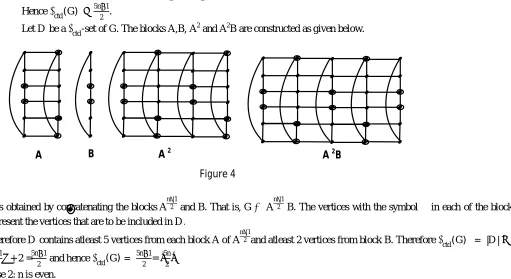
Let D′ be a γctd-set of G. The blocks A,B, A2 and A2B are constructed as given below.
G is obtained by concatenating the blocks A
n 1
2 and B. That is, G ≅ A n 1
2 B. The vertices with the symbol in each of the blocks
represent the vertices that are to be included in D′.
Therefore D′ contains atleast 5 vertices from each block A of A
n 1
2 and atleast 2 vertices from block B. Therefore γ
ctd(G) = |D
′
| ≥ 5
n 1 2 + 2 =
5n 1
2 and hence γctd(G) = 5n 1
2 = 5n
2 .
[image:6.612.55.566.448.727.2]Case 2: n is even.
Figure 4
Let D′= [⋃ {v1,2i 1,
n 2
i 1 v5,2i 1,v6,2i 1}]∪[⋃ni 1{v2i,}][⋃ {v3,2i ,v4,2i}]
n 2
i 1 .
Then |D′| = 3 n2 + n +2 n2 = 7n2 and D = V(G) - D′. Then D is a dominating set of G. Also <V (G) – D > = <D′> is a tree obtained
from the path Pn= < v2,i, i=1,2,3, … ,n >, (n ≥ 2) by attaching P4 at each of the vertices v21,v23,v25,… ,v2,n 1 and attaching P3 at
each of the vertices v22,v24… ,v2n. Therefore D is a ctd-set of G.
γctd(G) ≤ |D| = |V(G) - D′| = 6n - 7n
2 = 5n
2.
Hence γctd(G) ≤5n
2.
Let D′ be a γctd-set of G. The block A is constructed as in Case 1.
ThenG ≅ A
n
2. The vertices with the symbol in each of the blocks represent the vertices that are to be included in D′.
Therefore D′ contains atleast 5 vertices from each block A of A
n 2.
Therefore γctd(G) = |D′| ≥ 5 n
2 = 5n
2 and henceγctd(G) = 5n
2 = 5n
2 .
Hence γctd(G) = 5n
2 , n ≥ 1.
N. Remark 2.2.
In view of Theorem 2.4, Theorem 2.5, Theorem 2.6, and Theorem 2.7,
1) γctd( C3 x Cn) = n+1, n ≥ 2.
2) γctd( C4 x Cn) =
3n 1 2 +1
3) γctd( C5 x Cn) =
2n+1, ifniseven 2n,ifnisodd. 4) γctd( C6 x Cn) =
5n 2 +1.
O. Remark 2.3.
1) If G1 ≅ Km and G2 ≅ Kn, then γctd(G1 + G2) = m + n-2.
2) If G1 and G2 are any two noncomplete connected graphs of order m and n respectively, with minimum degree atleast two, then γctd(G1 + G2) ≤ m + n – 4. Equality holds, if G1≅ Km – e, G2≅ Kn – e.
3) For any two connected graphs G1 and G2 of order m and n respectively, γctd(G1 ° G2) ≤ m + n – 4. Equality holds, if G1≅
P2 and G2≅ C3.
P. Distance Two Complementary tree domination number of Cartesian product of graphs
In the following, distance two complementary tree domination number of Km x Kn, Km x Pn, Km x Cn, C3 x Pn, C4 x Pn, C5 x Pn, C6 x
Pn, C3 x Cn, C4 x Cn, C5 x Cnand C6 x Cnare given
1) If G ≅ Km x Kn (m, n ≥ 3 and m ≤ n), then γd2ctd(G) =
m(n−2) + 1,ifm=n m(n−2), ifm<n
2) If G ≅ Km x Pn ( 4≤ m ≤ n), then γd2ctd(G) = n (m – 2). 3) γd2ctd( Km x Cn) = n(m – 2) + 1.
4) If G ≅ C3 x Pn, then γd2ctd(G) = n, n ≥ 1.
5) If G ≅ C4 x Pn, then γd2ctd(G) =
3n 1
2 , n ≥ 1.
6) If G ≅ C5 x Pn, then γd2ctd(G) = 2n, n ≥ 3.
7) If G ≅ C6 x Pn, then γd2ctd(G) =
5n
2 , n ≥ 1.
8) γd2ctd(C3 x Cn) = n+1, n ≥ 2.
9) γd2ctd(C4 x Cn) =
3n 1 2 +1
10) γd2ctd(C5 x Cn) =
11) γd2ctd(C6 x Cn) =
5n
2 +1, n ≥ 2.
REFERENCES
[1] M. El-Zahav and C.M. Pareek, Domination number of products of graphs, Ars Combin., 31 (1991),223–227. [2] F. Harary, Graph Theory, Addison-Wesley, Reading Mass, 1972.
[3] T.W. Haynes, S.T. Hedetniemi and P.J. Slater, Fundamentals of domination ingraphs, Marcel Dekker Inc., New York, 1998.
[4] S. Muthammai and G. Ananthavalli, Distance Two Complementary Tree Domination Number of a graph, International Journal For Research in Applied Science and Engineering Technology. (submitted
[5] S. Muthammai and G. Ananthavalli, Complementary Tree Nil Domination Number of cartesian product of Graphs, International Journal of Engineering Science, Advanced Computing and Bio-Technology.(submitted
[6] S. Muthammai, P. Vidhya, Complementary tree domination in grid graphs,International Journalof Engineering Science, Advanced Computing and Bio-Technology, 2(3) (2011), 118–129