Technology (IJRASET)
©IJRASET: All Rights are Reserved
351
Estimation of Software Development Effort Using
Back Propagation Neural Network for
COCOMO-II Dataset
T. M. Kiran Kumar1, Shivu K.N2 1
Assistant Professor, 2Project Student, Department of MCA Siddaganga Institute of Technology, Tumkur 572103, India
Abstract— Software cost estimation is an important phase in software development. It predicts the amount of effort and development time required to build a software system. It is one of the most critical tasks and an accurate estimate provides a strong base to the development procedure. In this paper, the most widely used software cost estimation model, the Constructive Cost Model (COCOMO) is discussed. The model is implemented with the help of artificial neural networks and trained using the perceptron learning algorithm. The COCOMO dataset is used to train and to test the network. The test results from the trained neural network are compared with that of the COCOMO model. The aim of our research is to enhance the estimation accuracy of the COCOMO model by introducing the artificial neural networks to it.
Keywords: Artificial Neural Network, Constructive Cost Model, Software Cost Estimation
I. INTRODUCTION
Software cost estimation is one of the most significant activities in software project management. Accurate cost estimation is important because it can help to classify and prioritize development projects to determine what resources to commit to the project and how well these resources will be used. The accuracy of the management decisions will depend on the accuracy of the software development parameters. These parameters include effort estimation, development time estimation, cost estimation, team size estimation, risk analysis, etc. These estimates are calculated in the early development phases of the project. Accurate effort estimation is important as over estimation may lead to loss of business and under estimation may lead to low quality of software which soon leads to software failure [1]. So, we need a good model to calculate these parameters. An early and accurate estimation model reduces the possibilities of conflicts between members in the later stages of project development. In the last few decades many software cost estimation models have been developed. The algorithmic models also known as conventional models use a mathematical formula to predict project cost based on the estimates of project size, the number of software engineers, and other process and product factors[2]. These models can be built by analysing the costs and attributes of completed projects and finding the closest fit formula to actual experience. COCOMO (Constructive Cost Model), is the best known algorithmic cost model published by Barry Boehm in 1981. It was developed from the analysis of sixty three software projects. These conventional approaches lacks in terms of effectiveness and robustness in their results[3]. These models require inputs which are difficult to obtain during the early stages of a software development project. They have difficulty in modelling the inherent complex relationships between the contributing factors and are unable to handle categorical data as well as lack of reasoning capabilities. The limitations of algorithmic models led to the exploration of the non-algorithmic models which are soft computing based. Non algorithmic models for cost estimation encompass methodologies on fuzzy logic (FL), artificial neural networks (ANN) and evolutionary computation (EC).These methodologies handle real life situations by providing flexible information processing capabilities. . Neural networks have been found as one of the best techniques for software cost estimation[4]. Now-a days many researchers and scientists are constantly working on developing new software cost estimation techniques using neural networks. In this paper we have analysed performance of different manufactured neural network models inserted in the COCOMO II to beat the imprecision and ambiguity of
softwareattributes which results results in creating better results[5].
II. EFFORT ESTIMATION METHODS
Technology (IJRASET)
©IJRASET: All Rights are Reserved
352
effort estimation.
A. COCOMO II
The COCOMO II technique was created using COCOMO-81 model. The model was created by examining the changes in programming designing in the course of recent years reflecting these progressions.
1) Neural Networks for Software Effort Estimation: Cocomo II provides two models Early Design Model.
Post-Architecture Model.
Early Design Model: This model is used to make irregular estimates of a project's cost and duration before it is entire architecture is not resolved. It uses a small set of new Cost Drivers, and new estimating equations.
Post-Architecture Model: The Post-Architecture model coating the actual development and maintenance of a software product.
Artificial Neural Network is old in effort estimation due to its capacity to learn from previous data. It is also able to model complex connection between the dependent (effort) and independent variables (cost drivers). In addition, it has the ability to derive from the training data set thus enabling it to produce acceptable result for previously invisible data. The goal of the Neural Network is to model the relationship between the input and output from the historic data so that it can be used produce the good estimate for the future projects. Neural Network is compared to regression models and sophisticated Neural Network is better than regression method for estimating effort [6].
III. NEURAL NETWORKS IN PREDICTION
A. Back Propogation
The back propagation learning algorithm is one of the best widely used methods in neural network. The network associated with back-propagation learning algorithm is termed as back propagation network. While training a network a set of input-output combination is provided the algorithm provides a procedure for changing the weight in BPN that helps to classify the input output combination correctly. The aim of the neural network is to train the network to achieve a balance between the net’s capacity to respond and its understanding to give reasonable responses to the input that is similar but not identical to the one that is used in training. Back propagation algorithm modify from the other algorithm by the method of weight calculation during learning. The defect of Back propagation algorithm is that if the hidden layer increases the network become too complex.
IV. DATASET DESCRIPTION
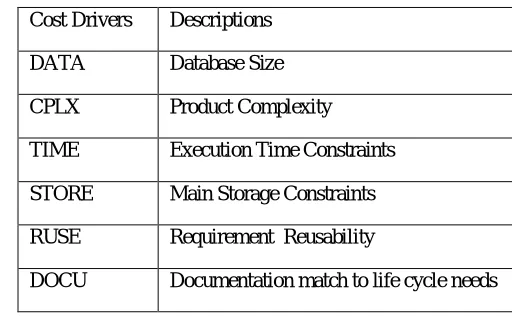
[image:3.612.171.427.579.737.2]CocomoII The COCOMO Dataset not new in the analysis and acceptance of the model is achieving from the historic projects of NASA. One set of dataset response of 63 projects and other has 93 projects. The datasets is of COCOMO II format. In our measures 93 projects are used for training and 63 projects are used for testing .Number of effort adjustment factor is increases by 5, now it becomes 22 as shown in table 1.
Table 1: Cocomo dataset
Cost Drivers Descriptions
DATA Database Size
CPLX Product Complexity
TIME Execution Time Constraints
STORE Main Storage Constraints
RUSE Requirement Reusability
Technology (IJRASET)
©IJRASET: All Rights are Reserved
353
[image:4.612.123.487.370.566.2]
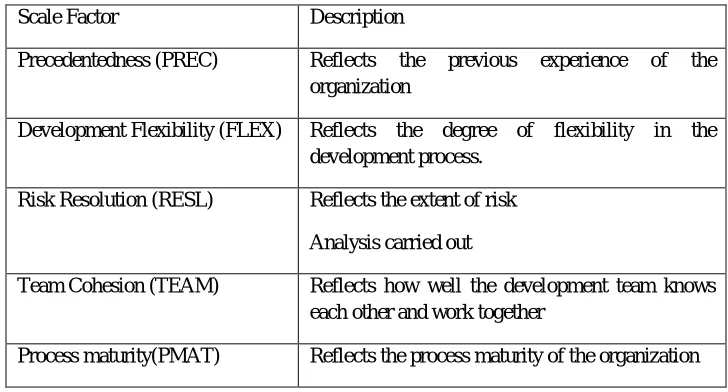
Effort adjustment factors used in intermediate Cocomo other than intermediate Cocomo
Table 2: Cocomo dataset
IV. RELATED WORK
G. E. Wittig, et al.[1] used a dataset of 15 commercial systems, and used feed-forward back-propagation multilayer neural network for their experiment. ANN used in this paper are with numbers of hidden layers varying from 1-6 , but found the best performance for only one hidden layer with sigmoid function. It has been observed that for smaller system the error was 1% and for larger systems error was 14.2% of the actual effort. Jaswinder Kaur, et al.[2] implemented a back-propagation ANN of 2-2-1 architecture on NASA dataset consist of 18 projects. Input was KDLOC and development methodology and effort was the output. He got result MMRE as 11.78. Many researchers used their different ANN and different dataset, to predict the effort more correctly. F. Barcelos Tronto, et al.[4], also used COCOMO-81 dataset, with only one input, i.e TOTKDSI (thousands of delivered source instructions). All the input data were normalized to [0, 1] range. Here a feed-forward multilayer back-propagation ANN was used with the 1-9-4-1 architecture.
The performance in MMRE found was 420, where as that of COCOMO and FPA was 610 and 103 respective. The paper presented
PVOL Platform Volatility
SCED Scheduling Factors
RELY Required Reliability
TOOL Use Of Software Tools
APEX Application Experience
ACAP Analyst Capability
PCAP Programmability Capability
PLEX Platform Experience
LITE Language and Tool Experience
PCON Personnel continuity
SITE Multisite Development
Scale Factor Description
Precedentedness (PREC) Reflects the previous experience of the
organization
Development Flexibility (FLEX) Reflects the degree of flexibility in the
development process.
Risk Resolution (RESL) Reflects the extent of risk
Analysis carried out
Team Cohesion (TEAM) Reflects how well the development team knows
each other and work together
Technology (IJRASET)
©IJRASET: All Rights are Reserved
354
by TOSUN, et.al. [5], a novel method for assigning weights to features by taking their particular importance on cost in to analysis. Two weight assignment searching are implemented which are inspired by a widely used numerical technique called Principal Component Analysis (PCA). The paper by BURGESS and LEFLEY [7], calculate the potential of Genetic Programming (GP) in software effort estimation and comparison is made with the Linear LSR, ANNs etc.
The paper by Abbas Heiat, [8], measure the neural network approach and old regression analyses in terms of mean value percentage error. The balancing was done in terms of multilayer perceptron and radial basis function based neural network to that of regression tests which display that neural network gives the best results and improved performance in terms of effort estimation. A recent study by Jorgensen provides a detailed review of different studies on the software development effort [15].
Nasser Tadayon [16] has proposed a dynamic neural network that will initially use COCOMO II Model. COC OMO, however, has some limitations. It cannot forcefully deal with imprecise and uncertain information, and calibration of COCOMO is one of the most functional tasks that need to be done in order to get accurate estimations. So, there is always scope for developing effort estimation models with better guessing accuracy. In Ref[19]. The author has explained that one of the greatest challenges for the software industry is to select the best approach to compute the effort estimation cost of the software. Neural techniques have proved very effective in software effort estimation.
The performance of a neural network depends on its architecture and their parameter settings. There are many parameters dominate the architecture of the neural network including the number of layers, the number of nodes in each layer, the transfer function in each node, study algorithm parameters and the weights which determine the connectivity between nodes. Garbage selection of network patterns and learning rules may cause serious difficulties in network performance and training. The complication is to decide the number of layers and number of nodes in the layers and the research algorithm as well. However, the criterion is to select the minimum nodes which would not impair the network performance. The number of layers and nodes should be minimized to amplify the performance [21]. ANN(Artificial Neural Network) techniques to compute the presentation indices Mean Magnitude-Relative-Error (MMRE), Relative-Root-Square Error (RRSE), Correlation Coefficient (CC), Root-Mean Square-Error (RMSE), Mean-Square-Error (MSE).
By the above reference work what we came about is that there is no one good technique will be used for the Predicting Effort Estimation using neural networks.
V. EVALUATION CRITERIA
For evaluating the different software effort estimation models, the most widely accepted evaluation criteria are the mean magnitude of relative error (MMRE), Probability of a project having relative error less than 0.25,Root mean square of error, Mean and standard deviation of error.
MREi=
| |
(1)
The MRE value is calculated for each observation whose effort is predicted. The aggregation of MRE over multiple observations can be achieved through the mean MMRE.
MMRE = i∑ (2)
PRED(25) = .
(3)
Consider Y is the neural network output and T is the desired target. Then Root mean square error (RMSE) can be given by[1].
RMSE= ( − )2 (4)
VI. EXPERIMENT
A. Data Preparation
Technology (IJRASET)
©IJRASET: All Rights are Reserved
355
B. ANN Preparation
In this experiment we have created different types of neural network and compare their performance. In that back-propagation neural networks and one recurrent neural network is used. MATLAB10 NN tool is used for this experiment. Maximum of the work in the application of neural network to effort estimation made use of feed-forward multi-layer, Back-propagation algorithm. However many researchers refuse to use them because of their fault of being the black boxes that is, certain why an ANN makes a particular decision is a difficult task. But then also many different models of neural nets have been proposed for solving many elaborate real life problems [9].
The 7 steps for effort estimation using ANN can be outline as follows:
1) Data Collection: Collect data for already developed projects like method used, and other characteristics.
2) Division Of Data Set: Divide the number of data into two factors – training set & validation set.
3) ANN Design: Construct the neural network with number of neurons in input layers like as the number of characteristics of the project.
4) Training: Grain the training set first to train the neural network.
5) Validation: Later training is over then validates the ANN with the validation set data.
6) Testing: Lastly test the created ANN by feeding test dataset.
7) Error Calculation: Analysis the performance of the ANN. If satisfactory then stop, else again go to step (3),make some changes to the network parameters and proceed.
VII. RESULT
Comparison results of BPN for training is given below in Table3. A model which gives lower
MMRE is better than the model which gives higher MMRE. A model which gives higher PRED (25) is better than the model which gives lower PRED (25). Similarly the model which gives lower RMSE is better than the model which gives higher RMSE. The model which mean and standard deviation nearest to Zero is better than the models which gives mean and standard deviation far away from zero.
Technology (IJRASET)
©IJRASET: All Rights are Reserved
356
Table3: Results of Training for BPN
VIII. CONCLUSION
Different methods of neural network have been used to calculate effort estimation. Each and every technique focuses on providing best software effort estimation. In our paper we propose neural network is a good approaching estimating development effort. It was suggested for complex and computationally large projects it’s better to use neural network approach. But there is a need to examine accuracy of methods which mostly required in software effort estimation. We analysed that neuron based models have better estimation capability and hence can be used to calculate software effort estimation of all kinds of project.
REFERENCES
[1] G.E. Wittig and G.R Finnic, ―Using Artificial Neural Networks and Function Points to estimate 4GL software development effort‖, AJIS,1994, page:87-94. [2] Jaswinder Kaur, Satwinder Singh, Dr. Karanjeet Singh Kahlon, Pourush Bassi, 2010. Neural Network- A Novel Technique for Software Effort Estimation.
[3] Sheta, A., Rine, D., & Ayesh, A. (2008, June). Development of software effort and schedule estimation models using soft computing techniques. In Evolutionary Computation, 2008. CEC 2008.(IEEE World Congress on Computational Intelligence). IEEE Congress on (pp. 1283-1289). IEEE.
[4] Ali Idri and Taghi M. Khoshgoftaar& Alain Abran,‖Can Neural Networks be easily Interpreted in Software Cost Estimation‖, IEEE Transaction, 2002, page:1162-1167.
[5] Venkatachalam, Software Cost Estimation Using Artificial Neural Networks, International Joint Conference on Neural Networks, Nogoya,IEEE, 1993. [6] A.Tosun, B. Turhan and A.B. Bener, “Weighting Heuristics for Analogy- based Effort Estimation Models,” Expert Systems with Applications, vol. 36,
pp.10325-10333, 2009.
[7] C.J. Burgess and M.Lefley, “Can Genetics Programming improves Software Effort Estimation? A Comparative Evaluation,” Information and Software Technology, vol.43, pp.863-873, 2001.
[8] Abbas Heiat, Comparison of Artificial Neural Network and Regression Models for Estimating Software Development Effort, Information and Software Technology, vol.44, pp.911-922, 2002.
[9] Prabhakar, Maitreyeea Dutta, 2013. Prediction of Software Effort Using Artificial Neural Network and Support Vector Machine.(2013).
[10] Clark, B., Chulani, S. and Boehm, B. (1998), “Calibrating the COCOMO II Post Architecture Model,” International Conference on Software Engineering, Apr.1998.
[11] I.F. Barcelos Tronto, J.D. Simoes da Silva, N. Sant. Anna , ―Comparison of Artificial Neural Network and Regression Models in Software Effort Estimation‖,
INPE ePrint, Vol.1, 2006.
[12] Putnam, L. H. (1978). A general empirical solution to the macro software sizing and estimating problem. IEEE transactions on Software Engineering, 4(4), 345-361.
[13] Lippmann, Richard P. "An introduction to computing with neural nets." ASSP Magazine, IEEE 4.2 (1987): 4-22.
[14] S.Kanmani, J. Kathiravan, S. Senthil Kumar and M. Shanmugam, “Neural Networks Based Effort Estimation using Class Points for OO Systems”,IEEE proceedings of the International Conference on Computing: Theory and Applications(ICCTA’2007).
[15] Jorgerson, M., “Experience with accuracy of software maintenance task effort prediction models,” IEEE Transactions on Software Engineering, Volume 21 (8), 674–681, 1995.
[16] Nasser Tadayon, “Neural Network Approach for Software Cost Estimation”, IEEE proceedings of the International Conference on Information Technology: Coding and Computing(ITCC ’2005).
[17] S.N. Sivanandam, S.N. Deepa, Principles of Soft Computing, Wiley India (2007).
[18] B.W. Boehm, “Software Engineering Economics,” IEEE Trans Software Eng., vol. 10, no. 1, pp. 4-21, 1984.
[19] T. Mukhopadhyay, S.S. Vicinanza, and M.J. Prietula, “Examining the Feasibility of a Case-Based Reasoning Model for Software Effort Estimation,” MIS Quarterly, vol. 16, pp. 155-171, June, 1992.
[20] Y. Miyazaki et al., “Method to Estimate Parameter Values in Software Prediction Models,” Information and Software Technology, vol. 33, no. 3, pp. 239-243, 1991.
[21] Suresh Nageswaran, ”Test Effort Estimation Using Use Case Points”, Quality Week , San Francisco, California, USA, June 2001.
[22] Vahid Khatibi, Dayang N. A. Jawawi, ”Software Cost Estimation Methods: A Review”, Journal of Emerging Trends in Computing and Information Sciences, ISSN 2079-8407, Volume 2 No.1, pg. no 21-29,2010-11.
[23] Hareton Leung, Zhang Fan, ”Software Cost Estimation”, Article 2001.
[24] Bogdan Stepien, ”Software Development Cost Estimation Meth- ods and Research Trends”,Computer Science, Vol.5,2003.
Performance
Measures
BPN
Min Max Mean
MMRE 0.0371 0.2098 0.0789
PRED(25) 72.712 89.002 79.806
RMSE 0.3449 2.0168 0.6122
Technology (IJRASET)
©IJRASET: All Rights are Reserved
357
[25] Jin Yongqin, Li Jun, Lin Jianming, Chen Qingzhang, ”Software Project Cost Estimation Based On Groupware”, World Congress on Software Engineering, IEEE, 2009.
[26] Chen Qingzhang, Fang Shuojin, Wang Wenfu, ”Development of the Decision Support System for Software Project Cost Estimation”, World Congress on Software Engineering,IEEE, 2009.