Technology (IJRASET)
©IJRASET 2015: All Rights are Reserved
887
Human Identification System Based On Iris Scan
Varsharani M. Sultanpure1, Prof. S. D. Mali2 1,2DepartmentofE&TC,
1,2SinhgadCollegeofEngineering,Pune,India.
Abstract— Biometrics includes various technologies for uniquely identifying an individual person in accordance
with anexamination ofparticular attributes ofeithertheperson’sinteriororexterioreye.Thetechnologies havemade
biometricsystemsmore accurate, convenient, and secure than the widely referred means of identification such as
ID cards. In this paper, identification and verification approach based on human iris pattern is represented. The
system is based on several steps from capturing the iris pattern, determining and localizing the iris boundaries,
transformationoflocalizedirisintorectangular andpolar components, extracting the features from image based on
wavelet transformation and at the end matchingofthe irisbasedonthe calculating the Hammingcodes ofdifferent
irises.PublicallyavailableirisimagedatabasenamelyCASIAversion1.0 isused, insteadofcapturing CCDcamera.In
preprocessing region of interest (RIO) radius of pupil and center of pupil is calculated using scanning method,
normalization of iris image is done using Daugman’s rubber sheet model. Performance evaluation parameters,
computation time, humming distance variation, False Acceptance Rate (FAR) , False Rejection Rate (FRR) are
calculatedthroughvariousfundamentalandgraphicalperformancemeasures.
IndexTerms:irisrecognition;segmentation;Wavelettransform;Hammingdistance;Matchscore;Performance
evaluation
I. INTRODUCTION
Human identification is a goal as ancient’s humanity itself. As technology and services have developed in modern world, human activities and transactions have proliferated in which rapid and reliable personal identification is required. Examples includes passport control, computer login control, bank automatic teller machines and other transaction authorization, premises access control, and security system generally. all such identification efforts share the common goals of speed, reliability and automation. Biometric indicia is used for identification purposes requires that a particular biometric factor be unique for each individual that it can be voluntarily measured, and that it is invariant over time. Biometrics such as photographs, fingerprints, signatures, voiceprints and retinal blood vessel pattern all have significant drawbacks. Although photographs and signatures are despicable and easy to obtain and store, and easily forged. Electronically recorded voiceprints are significant drawback. Although photographs and signatures are despicable and easyible to changes in a person’s voice,and they can be counterfeited
to obtain and store, and easily forged. Electronically recorded voiceprints are susceptible to changes in a person’s voice, and they can be counterfeited. Human iris is an internal organ of the eye and well protected from the external environment, yet it is easily visible from within one meter of distance makes it a perfect biometric for an identification system with the ease of speed, reliability and automation.
[image:2.612.188.415.607.701.2]Biometric Recognition System process starts by the image capturing or data sample acquisition. image capturing is the process of capturing all information related to biological attribute of the subject, the objective is to measure data that can be used to identify the important and unique properties of the subject which are stable and repeatable over time and and converts the measured data Into a format that is suitable for image analysis.
Technology (IJRASET)
A quality measure module determines whether the captured biometric image samples having the suitable feature for next processing. An enhancement check module is used to develop the signal quality. Both of these modules are included in first stage. Using feature extraction stage, only the useful significant information from a biometric trait that is used for the person identification task is encoded and a biometric template is formed. these templates are stored in the database called as registered database .In identification scheme, the subject's template is compared with the stored templates. A match system module compares two attribute sets during recognition and determines their measure of similarity. A decision module determines the user identity based on the similarity output by the matcher. If the comparison between biometric templates has almost comparable, it is implicit that both of these were extracted from the similar person, otherwise, they will be extracted from different persons.
The performance of a biometric system may also be summarized using single-valued measures such as the Equal Error Rate (EER) and the d-prime value. higher d-prime value indicates better performance.
II.SYSTEM BLOCK DIAGRAM
Identify or Rejected value
Fig. 2. illustrates the basic Block diagram of Human Identification systems.
A.IrisSegmentationstage
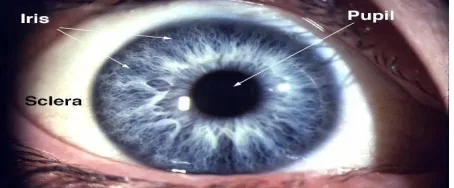
The first stage of Human Identification System is to isolate the actual iris region in a digital eye image. the iris region ,can be approximated by two circles, first one for the scalara boundary and second one, interior to first, for the pupil boundary. The eyelids and eyelashes are appears as upper and lower part of the iris region. The success of segmentation depends on the imaging quality of eye image.
The segmentation stage is difficult to the success of an iris identification system, so the data which is wrongly represented as iris pattern data will corrupt the generated biometric templates ,resulting in the poor recognition rates.
1)Iris SegmentationTechniques
a) ActiveContourModels: Ritter et al. makes use of active contour models for localizing the pupil in eye images. Active contours respond to pre-set internal and external services by deforming internally or moving across an image until symmetry is reached. The contour contains number of vertices, whose position changed by two opposing forces that is internal forces, which is depends on the image. For pupil location ,the internal forces are calibrated due to which the contour forms globally increasing discrete circle. Each vertex is moved between time t and t + 1 by,
= + + (1)
Where is the internal force, is the external force and is the position of vertex i . the external forces
Technology (IJRASET)
©IJRASET 2015: All Rights are Reserved
889
it reaches equilibrium, and the pupil is localized.
B.IrisNormalization
Daugman suggested normal Cartesian to polar transformation that maps each pixel in the iris area into a pair of
polar coordinates(r, θ), where r and θ are on the intervals of [0 1] and [0 2π] .this represent is called as Rubber Sheet Model.
Once the pupil is detected the iris section can be extracted easily. we have taken the small part of iris region for further processing .we use only lower half part of iris region because most of the times the upper iris region is covered by eyelashes which can reduce the accuracy of the system. After determining the limits of the iris, it should be isolated and stored in a separate image. We observed that there is a possibility of the pupil dilating and appearing of different size of pupil for different images. Due to this change the coordinate system by unwrapping the lower part of the iris and mapping all point within the boundary of the iris into polar equivalent using Daugman rubber sheet model as shown in figure 3.
Once the region of interest has been isolated ,it is transformed to a dimensionless polar system. The implemented algorithm is based on the Daugman’s stretched polar coordinate system. For this transformation, the value of r is ranges from [0:32] and angular value spans the normal [0:180]. That means we consider only 32 pixel in angle
The remapping of the iris image I(x, y) from raw Cartesian coordinates (x, y) to the dimensionless non concentric polar
coordinate system (r, θ) can be represented as:
I(x(r;θ); y(r;θ))Ű→ I(r;θ) (2)
where x(r, θ) and y(r, θ) are defined as linear combinations of two set of pupillary boundary points (xp(θ);yp(θ)) and the
set of limbus boundary points along the outer perimeter of the iris (xs(θ); ys(θ)) bordering the sclera, which are
found in the iris segmentation stage as:
x(r;θ) = (1 - r) * xp(θ) + (1 - r) * xs(θ) (3) y(r;θ) = (1 - r) * yp(θ) + (1 - r) * ys(θ)
(4)
Fig. 3. Normalization of the iris image through the Daugman rubber sheet.
C.FeatureExtraction
In order to provide accurate recognition of individuals, the most discriminating information present in an iris pattern which must be extracted. Only the significant features of the iris must be encoded so that comparison between templates can be made. Most iris recognition system makes use of a band pass decomposition of the iris image to create a biometric template. The template that is generated in the feature encoding process will also need a corresponding matching metric, which gives a measure of similarity between two iris templates. This metric should give one range of values when comparing templates generated from the same eye, known as intra-class comparisons, and another range of value when comparing templates created from different irises, known as inter-class comparisons. These two cases should give distinct and separate values, so that a decision can be made with high confidence as to whether two templates are from the same iris or from two different irises.
Technology (IJRASET)
D.FeatureComparison
The method chosen to compare between iris signature is highly trained by the feature extraction strategy, the feature comparison is normally performed through the use of distance metrics: Hamming, Weighted Euclidean methods based on signal correlation.
III. SOFTWARE REQUIREMENT
A.IrisImageDatabases
We describe the main characteristics of the public and freely available iris image databases for biometrics purposes.
1) PublicandFreeDatabases: The biometrics research and development demands the analysis of human data. Obviously, it is unrealistic to perform the test of algorithms in data captured on them, due to the complexity. Therefore, when it comes to the test of recognition methods, standard biometric databases consider high relevance to the development process. In order to evaluate the performance of iris recognition system, the benchmark database plays an important role.
a)CASIADatabase: CASIA iris image database the CASIA v.1 database includes 756 iris images from 108 eyes, hence 108 classes. For each eye, 7 images are captured in two sessions, where three samples are collected in the first and four in the second session.
IV. ACKNOWLEDGMENT
Behind every successful work, there are efforts of many people, directly or in-directly. I take this opportunity to thank all those who helped me during this endeavor.
First of all, I would like to express my sincere, profound sense of gratitude towards my guide Prof. S. D. Mali and co-guide Prof. Achala Deshmukh who was always there with me to show me the way whenever I was in need. I am privileged by being associated with him. His constant support and inspiration gave me the initial thrust required to excel further. I am thankful to Dr. S. D. Lokhande, Principal of Sinhgad College of Engineering, Pune for his zealous and encouraging attitude. I am thankful to Dr. M. B. Mali ,Head of Electronics and Telecommunication Department and Prof. S. O. Rajankar, P.G. Coordinator ,Digital System for their all-round support. I devote this work to my family who are behind success of this work. Without their support, this work would have been impossible.
REFERENCES
[1] J. G. Daugman, “How iris recognition works," IEEE Transactions on Circuits and Systems for Video Technology, vol. 14, pp. 21-30, January 2004.
[2] J. G. Daugman, “High confidence visual recognition of persons by a test of statistical independence", IEEE Transactions on Pattern Analysis and
Machine Intelligence, vol. 25, pp. 1148-1161, November 1993.
[3] A. K. Jain, Handbook of Biometrics. New York, USA: Springer, 2007.
[4] H. Proenca, “Towards Non-Cooperative Biometric Iris Recognition”, PhD thesis, University of Beira Interior, Department of Computer Science, october 2006.
[5] W. W. Boles and B. Boshash, “A human identification technique using images of the iris and wavelet transform", IEEE Transactions on Signal Processing, vol. 46, pp. 1185-1188, April 1998.