acting as a sensor so it can take the images that are under process to show occupancy of car parks and also free parking slots. By having this image, the particular car park vacant can be known rather than wasting time to find one. This proposed system has been developed in both software and hardware platform. This automatic parking system makes the whole process of parking cars more efficient and less complex for both drivers and administrators.
Keywords: Smart parking, Image processing, Intelligent parking, time saving parking, IOT based parking
I. INTRODUCTION
This project aims that currently most of the existing car parks do not have an organized system. Most car parks nowadays are not run efficiently. This means that on busy days drivers may take an extra time driving around a car parking in order to find a free parking space. Implementing this system will help to solve the growing problem of traffic congestion, wasted time, wasting money, and help provide better public service, reduce car emissions and pollution, improve city visitor experience, increase parking utilization, and prevent unnecessary capital investments. This problem usually occurs in urban areas, where number of vehicles is superior as compared to the availability of parking spaces. These ineffective circumstances happened because of the lack of implementation in technologies which are available in the market today. From manual implementations used in the old systems, they have evolved into fully automated and computerized systems. Nowadays, there are many methods used in detecting the free parking space in parking lots. In the project, a camera is used as a sensor for video image detection. This is due to its capability and cheap cost. A computer system that manages the whole process and various display panels and lights that assist the driver in parking his car is implemented.
II. SYSTEM MODULE
The Vehicle counting module is used for the counting of number of vehicles in the parking area. This involves the Feature extraction, Classification by ANN and the Output. One or more cameras are used for vehicle counting module .Software is needed to process the images captured by cameras .The video image technique has five modules for this type of photo.
A. Vehicle counting module
Y It is a cyclic process. Once the software starts running it had to be constantly kept running so that the output is real time. Various blocks that are involved in the vehicle counting module are shown in the fig.1
Fig.1 Block diagram for Vehicle Counting Module B. Image acquisition
Fig.2 showing the model of parking lot
C. Image Processing
We use gray scale image so that it can be processed faster. Image needs to be converted to a gray scale format so that each pixel can be simply compared with the threshold. The equation to do is shown in Equation (1). The rgb2gray command is used to do this. Gray = (0.299*r + 0.587*g + 0.114*b) (1)
[image:3.612.214.411.272.424.2]Equation (1) is to convert RGB values to a gray value.
Fig.3 Grayscale image
D. Edge detection
Edge detection is an image processing method for finding the boundaries of objects within images. The process works by detecting discontinuities in brightness .Edge detection is used for image segmentation and data extraction in fields such as image processing, computer vision, and machine vision.
Fig. 4 Edge detected region
E. Image development
[image:3.612.213.409.492.679.2]Fig. 5 Dilated image
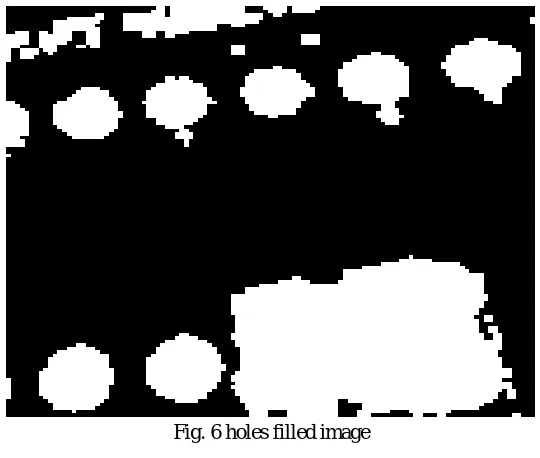
After dilating the image we will fill the image to form proper circles so that they can be detected and in this project we work and find out using circles.
Fig. 6 holes filled image
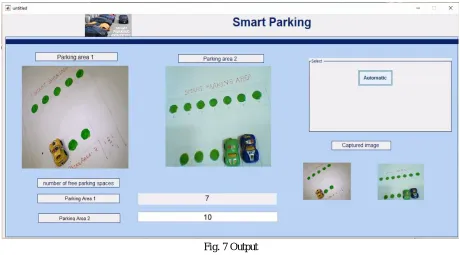
III. GUI
[image:4.612.176.446.405.634.2]Fig. 7 Output
IV. CONCLUSIONS
An image based method of detecting the availability of a car park was modeled and tested with different occupancy scenarios of car parks. The method of analyzing an aerial view of the car park has been presented step by step. This consists of finding car park coordinates from an empty car park, acquiring an image with cars, converting the image to black and white for simple analysis, removing noise and determining whether car parks are vacant or filled. The current limitation in this project is the accurate test reading results in few errors which we hope to overcome in future..
REFERENCES
[1] Thomas Moranduzzo, Student Member, IEEE, and Farid Melgani, Senior Member, IEEE, “Detecting Cars in UAV Images With a Catalog-Based Approach”,
IEEE Transactions on Geoscience and Remote Sensing, vol. 52, no. 10, October 2014, pp.6356-6367
[2] 2) M. Blumenstein, B. K. Verma and H. Basli, A Novel Feature Extraction Technique for the Recognition of Segmented Handwritten Characters, 7th
International Conference on Document Analysis and Recognition (ICDAR ’03) Eddinburgh, Scotland: pp.137-141, 2003.
[3] 3) R. Gonzalez, E. Woods, Digital Image Processing, 2nd edition , Prentice hall.
[4] 4) R. Yusnita, Fariza Norbaya, and Norazwinawati Basharuddin, “Intelligent Parking Space Detection System Based on Image Processing”, International
Journal of Innovation, Management and Technology, Vol. 3, No. 3, June 2012, pp.232-235.
[5] 5) T. Zhao and R. Nevatia, “Car detection in low resolution aerial images,” in Proc. IEEE Int. Conf. Comput. Vis., 2001, pp. 710–717.
[6] 6) Ms.Sayanti Banerjee, Ms. Pallavi Choudekar and Prof. M. K. Muju. “Real time car parking system using image processing,” 2011. IEEE, pp. 99-103.
[7] 7) Wolff, J., Heuer, T., Gao, H., Weinmann, M., Voit, S. and Hartmann, U. (2006) Parking Monitor System Based on
[8] 8) Magnetic Field Sensors. Proceedings of the IEEE ITSC 2006 Intelligent Transportation Systems Conference, Toronto,17-20 September 2006, 1275-1279.
http://dx.doi.org/10.1109/ITSC.2006.1707398
[9] 9) Wang, L.F., Chen, H. and Li, Y. (2009) Integrating Mobile Agent with Multi-agent System for Intelligent Parking Negotiation and Guidance. 4th IEEE
Conference on Industrial Electronics and Applications, 25-27 May 2009, Xi’an,1704-1707.
[10] 10) Lin, S., Chen, Y. and Liu, S. (2006) A Vision-Based Parking Lot Management System. IEEE International Conference on Systems, Man, and Cybernetics,
Taipei, 8-11 October 2006, 2897-2902.