5
IX
September 2017
Evaluation of Stability of Water-Based Nano Fluids
Using UV/VIS Spectrophotometer
Gulivindala Anil kumar1, Sajja. Ravi Babu2
1
Student, Thermal engineering, M.tech ,GMRIT,Rajam
2
Sr.Asst Professor, Department of Power Engineering, GMRIT, Rajam
Abstract: Stability is a key issue while preparing and utilization of nano fluids. Stable suspension by direct dispersion of nano particles in base fluids is not possible. Modifiers such as magnetic stirring, ultra sonication, pH modifiers and surfactant addition are used to increase the stability. But these pH modifiers and surfactant addition affect properties whereas magnetic stirring, ultra sonication involved in time consumption. There is a need to find the best method to get stable suspension with less effect on properties. The present study involves the measurement of stability in terms of absorbance by using UV/Vis spectroscopy. From this study best modifier is identified and analyzed to get better results.
Keywords: Nano fluids, stability, modifiers, absorbance
I. INTRODUCTION
Dispersing certain weight fraction of nano particles in base fluids is called as Nano fluids. Due to outstanding enhancement in thermal conductivity compared to base fluids made nano fluids as promising heat transfer fluids. These findings encouraged to enhance convection heat transfer of commonly used coolants modified by nano particles (1). It has been reported that the enhancement of nanofluids depend not only on nanoparticle parameters but also on their suspension stability in base fluid. (2)
Unfortunately, the nano particles have a great tendency to aggregate due to their higher densities compared to base fluids and this deteriorates the nano fluid performance (3).
It is necessary to keep uniform and homogenous dispersion of nano particles at different volume fractions to obtain possible enhancement. Thereforeit is important measure stability of nano fluid for quality issue also.
Various stabilization methods such as ultra-sonication, pH control, and adding surfactant had been considered to enhance stability during preparation of nanofluids (4).
Previously, the methods to inspect stability were limited to sedimentation, photo capturing, TEM (transmission electron microscopy), SEM (scanning electron microscopy), from 2003, a new method for stability measurement by UV-Vis Spectrophotometer is adopted (5). In this paper, the effect of pH values and SDBS (sodium dodecyl benzene sulphate) surfactant concentration, ultra sonication, magnetic stirring are studied.
The absorbance measurements using UV-Vis spectrophotometer were taken as the stability responses after preparation. The objective of this work is to optimize the stability based methods of magnetic stirring, ultra sonication and surfactant addition through pH control. Appropriate time to get stable suspension by magnetic stirring and ultra-sonication is explained by measuring absorbance through UV-Vis spectrophotometer is discussed. Furthermore, the optimum stable combination of SDS wt. % is and its effects also explained.
A. Preparation of nanofluid
International Journal for Research in Applied Science & Engineering Technology (IJRASET
)
ISSN: 2321-9653; IC Value: 45.98; SJ Impact Factor:6.887 Volume 5 Issue IX, September 2017- Available at www.ijraset.com
Fig.1: magnetic stirring of Al2O3- H2O
Fig.2: ultra- sonication of Al2O3- H2O
B. Experimentation
1) Ultraviolet/Visible spectroscopy: UV/Vis spectroscopy was used extending over a range of wavelengths from 200 nm to 900 nm (11). The output is a relation between absorbance of light and wavelength. To assess the dispersion of nanoparticles in base fluid, the absorbance of nano fluids sample is compared to the absorbance of water (base fluid). The difference in absorbance is directly related to nanoparticle concentration. The absorbance measured directly after preparation is taken as a reference, where sedimentation process is not effective at that time due to small sedimentation velocity. In this case the concentration of the upper part of the sample is reduced with a subsequent reduction in the effective surface area of nanoparticles. This will be directly reflected on the maximum absorbance measured by UV/Vis spectroscopy. So, any fall in the absorbance value can be easily related to agglomeration rate of Al2O3 nano particles (12).
Based on this illustration, UV/Vis spectroscopy can be used to assess the stability of nano particles in water-based nanofluids. The measurements were performed by pouring the nanofluids sample in a cuvette cell through which electromagnetic radiation is passed. This cuvette has a two highly polished faces to minimize reflection and scatter losses. The other two faces are transparent, where they faces incident light beam. Directly after preparation, a sample was drawn from prepared nano fluids, and then it was poured into the cuvette for testing.
II. RESULTS & DISCUSSIONS
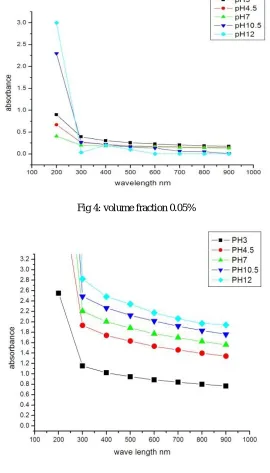
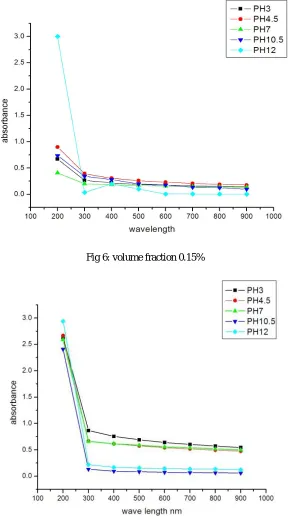
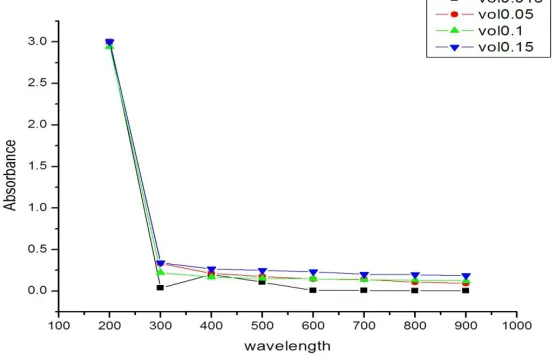
[image:4.612.170.440.235.708.2]Surfactant addition, pH modifiers affect adversely on the properties but give instant results. Magnetic stirring, ultra-sonication are found to be good stability modifiers without changing any properties but it does not give instant results (13). In our study, the influences of properties are never discussed. Selection of suitable surfactant, time to spend on mechanical modifiers can be known by drawing a relation between pH and absorbance.
Fig 4: volume fraction 0.05%
International Journal for Research in Applied Science & Engineering Technology (IJRASET
)
[image:5.612.161.451.83.603.2]ISSN: 2321-9653; IC Value: 45.98; SJ Impact Factor:6.887 Volume 5 Issue IX, September 2017- Available at www.ijraset.com
Fig 6: volume fraction 0.15%
Fig7: volume fraction 0.1%
Fig.8: vol 0.015% with magnetic stirring
Fig.9: vol 0.05% with magnetic stirring
[image:6.612.178.431.80.261.2]International Journal for Research in Applied Science & Engineering Technology (IJRASET
)
[image:7.612.219.394.82.239.2]ISSN: 2321-9653; IC Value: 45.98; SJ Impact Factor:6.887 Volume 5 Issue IX, September 2017- Available at www.ijraset.com
Fig.11: vol 0.15% with magnetic stirring
[image:7.612.161.445.324.728.2]From the fig.8, 9, 10, 11 it can be observed that by using magnetic stirring there is a possibility to get stable suspension. But at higher volume fractions, magnetic stirring is not enough to stable suspension. Because at higher volume fractions, speed offered by magnetic stirrer is failed to break the agglomerations. At lower volume fractions such as 0.015, 0.05 magnetic stirring showed good results and it needed continuous stirring of 1 hour.
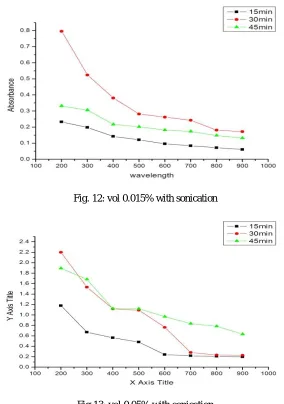
Fig. 12: vol 0.015% with sonication
[image:7.612.167.441.344.505.2]Fig.14: vol 0.1% with sonication
International Journal for Research in Applied Science & Engineering Technology (IJRASET
)
ISSN: 2321-9653; IC Value: 45.98; SJ Impact Factor:6.887 Volume 5 Issue IX, September 2017- Available at www.ijraset.com
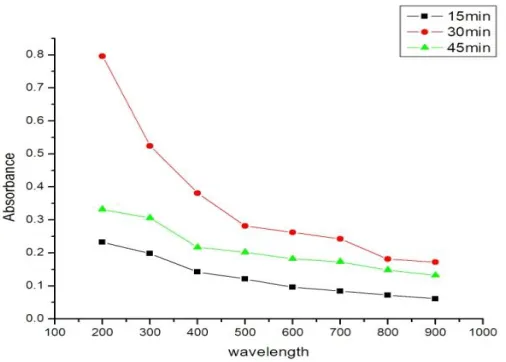
[image:9.612.169.449.156.335.2]From the fig.12, 13, 14, 15 it can be observed that at higher volume fractions only the energy offered by pulsating wave utilized more. However, after passing the optimized duration of the process, it will cause more serious problems in agglomeration and clogging results in fast sedimentation. For continuous sonication of 30 min is found to be enough to get stable suspension but further reduces the absorbance. It showed that a high energy pulsating wave made agglomeration. Obtained result made an agreement with the other experimental work. (4)
Fig. 16: different volume fractions with surfactant
From the above graphs 16, the effect observed by the NaoH can be as the surfactant SDBS. As the sodium dodecane benzene sulphate base in nature, it follows the same trend followed by the NaoH. A repulsion force between nano particles is made the base fluid to stand at iso-electric point but due to rise in the surface charge of the particles increases the van der Waals attractions which increase agglomerations. Sodium dodecane benzene is not good surfactant for Al2O3– H2O nano fluids and the same opinioned in another work.
(16)
III. CONCLUSIONS
In this paper, the stability of water- based Al2O3 has been evaluated UV/Vis considering the effect of volume fraction, stability modifiers. A relation is drawn between the pH and absorbance. It is proved that SDBS is no longer suitable surfactant and it is showed negative results. There is no need of ultra-sonication for smaller volume fractions and magnetic stirring has does not show good results in higher volume fractions.
A.0.015, 0.05 volume fractions require 1 hour of magnetic stirring to get stable suspension during the experiment.
B.0.1, 0.15 volume fractions require 45 min of ultra-sonication to get stable suspension during the experiment.
C. A surfactant maintains its pH lower than 4.5 or higher than 10 give stable suspensions in water based nano fluids
IV. ACKNOWLEDGEMENT
The authors can acknowledge any person/authorities in this section. This is not mandatory.
REFERENCES
[1] Stephen U. S. Choi1 and J. A. Eastman2, “Enhancing thermal conductivity of fluids with nanoparticles” , ASME November 1995, Conference , Sanfrancisco [2] A. Nasiri, M. Shariaty-Niasar, A. Rashidi, A. Amrollahi and R.Khodafarin, “Effect of dispersion method on thermal conductivity andstability of nanofluid,”
Experimental Thermal and Fluid Science, Vol.35, pp. 717-723, 2011.
[3] W. Evans, R. Prasher, J. Fish, P. Meakin, P. Phelan, P. Keblinski, Effect ofaggregation and interfacial thermal resistance on thermal conductivity ofnanocomposites and colloidal nanofluids, Int. J. Heat Mass Transfer 51 (5-6)(2008) 1431–1438
[4] R. Sadeghi · S. Gh. Etemad · E. Keshavarzi ·M. Haghshenasfard, “Investigation of alumina nanofluidstability by UV–vis spectrum ” Springer-Verlag Berlin Heidelberg 2014
[5] Kreibig U, Genzel L (1985) Optical absorption of small metallic particles. Surf Sci 156:678–700
[7] Y. Hwang, J.K. Lee, C.H. Lee, Y.M. Jung, S.I. Cheong, C.G. Lee, B.C. Ku, S.P. Jang,Stability and thermal conductivity characteristics of nanofluids, Thermochim.Acta 455 (1-2) (2007) 70–74
[8] Y. Hwang, J.-K. Lee, J.-K. Lee, Y.-M. Jeong, S.-i. Cheong, Y.-C. Ahn, S.H. Kim, Production and dispersion stability of nanoparticles in nanofluids, PowderTechnol. 186 (2) (2008) 145–153
[9] G.P. Peterson, C.H. Li, Heat and mass transfer in fluids with nanoparticle, Adv.Heat Transfer Suspensions 39 (2006) 257–376 [10] Diaa-Eldin A. Mansour and Eman G. Atiya, Application of UV/Vis Spectroscopy to Assess the
Stability of Oil-Based Nanofluids, IEEE978-1-5090-4654-6/16, 2016
[11] A. Ghadimi, R. Saidur and H.S.C. Metselaar, “A review of nanofluid stability properties and characterization in stationary conditions”, Int.Journal of Heat and Mass Transfer, Vol. 54, pp. 4051-4068, 2011
[12] Wei Yu and HuaqingXie, A Review on Nanofluids: Preparation, Stability Mechanisms, andApplications, Hindawi Publishing Corporation Journal of Nanomaterials, Volume 2012,Article ID 435873, 17 pages, doi:10.1155/2012/435873
[13] L. Jiang, L. Gao, J. Sun, Production of aqueous colloidal dispersions of carbonnanotubes, J. Colloid Interface Sci. 260 (1) (2003) 89–94
[14] H. Chang, C. Jwo, P. Fan, S. Pai, Process optimization and material propertiesfornanofluid manufacturing, Int. J. Adv. Manuf. Technol. 34 (3) (2007) 300–306 [15] S.S. Khaleduzzamana, M.R. Sohela, R. Saidura,b , J. Selvarajb, “Stability of Al2O3-water Nanofluid for Electronics Cooling System”, ScienceDirect, 6th
BSME International Conference on Thermal Engineering (ICTE 2014) 406 – 411