5
X
October 2017
Image Compression Using Discrete Cosine
Transform (DCT) & Discrete Wavelet Transform
(DWT) Techniques
Sunita Devi1, Arvind Kalia2 #
¹Research Scholar,²Professor, Department of Computer science, Himachal Pradesh University, Shimla, India
Abstract: Image compression is a process of reducing or eliminating redundant or irrelevant data. It helps in effective utilization of high speed network resources. Many techniques are available for compressing the images. This paper addressed the two compression techniques, i.e. Discrete Cosine Transform (DCT) and Discrete Wavelets Transform (DWT) that are widely used. DCT is an orthogonal transform and attempts to decorate the image data. DWT is a mathematical tool for changing the coordinate system which represents the signal to another domain that is best suited for compression. The objective is to compare two compression techniques (DCT &DWT) and validate the results using MATLAB. In order to meet the objective the both theoretical and practical approach has been used. The research methodology used practical approach for performance analysis. MATLAB is used as a simulator to implement the techniques of steganography. This is a comparative study based on peak-signal-to-noise (PSNR), compression time (CR) and mean square error (MSE) values of image qualities for corresponding techniques.The performance of the block-based DCT scheme degrades at high compression ratio. On the other hand,the output of the DWT image compression is good.
Keywords: Compression Techniques, DCT, DWT, PSNR, CR, MSE.
I. INTRODUCTION
Image processing is a method to perform some operations on an image, in order to get an enhanced image or to extract some useful information from it. Digital image processing deals with developing a digital system that performs operations on the digital image. Digital media such as images, videos, audios can be loaded or save on disk. The storage space of digital media becomes a major issue in digital image processing. Therefore, the image compression required to solve this issue related to storage space transmission time required. The main objective of image compression is to reduce the size of data, i.e.used to represent a digital media in an efficient manner without causing major degradation to the quality of the image. To increase the efficiency and performance of digital data, image compression is used in various fields like security industries, federal government agencies and health industries. The reduced size may facilitate the quick transfer of the data over the communication channels. There are two types of compression methods. One is lossless and second is lossy compression. In lossless compression no information is lost. It reduces bits by finding and eliminating redundancy. In lossless compression, every single bit of data that was originally in the file remains same after the
file is uncompressed. All of the information is completely restored. The most popular image formats that use lossless compression is
GIF (Graphical Interchange Format) and BMP (bitmap file) [13]. Lossy compression technique reduces the size of data by finding
non-essential information and destroys it. Lossy compression reduces a file by permanently eliminating certain information,
especially redundant information. When the file is uncompressed, only a part of the original information remains. In this case the resulting image is expected to be similar to the original image. An example of an image format that uses this compression technique is JPEG (Joint Photographic Experts Group).
A. Overview Of Image Steganography Techniques
recreate the image from compressed representation. It is a lossy compression algorithm and commonly used for multimedia image or video compression. The DCT helps to separate the image of parts with respect to the image visual quality i.e., High, low & middle frequency components. DCT helps separate the image into parts (or spectral sub-bands) of differing importance (with respect to the image's visual quality). The DCT is similar to the discrete Fourier transform: it transforms a signal or image from the spatial domain to the frequency domain.Here, the input image is of size n*m. f (i, j) is the intensity of the pixel in row i and column j; F(u,v) is the DCT coefficient in row u and column v of the DCT matrix shown in figure1.1.
Figure 1.1: Discrete Cosine Transform of an Image
B. DCT Encoding
The general equation for a 1D (N data items) DCT is defined by equation 1:
---(1) and the corresponding inverse 1D DCT transform is given by F-1 (u), here
The general equation for a 2D (N *M image) DCT is defined by equation 2:
----(2) and the corresponding inverse 2D DCT transform is given by F-1 (u, v),
Here
C. The advantages of DCT are:
1) It has been implemented in a single integrated circuit.
2) It has the ability to pack the most information in fewest coefficients.
3) It minimizes the block like appearance called blocking artifact that results when boundaries between sub-images become visible.
D. DCT compression algorithm:
1) The input image is divided into 8-by-8 or 16-by-16 blocks.
2) The two-dimensional DCT is computed for each block.
3) The DCT coefficients are then quantized, coded and transmitted.
4) The receiver decodes the quantized DCT coefficients, computes the inverse two-dimensional DCT (IDCT) of each block.
E. Discrete Wavelet Transformation (DWT)
DWT is used in signal and image processing, especially for lossless and lossyimage compression.The wavelet transformation is different on merit function than other techniques. Wavelet transforms, use functions that are localized in both the real and Fourier space. It is used to separate the image into a pixel. It transforms a discrete signal. Generally, the wavelet transform can be expressed by the following equation ---(3)
Here “ *” indicates the complex conjugate symbols and function ψ is any function.
Wavelets are described as the functions obtained over a fixed interval and have zero as an average value. This transformation is an extremely necessary way to be used for signal investigation as well as image processing, mainly for multi-resolution demonstration[7]. It may crumble a signal into a number of constituents of frequent domains. 1-D DWT segments a cover image further into two major components known as approximate component and detailed component.L represent the low-pass filtered signalwhich allows the perfect reconstruction of original Imageand H represents the high-pass filtered signal. A 2-D DWT is used to segment a cover image of mainly four sub components: one approximate component (LL) and the other three include detailed components represented as (LH, HL, HH) which is shown in figure 1.2.
Figure 1.2: Discrete Wavelet Transformation Components
DWT refers to wavelet transforms for which the wavelets are discretely sampled. A transform which localizes a function both in space and scaling and has some desirable properties compared to the Fourier transformation [6]. The transform is based on wavelet matrix, which can be computed more quickly than the analogous Fourier matrix. Mostly the DWT is used for signal coding, where the properties of the transform are exploited to represent a discrete signal in a more redundant form, often as a preconditioning for data compression. The wavelet transform describes a multi-resolution decomposition process in terms of expansion of a signal onto a set of wavelet basis functions. Wavelet compression is a form of data compression, well suited for image compression [2].
F. DWT compression algorithm:
1) Digitize the source image into a signal, which is a string of numbers.
2) Decompose the signal into a sequence of wavelet coefficients w.
3) Use threshold to modify the wavelet coefficients from w to w’.
4) Use quantization to convert the w’ to a sequence q. 5) Entropy encoding is applied to convert q into a sequence e.
G. Advantages of DWT over DCT:
1) No need to divide the input coding into non- overlapping 2D blocks, it has higher compression ratios avoids blocking artifacts.
2) Allows good localization both in time and spatial frequency domain.
3) The transformation of the whole image, introduces inherent scaling.
II. RELATED WORK
Kaur and Kaur [10]are of the view that the Image compression is the application of Data compression on digital images. There work entails the study of various image compression techniques and algorithms. Different techniques for digital image compression have been reviewed and presented that include DFT, FFT, DCT and DWT. A new algorithm for image compression using Fast Wavelet Transform has been proposed as FWT reduces the problems of border distortions in Image Compression.Tripathi P.
LL HL
improve the transfer time of the image. Without compression, file size is significantly larger, usually several megabytes, but with compression it is possible to reduce file size to 10 percent from the original without noticeable loss in quality. There are so many compression techniques which already presented a better technique which is the fastest and memory efficient.Negahban F. et al. [11]described a novel technique in image compression with different algorithms by using the transform of wavelet accompanied by neural network as a predictor. In addition, it predicts high level detail sub bands using low level detail sub bands. This Paper consists of four novel algorithms for image compression as well as comparing them with each other and well- known JPEG and jpeg2000 methods.Subbarao [12] is of the view that the Image compression is playing a key role in the development of various multimedia computer services and telecommunication applications. The ideal image compression system must yield good quality compressed images with good compression ratio, while maintaining minimal time cost. The goal of image compression techniques is to remove the redundancy present in the data in a way that enables image compression technique. There are numerous lossy and lossless image compression techniques. Wavelet-based image compression provides substantial improvements in picture quality at higher compression ratios. In this paper both of these methods for compression of images to obtain better quality.Vanaja and Prabha [16]presented a throughput, efficient image compression using, “Set Partitioning in Hierarchical Trees‟ (SPIHT) algorithm
for compression of images. The SPIHT use inherent redundancy among wavelet coefficients and suited for both gray and color images.Jayakar [7] described the performance of different wavelets using the SPIHT algorithm for compressing color image. In this R, G and B component of color image were converted to YCbCr before the wavelet transformation is applied. Y is luminance component; Cb and Cr are chrominance components of the image. The Lena color image was taken for analysis purpose. The image is compressed for different bits per pixel by changing levels of wavelet decomposition. Matlab software was used for simulation. Results were analyzed using PSNR and HVS property. Graphs were plotted to show the variation of PSNR for different bits per pixel and level of wavelet decomposition.
III. OBJECTIVES
The main objective of the study is to boost security of important and confidential data over internet. The specific objectives of the study are:
A. To study the various image steganography techniques using different image format.
B. To compare the performance analysis of image compression using image steganography.
IV. SCOPE AND METHODOLOGY
Security is an important issue while transferring the data using internet because any unauthorized person can hack the data.The transmission of the important data and information over the network is very risky these days.As the hackers are very aware of hacking and they keep trying on such data to get it without the permissions. To refine the security levels using it is important to find the drawbacks of cryptography and steganography, it is also important to study that how they work and how we can use them?.Image compression play very important role.In order to meet the objective the both theoretical and practical approach has been used. The research methodology used theoretical approach for the study and selection of tool for the objective which includes literature survey, articles, books, research paper and internet. The theoretical approach concentrated on understanding the basis of steganography, image steganography and the comparative study of different techniques used in image steganography. Practical study configures, implements, tests and evaluates the images for performance and modified. For the implementation, Matlab is used. MATLAB is used as simulator to implement the techniques of steganography. MATLAB provides highly computing environment and advanced in-built function for image processing.
V. ANALYSIS
Comparative analysis of DCT and DWT based steganography has been done on the basis of parameters PSNR, MSE and Compression Ratio on different images and the results are analyzed. If PSNR ratio is higher than images are of best quality. Both techniques are implemented in MATLAB.MATLAB provides highly computing environment and advanced inbuilt function for image processing. The cover images are first converted into gray scale because the shades of gray changes very gradually between the palette entries and then both steganography techniques are implemented on it.For compression the following parameters can play the major role. For this study PSNR, MSE, CR is considered for analysis.
A. PSNR (Peak Signal to Noise Ratio)
It is defined as the ratio between the maximum possible power of a signal and the power of corrupting noise that affects the fidelity of its representation. This ratio measures the quality between the original and a compressed image. The higher value of PSNR represents the best quality of the compressed image [10].
where Imax is the intensity value of each pixel which is equal to 255 for 8 bit grayscale images.
B. MSE (Mean Square Error)
It is defined as the average squared difference between a reference image and a distorted image. The smaller the MSE, the more efficient the image steganography technique. MSE is computed pixel-by-pixel by adding up the squared differences of all the pixels and dividing by the total pixel count.
where M and N denote the total number of pixels in the horizontal and the vertical dimensions of the image Xi, j represents the pixels in the original image and Yi, j, represents the pixels of the stego image.
C. Compression Ratio
The compression ratio is used to measure the ability of data compression by comparing the size of the image being compressed to the size of the original image. The greater the compression ratio means the better the wavelet function.
1) Analysis In Dct
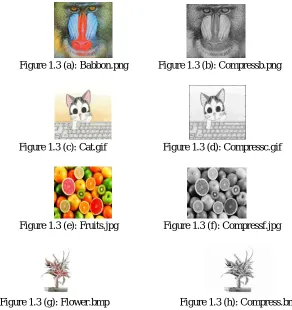
The DCT technique is implemented on the different images by evaluating PSNR, MSE, CR. Figure 1.3 (a, c, e,g) shows the original images, whereas figure 1.3 (b,d,f,h)shows the compressed images.
Figure 1.3 (a): Babbon.png Figure 1.3 (b): Compressb.png
Figure 1.3 (c): Cat.gif Figure 1.3 (d): Compressc.gif
Figure 1.3 (e): Fruits.jpg Figure 1.3 (f): Compressf.jpg
Figure 1.3 (g): Flower.bmp Figure 1.3 (h): Compress.bmp
[image:6.612.156.448.385.695.2]Table 1.1: Performance evaluation parameters of DCT.
IMAGE FORMAT COMPRESSION
RATIO (%)
MSE PSNR
Babbon.png 39 0.0042 71.94
Cat.gif 78 0.0018 77.77
Fruits.jpg 19 0.0013 77.05
Flower.bmp 90 3.4862 e-04 82.70
[image:7.612.141.474.246.439.2]From the table 1.1, it can be concluded that the performance of Therefore the bitmap image has a higher compression ratio, higher PSNR as well as higher MSE than the other image format.The observed results of DCT are represented graphically as shown in Figure 1.4.
Figure: 1.4: Parameter evaluation based on different image format.
2) Analysis In Dwt
The DWT technique is implemented on different images by evaluating PSNR, MSE, CR. Figure 1.5 (a,c, e,g) shows the original images, whereas figure 1.5 (b,d,f,h) shows the compressed images.
Figure 1.5 (a): Babbon.png Figure 1.5 (b):Compress1.png
Figure 1.5 (c): Cat.gif Figure1.5 (d):Compressc2.gif
Figure 1.5 (e): Fruits.jpg Figure 1.5 (f):Compress3.jpg
0 10 20 30 40 50 60 70 80 90 100
MSE
PSNR
[image:7.612.102.464.505.732.2]
Figure 1.5 (g): Flower.bmp Figure 1.5 (h):Compress4.bmp
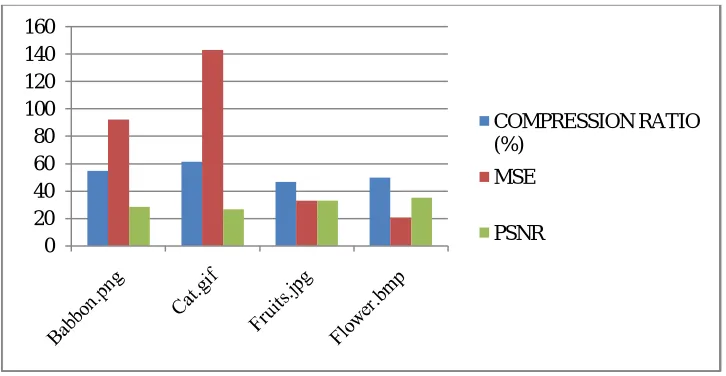
The results that are obtained from these experiments are evaluated and summarized in the table 1.2 and shown in figure1.6. Table 1.2: Performance evaluation parameters of DWT.
IMAGE FORMAT
COMPRESSION RATIO (%)
MSE PSNR
Babbon.png 54.67 92.21 28.48
Cat.gif 61.27 143.2 26.57
Fruits.jpg 46.70 32.98 32.95
Flower.bmp 49.95 20.58 35
[image:8.612.131.484.190.298.2]From the table1.2, it can be concluded that the. gif image has a higher compression ratio than the other image format, whereas bitmap image has higher PSNR as well as smaller MSE. So bitmap image provide better result as compared to other. The observed results of DWT are represented graphically as shown in Figure 1.6.
Figure: 1.6: Parameter evaluation based on different image format
VI. CONCLUSION & FUTURE SCOPE
Image compression is very important for efficient transmission and storage of images. It helps in effective utilization of high speed network resources. This paper focused on comparing the two most widely used techniques in the image compression,i.e. DWT and DCT on a number of images. The implementation has been carried on the basis of PSNR, MSE, CR use theMATLAB software and the results have been analyzed. The comparison shows as given in the results of the same input image the compression in DCT technique is more than the DWT technique, however the quality of the image decreases. Compression ratio indicates the efficiency of compression technique, more the compression ratio, less memory space required. The performance of the block-based DCT scheme degrades at high compression ratio. On the other hand, the output of the DWT image compression is good. Generally, the DWT image compression technique is used to get the best output, and also to get the quality of the image. This can provide better image quality than DCT, especially at higher compression ratios.DWT gives better results without losing more information on image. The pitfall of DWT is that it requires more processing power. For future work, the main research can be done on the image
0 20 40 60 80 100 120 140 160
COMPRESSION RATIO (%)
MSE
[image:8.612.126.489.360.548.2]processing and analyze the steganography on the 3d multimedia images and videos. Work can be done to make the steganography reliable, secure and easily available to provide more security and more authenticity.
REFERENCES
[1] Ahmed N., Natarajan T., and Rao K. R., Discrete cosine transform, IEEE Trans. On Computers, vol. C-23, pp. 90-93,1974.
[2] Das Swastik and SethyRanjan Rashmi, Digital Image Compression using Discrete Cosine Transform and Discrete Wavelet Transform B.Tech Dissertation NIT,Rourkela,2009.
[3] Desai Jay, Hemalatha S, ShishiraS.R.,Comparison between DCT and DWT Steganography Algorithms, International Journal of Advanced Information Science and Technology (IJAIST) , Vol.24, No.24, April 2014.
[4] Gonzalez R. C., Woods R. E., Digital Image Processing, Second edition, pp. 411-514, 2004.
[5] HernandezJ.R.,AmadoM., PerezGonzalezF., DCTDomain Watermarking Techniques for Still Images: Detector Performance Analysis and a New Structure, IEEE Trans. Image Processing, 9, Jan. 2000, 55-68.
[6] Jain A., ―Fundamentals of Digital Image Processing Prentice-Hall, 1989.
[7] JayakarSadashivappa1, Mahesh,Color Image Compression using SPIHT Algorithm International Journal of Computer Applications (0975 – 8887)Volume 16– No.7, February 2011.
[8] KatochMunish, JaswalReenu, Image Steganography: A Review, International Journal of Advanced Research in Computer and Communication Engineering Vol. 5, Issue 4, April 2016.
[9] Kaur Amandeep, Kaur Rupinder, Kumar Navdeep,A Review on Image Steganography Techniques, International Journal of Computer Applications (0975 – 8887) Volume 123 – No.4, August 2015.
[10] Kaur Gaganpreet, KaurSandeep,Comparative Analysis of Various Digital Image Compression Techniques Using Wavelets, International Journal of Advanced Research in Computer Science and Software Engineering, Volume 3, Issue 4, April 2013 ISSN: 2277 128X.
[11] NegahbanFarnoosh,MohammadAliShafieian, and MohammadRahmanian,Various Novel Wavelet – Based Image Compression Algorithms Using a Neural Network as a Predictor,J. Basic. Appl. Sci. Res., 3(6)280-287, 2013 ISSN 2090-4304.
[12] SubbaraoVenkataM.,Hybrid Image Compression using DWT and Neural Networks, International Journal of Advanced Science and Technology Vol. 53, April, 2013.
[13] Thota RaoNageswara, Kumar Srinivasa, Image Compression Using Discrete Cosine Transform, Georgian Electronic Scientific Journal: Computer Science and Telecommunications, No.3 (17), 2008.
[14] Tiwari Yashi, Kumar Amit,Comparision Between DCT& DWT Image Compression Technique,International Journal Of Engineering And Computer Science ISSN: 2319-7242 Volume 5 Issue 12 Dec. 2016, Page No. 19450-19452.
[15] TripathiPrachi, Image Compression Enhancement using Bipolar Coding with LM Algorithm in Artificial Neural Network,International Journal of Scientific and Research Publications, Volume 2, Issue 8, August 2012 1 ISSN 2250-3153.