5
X
October 2017
A Performance Optimization and Analysis of
Torque Transmissibility by Using Experimental
Techniques
Krunal C. Chaudhari1, Shantanu J. Chaudhari2
1
Research Scholar, Mechanical Engineer,NMU Jalgaon, Maharashtra
2
Associate Professor, Automobile Engineering Dept.SGDCOE Jalgaon,Maharashtra
Abstract :In many vibration problems, the primary excitation force typically has a repetitive periodic nature, and in some cases this periodic forcing function may be even purely sinusoidal. Examples are excitations due to mass eccentricity and misalignments in rotational components. In basic terms, the frequency response of a dynamic system is the response to a pure sinusoidal excitation. As the amplitude and the frequency of the excitation are changed, the response also changes. A typical problem is a rotating machine (such as a pump, AC compressor, blower, engine, etc) mounted on a roof, or on a floor above the ground floor. The problem is usually most apparent in the immediate vicinity of the vibration source. However, mechanical vibrations can transmit for long distances, and by very circuitous routes through the structure of a building, sometimes resurfacing hundreds of feet from the source. A related problem is the isolation of vibration-sensitive machines from the normally occurring disturbances in a building (car or bus traffic, slamming doors, foot traffic, elevators…)
Using Spring, Rubber and Wood isolator, various frequencies, various eccentric masses, various eccentricity measuring the torque transmissibility and graphs are analyzed.
I. INTRODUCTION
Vibration can be defined as simply the cyclic or oscillating motion of a machine or machine component from its positions of rest. When motorized equipment, such as electric motors, fans or pumps, is mounted to a solid structure, energy can be transferred from the equipment to the structure in the form of vibration This vibration often radiates from the structure as audible noise and potentially reduces performance or damages equipment. Most portable electronics, CD drives and vehicle- mounted electronics are especially sensitive to vibration and shock and must be isolated from that energy to ensure proper performance.
Forces generated within the machine cause vibration. These forces may: (i) Change in direction with time, such as the force generated by a rotating unbalance. (ii) Change in amplitude or intensity with time, such as the unbalanced magnetic forces generated in an induction motor due to unequal air gap between the motor armature and stator (field). (iii) Result in friction between rotating and stationary machine components in much the same way that friction from a rosined bow causes a violin string to vibrate. (iv)Cause impacts, such as gear tooth contacts or the impacts generated by the rolling elements of a bearing passing over flaws in the bearing raceways. (v) Cause randomly generated forces such as flow turbulence in fluid-handling devices such as fans, blowers and pumps; or combustion turbulence in gas turbines or boilers.
A.Characteristics of Vibration
The characteristics needed to define the vibration include:
1) Frequency
2) Displacement
3) Velocity
4) Acceleration
5) Phase
6) Vibration Frequency
(t)= vertial displacement, f(t)= excitation force
If we neglect damping, the vertical motion of the system, x(t) can be shown to be: ( ) = sin
Where r=ω/ , =
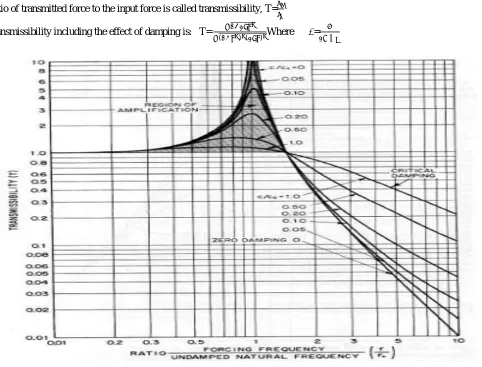
The system has a natural, or resonant frequency, at which it will exhibit a large amplitude of motion, for a small input force. In
units of Hz (cycles per second), this frequency, is : = =
The ratio of transmitted force to the input force is called transmissibility, T=
The transmissibility including the effect of damping is: T=
[image:3.612.69.551.290.657.2]( ) ( ) Where =
Fig no. 1 Transmissibility Vs Frequency Ratio
II. TEST RIG AND COMPONENT SPECIFICATION
The whole assembly is supported on metallic stand above which clips are welded.
Isolators are fixed between two two metallic plates which have holes drilled at its four corners for fitting purpose. The isolator is fitted over the base plate by means of nut & bolt to bottom plate of isolator.
The motor is placed over the upper plate of isolator & they are bolted together to provide the frequent engagement & disengagement of various types of isolators sets.
On the motor shaft the disk is fitted which rotate with the speed of motor.
[image:4.612.38.421.324.649.2]The rotating disc is fixed to shaft of motor with the help of pulley which is rigidly connected to motor shaft. The holes are provided on plate various distances to provide provision for installation of eccentric masses.
Fig no. 2 Assembly of test rig
The Test Rig Consist Of Following Component
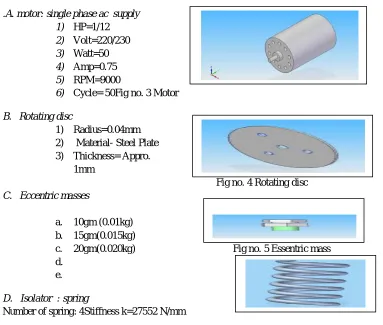
.A. motor: single phase ac supply 1) HP=1/12
2) Volt=220/230
3) Watt=50
4) Amp=0.75
5) RPM=9000
6) Cycle= 50Fig no. 3 Motor
B. Rotating disc
1) Radius=0.04mm 2) Material- Steel Plate 3) Thickness= Appro.
1mm
Fig no. 4 Rotating disc
C. Eccentric masses
a. 10gm (0.01kg) b. 15gm(0.015kg)
c. 20gm(0.020kg) Fig no. 5 Essentric mass d.
e.
D. Isolator : spring
Number of spring: 4Stiffness k=27552 N/mm
Stiffness Ke= 4k =4*27552 =110208 N/mm = 178 Rad/Sec
1) Spring Diameter=35mm 2) Coil Diameter=45mm
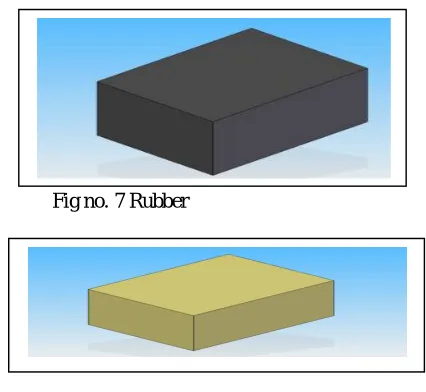
E. Isolator : rubber (ams 3205) neoprene
Stiffness=0.01 (Assumed)
= 0.053 Rad/Sec
1) Length=125mm
2) Breadth=70mm
3) Thickness=50mm Fig no. 7 Rubber
F. Isolator : wood
Stiffness=0.02(Assumed) = 0.076 Rad/Sec Dimension
Length=122mm Breadth=67mm Thickness=45mm
Fig no. 8 Wood block
G. Each isolator is fixed between two steel plate.
Steel Plate Length L 1 =150mm L 2 =150mm Area=L 1* L 2 =150*150=22500mm2 Number of plates used for each isolator =2
Total no of plates used for isolator =2*3(Isolator) =6
H. Base plate for assembly (motor+ isolator)
[image:5.612.257.470.85.281.2]Material :- Cast Iron Area =150*150=22500mm2
Fig no .9 Base plate
I. weighing machine :is used as loadcell.
[image:5.612.50.454.388.636.2]Capacity: 30 kg
Fig no. 10 Weighing Machine
J. Stand- square bars
Length= 445mm Breadth=250mm Thickness=245mm Fig no. 11 Stand
III. ANALYSIS OF ISOLATORS
In order to go for analysis it is necessary to give proper notations.Following are the notations used to deal with test rig
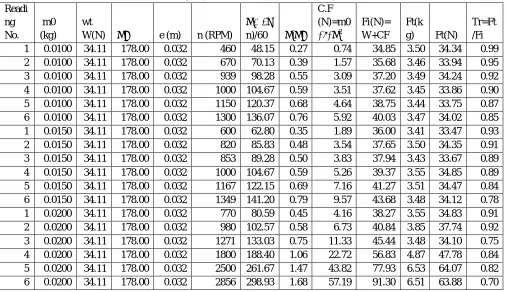
Let, Eccentric mass=m0, Kg, Combined weight of motor and isolator =W(N), Natural frequency for isolator=ωn, Eccentricity=e (m), Revolution of motor=n (rpm ), Angular velocity of eccentric mass ω=(2 n)/60, Centrifugal force due to eccentric mass CF=m0eω2 , Applied force=Fi=W+CF, Transmitted force=Ft, Transmissibility =Tr=Ft/Fi
Table No.1 Spring Transmissibility for eccentricity 0.032m Readi
ng No.
m0 (kg)
wt
W(N) ωn e (m) n (RPM)
ω=(2π
n)/60 ω/ωn
C.F (N)=m0
*e*ω2
Fi(N)= W+CF
Ft(k
g) Ft(N)
Tr=Ft /Fi
1 0.0100 34.11 178.00 0.032 460 48.15 0.27 0.74 34.85 3.50 34.34 0.99
2 0.0100 34.11 178.00 0.032 670 70.13 0.39 1.57 35.68 3.46 33.94 0.95
3 0.0100 34.11 178.00 0.032 939 98.28 0.55 3.09 37.20 3.49 34.24 0.92
4 0.0100 34.11 178.00 0.032 1000 104.67 0.59 3.51 37.62 3.45 33.86 0.90 5 0.0100 34.11 178.00 0.032 1150 120.37 0.68 4.64 38.75 3.44 33.75 0.87 6 0.0100 34.11 178.00 0.032 1300 136.07 0.76 5.92 40.03 3.47 34.02 0.85
1 0.0150 34.11 178.00 0.032 600 62.80 0.35 1.89 36.00 3.41 33.47 0.93
2 0.0150 34.11 178.00 0.032 820 85.83 0.48 3.54 37.65 3.50 34.35 0.91
3 0.0150 34.11 178.00 0.032 853 89.28 0.50 3.83 37.94 3.43 33.67 0.89
4 0.0150 34.11 178.00 0.032 1000 104.67 0.59 5.26 39.37 3.55 34.85 0.89 5 0.0150 34.11 178.00 0.032 1167 122.15 0.69 7.16 41.27 3.51 34.47 0.84 6 0.0150 34.11 178.00 0.032 1349 141.20 0.79 9.57 43.68 3.48 34.12 0.78
1 0.0200 34.11 178.00 0.032 770 80.59 0.45 4.16 38.27 3.55 34.83 0.91
2 0.0200 34.11 178.00 0.032 980 102.57 0.58 6.73 40.84 3.85 37.74 0.92
[image:6.612.58.555.405.722.2]3 0.0200 34.11 178.00 0.032 1271 133.03 0.75 11.33 45.44 3.48 34.10 0.75 4 0.0200 34.11 178.00 0.032 1800 188.40 1.06 22.72 56.83 4.87 47.78 0.84 5 0.0200 34.11 178.00 0.032 2500 261.67 1.47 43.82 77.93 6.53 64.07 0.82 6 0.0200 34.11 178.00 0.032 2856 298.93 1.68 57.19 91.30 6.51 63.88 0.70
Table No 2 Spring Transmissibility for eccentricity 0.035m Readi
ng No.
m0 (kg)
wt
W(N) ωn e (m) n (RPM)
ω=(2π
n)/60 ω/ωn
C.F (N)=m0
*e*ω2
Fi(N)= W+CF
Ft(k
g) Ft(N)
Tr=Ft /Fi
1 0.0100 34.11 178 0.035 460 48.15 0.27 0.81 34.92 3.10 30.41 0.87
2 0.0100 34.11 178 0.035 670 70.13 0.39 1.72 35.83 3.46 33.94 0.95
3 0.0100 34.11 178 0.035 939 98.28 0.55 3.38 37.49 3.49 34.24 0.91
4 0.0100 34.11 178 0.035 1000 104.67 0.59 3.83 37.94 3.45 33.86 0.89
5 0.0100 34.11 178 0.035 1150 120.37 0.68 5.07 39.18 3.44 33.75 0.86
6 0.0100 34.11 178 0.035 1300 136.07 0.76 6.48 40.59 3.47 34.02 0.84
1 0.0150 34.11 178 0.035 600 62.80 0.35 2.07 36.18 3.41 33.47 0.93
2 0.0150 34.11 178 0.035 820 85.83 0.48 3.87 37.98 3.50 34.35 0.90
3 0.0150 34.11 178 0.035 853 89.28 0.50 4.18 38.29 3.43 33.67 0.88
4 0.0150 34.11 178 0.035 1000 104.67 0.59 5.75 39.86 3.55 34.85 0.87
5 0.0150 34.11 178 0.035 1167 122.15 0.69 7.83 41.94 3.51 34.47 0.82
6 0.0150 34.11 178 0.035 1349 141.20 0.79 10.47 44.58 3.48 34.12 0.77
1 0.0200 34.11 178 0.035 770 80.59 0.45 4.55 38.66 3.55 34.83 0.90
2 0.0200 34.11 178 0.035 980 102.57 0.58 7.36 41.47 3.85 37.74 0.91
Table No 3 Spring Transmissibility for eccentricity 0.037m Readi ng No. m0 (kg) wt
W(N) ωn e (m) n (RPM)
ω=(2π
n)/60 ω/ωn
C.F (N)=m0 *e*ω2 Fi(N)= W+CF Ft(k
g) Ft(N)
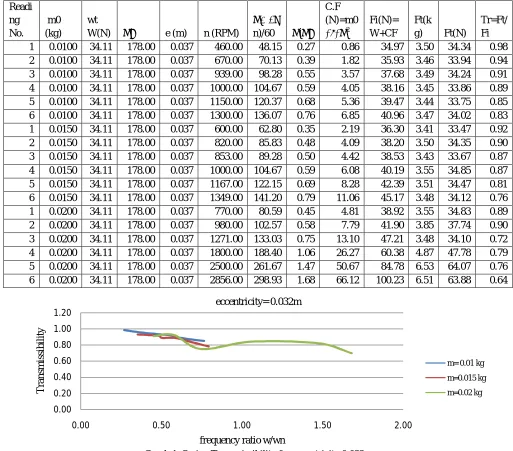
Tr=Ft/ Fi 1 0.0100 34.11 178.00 0.037 460.00 48.15 0.27 0.86 34.97 3.50 34.34 0.98 2 0.0100 34.11 178.00 0.037 670.00 70.13 0.39 1.82 35.93 3.46 33.94 0.94 3 0.0100 34.11 178.00 0.037 939.00 98.28 0.55 3.57 37.68 3.49 34.24 0.91 4 0.0100 34.11 178.00 0.037 1000.00 104.67 0.59 4.05 38.16 3.45 33.86 0.89 5 0.0100 34.11 178.00 0.037 1150.00 120.37 0.68 5.36 39.47 3.44 33.75 0.85 6 0.0100 34.11 178.00 0.037 1300.00 136.07 0.76 6.85 40.96 3.47 34.02 0.83 1 0.0150 34.11 178.00 0.037 600.00 62.80 0.35 2.19 36.30 3.41 33.47 0.92 2 0.0150 34.11 178.00 0.037 820.00 85.83 0.48 4.09 38.20 3.50 34.35 0.90 3 0.0150 34.11 178.00 0.037 853.00 89.28 0.50 4.42 38.53 3.43 33.67 0.87 4 0.0150 34.11 178.00 0.037 1000.00 104.67 0.59 6.08 40.19 3.55 34.85 0.87 5 0.0150 34.11 178.00 0.037 1167.00 122.15 0.69 8.28 42.39 3.51 34.47 0.81 6 0.0150 34.11 178.00 0.037 1349.00 141.20 0.79 11.06 45.17 3.48 34.12 0.76 1 0.0200 34.11 178.00 0.037 770.00 80.59 0.45 4.81 38.92 3.55 34.83 0.89 2 0.0200 34.11 178.00 0.037 980.00 102.57 0.58 7.79 41.90 3.85 37.74 0.90 3 0.0200 34.11 178.00 0.037 1271.00 133.03 0.75 13.10 47.21 3.48 34.10 0.72 4 0.0200 34.11 178.00 0.037 1800.00 188.40 1.06 26.27 60.38 4.87 47.78 0.79 5 0.0200 34.11 178.00 0.037 2500.00 261.67 1.47 50.67 84.78 6.53 64.07 0.76 6 0.0200 34.11 178.00 0.037 2856.00 298.93 1.68 66.12 100.23 6.51 63.88 0.64
Graph 1 Spring Transmissibility for eccentricity 0.032m
Graph 2 Spring Transmissibility for eccentricity 0.035m 0.00 0.20 0.40 0.60 0.80 1.00 1.20
0.00 0.50 1.00 1.50 2.00
T ra n sm is si b il it y
frequency ratio w/wn eccentricity= 0.032m
m= 0.01 kg
m=0.015 kg m=0.02 kg 0.00 0.20 0.40 0.60 0.80 1.00
0.00 0.20 0.40 0.60 0.80 1.00 1.20 1.40 1.60 1.80
T ra n sm is si b il it y
Frequency ratio w/wn eccentricity= 0.035 m
m=0.01 kg
m=0.015 kg
Graph 3 Spring Transmissibility for eccentricity 0.037m
[image:8.612.39.556.406.699.2]B. Analysis of rubber
Table No.4 Rubber Transmissibility for eccentricity 0.032m Readi
ng No.
m0 (kg)
wt
W(N) ωn e (m)
n (RP M)
ω=(2πn
)/60 ω/ωn
C.F (N)=m0
*e*ω2
Fi(N)= W+CF
Ft(k
g) Ft(N)
Tr=Ft/ Fi 1 0.0100 34.82 0.053 0.032 850 88.97 1678.62 2.53 37.35 3.50 34.34 0.92 2 0.0100 34.82 0.053 0.032 987 103.31 1949.17 3.42 38.24 3.46 33.94 0.89 3 0.0100 34.82 0.053 0.032 1051 110.00 2075.56 3.87 38.69 3.49 34.24 0.88 4 0.0100 34.82 0.053 0.032 1260 131.88 2488.30 5.57 40.39 3.45 33.86 0.84 5 0.0100 34.82 0.053 0.032 1843 192.90 3639.64 11.91 46.73 3.44 33.75 0.72 6 0.0100 34.82 0.053 0.032 2252 235.71 4447.35 17.78 52.60 3.47 34.02 0.65 1 0.0150 34.82 0.053 0.032 874 91.48 1726.01 4.02 38.84 3.41 33.47 0.86 2 0.0150 34.82 0.053 0.032 945 98.91 1866.23 4.70 39.52 3.50 34.35 0.87 3 0.0150 34.82 0.053 0.032 995 104.14 1964.97 5.21 40.03 3.43 33.67 0.84 4 0.0150 34.82 0.053 0.032 1086 113.67 2144.68 6.20 41.02 3.55 34.85 0.85 5 0.0150 34.82 0.053 0.032 1370 143.39 2705.53 9.87 44.69 3.51 34.47 0.77 6 0.0150 34.82 0.053 0.032 1681 175.94 3319.71 14.86 49.68 3.48 34.12 0.69 1 0.0200 34.82 0.053 0.032 743 77.77 1467.31 3.87 38.69 3.92 38.46 0.99 2 0.0200 34.82 0.053 0.032 835 87.40 1648.99 4.89 39.71 3.85 37.74 0.95 3 0.0200 34.82 0.053 0.032 943 98.70 1862.28 6.23 41.05 3.48 38.45 0.94 4 0.0200 34.82 0.053 0.032 1050 109.90 2073.58 7.73 42.55 4.87 40.02 0.94 5 0.0200 34.82 0.053 0.032 1345 140.78 2656.16 12.68 47.50 6.53 42.39 0.89 6 0.0200 34.82 0.053 0.032 1590 166.42 3140.00 17.73 52.55 6.51 44.52 0.85
0.00 0.20 0.40 0.60 0.80 1.00 1.20
0.00 50.00 100.00 150.00 200.00 250.00 300.00 350.00
T
ra
n
sm
is
si
b
il
it
y
frequency ratio w/wn eccentricity= 0.037 m
m= 0.01kg
m=0.015 kg
Table No.5 Rubber Transmissibility for eccentricity 0.035m Readi ng No. m0 (kg) wt
W(N) ωn e (m)
n (RP M)
ω=(2πn
)/60 ω/ωn
C.F (N)=m0 *e*ω2 Fi(N)= W+CF Ft(k
g) Ft(N)
Tr=Ft/ Fi 1 0.0100 34.82 0.053 0.035 850 88.97 1678.62 2.77 37.59 3.50 34.34 0.91 2 0.0100 34.82 0.053 0.035 987 103.31 1949.17 3.74 38.56 3.46 33.94 0.88 3 0.0100 34.82 0.053 0.035 1051 110.00 2075.56 4.24 39.06 3.49 34.24 0.88 4 0.0100 34.82 0.053 0.035 1260 131.88 2488.30 6.09 40.91 3.45 33.86 0.83 5 0.0100 34.82 0.053 0.035 1843 192.90 3639.64 13.02 47.84 3.44 33.75 0.71 6 0.0100 34.82 0.053 0.035 2252 235.71 4447.35 19.45 54.27 3.47 34.02 0.63 1 0.0150 34.82 0.053 0.035 874 91.48 1726.01 4.39 39.21 3.41 33.47 0.85 2 0.0150 34.82 0.053 0.035 945 98.91 1866.23 5.14 39.96 3.50 34.35 0.86 3 0.0150 34.82 0.053 0.035 995 104.14 1964.97 5.69 40.51 3.43 33.67 0.83 4 0.0150 34.82 0.053 0.035 1086 113.67 2144.68 6.78 41.60 3.55 34.85 0.84 5 0.0150 34.82 0.053 0.035 1370 143.39 2705.53 10.79 45.61 3.51 34.47 0.76 6 0.0150 34.82 0.053 0.035 1681 175.94 3319.71 16.25 51.07 3.48 34.12 0.67 1 0.0200 34.82 0.053 0.035 743 77.77 1467.31 4.23 39.05 3.92 38.46 0.98 2 0.0200 34.82 0.053 0.035 835 87.40 1648.99 5.35 40.17 3.85 37.74 0.94 3 0.0200 34.82 0.053 0.035 943 98.70 1862.28 6.82 41.64 3.48 38.45 0.92 4 0.0200 34.82 0.053 0.035 1050 109.90 2073.58 8.45 43.27 4.87 40.02 0.92 5 0.0200 34.82 0.053 0.035 1345 140.78 2656.16 13.87 48.69 6.53 42.39 0.87 6 0.0200 34.82 0.053 0.035 1590 166.42 3140.00 19.39 54.21 6.51 44.52 0.82
Table No.6 Rubber Transmissibility for eccentricity 0.037m Readi ng No. m0 (kg) wt
W(N) ωn e (m)
n (RP M)
ω=(2πn
)/60 ω/ωn
C.F (N)=m0 *e*ω2 Fi(N)= W+CF Ft(k
g) Ft(N)
[image:9.612.53.558.406.696.2]Graph 4 Rubber Transmissibility for eccentricity 0.032m
Graph.5 Rubber Transmissibility for eccentricity 0.035m
Graph 6 Rubber Transmissibility for eccentricity 0.037m 0.00
0.20 0.40 0.60 0.80 1.00 1.20
0.00 1000.00 2000.00 3000.00 4000.00 5000.00
T
ra
n
sm
is
si
b
il
it
y
frequency ratio w/wn eccentricity = 0.032 m
m=0.01 kg
m=0.015 kg
m=0.02 kg
0.00 0.20 0.40 0.60 0.80 1.00 1.20
0.00 1000.00 2000.00 3000.00 4000.00 5000.00
T
ra
n
sm
is
si
b
il
it
y
frequency ratio w/wn eccentricity= 0.035 m
m=0.01 kg
m=0.015 kg
m=0.02 kg
0.00 0.20 0.40 0.60 0.80 1.00 1.20
0.00 1000.00 2000.00 3000.00 4000.00 5000.00
T
ra
n
sm
is
si
b
il
it
y
frequency ratio w/wn eccentricity= 0.037m
m=0.01 kg
m=0.015 kg
C. Analysis of wood
Table No.7 Wood Transmissibility for eccentricity 0.032m Readi ng No. m0 (kg) wt
W(N) ωn e (m)
n (RP M)
ω=(2πn
)/60 ω/ωn
C.F (N)=m0 *e*ω2 Fi(N)= W+CF Ft(k
g) Ft(N)
Tr=Ft/ Fi 1 0.0100 33.29 0.076 0.032 952 99.64 1311.09 3.18 36.47 3.50 34.34 0.94 2 0.0100 33.29 0.076 0.032 1000 104.67 1377.19 3.51 36.80 3.46 33.94 0.92 3 0.0100 33.29 0.076 0.032 1265 132.40 1742.15 5.61 38.90 3.49 34.24 0.88 4 0.0100 33.29 0.076 0.032 1320 138.16 1817.89 6.11 39.40 3.45 33.86 0.86 5 0.0100 33.29 0.076 0.032 1518 158.88 2090.58 8.08 41.37 3.44 33.75 0.82 6 0.0100 33.29 0.076 0.032 1729 180.97 2381.17 10.48 43.77 3.47 34.02 0.78 1 0.0150 33.29 0.076 0.032 833 87.19 1147.20 3.65 36.94 3.41 33.47 0.91 2 0.0150 33.29 0.076 0.032 996 104.25 1371.68 5.22 38.51 3.50 34.35 0.89 3 0.0150 33.29 0.076 0.032 1100 115.13 1514.91 6.36 39.65 3.43 33.67 0.85 4 0.0150 33.29 0.076 0.032 1380 144.44 1900.53 10.01 43.30 3.55 34.85 0.80 5 0.0150 33.29 0.076 0.032 1600 167.47 2203.51 13.46 46.75 3.51 34.47 0.74 6 0.0150 33.29 0.076 0.032 1724 180.45 2374.28 15.63 48.92 3.48 34.12 0.70 1 0.0200 33.29 0.076 0.032 887 92.84 1221.57 5.52 38.81 3.92 38.46 0.99 2 0.0200 33.29 0.076 0.032 923 96.61 1271.15 5.97 39.26 3.85 37.74 0.96 3 0.0200 33.29 0.076 0.032 1040 108.85 1432.28 7.58 40.87 3.48 38.45 0.94 4 0.0200 33.29 0.076 0.032 1230 128.74 1693.95 10.61 43.90 4.87 40.02 0.91 5 0.0200 33.29 0.076 0.032 1416 148.21 1950.11 14.06 47.35 6.53 42.39 0.90 6 0.0200 33.29 0.076 0.032 1500 157.00 2065.79 15.78 49.07 6.51 44.52 0.91
Table No.8 Wood Transmissibility for eccentricity 0.035m
Readi ng No.
m0 (kg)
wt
W(N) ωn e (m)
n (RP M)
ω=(2πn)
/60 ω/ωn
C.F (N)=m0* e*ω2 Fi(N)=W +CF Ft(k
g) Ft(N)
Tr=Ft/ Fi
1 0.0100 33.29 0.076 0.035 952 99.64 1311.09 3.48 36.77 3.50 34.34 0.93
2 0.0100 33.29 0.076 0.035 1000 104.67 1377.19 3.83 37.12 3.46 33.94 0.91
3 0.0100 33.29 0.076 0.035 1265 132.40 1742.15 6.14 39.43 3.49 34.24 0.87
4 0.0100 33.29 0.076 0.035 1320 138.16 1817.89 6.68 39.97 3.45 33.86 0.85
5 0.0100 33.29 0.076 0.035 1518 158.88 2090.58 8.84 42.13 3.44 33.75 0.80
6 0.0100 33.29 0.076 0.035 1729 180.97 2381.17 11.46 44.75 3.47 34.02 0.76
1 0.0150 33.29 0.076 0.035 833 87.19 1147.20 3.99 37.28 3.41 33.47 0.90
2 0.0150 33.29 0.076 0.035 996 104.25 1371.68 5.71 39.00 3.50 34.35 0.88
3 0.0150 33.29 0.076 0.035 1100 115.13 1514.91 6.96 40.25 3.43 33.67 0.84
4 0.0150 33.29 0.076 0.035 1380 144.44 1900.53 10.95 44.24 3.55 34.85 0.79
5 0.0150 33.29 0.076 0.035 1600 167.47 2203.51 14.72 48.01 3.51 34.47 0.72
6 0.0150 33.29 0.076 0.035 1724 180.45 2374.28 17.09 50.38 3.48 34.12 0.68
1 0.0200 33.29 0.076 0.035 887 92.84 1221.57 6.03 39.32 3.92 38.46 0.98
2 0.0200 33.29 0.076 0.035 923 96.61 1271.15 6.53 39.82 3.85 37.74 0.95
3 0.0200 33.29 0.076 0.035 1040 108.85 1432.28 8.29 41.58 3.48 38.45 0.92
4 0.0200 33.29 0.076 0.035 1230 128.74 1693.95 11.60 44.89 4.87 40.02 0.89
5 0.0200 33.29 0.076 0.035 1416 148.21 1950.11 15.38 48.67 6.53 42.39 0.87
Table No.9 Wood Transmissibility for eccentricity 0.037m Readi
ng No.
m0 (kg)
wt
W(N) ωn e (m)
n (RP M)
ω=(2πn
)/60 ω/ωn
C.F (N)=m0
*e*ω2
Fi(N)= W+CF
Ft(k
g) Ft(N)
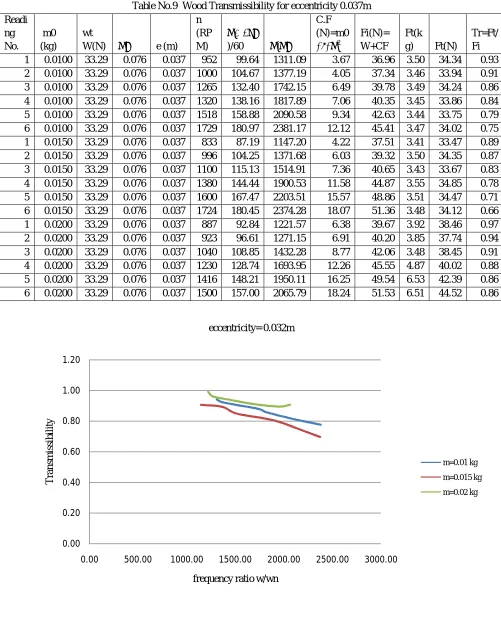
Tr=Ft/ Fi 1 0.0100 33.29 0.076 0.037 952 99.64 1311.09 3.67 36.96 3.50 34.34 0.93 2 0.0100 33.29 0.076 0.037 1000 104.67 1377.19 4.05 37.34 3.46 33.94 0.91 3 0.0100 33.29 0.076 0.037 1265 132.40 1742.15 6.49 39.78 3.49 34.24 0.86 4 0.0100 33.29 0.076 0.037 1320 138.16 1817.89 7.06 40.35 3.45 33.86 0.84 5 0.0100 33.29 0.076 0.037 1518 158.88 2090.58 9.34 42.63 3.44 33.75 0.79 6 0.0100 33.29 0.076 0.037 1729 180.97 2381.17 12.12 45.41 3.47 34.02 0.75 1 0.0150 33.29 0.076 0.037 833 87.19 1147.20 4.22 37.51 3.41 33.47 0.89 2 0.0150 33.29 0.076 0.037 996 104.25 1371.68 6.03 39.32 3.50 34.35 0.87 3 0.0150 33.29 0.076 0.037 1100 115.13 1514.91 7.36 40.65 3.43 33.67 0.83 4 0.0150 33.29 0.076 0.037 1380 144.44 1900.53 11.58 44.87 3.55 34.85 0.78 5 0.0150 33.29 0.076 0.037 1600 167.47 2203.51 15.57 48.86 3.51 34.47 0.71 6 0.0150 33.29 0.076 0.037 1724 180.45 2374.28 18.07 51.36 3.48 34.12 0.66 1 0.0200 33.29 0.076 0.037 887 92.84 1221.57 6.38 39.67 3.92 38.46 0.97 2 0.0200 33.29 0.076 0.037 923 96.61 1271.15 6.91 40.20 3.85 37.74 0.94 3 0.0200 33.29 0.076 0.037 1040 108.85 1432.28 8.77 42.06 3.48 38.45 0.91 4 0.0200 33.29 0.076 0.037 1230 128.74 1693.95 12.26 45.55 4.87 40.02 0.88 5 0.0200 33.29 0.076 0.037 1416 148.21 1950.11 16.25 49.54 6.53 42.39 0.86 6 0.0200 33.29 0.076 0.037 1500 157.00 2065.79 18.24 51.53 6.51 44.52 0.86
Graph 7 Wood Transmissibility for eccentricity 0.032m 0.00
0.20 0.40 0.60 0.80 1.00 1.20
0.00 500.00 1000.00 1500.00 2000.00 2500.00 3000.00
T
ra
n
sm
is
si
b
il
it
y
frequency ratio w/wn eccentricity= 0.032m
m=0.01 kg
m=0.015 kg
Graph 8 Wood Transmissibility for eccentricity 0.035m
Graph 7 Wood Transmissibility for eccentricity 0.037m
IV. CONCLUSION
The force transmissibility of different isolator are calculated by using load cell (weighing machine). Hence from graphical representation results are obtained.
A. As frequency of dynamic vibration increases, torque transmissibility decreases.
B. For all type types of isolating materials result shows value of transmissibility is lower than one it means that all the time transmitted force is less than impressed force.
C. As rotating masses increases from 10gm to 20 gm and frequency of vibration increases ultimately result in decreasing transmissibility in spring, rubber and wood isolation.
D. For spring, rubber and wood, the graph frequency ratio increases, transmissibility decreases. Transmissibility of spring, rubber and wood Tr<1.
E. Transmissibility decreases with increasing order of frequency due to dynamic vibration using rubber as a isolation material. It concludes that rubber isolator gives best transmissibility.
REFERENCES
[1] J. M. Krodkiewski Department of Mechanical and Manufacturing Engineering, The University of Melbourne, Melbourne, Victoria 3052, Australia [2] Department of Electrical Engineering, School of Tecnology and Management, Polytechnic Institute of Leiria Campus 2 – Morro do Lena – Alto do Vieiro,
2411-901 Leiria, Apartado 4163, Portugal
[3] frequency Response, Damping, And Transmissibility Characteristics Of Top-Loaded Corrugated Containers U.S.D.A. FOREST SERVICE RESEARCH PA PER FPL 160 1971
[4] Transmissibility and DPMI analysis of the seated posture of Human under Low frequency vibration. N.V. Amar Kishore, A.S. Prashanth, V.H. Saran, S.P. Harsha*.
0.00 0.20 0.40 0.60 0.80 1.00 1.20
0.00 500.00 1000.00 1500.00 2000.00 2500.00 3000.00
T
ra
n
sm
is
si
b
il
it
y
frequency ratio w/wn eccentricity= 0.035m
m=0.01 kg
m=0.015 kg
m=0.02 kg
0.00 0.20 0.40 0.60 0.80 1.00 1.20
0.00 500.00 1000.00 1500.00 2000.00 2500.00 3000.00
T
ra
n
sm
is
si
b
il
it
y
frequency ratio w/wn eccentricity= 0.037m
m=0.01 kg
m=0.015 kg