www.ijraset.com Volume 3 Issue V, May 2015 IC Value: 13.98 ISSN: 2321-9653
International Journal for Research in Applied Science & Engineering
Technology (IJRASET)
©IJRASET 2015: All Rights are Reserved
278
Safe Guard for Wild Animal
Sumit Kudale1, Shrirang Kulkarni2
Department of Electronics and Telecommunication, Savatribai Phule Pune University
Abstract— - In today’s world, wildlife is an important factor in maintain natural balance of any nation’s environment. One of the important and vital roles is played by the forest department. There are many concerns regarding the safety of wildlife animals. So for their security is of main concern for this purpose instrument may be mounted on them to view their health status as well as present location. Bio-sensor systems comprise various types of small physiological sensors, transmission modules and processing capabilities, and can thus facilitate low-cost wearable unobtrusive solutions for health monitoring. GPS used to log the longitude and latitude so that direction can be known easily. These devices are being added to them will explore the possibility of embedding GPS devices so forest department official can track their animal’s movements in real time. RF module can be used for High-speed, short-range wireless communications that will be required to relay information on situational awareness, and covert surveillance related data during special operations reconnaissance and other missions .So by using these equipment’s we are trying to implement the basic life- guarding system for wild life in low cost and high reliability.
Keywords— Tracking, GPS, Biomedical sensors, Navigation, low-cost
I. INTRODUCTION
The growth of environmental awareness and public concern for wildlife that began in the 1980s has continued into the 21st century. Large-scale alterations of the landscape such as hydroelectric development, or the cumulative effects of timber extraction over many years, have continued the demand for high-quality studies of impacts on wildlife and their habitats. Many resource agencies have shifted their management approach to a landscape scale to address issues such as conservation of biodiversity and habitat fragmentation. To overcome some of the limitations of existing technology and provide the detailed information required by studies undertaken to address environmental concerns and evaluate new policies, telemetry systems based on the Global Positioning System (GPS) were developed in the 1990s.
Since commercial development of GPS-based telemetry systems for tracking animals began in 1991, a variety of configurations have been designed for use by researchers in different situations. In addition, numerous improvements have been made to the size and performance of GPS systems and their cost has been dramatically reduced. The enormous quantities of data generated by these systems clearly present a challenge to data management and analytical procedures. Given the variety of configurations and features of current GPS systems, researchers must carefully plan and select an appropriate system to address particular biological issues. In this paper I will provide a historical overview of the development of GPS-based tracking systems and health monitoring
A. Objective of the project
The main objectives of our project are mentioned below:
1) To provide accurate health information and location of the animal and can be implemented in wild life sanctuaries.
2) So they can be protected from illegal hunting, killing or capturing of wild animals.
3) This project will provide safety and security to wildlife and help to increase their numbers which are on extinction.
II. LITERATURESURVEY
A. Research Objectives and Solutions
Technology (IJRASET)
B. The research objectives of this dissertation are
To design a system that is able to monitor a wide variety of animals, in a typical game park environment (areas of tens to hundreds of square kilometres).
To make the system scalable, so it works well both on small and large numbers of nodes.
1) To make the system adaptable to device insertions and removals.
2) To make the system modular and flexible.
3) To make the system energy conscious to maximise lifespan.
4) To validate the system design with real world tests.
To address these objectives, research was undertaken in three main areas, namely in the system design of a wildlife tracking network, in the formulation of a network management protocol that can deal with large amounts of heterogeneity and in the proposal of a uniform distance sampling based approach to GPS tracking.
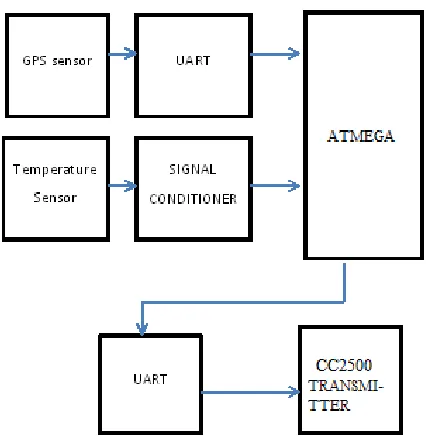
III. BLOCK DIAGRAM
[image:3.612.153.406.245.681.2]A. At Transmitter
Fig. 1. Block diagram of transmitter
B. At Receiver
[image:3.612.190.403.267.489.2]www.ijraset.com Volume 3 Issue V, May 2015 IC Value: 13.98 ISSN: 2321-9653
International Journal for Research in Applied Science & Engineering
Technology (IJRASET)
©IJRASET 2015: All Rights are Reserved
280
IV. BASIC COMPONENTS
A. ATmega 16
The ATmega16 is a low-power CMOS 8-bit microcontroller based on the AVR enhanced RISC architecture. By executing powerful instructions in a single clock cycle, the ATmega16 achieves throughputs approaching 1 MIPS per MHz allowing the system designed to optimize power consumption versus processing speed.
B. GPS (SR87)
SR-87 series GPS modules incorporates high sensitivity, high performance design. The module tracks up to 20 satellites at a time while offering fast time-to-first-fix and 1Hz navigation update. SR-87 design utilizes the latest surface mount technology and high level circuit integration to achieve superior performance while minimizing dimension and power consumption The module communicates with application system via RS232.
C. RF Transceiver(CC2500)
This is an FSK transceiver module, which is designed using Chipcon IC(cc2500).it is true single-chip transceiver, it is based on 3 wire digital serial interface and an entire phase-locked loop for precise local oscillator generation .it can be used in 2400-2483.5GHz ISM/SRD band system. it is high performance and low cost module.
D. Biosensors
LM35 To find the health status of wildlife we are measuring body temperature, pulse rate require signal conditioning. LM 35 is a precision integrated circuit temperature sensor whose output voltage is linearly proportional to temperature.
E. Computer
Computer is used to display information about location of animal and his body temperature
V. ALGORITHM
A. Power on.
B. Initialize serial communication.
C. Read data from GPS.
D. Read body temperature status.
E. Send GPS location, temperature status to base station.
F. Receive data.
G. display screen
VI. CONCLUSIONS
This project will provide safety and security to wildlife and help to increase their numbers which are on extinction. Animal tracking system is useful for tracking and monitoring of animals. So they can be protected from illegal hunting, killing or capturing of wild animals. Also the system helps to monitor health of the animal. Embedded system based this project provides accurate health information and location of the animal.
VII. ACKNOWLEDGMENT
We would like to thank Prof. Bahubali Shiragapur and Prof. Pratik Shah For his help.
REFERENCES
[1] Cai Chen, “Developing a wildlife tracking extension for arcgis”,May 2009.
[2] Andrew Markham,” On a Wildlife Tracking and Telemetry System: A Wireless Network Approach”, August 2008.
[3] Pavan Kumar,Ghadge Rasika Vijay ,Patil Vidya Adhikrao,Bobade Sonali Vijaykumar,International “Health Monitoring and Tracking of Soldier Using GPS” , Journal of Research in Advent Technology, Vol.2, No.4, April 2014.
[4] Published in: Computer and Network Technology (ICCNT), 2010.
[5] R. Rodgers, “Tracking Animals with GPS”,an international conference held at the macaulay land use research institute aberdeen, 12-13 march 2001. [6] Alexandrous Plantelopoulous and Nikolaos ,G. Bourbakis, “A Survey on Wearable sensor based system for health monitoring and prognosis”,IEEE