M E T H O D
Open Access
Classification of low quality cells from
single-cell RNA-seq data
Tomislav Ilicic
1,2, Jong Kyoung Kim
1, Aleksandra A. Kolodziejczyk
1,2, Frederik Otzen Bagger
1,5,6,
Davis James McCarthy
1,7, John C. Marioni
1,2,4and Sarah A. Teichmann
1,2,3*Abstract
Single-cell RNA sequencing (scRNA-seq) has broad applications across biomedical research. One of the key challenges is to ensure that only single, live cells are included in downstream analysis, as the inclusion of compromised cells inevitably affects data interpretation. Here, we present a generic approach for processing scRNA-seq data and detecting low quality cells, using a curated set of over 20 biological and technical features. Our approach improves classification accuracy by over 30 % compared to traditional methods when tested on over 5,000 cells, including CD4+ T cells, bone marrow dendritic cells, and mouse embryonic stem cells.
Background
Over the last 15 years, transcriptome-wide profiling has been a powerful element of the modern biological re-searcher’s toolkit [1, 2]. Recently, protocols that allow amplification of the minute amounts of material in indi-vidual cells have taken RNA-seq to the next level [3–5], leading to the discovery and characterization of new subtypes of cells [6–11]. Additionally, quantifying gene expression in individual cells has facilitated the genome-wide study of fluctuations in transcription (also referred to as ‘noise’), which will ultimately further our under-standing of complex molecular pathways such as cellular development and immune responses [12–17].
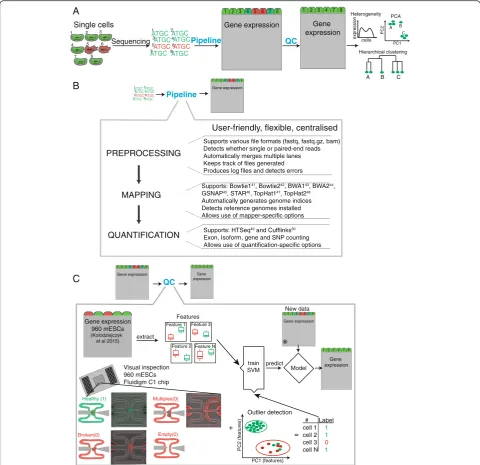
Utilizing microfluidics or droplet technologies, tens of thousands of cells can be sequenced in a single run [18, 19]. In contrast, conventional RNA-seq experiments contain only up to hundreds of samples. This enormous increase in sample size poses new challenges in data analysis: sequencing reads need to be processed in a sys-tematic and fast way to ease data access and minimize errors (Fig. 1a, b).
Another important challenge is that existing available scRNA-seq protocols often result in the captured cells
(whether chambers in microfluidic systems, microwell plates, or droplets) being stressed, broken, or killed. Moreover, some capture sites can be empty and some may contain multiple cells. We refer to all such cells as ‘low quality’. These cells can lead to misinterpretation of the data and therefore need to be excluded. Several ap-proaches have been proposed to filter out low quality cells [7, 13–15, 20–24], but they either require arbitrarily setting filtering thresholds, microscopic imaging of each individual cell, or staining cells with viability dyes. Choosing cutoff values will only capture one part of the entire landscape of low quality cells. In contrast, cell im-aging does help to identify a larger number of low quality cells as most low quality cells are visibly damaged, but it is inefficient and time-consuming. Staining is relatively quick but it can change the transcriptional state of the cell and hence the outcome of the entire experiment. Lastly, none of these methods are generally applicable to data from di-verse protocols and thus, no unbiased method has been developed to filter out low quality cells.
Here we present the first tool for scRNA-seq data that can process raw data and remove low quality cells in a straightforward and effective manner, thus ensuring that only high quality samples enter downstream analysis. This pipeline supports various mapping and quantification tools with the possibility for flexible extension to new soft-ware in the future. The pipeline takes advantage of a highly-curated set of generic features that are incorporated into a machine learning algorithm to identify low quality * Correspondence:[email protected]
Tomislav Ilicic and Jong Kyoung Kim joint first authorship
1European Molecular Biology Laboratory, European Bioinformatics Institute
(EMBL-EBI), Wellcome Trust Genome Campus, Hinxton, Cambridge CB10 1SD, UK
2Wellcome Trust Sanger Institute, Wellcome Genome Campus, Hinxton,
Cambridge CB10 1SA, UK
Full list of author information is available at the end of the article
cells. This approach allowed us to define a new type of low quality cells that cannot be detected visually and that can compromise downstream analyses. Comprehensive tests on over 5,000 cells from a variety of tissues and protocols demonstrate the utility and effectiveness of our tool.
Results
We have developed a pipeline to preprocess, map, quan-tify, and assess the quality of scRNA-seq data (Fig. 1b).
To evaluate data quality we obtained raw read counts of unpublished and previously published [9] datasets com-prising 5,000 CD4+ T cells, bone marrow dendritic cells (BMDCs), and mouse embryonic stem cells (mESCs) (Additional file 1: Figure S1A-C). Prior to our analysis, each cell had already been annotated by microscopic in-spection, indicating whether it was broken, the capture site was empty, or contained multiple cells (Fig. 1c, Additional file 2: Table S1). This covered a wide range
[image:2.595.57.538.88.553.2]of the landscape of low quality cells. Libraries for these data were prepared using the Seq [25], Smart-Seq2 [24], or modified Smart-Seq with UMIs [22]. We used 960 mESCs (further referred to as a training set) that were cultured under different conditions (2i/LIF, serum/LIF, alternative 2i/LIF; Additional file 1: Figure S1D) to extract biological and technical features capable of distinguishing low from high quality cells [26]. We then used these biological and technical features, in combination with prior gold standard cell annotation by microscopy to train an SVM model (Fig. 1c). To assess the performance of the model, we performed nested cross-validation and subsequently applied the model to the remaining datasets, comprising different cell types and protocols (Additional file 1: Figure S1A). All data-sets were mapped and quantified with the same parame-ters using the pipeline described below.
Pipeline to process scRNA-seq data
Previous studies using conventional bulk RNA-seq rarely analyzed more than a dozen samples simultaneously. However, the nature of single cell sequencing generates from thousands to tens of thousands samples in a single experiment [18, 19]. Currently available pipelines [27–29] do not take this massive data flow into consideration and are ineffective and complicated in terms of systematically processing and storing large number of cells.
We implemented a pipeline capable of: (1) data pre-processing; (2) mapping; and (3) quantifying (Fig. 1b) mRNA expression levels in a large number of samples. Each step of the pipeline can be executed as a single module or can be combined. It supports numerous map-ping and quantification tools (Fig. 1b). Additionally, the pipeline allows allele-specific experiments to be quanti-fied, which is an important application [12, 30, 31]. Users can process individual cells or apply the pipeline in parallel to process thousands of cells simultaneously. For straightforward access to output, each step generates simple subdirectories for file storage. It automatically de-tects available tools and reference genomes and proposes these to the user. Overall it offers a flexible way to process large quantities of scRNA-seq data.
Biological features of low quality cells
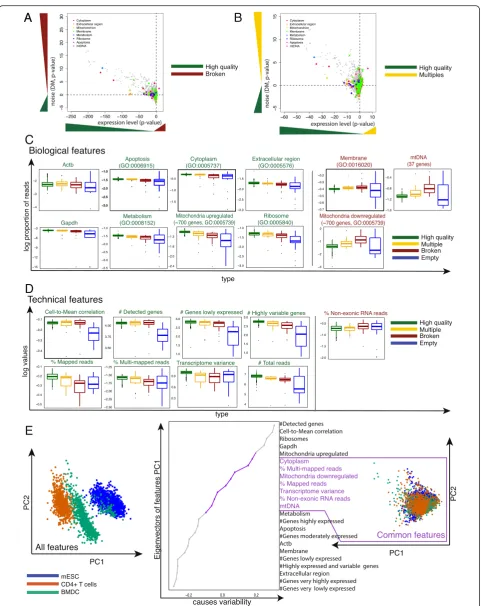
To identify features that distinguish high and low quality cells (defined through visual annotation within C1 cap-ture sites), we first used our pipeline to quantify gene ex-pression levels of our training set of 960 mESCs [26]. Subsequently, we grouped genes into functional categor-ies (Gene Ontology terms) and identified those that showed differences in expression level between each type of low quality (multiple, broken, empty) and high quality cells (Methods).
We first tested whether each type of low quality cell (broken, empty, multiple) has higher average gene ex-pression in specific functional categories (Gene Ontology terms) compared to high quality cells. Second, we calcu-lated whether gene expression in these functional categor-ies is noisier for low versus high quality cells (see Methods). Our results suggest that there are indeed several top-level biological processes and components that are sig-nificantly different.
Specifically, genes relating to Cytoplasm (Padjust< 2.2 ×
10−16), Metabolism (Padjust< 2.2 × 10⁻¹⁶), Mitochondrion
(Padjust< 2.2 × 10⁻¹⁶), Membrane (Padjust< 2.2 × 10⁻¹⁶),
and a few other categories (Fig. 2a, b, Additional file 3: Table S2) are strongly downregulated (on average, two-sided pairedt-test) in broken cells. Other downregulated biological categories correspond to basic molecular func-tions and biological processes (gray dots). Some of these categories have been previously described as being indi-cative of poor quality cells [7, 13–15, 20–24]. Further-more, broken cells have transcriptome-wide increased noise levels compared to high quality cells. Interestingly, wells containing multiple cells (multiples) show similar expression and noise patterns to broken cells (Fig. 2b, Additional file 3: Table S2). This suggests that multiple cells contain a mixture of broken and high quality cells.
Next, we calculated for each cell the proportion of reads mapped to genes relating to previously described categories (Fig. 2c). Consistent with our previous results, most categories are downregulated in broken cells (green labeled GO terms). However, genes relating to Mem-brane (Padjust= 0.017, one-sided t-test), mitochondrially
encoded genes (mtDNA, 37 genes, P= 9.96 × 10⁻⁶), and mitchondrially localized proteins (approximately 1,500 genes) are marginally upregulated (red labeled GO terms). As mentioned above, we observed that RNAs coding for mitochondrially localized proteins (approxi-mately 1,500 genes) are upregulated in broken cells. However, differential expression analysis (using DESeq [32]) between low and high quality cells revealed that only half of the genes are upregulated and the other half downregulated (Additional file 4: Table S3, Fig. 2c) and we therefore treat them as separate features.
categories (for example, Cytoplasm, Extracellular region, Mitochondria, mtDNA; Additional file 4: Table S3, Fig. 2c).
Technical features that distinguish low from high quality cells
As well as expression patterns that distinguish low from high quality cells, we investigated the relationship be-tween technical features and quality. We found 10 fea-tures that separate the different types of low quality cells from high quality cells (Fig. 2d). Similar to biological fea-tures (Fig. 2c), most technical feafea-tures have higher values in high quality cells (Additional file 4: Table S3, one-sided t-test). Only the number of not aligned and non-exonic reads is larger in broken cells (P= 0.0014, P= 0.005, respectively; Additional file 4: Table S3), fur-ther supporting the hypothesis that these cells have lost transcripts prior to cell lysis. We also compared the proportion of duplicated reads (Additional file 5: Figure S2A) between low and high quality cells and observed a difference between multiples and high quality cells (P= 0.0711; Additional file 4: Table S3). We further exam-ined the ratio between ERCC spike-ins and exonic read counts, and observed that a subset of the low quality cells has higher ratios compared to high quality cells (Additional file 4: Table S3 and Additional file 5: Figure S2B). It is likely that the cells with high ratios are broken and due to endogenous transcript loss, most reads map to the spike-in RNA.
In addition, we designed three features based on the assumption that broken cells contain a lower and mul-tiple cells a higher number of transcripts compared to a typical high quality single cell. For the first feature we calculated the number of highly expressed and highly variable genes. For the second feature we calculated the variance across genes. Lastly, we hypothesized that the number of genes expressed at a particular level would differ between cells. Thus, we binned normalized read counts into intervals (very low to very high) and counted the number of genes in each interval (for example, ‘Number of genes lowly expressed’; Fig. 2d). These add-itional features show substantial differences in broken compared to high quality cells (Fig. 2d, Additional file 4: Table S3). Surprisingly, the patterns were highly similar
between broken and multiple cells. One potential ex-planation for this is that broken cells have inadvertently been called as multiples in the manual annotation using microscopy. Overall, our results show that technical fea-tures can help distinguish low and high quality cells.
Features independent of cell type
To understand how generalizable these features are across various cell types and protocols, we downloaded and processed gene expression data from over 5,000 sin-gle cells from published [8, 9, 13, 26, 36] and unpub-lished datasets comprising CD4+ T cells and mESCs. We applied principal component analysis (PCA) using all features on these cells, and observed that the first two principal components (Fig. 2e) clearly separate the different cell types. This suggests that at least a subset of the features considered are cell type specific.
To eliminate such cell type specific effects, we dis-carded features that have large loadings on the first two principal components (removing features with loadings less than the lowest 25 % or larger than the top 25 % of the first or second principal component). Further, we re-moved features that are likely to depend on the experi-mental setting (for example, total number of sequenced reads). This resulted in seven features that are independ-ent of cell type and protocol: Cytoplasm, Mitochond-rially localized proteins, mtDNA encoded genes, Mapped reads, Multi-mapped reads, Non-exonic reads, and Transcriptome variance.
Somewhat surprisingly, the levels of Membrane, Ribo-somes, Metabolism, Apoptosis, and Housekeeping genes are highly cell type specific. In contrast, Mitochondrial (localized or encoded) and Cytoplasmic genes are more generic features. Moreover, the proportion of mapped, multi-mapped, not aligned, non-exonic reads, and vari-ance across genes do not contribute to the variability in the PCA plot (Fig. 2e). Interestingly, only moderately and strongly expressed genes seem to be similar between the datasets. Genes that are very strong or lowly expressed are highly cell type specific. Finally, to ensure that we can reproduce our results with only a subset of our data, we performed the same analysis on only 25 % of cells of each cell type and achieved identical results (Additional file 5: Figure S2C).
(See figure on previous page.)
Deceptive cells appear intact but are low quality
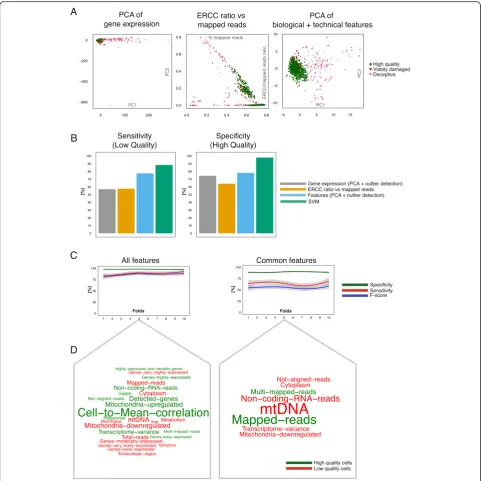
Annotation based on visual inspection under the micro-scope is not always perfect: broken cells can be wrongly annotated and even seemingly empty capture sites may contain enough RNA to yield high gene expression. To explore this further, we performed PCA on our training set of 960 mES cells. As we are performing this analysis on only one cell type, we used all features as input for PCA. We plotted the first two principal components and colored visually intact and visibly damaged cells as de-fined by microscopy. This revealed a dense cluster of visually intact cells, with visibly damaged cells clearly be-ing marked as outliers. Strikbe-ingly, 92 visually intact cells are scattered amongst the damaged cells (Fig. 3a). We applied an unsupervised outlier detection algorithm (‘mvoutlier’ R package [37]) to confirm that these cells do not belong to the dense cluster and are enriched in the outlier area (P= 0.00916, Fisher’s exact test, Fig. 3a). Unsurprisingly, visibly damaged cells are also enriched in the outlier area (P= 3.9 × 10⁻⁹; Fig. 3a). We further refer to the visually intact cells that cluster with dam-aged cells as‘deceptive’.
This prompted us to explore the difference between deceptive versus intact cells. To do this, we applied the same statistical test as described above (two-sided paired t-test; Fig. 2a, b). We found that similar to broken cells genes encoded by mtDNA encoded genes and genes re-lated to Membrane are strongly upregure-lated in the de-ceptive cells (Fig. 3b, Additional file 3: Table S2). Moreover, transcriptome-wide noise is also greater, that is, this means they have more cell-to-cell variation than healthy cells relative to each other. Consequently, al-though these cells appear healthy under microscopic supervision, they are either pre-apoptotic or ruptured after the visualization.
In Fig. 3c we show an image of a deceptive cell (which we predict to be low quality) next to a typical image of an intact cell from the same mouse ES cell dataset [26] (Additional file 5: Figure S2D). From these images, there is no obvious difference between the intact cell in the dense area and the deceptive cell. Nevertheless, the tran-scriptomic data show a higher fraction of reads mapped to external spike-ins (that is, less total RNA) and more expression of mtDNA-encoded genes (Fig. 3b) for the deceptive cells. One possibility is that these cells are subtly damaged such that they are leaking mRNA from their cytoplasm, but the damage is not visible from the microscopy images.
Impact of including deceptive cells in downstream data analysis
We then probed the impact of these deceptive cells on downstream analysis. As mentioned above, our training set comprised mESCs cultured under three different
conditions: 2i/LIF, serum/LIF, and alternative 2i/LIF. We performed clustering, differential expression, and cell-to-cell variation analysis between 2i/LIF and serum/LIF cells. Each analysis was performed twice: excluding low quality cells that are visibly damaged and a second time by also excluding deceptive cells. A PCA excluding vis-ibly damaged cells (using all expressed genes) did not show the expected three subpopulations as clusters. Fur-ther, differential expression between 2i/LIF and serum/ LIF cells resulted in only a small number of differentially expressed genes (116 genes,P<0.05, DESeq).
By contrast, upon removal of deceptive cells, PCA sep-arates the cells clearly into the three expected distinct clusters (Fig. 3d). Differential expression also returns a much higher number of significant genes (855 vs. 116 genes, P adjusted <0.05, DESeq [32], Fig. 3e). Gene set enrichment analysis of these 855 genes (topGO R pack-age [38]) revealed that functional categories (Gene Ontology Terms) such as positive regulation of cell mi-gration (P= 4.9 × 10⁻⁹, GO:0007264) and protein binding (Fig. 3e boxplot, P= 3.5 × 10⁻¹³, GO:0005515) were dif-ferentially expressed between serum/LIF and 2i/LIF. These GO terms contain 56 key genes that are strongly involved in pluripotency such as Nanog, Klf4, Prdm14, and Tcl1, and have been previously observed to be dif-ferentially expressed between the two conditions [39].
To compare cell-to-cell variation we calculated the co-efficient of variation (CV) for each gene and compared it against the mean expression. This revealed a set of highly expressed and highly variable genes that disappear if deceptive cells are excluded (Fig. 3f ). These genes are significantly enriched in biological processes such as Mitochondrial respiratory chain complex (P= 6.2 × 10⁻⁵, GO:0033108) and Regulation of transcription (P= 7.0 × 10⁻⁵, GO:0006355). It seems that deceptive cells have lower expression of genes in these two functional cat-egories, as overall expression level drops substantially if they are included (Fig. 3f Boxplots). This hypothesis is further supported by the statistical test described above (Fig. 3b) as most of the functional categories seem to be downregulated in deceptive cells. These results strongly suggest that these cells are broken but not visible as such under the microscope. Therefore, they need to be treated as low quality and excluded from downstream analysis.
Identification of low quality cells
deceptive cells (described in Fig. 3) become apparent. However, visibly damaged low quality cells are difficult to detect by eye.
In contrast, by comparing PC1 and PC2 on curated features (Fig. 3), not only deceptive but also visibly dam-aged low quality cells can be easily spotted. This is very advantageous if no prior annotation is available, as it be-comes easier to distinguish low from high quality cells.
While our approach allows visibly damaged cells to be identified visually we were interested in our ability to discriminate more analytically between visibly damaged cells (sensitivity) and high quality cells (specificity). In-stead of arbitrarily choosing a cutoff point and deciding whether a cell is of low or of high quality, we applied a widely used outlier detection algorithm to classify each cell (‘mvoutlier’R package [37]). We compared the clas-sification outcome to the gold standard annotation and computed the sensitivity and specificity.
Conventional quality control methods were only able to capture half of the visibly damaged cells (Fig. 4b, Additional file 6: Figure S3A). Our features increased classification accuracy by more than 25 %. Detecting high quality cells (specificity) was reasonably accurate (approximately 70 %) across all three methods.
Having tested unsupervised methods, we next evalu-ated the performance of an SVM classifier through nested cross-validation (Methods, Fig. 3b). Using this ap-proach, sensitivity remained similar to the feature-based PCA and outperformed traditional methods (Fig. 4b). More importantly, the SVM was able to achieve an in-crease in specificity of over 20 % to 30 % compared to all other methods. Moreover, this observation did not change if TPM normalized counts were used as input (see Methods), instead of library size normalized counts (Additional file 6: Figure S3C).
Next, we investigated the effect of training the SVM using all versus common features by training the SVM, respectively. As expected, training on all features re-sulted in higher sensitivity than training only on com-mon features (Fig. 4c). Specificity was high in both cases. Using a linear kernel we investigated features with the largest impact on classification considering all and com-mon features. We extracted the weight of each feature
and plotted its frequency (Fig. 4d). As expected, Mito-chondrial related categories and technical features such as proportion of mapped reads and non-exonic reads seemed to be characteristic for low quality cells.‘ Cell-to-mean-correlation’ appeared to be the most important factor in identifying high quality cells. Nevertheless, it is important to emphasize that a combination of factors yielded the best classification accuracy.
Application to diverse cell types and protocols
Next, we asked whether the model derived using the training data can be applied to find low quality cells in datasets comprising other cell types and across diverse protocols. To this end we trained an SVM model using the full training dataset and estimated optimal hyper-parameters. To maximize accuracy, we generated a model ensemble (Methods). We applied the ensemble to other datasets and measured sensitivity and specificity by considering all features as well as the common features.
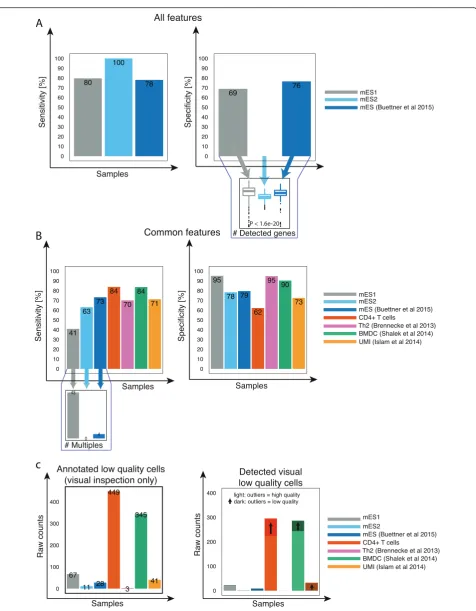
The ensemble performed very well on data from differ-ent mESC experimdiffer-ents if trained on all features, and sensitivity was high in each independent mESC dataset (Fig. 5a). Interestingly, specificity was high in all but one dataset. Due to problems with the library preparation, the number of genes in this particular dataset is signifi-cantly lower (P< 2.2 × 10⁻¹⁶, Wilcoxon rank sum test) compared to the other datasets (Fig. 5a). As expected, classification failed in other cell types and protocols since all cells are considered as high quality (zero sensi-tivity), due to training the model with cell-type specific features (Fig. 2e).
Applying the ensemble considering only common fea-tures decreased sensitivity on other mESC datasets. This is due to the high number of multiples contained in these datasets, which are then classified as high quality cells (Fig. 5b) because we use a smaller set of features. However, in the case of CD4+ T cells and BMDCs, the ensemble performed very well in classifying low and high quality cells (Fig. 5b).
To classify cells generated using UMI-based protocols, we transformed absolute transcript counts to raw read counts (Additional file 7: Figure S4A) using regression
(See figure on previous page.)
(Methods). We extracted features based on the trans-formed counts. Even without transformation, PCA of the features shows clear separation between the annotated low and high quality cells (Additional file 7: Figure S4B). We further applied the PCA-based method on two data-sets containing published human cancer cell lines without
prior quality annotation. It again clearly separates low from high quality cells in each dataset (Additional file 7: Figure S4C, D) having classified approximately 25 % of cells as low quality. To test if this is reasonable, we plotted the top three eigenvalues of each principal component (Additional file 7: Figure S4C, D boxplots). Similar to our
[image:9.595.57.539.87.569.2]A
B
c
[image:10.595.60.537.81.693.2]previous results (Figs. 2 and 3), genes related to mtDNA were upregulated in low quality cells, as well as the ERCC/mapped reads ratio. This suggests that these cells are broken and thus of low quality.
We also tested our mouse SVM model on human cancer cells and observed that it performed best (65 % accuracy based on prior feature-based PCA annotation) when excluding genes relating to Cytoplasm as a fea-ture. PCA on a combination of our mouse training set and the human cancer samples revealed that the Cyto-plasm feature separated the two species (Additional file 7: Figure S4E). This means that an SVM model trained on mouse cells cannot be directly applied to human cancer cell lines.
Above, we treated deceptive cells as low quality in all datasets. Now, we ask how the classifier performs when it is trained on data where they are, as initially thought, annotated as being of high quality. We measured the number of detected visibly damaged cells twice: Once by labeling deceptive cells as high quality, and a second time as low quality (both trained on common features). We then calculated the number of additionally detected damaged cells for each cell type. As expected, when de-ceptive cells are labeled as low quality, additional visibly damaged cells were detected (Fig. 5c). Overall, this con-firms that deceptive cells do need to be treated as low quality and that they improve sensitivity. These results confirm that the PCA-based version and our SVM model are able to remove low quality cells from datasets of various cell types and protocols.
Discussion
scRNA-sequencing experiments generate an enormous dataflow that needs to be stored and processed systemat-ically. Our pipeline offers simple options to enable inex-perienced command line users to process a large number of cells. It can be parallelized for rapid process-ing of thousands of cells, and identical parameters can be applied to ensure comparability. Users have the abil-ity to combine modules of the pipeline and easily choose the appropriate mapping and quantification tool (Fig. 1b). The pipeline can be run on an internal cluster or on Amazon’s AWS cloud. This enables scientists without large computing facilities to process large amounts of data.
Once the data are processed, low quality cells need to be removed. The number of low quality cells will vary depending on the experimental setting. Most of the data we used contained between 10 % and 40 % low quality cells (Additional file 1: Figure S1B). With microfluidic capture methods visual inspection under the microscope allows identification of wells containing broken, empty, and multiple cells to be found. However, continuous improvements in library preparation protocols and
decrease in sequencing costs are enabling thousands of single cells to be sequenced in parallel. Determining the quality of each cell through visual inspection will there-fore become impractical if not unfeasible. Even if one does take the time: some will appear intact but are in fact low quality (deceptive cells; Fig. 3). Similarly, multi-ples that are stacked (one over the other) will appear as single cells. Fluidigm have published a white paper reporting up to 30 % of multiples present in their stud-ied data (through dual-fluorescent coloring of a mixture of mouse and human cell types) [40]. They suggest that two independent operators image each capture site at 40× magnification with Z-stacking [40]. Some, non-microfluidic capture technologies do not support micro-scopic inspection, making it even harder to filter out low quality cells. This emphasizes the need for some meta-data about cells for any capture technology. We have shown that there are biological and technical features within the sequencing data that allow automatic identifi-cation of the majority of low quality cells (Fig. 2).
PCA and subsequent outlier detection of features im-proves visualization of low quality cells compared to traditional methods (Fig. 4a). However, this is not ideal for reliably discarding the majority of low quality cells. In the case of faulty capture devices or low capture effi-ciency, many low quality cells will be contained in a dataset. Visualizing such data would yield dense clouds of low quality cells. Hence, outlier detection algorithms would treat them as high quality.
Therefore, we developed a supervised classification approach and showed that it performs very well on all datasets and is capable of removing a higher num-ber of low quality cells compared to other methods (Figs. 4b, 5).
Using all features, the classifier removes the majority of low quality cells, including multiples (Fig. 5). More-over, it removes a subtype of low quality cells that can-not be detected under the microscope (Fig. 3). It appears that these cells are damaged enough for transcript loss to occur and to produce stress signals, but still appear reasonably intact upon microscopic inspection. Import-antly, the impact of this subtype on downstream data in-terpretation can be large (Fig. 3d-f ).
with cell annotations, can then be used to train a new model that targets a certain cell type or protocol, thus improving accuracy. To do this, annotating only a frac-tion of the cells would be sufficient to classify the remaining cells with high accuracy [8].
Overall, our approach allows the majority of low qual-ity cells to be discarded, regardless of whether any prior annotation exists. Using correctly annotated cells is im-mensely important when training the classifier: wrong annotation will very likely yield poor performance. In the future, our model could be further improved by more detailed annotations of cells, larger datasets, and perhaps using alternative computational classification methods.
Methods
Implementation of pipeline
The pipeline is a fast and simple Python script, imple-mented to be executable as independent modules. The number of required pre-installed packages is very low, making it portable and easily executable. It supports the following mapping tools: Bowtie1 [41], Bowtie2 [42], BWA1 [43], BWA2 [44], GSNAP [45], STAR [46], TopHat1 [47], and TopHat2 [48]. It supports two quan-tification tools: HTSeq [49] and Cufflinks [50]. All pre-sented datasets (except the UMI data) were processed with the pipeline. Reads were mapped to the Mus mus-culus genome (Ensembl version 38.73) using GSNAP [45] (version 2013-02-05) andHTSeq[49] (version 0.6.1) for gene expression quantification.
Normalization of raw read counts
To ensure that each cell can be classified independently we normalized raw reads of each cell by dividing each gene by the total number of mapped reads (excluding reads mapped to ERCC). Normalization approaches, such as the commonly used DESeq size factor normalization [32] are not appropriate for classification: size factors are a result of calculating a reference sample and taking the me-dian gene of each cell that deviates from that reference. Doing this independently on the training set and on a pre-diction set of samples could lead to biased classification results. Thus by simply accounting for the total number of reads in each cell datasets can be easily normalized with-out considering the training set.
Additionally, as we do not use genes but quality fea-tures, normalization becomes less of an issue. To gener-ate biological features, we grouped the genes into GO terms. We then summed up counts of all genes for each GO term and divided the counts by the total number of mapped reads. In other words, we calculated the proportion of reads mapping to groups of genes (ignoring overlaps) representing each GO category, and used this proportion for training the SVM.
TPM normalization
As an alternative to raw read counts produced by HTSeq [49], we also support transcripts per million (TPMs) as in-put for our PCA-based and SVM version. We were not able to detect substantial differences in performance when comparing to raw read counts (Fig. 4 and Additional file 6: Figure S3C). To get TPMs we first used Cufflinks [50] to generate FPKM (fragments per kilobase of transcript per million) and transformed these to TPM values. To cal-culate TPM values for biological features (for example, mtDNA) we summed up all TPM values of genes belong-ing to one particular group.
Determining functional categories with differential gene expression
To test differences in expression between low and high quality cells, we compared two sets of expression values for each GO term using a two-sided pairedt-test. In addition, we determined differentially expressed genes using both the DESeq[32] andPiano[51] package available on Bioconduc-tor. Cell-to-cell variation for each GO term was also deter-mined by calculating the two-sided paired t-test on the previously described [26] DM values. The associations be-tween GO terms and their child terms were obtained from theGO.dbannotation Bioconductor [38] package.
Accuracy measurements
Sensitivity and specificity were calculated as follows:
Sensitivity¼ TP
TPþFN
Specificity¼ TN
TNþFP;
where true positives (TP) are the number of low quality cells and true negatives (TN) are the number of high quality cells. This defines sensitivity as the proportion of correctly classified low quality cells, and specificity as the proportion of correctly identified high quality cells.
Total accuracy was calculated as follows:
Accuracy¼ TNþT P
TNþT PþFNþFP. The training set (960 mES cells) contained an imbalanced class distribution (80 TN/20 TP) and therefore total accuracy was not ideal for performance measurements. Instead, we calcu-lated a harmonic mean between sensitivity and specificity
called the FβScore:Fβ¼ 1þβ 2
ð ÞTP
1þβ2
ð ÞT Pþβ2FNþFP.
SVM classification of low quality cells
For classification we used the functions provided in the R package ‘e1071’ [53]. To determine SVM-classification model stability we performed nested cross-validation (Additional file 6: Figure S3). Nested cross-validation min-imizes overfitting and allowed us to measure sensitivity and specificity in each fold. This procedure consists of two loops. The outer loop splits the data into 10 folds and uses one fold to measure sensitivity and specificity. The inner loop splits the other nine folds again into 10 folds to esti-mate optimal hyperparameters. We picked the highest F1-score (harmonic mean between sensitivity and specificity) in each inner fold to optimize hyperparameters. Simply choos-ing the parameters with the highest total accuracy would have led to low sensitivity because the training dataset has an imbalanced distribution of high and low quality cells (80 and 20, respectively). We then used the accuracy rate for each fold to determine the final accuracy (Fig. 4b, c).
We used a radial kernel that transforms the data to higher dimensions to ensure more accurate classifica-tion. We also tested linear kernel and observed a small drop in classification accuracy. To obtain optimal pre-diction accuracy we estimated hyperparameters. These comprise gamma, cost, and class weights to account for the imbalanced class distribution. We applied nested cross-validation to narrow down possible choices of hyperparameters. For each parameter, we then retrieved an F-score prior to bootstrapping the data. The highest score was the criterion to choose the best parameter.
Model ensemble
Research in the field of machine learning has shown that classification accuracy can be improved by combining different classification models. This combination is re-ferred to as a model ensemble. To retrieve an ensemble, we applied the above described hyperparameter estima-tion 50 times. Performing hyperparameter estimaestima-tion multiple times shuffles the training and validation data-sets, which results in different parameters as output. Therefore, our ensemble consists of 50 models with differ-ent hyperparameter combinations. To predict a single data point, each model outputs a class prediction value and a majority voting scheme determines the final outcome.
Count transformation for UMI datasets
To convert the absolute number of transcripts of an scRNA-seq dataset generated using a UMI protocol to the number of reads, we modeled the relationship be-tween the independent variable xi (the mean number of
transcripts of gene i) and the dependent variable yi (the
mean number of reads of gene i from the 960 mESCs training set) using a cubic polynomial regression, where we added a pseudo count of 0.1 to both xi and yi and
log-transformed the data. The polynomial regression
coefficients were estimated by thenlsLMfunction in the minpack.lmR package.
Data availability
To ease usability, we developed an R package, which contains functions to extract all necessary classification fea-tures from single-cell gene expression data. The package vi-sualizes outliers, which were initially annotated as high quality. Additionally, it offers the ability to automatically fil-ter out low quality cells by using our previously trained SVM model. This gives the user the flexibility to combine this algorithm with prior annotation to identify deceptive cells (Fig. 3), or if no annotation is available, to automatically remove low quality cells. Moreover, the R package is built into the processing pipeline. This enables the user to auto-matically filter out low quality cells whilst data is being proc-essed. In this way, even inexperienced users can process thousands of cells by using only a single simple command. The R package is available on our GitHub repository under https://github.com/ti243/cellity and the Python pipeline can be found under https://github.com/ti243/celloline. Both soft-ware tools fall under the GNU General Public License 3.0.
The data are available under following Array express accessions.
training set mES [26]: E-MTAB-2600 mES [9]: E-MTAB-3749
Th2 [13]: E-MTAB-1499 BMDC [8]: E-GEOD-48968
UMI (Islam et al., 2014 [22]): E-GEOD-46980 mES2 + 3: anonymized, published elsewhere CD4+ T cells: anonymized, published elsewhere
Ethics approval
Does not apply to this work and therefore is irrelevant.
Additional files
Additional file 1: Figure S1.Overview of single cell RNA sequencing datasets. (A) Total number of cells per dataset. (B) Number of high quality and low quality cells per dataset. (C) Proportion of each type of low quality cells (broken, empty, multiple). (D) Number of cells for 2i/LIF, alternative 2i/LIF, and serum/LIF condition for the training dataset (960 mESCs). (PDF 441 kb)
Additional file 2: Table S1.Quality annotation of cells for all tested datasets. (XLSX 146 kb)
Additional file 3: Table S2.Pvalues of two-sided pairedt-test comparing expression and noise level, between each type of low quality cell for different GO-terms (training mES dataset). (XLSX 2641 kb)
Additional file 4: Table S3.Pvalues oft-test comparing features between each type of low quality and high quality cells (training mES dataset). (TXT 1 kb)
microscopic images of a single C1 capturing site containing one intact and one deceptive cell, respectively. (PDF 1026 kb)
Additional file 6: Figure S3.Post-QC outliers and SVM performance evaluation. (A) Visualization of low and high quality cells after outlier detection with traditional and with our PCA feature-based methods (B) Schematic of nested cross-validation. The training set was split twice into 10 folds. The inner folds were important to estimate optimal hyperparameters, whereas the outer folds served to measure accuracy. Optimal hyperparameters were saved for later use. (C) Sensitivity and specificity of feature-based PCA and SVM using TPM values. (PDF 558 kb)
Additional file 7: Figure S4.Datasets distant from mES training data. (A) Comparing log normalized UMI counts (y-axis) and log normalized read counts (x-axis) for each gene in 960 mESCs. (B) PCA of first two principal components of all features. Low quality cells separate from high quality cells. (C, D) PCA plot of features of two published human cancer cell datasets [28, 53]. Boxplots on the left and bottom show the top three features separating low from high quality cells for PC1 and PC2, respectively. They align with our previous findings that the mtDNA and ERCC to mapped reads ratios are upregulated in low quality cells. (E) Feature-based PCA combining mouse ES training set and two published human cancer datasets.‘Cytoplasm’separates not only the human from the mouse but also the two different cancer samples from each other, meaning that the features trained on mouse cells are not directly transferrable to human cancer cells. (PDF 591 kb)
Competing interests
The authors declare no competing financial interests.
Authors’contributions
TI analyzed and interpreted the data, developed the software, and prepared figures and manuscript; JKK carried out statistical analyses, figure preparation, and contributed to manuscript preparation; FOB helped with developing the pipeline and contributed to preparing the manuscript; DJM helped with developing the R package and contributed to preparing the manuscript; AAK helped with biological interpretation and contributed to preparing the manuscript; JCM developed and advised on statistics and bioinformatics methods and analysis, and contributed to manuscript preparation; SAT designed experiments, advised on analysis, and contributed to manuscript preparation. All authors read and approved the final manuscript.
Acknowledgements
We are grateful to Kedar Natarajan for providing microscopic images of deceptive cells, Rahul Satija, Alex Tuck, and Gozde Karr for quality annotation of cells, and to Valentine Svensson for constructive discussions on methodology.
Funding
AAK is funded by a BBSRC CASE Studentship with Abcam plc and SAT gratefully acknowledges an award from the Lister Institute. DJM receives funding as an NHRMC Early Career Fellow. FOB was supported by The Lundbeck Foundation. We thank EMBL and the WTSI for core funding. All authors read and approved the final manuscript.
Author details
1European Molecular Biology Laboratory, European Bioinformatics Institute
(EMBL-EBI), Wellcome Trust Genome Campus, Hinxton, Cambridge CB10 1SD, UK.2Wellcome Trust Sanger Institute, Wellcome Genome Campus, Hinxton, Cambridge CB10 1SA, UK.3Cavendish Laboratory, Dept Physics, University of Cambridge, JJ Thomson Avenue, Cambridge CB3 0HE, UK.4University of Cambridge, Cancer Research UK Cambridge Institute, Robinson Way, Cambridge CB2 0RE, UK.5Department of Haematology, University of Cambridge, Cambridge Biomedical Campus, Cambridge CB2 0PT, UK. 6National Health Service (NHS) Blood and Transplant, Cambridge Biomedical
Campus, Cambridge CB2 0PT, UK.7St Vincent’s Institute of Medical Research, Fitzroy, Victoria 3065, Australia.
Received: 21 August 2015 Accepted: 27 January 2016
References
1. Wang Z, Gerstein M, Snyder M. RNA-Seq: a revolutionary tool for transcriptomics. Nat Rev Genet. 2009;10:57–63.
2. Ozsolak F, Milos PM. RNA sequencing: advances, challenges and opportunities. Nat Rev Genet. 2011;12:87–98.
3. Tang F, Lao K, Surani MA. Development and applications of single-cell transcriptome analysis. Nat Meth. 2011;8:S6–11.
4. Macaulay IC, Voet T. Single cell genomics: advances and future perspectives. PLoS Genet. 2014;10:e1004126.
5. Junker JP, van Oudenaarden A. Every cell is special: genome-wide studies add a new dimension to single-cell biology. Cell. 2014;157:8–11.
6. Mahata B, Zhang X, Kolodziejczyk AA, Proserpio V, Haim-Vilmovsky L, Taylor AE, et al. Single-cell RNA sequencing reveals T helper cells synthesizing steroids de novo to contribute to immune homeostasis. Cell Reports. 2014;7:1130–42. 7. Treutlein B, Brownfield DG, Wu AR, Neff NF, Mantalas GL, Espinoza FH, et al.
Reconstructing lineage hierarchies of the distal lung epithelium using single-cell RNA-seq. Nature. 2014;1–16.
8. Shalek AK, Satija R, Shuga J, Trombetta JJ, Gennert D, Lu D, et al. Single-cell RNA-seq reveals dynamic paracrine control of cellular variation. Nature. 2014;510:363–9.
9. Buettner F, Natarajan KN, Casale FP, Proserpio V, Scialdone A, Theis FJ, et al. Computational analysis of cell-to-cell heterogeneity in single-cell RNA-sequencing data reveals hidden subpopulations of cells. Nat Biotech. 2015;33:155–60.
10. Usoskin D, Furlan A, Islam S, Abdo H, Lönnerberg P, Lou D, et al. Unbiased classification of sensory neuron types by large-scale single-cell RNA sequencing. Nat Neurosci. 2015;18:145–53.
11. Patel AP, Tirosh I, Trombetta JJ, Shalek AK, Gillespie SM, Wakimoto H, et al. Single-cell RNA-seq highlights intratumoral heterogeneity in primary glioblastoma. Science. 2014;344:1396–401.
12. Deng Q, Ramskold D, Reinius B, Sandberg R. Single-cell RNA-seq reveals dynamic, random monoallelic gene expression in mammalian cells. Science. 2014;343:193–6.
13. Brennecke P, Anders S, Kim JK, Kołodziejczyk AA, Zhang X, Proserpio V, et al. Accounting for technical noise in single-cell RNA-seq experiments. Nat Meth. 2013;10:1093–5.
14. Xue Z, Huang K, Cai C, Cai L, Jiang C-Y, Feng Y, et al. Genetic programs in human and mouse early embryos revealed by single-cell RNA sequencing. Nature. 2014;500:593–7.
15. Trapnell C, Cacchiarelli D, Grimsby J, Pokharel P, Li S, Morse M, et al. The dynamics and regulators of cell fate decisions are revealed by pseudotemporal ordering of single cells. Nat Biotechnol. 2014;32:381–6.
16. Marinov GK, Williams BA, McCue K, Schroth GP, Gertz J, Myers RM, et al. From single-cell to cell-pool transcriptomes: stochasticity in gene expression and RNA splicing. Genome Res. 2014;24:496–510.
17. Biase FH, Cao X, Zhong S. Cell fate inclination within 2-cell and 4-cell mouse embryos revealed by single-cell RNA sequencing. Genome Res. 2014;24:1787–96.
18. Macosko EZ, Basu A, Satija R, Nemesh J, Shekhar K, Goldman M, et al. Highly parallel genome-wide expression profiling of individual cells using nanoliter droplets. Cell. 2015;161:1202–14.
19. Klein AM, Mazutis L, Akartuna I, Tallapragada N, Veres A, Li V, et al. Droplet barcoding for single-cell transcriptomics applied to embryonic stem cells. Cell. 2015;161:1187–201.
20. DeLuca DS, Levin JZ, Sivachenko A, Fennell T, Nazaire MD, Williams C, et al. RNA-SeQC: RNA-seq metrics for quality control and process optimization. Bioinformatics. 2012;28:1530–2.
21. Wang L, Wang S, Li W. RSeQC: quality control of RNA-seq experiments. Bioinformatics. 2012;28:2184–5.
22. Islam S, Zeisel A, Joost S, La Manno G, Zajac P, Kasper M, et al. Quantitative single-cell rna-seq with unique molecular identifiers. Nat Meth. 2014;11:163–6. 23. Jaitin DA, Kenigsberg E, Keren-Shaul H, Elefant N, Paul F, Zaretsky I, et al.
Massively parallel single-cell RNA-seq for marker-free decomposition of tissues into cell types. Science. 2014;343:776–9.
24. Picelli S, Björklund ÅK, Faridani OR, Sagasser S, Winberg G, Sandberg R. Smart-seq2 for sensitive full-length transcriptome profiling in single cells. Nat Meth. 2013;10:1096–8.
26. Kolodziejczyk AA, Kim JK, Tsang JCH, Ilicic T, Henriksson J, Natarajan KN, et al. Single cell RNA-sequencing of pluripotent states unlocks modular transcriptional variation. Cell Stem Cell. 2015;17:471–85.
27. Fonseca NA, Marioni J, Brazma A. RNA-Seq gene profiling–a systematic empirical comparison. PLoS One. 2014;9:e107026.
28. Goecks J, Nekrutenko A, Taylor J, Galaxy Team. Galaxy: a comprehensive approach for supporting accessible, reproducible, and transparent computational research in the life sciences. Genome Biol. 2010;11:R86. 29. Goncalves A, Tikhonov A, Brazma A, Kapushesky M. A pipeline for RNA-seq
data processing and quality assessment. Bioinformatics. 2011;27:867–9. 30. Tang F, Barbacioru C, Nordman E, Bao S, Lee C, Wang X, et al. Deterministic
and stochastic allele specific gene expression in single mouse blastomeres. PLoS One. 2011;6:e21208.
31. Kim JK, Kolodziejczyk AA, Ilicic T, Teichmann SA, Marioni JC. Characterizing noise structure in single-cell RNA-seq distinguishes genuine from technical stochastic allelic expression. Nat Commun. 2015;6:8687.
32. Anders S, McCarthy DJ, Chen Y, Okoniewski M, Smyth GK, Huber W, et al. Count-based differential expression analysis of RNA sequencing data using R and Bioconductor. Nat Protoc. 2013;8:1765–86.
33. Picard M, Zhang J, Hancock S, Derbeneva O, Golhar R, Golik P, et al. Progressive increase in mtDNA 3243A > G heteroplasmy causes abrupt transcriptional reprogramming. Proc Natl Acad Sci U S A. 2014;111:E4033–42. 34. Galluzzi L, Kepp O, Kroemer G. Mitochondria: master regulators of danger
signalling. Nat Rev Mol Cell Biol. 2012;13:780–8.
35. Detmer SA, Chan DC. Functions and dysfunctions of mitochondrial dynamics. Nat Rev Mol Cell Biol. 2007;8:870–9.
36. Islam S, Zeisel A, Joost S, La Manno G, Zajac P, Kasper M, et al. Quantitative single-cell RNA-seq with unique molecular identifiers. Nat Meth. 2013;11:163–6.
37. Filzmoser P, Garrett RG, Reimann C. Multivariate outlier detection in exploration geochemistry. Comput Geosci. 2005;31:579–87. 38. Alexa A, Rahnenfuhrer J. topGO: topGO: Enrichment analysis for Gene
Ontology. 2010.
39. Marks H, Kalkan T, Menafra R, Denissov S, Jones K, Hofemeister H, et al. The transcriptional and epigenomic foundations of ground state pluripotency. Cell. 2012;149:590–604.
40. Fluidigm Corporation. Doublet Rate and Detection on the C1 IFCs White Paper (PN 101-2711 A1). 2016. p. 1–12.
41. Langmead B, Trapnell C, Pop M, Salzberg SL. Ultrafast and memory-efficient alignment of short DNA sequences to the human genome. Genome Biol. 2009;10:R25.
42. Langmead B, Salzberg SL. Fast gapped-read alignment with Bowtie 2. Nat Meth. 2012;9:357–9.
43. Li H, Durbin R. Fast and accurate short read alignment with Burrows-Wheeler transform. Bioinformatics. 2009;25:1754–60.
44. Li H, Durbin R. Fast and accurate long-read alignment with Burrows-Wheeler transform. Bioinformatics. 2010;26:589–95.
45. Wu TD, Nacu S. Fast and SNP-tolerant detection of complex variants and splicing in short reads. Bioinformatics. 2010;26:873–81.
46. Dobin A, Davis CA, Schlesinger F, Drenkow J, Zaleski C, Jha S, et al. STAR: ultrafast universal RNA-seq aligner. Bioinformatics. 2013;29:15–21. 47. Trapnell C, Pachter L, Salzberg SL. TopHat: discovering splice junctions with
RNA-Seq. Bioinformatics. 2009;25:1105–11.
48. Kim D, Pertea G, Trapnell C, Pimentel H, Kelley R, Salzberg SL. TopHat2: accurate alignment of transcriptomes in the presence of insertions, deletions and gene fusions. Genome Biol. 2013;14:R36.
49. Anders S, Pyl PT, Huber W. HTSeq-a Python framework to work with high-throughput sequencing data. Bioinformatics. 2014;31:btu638–169. 50. Trapnell C, Williams BA, Pertea G, Mortazavi A, Kwan G, van Baren MJ, et al.
Transcript assembly and quantification by RNA-Seq reveals unannotated transcripts and isoform switching during cell differentiation. Nat Biotechnol. 2010;28:511–5.
51. Väremo L, Nielsen J, Nookaew I. Enriching the gene set analysis of genome-wide data by incorporating directionality of gene expression and combining statistical hypotheses and methods. Nucleic Acids Res. 2013;41:4378–91.
52. Matthews BW. Comparison of the predicted and observed secondary structure of T4 phage lysozyme. Biochim Biophys Acta. 1975;405:442–51. 53. Meyer D, Dimitriadou E, Hornik K, Weingessel A, Leisch F. Misc Functions of
the Department of Statistics, Probability Theory Group (Formerly: E1071), TU Wien. 2015.
• We accept pre-submission inquiries
• Our selector tool helps you to find the most relevant journal
• We provide round the clock customer support
• Convenient online submission
• Thorough peer review
• Inclusion in PubMed and all major indexing services
• Maximum visibility for your research
Submit your manuscript at www.biomedcentral.com/submit