A novel adaptive routing algorithm for
Wireless adhoc network
Deepshikha1,Dr.Savita Shiwani2
(Department of computer science Engineering, Suresh Gyan Vihar University, jaipur, Raj.India)1, (Assistance professor, Information and Technology department, Gyan Vihar University, India)2
Abstract: Wireless AD-HOC Network is the most frequently used network these days. The traditional routing involves a fixed path for the routing process. It consists of a centralized system. The packets are forwarded from the source to the destination, through the fixed path. Disadvantage of this type of routing is that it cannot change path according to the need of the packet. Wireless ADHOC network overcomes the disadvantages of the traditional routing. It consists of a number of mobile nodes working coherently with each other, without any centralized infrastructure. The traditional routing is not able to broadcast the data and also it can’t enjoy the wireless communication for transmission of data. The adaptive routing in wireless ADHOC network enjoys the transmission of data through broadcast method and also all the other approaches of the wireless system. In this paper we have proposed an adaptive routing algorithm for wireless ADHOC network, which minimizes the average per packet cost in transmitting a packet from source to destination.
Keywords:- Adaptive Routing, Algorithm, Wireless AD-HOC Network.
1. INTRODUCTION
Adaptive routing is the routing process in which the packets of data are transferred from source to destination through the path which is not fixed; the packet changes the path according to its requirement.
Different protocols are used for adaptive routing, they are RIP, OSPF, IS-IS, and IGR P or EIGRP. The systems using the adaptive routing are termed as using the dynamic routing.
The systems using the non-adaptive routing are termed as using the static routing, in which the fixed path is determined before the transmission of the packet starts. The packets can’t change the path even if any fault occurs or the traffic is high in that path The wireless HOC network is also known as mobile AD-HOC network(MANET).The MANET are mobile network so
Page 280
2. RELATED WORK
In case of traditional routing there is fixed route of transmitting the packets. So these types of networks are not able enjoy the facilities of the broadcasting or the one given by the wireless communication. So the main objective of this paper is to overcome the problems of the traditional routing protocol and to propose new method in ad-hoc routing protocol, to transmit the packets from source to destination efficiently.
3. PROPOSED WORK
We will propose n adaptive opportunistic Routing scheme for
the MANET, which will make real time routing decisions on the
basis of the actual transmission outcomes as well as a rank
ordering of neighboring nodes. It will minimize the expected
average per packet cost for routing a packet from a source node
to a destination node.
3.1
Methodologies:-We have investigated the problem of opportunistically routing
packets in a wireless multi-hop network when zero knowledge
of transmission success probabilities and network topology is
available. By using a reinforcement learning framework, we will
propose an adaptive opportunistic routing algorithm which
minimizes the expected average per packet cost for routing a
packet from a source node to a destination
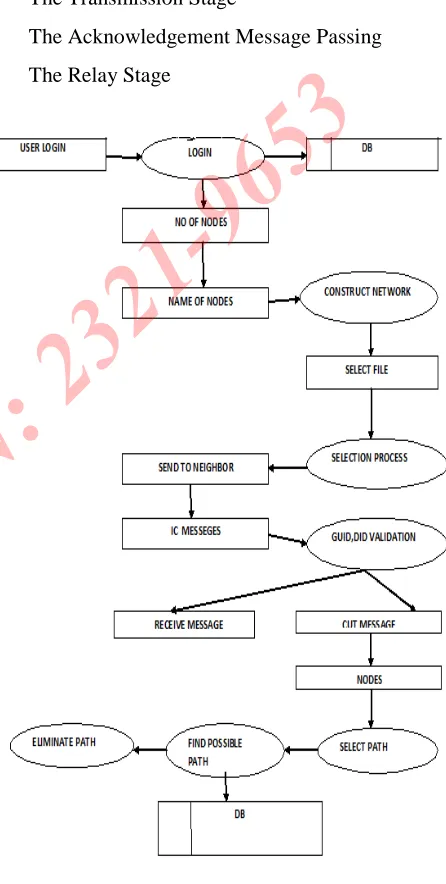
3.2 Stages of Proposed
work:-The proposed work functions in four
steps:- The Initialization stage
The Transmission Stage
The Acknowledgement Message Passing
[image:3.612.337.560.151.593.2] The Relay Stage
Figure 1. Data flow diagram
At this stage the source node and the destination node
are decided. zero numbering is given to the source node
and (d+1) is given to the destination node.
2. The Transmission stage:
At this stage the packets are transmitted from one node
to another.
3. The Acknowledgement Message Passing:
At this stage the acknowledgement message
is send from the node which received the
message to the node which send the
message.
4. The Relay Stage:
We are given a successful transmission from
node i to the set of neighbor nodes S, the next
routing decision includes
retransmission by node i,
relaying the packet by a node j 2 S
Dropping the packet all together. If node j is selected as
a relay then it transmits the packet at the next slot while
other nodes removes that packet.
4. RESULTS
The proposed scheme will result in low complexity, low
computational overhead, and distributed asynchronous
implementation.
4.1 Few characteristics of the proposed scheme are:
It will minimize the expected average per packet cost
for routing a packet from a source node to a
It is unaware to the initial knowledge of network.
It is distributed. So each node makes decisions based
on its belief using the information that it obtained from
its neighbors.
It is asynchronous. So at any time any subset of nodes
updates their corresponding beliefs.
4.2 Few steps to show how nodes are created and how
messages are exchanged among them.
Step.1.
In this part number of nodes to be created is
Page 282
Step 2:
In this step the source node and the destination node is entered,
and the connection is established among both the nodes.
Step 3:
In this step the nodes are formed and the messages
In the above diagram two nodes are present and the exchange of messages takes place among both the nodes.
5. CONCLUSION
In this paper the adaptive routing for wireless ad-hoc network has been proposed. The movement of the packets on the network is shown through the packet tracers. The nodes are created with the help of window programming in java, and the exchange of messages among the nodes is also shown. After studying the aspects of Ad-hoc networks in depth, we believe that they will be the future of wireless networking. The performance suffers as the number of devices grows and large ad-hoc networks become difficult to manage and route. However, much time is being devoted in achieving routing stability, and a few technical issues need to be solved before they are used commonly. The field of ad hoc networks is a very fast growing field, and due to the vast research in them, we are seeing these problems disappear and they are coming into a world of their own.
REFERENCES
1] A.Menaka Pushpa, “Trust Based Secure Routing in AODV Routing Protocol”, IEEE 2009.
[2] Wenchao Huang, Yan Xiong, Depin Chen, “DAAODV: A Secure Ad-hoc Routing Protocol based on Direct Anonymous Attestation”, 2009 International Conference on Computational Science and Engineering, IEEE 2009, pp. 809-916.
[3] Cuirong Wang, Shuxin CAI, and Rui Li, “AODVsec: A Multipath Routing Protocol in Ad-Hoc Networks for Improving Security”, 2009 International Conference on Multimedia Information Networking and Security, IEEE 2009, pp. 401-404.
[4] Zeyad M. Alfawaer and Saleem Al_zoubi, “A proposed Security subsystem for Ad Hoc Wireless Networks”, 2009 International Forum on Computer Science-Technology and Applications, IEEE Computer Society 2009, pp. 253-255.
[5] Muhammad Naeemv, Zah ir Ahmed, Rashid Mahmood, and Muhammad Ajmal Azad, “QOS Based Performance Evaluation of Secure On-Demand Routing Protocols for MANET's”, 20 1O IEEE, ICWCSC 2010X.
[6] Preeti Bhati, Rinki Chauhan and R K Rathy, “An Efficient Agent-Based AODV Routing Protocol in MANET”, International Journal on Computer Science and Engineering (IJCSE), Vol. 3 No. 7 July 2011, pp. 2668-2673.
[7] Ming Yu, Mengchu Zhou, and Wei Su, “A Secure Routing
Protocol against Byzantine Attacks for MANETs in Adversarial
Environments”, IEEE TRANSACTIONS ON VEHICULAR
TECHNOLOGY, VOL. 58, NO. 1, JANUARY 2009, pp.
449-460.
Page 284
International journal on applications of graph theory in wireless
ad hoc networks and sensor networks, pp. 46-57
[9] R. R. Choudhury, “Brownian gossip: Exploiting node
mobility to diffuse information in ad hoc networks,” in Proc. Int.
Conf. Collaborative Comput.: Netw. Appl. Worksharing, 2005,
pp. 1–5.
[10] T. Hara and S. K. Madria, “Consistent Management Strategies for Data Replication in Mobile Ad hoc Networks,”
IEEE Transactions on Mobile Computing, vol. 8, no. 7, July