Designing a Model for Web Page Generation Using
Repository of Templates
Anita Rani1, Harish Rohil2, Meghna Jain3
1
M.Tech (CSE) Scholar, Dept. of Computer Science and Applications,
2
Assistant Professor, Dept. of Computer Science and Applications,
3
B.Tech Scholar Dept. of Computer Science and Engineering
1, 2
Ch. Devi Lal University, Sirsa - 125055, Haryana, India
3
C.I.T. Rajasthan, India
Abstract: Software engineering is the art of Science containing software development life-cycle. It has different models which
are used for devolving any type of software with each model having its own life-cycle. Similar to software Engineering, Web
Engineering is a systematic and disciplined approach generally deals with the web development. According to this approach a
successful software development process is carried out for high quality usable web based system. Basically it focuses on the
methodologies, techniques and tools that are used for web application development which supports their development, evolution
and validation. The development of web is carried out with the help of number of steps. In My research work three major steps
are combined it into one single step. These steps are requirements engineering, web development and testing. The presented work
is the automated system that will accept the core web requirements respective to a web page in a user friendly manner and design
the webpage for both the server side as well as the client side generating a webpage according to user‘s requirement. This work
also includes the testing phase dynamically where all the validations on the client side will be implemented. My research work
also includes the concept of updating of template. If any of the Template does not exist in repository then new template get
automatically save there.
I. INTRODUCTION
The World Wide Web has become a major platform for carrying
out software development process. Software Engineering is an
engineering discipline which is concerned for developing any
software. In this discipline, Software requirement specification
is the basic step for generating any application. If all types of
user requirements are clearly defined then correct results will be
produced. There are two basic goals of Software Engineering,
the first one is to improve the quality of software products and
the second one is to increase the productivity and satisfaction of
Software Engineers.
In this definition, there are two key phases. The primary goals of
Software Engineering are to improve the quality of software
products and to increase the productivity and job satisfaction of
Software Engineers and these two goals are totally dependent on
the Software Engineering as these goals can’t be accomplished
without the knowledge of Software Engineering. Software is
nothing but the collection of instructions or the computer
programs when executed by desired functions to obtain desired
output or to meet the required performance. Web application
development has certain characteristics that make it different
from traditional software.
Web Engineering is multidisciplinary and contribution from
different fields like : system analysis and design, software
engineering, hypermedia/hypertext engineering, requirement
engineering, human-computer interaction, user interface,
information engineering, information indexing and retrieval,
testing, modeling and simulation, project management and
graphic design and presentation. Web engineering is neither a
clone nor a subset of software engineering, although both
involve programming and software development. Even if Web
Engineering uses Software Engineering principles, it
encompasses new approaches, methodologies, tools, techniques
and guidelines to meet the unique requirements of Web-based
applications. In particular, Web engineering focuses on the
methodologies, techniques and tools that are the foundation of
Web application. Software reliability is “the ability of a
program to perform a required function under stated conditions
within a stated period of time”. So software quality depends on
the software reliability. Successful software is very reliable. A
structured set of activities is required to develop a software
system. Software quality assurance (SQA) consists of a means
of monitoring the software engineering processes and methods
used to ensure quality of software. SQA encompasses the entire
software development process which includes processes such as
Requirement Specification: A Software Requirements
Specification (SRS) is a complete description of the
behavior of the system to be developed
Software Design: Software design is a process of
problem-solving and planning for a software solution.
Software design is actually a multi-step process that
focuses on four distinct attributes of a program: data
structure, software architecture, interface
representations and procedures.
Coding: After designing, it is divided into many
among appropriate developers and then they start
coding. After coding completes, it will be integrated.
Code reviews: Code review is systematic examination
of computer source code intended to find and fix
mistakes overlooked in the initial development phase
improving both the overall quality of software and the
developers' skills.
II RELATED TERMS
A Model-driven engineering (MDE)
MDE is a software development methodology which focuses on
creating models or abstraction of something more real that
describe the elements of a system. It is meant to increase
productivity by maximizing compatibility between systems,
simplifying the process of design and promoting communication
between individuals of teams working on the system. The first
tool to support MDE was the Computer-Aided Software
Engineering (CASE) tools developed in the 1980, but CASE had
the same problem that current MDA/MDE tools today have: the
model gets out of synchronized.
B Requirement Engineering
Requirement Engineering is concerned with identifying,
modeling, communicating and documenting the requirements of
a system and the context in which the system will be used.
Requirements describe what is to be done but not how they are
implemented. There are many techniques available for use
during the RE process to ensure that the requirements are
complete, consistent and relevant. This goal is based on two
major assumptions:
The later mistakes are discovered much expensive to
correct them.
It is possible to determine a stable set of requirements
before system design and implementation starts.
C Agile Development Methods
In comparison to traditional software processes, agile
development is less document-centric and more
code-oriented. However, this is not the key point but rather a
symptom of two deeper differences between them
Agile methods are adaptive rather than predictive.
Agile methods were developed to adapt and thrive on
frequent changes.
Agile methods are people-oriented rather than process
oriented. They rely on people’s expertise, competency
and direct collaboration rather than on rigorous,
document-centric processes to produce high-quality
software.
The most common agile methods
1) Extreme Programming (XP)
Extreme Programming (XP) is based on values of simplicity,
communication, feedback and courage. It works by bringing the
enough feedback to enable the team to see where they stand. XP
combines old, tried and tested techniques in such a way that they
reinforce each other. XP uses story cards for elicitation. A user
story is a description of a feature which provides business value
to the customer. Before story cards can be written, customers
have to think about what they expect the system to do. This
process seems brainstorming.
2) Agile Modeling (AM)
The basic idea of AM is to give developers a guideline of how
to build models that resolve design problems but not over-build
these models. Like XP, AM points out that changes are usual in
software development. AM highlights the difference between
informal models whose sole purpose is to support face-to-face
communication and models that are preserved and maintained as
part of the system documentation. The latter is what is often
found in RE approaches.
3) Scrum
It is a method for managing the system development process
by applying ideas on flexibility, adaptability and productivity
from industrial process control theory. Scrum focuses on how a
team should work together to produce quality work in a
changing environment concept of updation of the template
definition. If any of the existing template model does not satisfy
the user requirement, a new template model will be included to
satisfy the user requirement. We are developing a tool to
combine all required phase in a single unit called Navigational
Development Approach. According to this approach, during the
development user just need to select the field it will itself design
fully tested web pages.
III PROPOSED WORK
A website basically represents a business or the organization for
a user. Because of this a web application owner wants his
website such user-friendly that it will fulfill the need of his all
stakeholders. The web application owner may desire the regular
change requirement in his web application. These requirements
are based on the appearance of the website. These requirements
include some updation respective to the information that owner
want to provide to the stakeholder. It also includes the
requirements of the stakeholder that they want in that web
application. The inclusion of new attribute in any form filling
application is also the major requirement of web application
owner. It means in a web application the web requirements are
very clear at the initial phase but even then these requirements
change very frequently.
The feasibility is check related to user requirement and user
needs. But generally this process is done for one time. Once the
feasibility specified, generally it will not be changed after each
change in web requirement.
In case of web application the user requirements respective to
webpage components and the design is clearly defined but along
with this it is most changing requirement by the user. In such
case each user change will rollback the whole process. We are
providing the solution for the above defined problem by using
using the concept to automate the concept of web requirement,
design and development as a single unit. We are presenting the
concept of extreme programming methodology to capture the
knowledge requirement of the user and then this knowledge
acquisition will be automatically design and develop the web
page. We are developing a tool to combine all required phase in
a single unit called navigational development approach.
According to the approach during the development all the
components must be fully tested and verified.
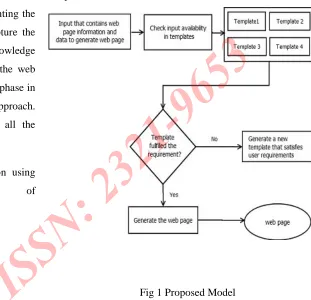
This is my proposed model for web page generation using
repository of
[image:6.612.264.575.150.450.2]templates
Fig 1 Proposed Model
Figure 1 shows that the process starts by defining objectives.
Using the procedure described below, requirements are captured
and defined. Requirements are classified according to their
nature: information storage requirements, actor’s requirements,
functional requirements, interaction requirements or
nonfunctional requirements. These requirements are described
in navigational tool using some especially defined patterns. A
pattern is a template with specific fields which must be
completed by the developer. It is an approach for the
specification and analysis of web information systems. The
complete development process can be defined as a bottom-up
process. The development process is focuse
on a very detailed requirements definition. And the presented
work only covers the first phase in the life cycle i.e. requirement
engineering. With the process of collecting user requirement, the
system is able to perform the website design, code
implementation and the testing.
The presented work is divided into three parts
Designing user interface
Construct Template Wizard
In case of designing user interface the collection of user
requirements process is used. For collection of user requirement
there is a template wizard that is totally based on graphical user
interface and this wizard contains different types of fields
according to the user requirements. After filling all the fields
according to the user requirement the web page will be
generated
IV EXPERIMENTAL WORK
The proposed model works on generating web pages according
to the user requirement .and in which user requirements is the
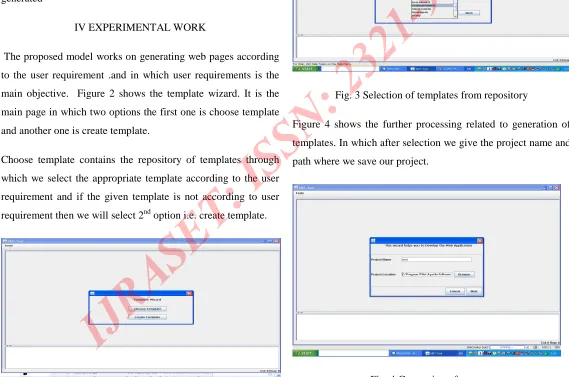
main objective. Figure 2 shows the template wizard. It is the
main page in which two options the first one is choose template
and another one is create template.
Choose template contains the repository of templates through
which we select the appropriate template according to the user
requirement and if the given template is not according to user
requirement then we will select 2ndoption i.e. create template.
Fig 2. Template Wizard
Figure 3 shows the selection of require template from the
repository of templates.
Fig. 3 Selection of templates from repository
Figure 4 shows the further processing related to generation of
templates. In which after selection we give the project name and
[image:7.612.20.589.258.635.2]path where we save our project.
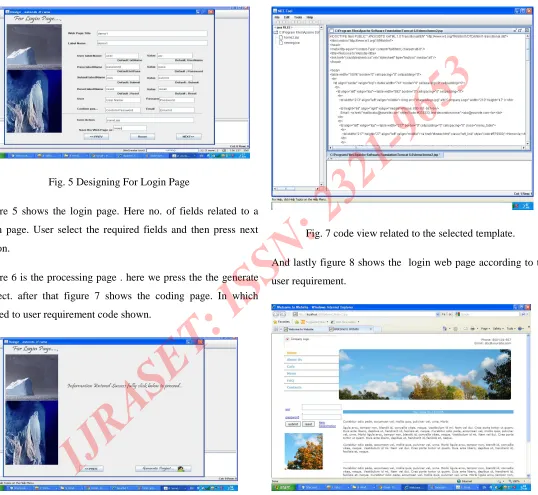
Fig. 5 Designing For Login Page
Figure 5 shows the login page. Here no. of fields related to a
login page. User select the required fields and then press next
button.
Figure 6 is the processing page . here we press the the generate
project. after that figure 7 shows the coding page. In which
related to user requirement code shown.
Fig. 6 processing page
Fig. 7 code view related to the selected template.
And lastly figure 8 shows the login web page according to the
user requirement.
IV CONCLUSIONS
The proposed approach provides a user friendly environment in
wizard form where user can pass the input step by step and
finally get a ready webpage or the website out of it.
The present work will give the benefit to both the end user and
the developer as the user can pass his basic requirements such as
appearance of website number of attributes that he want on the
web page etc. and the developer get the client side and the
server side page from the system. It means after input the basic
requirement to the system, developer need not to take care about
the code. The generated code is connected to the database
system also that can produce the database interactive server side
code.
REFERENCES
[1] C. Barry and M. Lang, “A Survey of Multimedia and
Web Development Techniques and Methodology
Usage,”
[2] S. Ceri, P. Fraternali, and P. Bongio, “Web Modeling
Language (WebML): A Modeling Language for
Designing Web Sites,” Proc. Ninth Int’l World Wide
Web Conf., Computer Networks, vol. 33, nos. 1-6, pp.
137-157, May 2008.
[3] P. Chen, “The Entity-Relationship Approach: Towards
a Unified Behavior of Data,” ACM Trans. Database
Systems, vol. 1, no. 1, pp. 9-36, Jan. 2006.
[4] Peter M. Jansson, Ravi P. Ramachandran, John L.
Schmalzel, and Shreekanth A. Mandayam, ” Creating
an Agile ECE Learning Environment Through
Engineering Clinics”. IEEE Transaction on education,
Vol 53, No. 19, August 2010 0018-9359, 2009 IEEE
[5] Kannan Mohan, Balasubramaniam Ramesh and
Vijayan Sugumaran, “Integrating Software Product
Line Engineering and Agile Development”. 0 74 0 - 74
5 9 / 1 0 / © 2 0 1 0 I E E E
[6] Christian Berger and Bernhard Rumpe, ” Supporting
Agile Change Management by Scenario-Based
Regression Simulation”.transactions on intelligent
transportation systems ,Vol 11, no. 2,june 2010
1514-9050/ 2010 IEEE
[7] Kera Z. Watkins and Tiffany Barnes, “Competitive and
Agile Software Engineering Education”. 978
-1-4244-5853-0/10/ ©2010 IEEE
[8] Vladan Devedˇ zic ´ and Sa˘ sa R. Milenkovic ,
“Teaching Agile Software Development: A Case
Study”.IEEE Transactions education, Vol. 54, no. 2,
MAY 2011 Digital
ObjectIdentifier10.1109/TE.2010.2052104
[9] Zornitza Racheva, Maya Daneva “How Do Real
Options Concepts Fit inAgilerequirements
[10] Stephen R. Foster and Ruben Ruiz, “Constructivist
Pedagogy meets Agile Development – A Case Study”.
2010 Seventh International Conference on Information
Technology10.1109/ITNG.2010.185
[11] Osama Sohaib and Khalid Khan, “Integrating
Usability Engineering and Agile Software
Development: A Literature Review”. 201O
International Conference On Computer Design And
Appliations (ICCDA 2010) 978-1-4244-7164-5/ ©
2010 IEEE
[12] David Oxenham “Agile Approaches to Meet Complex
System of System Engineering Challenges: A Defence
Perspective”. DOI 10.1109/SOSE.2010.668
[13] In year 2010, Martin Molhanec “Agile Project
Management Framework”. 978–1–4244–7850–7/2010/
©2010 IEEE
[14] Reinhard Hametner, Dietmar Winkler, Thomas
Östreicher, Stefan Biffl and Alois Zoitl, “The
Adaptation of Test-Driven Software Processes to
Industrial Automation Engineering”. 978
-1-4244-7300-7/10/ ©2010 IEEE
[15] Yaser Ghana, Darren Andreychuk, and Frank Maurer,
“Reactive Variability Management In Agile Software
Development”. 2010 Agile Conference. DOI
10.1109/AGILE.2010.6
[16] Song Quan-Lu Lu Ju QiaoZheng Xu, “Study on
Management Factors of Construction Machinery Host
Machinery Corporation supplier”. 2010WAE
International Conference on Information Engineering.