III. RESEARCH METHOD
A. Setting
This research was conducted at the first year student of SLTPN 1 Hulu Sungkai.
Class VII A as the subject, since based on school-Based Curriculum, descriptive
text is one of the texts that should be mastered by the first year students of junior
high school. Action Research was done based on the problems faced by students
in writing descriptive text. Based on the interview with the teacher, the researcher
found that the students in this class have low capability in writing the text. They
also got low score in writing the text. (See appendix 8). They got difficulties in
developing their ideas into a good text. The students also faced some problems in
using the appropriate grammar and the suitable generic structure of the text. Other
problems faced by the students such as lack of vocabulary and tend to be passive.
Among those problems causes, the researcher focused on the students’ difficulties
in developing the idea of the topic being discussed. Then, it was examined to find
problems solution that is teaching descriptive text writing through Word Field
Card Game, in which in this game the students guess the pictures or words state
on the cards as the clues. After teaching, the researcher asked the students to write
descriptive text based on the clues that they made when playing the game. The
To know how the Word Field Card Game can improve students’ descriptive text
writing ability, another observer was asked to observe and to note the activities
and the important things in the classroom during teaching-learning process based
on the observation sheet given. Then, the observation result during
teaching-learning process (the weaknesses and strength during teaching-teaching-learning process)
and the learning result (writing test of descriptive text) were analyzed and
discussed by the researcher together with the observer. The result of the analysis
and reflections were used to decide whether the next cycle was needed or not, in
which it was focused on the weaknesses in the previous cycle.
B. Research procedure
The researcher conducted the first cycle based on the problems faced by the
students in writing descriptive text that was difficulties in developing the idea of
the topic being discussed. Then the researcher taught descriptive text through
Word Field Card Games based on the lesson plan while the observer observes the
teaching-learning process by using observation sheet given. After teaching, the
students were given the writing test. The result of the writing test and the
observation sheet were analyzed and discussed by the researcher and the observer
in order to see whether the result of writing test and the result of observation sheet
has required the indicator of the research. The indicator of the writing test is 70%
students’ gain the score 70 or more, while the indicator of the observation sheet
for the teacher’s explanation is 70% teacher explains the aspects of outline and for
the first cycle has not required the indicator of the research, the second cycle was
conducted in which focused on the weaknesses of the previous cycle.
Each cycle consist of: 1) Planning, 2) Implementation, 3) Observation and
Interpretation, 4) Analysis and Reflection.
The following diagram shows the arrangement of the cycle:
Figure1. The cycle of the classroom action research adopted from Depdikbud (19997)
Keterangan:
A : Planning
B : Implementation C : Observation D : Reflection
Basically, the cycles are classified as the following description, they are:
1. Planning
Planning is the stage where the problem causes are identified. By knowing the
Problem, the focus of the problems can be formulated in the importance of the
implementation will be given. After deciding the problems, the appropriate
technique is chosen. And based on the formulation of the problem, the materials
(the topic being discussed) and teaching aids (Word Field Card Game) and the
D I B
C
D II B
C
D III B
C
type of test (writing test) are planned. To get complete data, an observer is
involved to observe teaching-learning process (by using observation sheet).
In this research, the researcher identified the problems based on the interview with
the teacher, among the problems; the researcher focused on the students’
difficulties in developing the idea of the topic being discussed. Having found the
problems, the researcher then analysis and formulates the problems that is
important in giving the treatment. Then, the researcher wrote the lesson plan
based on the problem by using Word Field Card Games. The researcher planed
the type of the writing test and the teaching material of descriptive text based on
the school-based curriculum.
2. Action
Action is the part of the cycle where the researcher as a teacher does the
treatment; that is teaching descriptive text writing through Word Field Card
Game. In this stage, lesson plan which have been made before is used. In the
activities the teacher handed out the game as the technique and asked the students
to guess the pictures or words state on the cards as the clues. In which those clues
were arranged into sentences and finally arranged into descriptive text. Here, the
researcher helped by an observer to observes the teaching-learning process that
involves teachers’ performance and students’ activities during teaching-learning
process.
3. Observation and interpretation
During the teaching-learning process, the students’ activities and the teacher’s
asked to observe and noted all the important things during teaching-learning.
Observation and interpretation toward the action in the class be done together with
the action.
After the teaching learning process, the teacher and the observer discussed
everything that happened in the teaching-learning process. The students’
participation, teachers’ performance, and the result of students’ work were
included in the process of teaching learning.
4. Analysis and Reflection
Analysis and reflection are stage where the researcher checks the result of the test
after teaching learning process. It was done to see the weaknesses and the strength
in each cycle and to decide the next step.
In this research, the researcher together with the observer (rater) analyzed the
result of class observation and the test after teaching-learning process.
C. Indicator of the Research
In order to see whether Word Field Card Game could be used to increase the
students’ ability in writing descriptive text, the researcher determined the indicator
dealing with the learning process and learning product.
1. Learning process
For the learning process, observation is done to both the teacher and students by
the observer during the teaching-learning process by observing the whole
done to know the students’ activity during learning process, in which the activity
in teaching descriptive text writing is divided into three activities, pre-writing
activity, writing activity, and re-writing activity.
In pre-writing activity the aspect observed were the students’ interests to follow
the class and respond to the topic. While in writing activity the aspects that
observed were students’ attention to the teacher explanation, they focused on the
aspects of descriptive text and their ability in identifying the generic structure and
language feature of descriptive text. In the re-writing activity, the focused was on
the students’ ability in writing descriptive text.
The target is if 70% students or more participate during teaching-learning process.
While the observation for teacher’s explanation was done to know that the teacher
explained the aspects of outline.
The target is if 70% teacher explains the aspects of outline.
2. Learning product
The indicator that should be achieved is 70% students gain score 70 or more in
writing text based on the criteria given. This target is determined based on the
result of students’ descriptive text writing at preliminary test to find out whether
any improvement in their writing ability. In giving score, the researcher used the
scoring criteria adopted from Jacobs (1981:90) as follows:
1. Content refers to the substance of writing, the experience of the main idea
2. Organization refers to the logical organization of the contents or the ideas, it is
coherence or not, it is unified or not.
3. Grammar refers to the use of the correct grammatical forms and syntactical
pattern.
4. Vocabulary refers to the selection of words those are suitable with the content.
5. Mechanic refers to the use of graphic conventional of the language.
The computation is as follows:
1. Content 30%
2. Organization 20%
3. Vocabulary 20%
4. Grammar 25%
5. Mechanic 5%
The five aspects evaluated by the researcher are content, organization, grammar,
vocabulary, and mechanic. According to Jacobs (1981:92-99) the descriptions and
the criteria are as follows.
Table 2 ESL Composition Profile Criteria 1. CONTENT
Description Criteria
Knowledgeable Is there understanding of the subject?
Are facts or other pertinent information used? Is there recognition of several aspects of the subject?
Are the interrelationships of this shown?
Substantive Are several main points discussed?
Is there sufficient details?
illustrate, define, compare, or contrast factual information supporting the thesis?
Through development of thesis Is this thesis expanded enough to convey a sense of completeness?
Is there a specific method of development (such as comparison/contrast, illustration, definition, example, description, fact, or personal experience)?
Is there an awareness of different points of view?
Relevant to assigned topic Is all information clearly pertinent to the topic?
Is extraneous material excluded?
2. ORGANIZATION
Description criteria
Fluent expression Dothe ideas flow, building on one another?
Are there introductory and concluding paragraphs? Are there effective transition elements – words, phrases or sentences – which link and move ideas both within and between paragraph?
Is enough written to adequately develop the subject? Ideas clearly stated
idea / supported
Is there any clearly stated controlling idea or central focus to the paper?
Do topic sentences in each paragraph support, limit, and direct the thesis?
Succinct Are all ideas directed concisely to the central focus of the paper, without digression?
Logical sequencing Are the point logically developed, using a particular sequence such as time order, space order, or
importance?
Is this development indicated by appropriate transitional markers?
Cohesive Doeseach paragraph reflecta single purpose? Does the paragraph form a unified paper?
3. VOCABULARY
Description Criteria
Sophisticated range Isthefacilitywithwordandidiomstoconveyintended information, attitudes, and feelings? Distinguish subtitles among ideas and intention? Convey shades and differences of meaning? Express the logic ideas? Is the arrangement and interrelationship of words sufficiently varied?
Effective word/idiom choice and usage
Are strong, active verbs and verbal used where possible?
Are phrasal and prepositional idioms correct? Do they convey the intended meaning?
Does word placement give the intended message? Emphasis?
Is there an understanding synonym? Antonyms? Homonyms?
Are denotative and connotative meanings distinguished?
Is there effective repetition of keywords and phrases? Do transition elements mark shift in thought? Pace? Emphasis? Tone?
Wordform mastery Are prefixes, suffixes, roots and compounds used accurately and effectively?
Are words correctly distinguished as to their function (adjective, adverb, noun, and verb)?
Appropriate register Is the vocabulary appropriate to the topic? To the audience? To the tone of the paper? To the method of development?
Is the vocabulary familiar to the audience?
Does the vocabulary make the intended permission?
4. GRAMMAR
Description Criteria
Effective complex Construction
Are sentence well-formed and complete, with appropriate complements?
Are single-words modifiers appropriate to the function? Properly formed, placed, sequenced?
Are phrases and clauses appropriate to the function? Complete? Properly placed?
Are introductory it and they used correctly to begin sentence and clauses?
Are main and subordinate ideas carefully distinguished?
Are ordinate and subordinate elements linked to other elements with appropriate conjunction, adverbials, relative pronouns or punctuation?
Are sentences typed and length varied? Are elements parallel?
Are techniques of substitutes, repetition, and deletion used effectively?
Agreement Is there basic agreement between sentence elements-auxiliary verbs? Subject-verb? Pronoun-antecedent? Adjective-noun? Nouns-quantifiers?
Number Do nouns, pronouns, and verbs convey intended quantity?
Word order function Is normal word order followed except for special emphasis?
Is each word, phrase, and clause suited to its intended function?
Articles Are a, an, and the, used correctly?
Pronouns Do pronouns reflect appropriate person? Gender? Number? Function? Referent?
Preposition Areproposition chosen-carefully to introduce modifying element?
Is the intended meaning conveyed?
5. MECHANICS
Description Criteria
Spelling Are words spelled correctly?
Punctuation Are periods, commas, semicolons, dashed, question marks used correctly?
Are words divided correctly at the end of the lines? Capitalization Are capital letter used where necessary and
appropriate?
Paragraphing Are paragraph intended to indicate when one sequence of thought ends and another begins?
Handwriting Is handwriting easy to read, without impeding communication?
Table 3 the scoring criteria devised from Jacobs (1981:90) as follows: Random General classification and description
Content 27-30
22-26
17-21
13-16
Very good to excellent: knowledgably substantive, relevant to topic, provides detail of the topic.
Average to good: some knowledge of subject, mostly relevant to the topic but lack detail.
Poor to fair: limited knowledge of subject, inadequate development of topic.
Very poor: does not show knowledge, not pertinent to topic.
Organization 18-20
15-17
10-14
Very good to excellent: ideas clearly stated, well-organized, logical sequencing, and relevant to generic structure.
Average to good: loosely organized, limited support, and logical but incomplete sequencing, relevant to generic structure but sometimes using unclear sentences.
7-9 Very poor: does not communicate, no organization, not enough to evaluate.
Vocabulary 18-20
14-17
10-13
7-9
Very good to excellent: sophisticated range, effective word or idiom choice and usage, word form mastery, appropriate register.
Average to good: adequate range, occasional errors of words/idioms, form, choice, usage, but meaning not obscured.
Poor to fair: limited range, frequent errors of
words/idioms, form, choice, usage, meaning confused or obscured.
Very poor: essentially translation, little knowledge of vocabulary, idiom, word form, or not enough to evaluate.
Grammar 22-25
18-21
11-17
5-10
Very good to excellent: effective complex
construction, few errors of agreement, tense number, word order/function, article, pronoun, and
preposition.
Average to good: effective but simple construction, minor problem in complex construction, several; errors of agreement, tense, word order/function, articles, pronoun, preposition, but meaning seldom obscured.
Poor to fair: major problem in complex/simple construction, frequent errors of negation, agreement, tense, word order/function, articles, pronoun,
preposition, and/or fragment, deletion, meaning confused, or obscured.,
Very poor: virtually no mastery of sentence construction rules, dominated by errors, did not communicate, or not enough to evaluate.
Mechanics 5
4
3
2
Very good to excellent: demonstrated mastery of convention, few errors of spelling, punctuation, capitalization, paragraphing.
Average to good: occasional errors of spelling, punctuation, capitalization, paragraphing, but meaning not obscured.
Poor to fair: frequent errors of spelling, punctuation, capitalization, paragraphing, poor handwriting, meaning confused or obscured.
Very poor: no mastery of conventions, dominated, by errors of spelling, punctuation, capitalization,
From the criteria of scoring above, it can be notified that the possible score are
[image:12.595.112.533.209.290.2]gained by the students rank from 0-100. Then, the scores could be arranged in the
table as seen bellow.
Table 4 Students’ Score in Each Component of Writing
No Name Content Organization Grammar Vocabulary Mechanic Total 1
2 3 etc
D. Instruments of the Research
In getting the data, the researcher employed two kinds of instruments. The
instruments can specifically describe like the following:
1. Writing test
The test that was given to the students is writing test. According to Harris
(1969:69), writing test is one of testing devices that requires the students to
compose their own and extended responses to problem set by the teacher.
Writing test measures certain writing abilities more effective than doing
objective test.
Therefore, the researcher used writing to get the data. The students had to
write a descriptive text based on the generic structure of the text which
consists of 10-20 words about the topics provided. The topic provided was
describing person. In writing the text the students had to use present tense
2. Observation
Observation is a data collection strategy in which the activities of subject are
visually examined. The purpose of observation is to explain the situation being
investigated, activities, people, or individuals are involved in an activity and
the relationship among them (Setiyadi, 2006). Observation is done to get a
clear image of a certain activity.
In this research, the observation was done to find out the students’ interest to
follow the class and respond to the topics, students’ attention to the teacher’s
explanation, their focus on the aspects of descriptive text, and their ability in
identifying the generic structure and language feature the descriptive text. The
researcher asked another observer (a rater) to observe directly the students’
activities and teacher’s performance during teaching-learning process of applying
Word Field Card Game in teaching descriptive text.
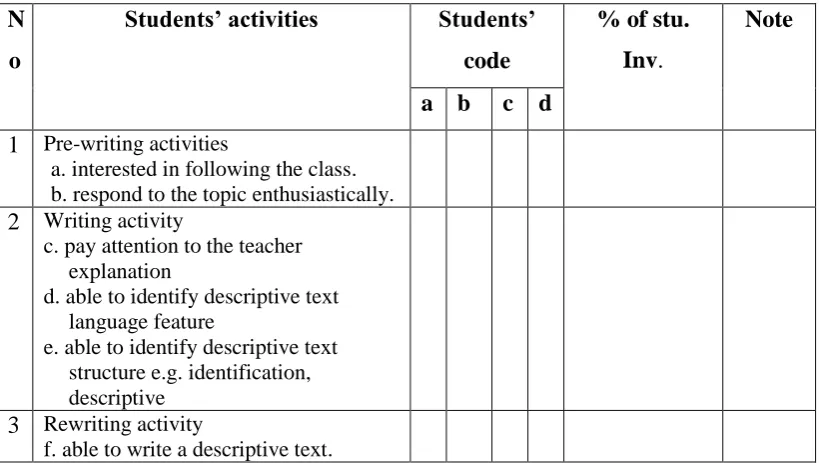
[image:13.595.115.525.525.756.2]The following is the aspects of outline in students’ observation sheet.
Table 5 Students’ Observation sheet N
o
Students’ activities Students’ code
% of stu. Inv.
Note
a b c d 1 Pre-writing activities
a. interested in following the class. b. respond to the topic enthusiastically. 2 Writing activity
c. pay attention to the teacher explanation
d. able to identify descriptive text language feature
e. able to identify descriptive text structure e.g. identification, descriptive
3 Rewriting activity
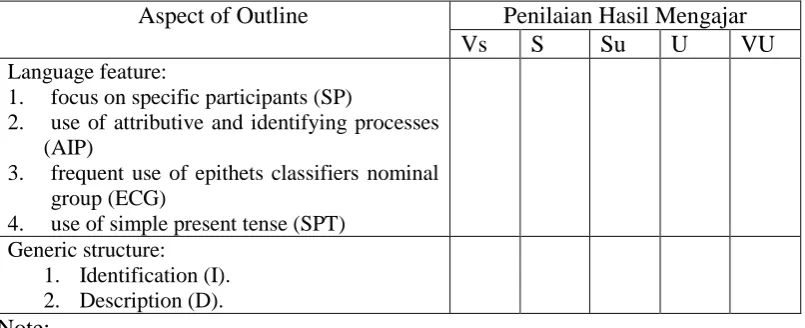
The following is the aspect of outline in teachers’ observation sheet.
Table 6 Teaching Observation Sheet
Aspect of Outline Penilaian Hasil Mengajar
Vs S Su U VU
Language feature:
1. focus on specific participants (SP)
2. use of attributive and identifying processes (AIP)
3. frequent use of epithets classifiers nominal group (ECG)
4. use of simple present tense (SPT) Generic structure:
1. Identification (I). 2. Description (D). Note:
Aspects of outline:
1. Language feature:
SP : Focus on specific participant
AIP : Use of attributive and identifying processes
ECG : Frequent use of epithets and classifiers in nominal groups SPT : Use of present tense
2. Generic structure:
I : Identification D : Description
VS : Very satisfactory, the teacher achieves 95% result if the teacher explains
and gives four examples from outline aspects.
S : Satisfactory, the teacher achieves 80% result the teacher explains and
gives three examples from outline aspects.
Su : Sufficient, the teacher achieves 70% result if the teacher explains and
gives examples from outline aspects.
U : Unsatisfactory, the teacher achieves 50% result if the teacher explains
and gives one example from outline aspects.
VU : Very unsatisfactory, the teacher achieves 30% result if the teacher
E. Data Analysis
Data analysis is the process of organizing the data in order to gain regularity of the
pattern and from of the research. The term interpretation can be defined as a
procedure of giving meaning in the result of the analytic process. Data analysis is
done to create understanding of the data after following the certain procedure final
result of the students can be presented by the researcher to the readers (Setiyadi,
2001)
In this research, the researcher validated the data by using test and class
observation. Having collected the data from the test and observation, the
researcher analyzed the data based on the limitation of the problems and the
objective of the research by using qualitative description.
In analyzing and interpreting the data, the first step that the teacher done was
making abstraction of all collected data. Then the researcher selected the data that
related with the research question. The next step, the researcher arranged all
collected data by classifying the data into two categories (data in learning process;
observation of teacher’s explanation and class activity), and (data in learning
product; students’ writing test). The last step was making the report. The
researcher tried interpreting all the collected data and described them into
conclusion. Then based on the analysis and reflection, the writer decided whether