SRJIS/BIMONTHLY/ DR. BHARAT PATIL (5452-5458)
MAY-JUNE 2017, VOL- 4/31 www.srjis.com Page 5452 ADHERENCE TO REPAYMENT OF LOAN IN MICRO FINANCE SYSTEM
Bharat V. Patil, Ph.D.
Associate Professor, Matoshri Bayabai Shripatrao Kadam, Kanya Mahavidyalaya,
Kadegaon, Dist-Sangli, Maharashtra (India)
Article enlighten the approach of SHGs members towards adherence to repayment of loan in micro finance system Finance is the essential condition for the any operations of the industry, services and even agricultural sector also. Rising of funds for the operations of any activity is important and strategic function. Cost of funds raising affect on the earning of the business activity. Funds must be raised from such sources which resulted lower cost of capital. Even individual also borrow loan at higher rate of interest for day to day operations. The raised funds must be strictly used for productive purposes. Individual persons made unplanned expenditure through loan amount. It affects the repayment capacity of the individual. Culture of repayment of loan must be essential for the development of financial system in the country. Attitude of repayment of borrowed loan must be totally positive. Many constraints caused to lower price to the agricultural goods. There are huge numbers of mediators for agricultural goods. Illiteracy of the farmers is one of the causes to cheat by the mediators. Some time cost of production of is not covered through selling of agricultural goods. Farmer’s financial position is not uplifting as compared to economic development of the country. Investment in agricultural business is not considerable. Over population is engaged in agriculture. Dependency on agriculture sector is required to reduce. Per capita income of the farmer is low and it causes on capital investment in the agricultural sector. All these situation leads to indebt of the farmers. Farmers establish SHGs to solve their financial problems. They borrow loan and adhere to repay loan for social status. Mostly women SHGs members are more serious in repayment of loan taken from SHGs.
Key Words: Repayment, resources, status, adherence
1. INTRODUCTION
The main object of SHG is to provide loan to its members. Loans are given to the
members for various purposes. There is no compulsion to avail of loan facility. SHGs offer
small and short term loan to its members. Loan is given to the members on need basis. Loan
is sanctioned in the meeting of SHGs. Terms of credit are conveyed clearly to the borrowing
members. Flexible repayment schedule are worked by groups. Loans are distributed to the
Scholarly Research Journal's is licensed Based on a work at www.srjis.com
AAAA
SRJIS/BIMONTHLY/ DR. BHARAT PATIL (5452-5458)
MAY-JUNE 2017, VOL- 4/31 www.srjis.com Page 5453 member in the presence of other members of the group. SHGs promote the decision making
capacity between the members. One of the key benefits of SHGs is women’s empowerment.
It also increase the number of women’s involvement in public affairs. The role of SHGs is an
inspiration and as a financer. Loan is distributed as per need of the members. SHGs are
facing problems such as low funds available for distribution, low knowledge of Government
schemes, political participation, poor financial management and poor accounting system. The
social empowerment assists the women to get an important place in her family and society. It
also includes a right given to a woman to make use of available resources. The SHG
programme has been successful in strengthening the capacities of poor women and assists to
mobilize savings. It also promote to get knowledge, meet each other, feel improved status in
the family, increased self confidence and develop the problem solving techniques. SHGs
members were come to gather to help and co-operate each other. Women members of BPL
and APL SHGs had an attitude to held and co-operate to other women members if she has
some financial, social problems.
2. LITERATURE REVIEW
Manimekalai and Jajewari (2000) reported that SHG assist rural poor people to
undertake entrepreneurial activities. The SHGs are quite credit worthy and repayment of loan
is satisfactory.
Nanavaty Reema (1992) argues that economic empowerment is the basis of social &
political empowerment for the poor women.
Ghosh; et. al. (1998) conducted research on women entrepreneurship in India and
egested a model for their development. The growth of economic development assists to
improve the lives of people.
Tripathy O. P. (1999) examined that the Self Help Groups (SHG) movement become
stronger with providing more micro finance.
Studies on SHGs by Karkar (1995) reviewed that as SHG programme was effectively
implemented resulted to increase the monthly income of the members. A large number of
groups had become finically self-sufficient and reduced the dependence on money lenders.
The process of group dynamics strengthened the networking, homogeneity and self-esteem of
women. SHG programme had provided women the opportunity to discuss, sit together and
share their views to solve problems. The group thus acts both as a pillar of strength and an
SRJIS/BIMONTHLY/ DR. BHARAT PATIL (5452-5458)
MAY-JUNE 2017, VOL- 4/31 www.srjis.com Page 5454 According to Karl M. (1995) role of empowerment of women on decision making and
concluded empowerment as multifaceted process which helps to acquire the administrative,
managerial, technical and analytical skill.
Basu Kishnjit and Jiandal Krishnan (2002) stated that Indian Micro finance System is
dominated by SHGs and their linkage to banks credit delivery through SHGs emerge as an
alternate to the extending system of credit disbursement by the banks.
Dogra Bharat (2002) studied women SHGs and suggested that the dissatisfaction with
the experience has demanded new modalities to provide sufficient finance to rural poor
women.
Prashant Sarangi (2003) conducted a study on SHGs and concluded that the formation
self help groups increased the decision making capacity among the members. Micro Finance
to the SHGs encourages formation of small enterprises.
Shirke H. P. & Vaske G. R. (2010) reported that SHGs are the effective instruments
of poor women empowerment. The social and political empowerment of women is
depending upon the economical empowerment of women.
3. METHODOLOGY
3.1 Selection of Sample
Ten villages of each category of BPL and APL SHGs selected purposely based on the
maximum number of SHGs in selected area. Three Self Help Groups selected from ‘Below
Poverty Line’ (BPL) and one of ‘Above Poverty Line’ (APL). Thirty SHGs were selected from ‘Below Poverty Line’ and ten SHGs ‘Above Poverty Line’ in the selected area. Thus,
total sample in the selected area amounted to forty SHGs. Investigation of sampling made
based on two-stage sampling technique. At the first stage, village as the primary unit and the
second is in regards to SHGs.
3.2 Significance of the Study
The study will helps to understand the repayment approach of the Self Help Group
members of the selected area. It assists to the policy formulation to the Governments, Banks,
NGOs and many other stakeholders. The present research study will enlighten to manage
SHGs on scientific basis. It is also valuable to the concerned SHGs. The study will also be
useful to the concerned departments of central and state governments and it will help to solve
the problems of SHGs.
3.3 Need of the Study
1) To study the repayment ability of the Self Help Groups.
SRJIS/BIMONTHLY/ DR. BHARAT PATIL (5452-5458)
MAY-JUNE 2017, VOL- 4/31 www.srjis.com Page 5455 3) To study the financial management of SHGs.
4) To study the reasons that encourages to repayment of loan in time taken by SHG
members.
3.4 Hypothesis
1) Regularity in collection of deposits develops financial discipline of SHGs.
2) The available funds are distributed to the members according to need of members.
3) Financial position and repayment ability of loan are dependent.
3.5 Sources of Data
Data was collect through the use of primary and secondary methods. The secondary
data was collected through the printed and published facts
3.6 Scope of the Study
The study relates to women Self Help Groups in Kadegaon taluka of which was
promoted by ‘District Rural Development Agencies’.
4. RESULTS AND DISCUSSION
4.1 Regularity in Collection of Deposits
For the economic development of the SHG it is necessary to contribute by the
members to SHGs regularly. It strengthens the financial position of the SHG. All the
contribution of the members are deposited into bank and distributed according to the need of
the members.
Following table 1 enlightened the regularity of contribution of the members to SHG.
Table 1: Regularity in Contribution of Funds to SHG
Sr.
No. Particulars
Contribution to Funds
No. of BPL SHGs No. of APL SHGs
1 Regular Contribution 29 (96.67 %) 10 (100 %) 2 Non-Regular Contribution 01 (3.33 %) -- (--)
Total 30 (100 %) 10 (100 %)
Source: Primary data
The above table 1 showed that 96.67 % of SHGs under ‘Below Poverty Line’ Scheme
contribute regularly and in case of ‘Above Poverty Line’ all SHGs contribution regularly.
4.2 Purpose of Loan
SHGs were formed to the uplift of the members of SHGs. All the members contribute
a fixed amount as a contribution to SHGs. These amounts were deposited into bank. Even
bank or financing agencies also sanction a loan to SHG. The available funds are distributed
SRJIS/BIMONTHLY/ DR. BHARAT PATIL (5452-5458)
[image:5.595.60.535.90.217.2]MAY-JUNE 2017, VOL- 4/31 www.srjis.com Page 5456 Table 2: Purpose of Loan (Multiple Responses)
Purpose of Loan No. of SHGs
BPL SHGs % to Total APL SHGs % to Total
Family Needs 30 100 10 100
Business Purpose 23 76.67 08 80
Education 11 36.67 04 40
Repayment of Loan 07 23.33 02 20
Religious Work 04 13.33 02 20
Other Reasons 02 6.67 -- --
Source: Primary data
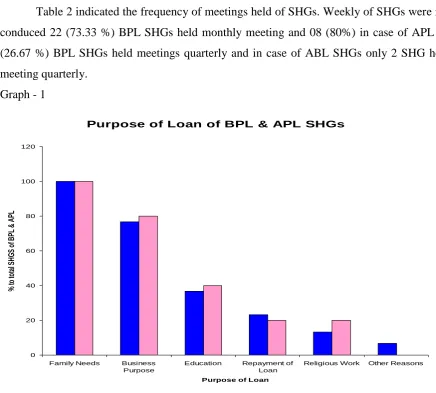
All the SHGs members of APL & BPL admitted that they have taken a loan for satisfy
family needs. Comparatively less preference is given to business purpose, education,
repayment of loan and religious work.
Table 2 indicated the frequency of meetings held of SHGs. Weekly of SHGs were not
conduced 22 (73.33 %) BPL SHGs held monthly meeting and 08 (80%) in case of APL 08
(26.67 %) BPL SHGs held meetings quarterly and in case of ABL SHGs only 2 SHG held
meeting quarterly.
Graph - 1
4.3 Monthly Deposit of Members
Early six month of formation of SHGs ever member has necessary to deposit some
fixed amount. The overall monthly collection of the members deposited in SHGs bank
account. According to the financial position of the members they decide how much
Purpose of Loan of BPL & APL SHGs
0 20 40 60 80 100 120
Family Needs Business
Purpose
Education Repayment of
Loan
Religious Work Other Reasons
Purpose of Loan
%
to
to
ta
l S
H
G
S
of
B
PL
&
A
[image:5.595.72.509.293.686.2]SRJIS/BIMONTHLY/ DR. BHARAT PATIL (5452-5458)
MAY-JUNE 2017, VOL- 4/31 www.srjis.com Page 5457 collection necessary to made. Table 3 showed the amount per month every member had
[image:6.595.60.536.132.244.2]deposited in SHG.
Table 3:Monthly Amount Deposited in SHG
Particulars Multiple Response
No. of SHGs BPL % No. of SHG APL %
10 to 20 01 3.33 -- --
20 to 50 14 46.67 02 20
50 to 100 11 36.67 05 50
100 to 200 04 13.33 02 20
Above Rs. 200 -- -- 01 100
Source: Primary data
Table 3 showed the monthly deposit of members of SHGs in the category of BPL &
APL. 14 (46.67 %) SHGs members of BPL contribute Rs. 20 to 50 per month where as only
2 (20 %) SHGs member of APL contribute in that range. 11 (36.67 %) SHGs members
deposit the amount in the range of Rs. 50 to 100 in BPL category where as in case of APL it
was 5 (50 %) SHGs member contribute in the range of Rs. 50 to 100. In the range, Rs. 100 to
200, 4 SHGs members PBL & 02 SHGs member of APL deposit monthly amount in SHGs.
Only one SHGs members deposit above Rs. 200. Lowest deposit in the range of Rs. 10-20
was made by one SHG of BPL category.
4.4 Availability of Finance
The sample SHGs belonging to the category of BPL & APL were not satisfactory
regarding availability of finance from various agencies. Sufficient finance is required to day
to day operations of sales groups. Members were demanding more finance for their personal
needs, business purpose, religious functions, education and repayment of loans taken from
other agencies. SHGs members demanded more finance to fulfill their needs.
5. CONCLUSIONS AND SUGGESTION
5.1 Conclusions
1) Financial discipline depends on better administration of the SHGs.
2) Funds are distributed to the members according to need of members.
3) All the contribution of the members is deposited into bank.
4) SHGs were formed to the uplift of the members of SHGs.
5) Members were demanding more finance for their personal needs.
6) SHGs belonging to the category of BPL & APL were not satisfactory regarding
availability of finance from various agencies.
7) Members of SHGs had an attitude to help and co-operate to other members if has some
SRJIS/BIMONTHLY/ DR. BHARAT PATIL (5452-5458)
MAY-JUNE 2017, VOL- 4/31 www.srjis.com Page 5458 5.2 Suggestions
Following measures are suggested for better administration of SHGs.
1) More priority should be given to finance entrepreneurial activities rather then family
needs.
2) Economic empowerment must be given more priority which leads to self reliant of
women SHGs.
3) Self Help Groups (SHG) movement becomes stronger with providing more micro
finance.
4) For transference in the transactions the contribution of the members are strictly deposited
into bank.
5) Sufficient finance facility should be for day to day operations of SHGs groups.
Reference
Arun K. Singh. Empowerment of Women in India, Manak Publications Pvt. Ltd., New Delhi, 2000. Khan S. S. (2000). Entrepreneurial Development, S. Chand and Sons, New Delhi, 2000.
K. NABARD, Banking With the Poor, Financing Self Help Groups, NABARD, Hyderabad, 2000. Puhazhend V. And K. J. S. Satyasai, Micro-Finance and Rural People : An Impact Evaluation,
NABARD, Mumbai, 2000.
Thomas Fisher & M. S. Sri Ram, Beyond Credit, Putting Development back into Micro-Finance, Vistaar Publications, New Delhi, 2002.
Venkata Ravi, Narayana Reddy and Venkata Ramana (Edt.), Empowerment of People – Gross root Strategies, Kanishka Publications, New Delhi, 2004.
Kamala K. Va. Ajyanna and Chikkarangaswamy, SHGs as an instrumental for Women Empowerment, Southern Economist, Vol.-48, No.-17, dated Jan. 2010, PP-31-33.
V. Balu, Developing Women Entrepreneurship through SHGs SEDME Vol.-32, No.-2, Published by National Institute a small Industry Extension Training, Hyderabad, dated June, 2005, PP-49-56.
Sugana B; ‘Empowerment of Rural Women Through Self Help Groups’ Discovery Publishing House, New Delhi,2006.
Bhagya Lakshmi J. (2000). Women in Development Employment News, 25(3), 2000.