Distributed Systems
Digital Technical Journal
Digital Equipment Corporation
Cover Design
The diverse resources of a distributed system and their physical separation are represented on our cover by a city's widespread and varied geography. just as the areas of a city are made acces sible by its highway system, so too are the distributed system's resources interconnected and made accessible by the network and its services.
The cover was designed by Barbara Grzeslo of the Graphic Design Department.
Managing Editor Richard W. Beane Production Staff
Production Editor- Helen L. Patterson Typographer - Rebecca A. Bombach Designer- Patrick E. Conte Illustrator- Deborah Keeley Advisory Board
Samuel H. Fuller, Chairman Robert M. Glorioso John W. McCredie Mahendra R. Patel F. Grant Saviers
William D. Strecker Victor A. Vyssotsky
The Digital Technical journal is published by Digital Equipment Corporation, 146 Main Street, Maynard, Massachusetts 01754.
Changes of address should be sent to Digital Equipment Corporation, attention: List Maintenance, 10 Forbes Road, Northboro, MA 01532. Please include the address label with changes marked.
Comments on the content of any paper are welcomed. Write to the editor at Mail Stop MLOl-3jB68 at the published-by address. Comments can also be sent on the ENET to RDVA.X::DIAKE or on the ARPANET to DIAKE%RDVA.X.DEC@DECWRL.
Copyright© 1989 Digital Equipment Corporation. Copying without fee is permitted provided that such copies are made for use in educational institutions by faculty members and are not distributed for commercial advantage. Abstracting with credit of Digital Equipment Corporation's authorship is permitted. Requests for other copies for a fee may be made to Digital Press of Digital Equipment Corporation. All rights reserved.
The information in this journal is subject to change with out notice and should not be construed as a commitment by Digital Equipment Corporation. Digital Equipment Corporation assumes no responsibility for any errors that may appear in this document.
ISSN 0898-901X
Documentation Number EY-Cl79E-DP
The following are trademarks of Digital Equipment Corporation: ALL-IN· I, DECjCMS, DECmail, DEC/MMS, DECnet, DECnet-DOS, DECnet-Rainbow, DECnetjSNA, DECnet-ULTRIX, DECnet-VAX, DECrouter, DECserver, DECserver 200, DECserver 500, DELNI, DEQNA, Digital, the Digital logo, EDT, L AN Bridge, L AN Traffic Monitor, MAilbus, Message Router, MicroVAX, MicroVAX 11, MicroVAX 3000, PDP-11(70, RA, RA81, RD53, RD54, RSX, SA482, ThinWire, UlTRIX, UlTRIX-32m, UlTRIX-32w, VAX, VAX C, VAXcluster, VAX DECjTest Manager, VAXELN, VAXmate, VAX Notes, VAX SPM, VAXstation 2000, VAXfVMS, VAX VTX, VAX 8200, VAX 8700, VAX 8800, VMS, VT, WPS.
DASIC is a trademark of Dartmouth College.
IDM and IDM PROFS are registered trademarks of International Business Machines Corporation.
Intel is a registered trademark of Intel Corporation. Microsoft and MS-DOS are registered trademarks of Microsoft Corporation.
SAS is a registered trademark of SAS Institute, Inc. UNIX is a registered trademark of American Telephone and Telegraph Company.
I
Contents
7 Foreword Butler Lampson
9 Development of the VAX Distributed Name Service Sally J Martin ,Janet M. McCann, and David R. Oran
Distributed Systems
16 Design and Implementation of the VAX Distributed File Service
William G. Nichols and Joel S. Emer
29 Remote System Management in Network Environments David M. Griffin and Brad C. Johnson
37 The Evolution of the MAILbus Peter 0. Mierswa
44 VAXjVMS Services for MS-DOS Alan Abrahams
51 The WAVE Tools Base for Protocol Testing
Peter G. Viscarola and Jeffrey E. Watkins
61 Peiformance Evaluation of Distributed Applications and Services in the DECnet Environment
Eugene Finkelstein and Richard A. Grawin
78 Measurement and Analysis Techniques for DEC net Products Vi jay G. D'Silva and Ruei-Hsin Hsiao
87 Modeling and Analysis of the DECnetjSN A Gateway
I
Editor's Introduction
Jane C. Blake
Editor
The network produ cts featured i n this issue of the Digital Technical journal a llow system resources to be shared throughout the network. Made up of differ em hardware systems, software syste ms, and many applications, the network is perceived by users a s one system - a distributed system. Performance in this environment is critica l ; therefore this issue also includes several papers about methods and tools developed by Digital's engineers to evaluate product and system performance .
A d istributed system's coherence depends largely on the ability to identify and locate resou rces. In the opening paper, janet McCann, Sally Martin, and Dave Oran describe the VAX Distributed Name Service product, which provides a globally accessi ble d irectory of ne twork resources. The au thors give overviews of the architecture and implementation, and review the design deci sions made to ensure t hat the service is fast, robust, and scales up as the net work grows.
The files on the network are among its most va l u able resources. Building o n VAX DNS, VAX Distributed File Service gives users common access to files located on the network . Wick Nichols and Joe l Emer discuss DFS de sign options and performance analyses, and present detail s of the DFS implementation .
Managing the variety of systems that reside on a network can be a com plex task. However, as Dave Griffi n and Brad Johnson explain, the nenvork itself can be used to exped ite certain system management activities. They relate how Remote System Manager facilitates, from a central point, software
distribu-2
tion , file backu p, and system administrative ta sks for numerous clients.
The next paper is about a set of products whose his tory extends back to the early 1970s. Peter Mierswa traces the development of the MNLbus family, which supports message exchange across a multivendor environment. A significant theme in the produ cts' history is Digital's early com mitment to sta ndards for the e xchange of e lectroni c mail and messages.
Alan Abrahams then de scribes VAXjVMS Services for MS-DOS This product seamlessly integrates the remote VAXjVMS file system into the MS-DOS envi ronment. Alan discusses the file server and disk server de sign s, and a service that allows personal computers to be booted over the network.
The next paper is not about a nenvork product but instead describes a reusable development tool, ca lled WAVE, for testing sophisticated protOcols. Peter Viscarola and Jeff Watkins present an overview of the script language and give an example of a WAVE based test tool developed for DECnet routing layer prorocols.
The final three papers address the methods devel oped for the essential work of eva luating distributed system produ ct performance. Gene Finkelstein and Richard Grawin describe a new methodology for examining system-level performance in the DECnet environment . With case studies, they demonstrate the util ity of this approach for product design and capacity planning. Next Vijay D'Silva and Ruei-Hsin Hsiao fo cus on the evaluation of individual product implementations. The authors outline key perfor mance metrics and then describe the methods applied in the testing and analysis of t he DFS and DNS prod ucts. In the closing paper, john Morency, Richard Pitkin, Ramasamy Jesuraj, and Ambrose Kwong de scribe a simu lation model of the DECnetjSNA Gateway product, a model u sed primarily for capac ity planning. The aut hors also discuss tools u sed to develop the model and the means ro test its validity.
Biographies
Alan Abrahams A principal software engineer, Alan Abrahams is a member of the Personal Computer Systems Group. He is currently a network architect respon sible for integrating Microsoft's MS·NET and LANmanager into Digital's Personal Computer Systems Architecture (PCSA). Since joining Digital in 1981, he has been involved in the design of Digital's NETBIOS emulation, remote boot of MS-DOS systems, and the PRO/COmmunications package. Alan also represents Digital on the x;open PC Interworking Group. He received a B.S. in computational and statistical science and a B.S. in mathematics from the University of Liverpool.
Vijay G. D'Silva Vijay D'Silva is a senior software engineer who is presently involved in the performance analysis and modeling of several networking prod· ucts for the Network Performance and Conformance Engineering Group. Prior to his work on these future products, he evaluated the performance of the VAX DFS, VMSjSNA, and VAX FTAM products. Vijay joined Digital in 1986 after receiving a B.S. in electrical engineering (1984) from the Indian Institute of Technology, Bombay, India, and an M.S. in compu ter studies from North Carolina State University. His interests are in high-speed local area networks and computer systems modeling.
Joel S. Emer Since joining Digital in 1979, Joel Emer, a consulting engineer, has worked on VAX processor and memory subsystem architecture and performance, and systems performance analysis. He also led the distributed systems research team whose work resulted in the DFS product. Joel recently finished work on a research project at M.l T. where he investigated issu es in heterogeneous distrib uted computing. He holds a Ph.D. in electrical engineering from the University of Illinois, and B.S. and M.S. degrees in electrical engineering from Purdue Univer sity. Joel is a member of Tau Beta Pi, Eta Kappa Nu, ACM, and IE EE.
Eugene Finkelstein Formerly on the technical staff at AT&T Bell Laboratories and a professor at the Electrical Engineering Institute of Communications, Leningrad, Gene Finkelstein came to Digital in 1987. Currently a consultant to the Distribmed System Technical Evaluation Group, he provides technical direction in the areas of testing and performance evaluation of integrated distributed systems. He is also leading the development of capacity planning guidelines for LAN-based distributed systems. Gene holds a Ph.D. and an M.S. in electrical engineering from the Electrical Engineering Institute. A senior member of IEEE, he has published four books and numerous papers ln the field of communications networks.
Richard A. Grawin Richard Grawin came to Digital in 1987 from a performance analysis group at AT&T Bell Laboratories. While at Bell Laboratories, he analyzed the development of a local area circuit switch and participated in architecture and design trade-off studies. Currently, he is a principal engineer in the Distributed System Technical Evaluation Group and is the project leader responsible for the distributed systems capacity planning guidelines. Richard received a B.S. degree in mathematics from the University of Wisconsin in 1972 and an M.S. in computer science from Purdue University in 1982. He is a member of the ACM.
I
4
David M. Griffin Dave Griffin is a principal software engineer working with the VAX Distributed Name Service engineering team on a new major release of DNS. Prior to this work, he served as leader of the RSM advanced development team and project leader for RSM version 2.0. He has recently applied as co-inventor for a patent on aspects of the RSM design. Dave has also been an information sys tems consultant to several groups and received the Digital Information Systems Achievement Award in 1985 for his work on distributed application tools. He is a member of the ACM.
Ruei-Hsin Hsiao Ruei-Hsin Hsiao is currently leading several projects designed to evaluate the performance of products under development in the Networks and Communications Group. Since joining Digital in 1982, he has evaluated the performance of numerous Digital products, including terminal servers, DECnet products, Ethernet bridges, communication devices, and the DECnet System Ser vices product set. Ruei-Hsin is a principal software engineer and holds a 13.S. in communication engineering from the National Chiao Thng University in Taiwan, Republic of China, and an M.S. in electrical and computer engineering from the University of Massachusetts in Amherst.
Ramasamy Jesuraj A principal engineer, Ramasamy Jesuraj joined Digital's Networks and Communications (NAC) Performance Group in 1986. Currently he supervises the Mid-range System Performance Analysis Group and is working on the characterization of clientjserver product performance. Prior to his work in modeling and characterizing the performance of NAC products, Ramasamy was a senior engineer at Prime Computers and an assistant professor of computer sci ence at the State University of New York. He holds a Ph.D. degree in applied mathematics from McGill University, and an M.S. degree in computer science from Concordia University, Montreal.
Brad C. Johnson Earning a B.A (Magna Cum Laude, 1984) in computer science from Rutgers University, Brad johnson recently received an M.S. in applied man agement from Lesley College. Before coming to Digital in 1986, he worked at Bell Laboratories and then at Data General where he led a project to develop a file server for IBM-compatible computers. Now a principal software engineer in the Distributed Processing Engineering Group, Brad is involved in designing a model for the next major version of RSM. He previously had project leader responsibilities for implementing RSM versions 2.0 and 2.1. Brad is a member of IEEE.
Ambrose C. Kwong Ambrose Kwong is a senior software engineer in the Net work Performance and Conformance Engineering Group. Having previously worked on the development of the routing conformance test tools and the LL
Sally J. Martin Sally Martin, a senior sofrware engineer, joined Digital in 1980 and began work on advanced development projects related to the design of the Digital Nerwork Architecture . She also served as a reviewer of the architecture specification. Now a member of the VAX DNS project team , Sally wrote the initial versions of the transaction agent and database and was responsible for the DNS version 1.0 background and advertisement modu les. During version 1.0 field test, she directed the design and operation of the Easynet namespace , the largest name · space bu ilt to date using DNS. Sally holds a 13.5. from Michigan State University.
Janet M. McCann janet McCann h as worked on the development of the VAX DNS product for over three years and is now the project leader responsible for imple· menting DNS version 2.0. Prior to the DNS project, she worked on the base operating system for the Professional 380 and was project leader for ProjSynergy. Now a principal sofrware engineer in the Nerworks and Communications Group, janet came to Digital from Western Electric in 1982. She received a 13.5. in mathematics from the University of New Hampshire in Durham and an M.S. in computer science from Boston University.
Peter 0. Mierswa A member of the Mail Interchange Group, Peter Mierswa is chief designer responsib le for the design and implemen tation of products that meet X .400 and X . 500 intern ational standards. In previous work, he was project leader for the DECnet·DOS family of produ cts and headed the team that produ ced the first rwo releases of DECnet-VAXmate, DECnet·DOS, and DECnet-Rainbow. A consu l · tant engineer, Peter previously published a paper about the DE Cnet·DOS system in the Digital Technical journal. He re ceived a 13.5. (Summa Cum Laude) in com · purer sciences from S.U.N.Y. at Stony Brook, where the computer science faculty named him its best graduating student.
John P. Morency john Morency is a consulting engineer currently defining
SNA interconnect capability in the area of on -line transaction processing. He has served as a principal technical contributor to Digital's 113M Interconnect Program for the past seven years and has also been actively involved in international stan dards work for on -line transaction processing. In other positions, john has provided worldwide technical su pport for DECnet, 113M , and X . 25 produ cts . Prior to joining Digital in 1978, john worked at IBM Corporation and the General El ectric Com· pany. He earned a 13.5. degree (Magna Cum Laude) in mathe matics and computer scie nce from the University of Hew Ham pshire .
William G. Nichols A consu ltant engineer in t he Distributed Processing Engi· neering Group, Wick Nichols is currently working on the development of new d istributed services. Prior to his work on VAX D istributed File Service, he served as project leader of a grou p that devel oped DECnet- 10, and as project leader and supervisor for the DECnet-20 produ ct. Before joining Digital in 1980, Wick was a system programmer for the Federal Reserve Bank of Boston and for the British Columbia Telephone Company. He re ceived an A.B. from Harvard Univer sity in 1973.
I
6
David R. Oran Dave Oran is a network architect working on the DNA nam ing service a nd other advanced facilities for the Digital Network Architecture. He also was responsible for the SNA Gateway architecture and su pported customers with large networks . Dave represents Digital on the ANSI and ISO com mittees for the OS! network layer and is the ISO project editor for Rout ing protocols. Before coming to Digital in 1976, he designed a nationwide network for the largest bank i•n Mexico and programmed at NASA. Earning a B.A. degree ( 1970) in English and physics from Haverford College, Dave is a member of ACM and is general chair· man of the eleventh Data Commu nications Symposiu m.
Richard P. Pitkin As a principal engineer and project l eader, ruchard Pitkin was a senior contributor to the DECnetjSNA Gateway and VMS/SNA projects. H is major work was in product development, testing, a nd performance analysis. Cur rently, ruchard is a..<;sessing the IEE E 802.5 token ring standard. In previous work, he was a principal software specialist involved in worldwide technical support for IDM interconnect products. Before coming to Digital in 1979, ruchard sup
ported large timesharing systems for the State of Massa chusetts . He earned a B s. degree in mathematics from the l niversity of Massachusetts, Boston.
Peter G. Viscarola Peter Viscarola joined Digital in 1987, first as architect and later as manager of the Networks and Commu nications (NAC) Conformance Engi neering Group. He has represe nted Digital in the area of data communications conforma nce on a number of technical comm ittees, includ ing those at the Cor poration for Open Systems, ANSI, a nd ISO . From 1979 u ntil joining NAC, Peter ran a private consulting practice which specialized in data commu nications . Peter also worked at Digital in 1977, when he was h ired as an instmctor .in Digital 's Edu cational Services Group.
I
Foreword
Butler W. Lampson
Corporate Consultant Engineer
A distributed system is several computers doing something together. This idea grew up naturally together with computer nerworking; it appears as one of the main goals i n the late 1960s plans for the ARPANET. Bur building a distributed system turned our to be difficult, and nerworks have been justified instead by the value of a few very basic applications: terminal access, file transfer, and electronic mail. As workstations, personal computers, and local area net works have become widely available, however, the val ue of a distributed system has grown too obvious to ignore. I n the last few years it has been increas ingly clear that the future of computing lies here .
Customers benefit from a distributed system over a centralized one because they can
• Grow a system incrementally to meet increased demand, rather than replace it with a larger one
• I nterconnect computers so their resources can be shared- especially the data they store-even when the computers are phys ical ly separate, independently managed, and different internally
• Get se rvice more of the time, even when some parts of the system are broken
• Pay less for computing cycles in small packages
On the other hand, centralized systems provide a large number of functions and a high degree of global coherence: a l l the resources of the system can be accessed and managed in the same way from any part of it. These too are valuable properties. I t is a major challenge to combine the virtues of both approaches.
VAX:jV MS clusters offer a l l the benefits of a dis tributed system as well as the functionaliry and coherence of a centralized VMS system, and they have been very successful . However, clusters l imit the number of machines that can be connected (a few doze n), and all the machines must run the same version of VMS and be managed as a un it . By contrast, a network such as DECner can accommodate thou sands of machines with many di fferent architectures and operating syste ms, and it too has been very suc cessful. However, a nerwork offers few functions and little coherence . Users must be registered sepa rately on each node, files cannot be named and accessed uni formly throughout the nerwork, each node must be managed independently, and so forth .
A distributed system, then, is
• A set of hardware, software , and data components, possibly heterogeneous
• Connected by a nerwork
• Providing a uniform set of services (user registra tion, time, files, records, printing, program execu tion, mail, terminals)
• With certain global properties: names, access, securiry, management and availability
The coherence that makes it a system rather than a collection of machines is a result of un iform ser vices and global properties. The services are avail able in the same way to every part of the system , and the properties a l low every part of the system to be viewed in the same way.
This definition of a distributed system assumes a single set of interfaces for the standard services and global properties. For example, every component of the system can be named, accessed , and managed in the same way. Further, every component that provides or consumes a service, such as file storage or print ing, does so through the same interface. There still may be severa l implementations of the interfaces for nam ing, manage ment, files, etc . , and this variery allows the system to be heterogeneous . In its inter fact;s. however, the system is homogeneous. It is this homogeneity that makes it a system with predictable behavior rather than a collection of componen ts that can communicate. If more than one interface exists for the same fu nction, it is unavoidable that the function will work differently through the different interfaces . The system will consequently be more
I
compl icated and less reliable. Perhaps some compo nents will not be able to use others at all because they have no interface in common.
In reality, of course, there is no absolute distinc tion berween a system and a collection of compo nen ts . A system with more different ways of doing the same thing, whether it is naming, security, file access, or printing, is less coherent and dependable. On the other hand, it can stil l do a lot of useful work. The evils of hete rogeneous interfaces can be mitigated by gateways, components that map from one interface to another. A gateway is often neces sary when rwo systems evolve separately and later must be joined into one . An obvious example is the conjunction of IBM's System Nerwork Architecture (SNA) and Digital's DECnet, and indeed there are sev eral DECnetjSNA gateways .
This issue describes many of the major com ponents that currently make up Digital's evolving distribured system product line: essential services such as files, printing, and mai l , and global proper ties such as naming and management . Except for the naming service, these components were not devel oped from scratch bur rather arose from previous products that were successful in standalone sys tems . In this way the distributed systems do not have
8
to provide new implementations of all the functions they offer, but instead can build on existing prod ucts . In several cases these components act as gate ways, for example, berween VMS and existing interfaces in MS-DOS, or berween DECnet and exist ing mai l , file transfer, or communication interfaces in SNA. In each case the product is important as a tool to integrate existing systems into a larger and more effective whole.
Typically a distributed system involves a number of mach ines. It can be conf igured in many different ways. It is built on top of one or more operating sys tems and one or more implementations of a nerwork architecture. All in all, there are a lot more ways for things to go wrong in a distributed system than in most centra lized systems. As a result, careful mode l ing, performance analysis, and testing are essential to the engineering of a distributed system that works reliably and predictably. Nearly half of this issue is devoted to these topics.
Development of the
Sally]. Martin
janet M. McCann
David
R.Oran
VAX Distributed Name Service
The VAX Distributed Name Service (DNS) is a global, highly scalable directory sys tem for computer networks. This robust name service provides fast translation of network-wide names into the values of attributes stored with the names. The DNS designers utilized such techniques as partitioning of the namespace and data replication to ensure service reliability and availability. For improved perfor mance, DNS implements the client interface by means of a clerk which controls communication protocols and also maintains a cache.
Networks bring a large and sophisticated set of ser vices to a diverse and growing user population. For this population to exploit the network's potential, the computing environment must be friendly, easy to navigate, and productive . One of the main imped iments to achieving this environment is the increas ing difficulty of identifying, locating, and accessing network resources. Much of the power of existing and future computer networks may go unused sim ply because users are either unaware of the facilities available to them or find the methods daunting. The difficulty can be expected to increase over time for the following reasons:
• Networks are getting very large . Thousand-node networks are now common, with million-node networks on the horizon for the world's larger public and private organizations.
• Networks are heterogeneous. More kinds of com puters are panicipating in networks all the time workstations, personal computers, minicomput· ers, supercomputers, and mainframes. Even more significant is the loose, heterogeneous composi tion of a large network that makes central control and management infeasible.
• Whole new classes of distributed appl ications are being developed. Applications such as network file systems and network-based electronic mail systems are already common.
New applications, such as fully distributed data bases, are being deployed today. Whole new models of computing in the distributed environ ment, such as remote procedure calls (RPCs), are being developed to make the construction of such applications easier.
To a great extent, the difficu lty in accessing net work resources arises from the lack of a consistent,
Digital Technica/]ournal No. 9 june 1989
globally accessible directory of network resources. In this paper, we describe a large-scale, production name service for DECnet networks called the VAX
Distributed Name Service (DNS). We begin with a pre sentation of the goals of DNS, followed by a discus s ion of the kinds of names used. In the balance of the paper, we give an overview of the DNS architecture and implementation and describe the major issues designers addressed during product development.
The Genesis
and
Goals for
DNS
DNS is a fundamental pan of the DECnet System Ser vices (DSS) product set and the Digital Network Architecture. DNS was under development for over five years within Digital. The project included a significant initial design phase (two years) , a bread board phase (one year) , a final architectural design phase (one year) , and a product implementation phase (one and a half years) . This system was designed to meet a number of significant technical goals, as follows:
• Score enough names to allow the system to scale to networks of at least 100 thousand to 1 million nodes.
• Be very robust so that the name service is at least as reliable and available as the resources it is used to find.
• Be highly self-configuring to limit the amount of effon necessary to set up the service and keep it running.
• Be fast, so applications can always use the service without penalty to locate resources.
• Allow decentralized management to avoid the inefficiency of centralized management of all the resources of a large computer network.
A Global Name Service
DNS provides a global name service. A global name is one that can be used anywhere in a network, by any user, to access a resource in the network. In this section, we discuss the kinds of names such a net work name service might support and place DNS in this context.
Kinds of Network Names
Figure 1 lists the kinds of names a network name ser vice could support. A descriptive name is a con struct that names a resource or object by specifying enough of its attributes to distinguish it from other objects. A descriptive name can be thought of as a query of the form "A color printer located near my office."
Descriptive names are most useful to human users who are searching the network for a resource that meets certain user-specified criteria. Descriptive name services are potentially the most powerful kind of name services, but they are the most demanding of computing resources and are difficult to distribute effectively. The Consultative Committee on International Telephony and Telegraphy (CCITI') and the International Standards Organization (ISO) are developing a standard for a descriptive name ser vice. The standard is primarily oriented toward international electronic mail systems and is known as X.500 .
A primitive name is a string of symbols that identi fies a single object or resource in the network. A primitive name is similar to the name of a person or business. If one knows the name of the resource sought, the primitive name is an extremely conve nient identifier to use to locate the resource or to discover more about it. A principal feature of primi tive names is that they are unambiguous; no two objects or resources in a network can have the same
!0
WHAT TH.E R ESOURCE IS CALLED
WHAT THE RESOURCE IS
WHERE THE RESOURCE IS
HOW TO GET TO THE RESOURCE
Figure 1 Kinds of Names in Network Naming Services
primitive name at the same time. Because of their simplicity, name services based on primitive names arc technically easier to design for speed, scalabil ity, and robustness, which are three of the goals outlined for VAX DNS. Consequently DNS processes pr·imitive names.
The third kind of name, an address, is a form of name that identifies a resource by its location in the network. For example, in DECnet Phase IV, all resources are identified by the node on which they reside. Although the node is named by a string of characters, in fact this string is a local user conve nience and simply stands for the address. As a net work grows, the relationship between the nodes and the resources residing on them becomes increas ingly complex and arbitrary. It is unnatural to use addresses to name resources that are either repli cated or that are not permanently tied to one loca tion in the network. Recon.figuring resources as new nodes are added or old nodes removed invalidates the names they were using.
A route names a resource by enumerating the path from the accessing user to the location where the resource is located. Routes suffer all of the disad vantages of addresses as names, and other disadvan tages as well. Route names are dependent on who is accessing the resource as well as where the resource is located. Different users must use different names to access the same resource. Worse, if any portion of the nerwork is reconfigured, the path to the resource is affected and its name changes.
For the remainder of this paper, we restrict the discussion to primitive names, since those are the names processed by DNS.
Possible Structures for Network Names Primitive names in a network name service could have a number of possible structures. The simplest of these would be a flat namespace in which the names are simply strings of symbols with no internal structure. (A namespace is the collection of names stored within DNS.) Flat names are easy for users to understand, but the assignment of unique names becomes increasingly difficult in large networks.
A second possible structure for network names is a tree. A tree is a type of graph in which each node has exactly one parent but may have any number of children. Computer file systems, such as those sup ported by MS- DOS, VAXfV MS, and CNIX operating sys tems, use a tree-structured namespace for naming files. In these systems, the tree is rooted; that is, a single node is the ancestor of all others. Trees allow a decentralized method of assigning names and give users a natural hierarchical scheme for organizing their network namespace. Trees suffer from a number
of deficiencies, however. The most serious is that a node in the graph can have only one name (because each node has a single parent).
To avoid the uniqueness limitation of trees, a third possible structure for network names is that of a directed graph. In this structure, names consist of paths from some initial node to the desired terminal node. Some computer file systems, such as UNIX, augment the basic tree with a capability called soft links. Soft links allow users to view the file system as a directed graph rather than a tree. Once a directed graph is permitted, it is possible for the graph to have cycles. Cyclic names are not terribly useful, hence most name services restrict the graph to be acyclic. Naming structures based on directed graphs have two major subtypes. The graph can be either rooted or unrooted. In a rooted graph, like a rooted tree, a distinguished node is the ancestor of all others and is globally known to all users. In an unrooted graph, no such node exists, and each user must choose a starting node in the graph from which to specify names.
DNS provides a rooted, acyclic directed graph as its naming structure. The underlying physical repre sentation of the graph is in fact a tree, which allows simplification of the algorithms that perform dis tributed maintenance of the graph. The tree is then augmented with a special form of name, called a soft link, which allows the users to view the struc ture as a directed graph.
Architectural Overview
This section describes the architecture of DNS at a high level. Readers interested in exploring the design at greater depth may obtain the architecture specification. 1
Properties of Names
A name is a string of characters that refers to an object or resource in the network. Names for objects are recorded in directories, which themselves have names. Some example names are as follows:
Parts.widgets.left-handed.SMOKESHIITER USGovernment: Treasury. Bi lis. CurrentSeries Nodes.%XAA0045D4013C
Engineering.sources. "alL.sources .c"
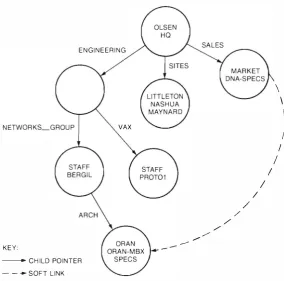
A directory may contain three types of entries: object entries, child pointer entries, and soft links. An object entry consists of the object's name and a set of attributes for the object. Most prominent of these attributes is the network address where the object currently resides. Child pointer entries link the directories into a rooted tree in which there is a
Digital Tecbnicaljormuu No. 9 june 1989
Development of the VAX Distributed Name Service
single path from the root directory, through a set of child directories, to the desired named object. A soft link is a form of alias, or indirect pointer, which allows a single entry to be reachable by more than one name. Soft links provide users flexibility by allowing a namespace to be viewed as a directed graph rather than as a pure tree. In addition, these links provide a graceful way tO reorganize a name space without incurring a massive invalidation of existing names. A tree of directOries, starting at a root, is called a namespace. Multiple namespaces may coexist on the same network, but they are com pletely disjoint. Figure 2 shows an example portion of a namespace.
To ensure that the set of directories that make up a namespace in fact makes a tree at all times, the name service enforces two directory invariants:
• Each directory has exactly one parent at any moment.
• No directory is a child of any of its descendants.
The first directory invariant guarantees that the graph always forms a tree. The second invariant guarantees that the graph has no loops.
Partitioning and Replication
In a large network, it is infeasible to stare all names in one central location. Besides being a single point of failure, a centralized service suffers from poor performance. First, the cost of accessing the service from distant part.s of the network is high. Second, the service provider can quickly become both a pro cessing and communication bottleneck to the entire network.
It is necessary not to allow single points of failure in the name service. The most appropriate tech nique for achieving this reliability is to replicate the data in multiple locations. Adding data replication to a system leads immediately to two crucial deci sions that guide the architecture. The first is to determine what the unit of replication should be. One could decide to replicate each name individu ally; to replicate the entire database; to replicate individual nodes; or to tie replication to the parti tioning in some way. The second issue is the effect of replication on data consistency. One must decide if all copies of the data should be kept tightly syn chronized, as in a classic database system. If so, what kind of synchronization algorithm is appropri ate. If the data is not synchronized, what consis tency semantics should be supported.
For the DNS architecture, designers chose to store the namespace in a partitioned, partially replicated database. Database partitioning means that part.s of
E N G I N E E R I N G
VAX
/ /' -KEY:
- CHILD PO INTER
- - .. SOFT LINK
/ / /
/ /
I \
\ \ I
I
I
[image:14.597.162.447.95.376.2]I I
Figure 2 Example of a Namespace
the namespace are stored in different locations. I3y partially replicated, we mean that part of the name space may be simultaneously stored in multiple database locations. The unit of partitioning and repli cation is the directory. A collection of (copies of) directories stored on a particular node is called a clearinghouse. The partitioning is accomplished by controlling which directories are stored in which clearinghouses. The replication is accomplished by storing a directory in more than one clearinghouse.
A copy of a directory stored in a particular clear inghouse is called a replica. To simplify the algo rithms for name creation and general namespace maintenance, one of the replicas of a directory is designated to be the master replica for that directory. Creation of new child directories is permitted only through the master replica for the parent directory. Creation of object entries and soft link entries, in addition to any update or deletion, may be directed tO another kind of replica storing the appropriate directory, called a secondary replica. A third kind of replica, the read-only replica, responds only tO lookup requests and is not permitted to perform creations, updates, or deletions on behalf of clients.
The name service maintains a distributed data base on behalf of its clients. However, unlike a typi cal distributed database, this database provides very loose consistency guarantees to allow high levels of
1 2
partitioning and replication. A client may receive different answers depending on which replica of a directory is queried when updates are being propa gated through the system.
Update Semantics
The exact update semantics for the namespace must be specified when the system is designed. The fol lowing must be decided:
• In the case of creating new names, what forms of mutual exclusion guarantees are provided. Can two users each try to create a resource with the same name and be allowed to succeed.
• Is each update an individual atomic action, or is some form of multioperation transaction pro vided as in a conventional database system.
• How are updates by multiple users at different times and locations serialized, if indeed serializa tion is supported at all.
DNS does not provide the usual database guarantee of mutual exclusion for name creation. An update can succeed if a single updatable replica is avail able. Instead of providing strong mutual exclusion, the system supports the notion of safe and unsafe names. When a user first creates a name, it is unsafe. Another user could create the same name in another
replica. While the name is unsafe, the name service will not necessarily detect this conflict. At some later time, through the operation of the background convergence algorithms, the name with the latest time-stamp becomes safe. All conflicting names dis appear. Once a name is safe, no user can create the same name without first deleting the existing one. A user can request the name service to attempt to make a name safe at any time.
Updates to attributes of names are time-stamped and applied such that the one with the latest time stamp wins. The update algorithms are designed such that all updates are idempotent and commuta tive; that is, multiple applications of an update have the same effect as a single application of the update, and updates applied in any order have identical results. These properties allow updates to be intro duced into the system by users at multiple locations.
Convergence of Replicas
The algorithm for producing convergence among the replicas of a directory is called the skulker. Skulkers operate independently on each directory in a namespace. Successful completion of a skulk oper ation ensures that all replicas of a directory have absorbed all updates applied to any replica prior to the time the skulk started. The more frequently skulks are run, the more up to date are all replicas of a directory. Skulks are expensive, however, so there is a trade-off between resources (network capacity, processing, memory) and timeliness.
Clients can control the frequency of skulks either by adjusting the convergence attribute of a direc tory, or by initiating skulks themselves. The skulker operates as follows:
1. All updates made to the master replica and any secondary replicas since the last skulk are gath ered and stored in the clearinghouse where the skulker is running.
2 . Each of the gathered updates is then dissemi nated to all replicas of the directory.
3. Each replica is informed of the time-stamp of the latest update that all of them are guaranteed to have seen.
Since skulks are expensive, DNS provides a mech anism cal led propagation for rapid convergence in common error-free cases. When a user makes an update to a directory with high convergence, DNS makes one attempt to propagate the changes to all available replicas.
State Growth and Scalability
A network's growth should not be constrained by the ability of the name service to continue growing;
Digital Technical]ournal No. 9 june 1989
Development of the VAX Distributed Name Service
therefore the name service must be highly scalable. In practice this means designers must avoid data storage techniques in which the amount of process ing and storage grows too rapidly as the size of the namespace grows. It is essential to avoid algorithms or data structures that grow faster than linearly, and desirable for all processing and storage overhead to grow no faster than logarithmically.
By naming the clearinghouses, DNS can avoid the linear growth of state information which might occur at the root of the namespace to record the identity and location of all clearinghouses.
Clearinghouses have names so users may conve niently refer to them and so the name service can find clearinghouses by looking up their names in the namespace.
The naming of clearinghouses follows a set of rigid rules. Under these rules, a name lookup cannot fail with the error that the clearinghouse in which the directory storing the object entry could not be found. Specifically, the name service ensures that the following clearinghouse invariants are never vio lated during the normal operation of a names pace:
• A clearinghouse must either store the root of the
namespace or store at least one directory whose name is closer to the root than the name of the directory in which the clearinghouse is registered.
• Each directory other than the root directory of
the namespace must be replicated in at least one clearinghouse whose name is closer to the root than the directory's name.
The first clearinghouse invariant guarantees that the root of the names pace is reachable by starting at any clearinghouse. The second guarantees that every directory is reachable from the root without having to look up a clearinghouse which in turn would require looking up the subject directory.
Attributes Stored with a Name
Each entry in a namespace contains a set of attrib utes. These attributes can be used to store a variety of information that assists in locating and accessing a resource. Particularly useful information to store is the network address of a computer that contains the named resource. Also useful are various local naming and addressing components which are needed to access the resource once its location in the network is known.
Attributes are identified by strings called attribute names and are of two types. Single-valued attributes hold a single value at a time, and set-valued attributes can hold an arbitrary number of values at a time. Updates are applied to individual values of attributes, and attributes can be freely created and deleted by means of the update mechanism.
Implementation - A ClientjServer
Model
This section discusses the implementation of the Distributed Name Service Architecture on a VA.,'XfVMS system.
Clients of the name service are programs that cre ate, delete, retrieve, and modify information main tained by the name service. Clients access the name service through the diem interface which is imple mented by the clerk on the local node. T he design of the clerk and the server are the subjects of this section.
Clerks are the components of the name service that reside on every node in the network. Clerks receive requests from clients tO access the name ser vice and determine the appropriate server to pro cess the request. T he clerk invokes the clerk-server protOcol to communicate with as many servers as necessary tO satisfy the request. It maintains a cache of the location of recently accessed directories and clearinghouses tO improve performance.
The server itself processes requests received through the clerk-server protocol. If the server does not have the necessary information to service a request, it directs the clerk to another server that is more likely tO have the information.
Design of the Clerk
The initial rel ease of DNS was implemented on the VMS operating system. T his section describes the clerk implementation.
To access the name server, a node requires the clerk, the advertisement-solicitation process, and the location of at least one name server.
The advertisement process is responsible for initial izing the clerk's cache and periodically updating it. On startup, the advertiser creates a global section, which serves as the cache, and loads a configuration file into the cache. T his file contains a list of name spaces and name servers tO insert into the cache. The first namespace in the file is the default namcspace for the node. The configuration file is the only way to initialize the cache on a wide area network (WAN) and is the management interface to the clerk.
The advertiser runs as a detached process. It lis tens on the Ethernet for advertisements from name servers. Advertisements comain the same type of information as the configuration file and are loaded into the clerk's cache. Advertisements provide the clerk with additional servers paired with their most recent addresses.
The clerk is written as a sharable image. It uses the cache created by the advertiser tO locate servers and process client requests. In addition to the data loaded into the cache by the advertiser, the clerk
1 4
adds data to the cache as the result of contacting a name server. 1\vo types of information are cached: the names and locations of servers, and the names and locations of directories. This information enables the clerk to have up-to-date addressing data for con tacting servers. Further, if the location of directories is known, the number of servers contacted can be reduced.
Since the cache is shared by multiple applica tions, it must be protected from both unintended updates and uncontrolled concurrent updates. The clerk prevents unintended updates by creating the cache in kernel mode, thus preventing access by less-privi leged users. The clerk is a user-written sys tem service, so it can raise its privileges and access the cache on behalf of less privileged clients. T he clerk uses a simple binary semaphore to protect the cache from concurrent updates . T he semaphore is stored in the cache .
The clerk also maintains a per-client DEC net logical link cache. Because of access control considerations, logical links cannot be shared by multiple clients. Since logical link establishment is expensive , a cache is needed to improve response time for successive requests to a server. The server disconnects idle links every 10 minutes. Either the server or clerk wil l disconnect links if resources are needed.
Design of the Server
Like the clerk, the initial release of the server was implemented for VMS systems. A server consists of the clerk, advertisement-solicitation, the transaction agent, and background processes.
The transaction agem is responsible for servicing clerk requests. T he agem implements the clerk server protocol and portions of the directory maintenance protocol. Some operations require the transaction agent to communicate with other trans action agents. This communication is effected through the clerk; therefore the transaction agent is a client of the clerk.
The background process implements the directory maintenance protocol and the update-propagation protocol. The background also communicates with other nodes through the clerk. Work is generated for the background process in three ways. First, requests from other background processes must be serviced. These are received by network connections. Second, requests are received from the transaction agent. Third, at least every 12 hours a timer goes off and the background scans the database for directories that need to be skulked.
The transaction agent and the background process have similar designs. The sections following describe the several design features these processes have in common.
Multithreading Both processes perform operations that access the disk or request i nformation from other name servers. During this time the process is id le. To improve throughput, we needed to make use of this idle time and process multiple requests simultaneously. To accomplish this, we used asyn chronous system traps (ASTs) .
Both processes stan running in user mode . They create the mailboxes necessary to communicate with management, issue an asynchronous read request, and wait. The user issues a stan command to the man agement program which sends the request to the server. This causes the mailbox read to complete and to run an AST. The AST routine declares the pro cess to be a network object and issues a read to the network. Then the routine reissues a read to the mail box. 1\vo threads of execution, that is, two ASTs, are now outstanding. For each new network connection, another thread is staned to process its transactions.
A process known as forking is available to suppon asynchronous disk 1/0 and clerk requests. Forking allows a thread to suspend execution until some asynchronous activity completes, thus a llowing other threads to run .
Database Both the transaction agent and back ground process were designed to be independent of the choice of data access routines. We wanted to be able to make changes if necessary in the future. After examining several techniques, we chose to use Record Management Services (RMS) i ndexed sequential files.
The name server requirements did not always match up with RMS features. First, RMS key sizes are a maximum of 255 bytes in length. Name server keys vary in length up to a maximum greater than 255 bytes. Therefore, we had to al low duplicates; and if a key is greater than 255 bytes, the name server per forms its own sequential lookup to find the correct record.
Locking turned out to be our biggest problem.
RMS provides extensive record locking capabilities for shared files. We relied on these capabilities to control concurrent access to the database by the transaction agent and background process. How ever, RMS does not recognize multiple threads of execution within the same process. If one thread locks a record for update and another thread attempts to access the same record on a different stream, the second request is rejected. Thus, the server restricts the operation of threads performing database updates. Once a thread locks a record for update, it cannot give up control to another thread until it unlocks the record .
Digital Tecbnical]ournal No. 9 june 1989
Development of the VAX Distributed Name Service
Design of Management
Management of the name server is handled by two modules. Together these modules manage both the name server and the names pace. Management of the name server involves staning and stopping name servers and clearinghouses, and monitoring coun ters. These functions are parsed by the management control program and then sent to the management listener where the functions are performed. The two functions were separated to allow for remote manage ment in a later release. Management of a names pace required a human interface to the clerk. The man agement control program provides this interface. A Network Control Program (NCP) -style command l ine interface was chosen.
A permanent global section is created by the man agement processes to maintain nonvolatile data. This includes the mapping from clearinghouse names to file names and the time-stamp generated locally. Since the transaction agent and background process also need access to this data, a shared global section is created. In addition, this section is used to main tain counters for the server. Counters are incre mented by the transaction agent and background and are displayed by management commands.
Summary
Currently, DNS is in use throughout Digital and at many customer sites. I ts use is expanded daily. DNS has proven to be robust in a network of many thou sands of nodes. It successfully suppons VAX Distrib uted File Service and VAX Remote System Manager, also described in this issue .
Acknowledgments
The authors wish to acknowledge the DNS develop ment team who worked hard to release a version 1 .0 product of qualiry. Team members include Larry Augustus, Claudia Peters, Arun Sastry, and Paul Pederson. In addition we would like to thank the DECnet-VAX group for its help, in panicular, Paul Beck and Tom Harding. Thanks are also due to Wick Nichols for his careful review of this paper.
Reference
1 . DNA Naming Service Functional Specification (Maynard: Digital Equipment Corporation, Order No. EK-DNANS-FS-00 1 , 1988).
WiUiam G. Nichols
I
]oel S. EmerDesign and Implementation of
the VAX Distributed File Service
The VAX Distributed File SeJVice ( DFS) provides fast, remote file access for VA XjVMS systems. DFS appears to be a local file service and thus requires no changes either to applications or to user commands. The DFS designers first examined the VMS file system to determine what type of service- disk, file, or record- would best achieve their goals. Having determined that a file semice would meet the goals, they used a queuing network model to assess program response time and throughput for users in a multiple workstation environment. This model was used to assess a number of design alternatives. The resulting implementation is well integrated into the VMS operating system and consists of device drivers and a server process. This paper presents the design options, the model and the DFS
implementation.
The VAX Distributed File Service (DFS) is one of the DECnet System Services (DSS) family of products. DSS products use network servers to provide services and functions that are often typical of a non-networked operating system. Use of these distributed services allows many client computers, and thus many users, tO share resources and to work together effectively.
Specifically, DFS addresses two needs that arise when many users share a distributed computing environment. First, users in this environment need common access to files. Second, managing this envi ronment can be simplified if many users' files are collected onto a common set of disks. There, the files can be managed by a common operations staff. DFS extends the local file system on a VAX/VMS sys tem to include these common file stOres.
The design of DFS was driven by three major goals. First, it should have high performance. Users should not easily perceive differences in the speed of their applications when they move files from local to remote devices. Second, the service should be trans parent. User commands and applications should work in the same way whether they are accessing local or remote files. Thus, the existing program ming interface and file system semantics should be preserved. When it is impossible to preserve exist ing semantics, the new semantic should avoid unex pected updates and other unpredictable results.
The third goal was that the service should scale up to handle large networks. Scaling encompasses three characteristics: large geographic extent, large numbers of active clients, and very large numbers of
16
potential clients. To allow scaling, a file service has to work on either a local area network (LAN) or a wide area network (WAN). Successful scaling also implies that transparency should be unchanged as a network grows from two nodes to 100,000 nodes. Funhermore, performance should not be impaired by factors unrelated to nodes actively using the ser vice, e.g., the number of potential user nodes, remote network panitions, or node failures.
This paper describes how engineers in the Dis tributed Processing Engineering Group designed and implemented DFS to meet these goals. The first section presents some options we considered in the initial design stage. The second section describes some of the performance analysis used to arrive at the current design and the third offers details of the implementation of the DFS design.
Design Options
To distribute any service, one must build software for the client system, where the application runs, and for the server system, where the service is pro vided. One can divide the overall service functional ity between the client and server in many different ways. However, when dividing an existing service such as a file system, it is frequently best to choose an existing, stable interface rather than design a new one.
The existing VMS file system is implemented in three layers. At the lowest layer, the disk subsystem reads and writes blocks of data to a disk. At this level, the disk is viewed as a single array of
Design and Implementation of the VAX Distributed File Service
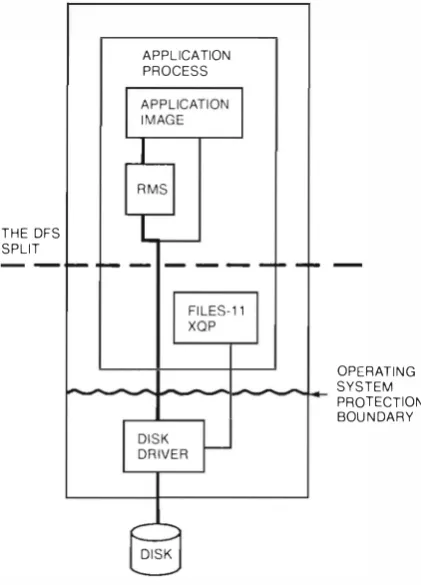
size blocks. At the middle layer, the file subsystem (FI LES- 1 1 ) organizes the disk blocks into files and file directOries. At this level, the disk is viewed as a set of arrays of fixed-size blocks, one array for each file. At the highest level, Record Management Ser vices (RMS) operates on structures within a file. At this level, the disk is v iewed as potentially more compl ex arrangements of records within files.
The interfaces between these layers are well defined and thus make conve nient points at which to divide the overall file system between client and server. The layers above the split remain with the cl ient; those below are moved to the server along with the disk they control. Given the three layers in the VMS fi.le system, the natural distributed service types are therefore a disk service, a file service, and a record service. A disk service sends disk names and disk blocks between client and server; a file service sends file names and file blocks; and a record ser vice sends file names, record descriptions, and records. References 1 and 2 have examples of a disk service and a record service, respectively.
There are many characteristics to consider when choosing among these three types of distributed ser vice. Based on our primary goals - performance, transparency, and scaling - we chose to implement a file service. We now outline the reasons for this decision.
Many facrors govern the performance of a storage service . However, even some of the most elementary analysis shows distinctions between the three ser vice types.
Our analysis has shown that in small networks with little sharing, the disk service has a perfor mance advantage over a file service. In this environ ment the record service offers considerably less performance. These differences arise primarily because the basic operations for the three types of service are of different complexities. In fact, they impose increasing computational load at the server as one moves from the disk service through the file service to the record service. More detailed analysis of the performance contrasts, including factors such as commu nication load, can be found i n references 3 and 4.
Distinctions between the services with respect to both performance and transparency can be seen when file sharing is considered. The VMS file system semantics demand that shared access to files and records within files be coordinated. If the server does nor provide this coordination implicitly, then the clients must coordinate their access to the shared data explicitly. This coord ination usually involves extra commu nication that can degrade
per-Digital Technical journal No. 9 june 1989
formance, especially when there is significant con tention for the data. Alternatively, the service might disallow shared access, thus reducing the commu ni cation overhead , but also reducing transparency.
The performance impact of sharing decreases as one successively considers a disk, file, and record service. With a disk service , many accesses require explicit coordination. For example, clients must coordi nate accesses to the directories and allocation tables that make up the file structure on a disk. This coordination occurs frequently, because file struc ture i nformation is shared even when no users are sharing files. Only by hav ing a read-only file system can these costs be eliminated.
A distributed file service does not require that the clients explicitly coordinate access to the file struc ture on a disk. The clients send file-level requests to the server. The server then serializes the requests and handles any interlocking within itself. This implicit coordination saves coordination communi cation over that requ ired by a disk service. To allow sharing of records within a file, a file service requires the clients to coordi nate explicitly. Finally, a dis tributed record service does not require explicit coordination for accesses ro either file or record structures. Thus, such a service performs well when there is significant record sharing.
The mechanisms for coordinating sharing also have an effect on the abi lity to scale the service. A service with implicit coordination scales very well. The scaling is primarily limited by the ability of the server to handle the active cl ients' load. The situa tion is more complex when explicit coordination is required.
There are two basic schemes for handling explicit coordination: centralized and decentralized. In cen tralized schemes, all clients coordinate through a si ngle coordinator. As with implicit coordination, the ability to scale is limited by the abi l ity to handle the active clients' requests. Centralized coordina tion, however, requires more commu nication than impl icit coord ination because distinct messages are required. As the network is scaled up to a WAN , per formance is degraded even more than in a LAN . The higher message latencies typical in a WAN make delays resulting from these extra messages even more significant.
In decentralized schemes, the coordination infor mation is distributed among the participants. Decen tralized schemes tend to be complex , because such schemes need protocols for joining and leav ing the set of active cl ients, for locating the coordi nating information, and for rationalizing the distributed state when nodes crash or are booted. These protocol s