ISSN: 1992-8645 www.jatit.org E-ISSN: 1817-3195
USERS COMPETENCE AND INFLUENCE ON THE QUALITY
OF ACCOUNTING INFORMATION SYSTEM
ENDRARIA
Lecturer Faculty of Economics University of Muhammadiyah Tangerang & Doctoral Students of Accountancy Department, Faculty of Economics and Business, Padjadjaran University,
Dipati Ukur Steet, PO box 40132, Bandung, Indonesia
e-mail: [email protected].
ABSTRACT
The purpose of this paper is to know that the effect on the user Competence Accounting Information Systems. Terori based on the description of the above it can be concluded that the competence of the user affects the quality of accounting information systems. Therefore, the quality of accounting information system can be further enhanced by more priority to the competence of the factors that these factors become important when the information system was created and developed. With demikiam exposure based on the results of the above it can be concluded that in order to develop the science of accounting, especially accounting information systems, this research has been in accordance with the hypothesis that the competence variables affect the quality of the information system
Keywords : Users Competence, Information System, Accounting Information System.
1. INTRODUCTION
Nowadays, competition affecting trends of economic globalization, how and organizational strategy in developing the business [1]. In economic competition, management must be able to conduct appropriate decision making and quality of information [2]. The organization's ability to compete is necessary if management can make the right decisions based on the information [3]. The information is presented and useful data in making decisions [4]. Next information is the data processing that gives meaning and benefits [5]. In line with previous statements where information also is the data that has been processed devoted to a person, organization or anyone who needs [6]. On the other hand information is also a decision that can affect the user for action [7]. Information is data that has been processed to produce something relevant and purposeful [8]. General information is data that is processed or altered in form or structure that is suitable for use by humans [9]. Information is also the company's resources are as important as capital, labor and so on and used for decision making, hence the quality of information is very important and needed by the organization [10]. In line with previous opinion information is a resource company that require a fee to obtain, create, store, retrieve and use that information has a value that is very beneficial to the organization in taking action [11].
In fact quality information is still happening in some fields, especially in the banking world where the sense of disappointment because Bank Indonesia (BI) does not provide accurate information about the financial status of the Bank Century [12]. Corroborate earlier statement states that in determining the status of Bank Century as a failed bank, the central bank did not provide information based on accurate data so that the disbursement of Bank Century bailout swells from the original plan of Rp 632 billion to Rp 6.7 trillion [13]. Inaccurate financial information also occurs in the tax sector in which the government originally necessary to have accurate data first before imposing the remission of tax (tax amnesty). Because the tax amnesty will not be useful if it is not accompanied by accurate data [14].
2. REVIEW OF LITERATURE
2.1.Users Competence
ISSN: 1992-8645 www.jatit.org E-ISSN: 1817-3195 of the people who do the work, while competence
is about the valuable work and achievement [16]. In understanding the concept of user competence must be measured from several points of view are as follows [17]:
1). Motivation (Motives) is of consistently and continuously considered by the individual or the individual's desire that can cause a particular action. Motivation will propel, steer and provide choice to behave individually with actions and specific purposes (Motives is the things a person consistently thinks about orwants that cause of action. Motives drive, direct and select behavior toward Certain actions or goals and away from others).
2). Properties (Traits) is a physical characteristic and consistent responses to situations or information (Traits is physical characteristics and consistent responeses to situations or information).
3). The concept of Self (Self Concept) is an attitude and behavior that reflect the values or the self-image of an individual (Self Concept is Aperson'sAttitudes, values or self-image). 4). Knowledge is information held by a person in a
field or something specific (Knowledge is information a person has in spescific content areas).
5). Skill is the ability of someone to perform certain physical or mental tasks (Skill is theability to perform mental or physical tasks acertain
To measure the competence of users of information systems can be seen from the point of view are as follows [18]:
1). Knowledge criteria is something that can be learned, either through a formal program of study or through the efforts of individuals such as reading and observation (Knowledge Criteria: is something that can be learned, either through formal courses of study or through such individual Efforts as reading and observation).
2). Skills based conditions: the individual is usually different inabillities dueto natural talent, and the learning process serves to refine (Skill Requirement: individual is usually Differ inabillities dueto natural gifts, and the learning process serves to refine them).
2.2. Information System
The information system has been defined as a set of organized procedures which when executed
provides information to support the organization (Information systems have been defined as a set of organized procedures that when executed Provides information to support the organization) [19]. Furthermore, the information system is to get the right information to the right people at the right time in the right quantity and in the right format. Because the information system is intended to provide useful information (Information system is to get the right information to the right people at the right time in the right amount and in the right format. Because information systems are intended to supply useful information) [20]. Furthermore an information system is a set of interacting artefacts and human activities that perform one or more functions that involve the handling of data and information, including data collection, creation, editing, processing and storage and selection of information, filtering, aggregation, presentation and use ("An information systems is a set of intracting artifacts and human activities that perform one or more functions involving the handling of the data and information, Including the data collection, creation, editing, processing and storage and information selection, filtering, aggregation, presentation and use) "[ 21].
An information system is a set of components interacting people, procedures, and technology-which together collect, process, store and distribute information to support control, decision-making and management in organizations (An information systems is a set of intracting components-people, procedures, and tecnologies-that together collect, process, store and distribute information to support control, decision making and management in Organizations) [22].
Further stated that the hallmark of quality information, among others [6]:
1). Relevant. Information can be said to be relevant if the information contained therein can affect the decisions users by helping them evaluate the events of the past or the present and predict the future, and confirm or correct the results of their evaluations in the past. Thus, the relevant financial management information can be linked to rnaksud use. Relevant information is information that: 1). Have the benefit of feedback, 2). The information allows the user to confirm or correct their expectations in the past, 3). Has the benefit of predictive, 4). The information can help users to predict the future based on the results of past and present events.
ISSN: 1992-8645 www.jatit.org E-ISSN: 1817-3195 presenting any facts in an honest and
verifiable, Inforrnasi may be relevant, but if the presentation is not accurate then use that information could potentially misleading. 3). Accurate information meets the following
characteristics: 1). Honest Presentation: Information honestly describe transactions and other events should be presented or which may reasonably be expected to be presented, 2). Neutrality: Inforrnasi directed to the common needs and are not in favor of the needs of a particular party.
4). Complete. Information is presented as completely as possible, which includes all the information that can influence decision making. The information behind every piece of information contained in the main financial management information is expressed clearly that mistakes in the use of such information can be prevented. Detailed information meets the following characteristics: 1). Served with Complete, 2). In accordance with the terms and Supplies.
5). On time. Information is presented so as to effect timely and useful in decision making. Timely information that meets the following characteristics: 1). Available when needed, 2). Latest information presented.
6). Can be understood. The information presented in the financial management information is expressed in the form and terms that are tailored to the understanding of the users. 7). Can be verified. The information presented in
the financial management information can be tested, and if testing is done more than once by different parties, the results still indicate that not much different conclusions
8). Accessible. Information is available when needed and in a format that can be used.
2.3. Accounting Information Systems
Accounting information system is a special subsystem of the information system where the purpose of the accounting information system is to collect, process and report information relating to the financial aspects of business activity. "Accounting information system of the which is a Specialized subsystem of the information system. The purpose of this separate accounting information system was to collect, process and report information related to the financial aspect of business events "[23].
In line with the previously explained that the accounting information system is an activity to collect, record and process the data to produce information for decision makers (Accounting information systems is an activity to collect, record and process the the data to produce information for decision makers) [24], Accounting information system is regarded as very important organizational mechanisms to support effective decision-making and control in an organization (The Accounting information system is Considered an organizational mechanism that is critical to support effective decision making and control in Organizations) [25].
Further description of the term "model of success" where it is said that success can be seen from the quality system where the system is interrelated (Term models of "success" where it is said that success can be seen from the quality system where the system is interrelated) [26]. Further it is said that there are six measures of success in information systems, among others [27]: 1). The quality of the system, the desired
characteristics of an information system. For example: ease of use, system flexibility, system reliability, and ease of learning, the system features an intuitive, sophistication, flexibility, and response time (System quality-the desirable characteristics of an information system. For example: ease of use, system flexibility, system reliability , and ease of learning, as well as system features of intuitiveness, sophistication, flexibility, and response times).
2). The quality of information, the desired characteristics of the output of the system; namely, management reports and web pages. For example: relevance, understandability, accuracy, conciseness, completeness, understandability, currency, timeliness, and usefulness (Information quality - the desirable characteristics of the system outputs; that is, management reports and web pages. For example: relevance , understandability, accuracy, conciseness, completeness, understandability, currency, timeliness, and usability).
ISSN: 1992-8645 www.jatit.org E-ISSN: 1817-3195 accuracy, reliability, technical competence ,
and empathy of the personnel staff).
4). System usage, extent and manner in which the staff and customers take advantage of the ability of an information system. For example: the amount of use, frequency of use, nature of use, accuracy of use, level of use, and the intended use (System use-the degree and manner in the which staff and customers Utilize the capabilities of an information system. For example: amount of use, frequency of use, nature of use, appropriateness of use, extent of use, and purpose of use).
5). User satisfaction, the level of user satisfaction measure satisfaction with the reports, websites, and support services (User satisfaction - users' level of satisfaction with reports, Web sites, and support services).
6). Net profit, the extent to which the IS contribute to the success of individuals, groups, organizations, industries, and countries. For example: improved decision making, increased productivity, increased sales, reduced costs, increased profits, market efficiency, consumer welfare, job creation, and economic development (Net benefits - the extent to the which the IS are contributing to the success of individuals, groups , Organizations, industries, and nations. For example: improved decision-making, improved productivity, Increased sales, cost reductions, improved profits, market efficiency, consumer welfare, creation of jobs, and economic development).
3. THEORETICAL FRAMEWORK :
Competence influence Users Against
Accounting Information Systems
Accounting information system designed to incorporate elements of user competence will increase job satisfaction and information systems will function effectively (Information systems are designed with the personal competence, job satisfaction will be improved and information system will function Effectively) [28]. Further explained that the development of human resources and competence of users of information systems will increase the success of the use of information systems in an organization. (Developing the Appropriate resources and user competencies to deploy Information System Successfully accross the Organization) [29].
4. RESEARCH MODELS AND HYPOTHESIS
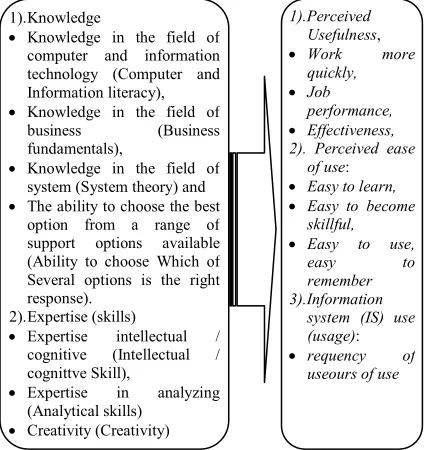
Based on the discussion of the previous literature, the research model shown in the figure below:
[image:4.612.318.531.158.383.2]
Figure 1 : Research Model
Of the framework that has been described, among other research hypothesis that the effect on the user Competence Accounting Information Systems.
5. METHODOLOGY, FINDING AND DISCUSSION
The research methodology is the means or methods used systematically researchers in solving research problems [30]. Further explained that the descriptive research includes surveys and fact-finding inquiry and different types [30]. The main objective of descriptive research is to describe the situation as it exists today. Businesses in science and social studies often use research Ex post facto for descriptive research study. The main characteristic of this method is that researchers do not have control over the variables; he can only report what has happened or what is happening. Most ex post facto used untukl descriptive research, especially studies "Descriptive research includes surveys and fact-finding inquiry and of different types. The main objective of descriptive research is to describe the situation as it exists today. Businesses in science and social studies Often Ex post facto research use descriptive research for the study. The main characteristic of this method is that
1).Knowledge
• Knowledge in the field of
computer and information technology (Computer and Information literacy),
• Knowledge in the field of
business (Business
fundamentals),
• Knowledge in the field of
system (System theory) and
• The ability to choose the best
option from a range of
support options available
(Ability to choose Which of Several options is the right response).
2).Expertise (skills)
• Expertise intellectual /
cognitive (Intellectual /
cognittve Skill),
• Expertise in analyzing
(Analytical skills)
• Creativity (Creativity)
•
1).Perceived Usefulness,
• Work more
quickly,
• Job performance,
• Effectiveness,
2). Perceived ease of use:
• Easy to learn,
• Easy to become
skillful,
• Easy to use,
easy to
remember 3).Information
system (IS) use (usage):
• requency of
ISSN: 1992-8645 www.jatit.org E-ISSN: 1817-3195 Researchers do not have control over the variables;
he can only report what has happened or what is happening. Most ex post facto used for research specifically descriptive study ". This study was conducted to test the hypothesis put forward by using research methods that have been designed in accordance with the variables - variables to be studied in order to obtain accurate research results.
Population refers to the entire group of people, events, or things of interest that researchers want to investigate. This is a group of people, events, or things that are interesting where researchers want to make conclusions based on the statistical sample "The population Refers to the entire group of people, events, or things of interest that the researcher wishes to Investigate. It is the group of people, events, or things of interest for the which the researcher wants to a make inferences based on sample statistics "[31]. Further study population is describing a group (usually people) and describe who we can then be deduced "The population for a study is that group (usually of people) about Whom we want to be Able to draw Conclusions" [32] ,
Based on the understanding of the above, the population in this study are all state-owned companies in the city of Bandung, this is done because it is based on a statement in which he stated that the target population should define or describe the elements, geographical boundaries and time "The targeted population must be defined in terms of elements, geographical boundaries, and time "[31]. Therefore the number of state-owned companies located in the city of Bandung in West Java in 2015 amounted to 36 companies of State Owned Enterprises (SOEs).
Furthermore, the sample is representative of the population that is selected if the aggregate sample characteristics have estimates of the characteristics of the aggregate equal to the population of "A sample is representative of the population from the which it is selected if the aggregate characteristics of the sample closely approximate Reviews those same aggregate characteristics in the population "[32]. Corroborate earlier where samples are part of the population consisting of some selected members of the part itself, in other words some but not all elements of the population that formed the sample "A sample is a subset of the population. It comprises some selected members from it. In other words, some, but not all, elements of the population form the sample "[31].
To determine how the minimum required sample if the population size is known, can be used Slovin formula, as follows [33]:
2 1 Ne
N n
+ =
Description:
n = The sample size N = Size of population
e = Allowance inaccuracy due to sampling error that ditololerir (5%).
Slovin of the formula above, the number of samples obtained in this study are as follows:
) 05 . 0 36 ( 1
36
2
x n
+ =
09 . 0 1
36
+ =
n
= 33,03 = 33
Thus the samples obtained in the study are as many as 33 companies of State Owned Enterprises (SOEs) contained in Bandung, West Java.
ISSN: 1992-8645 www.jatit.org E-ISSN: 1817-3195 choice of 1 to 5 answer the question with the
following conditions:
Value 5: To answer means that the respondents strongly agree strongly agree with the question because it is very appropriate to the circumstances perceived by the respondents. Value 4: To answer the question artunya agree deemed appropriate to the circumstances perceived by the respondents. Value 3: To answer does not agree that means it can not determine or if the respondent can not determine with certainty what is felt. Value 2: For answers to disagree meaning of respondents disagreed with the question because it does not fit with what is perceived. Value 1: To answer the question means strongly disagree strongly according to the circumstances perceived by the respondents.
Analysis of the data used in this research is the analysis of quantitative data with descriptive method, which is a quantitative research study that emphasizes phenomena and studied quantitatively. Maximizing the objectivity of the design, the study was conducted using figures statistical processing, structure and controlled trials. While descriptive study (Descriptive Research) is a research method that is intended to describe the phenomena - phenomena that exist, which takes place at this time or past time. Descriptive studies can describe a situation, but it could also describe the situation in the stages of development. The quantitative analysis will be carried out aiming to determine the relationship between variables through hypothesis testing using structural equation modeling (Structural Equation Model-SEM) approach Partial Least Square (PLS) [35].
Partial Least Square (PLS) is a powerful analytical method therefore not based on many assumptions. Data does not have to multivariate normal distribution (with a scale indicator categories, ordinal, interval until the ratio can be used to model equal), the sample should not be large. Although the Partial Least Square (PLS) can also be used to confirm the theory, but it can also be used to explain the relationship between the presence or absence of latent variables. Therefore focuses on the data and the estimation procedures are limited, so mispesifikasi model does not so affect the parameter estimates [36].
Further explains that there are two models of indicators developed in the Partial Least Square (PLS), among others: [36]
1). Reflexive indicator models; Developed based on classical test theory which assumes that the
variance measurement scores construct a function of the true score plus error. So the latent constructs affect variations in measurements and assumptions causality of constructs to the indicator. Model reflexive often referred to as a principal factor covariance model where the indicator measurements affected by latent constructs or reflect the variation of latent constructs. In the reflexive construct unidimensional models depicted with an elliptical shape with a few arrows of the construct to the indicator. This model hypothesizes that changes in latent constructs would affect the change in the indicator. The characteristics of the reflective indicator model is:
a). The direction of causality of constructs to indicators
b). Inter-size indicator is expected correlated (size must have an internal consistency reliability) c). Eliminate the indicator of the measurement
model would not change the meaning or sense construct
d). Calculate the measurement errors (error) at the level of the indicator
e). Construct means "surplus"
f). Scale scores do not describe the construct 2). Model Formative; The origin of the formative
model can be traced back to the model of "operational definition". Based on the model operationalism stated that a concept will be the measurement and has no meaning beyond the measurement itself if the overall meaning of a concept associated with the measurement and theoretical concepts and have just one single measurement. The characteristics of formative indicator model is:
a). The direction of causality of indicators to construct
b). Inter-indicators are assumed uncorrelated (not required test or the internal consistency Cronbach alpha)
c). Eliminate the indicator result in changing the meaning of the construct
d). measurement error is placed on the level constructs (zeta)
e). Construct has the meaning of "urplus" f). Scale scores do not describe the construct
Model analysis of all lines in the latent variable PLS consists of three sets of relationships, among others [36]:
1). Inner model that specifies the relationship between the latent variables (structrual model), 2). Outer model that specifies the relationship
ISSN: 1992-8645 www.jatit.org E-ISSN: 1817-3195 indicator manifestnya (measurement model),
and
3). Weight Relation in which case the value of the latent variables can be estimated. Without loss of generalization, it can be assumed that the latent variables and manifest variables scaled indicator or zero means and unit variance (standardized value) so that the location parameter (constant parameter) can be omitted in the model.
6. CONCLUSION
The theory is based on the description above can be concluded that the competence of the user affects the quality of accounting information systems. Therefore, the quality of accounting information system can be further enhanced by more priority to the competence of the factors that these factors become important when the information system was created and developed. With demikiam exposure based on the results of the above it can be concluded that in order to develop the science of accounting, especially accounting information systems, this research has been in accordance with the hypothesis in which the competence of the variables affecting the quality of accounting information system
REFERENCES
[1] Whitten dan Bentley. 2007. Systems Analysis & Design Methods. Seventh Edition. McGraw-Hill.
[2] Bingxin Wu. 2013. New Theory on Leadership Management Science. Chartridge Books Oxford
[3] George H. Bodnar dan Hopwood William S. 2014. Accounting Information Systems. Tenth Edition. Person New International Edition.
[4] Gelinas, Ulric J. and Dull, Richard B., 2011. Accounting Information Systems 7 ed. Thomson South-Western.
[5] Azhar Susanto. 2013. Sistem Informasi Akuntansi: Struktur Pengendalian Risiko Pengembangan. Edisi Perdana. Cetakan Pertama. Bandung: Lingga Jaya.
[6] Sri Mulyani NS. 2007. Metode Analisis dan Perancangan Sistem. Cetakan ke-I. Bandung: Abdi Sistematika.
[7] James A. Hall. 2011. Accounting Information System.7th Edition. Cengage Learning
[8] Keri E. Pearlson dan Carol S. Saunders. 2013. Managing & Using Information Systems: A Strategic Approach. Fifth Edition. John Wiley & Sons, Inc.
[9] Simons Kendal dan Malcolm Creen, 2007. An Introduction To Knowladge Engineering. Springer Science & Business Media.
[10] Wawan S. Jawadekar. 2013. Management Information Systems: Text and Cases; A Global Digital Interprise Perspective. Tata Mc Graw-Hill Education.
[11] Mehdi Khosrowpour. 2003. Information Technology And Organization: Trends, Issues, Challenges and Solution. Volume 1. Idea Group Inc. (IGI).
[12] Sri Mulyani. 2014. Antara Kalla, Sri, dan
Boediono. Melalui :
http://nasional.kompas.com/read/2014/05/09/ 1517321/Antara.Kalla.Sri.dan.Boediono. Diakses [22 Agustus 2015]
[13] Hadi Purnomo. 2009. BPK: Kebijakan Bailout Century Salah ! (Rp 500 M Mengalir
ke Politisi). Melalui :
https://nusantaranews.wordpress.com/2009/1 1/23/bpk-kebijakan-bailot-bank-century-salah/. Diakses [20 Agustus 2015]
[14] Yustinus Prastowo. 2015. Data Tak Akurat, Pengampunan Pajak Tak Bermanfaat. Melalui http://ekbis.sindonews.com/read /1007985/33/ data-tak-akurat-pengampunan-pajak-tak-bermanfaat-1433238607. Diakses [20 Agustus 2015].
[15] William J. Rothwell, 2015. Organization Development Fundamentals: Managing Strategic Change. Association For Talent Development (ADT).
[16] Stephen Pilbeam dan Marjorie Corbridge, 2006. People Resourcing Contemporary HRM in Practice. Third Edition. Pearson Education Limited.
[17] Spencer, Lyle M & Signe M Spencer.1993. Competence Work, Model for Superrior Performance. Canada:John Willey & Sons.
[18] McLeod, Raymond and Schell, George P. 2008. Management Information Systems, Tenth Edition, Upper Saddle River New Jersey 07458: Pearson/Prentice Hall.
[19] David J. Grimshaw, 2000. Bringing Geographical Information Systems Into Business. Second Edition. Simultancously Canada
ISSN: 1992-8645 www.jatit.org E-ISSN: 1817-3195 Transforming Business. 3th Edition. Jhon
Wiley & Sons, Inc.
[21] David L Olson dan Subodh Kesharwani, 2010. Enterprise Information Systems Contemporary Trend And Issues. World Scientific Publishing
[22] Richad Vidgen, David Avison, Bob Wood, Trevor Wood Harper, 2002. Developing Web Information systems. Information Systems Series. Elsevier Inc.
[23] Ulric J. Gelinas, Jr., Richard B. Dull, dan Patrick R. Wheeler, 2015. Accounting Information Systems. 10th Edition. Cengage Learning.
[24] Marshall B. Romney dan Paul J. Steinbart. 2015. Accounting Information Systems. Thirteenth Edition. Pearson Higher Education.
[25] Daniela Mancini, Eddy H.J Vaasen dan Renata Paola Dameri, 2013. Accounting Information Systems For Decision Making. 3th Edition. Springer.
[26] William H. Delone dan Ephraim R. McLean . 2003. The DeLone and McLean Model Of Information Systems Success:A Ten-Year Update. Journal of Management Information Systems. Vol. 19, No. 4, pp. 9– 30.
[27] Stacie Petter, William DeLone dan Ephraim McLean, 2008. Measuring Information Systems Success: Model, Dimension, Measures and Interrelationships. European Journal Of Information Systems. 15 May 2008. Pp 236-263.
[28] Curtis, Graham dan David Cobham. 2005. Business Information Systems: Analysis, Design and Practice. 5th Edition. England: Pearson Education Limited.
[29] Ward, Jhon & Joe Peppard. 2002 Strategic Planning For Information system. England: Jhon Willey & Sons.
[30] C.R. Kothari, 2004. Research Methodology: Methods And Techniques. Second Revised Edition . New Age International Limited Publishers.
[31] Uma Sekaran dan Roger Bougie. 2013. Research Methods For Business. Sixth Edition. UK: John Wiley & Sons.
[32] Michael G. Maxfield dan Earl Babbie, 2009. Basics Of Research Methods For Criminal Justice And Criminology. Second Edition. Wadsworth, Cengage Learning.
[33] Husein Umar, 2002. Metode Riset Bisnis Panduan Mahasiswa Untuk Melaksanakan Riset Dilengkapi Contoh Proposal dan Hasil Riset Bidang Manajemen dan Akuntansi.
Cetakan kedua. PT. Gramedia Pustaka Utama.
[34] Uma Sekaran. 2003. Research Methods For Business:A Skill Building Approach. Fourth Edition. John Wiley & Sons, Inc.
[35] Asep Saepul Hamdi dan E. Bahrudin, 2015. Metode Penelitian Kuantitatif Aplikasi dalam Pendidikan. Sleman Yogyakarta. Deepublish.