C21-908-101 Programmable Terminals
Wang Laboratories 2200 Series
MANAGEMENT SUMMARY
Wang Laboratories' 2200 Series product line currently
consists of the 2200VP, 2200MVP, 2200LVP and
2200SVP processors, all of which are user or
multi-user upgradeable systems. The 2200 Series product line
also includes the 2200 PCS-I1I, a packaged system which
is single-user oriented.
The CPU and floppy disk drive are packaged together
with appropriate cables and a cabinet to produce an
integrated system. The 2200 PCS-I1I includes the CPU,
CRT, keyboard and single-sided double density
minidiskette drive in a standard CRT-size enclosure as
well as an optional disk multiplexer controller. The
number of peripherals that can be attached to a given
system depends on the number of I/O slots that are
available, with most peripherals requiring one slot. In all
2200 Series CPUs, highly efficient use of memory is
achieved through the use of separate control memory to
store the BASIC-2 interpreter and operating system.
Wang began marketing the original 2200 Series in the
Spring of 1973. The Model 2200VP processor, announced
in September 1976, introduced the second generation 2200
Series CPU design with enhancements such as a maximum
of 64K bytes of user memory, faster execution time, wider
internal data paths, faster memory, error checking, and the
BASIC-2 programming language.
The Model 2200MVP processor was the first multi-user
processor that Wang offered for the 2200 Series. The
2200MVP can support up to twelve interactive terminals
and up to sixteen concurrent jobs. Each terminal has
access to a foreground and multiple background
partitions. CPU-intensive jobs such as printing and
sorting can be processed in the background while
1:>
A series of five minicomputer systems that offer both batch and interactive communica-tions capabilities.
Emulation packages are provided for standard Teletype communications; IBM 2741 emula-tion; IBM 2780, 3780, and 3741 batch terminal communications; and IBM 3270 interactive communications.
A basic 2200PCS-1II with 32K bytes of user memory, a CRT display, and a minidiskette drive is priced at $6,500. Prices range upward to $21,000 for a 2200MVP proc-essor with 256K bytes of user memory, excluding peripherals. Leases and rental plans are also available.
CHARACTERISTICS
VENDOR: Wang Laboratories,lnc., One Industrial Avenue, Lowell, Massachusetts 01851. Telephone (617) 459-5000. DATE OF ANNOUNCEMENT: 2200VP, 11/76; 2200MVP, 3/77; 220OSVP, 4/80; 2200LVP, 4/80; PCS-III, 4/80. DATE OF FIRST DELIVERY: 2200VP, 12/75; 2200MVP, 1/78; 2200LVP, 6/80; 2200SVP, 9/80; PCS-III, 10/80. NUMBER INSTALLED. TO DATE: SO,OOO 2200 Series systems.
SERVICED BY: Wang Laboratories. CONFIGURATION
The 2200 Series currently consists of five models:
Wang's 2200LVP uses a one-mega-byte dual-sided. double-density disk-ette and a 2-. 4-. or 8-megabyte fixed disk. User memory can be expanded from 32K bytes to l28K bytes. The system can support from one to four terminals and can perform multiple functions concurrently with no sacri-fice in response time.
C21-908-102
Programmable Terminals
Wang laboratories 2200 Series
~
interactive applications programs or program
develop-ment tasks are executed in the foreground.
The Model 2200LVP central processing unit is a
high-performance processor which can support as many as
four users simultaneously and provide computing speed
and power unavailable on other machines in its price
range. The LVP employs a user-defined, fixed-partition
memory configuration to extend mUltiprogramming
capabilities to system users.
The 2200L VP J,ltilizes two new disk drive units, featuring
the latest advances in hardware design. The soft-sectored,
dual-sided double density diskette can store
approxi-mately one megabyte of data and quickly provide
backup. A fixed-only rigid disk drive utilizes new 8"
Winchester technology. Both the DSDD diskette and the
fixed-disk drive are integrated into the compact system
housing.
.
The Model 2200SVP is a compact single-user.
high-performance processor. Programmable in Wang's
BASlC-2 language. the 2200SVP is designed to meet the
requirements of both the first-time user and large
corporations. The 2200SVP incorporates the DSDD
diskettes or an optional fixed-only rigid disk. The 2200
SVP. LVP. MVP. and VP are software-.compatible.
The 2200 PCS-III is a computer system providing data
entry and business/ scientific calculation capabilities at
either local or remote sites. Its compact design makes
portability an added feature. Contained within the
PCS-III is a central processor with a standard 32K of random
access user memory. Since only 700 bytes are utilized for
system overhead. all remaining memory is accessible to
the user. The PCS-I I I incorporates within the single
compact unit a 9-inch CRT. a single-sided double density
5Y<1 inch diskette. and a BASIC language keyboard fOf
text entry.
All systems manufactured by Wang are modular. They
can be expanded from minimal processors to larger
systems simply by installing additional memory plus the
desired peripheral devices such as disk and diskette
drives. printers, plotters. magnetic tape drives,
telecom-munications devices. and terminals.
. Communications capabilities are provided by a
combination of hardware and software options. Support is
provided for emulation of Teletype operations and the
following IBM equipment: 2741, 2780 EBCDIC, 2780
ASCII, 2780 multipoint, 3780, 3275, and 3271-2. A remote
control and maintenance software package is available·
that permits diagnostics to
beperformed by one 2200
system on another remote 2200 system. Another package
is available that includes software and interface hardware
to support the transfer of word processing documents
between a 2200 system and a Wang OIS, WPS, or VS
system.
Simplicity of programming is a significant 2200 Series
feature. A BASIC-2language interpreter. which resides in
t:>
. . . 2200VP-A single-workstation sY$tem that provides 32K to 64K bytes of user memory and 9 I/O slots for attachment of peripheral devices.· .
2200MVP .... A multi-workstation system that provides 32K to 2S6K bytes of user memory and 9 I/O slots for at~hment
of peripheral devices. Up to 12 workstations can be
supported~
2200LVP-A multi-workstation sy~tem that provides 32K to . 128K bytes of user memory, an integral sided/ double-density floppy disk drive, and 30r 9 I/O slots for attachment of additional peripheral devices. Up to 4 workstations can be supported.
220OSVP-A single-workstation system that provides 32K to . 64K bytes of user memory, and an integral single-sided/double-density, floppy disk drive.
2200PCS-I1I-A single-workstation desktop system that provides 32K bytes of user memory, an integral mini-floppy disk drive, and a keyboard/display.
All Wang 2200 Series systems use microprogram-controlled central processing Imits. Processor cycle time is 600 nanoseconds on 2200VP, ~200MVP, 2200SVP, 2200LVP; •. 6 microseconds on the PCS-ID. Parity checking in both data memory and control memory ,s standard on aU 2200 Series systems except the 2200 PCS-Ill. The programming language, BASIC, is integral to the CPU. The interpreter is loaded from disk on the 2200VP, 2200MVP, 2200SVP, and 2200LVP; on the 2200 PCS-llI, the interpreter is a firmware package permanently in ROM.
The 2200VP and MVP CPUs contain slots for nine I/O controllers. The 2200L VP contains either three or nine slots for I/O controllers. Each I/O controDer can support one or . more devices. The number of devices that can be plugged into the system is limited only by the numbEl' of I/O slots available. The SVP can support two printers, one terminal, and one telecommunications device. Most peripherals have independent microprocessor~based controllers with extensive butTering capabilities, allowing overlapped I/O capabilities. True multi-processing capabiUties exist within the 2200 Series product line. Both the MVP and LVP can execute 16 concurrent jobs. All 2200 Series processors have disk multiplexing capabilities, allowing the sharing of processing between multiple processors.
The 2200VP, SVP, and PCS-II1 will eadt support one workstation; the 2200L VPwill support 4; and the 2200MVP will support twelve.
The 2200MVP and 2200VP can support 480 megabytes of disk storage (six 8O-megabyte drives). The 2200SVP can support over one megabyte of single-sided, double-density diskette storage and over four megabytes of fixed disk storage (500,000 bytes of diskette storage is standard). The 2200L VP can support one megabyte of double-sided, double-density diskette storage and up to .eight megabytes of fixed disk storage. The PCS-Ill single-sided, doubJe.density diskette drive contains 140K bytes, and a second drive can be added. Nine-track tape drives which record at 800 or 1600 bpi are available with controDer. A drive-only model is available with 800 bpi density only.
Printers are available with print speeds ranging from 30 cps to 600 Ipn!.
TRANSMISSION SPECIFICATIONS
The following optional communications features are
available for the 2200 Series.
J
© 1981 OATAPRO RESEARCH CORPORATION. DELRAN. NJ 08075 USA REPRODUCTION PROHIBITED
C21-90B-103 Programmable Terminals
Wang Laboratories 2200 Series
'>
control memory, is included in the 2200 Series product
line. The interpreter is loaded into RAM from a storage
device. The BASIC-2 language was developed because it
is easy to learn, allowing for ready implementation of
programs by the user. An extensive operating system is
not required because BASIC-2 language statements,
when executed, invoke a large number of functions,
providing system and input/ output control. The Wang
systems are interpreter-based, permitting the user to
program directly in BASIC-2 without the need for
intermediate compiling or assembling.
The major source of software for the 2200 Series is
Wang's independent software vendor network. This
network has created literally thousands of applications
that can be run on the 2200 Series product line.
Appli-cations have been created for diversified fields, both
commercial and scientific. Many software packages
written by the software network are cross-licensed
between vendors to allow for national and regional
coverage. Wang sales personnel can coordinate and
provide liaison between the user and those software
houses which have developed 2200 Series applications.
Wang also has developed and markets its own software
packages, including the five available General Business
System (GBS) accounting modules: Module I includes
invoicing, accounts receivable, sales analysis. and
inventory capabilities; Module 2 consists of order entry
and inventory reporting; Module 3 consists of accounts
payable and general ledger; Module 4 includes payroll;
Module 5 consists of bill of materials. In addition. there is
an inventory management package that is compatible
with G BS. These modules can be run on a minimum
system consisting of any 2200 Series CPU with 32K bytes
of memory and a 2231 W printer. One version runs on a
5-or to-million-byte disk with a single diskette. while a
second version runs on a triple-diskette system.
The General Business Systems modules are installed and
maintained by software vendors located in each of the
Wang districts throughout the United States and Canada.
The modules are provided to the software vendors
through a license fee arrangement from Wang.
Installa-tion prices charged by the software vendor are directly
related to the complexity of the installation. Thus. no
prices for the GBS software are given at the end of this
report.
IDEAS (Inquiry Data Entry Access System) is a
develop-ment tool used to create and maintain data files, to
generate sophisticated screen formats, to solicit and
validate operator-entered data, and to produce complex
reports. IDEAS produces highly modularized BASIC
code which can be easily modified through the use of
resident system subroutines.
Additional specialized applications. which are
problem-oriented and- not as generalized as the modules, are
available from Wang Laboratories and independent 1>
.,2207A ASYNCHRONOUS INTERFACE CONTROL-LER: The 2207 A provides an RS-232-C interface between a 2200VP CPU and any Teletype-compatible peripheral, terminal, or laboratory instrumentation device. Two switch-selectable operating modes are provided: eight-bit transparent mode or seven-bit even-parity mode. Five data rates are also switch-selectable from 110 to 1200 bits per second.
2227B ASYNCHRONOUS TELECOMMUNICATIONS CONTROLLER: The 2227B operates in either full- or half-duplex mode and has a switch-selectable character length (five to eight bits), stop bits (one or two), and parity (odd, even, or none). Anyone of the following rates can be set via the initializing communication control vector; SO, 75, 110, 1345,150,200,300,600,1200,1800,2400,3600,4800,7200, or 9600 bps. With this controller, a system can be programmed to function like a variety of asynchronous terminals (Teletype, IBM 2741 typewriter terminal, Wang word processing terminal) or to communicate with another comparably equipped system. The unit can operate at switch-selectable data rates of 110, 150, or 300 bits per second through a Bell 103A or equivalent modem and can operate at 1200 bps through a Bell 202C when connected to a switched line. The unit can also operate at 1800 bps when directly connected to a dedicated line. All Wang processors support the 22278 through the 5GI0 instructions and utility software packages. The 2227N null modem adapter is used wben connecting to a dedicated line.
2228B BISYNCHRONOUS COMMUNICATIONS CON-TROLLER: The 2228B contains a microprocessor, ROM, RAM, and 1/0 buffers to execute a communications program. Currently three emulator programs are aval1able from Wang: IBM 2780 EBCDIC, 2780 ASCII, 2780 multipoint, IBM 3780, and mM 3741. One program is included in the price of the controller, and other emulator programs may be ordered for 5200 each. The following modems can be used: Bell 20lA (2000 bps), Bell 20lC (2400 bps), or Bell 208B (4800 bps).
2228C BISYNCHRONOUS COMMUNICATIONS CON-TROLLER: The 2228C can support Wang's 327S bisyn-chronous emulator in addition to all of the software supported by the 2228B.
22280 BISYNCHRONOUS COMMUNICATIONS CON-TROLLER: The 2228D supports the 22TC-3271 emulator for MVP and L VP systems only. Using this emulator, up to 3 of the 7 CRT workstations and up to 4 printers of an L VP ~
The 2200SVP is one of the newest additions to Wang's 2200 series. A single-user system, the 2200SVP is programmable in Wang's BASIC-2 language, offers memory expansion to 64K bytes, and includes a newly-designed 500K single-sided, double-density diskette. An additional 500K diskette can be added.
C21-908-104
Programmable Terminals
Wang Laboratories 2200 Series
t:>
software houses_ Such applications include an insurance
package, a patient billing package, a mortgage
manage-ment package, a distributors inventory package, plotter
utilities, and a civil engineering surveying package_
The 2200 Series product line competes directly with the
IBM Series I systems and System 32, the Data General
CS Series, and the DEC Datasystem line. The 2200L VP
competes with the Texas Instrument DS99O, model 2
among others. The 2200 PCS-III Personal Computer
System and the 2200SVP are active in the competitive
"table-top" computer market with IBM's 5120, DEC's
Datasystem 150, and the Hewlett Packard 9845.
Wang Laboratories' financial picture continues to show
strong improvement. Sales of the company's products
increased by 69 percent from fiscal 1979 to fiscal I 980-to
$543 million-and net income increased by 82 percent.
With an installed base exceeding 40,000, Wang is ranked
as the number 2 worldwide supplier of small business
systems.
USER REACTION
In our 1980 user survey, Datapro received thirty
responses from users of Wang's 2200 Series systems.
Eight users had a total of forty-eight 2200VP's, and the
other twenty-two users had thirty-four 2200MVP's.
Geographically, the thirty users almost blanket the
United States, from Massachusetts in the East to Hawaii
in the West, with every section in between represented.
The users included four developers of software, five
service bureaus, three manufacturers, a savings and loan,
an office of a very large soup company, a CPA firm, a
printing company, a trust company, a large commercial
farm, a contractor, an elevator company, and a senior
high school.
Accounting was by far the most reported application,
with payroll/personnel the runner-up. Other applications
reported were transaction processing, retail, insurance,
engineering/ scientific, distributed processing, banking/
finance, word processing, manufacturing, government,
education, and construction. In-house personnel had
been the main source of applications programs for
twenty-two of the users. Other leading sources were
programs from the manufacturer, contract programming,
and proprietary software packages. BASIC was the only
programming language in use.
Sixty-four of the systems had been purchased; eleven
were being rented; and the rest were leased. The average
life of the 2200VP's was thirty-three months, and the
average 2200MVP had been in use for sixteen months.
The average 2200VP had two workstations attached,
while the average 2200MVP had 2.6 workstations. Two
of the 2200VP users plan to replace their systems in 1980
with equipment from a different manufacturer; the other
twenty-eight users have no plans to replace their systems
1>-this year.
~ system, or up to 7 of the 12 CRT wolkstations and up to 4 printers on an MVP system, may operate as mM 3277-2 displays and 3288-2 printers under control of the 2200 processor, which operates as a 3271-2 controUer. The 2228D Controller may be specified with either an RS-232-C/V.24 or RS-449 interface.
2250 PARALLEL INTERFACE CONTROLLER: Tbe 1250 provides an eight-bit program-controlled parallel input and outpUt interface to similar peripherals. The unit can support data rates up to 10K characters per second. The normal operatin( mode for the 2250 is to pass seven-bit ASCII characters with the eighth hit set to logical zero. The 2250 is supported by the standard BASIC interpreter on the 1200VP.
22S2A BCD INPUT INTERFACE: The 22S2A is used to interface external devices such as digital voltmeters, digital panel meters, counters, etc., to 2200 systems. Inputs to the 22S2A can be up to ten BCD digits or up to forty bits of binary information. Data can be either fixed or Roating point. The logic interface is TIL/DTL-compatible. 2254 IEEE488 INTERFACE: This interface requires one I/O slot in the CPU and transfers data in byte-serial and bit-parallel modes, along with BUS control and management information. Devices connected to the interface may be any one of the following: Listener, Talker, Talker/Listener, or Controller. The 2254 can be field-settable to operate as a controller or non-controller. Up to fifteen devices can be connected.
MODEL 2236MXD TERMINAL PROCESSOR: Pro-vides the means to support as many as four Model 2236 interactive terminals per each l236MXD. Three l236MXD may be used in conjunction with the 2200MVP; only one MXD may be used with the 2200LVP. The 2236MXD serves as a front-end processor between terminals and the main CPU. Other specifications are identical to those of the MXC.
OPTION 62B COMMUNICATIONS CONTROLLER: Allows Wang's minidiskette-based PCS-III system to function as an "intelligent" distributed processing terminal, using binary synchronous communications protocols in turnkey emulation utilities packages for the IBM 2780, 3780, or 3741 and asynchronous emulation packages for Teletype and IBM 2741 procedures. A software package for anyone device type is provided at no additional charge with each Option 62B controUer.
SOFTWARE
OPERATING SYSTEM: None (see next paragraph). LANGUAGES: All programming is done in BASIC or BASIC-2. A BASIC-2 language interpreter which resides in control memory is embedded in the 2200 Series processors. The interpreter is loaded into RAM from a storage device. The BASIC-2 language was developed because it is easy to learn, allowing for ready implementation of programs by the user. An extensive operating system is not required because BASIC-2 language statements, when executed, invoke a large number of functions, providing system and input/ output control.
In general, the user is offered a choice of two operating modes, program and immediate. In the immediate mode, single and multiple BASIC-2 statements are executed as on-line instructions. This mode can he implemented without altering existing programs. For example, the operator can use the 2200 Series system to perform arithmetic calculations during an interactive program without disrupting program
execution. . .
© 1981 DATAPRO RESEARCH CORPORATION, DELRAN. NJ 08075 USA REPRODUCTION PROHIBITED
C21-908-105 Programmable Terminals
Wang Laboratories 2200 Series
">
The users' ratings are tabulated below.
Excellent Good Fair Poor WA*
Ease of operation 23 6 0 I 3.7
Reliability of mainframe 18 10 2 0 3.5 Reliability of peripherals 8 16 4 2 3.0 Maintenance service:
Responsiveness 8 15 3 3 3.0
Effectiveness 9 12 7 2 2.9
Technical support:
Trouble-shooting 5 14 8 I 2.8
Education 4 10 8 7 2.4
Documentation 4 II 10 4 2.5
Manufacturer's software:
Operating system II II I 3 3.2
Compilers and assemblers 10 7 0 I 3.4
Applications programs 6 7 6 3 2.7
Ease of programming 16 10 I I 3.5
Ease of conversion II 7 4 2 3.1
Overall satisfaction 14 14 I I 3.4
*Weighted Average on a scale of 4.0 for Excellent.
Only thirteen of the thirty users indicated that they had
experienced any significant problems with their systems,
and only three failed to report any significant advantages.
The highest-ranking advantage was that the systems are
easy to expand or reconfigure. The next most reported
advantage was that the users are happy with the systems'
response time. Other advantages reported, more or less in
sequence, were that the programs and data are
compatible with other systems, that productivity aids
help to keep programming costs down, that terminals and
peripherals are compatible, that the systems are
power/ energy efficient, that the database language is
effective, and that deliveryand/ or installation of
equipment and software was ahead of schedule.
No one problem seemed to stand out above the others,
and the problems which had been encountered were
reported by very few users. Four users felt that the system
proposed by the vendor had proven to be too small; three
said that the delivery and/ or installation of the
equipment was late; six found that their costs had
exceeded expectations; three said that the vendor did not
provide all the promised software or support; two felt
that the vendor's enhancements and changes to hardware
and software are hard to keep up with; and four said that
the equipment was excessively noisy.
Individual comments included, "Wang hardware has
excellent price/ performance advantage over the other
systems we evaluated (NCR 8200, Burroughs B800,
Qantel)" and ". . . the recently introduced IDEAS
package is a fine set of programs which perform most file
management operations without the need for any
programming. "
One user, a service bureau, added the following to the
survey form:
"The Wang 2200 [an MVP, in this case] system is
modular and expansion is extremely easy. We have
just recently incorporated the use of Wang's new 2280
t:>
~ Programming features in the program mode include the use of four types of variables, with each type having as many as 286 names available. These variable types are numeric, numeric array, string and string array. One- and two-dimensional numeric or arithmetic string arrays can be used.
User-defined special functions are subroutines, program functions, or character strings stored in memory which can be accessed by special function keys. Sixteen keys are available; each key controls two special functions, for a total of 32 special functions.
Debugging and error diagnostics are standard features available to the user. When an error is made during program entry, a diagnostic error pointer and an error code indicate the portion of the line containing the error along with a code referencing the type of error. In the programmable trace function, either a CRT display or a printout is made whenever a program transfer occurs or when a program variable receives a new value. Another debugging aid is the halt/step operation (a key on the keyboard): one program statement is displayed and executed each time the halt/step key is pressed. This aid permits a line-by-line program analysis.
The useful program editing features are statement renumbering, line correction, and line insertion. Whole programs or program segments can be renumbered, with new statement number increments as defined by the user. line corrections can be made in three ways: backspacing through a line to the point of error and then retyping the corrected line from that point, deleting the entire line by re-entering the line number and striking the return key, or replacing the line by re-entering the line number and keying in the correct program statement.
Program loading can be accomplished from the keyboard or, as in the case of chained program operation, under program control. Entire programs or portions of programs can be saved on disk. Saved programs are identified by alphanumeric name from disk storage. A special program protection command, SAVE P, when included in the program, prevents listing or altering of the program. On all 2200 Series systems except the PCS-II1, programs can be scrambled to ensure even greater security.
INTEGRATED SUPPORT SYSTEMS: ISS has two functions. First, it provides a complete selection of stand-alone utilities, a file access management system, and programming aids; and second, it integrated these system elements with one another and with user software by means of a common access procedure. ISS is supplied by Wang on four functionally organized diskettes. These diskettes can be converted to any Wang standard storage device. One diskette provides system support utilities, one provides the KF AM file access management system, one provides a sort software system, and the fourth provides programming aids. The software is also available on a dual-sided double-density diskette.
The utilities are stand-alone routines designed to perform tasks frequently required in a disk-based data processing system: Copy/Verify, Sort Disk Catalog, Disk Dump, Compression (which reduces the size of source program rues by eliminating spaces, remark lines, and nonessential line numbers), and Decompress (which copies program files and breaks up all muIti-statement lines by assigning a unique line number to each BASIC statement). Others include List/Cross Reference, List, Reconstruct Catalog Index, and Create Reference File.
The KF AM (Keyed File Access Method) is a software system designed to produce, search, and maintain an index ~
C21-908-106
Programmable Terminals
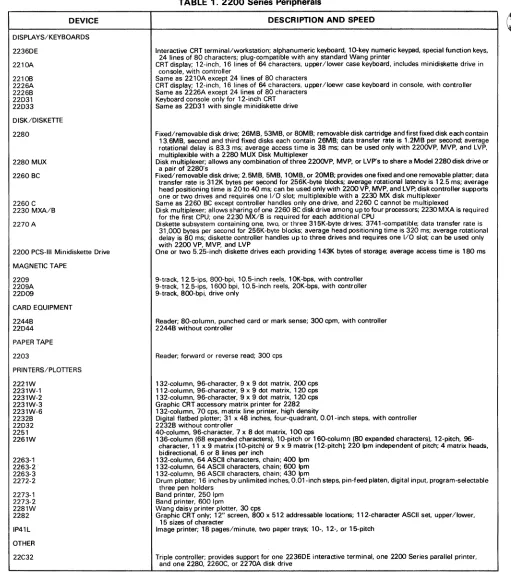
DEVICE DISPLAYS/KEYBOARDS
2236DE
2210A
22108 2226A 2226B 22031 22033
DISK/DISKETIE
2280
2280 MUX
2260 BC
2260C 2230 MXA/B
2270A
2200 PCS-III Minidiskette Drive
MAGNETIC TAPE
2209 2209A 22009
CARD EQUIPMENT
2244B 22044
PAPER TAPE
2203
PRINTERS/PLOmRS
2221W 2231W-l 2231W-2 2231W-3 2231W-6 2232B 22032 2251 2261W
2263-1 2263-2 '. 2263-3 2272-2
2273-1 2273-2 2281W 2282
IP41L
OTHER
22C32
[image:6.612.53.564.68.650.2]Wang Laboratories 2200 Series
TABLE 1. 2200 Series Peripherals
DESCRIPTION AND SPEED
Interactive CRT terminal/workstation; alphanumeric keyboard, 10-key numeric keypad, special function keys, 24 lines of 80 characters; plug-compatible with any standard Wang printer
CRT display; 12-inch, 16 lines of 64 characters, upper/lower case keyboard, includes minidiskette drive in console, with controller
Same as 2210A except 24 lines of 80 characters
CRT display; 12-inch, 16 lines of 64 characters, upper/loewr case keyboard in console, with controller Same as 2226A except 24 lines of 80 characters
Keyboard console only for 12-inch CRT Same as 22031 with single minidiskette drive
Fixed/removable disk drive; 26MB, 53MB, or 80MB; removable diSk cartridge and first fixed disk each contain 13.6MB, second and third fixed disks each contain 26MB; data transfer rate is 1.2MB per second; average rotational delay is 83.3 ms; average access time is 38 ms; can be used only with 220OVP, MVP, and LVP, multiplexible with a 22SO MUX Disk Multiplexer
Disk multiplexer; allows any combination of three 220OVP, MVP, or LVP's to share a Model 2280 disk drive or a pair of 2280's
Fixed! removable disk drive; 2.5MB, 5MB, 10MB, or 20MB; provides one fixed and one removable platter; data transfer rate is 312K bytes per second for 256K-byte blocks; average rotational latency is 125 ms; average head positioning time is 20 to 40 ms; can be used only with 2200 VP, MVP, and LVp; disk controller supports one or two drives and requires one I/O slot multiplexible with a 2230 MX disk multiplexer
Same as 2260 BC except controller handles only one drive, and 2260 C cannot be multiplexed
Disk multiplexer; allows sharing of one 2260 BC disk drive among up to four processors; 2230 MXA is required for the first CPU; one 2230 MX/B is required for each additional CPU
Diskette subsystem containing one, two, or three 315K-byte drives; 3741-compatible; data transfer rate is 31,000 bytes per second for 256K-byte blocks; average head poSitioning time is 320 ms; average rotational delay is 80 ms; diskette controller handles up to three drives and requires one I/O slot can be used only with 2200 VP, MVP, and LVP
One or two 5.25-inch diskette drives each providing 1431< bytes of storage; average access time is 180 ms
9-track, 12.5-ips, 800-bpi, 10.5-inch reels, 10K-bps, with controller 9-track, 12.5-ips, 1600 bpi, 10.5-inch reels, 20K-bps, with controller 9-track, 800-bpi, drive only
Reader; 80-column, punched card or mark sense; 300 cpm, with controller 2244B without controller
Reader; forward or reverse read; 300 cps
132-column, 96-character, 9 x 9 dot matrix, 200 cps 112-column, 96-character, 9 x 9 dot matrix, 120 cps 132-column, 96-character, 9 x 9 dot matrix, 120 cps Graphic CRT accessory matrix printer for 2282 132-column, 70 cps, matrix line printer, high density
Digital flatbed plotter; 31 x 48 inches, four-quadrant, O.Ol-inch steps, with controller 2232B without controller
4O-column, 96-character, 7 x 8 dot matrix, 100 cps
136-column (68 expanded characters), 10-pitCh or 160-column (SO expanded characters), 12-pitch, 96-character, 11 x 9 matrix (10-pitch) or 9 x 9 matrix (12-pitcht 220 Ipm independent of pitch; 4 matrix heads, bidirectional, 6 or 8 fines per inch
132-colu mn, 64 ASCII characters, chain; 400 Ipm 132-column, 64 ASCII characters, chain; 600 Ipm 132-column, 96 ASCII characters, chain; 430 Ipm
Drum plotter; 16 inches by unlimited inches, O.Ol-inch steps, pin-feed platen, digital input, program-selectable three pen holders
Band printer, 250 Ipm Band printer, 600 Ipm
Wang daisy printer plotter, 30 cps
Graphic CRT only; 12" screen, 800 x 512 addressable locations; 112-character ASCII set, upper/lower, 15 sizes of character
Image printer; 18 pages/minute, two paper trays; 10-, 12-, or 15-pitch
Triple controller; provides support for one 2236DE interactive terminal, one 2200 Series parallel printer, and one 2280, 226OC, or 2270A disk drive
J>-
disk drive (80 megabytes) ... and 4 new
2236DE
graphics
terminals. The new peripherals were fully functional
within an hour after being uncrated and we have
encountered absolutely no problems."
~ to the records in a disk-based data file. KF AM includes subroutines which are incorporated into user-written application proanuns.
These
subroutines perform all the required applications on the index (e.g., random-access search, sequential-access search, adding and deleting records). KFAM also provides the utility programs requiredTwenty-seven of the users said that they would
recom-mend their system to other users; three said that they
would not. Two of those three were responsible for
almost all of the low ratings.D
to set up new riles and provide all necessary file maintenance. KF AM is available in versions to support configurations ranging from
a
siIlg1e-CPU system to multiple-CPU /multi- )II pJe.disk systems.© 1981 DATAPRO RESEARCH CORPORATION, DELRAN, NJ 08075 USA REPRODUCTION PROHIBITED
C21-908-107 Programmable Terminals
Wang Laboratories 2200 Series
. . Programming aids offer the programmer a variety of subroutines which may be incorporated into application programs. The programming aids subroutines include search catalog index, allocate data file space, free unused sectors, data entry, open/close output, alphanumeric input, etc. Programming aids also include SORT-4, a flexible, free-standing sort routine.
APPLICATIONS PROGRAMS: Wang I.aboratories offers 2200 Series applications programs through three groups: the software vendor network; the Wang Users' group; and the Wang in-house software development staff. The major source of software for the 2200 Series product line is Wang's independent software vendor network. Commercial and scientifIC applications have been created for diversified fields. Many software network-developed packages are cross-licensed between vendors, allowing national and regional access.
Most of the currently available applications programs tuive been developed by users and software vendors. Wang's in-house software group has produced the utilities, standard subroutines, an extremely comprehensive statistical analysis package, and several accounting packages. Brief descriptions of some Wang-developed and supported packages follow:
General Business Systems Modules: Include packaged programs for invoicing, accounts receivable, sales analysis, order entry, inventory control, accounts payable, and general ledger.
IDEAS: Inquiry Data Entry Access System is an application development tool which can be used to create and maintain data files, generate sophisticated screen formulas, solicit and validate operator-entered data, and produce complex reports.
Statistics/Engineering General Program Library: Includes a wide variety of programs for common problems in statistics (including several regression analyses), civil and sanitary engineering, electrical engineering, chemical engineering, and structural engineering.
General Plotter Utilities: Provide users of digital plotters with full plotting capabilities. These are stand-alone programs which scale, plot, and alphanumerically label rectangular, parametric, or polar equations; bar charts; pie charts; point plots; and line grapbs. The user can select either linear, logarithmic, or polar scales for special plots. No technical programming background is necessary to produce graphs.
ReM: Remote Control and Maintenance is a diagnostic tool tbat allows one 2200 system to take command of another
remote 2200 system and to perform diagnostic tests on that system.
COMPONENTS
See Table 1 for a complete list and brief description of all 2200 Series peripherals.
PRICING
The Wang 2200 Series systems are available for pur-cbase, lease, or rental. Most software (i.e., application packages) is separately priced and is available directly from Wang Laboratories and also from independent software houses. Marketing personnel at Wang can assist users in selecting software houses that can meet their particular user needs.
Wang Laboratories, Inc., offers two-, three-, and five-year leases, with separate service contracts mandatory for one year on leased equipment.
Rentals are available either with or without an option to purchase. Rental agreements include full maintenance of the equipment. On rentals with option to purchase, rebates are offered depending on the term of rental (minimum rental terms are three months, with maximum rental for up to 24 months). The amount of rebate applicable to system purchase depends on the particular rental plan agreed upon; ten plans are available. However, the service portions of the rental do not apply to purchase.
The equipment is sold with a 90-day warranty on parts and labor plus a one-year warranty on parts manu-factured by Wang Laboratories. Maintenance beyond the 9O-day warranty is offered on a contract basis depending on the nature of the equipment.
Initial installation and system testing are performed at no charge. After the initial system installation, a small service charge to cover the cost of maintenance personnel expenses is made for each peripheral device added to the system. Training is available at the company's training facility in Burlington, Massachusetts. Scheduled five-day courses are given covering system operation, programming, and applications. Users pay for course enrollment plus travel and accommodation expenses incurred during training. Sales personnel are trained at company headquarters and assigned to over 115 sales offices located throughout the United States. Wang has 300 offices in eighty countries. . .
C21·908·108
Programmable Terminals
~ SYSTEMS
2200VP 2200VP-8 2200VP-16 2200MVP 2200MVp-8 2200MVP-16 2200MVP-32 2200MVP-48 2200MvP-64 2200SVP 2200SVP-8 2200SVP -16 2200LVP 2200LVP-8 2200LVP-16 2200LVP-32 PCS-III
CPU. 9 I/O slots. 32K memory CPU. 9 I/O slots. 64K memory
Wang Laboratories 2200 Series
EQUIPMENT PRICES
CPU. 9 I/O slots. 32K memory. extended configuratiOn chassis Same with 64K memory
Same with 128K memory Same with 192K memory Same with 256K memory
CPU. 500K single-sided double-density diskette. 32K memory Same with 64K memory
CPU. 3 VO slots. I-megabyte double-sided double-density diskette. 32K memory. cabinet
Same with 64K memory Same with 128K memory
2200f>cS-III-8 Personal Computing System. 9-inch CRT (64 x 16. upper/lower case). 140K single-sided double-density diskette. 32K memory
MEMORY V3264 V32128 V32192 V32256 V64128 V64192 V64256
32K to 64K upgrade (for 2200VP. 22ooMVP. 22ooSVP. and 2200 LVP) 32K to 128K upgrade (for 2200MVP and 22ooLVP)
32K to 192K upgrade (for 2200MVP) 32K to 256K upgrade (for 2200MVP)
64K to 128K upgrade (for 2200MVP and 22ooLVP) 64K to 192K upgrade (for 22ooMVP)
64K to 256K upgrade (for 2200MVP)
MASS STORAGE
2260-1/4 2260-112 2260C 2260C-2 2260BC-l/4 2260BC-112 2260BC 2260BC-2 2270-1 2270-2 2270-3 2270A-l 2270A-2 2270A-3 2280-1 2280-2 2280-3 2280N-l 2280N-2 2280N-3 22C03 2297 OP-l03
1.25-megabyte fixed and 1.25-megabyte removable disk drive with 22C 12 controller and stand 2.5-megabyte fixed and 2.5-megabyte removable disk drive with 22C 12 controller and stand 5-megabyte fixed and 5-megabyte removable disk drive with 22C12 controller and stand Oual 5-megabyte fixed and 5-megabyte removable disk drives with 22C12 controller and stands 1.25-megabyte fixed and 1.25-megabyte removable disk drive with 22C13 controller and stand 2.5-megabyte fixed and 2.5-megabyte removable disk drive with 22C13 controller and stand 5-megabyte fixed and 5-megabyte removable disk drive with 22C13 controller and stand Dual 5-megabyte fixed and 5-megabyte removable disk drives with 22C13 controller and stand 1/4-megabyte single removable diskette drive only
112-megabyte dual removable diskette drives only 3/4-megabyte triple removable diskette drives only
1I4-megabyte Wang/3740 diskette. single removable diskette drive only 1I2-megabyte Wang/3740 diskette. dual removable diskette drives only 3/4-megabyte Wang I 3740 diskette. triple removable diskette drives only
13.4-megabyte fixed and 13.4-megabyte removable disk drive with 22C14 disk processing unit and controller
4O.2-megabyte fixedat1d 13.4-megabyte removable disk drive with 22C14 disk processing unit and controller
67-megabyte fixed and 13.4-megabyte removable disk drive with 22C14 disk processing unit and controller
13.4-megabyte fixed arid 13.4-megabyte removable disk drive only 4O.2-megabyte fixed and 13.4-megabyte removable disk drive only 67-megabyte fixed and 13.4·megabyte removable disk drive only Disk/diskette controller
Optional stand for 2260C series drives
Additional single-sided. double-density minidiskette drive for PeS-III
MAGNETIC TAPE
2209 22009 2209A
2250
Magnetic tape drive. 9-track. 8OQ-bpi. with controller 9-track. 8OO-bpi drive only
Magnetic tape drive. 9-track. 1600-bpi. with controller B-bit parallel I/O interface controller
© 1981 DATAPRO RESEARCH CORPORATION. DELRAN. NJ 08075 USA REPRODUCTION PROHIBITED
Purchase Price
$ 6.000 8.500 9.000 12.000 15.000 18.000 21.000 6.000 9.000 8.000 11.000 14.000 6.500 3.000 8.000 11.000 16.000 5.000 8.000 13.000 7.200 9.200 11.200 18.400 8.000 10.000 12.000 19.000 3.200 4.700 6.200 3.600 5.100 6.600 19.000 20.000 21.000 17.000 18.000 19.000 200 250 1.000 10.400 10.000 15,000 400 Monthly Maint.
$ 70.00 97.00 81.00 107.00 172.00 220.00 268.00 68.00 95.00 80.00 108.00 170.00 88.00 28.00 90.00 139.00 187.00 62.00 113.00 161.00 108.00 108.00 108.00 173.00 108.00 108.00 108.00 173.00 36.00 49.00 70.00 33.00 49.00 65.00 206.00 216.00 227.00 184.00 195.00 206.00 2.50 N/C 9.00 98.00 96.00 119.00
2.50
II
Wang Laboratories 2200 Series
EQUIPMENT PRICES
~ CARD EQUIPMENT 2244B
22044 22C06B
Hopper-feed mark sense/punched card reader with controller, 300 cpm Card reader only
Card reader controller
PRINTERSIPLOTTERS
All printers must be attached to the 22C02 controller, directly to the 2236DE interactive terminal, or to the 22Cll dual controller (print plus diskette) or the 22C32 triple controller for diskette, printer, and 2236DE.
.2221W 2231W-l 2231W-2 2231W-3 2231W-6 2232B 22032 22COl 2251 2261W 2263-1 2263-2 2263-3 2272-2 2273-1 2273-2 2281W OP-123 BFT-l 2282 IP41L 22C02 22Cl1 22C32 2211M 2295 TERMINALS 2236DE 2236MXD 2210A 2210B 2226A 2226B 22031 22033 22C31 22C33 22C34
Matrix printer with stand; 132 col., 200 cps, 10-pitch Matrix printer; 112 col., 120 cps, 10-pitch
Matrix printer; 132 col., 120 cps, 12-pitch 2282 graphic CRT accessory matrix printer Matrix line printer, high density, 132 col., 70 cps Digital flatbed plotter, 31" x 48", with controller Plotter only
Output writer/plotter controller Une printer; 40 col., 100 cps Matrix line printer; 220 Ipm, dual pitch Une printer; 400 Ipm, 64 char. Une printer; 600 Ipm, 64 char. Une printer; 430 Ipm, 96 char. Drum plotter with three pens Band printer; 250 Ipm Band printer; 600 Ipm
Wang daisy printer/plotter, 30 cps
Monodirectional forms tractor option for 2281W
Bidirectional forms tractor for 2281W; necessary for plotting on 2281W GraphiC CRT only; 12" screen; 112 upper/lower ASCII characters Image printer; 18 pages/minute; 10-, 12-, or 15-pitch
Printer/drum plotter controller
Dual controller, printer/drum plotter and diskette
Triple controller for diskette, printer, and one 2236DE interactive terminal Une printer multiplexer (maximum 4 CPU and 1 printer)
2231W printer stand
Interactive terminal; CAT/keyboard, 24 x 80, 10-key pad, function keys 4-port terminal multiplexer for 2236DE
12" CRT; 64 x 16, upper/lower case keyboard with single minidiskette drive and controller 12" CRT; 80 x 24, upper/lower case keyboard with single minidiskette drive and controller 12" CRT; 64 x 16, upper/lower case keyboard with controller
12" CRT; 80 x 24, upper/lower case keyboard with controller 12" CRT; keyboard console only
12" CRT; keyboard console with single minidiskette drive Triple controller for disk/diskette, keyboard, line printer
80 x 24 upper/lower case CRT controller
64 x 16 upper/lower case CRT controller TERMINAL OPTIONS
OP-31 OP-32 OP-33 OP-l0l
Audio signal for 2210, 2226 Keyboard clicker for 2210, 2226
80 x 24 upper/lower case CRT controller Additional minidiskette drive for 2210 only
1/0 INTERFACES 2207A 2227B 2227N 2228B 2228C 2228N
110 interface controller, RS-232C, selectable bps Buffered asynchronous telecommunications controller Null modem
Bisynchronous communications controller
Bisynchronous communications for IBM 3275 emulation Null modem
1/0 INTERFACE OPTIONS FOR 2200SVP OP27B
OP28B OP28C
Buffered asynchronous telecommunications controller Bisynchronous communications controller
Bisynchronous communications controller for IBM 3275 emulation
110 INTERFACE OPTION FOR PeS-III Bisynchronous communications option
FEBRUARY 1981 @ 1981 DATAPRO RESEARCH CORPORATION, DELRAN, NJ 08075 USA REPRODUCTION PROHIBITED
C21-908-101 Programmable Terminals
Wang Laboratories
pes-II
The
pes-II
shown above has an independent processor to handle the communications line; two Minidiskette Drives sit atop the display unit. The compact system can function as a terminal or as a data processor.MANAGEMENT SUMMARY
Wang's Personal Computer System II (PCS-II) is a hybrid
equally usable as an intelligent terminal and as a small
business computer. This capability is implemented by two
minidiskette drives that provide on-line access to a total
of 179,200 bytes of random mass storage contained on two
five-inch floppy disks.
A separate microprocessor is used for handling the
com-munications interface. This not only makes the function
transparent to the user, but also offers operational
flexi-bility beyond that indicated by the interface name. For
instance, the Bisynchronous Communications Controller
with the BSC program loaded will handle BSC lines, but
with the Asynchronous program loaded will handle
Tele-type or IBM 2741 protocol. Support of other protocols
could easily be programmed. The Asynchronous
Con-troller, half the price of the Bisynchronous ConCon-troller,
cannot support BSC protocol because it does not have
sufficient RAM to contain the BSC program.
Since the communications controller microprocessor
operates independently of the central processor, data
entry can be in progress concurrent with data
trans-mission, given the appropriate software support. Timing
and volume consideration of the specific applications
would determine the advisability of concurrent
opera-tions.
For time-critical I/O operations, PCS's BASIC language
provides the capability to code such operations in
time-efficient, absolute-like code. However, for typical
applica-tions, such considerations are user-transparent. For the
user employing the terminal for data entry, and not
wishing to do his own programming, Wang supplies 1:>
A programmable terminal capable of func-tioning as a stand-alone processor for small business applications. as an intelligent terminal in larger networks. or as a combina-tion of both.
The basic PCS-II includes a microprocessor with up to 32K bytes of solid-state memory. a 64x16 video display unit. one or two minidiskette drives (89.600 bytes of storage each). and a microprogrammed communica-tions controller capable of handling ASCII. EBCDIC, BSC, or Burroughs Basic Mode protocols.
A PCS-II equipped with 16K bytes of RAM and a BSC controller is priced at $6,700 or can be rented on a five-year lease for approximately $165 per month. A mainte-nance contract for purchased equipment would cost about $75 per month. On leased equipment, maintenance is included.
CHARACTERISTICS
VENDOR: Wang Laboratories, Inc., One Industrial Ave-nue, Lowell, Massachusetts 01851. Telephone (617) 851-4111.
DATE OF ANNOUNCEMENT: March 1977.
DATE OF FIRST DELIVERY: March 1977.
NUMBER DELIVERED TO DATE: Over 250.
SERVICED BY: Wang Laboratories, Inc.
CONFIGURATION
The Personal Computer System-II (PCS-II) is a desktop programmable terminal featuring Minidiskette Drives for random access mass storage and an optional, independent microprogrammed communications controller. The latter permits the terminal to emulate the protocols of the mM 2780, 3780, 3741, and 2741 on a user-transparent basis.
The basic PCS-II includes:
• A self-contained version of the Wang 2200T processor.
• 8K bytes of random access memory (RAM).
• A read-only memory (ROM) coded with the BASIC interpreter and the operating system.
• A 9-inch (64xI6) CRT.
• A keyboard.
• One Minidiskette Drive.
• A Telecommunications Connector.
AUGUST 1978 © 1978 DATAPRO RESEARCH CORPORATION. DELRAN. N.J. 08075
C21-908-102
Programmable Tanninals
Wang Laboratories
pes-II
t>
EASYFORM, a software package to drive the terminal as
a data entry device.
Wang is one of several terminal vendors that offers
turnkey systems, hardware and special purpose
applica-tion software for a single price.
Wang would not identify any users for Datapro, and we
were unable to find any; so, we could not check on
user reaction.O
~ • Provision for attachment of an Auxiliary CRT.
• Two Printer/Plotter Connectors_
• A spare EIA conn~or to interface a controller, plotter, or line printer.
The Telecommunications Connector can support attach-ment of the Bisynchronous Communications Controller, the Asynchronous Communications Controller, the Parallel I/O Controller, or an instrumentation interface. A selection of character and line printers, a single-pen plotter, and a three-pen plotter can be attached to the Printer/Plotter Con-nectors. One Auxiliary 8Ox24 CRT can be supported by the Auxiliary CRT connector.
TRANSMISSION SPECIFICATIONS
One of three communications controllers or an instrumenta-tion interface can be attached to the PCS-II Telecommunica-tions Connector.
The Bisynchronous Communications Controller contains its own microprocessor with a IK ROM and an 8K RAM. With one of three no-cost Wang-supplied software packages, this controller can emulate the BSC protocol of the IBM 2780, 3780, or 3741. Such configurations permit the PCS-II to function as a workstation to an IBM System 360/370 or other BSC-compatible host computer systems. This con-troller can also be loaded with a program for Burroughs Basic Mode protocol, which supports asynchronous or syn-chronous, multipoint (poll/select) transmission.
A version of the same microprocessor, with less RAM, is programmed to handle Teletype and IBM 2741 protocols. This Asynchronous Telecommunications Controller is normally used for interactive communications between a host computer and the PCS-II.
Both the Asynchronous and tbe Bisynchronous Communi-cations Controllers support EIA RS-232C or CCITT V.24 standards. Asynchronous speeds of up to 9600 bps and synchronous operation at up to 7200 bps are supported. An 8-bit Parallel I/O Controller is also available.
SOFTWARE
User programming is normally performed in Wang Ex-tended BASIC. BASIC statements are entered directly through the keyboard and can be run either as entered (immediate mode) or when required (program mode). BASIC statements resident in the RAM are operated upon, or compiled, by the BASIC Interpreter that is permanently resident in the 42.5K-byte ROM along with the operating system. The interpreted instructions are executed by the processor while the next statement is simultaneously being interpreted. BASIC has a repertoire of 132 statements, 99 error codes, and 13 commands. The commands give the user keyboard communication with the Basic Interpreter. BASIC can be commanded to run a program, clear memory, list
a program, etc. The user can make up to 32 subroutines of frequently used functions; these can be invoked when writing Program statements by depressing a single function key. Since BASIC does not require one statement per line, a single 192 character line can contain many statements. In addition to the fundamental statements, BASIC provides statements to handle math matrix, trigonometric and alge-braic functions, and alphanumeric sorts. One statement gives the programmer the ability to write I/O statements in an absolute code-like fashion. BASIC will support up to 286 variable names for either simple numeric or alphanumeric variables or arrays. The total number of unique variable names is 1144. An alphanumeric variable can be up to 64 bytes long. The nesting maximum for FOR/NEXT loops and for subroutines is each 45 levels. Arithmetic precision is 13 significant digits. All math functions are performed by a separate floating-point processor.
When using the terminal for data entry, the user can avoid programming altogether by using EASYFORM, a Wang software package. The package facilitates creation of an input prompting form that can be used by the operator when entering data. Up to 10 form layouts, each with up to 50 data fields, can be saved on diskette. Data entered through EASYFORM is stored on disk in the appropriate trans-mission format.
Wang also markets the PCS-II as part of several turnkey systems that also include the application software. Two such systems are described below.
The Time/Check II system performs time analysis of bill-able time for attorneys, accountants, advertising agencies, architects, and other professionals. The system can also perform the actual billing function and produce customized mass mailings.
The PCS-II Lifeline system produces customized policy proposals for independent life insurance agents. The system can also perform mass mailing of customized letters.
Other software systems include MINI CASH, an ac-countants work-up system; MINI/SPARK, a simplified inventory and warehouse control system for auto parts dealers; AUTOMATE II, an auto dealers finance, insurance and forms fding system; MINI/MPS, a management plan-ning system for budgeting and modeling of forecasts; and MORTGAGE MANAGEMENT, a system to manage and compute residential/commercial mortgages for thrift institu-tions.
COMPONENTS
DISPLAY UNIT: The console CRT is a 9 inch (22.9 cm) diagonal unit with 16 lines, each accommodating 64 char-acters (1024 charchar-acters total). Character height and width is 0.125 inches (0.32 cm).
An Auxiliary CRT can be attached to the system. The unit accommQCiates 24 lines, each line having 80 characters.
KEYBOARD: Consists of a full-typewriter layout, a full numeric pad, mathematical function keys, arithmetic opera-tion keys, 16 shiftable special funcopera-tion and edit keys, a cen-tral processor busy light, and an upper/lowercase light. The . special function keys are used both for edit functions and for 32 user-defined functions or subroutines for BASIC state-ment writing. A toggle switch at the left of the keyboard sets the keyboard for alphanumeric entry or BASIC statement (keyword) entry. A keyboard clicker and audio alarm can be optionally attached.
MINIDISKETTE UNIT: One Minidiskette Drive is standard with the PCS-II and a second is optional. Each •
© 1978 DATAPRO RESEARCH CORPORATION, DELRAN, N.J. 08075 REPRODUCTION PROHIBITED
C21-908-103
Programmable Terminals
Wang Laboratories
pes-II
Configuration
PCS-II
I I
9 inch CRT I I
(64 x 16) I Minidiskette I Minidlskette
and I Drive
I
DrtveKeyboards I
I
I
_______________ .... ______ .J _______
I
TelecommunicationsProcessor I
-
Communications ControllerConnector
1- ______________ OR
Instrumentation Interface
---~
ROM (BASIC Interpreter and 1 Printer/Plotter
operating system) I Connector
__________
~_~__ L ____________
0 ne or two printers
and/or plotters
I
I Printer/Plotter
I Connector
L ____________
RAM I
8K bytes standard; I Auxiliary CRT
-32K bytes maximum I Connector One 8Ox24 AUXIliarv CRT
L ____________
I
Spare EIA
1 Connector
I (for future expansion) I
. . . drive accommodates a 5Yz-inch (13.3cm) Minidiskette. a reduced version of the original floppy disk. The Mini-diskette has 35 tracks, each of which contains 10 sectors of
~56 bytes per sector, for a total of 89,600 bytes per diskette. Average access time is 533 milliseconds and the transfer rate is 115K bits per second. The Minidiskette has a write protect notch.
USER MEMORY: The basic system is aV8l1abie with 8K bytes of random access memory and is expandable in either 8K- or 16K-byte increments up to 32K bytes.
PRINTERS AND PLOTTERS: Matrix character printers are available
in
varying speeds from 110 to 200 characters per second. Line printers are available in speeds of 240, 400. and 600 lines per minute. A bidirectional ball printer with 156 print positions and a speed of 15 characters per second is available. A daisy wheel, 40 character-per-seoond. bidirec-tional printer is offered in 132 or 1 S8 positions.A single-pen or a three-pen plotter is attachable; either unit accepts IfMnch wide paper of unlimited length.
PRICING
The Personal Computing System is available for purchase or on a lease-purchase basis. Wang Leasing, a subsidiary. will provide a 6&-month lease-purchase agreement with a
22oo-PCS-II-2 22oo-PCS-II-4 22oo-PCS-II-6 22oo-PeS-II-8
Basic PCS-II; BK bytes Basic PeS-II; 16K bytes Basic PCS-II; 24K bytes Basic PCS-II; 32K bytes
Random Access l\IIemory
8K-byte Memory Increment 16K-byte Memory Increment 24K-byte Memory Increment
MiniDiskette Drive
Additional Minidiskette Drive
monthl) charge tbat is 2_45 percent of the purchase price. A separate maintenance contract is available.
PRICING
The PCS-II is obtainable by purchase for the prices shown in the accompanying table. The terminal is also available on rental or lease plans. Maintenance is included in all rental plans and available separately for leased or purchased equipment. Lease contracts are offered on a full-payout basis only; rental contracts bave purchase accruals of 90 percent within the first 90 days from contract execution or 50 percent from the 91st day to the end of the first contract )ear; thereafter. there are no accruals toward purchlL'Ie'.
Leases can be obtained under the foUowing terms (based on the total purchase price): 24 months. S%/month; 36 months. 3.6%/month; 60 montbs. 3.0%/month. Rental contracts. including maintenance, are calculated (based on the total purchase price) as follows: 12 months. 4.5%/month; 24 months. 3.75%/month; 36 montbs, 3.S%/month; 60 months. 3.0%/month. Maintenance is available for purchased equip-ment at the rates shown; separate maintenance contracts can be negotiated for preventive maintenance coupled with repair activities, or for repair action only. Without a maintenance contract, service is billed on an hourly basis. At the end of a lease, purchase can be effected under negotiable terms. AU PCS-II hardware carries a 90-day warranty.
Purchase Price
$4,800
5.200 6,000 6,800
1,300
2,200 3,500
1,000
Monthly Maint.
$ 50
60
70
80
10
20 30
8
C21-908-104
Programmable Terminals
OP-62 OP-62B OP-67 OP-65
OP-60 OP-60A
2221W 2231W-l 2231W-2 2295 2251 2261W 2263-1 2263-2 2281 2271 2272-1 2272-2
Wang Laboratories
pes-II
Telecommunications Options Asynchronous Communications Controller Bisynchronous Communications Controllel 8-bit Parallel I/O Interfaca Controller IEEE-488 Standard Interface
Auxiliary CRT
Keyboard Clicker. Audio Alarm. and Auxiliary CRT Connector 8Ox24 CRT. Keyboard Clicker. and Audio Alarm
Printers/Plotters
200 cps Printer. 10 cpi. 132 positions 120 cps Printer. 10 cpl. 112 positions 120 cps Printer. 12 cpi. 132 positions 2231 Printer Stand
110 cps Printer. 40 positions 240 Ipm Printer
400 Ipm Printer 600 Ipm Printer
40 cps Daisy Output Writer 15 cps Selectric Output Writer Single Pen Drum Plotter Three Pen Drum Plotter
Turnkey Systems
Purchal8 Monthly
Price Maim.
750 15
1.500 15
400 2
750
..
100 2
400 5
5.000 66
2.900 28
3.200 28
250
1.200 11
7.CX1J
6014.500 125
16.000 138
4.500 35
3.200 26
2.900 30
3.200 33
Purchase Monthly Maintenance
Price Hardwara Software
PCS II MINI/CASH; includes PCS-II. '16K bytes. 2nd Diskette Drive. 120 cps Printer. and Auxiliary 8Ox24 CRT
Time/Check II; includes PCS-II. 16K bytes. 120 cps Printer. and Auxiliary 8Ox24 CRT
PeS-II MINI-LIFELINE; includes PCS-II. 8K bytes. 2nd Diskette Drive. 8Ox24 CRT. and 40 cps Daisy Wheel Printer
$14.600
13.100
16.000
$112
112
98
© 1978 DATAPRO RESEARCH CORPORATION. DELRAN. N.J. 08075 REPRODUCTION PROHIBITED
$30 20
3011
C21-908-101 Programmable Terminals
Wang Laboratories
pes-II
The peS-II shown above has an independent processor to handle the communications line; two Minidiskette Drives sit atop the display unit. The compact system can junction as a terminal or as
a data processor.
MANAGEMENT SUMMARY
The Personal Computer System has been built on the
same processor architecture, the 2200T, that Wang
Lab-oratories successfully included in the 1975 introduction of
its WCS series of minicomputer systems.
Wang describes the PCS-II as a hybrid system-half
intelligent terminal and half small business computer.
The capability of this compact terminal to function as a
small business· computer is due to the new Minidiskette
Drives. With two Minidiskette Drives, the system has
on-line access to 179,200 bytes of random mass storage
con-tained on easily removable, five-inch, floppy disks.
A separate microprocessor is used for handling the
com-munications interface. This not only makes the function
transparent to the user, but also offers operational
flexi-bility beyond that indicated by the interface name. For
instance, the Bisynchronous Communications Controller
with the BSC program loaded will handle BSC lines, but
with the Asynchronous program loaded will handle
Tele-type or IBM 2741 protocol. Support of other protocols
could easily be programmed. The Asynchronous
Con-troller, half the price of the Bisynchronous ConCon-troller,
cannot support BSC protocol because it does not have
sufficient RAM to contain the BSC program.
Since the communications controller microprocessor
operates independently of the central processor, data
entry can be in progress concurrent with data
trans-mission, given the appropriate software support. Timing
and volume consideration of the specific applications
would determine the advisability of concurrent
opera-tions.
1:>
Programmable display terminal with exten-sive data processing support.
The basic PCS-II includes a 64x16 Display Unit; up to two Minidiskette Drives with 89,600 bytes of storage each; a micropro-grammed processor with up to 32K bytes of semiconductor memory; and a micropro-grammed communications controller for handling either teletype, IBM 2741, BSC. or Burroughs Basic Mode protocols.
The PCS-II with 16K bytes of RAM and the BSC Controller can be purchased for $9,800; a maintenance contract would cost $81 per month.
CHARACTERISTICS
VENDOR: Wang Laboratories, Inc., One Industrial Ave-nue, LoweD, Massachusetts 01851. Telephone (617) 851-4111.
DATE OF ANNOUNCEMENT: March 1977.
DATE OF FIRST DELIVERY: March 1977.
NUMBERED DELIVERED TO DATE: 200.
SERVICED BY: Wang Laboratories, Inc.
CONFIGURATION
The Personal Computer System-II (pCS-II) is a desktop programmable terminal featuring Minidiskette Drives for random access mass storage and an optional, independent microprogrammed communications controller. The latter permits the terminal to emulate the protocols of the mM 2780, 3780, 3741, and 2741 on a user-transparent basis. The basic PCS-II includes:
• A self-contained version of the Wang 2200T processor. • 8K bytes of random access memory (RAM).
• A read only memory (ROM) coded with the BASIC interpreter and the operating system.
• A 9 inch (64xl6) CRT.
• A keyboard.
• One Minidiskette Drive.
• A Telecommunications Connector.
• Provision for attachment of an Auxiliary CRT.
• Two Printer/Plotter Connectors.
• A spare connector.
The Telecommunications Connector can support
attach-ment of the Bisynchronous Communications ControUer, the ~
JUNE 1977 ©1977 DATAPRO RESEARCH CORPORATION, DELRAN, N.J.OB075