
DEVELOPMENT AND EVALUATION OF MODEL FOR
TEACHING AND LEARNING TRADITIONAL CRAFT
COURSEWARE
1SALYANI OSMAN, 1NORAIDAH SAHARI@ASHAARI, 1NOR AZAN MAT ZIN, 1RATNA
ZUARNI RAMLI, 2NORAZIMAH AWANG, 1SITI ROSNI MOHAMAD YUSOFF
1Faculty of Information Science and Technology, Universiti Kebangsaan Malaysia, Malaysia
2
Faculty of Computer Science and Information Technology, Universiti Selangor, Malaysia
E-mail: [email protected], [email protected], [email protected], [email protected],
[email protected], [email protected]
ABSTRACT
This paper discusses the development and evaluation phases involved in the development of a model for traditional craft courseware. The model called CDTC Model was developed based on the software development life cycle methodology consisting of Analysis, Design, Development and Evaluation phases. Every phase has its own contribution towards the objectives of the research. However, this paper concentrates on the development phase which involves adapting the model into a series of prototype development and evaluation phase that focus on four parts: usability study of the prototype derived from the model, effectiveness evaluation, satisfaction assessment on cognitive apprenticeship adaptation and final validation. The final validation was conducted among selected craft instructors to verify the model's component as well as to confirm the final version of the model. The results of the final validation indicate that the CDTC Model components are obviously found important to the development of courseware for teaching and learning traditional craft.
Keywords: Traditional Craft Model development, Traditional craft courseware, Craft Education
1. INTRODUCTION
Teaching and learning traditional craft is basically done through the conventional way of learning called traditional apprenticeship. Refer to [1], this type of learning requires direct observation from the instructors, where students receive immediate feedback when the skills are repeatedly practiced. There are several limitations found in the existing traditional apprenticeship approach. The obvious problem in conventional approach is when an instructor needs to teach a group of students. It is potentially limiting the support from instructor to monitor, focus and assess student individually.
Preliminary studies show that problems occur in conventional learning of traditional craft, which lead to the weaknesses of traditional apprenticeship itself [2]. Some of the identified problems faced by most students are high level of dependency on the instructor, frequent repetition of the teaching process, high time consumption for memorization of the learning process, difficulty in obtaining
readily available instructor assistance and related course, communication problems of verbal learning and difficulty to visualize practical , verbally delivered teaching. This requires an alternative method of teaching and learning traditional craft. One such alternative method is by exposing the students to digital learning which offers more flexibility, as in the past decades there have been many efforts to integrate technology into teaching and learning practices. In order to ensure effective support teaching and learning pedagogy, and that the courseware for teaching and learning traditional craft is highly applicable, a model for courseware development of teaching and learning traditional craft known as CDTC Model was developed and derived from methodologies synthesized from related research areas. The development of the CDTC Model is intended to
assist courseware designers in developing
develop interactive multimedia applications and encourage them to develop more multimedia applications. This paper will look into the details design process of CDTC Model which concentrates on the development and evaluation phases.
2. REVIEW OF MODEL DEVELOPMENT
The CDTC Model was constructed and documented for utilization by educators, instructional designers, and product developers as a reference for developing similar applications. The model is focus on user-centered design and verified by experts in traditional craft. The process of designing the model includes four main phases of software development life cycle: analysis, design, development and evaluation [2]. A series of prototypes were developed as a part of the design process of the model.
The first phase involves an analysis study of the relevant teaching and learning theories, identifying related learning model development, comparing available multimedia applications for teaching and learning crafts and literature review on teaching and learning traditional craft approaches. A preliminary study was also carried out among students and instructors from the National Craft Institute, Malaysia in order to determine the problems in conventional methods in teaching and learning traditional craft. As a result of the analysis, important components were absorbed into the development of proposed CDTC Model which is comprised of (i) teaching and learning components and (ii) digital traditional craft components [3]. The teaching and learning components comprised of the
following elements: (1) Teaching and learning goal
setting: which emphasizes on the teaching and
learning objectives. (2) Teaching and learning
theories adaption: to provide the appropriate
learning environment and improve learning
effectiveness. (3) Course Materials Design:
involves selecting contents and elements used for appropriate craft learning and divides the contents
into sequence of delivery. (4) Teaching and
Learning Strategy: to determine the approach for
achieving the learning objectives. Cognitive apprenticeship method was identified beneficial to be used for online teaching and learning craft and can be highlighted through simulations, discussion,
tutorials and exercises. (5) Course Structure
Design: which involves designing layout of the
elements in the presentation. (6) Delivery design:
which will divide the presentation into several parts such as introduction, body, conclusion and
assessment. Meanwhile, digital traditional crafts components were identified and these consist of:
(1) Multimedia Technology and Delivery Medium:
to provide selective media technology and elements that allow learners to improve their learning and
performance when interacting with content
meaningfully. (2) Immersive environment: to make
learners absorb the learning environment. (3)
Interactive Design: to allow user control what
elements are to be delivered and when they are to
be delivered. (4) Adaptive Crafts Modules:
designed based on learning goals and structured by
following course materials design.(5) Self
assessment: to allow learners to track their personal
development and deepen their learning experience.
(6) Outcomes and Rewards: to determine the level
of learner’s performance. Reward is given after completion of each exercise.
The design phase then validates the models' components and utilizes the validated components to design a preliminary version of the model. In order to validate the proposed model, selected instructors were called through the Delphi technique using survey instrument to collect the opinions of experts on subject. Results from initial validation showed immersive component was excluded and the component of multimedia database was added to the model to allow accessibility of data and enable more options in hosting one or more primary media file types [2].
The development phase focused on the development working prototypes derived from the model and the evaluation phase tested the model for its compliance to the criteria set. The final verification produced the final version of the model.
3. DEVELOPMENT PHASE
3.1 Adapting A CDTC Model Into Prototype Development
designer. The courseware prototype was developed in a web-based environment and all models' components were absorbed in the design of prototype in various way and activities. The most important concerns is that the development of prototype lie on the learning strategy of cognitive apprenticeship element. This web-based prototype has been implemented based on the Dick and Carey's model [4] as a flow guidelines for the whole prototype development process. This model involved four development phases which are Analysis, Design, Development and Evaluation. These phases are summarized in Figure 1.
Phase I is an analysis study. The analysis is done to identify goals and requirement analysis based on interviews, observations, questionnaire and reading on the past research related to the study.
Phase II involves designing the prototype by referring to the data gathered from the analysis. The important part is to absorb the identified preliminary CDTC Models' components into the Instructional Design Model for courseware prototype. Before commencing the next development process, the early step is to identify the requirement tools. The following software have been chosen as development tools: Adobe Flash CS3 Professional was used as multimedia authoring software, Adobe Illustrator and Microsoft Paint for creating graphics, Adobe Photoshop CS3 for image editing and tool for creating the icon of prototype interface, Microsoft Sound Recorder and Sound Forge 8.0 for audio recording and editing, Adobe Premier Pro CS3 for video editing and Swish Max4 as an advanced Flash creation tool for 3D graphics and effects. Because the prototype is developed in a web-based environment, the following software have also been considered: Microsoft internet browser to launch the prototype, Adobe Dreamweaver CS3 as a tool for designing the interface which can be linked with the programming language and Php programming for creating dynamic web page. Php was used in creating online test, chatting room and also forum. For database, Mysql was used and work extremely well with php. In order to make sure that the courseware prototype is rich in contents, the modules in the couseware prototype highly relies on the book of "Seni Kraf Tenunan - Motif dan Teknik", first edition published by Institut Kraf Negara [5]. Besides, cross references were also made by referring to expert instructors and several related reference books.
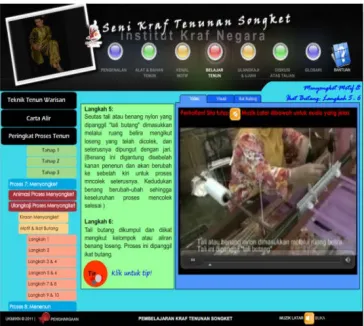
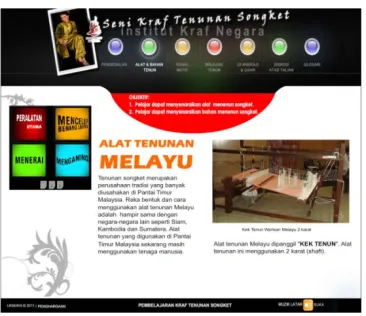
During the development phase in Phase III, all the identified theories and design from the previous phase were referred for developing a working prototype. The courseware prototype consists of eight modules: Introduction, Materials & Tools, Knowing Motifs, Learn to Weave, Quizzes & Test, Online Discussion, Glossary and Help. Samples of the courseware prototype interfaces are shown in Figure 2, Figure 3, Figure 4 and Figure 5.
[image:3.612.323.505.444.607.2]Phase IV involves the courseware prototype testing and evaluation. The initial prototype underwent several stages of formative evaluation process suggested by [6] in [7]: quality review by an instructional designer and a subject matter expert, pilot testing with selected students and validation among students and expert. After an alpha testing was done by the development team, the prototype was subsequently presented to the Evaluator committee (selected craft instructors) to evaluate its fidelity to the preliminary model components. Modifications suggested by the committee were implemented. This process was repeated twice more before the committee was satisfied with the overall prototype’s design and functionality; subsequently the development of a complete prototype was approved. A pilot testing was then conducted to make sure the prototype was designed and developed according to users' requirements.
Figure 3:Interface From Quiz Module
Figure 4: Interface From Online Chat
Figure 5: Interface From Materials And Tools Lesson
3.2 Pilot Testing
Pratt [8] described a pilot test as "Simulating the actual data collection process on a small scale to get feedback on whether or not the instruments are
likely to work as expected in a “real world” situation. A typical pilot test involves administering instruments to a small group of individuals that have similar characteristics to the target population, and in a manner that simulates how data will be collected when the instruments are administered to the target population".
A pilot test in this research was conducted to measure the usability of the prototype before it is used to study the effectiveness of the model. This testing was conducted among ten second year students from Diploma Seni Tenun, Fakulti Seni Kraf Tenun, Institut Kraf Negara. They were asked to evaluate the prototype usability based on the these constructs: memorability, learnability and ease of use, content delivery, feedback, interface and screen design, media integration and satisfaction using a set of questionnaires. The students rate the questionnaire using a five-point Likert Scale ranging from "1=Strongly disagree" to "5=Strongly agree". The result obtained were analyzed using SPSS 17.0.
Result (Table 1) shows that the mean score for all constructs received an average of 4.40 which testify that the courseware prototype is above average score and is considered acceptable to use for actual usability and effectiveness evaluation. Construct of “memorability” was rated at a mean score of 4.55, followed by “Learnability and Ease of Use” (4.37), “Content Delivery” (4.41), “Feedback” and “Interface and Screen Design” (4.40), “Media” was rated at a mean score of 4.22 and "Overall Satisfaction" has a mean score of 4.48.
Modifications of the courseware prototype were made based on user feedback such as image enhancement, updating contents and quizzes questions. Since the purpose of prototype evaluation is to validate the model, the details study in usability and effectiveness evaluation as well as final validation will be discussed further in the model's evaluation phase. The result from evaluations will help in establishing the final version of the model.
4. EVALUATION PHASE
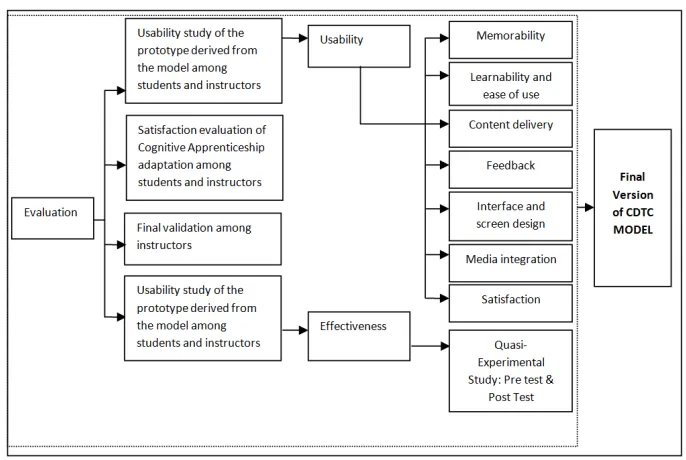
[image:4.612.100.283.485.643.2]Usability evaluation of the courseware has become an established field of activity in software development and is always considered after using a courseware. There are many different approaches to measure usability. Shackel [9] as cited in [10] has proposed to measure usability by its operational criteria, on four dimensions: effectiveness: performance in accomplishment of tasks; learnability: degree of learning to accomplish tasks; flexibility: adaptation to variation in tasks and attitude: user satisfaction with the system. Nielsen [11] defined usability as consisting of five attributes: learnability, efficiency, memorability, errors, and satisfaction. Usability of courseware prototype in this research were measured based on constructs derived from a thorough review of the literature [11-15]. Effectiveness is defined as "how good a product is at doing what it is supposed to do" [16]. The effectiveness of the courseware can be measured by comparing student's achievement and performance among two groups of students i.e students who learnt from conventional learning and from using the courseware. The evaluation of satisfaction on cognitive apprenticeship adaptation is done to obtain students’ and instructors’ perceptions towards the learning strategy used in web based traditional craft learning environment. A final validation is done to ensure that the components are important to the model.
4.1 Usability And Effectiveness Evaluation
The evaluation methodology in usability and effectiveness study was conducted among students and this began with the purposive selection of participants from first year student (those without traditional apprenticeship experience). All of them registered for certificate and diploma in weaving craft from Fakulti Seni Kraf Tenun, IKN. Because of the limitation of the students who registered for the courses, all 20 students have participated as sample size in this evaluation study.
The process of identifying the effectiveness of the prototype which absorbed the CDTC Models' components is done based on the quasi-experimental design. This study involves two
groups of samples: the control group (X1) and the
experiment group (X2). Each group is comprised of
10 students. All students were required to answer pre test questions before starting the lesson. The pretest consists of two parts, Part A includes the subject's basic information to assess the students' knowledge toward the topics and Part B includes practical questions that assess the ability of students to perform the weaving process instructions. After that the students in the control group were taught
the traditional apprenticeship method by their instructor through conventional learning, while the students in the experiment group were exposed to the cognitive apprenticeship method using the web based courseware prototype as a learning instrument. This treatment was given for eight weeks as the lesson is taught for theory and practical learning. After completing 32 hours of the lesson (time allocated for both groups to cover the topic in theory and practical basis), all students from both groups were given the posttest questions based on both topics. Similar with the pre test, the posttest questions also consists of two parts: Part A is knowledge (theory) questions and Part B is practical questions in which require students to perform practically based on the given instructions. Both groups were given 45 minutes to answer Part A, meanwhile for Part B, both groups was assessed separately by an examiner using a 20 item checklist assessment tool. The items in assessment tool have been developed based on sources from book of "Seni Kraf Tenunan-Motif dan Teknik" [5]. As Part B requires students to produce a songket weaving product, the extra two weeks were given for them to complete the test.
All data collected from both tests were compiled and analyzed using SPSS software. A non-parametric statistical test was employed as the sample size in this study was small [17 - 18] and a conventional level of significance of 0.05 was used to detect differences. The Mann-Whitney U-Test was used to check for significant differences in knowledge assessment test scores and practical performance test scores between the control group and the experimental group. Meanwhile, the Wilcoxon signed ranks test was used to compare knowledge assessment test scores and practical performance test scores within groups between the
pretest and posttest.A significant difference found
in the results will indicate the effectiveness of the prototype as well as the proposed model.
To obtain usability result, the experiment group
(X2) were required to assess the courseware
4.2 Satisfaction Evaluation On Cognitive Apprenticeship Adaptation
The development of the prototype is done by adapting E-CRAFT models' components which emphasized on cognitive apprenticeship learning strategy. To study the perceptions of adaptation cognitive apprenticeship strategy in web-based teaching and learning traditional craft, the survey questionnaires, observation and interviews were carried out among experiment students after completing usability and effectiveness study. Selected instructors who were involved in usability evaluation were also required to complete the evaluation.
4.3 Final Validation
The final validation was intentionally conducted to assess the components of CDTC Model that was applied in the courseware prototype. This is a very important task which was carried out in order to get feedbacks from instructors and to ensure that the final components of the model positively impact the courseware for teaching and learning traditional craft. The validation process also acquires instructors to look at the whole learning process during the treatment session in experimental study of evaluation phase.
4.3.1 Design
After the usability and effectiveness evaluation among students were done, five selected instructors with more than five years experience were asked to evaluate the courseware prototype in order to perceive its usability. After reviewing and using the prototype in four hours, instructors were given a similar questionnaire as evaluated by the
experiment group (X2) after they used the
prototype, but with additional questions to verify
the models' components. The questionnaire
comprised of twelve components.
4.3.2 Data Collection
Based on instructors experience of using the courseware prototype, they were asked to rate the importance of each component using a five-point Likert scale ranging from 1 (very unimportant) to 5 (very important). It was agreed that the component receiving an average rating of less than mean 2.0 be removed from the list of CDTC Model's component.
4.3.3 Data Analysis
Data were analyzed using Statistical Product and Service Solution software (SPSS 17.0). A descriptive analysis was performed to compute the means for each item.
4.3.4 Findings
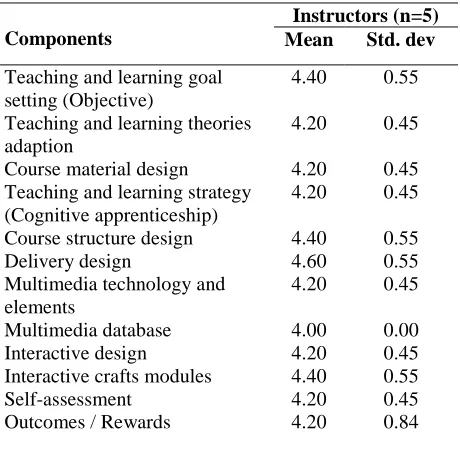
As shown in Table 2, the instructors gave positive perception towards the CDTC Model
components based on average mean scores for all components being above 4.00. All components were ranked from mean scores 4.00 to 4.60, which are included in the category of important and very important. The content delivery design component received the highest mean score with 4.60. This component takes into account the aspects of interface design and screen; and navigation system displayed in the presentation of courseware prototype.
Three components received a mean score of 4.4 (component of teaching and learning goal setting, course structure design and interactive crafts modules), meanwhile another seven components were rated at a mean score of 4.20 (components of teaching and learning theories adaption, course materials design, teaching and learning strategy, multimedia technology and elements, interactive design, self-assessment and outcomes / rewards).
[image:6.612.311.541.425.653.2]After the final validation process, it is confirmed that all components of the CDTC Model have been retained and they are obviously found important to the development of courseware for teaching and learning traditional craft.
TABLE 2: Analysis Of Final Validation Of CDTC Model Components
Components
Instructors (n=5)
Mean Std. dev
Teaching and learning goal setting (Objective)
4.40 0.55
Teaching and learning theories adaption
4.20 0.45
Course material design 4.20 0.45
Teaching and learning strategy (Cognitive apprenticeship)
4.20 0.45
Course structure design 4.40 0.55
Delivery design 4.60 0.55
Multimedia technology and elements
4.20 0.45
Multimedia database 4.00 0.00
Interactive design 4.20 0.45
Interactive crafts modules 4.40 0.55
Self-assessment 4.20 0.45
Outcomes / Rewards 4.20 0.84
5. CONCLUSION
courseware development for teaching and learning traditional crafts. The development phase focused on adapting a CDTC Model into multimedia application prototype development and pilot testing to obtain user feedback to further improve on the courseware. The effectiveness and usability of the courseware were conducted among students and instructors in the evaluation phase. The quasi experimental design has been deployed for the effectiveness evaluation and usability evaluation was evaluated based on usability constructs: memorability, learnability and ease of use, content delivery, feedback, interface and screen design, media integration and satisfaction. User satisfaction towards cognitive apprenticeship adaptation in web-based teaching and learning traditional craft was done among instructors and students. In order to finalize the components of the CDTC Model, a final validation was conducted among selected instructors. The results from final validation show that all components were ranked above an average mean score of 4.00 which ratify that CDTC Model contains important components for the development of courseware for teaching and learning traditional crafts. Therefore, it is confirmed that CDTC Model is able to become as a guide to other developers who wish to design similar traditional crafts courseware. Further works will focus on analyzing the effectiveness and usability of the courseware as well as cognitive apprenticeship adaptation in order to indicate the user acceptance towards the courseware.
REFERENCES:
[1] J. Gamble (2001). Modelling The Invisible: The Pedagogy of Craft Apprenticeship.
Studies in Continuing Education, 23, 2,
pp.185-200.
[2] S. Osman, N. A. M. Zin, N. Sahari@Ashaari, , Y. Omar, R. Z. Ramli, & N. Awang (2012). New Model for Teaching and Learning Traditional Craft Courseware: Analysis and
Design Phase. Journal of Theoretical and
Applied Information Technology, 40(1), 29-38.
[3] S. Osman, & N. A. M. Zin (2010, 15-17 June
2010). Proposed model for courseware
development of virtual teaching and learning
traditional craft. Paper presented at the 2010
International Symposium in Information Technology (ITSim)
[4] W. Dick, & L. Carey (1978). The Systematic
Design of Instruction. Glenview, IL.: Scott,
Foresman.
[5] H. A. Shukor, N. Johan, A. Ibrahim, A. Saari, N. Abdullah, A. A. Rahman, . . . Y. Yusof (2009).
Seni Kraf Tenunan: Motif & Teknik (Fisrt ed.):
Institut Kraf Negara
[6] S. M. Alessi, & S. R. Trollip (2001). Multimedia
for Learning: Methods and Development (3rd
ed.): Boston: Allyn and Bacon.
[7] B.L. Mann (2006). Conducting formative evaluations of online instructional material. In
Bruce L. Mann (Ed.). Selected styles in
web-based educational research. (pp. 232-242)
Hershey, PA: Idea Group Publishing.
[8] D. Pratt (2008). Planning and Conducting Pilot
Test. Retrieved from website:
http://www.nationalserviceresources.org/practic es/19498/ [viewed 5 Jun 2012]
[9] B. Shackel (1991). Usability - context, framework, design and evaluation, in: Shackel,
B. , Richardson, S. (Eds) Human factors for
Informatics Usability, Cambridge University
Press, Cambridge, 21-38.
[10] E. Folmer & J. Bosch (2004). Architecting for
usability: a survey. The Journal of Systems and
Software, 70, 61–78.
[11] J. Nielsen (1993). Usability Engineering.
Academic press, San Diego.
[12] T. Brinck, D. Gergle, & S. D. Wood (2002). Usability for the Web: Designing Web Sites that
Work (1 ed.): Morgan Kaufmann.
[13]L.D. Hollins (2008). The Development of An Instrument to Assess The Usability of
Courseware. Proquest Dissertation And Theses
2008. Northern Illinois University, 2008.
Publication Number: 3324334
[14]G. Perlman (2009). User Interface Usability
Evaluation with Web-Based Questionnaires.
ACM Online, Retrieved from website: http://oldwww.acm.org/perlman/question.html [viewed 20 March 2012].
[15] N. A. M. Zin (2009). A-maths multimedia courseware for effectiveness mathematics learning: Matching instruction to the student’s
learning style. Journal of Applied Science, 9(8).
[16] Y. Rogers, H. Sharp & J. Preece (2007). Interaction Design: Beyond Human-Computer
Interaction. (2ndEdition). John Wiley & Sons,
Ltd ISBN 978-0-470-01866-8
[17] J. Pallant (2001). SPSS Survival Manual Open
University Press.
[18] N. Walliman (2011). Research Methods: The
Basics: Routledge, Taylor & Francis
Figure 1: Prototype Development Phases
[image:8.612.137.480.489.719.2]Figure 6: The Mean Scores Of Usability Constructs For The Prototype In Pilot Testing
![Assessment of Physiological Health Status in Relations to Different Anthropometric and Cardio respiratory Measures of Head Supported Load Carrying Male Porters of Sikkim, India [Article Retracted]](data:image/gif;base64,R0lGODlhAQABAIAAAP///wAAACH5BAEAAAAALAAAAAABAAEAAAICRAEAOw==)