1-o J..' ,) '.' i (J (:!I'i\''''
no.
SR -uDJI!
If/h'"
a..
RESEARCI-I
J
INC.
CRAY X-MP ANDCRAY-1®
COMPUTER SYSTEMS
LIBRARY
··--1==1
.... __ • 1.-...
~~
TRECORD OF REVISION PUBLICATION NUMBER SR-0014
Each time thil manual is revised end reprinted, all chanE)es issued against the previous version in the form of change packets are
inc\?rporated into the n~w ,,:ersion and the new version IS assigned an alphabetic .Ievel: Between reprints, changes may be issued
against the current ver.lon In the form of change packets, Each change packet IS assigned 8 numeric designator starting with
01 for the first change packet of each revision level. '
Every page changed by a reprint or by a change packet has the revision level and change packet number in the lower righthand
corner. Changes to part of II pegellre noted by a change bar along the margin of the page. A change bar in the margin opposite
the page number indicates that the entire page is new; a dot in tha same place indicates that information has been moved tram one page to another, but has not otherwise changed.
Requests for copies of Crav Research, I nco publications and comments about these publications should be directed to: CRAY RESEARCt4,INC ••
1440 Northland Drive,
Mendota Heights, Minnesota 55120
Revision Description
April, 1977 - First edition.
A August, 1977 - Reprint with revision. This printing obsoletes the first edition.
B June, 1978 - Reprint with revision. The addition of Section
4, Performance Statistics comprises the major change to this manual.
C December, 1979 - This printing represents an expansion of the Mathematics Subroutines Reference Manual to include all CRAY-l
subprograms available to the user. TO reflect this expansion, the title of the manual has been changed to the CRAY-l Library Reference Manual. The subprograms listed and described in this manual reside in the $FTLIB, $SYSLIB, and $SCILIB
libraries. This printing obsoletes the previous title of the manual and all previous printings.
C-Ol
D
SR-0014
January, 1980 - Technical corrections to pages 4-17 and 4-18.
April, 1980 - This printing represents a reprint with
revision, bringing the manual into agreement with the released system, version 1.08. It obsoletes all previous printings. Major additions include unblocked I/O, directive processing, SKOL support, and library error processing. Replacing the text of the previous summary section is a subprogram list with subprograms grouped by UPDATE deck name within each library. An index section has also been added.
Because of the extensive reorganization and this manual, editing changes are not noted. are noted by change bars.
repagination of Technical Changes
The publication number has been changed from 2240014 to SR-0014.
D-Ol April, 1980 - This change packet clarifies the formula for the OPFILT routine and corrects the formulas and one parameter for the Fourier transform routines.
E October, 1980 - This reprint with revision brings the manual into agreement with version 1.09 of the released system.
E-Ol
F
Major features include open, close, and inquire routines; SMACH, which returns machine constants, and FOLR and SOLR, which solve first- and second-order linear occurrences. Other revisions include $PAUSE, a special-purpose routine that
eliminates the need to substitute $STOP: and an update to the performance statistics for single-precision, single-argument
routines. The index now includes all routines listed in the manual. All technical changes except changes to the index are noted by change bars.
All previous versions of this manual are obsolete.
June, 1981 - This change packet brings the manual into agreement with version 1.10 of the released system. Major features include FORTRAN 77 trigonometric, hyperbolic, and character routines; linear algebra routines, ISEARCH, ISAMIN,
FOLRN, SOLRN, and SOLRN3: logical record I/O and dataset
control routines, READIBM and WRITIBM; definition and control, SDACCESS: directive processing routine, CEXPRi job control routines, RERUN and NORERUN: and miscellaneous special purpose routines, ECHO, JNAME, LOGECHO, WFBUFFER.
June, 1982 - This rewrite brings the manual into agreement with version 1.11 of the released COS system and version 1.10 of CFT and $FTLIB. Sections 4 and 5 have been reorganized. Most of the routines in section 3 are now in table format and the calling sequence format has changed. Also, section 2 now contains a subprogram summary with page references. The major new features are tapes and ORDERS, an in-memory sort routine.
All previous versions of this manual are obsolete.
G July, 1983 - This reprint with revision brings the manual into agreement with version 1.12 of the COS system and version 1.11 of
eFT.
Major changes include the new calling sequence andthe split of $FTLIB. Also included are random access dataset I/O routines, dataset skip routines, search routines, and exchange package routines.
G-OI
Because of extensive repagination of this manual, editing changes are not noted. Technical changes are noted by change bars. All previous versions of this manual are obsolete.
H February, 1984 - This reprint with reVISIon brings the manual into agreement with version 1.13 of COS and eFT. Major
changes include the addition of the heap and stack routines, array search routines, and bidirectional memory transfer
routines 1 additions to the Linpack, Eispack, and random access routines; and the multitasking capability. Numerous minor changes have also been made. All previous versions of this manual are obsolete.
I December, 1984 - This reprint with revision brings the manual
into agreement with version 1.14 of COS and CFT. Major
additions include explicit data conversion routines, byte and bit manipulation routines, tape positioning and synchroni~ing
routines, new Pascal routines, and a number of miscellaneous special purpose routines. Reorganizational changes include moving routines MVC, PACK, UNPACK, and PUTBYT from the
miscellaneous special purpose SUbsection to the byte and bit manipulation subsection. Appendix B contains new statistics for single-precision, single-argument subprograms. Appendix
C, formerly containing processing times for the routine
ORDERS, now contains sort entry points. The tables containing processing times have been moved to the location of the
description of the routine ORDERS. Numerous minor changes have also been made. All previous versions of this manual are obsolete.
I
PREFACE
This publication describes the subprograms available to users of the CRAY-I and CRAY X-MP Computer Systems. It also contains subprograms that allow the translation of a subset of International Business Machines
(IBM) or Control Data Corporation (CDC) file types online to a Cray Computer System.
The user of this manual is assumed to be familiar with the Cray Operating System (COS), and either the Cray FORTRAN Compiler (CFT), or the Cray Assembly Language (CAL). The following Cray Research publications might be helpful:
CRAY-OS Version I Reference Manual, publication SR-OOII
Macros and Opdefs Reference Manual, publication SR-OOI2
FORTRAN (CFT) Reference Manual, publication SR-0009
CAL Assembler Version 1 Reference Manual, publication SR-OOOO
CRAY-oS Message Manual, publication SR-0039
SKOL Reference Manual, publication SR-D033
COS Table Descriptions Internal Reference Manual, publication SM-004St
Pascal Reference Manual, publication SR-0060
t This manual is available only on tape. See your CRI site analyst for
CONTENTS
PREFACE • • • • V
I. INTRODUCTION • 1-1
SUBPROGRAM CLASSIFICATION • • 1-1 CFT LINKAGE METHODS •
..
• • 1-2 CFT linkage macros • • • • • 1-2 CONVENTIONS..
..
• 1-32. SUBPROGRAM SUMMARY • •
..
2-1INTRODUCTION
..
..
• 2-1 TABLE DESCRIPTION • •..
•..
..
2-1 Primary reference name • • • 2-2 page number • •.. ..
..
..
2-2 UPDATE deck name • • 2-2 Entry type..
• 2-2 CFT call type •..
..
..
• • 2-3.-' Library • • • 2-3 OS dependency • • • • • • 2-3 Purpose
..
..
..
2-3 Pascal subprograms • • • 2-33. COMMON MATHEMATICAL SUBPROGRAMS • • • •
..
3-1INTRODUCTION
..
•..
• • 3-1 LOGARITHMIC ROUTINES • •..
3-54.
COMMON MATHEMATICAL SUBPROGRAMS (continued)
ASCII CONVERSION FUNCTIONS PSEUDO VECTORIZATION ROUTINES MISCELLANEOUS MATH ROUTINES • RANDOM NUMBER ROUTINES • • •
.
. .
. .
. .
.
.
. .
.
.
MATH TABLES • • • • • • • •.
.
SCIENTIFIC APPLICATIONS SUBPROGRAMS •
INTRODUCTION
. .
.
. .
.
. .
.
.
. .
.
BASIC LINEAR ALGEBRA SUBPROGRAMS
. .
. .
.
.
.
.
.
.
.
. .
~
. .
.
.
.
.
.
.
.
.
.
.
Index of element having maximum absolute value • • • • • • Sum of the absolute values • • • • • • • • • • • • • • Constant times a vector plus another vector
Copy one array into another • • • • • • • • • • • • Compute an inner product of two vectors • • • • • • • • • Euclidean norm of an array (12 norm) • • • • • • • • • Construct Givens plane rotation • • • • • • • • Apply Givens plane rotation • • • • • • • • • • • • • • • Construct modified Givens plane rotation • • • • • • Apply modified Givens plane rotation • • • • • • • Scale array • • • • • • • • • • • •
Swap two arrays • • • • • • • • •
• •
OTHER LINEAR ALGEBRA SUBPROGRAMS • • • • Sparse matrix primitives • • • • • • • • Index of element with maximum or minimum Index of element having minimum absolute Sum of the values • • • • • • • • • • •
. . .
value
value •
.
. . .
.
. . .
.
Compute complex Givens plane rotation. • • • • • • • • Construct complex Givens plane rotation. • • • • • • Cray machine constants • • • • • • • • • • • • • • • • FUNCTIONS AND LINEAR RECURRENCE SUBROUTINES • • • • • • • • SINGLE-PRECISION REAL AND COMPLEX LINPACK ROUTINES
SINGLE-PRECISION EISPACK ROUTINES • • • • •
.
.
.
MATRIX INVERSE AND MULTIPLICATION ROUTINESFAST FOURIER TRANSFORM ROUTINES • •
.
.
.
.
.
.
. . .
. .
.
. .
.
.
.
. .
.
FILTER SUBROUTINES. .
.
.
.
.
. .
.
.
.
.
.
GATHER, SCATTER ROUTINES
SEARCH ROUTINES • • •
.
. . .
.
. .
.
.
. .
.
.
.
.
Number or sum of values within or before an element
Searching for an object in a vector • • • • • • • • • Indexed array of all positions of an object in a vector SEARCH ORDERED ARRAY FOR TARGET • • • • • • • • • • • SORT ROUT INE • • • • • • • • • • • • • • • •
Method • • • • • • • • • Large radix sorting Multipass sorting •
.
.
. . .
.
.
SR-OOl4 viii
5. INPUT/OUTPUT SUBPROGRAMS • •
. .
.
.
.
.
. .
.
.
. .
. .
.
INTRODUCTION • • • • • • • • • • • • • • • • • • • • • • • FORTRAN I/O ROUTINES • • • • • • • • • • • Initialization routines • • • • • • • • • • • • • • • Input initialization routines • • • • • • • • • • Output initialization routines • • • • Transfer routines • • • • • • • • • • • • • • • • • • • •
Formatted and unformatted input transfer routines Buffered input transfer routines • • • • • • • • • • Namelist input transfer routines • • • • • • • • • • Formatted and unformatted output transfer routines Buffered output transfer routines
Name1ist output transfer routines • •
Final ization routines • • • • • • • • • • • • • • • • Input finalization routines • • • • • • • • • • Output finalization routines
TAPE TRANSLATION ROUTINES • • • •
Buffer management routines • • • • • • • • • Input buffer management routines • • •
Output buffer management routines • • • • •
.
. .
Record format management routines • • • • • • • • • Input record format management routines • • • • • • • Output record format management routines • • • • • • Data format management routines • • • • • • • • • • • Input data format management routines • • • • • • Output data management format routines • • • • • • • EXPLICIT DATA CONVERSION • • • • • • • • • • • • • • • • • • •
IBM single-precision to Cray single-precision routine • • IBM double-precision to Cray single-precision routine IBM integer to Cray integer routine • • • • • • • EBCDIC to ASCII routine • • • • • • • • • • • • • • • IBM packed decimal field to integer routine • • • • IBM logical to Cray logical routine • • • • • • • • • • • Cray single-precision to IBM single-precision routine
Cray single-precision to IBM double-precision routine • • Cray integer to IBM integer routine • • • • • • • • • • • ASCII to EBCDIC routine • • • • • • • • • • • • • • • Integer to IBM packed decimal field routine • • • • • Cray logical to IBM logical routine • • • • • • • • • Unpack 60-bit words routine • • • • • • • • • • • • • • • Pack 60-bit words routine • • • • • • • • Pack 32-bit words routine • • • • • • • • • • • • • • Unpack 32-bit words routine • • • • • • • • • • • • CDC integer to Cray integer routine • • • • • • • CDC single-precision to Cray single-precision routine CDC display code character to ASCII character routine Cray integer to CDC integer routine • • • • • • • • • • • Cray single-precision to CDC single-precision routine • • ASCII character to CDC display code character routine • • DATASET CONTROL ROUTINES • • • • • • • • • • • • • • • • • • •
6.
DATASET CONTROL ROUTINES (continued)
Close dataset routine
·
.
Inquire routine • • • •. . .
.
Dataset copying routines • • • • • • • •Copy records • • • • • • • • • • • • • • • Copy files • • • • • • • • •
Copy dataset • • • • • •
Copy sectors (unblocked) • • • •
.
.
.
Dataset skip routines • • •. .
Skip records • • • • • •
Skip files • • • • • • • • •
·
.
.
·
.
Skip dataset • • • • • • • • • •
·
. .
.
.
Skip sectors (unblocked) • • •. .
.
. .
.
Dataset positioning routines • •Get position of mass storage dataset • • • • • •
·
.
Set position of dataset • • •Backspace one record • • • • • • • • • • Backspace one file • • • • • • • • •
Rewind dataset • • • • • • • • • • •
· .
·
.
Position dataset
Synchronize tape dataset Dataset termination routines •
r/o
status routines • • • • • Auxiliary NAMELIST routines.
.
.
.
.
.
.
.
. .
. .
.
LOGICAL RECORD I/O ROUTINES • •
.
.
. .
. . .
.
. .
.
.
.
Read routines • • • • Read words
Read characters • • •
.
.
.
.
.
.
.
.
· .
.
.
.
Read IBM words
· .
.
.
. . . .
..
Read unblocked data •. .
.
. . .
.
.
. .
. .
.
.
.
·
.
write routines • • • • • Write words • • • write characters write IBM words • • write unblocked data
·
.
..
. .
·
. . .
.
.
.
.
.
.
.
• •
·
. .
CAL I/O interface routine
. . .
.
.
.
.
.
Bad data error recovery routines •
Character routines • • • • • •
·
.
..
.
.
· .
.
NUMERIC CONVERSION ROUTINES • • • • • •· . . .
.
.
· . .
.
RANDOM ACCESS DATASET I/O ROUTINES • • • • • • • •
Record-addressable, random access dataset I/O routines Word-addressable, random access dataset I/O routines •
WORD-ADDRESSABLE I/O AND DATASET CONTROL ROUTINES • • • • •
DATASET MANAGEMENT SUBPROGRAMS
..
.
.
. .
.
.
. .
.
. .
. . .
..
INTRODUCTION.
. . .
. . .
.
.
.
. .
. .
. . .
. .
.
.
.
CONTROL STATEMENT TYPE SUBPROGRAMS
Permanent dataset management (PDM) routines • • • Dataset staging routines • • • • • • • • • • •
·
.
Definition and control routines • • • • • •·
.
.
SR-0014 x
7.
DATASET SEARCH TYPE SUBPROGRAMS • DATASET INPUT/OUTPUT SUBPROGRAMS
TABLES • • • • • • • • • • • • •
. .
.
.
.
.
· .
.
·
.
.
·
. .
SPECIAL PURPOSE SUBPROGRAMS •
. . .
. . .
.
. . . .
.
. .
INTRODUCTION
.
.
. . . .
.
.
. .
.
. .
· .
.
DEBUG AID ROUTINES. .
. .
••
· .
.
Flow trace routines
·
..
. .
.
.
·
.
.
.
Traceback routines • • • • •.
.
Dump routines • • • • • • • •
Exchange Package processing routines • Array bounds checking routines
TABLE MANAGEMENT ROUTINES •
TM common block • • •
STACK MANAGEMENT ROUTINES • HEAP MANAGER ROUTINES • • • •
.
.
.
·
. .
.
. .
..
..
.
.
·
. ·
.
.
.
.
• •·
.
• •· . .
· .
·
.
.
.
. · .
Allocate routines
.
..
..
.
.
.,· .
.
.
.
.
Deallocate routines
Set new length routines
· .
·
..
.
.
.
.
·
.
. .
Change length and move routines
. .
.
• • •·
.
Heap block length routines • • • • • • • •Heap shrink routines • • • • • • • • • • •
·
..
..
..
.
.
JOB
Heap integrity check routines • • • • • • • • • Heap statistics routines • • •
Dump heap control word routines •
•
Heap expansion routine • • • • • • • •..
.
..
.
Heap memory request routine • • •Heap merge routine • • • • • •
· . .
..
• •CONTROL ROUTINES • • • • • • •
·
. .
FLOATING-POINT INTERRUPT ROUTINES • • • •Floating-point interrupt test • • • • •
· .
. .
.
·
. .
· . .
·
. .
·
. .
.
.
· .
..
..
Temporary floating-point interrupt control • •Job floating-point interrupt control • • •
·
.
.
..
..
..
BIDIRECTIONAL MEMORY TRANSFER ROUTINES • • • • •
Bidirectional memory transfer test • • • • • • • Temporary bidirectional memory transfer control Permanent bidirectional memory transfer control
TIME AND DATE ROUTINES • • • • • • • • • • • • TIMESTAMP ROUTINES • • • • • • • •
CONTROL STATEMENT PROCESSING ROUTINES • • •
·
. .
Control statement cracking routines • • • • • •
·
. .
.
.
.
• •·
..
. . .
·
..
..
.
.
·
. .
..
.
· .
.
.
.
.
Cracked parameter list • • • Get parameter routine ••
Directive cracking routine • •
·
.
.
Process parameter list routine • • • • • • • •..
.
..
..
Crack expression routine • • • • • • • • • • • •.
. .
SKOL RUN-TIME SUPPORT ROUTINES • •
• • •
• •8.
Character-string manipulation routines Character-code translation routines Error-handling routine .. .. •
..
ERROR-PROCESSING ROUTINES .. • .. BYTE AND BIT MANIPULATION ROUTINES
Move bytes routine Move bits
Move characters routine Replace byte routine compare bytes function Search bytes routine ASCII to integer routine
Integer to ASCII routines
..
..
.
..
.. ..
..
Pack, unpack
MISCELLANEOUS SPECIAL PURPOSE ROUTINES
PASCAL SUBPROGRAMS
..
INTRODUCTION P$$$HPAD P$ABORT P$BREAK P$CALLR P$CBV P$CONNEC P$DATE P$DBP P$DEBUG P$DISP P$DIVMOD P$ENDP P$EOF..
P$EOLN P$GET .. P$HALT P$JTlME P$LOGMSG P$LSTREW P$MEMRY P$MOD P$NEW P$OSDBS P$OSDDT P$OSDEP .. P$OSDJT P$OSDLM P$OSDPR P$OSDQI P$OSDRC P$OSDRP..
..
..
..
..
..
..
..
..
..
..
..
..
..
..
..
..
..
..
..
..
..
..
..
..
.. ..
..
..
..
.. ..
.. ..
..
.. ..
.. ..
..
.. .. .. .. ..
..
..
..
..
..
..
..
..
.. .. ..
..
..
..
.. .. ..
..
..
..
.. ..
..
..
..
..
..
..
..
..
..
.. ..
.. .. ..
..
..
..
.. ..
..
..
..
..
..
..
..
.. .. ..
..
..
..
SR-0014 xii
8. PASCAL SUBPROGRAMS (continued)
9.
P$OSDRW P$OSDTM • P$OSDWC P$OSDWF P$OSDWR •
P$OSDXP •
P$PAGE
P$PUT p$RB
P$RCH • •
P$READ p$READLN P$REPRV • P$RESET P$REWRIT P$RF P$RI P$ROUND P$RSTR P$RTlME • P$RTMSG
P$RUNTIM P$SFRAME
P$TlME
P$TIMER ..
P$T.RACE • P$TRUNC
P$WB P$NCH • P$WEOF P$NI • •
..
• •..
P$WOP$WRFIX •
P$WRFLT .. P$WRITE P$NRITLN P$WSTR • • • • • • • • • • • • • • • • • • • • • • •
..
. .
. .
....
.
.
.
• • • • • • • •...
.
• •. .
..
.
.
..
.
.
...
• •·
.
..
.
·
...
.
• • • • • • • • • • • • • • • • • • • • • • • • • • • • • • • • • • • • • • • • • • • • • • • • • •..
..
.
• • • • • • • • • • • • • • • • • • • • • • • • • • • • •·
...
• • • • • • • • • • • • • • • • • • • • • • • • • • •MULTITASKING SUBPROGRAMS •
TARS ROUTINES •
..
TASK CONTROL ARRAYLOCK ROUTINES .. ..
..
..
EVENT ROU'l'INES
UTILITY SUBPROGRAMS
APPENDIX SECTION
A. ALGORITHMS
.
.. ..
..
..
..
..
..
•ACOS AND ACOSV ALOG AND ALOGV ATAN AND ATANV ATAN2 AND ATAN2V CABS AND CABSV CCOS AND CCOSV CEXP AND CEXPV CLOG AND CLOGV
• • • • • •
.. ..
•..
..
•..
..
..
..
..
..
•.. ..
..
..
.. ..
.. .. .. ..
•..
• • •.. ..
..
COS AND COSV; COSS AND COSSV • COSH AND COSHV
CO'I' AND COTV CSIN AND CSINV
..
•
..
CSQRT AND CSQRTV
CTOCSS, CTOCSV, CTOCVS,
C'l'OISS, CTOISV, CTOIVS, CTORSS, CTORSV, CTORVS, DACOS AND DACOSV
DASIN AND DASINV
DATAN AND DATANV DCOS AND DCOSV DCOSH AND DCOSHV DCOT AND DCOTV DEXP AND DEXPV
DLOG AND DLOGV
OMOD AND DMODV DSINH AND DSINHV DSQRT AND DSQRTV
DTAN AND DTANV
• •
..
• •..
..
..
..
..
..
..
•..
..
..
..
..
..
•.. ..
•..
•..
• •·
..
AND CTOCW
AND CTOIW
AND CTORW
• • • •
..
..
• • • • •.. ..
• • • • •..
.
..
.. .. ..
• • • • • • • • • • ••
• • • •..
..
..
DTANH AND DTANHV • • • • • • • • DTODSS, DTODSV,
DTOISS, DTOISV, EXP AND EXPV ITOISS
ITOIVS, RANF
RANFV •
RANGET
lTOIW
DTODVS, AND DTODW DTOIVS, AND D'l'OIW
..
..
..
..
.. ..
..
..
..
..
•..
..
..
..
..
• •..
..
•..
..
• •RANSET •• • •
.. ..
..
..
..
•..
..
•RTOISS, R'l'OIVS, AND RTOIW RTORSS RTORVS RTORVV
..
..
..
..
.. ..
SQRT AND SQRTV
B. PERFORMANCE STATISTICS
· . . .
. . .
.
. . .
. .
. . . .
.
COMMON MATHMATlCAL SUBPROGRAMS
SCIENTIFIC APPLICATIONS SUBPROGRAMS •
· .
· .
. . . .
.
. . .
.
. .
.
.
. .
.
C. SORT ENTRY pOINTS •
· . .
.
.
. . .
.
. .
. .
.
. .
FIGURES
5-1 Group name
. ·
• •· · ·
• •·
• • • • • • • • • •·
5-2 Variable entry • • • • • • • • •·
• •·
• •·
• • • • • •·
·
5-3 Array entry • • • • • • • • • • •· ·
•· ·
•·
5-4 Logical read· ·
·
• •· ·
•·
• • •· · · ·
·
5-5 Logical write·
· · · ·
·
• • • • • •·
• 7-1 Exchange Package printout •·
• • •· ·
•·
• • •·
• 7-2 Parameter Control Table·
·
· ·
• •· ·
7-3 Parameter control entry • •
·
•· · ·
•·
• • • • • • • • 7-4 Message Control Table·
• • •·
• • • • • • • •· · ·
TABLES
2-1 Subprogram summary • • • • • • • • •
2-2 Pascal subprogram summary • • • • • • • • • • • 3-1 Logarithmic routines • • • • • • • • • • • • • • • •• 3-2 Exponential routines • • • • • • • • • • • • • • • • • • 3-3 Square root routines • • • • • • • • • • • • • • • 3-4 Trigonometric routines • • • • • • • • • • • • • • • • • • 3-5 Hyperbolic routines • • • • • • • • • • • • • • • • • • • • • • 3-6 Boolean arithmetic routines • • • • • • • • • • • • • • • • 3-7 Values raised to a power • • • • • • • • • • • • • • • • • • • 3-8 Double-precision arithmetic routines • • • • • • • • • • • • • 3-9 Triple-precision arithmetic routines • • • • • • • • • • 3-10 64-bit integer division • • •• • • • • • • • • • • • • • • • 3-11 Character comparison functions called from FORTRAN • • • • • •
3-12 Character comparison functions called from CAL •• • • • • • 3-13 ASCII conversion • • • • • • • • • • • • • • • 3-14 Miscellaneous math routines • • •
3-15 4-1 4-2 4-3 4-4 4-5 4-6 4-7 4-8 4-9 5-1
Random number routines • • Basic linear algebra subprograms (BLAS) Other linear algebra subprograms
Single-precision LINPACK routines • • • Single-precision EISPACK routines • • • Arguments for Fourier transform routines
ISRCH routines • • • • • • • • • WHEN routines • • • • • •
Sort times in seconds Sort times in seconds FORTRAN I/O routines
for ORDERS • • • with ASCII key
TABLES (continued) 5-2 5-3 5-4 5-5 5-6 5-7 5-8 5-9 5-10
7-1
B-1 B-2 B-3 INDEXOPEN specifiers and their meanings
CLOSE specifiers and their meanings • INQUIRE specifiers and their meanings Conversion mode descriptions • • • • Conversion return conditions • • • •
.
.
.
.
.
.
.
.
.
·
.
.
. .
.
· .
. . .
. .
.
. .
.
·
. .
.
. . .
.
·
.
• • •Error codes for record-addressable, random access dataset
I/O routines • • • • • • • • • • • • • • • • • • • • • CLOSMS statistics • • • • • • • • • • • • • • • • • • • • • • • WOPEN statistics • • • • • • • • • • • • • • • • • • • • • • • Error codes for word-addressable, random access dataset
I/O routines • • • • • • • • • • • • • • • • • • • • • • • • • Performance counter group descriptions • • • • • • • • • Statistics for single-precision, single-argument subprograms • $SCILIB timings and comparisons • • • • • • • • • • • • $SCILIB timings and MFLOP rates • • • • • • • • • • • • • • • •
SR-0014 xvi
INTRODUCTION
This manual describes the subprograms provided in the standard libraries, $ARLIB, $FTLIB, $IOLIB, $SCILIB, $SYSLIB, and $UTLIB. Routines generated by CFT in the form of inline code are not included in this manual but are described in the FORTRAN (eFT) Reference Manual, CRI publication SR-0009.
Section 2 provides a subprogram summary grouped alphabetically by primary reference name within each library. Sections 3 through 7 provide
detailed descriptions and calling sequences of the subprograms listed in section 2. Sections 3 through 6 cover specific subprogram applications and common mathematics, scientific mathematics, input/output, and dataset management. Section 7 is a collection of special purpose subprograms, grouped by application. These applications are debugging aids, job control, floating-point interrupt control, time and date requests, and control statement processing. The last subsection in section 7 consists of routines whose applications do not lend themselves to any particular grouping and are therefore listed separately. Section 8 presents
procedures and functions that reside in the Pascal runtime library, $PSCLIB. Section 9 describes multitasking subprograms.
SUBPROGRAM CLASSIFICATION
The subprograms described in this manual are either subroutines, scalar functions, or vector functions. Some subprograms can be used as either subroutines or scalar functions. Scalar functions produce a single result while vector functions produce a vector of results. Some vector functions (called
pseudo veatop funation8)
call the correspondingscalar functions. Such a scalar function call can occur when the vector function performs infrequently used calculations or when the calculation is not suited to vectorization.
In general, arguments to vector call-by-value functions are passed in V
registers~ scalar arguments are broadcast if necessary. However, some
routines implicitly called by eFT, such as exponentiation, have mixed scalar and vector arguments.
eFT LINKAGE METHODS
The CFT-callable library routines are accessed by one of two methods: call-by-address or call-by-value. Subroutines are always accessed by the call-by-address method. Library functions intrinsic to CFT, or user functions named in a VFUNCTION directive, are accessed by CPT in either
call-by-address or call-by-value mode, depending on context.
In call-by-value mode, arguments are loaded into either S or V registers, and the function returns its result in S1 or vI (52 or V2 are also used for complex or double-precision functions). vector functions must also have the vector length present in the VL register.
In call-by-address mode, addresses of arguments are stored sequentially in memory. Under the CFT 1.10 version of the calling sequence, the address of the first argument is stored at entry 1, the second at entry
2, etc. Under the CFT 1.11 version, the list of addresses is stored in a block of memory allocated for that purpose. Functions return their
results in registers. Subroutines return results through their argument lists. (For information on the new calling sequence, see the Macros and Opdefs Reference Manual, CRI publication SR-0012.)
By convention a call-by-value has a % suffix (for example, SIN%), and a vector call-by-value has a % prefix and suffix as shown below.
Type Call by call by Address Value
Scalar RTE RTE%
Vector %RTE %RTE%
Routines that are accessible from CAL programs only also can be prefixed with a $.
CFT LINKAGE MACROS
CFT linkage macros generate code to handle subprogram linkage between CFT-compiled routines and CAL-assembled routines. These linkage macros and their uses follow.
CALL Provides linkage to call-by-address routines
CALLV Provides linkage to call-by-value routines
ENTER Reserves space for parameter addresses, saves Band T registers, and sets up traceback linkage
EXIT Initiates a return from a routine to its caller; restores any B or T registers not considered scratch by CFT.
eFT linkage macros should be used whenever possible to maintain compatibility across versions of CFT. See the Macros and Opdefs
Reference Manual, CRI publication SR-0012, for detailed descriptions of CFT linkage macros and linkage conventions.
All $ARLIB, $FTLIB, $IOLIB, $SCILIB, $UTLIB, and $SYSLIB subroutines can use any of the A, S, V, VL, and VM registers as scratch registers~
therefore, the calling routine should not depend on any of these
registers being preserved. However, these routines preserve the contents of registers BOI through B658 and TOO through T67S. Registers B708
through B778 and T70 8 through T77a also can be used as scratch registers.
NOTE
Cray Research, Inc., reserves the right to make future use of any of the A, S, V, VL, VM, B66-B77, and T70-T77 registers in any library subroutine. Users cannot depend on the contents of these registers being preserved by any library routine.
CONVENTIONS
The following conventions are used in this manual.
Convention
Italics
[] Brackets
(51), (52), etc.
Description
Define generic terms representing words or symbols to be supplied by the user and identify new terms
Enclose optional portions of a command format
Content of register Sl, 52, etc., respectively
SUBPROGRAM SUMMARY
INTRODUCTION
This section summarizes the subprograms in this manual. These
subprograms are callable from CAL or Cray FORTRAN programs and reside in the $ARLIB, $FTLIB, $IOLIS, $UTLIB, $SYSLIB, and $SCILIB libraries.
$ARLIB contains routines primarily concerned with returning some numeric result. Mathematical routines intrinsic to FORTRAN such as SIN reside here.
$FTLIB contains CFT-specific routines such as ICBAR, LEN, and DOC.
SIOLIB contains routines that move data from external devices to main memory or control that movement.
$UTLIB contains routines more infrequently used and of a utilitarian nature.
$SCILIB routines perform operations such as matrix multiply or Fast Fourier transform and must be explicitly called. Such processes are not intrinsic properties of the Cray FORTRAN language and are independent of specific Cray Operating System (COS) features.
2
$SYSLIB routines usually link directly to the operating system through a normal exit. These routines are not usually accessible from a Cray
FORTRAN program, but are called by $IOLIB and $UTLIB routines for
specific tasks. In general, $SYSLIB serves as a link between the general purpose $IOLIB and $UTLIB routines and the details of COS. $SYSLIB
routines depend on specific COS features.
Subprograms implicitly called by a CFT routine (for example, routines used for exponentiation or I/O) have a $ or % character in their names. They are not directly callable by a Cray FORTRAN program.
TABLE DESCRIPTION
•
Primary reference name•
Page number•
UPDATE deck name•
Entry type•
CFT call type•
Library•
OS dependency • PurposePRIMARY REFERENCE NAME
Primary reference name is a general group name identifying a subprogram and is generally similar to the subprogram name. For example, BACKSP is
the primary reference name for the backspace subprograms BACK, $BACK, BKFlLE, BKSP, $BKSP, and BKSPF. The subprograms are alphabetized by primary reference name.
PAGE NUMBER
The page numbers of subprogram locations are listed under each primary reference name and reference detailed descriptions of the subprogram.
UPDATE DECK NAME
UPDATE deck name is the listed name of the subprogram in the UPDATE program library.
ENTRY TYPE
Entry type indicates the source of the subprogram call, either CFT or CAL. Entries callable from eFT are further divided into (1)
call-by-address and (2) call-by-value. See the description of these linkage methods in the introduction to this manual.
CFT CALL TYPE
CFT call type indicates three classifications for CFT callable subprograms:
S Subroutine
SF Scalar function
VF Vector function
See the introduction to this manual for a description of these classifications.
LIBRARY
The library column indicates the library residence of the subprogram.
OS DEPENDENC~
Each subprogram is labeled either OS dependent (Dep.) or OS independent (Ind.). This classification is a guideline for use of the routine under operating systems other than the current version of COS. Independent routines can be executed under other operating systems with minor changes such as macro redefinition or substitution of external routines.
Dependent routines rely heavily on COS features.
PURPOSE
The purpose is a 1- or 2-1ine description of the subprogram.
PASCAL SUBPROGRAMS
Table 2-1. Subprogram summary
Entry Type
Primary UPDATE CF'r Standard CFT
Reference Deck call
From
CallLibrary
OS PurposeName Name Address Value CAL Only 'l'YPe Dep
ABORT
ABORT ABORT S $UTLIB Ind. Aborts job with traceback
ABS
REAL ABS SF $ARLIB Ind. Computes absolute value
ACCESS
ACS ACCESS S $SYSLIB Dep. Accesses a permanent dataset
ACOS
ACOS ACOS ACOS%: SF $ARLIB Ind. Computes arccosine ACOSV %ACOS%: %ACOS VF $ARLIB
Ind.
Computes vectorizedarccosine
ACPTBAD
RCVRBAD ACPTBAD S $SYSLIB Dep. Transfers bad data to a specified buffer for the caller
Table 2-1. Subprogram summary (continued)
Entry Type
Primary UPDATE CFT Standard CFT
Reference
Deck
call From call Library OS PurposeName
Name Address Value CAL Only Type DepACQUIRE
AQR ACQUIRE S $SYSLIB Dep. Accesses a permanent
dataset or acquires a
front-end resident dataset and stages it to the Cray mainframe
ACTTABLB
AC'l"I'ABLE AC'l"I'ABLE S $SYSLIB Dep. Returns job accounting table
ADJUST
ADJ ADJUST S $SYSLIB Dep. Expands or contracts a
permanent dataset
AlMAG
COMPLX AIMAG SF $ARLIB Ind. Returns imaginary part of a complex number
AINT
Table 2-1. Subprogram summary (continued)
Entry Type
Primary UPDATE CPT Standard eFT
Reference Deck Call From Call Library OS Purpose
Name Name Address Value CAL Only Type Dep
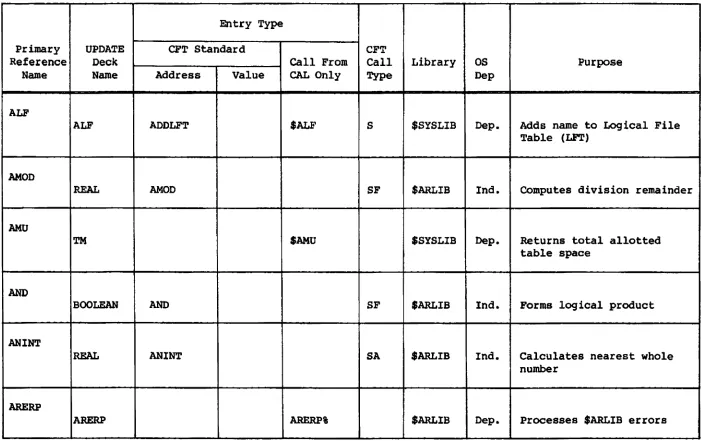
ALP
ALF ADDLFT $ALF S $SYSLIB Dep. Adds name to Logical File Table (LFT)
AMOD
REAL AMOD SF $ARLIB Ind. Computes division remainder
AMU
TM $AMU $SYSLIB Dep. Returns total allotted
table space
AND
BOOLEAN AND SF $ARLIB Ind. Forms logical product
ANINT
REAL ANINT SA $ARLIB Ind. Calculates nearest whole
number
ARERP
ARERP ARERP% $ARLIB Dep. Processes $ARLIB errors
SR-OOl4 2-6 I
[image:26.845.69.770.55.496.2]Table 2-1. Subprogram summary (continued)
Entry Type
Primary UPDATE CFT Standard CFT
Reference Deck Call From Call Library OS Purpose Name Name Address Value CAL Only Type Dep
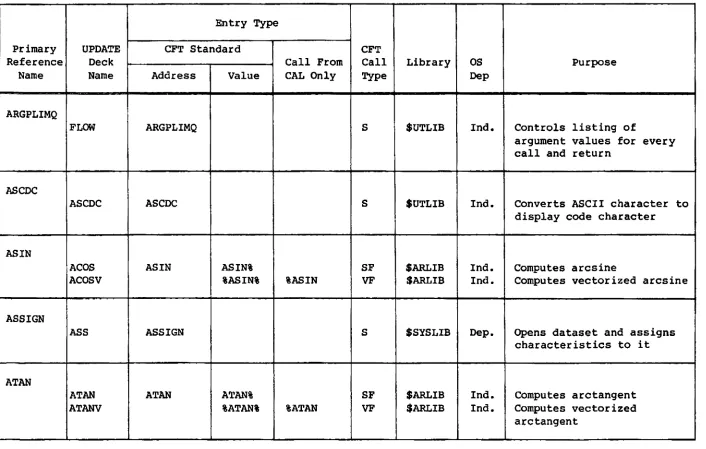
ARGPLIMQ
FLOW ARGPLIMQ S $UTLIB Ind. Controls listing of
argument values for every call and return
I
AS CDCASCDC ASCDC S $UTLIB Ind. Converts ASCII character to display code character
AS IN
ACOS ASIN ASIN% SF $ARLIB Ind. Computes arcsine
ACOSV %ASIN% %ASIN VF SARLIB Ind. Computes vectorized arcsine
ASSIGN
ASS ASSIGN S $SYSLIB Dep. Opens dataset and assigns characteristics to it
ATAN
ATAN ATAN ATAN% SF $ARLIB Ind. Computes arctangent ATANV %ATAN% %ATAN VF $ARLIB Ind. Computes vectorized
[image:27.846.73.779.50.499.2]Table 2-1. Subprogram summary (continued)
Entry Type
Primary UPDATE CFT Standard CFT
Reference Deck Call From Call Library OS Purpose Name Name Address Value CAL Only Type Dep
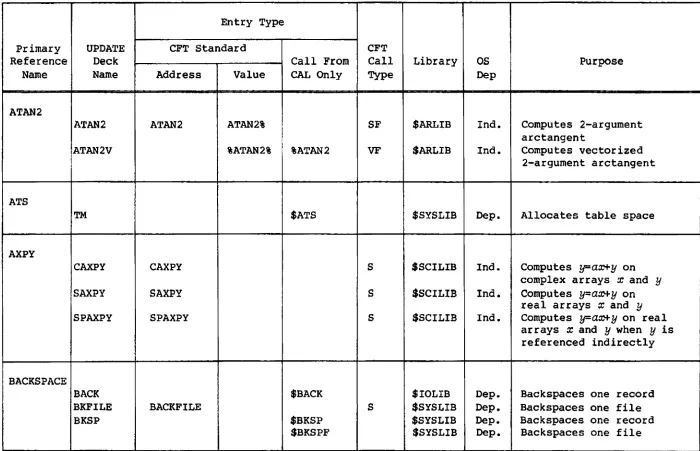
ATAN2
ATAN2 ATAN2 ATAN2% SF $ARLIB Ind. computes 2-argument arctangent
ATAN2V %ATAN2% %ATAN2 VF $ARLIB Ind. Computes vectorized 2-argument arctangent
ATS
TM $ATS $SYSLIB Dep. Allocates table space
AXPY
CAXPY CAXPY S $SCILIB Ind. Computes
y=ax+y
on complex arraysx
andy
SAXPY SAXPY S $SCILIB Ind. Computes y~aX*y on real arrays
x
andy
SPAXPY SPAXPY S $SCILIB Ind. Computes
y=ax+y
on real arraysx
andy
wheny
is referenced indirectlyBACRSPACE
BACK $BACK $1OLIB Dep. Backspaces one record BKFILE BACRFILE S $SYSLIB Dep. Backspaces one file BKSP $BKSP $SYSLIB Dep. Backspaces one record
$BKSPF $SYSLIB Dep. Backspaces one file
[image:28.845.69.769.58.509.2]Table 2-1. Subprogram summary (continued)
Entry Type
Primary UPDATE CFT Standard CFT
Reference Deck Call From Call Library
as
Purpose Name Name Address Value CAL Only Type nepI
BICONBICONV BICONV S $UTLIB Ind. Converts integer to ASCII aICONZ BICONZ S $UTLIB Ind. character
BTD
BTD BTD BTD% $BTD SF $UTLIB Ind. Converts binary number to ASCII decimal
BTD BID% SF $UTLIB Ind. Converts binary to decimal ASCII right justified, blank filled.
BTDR BTDR% SF $UTLIB Ind. Converts binary to decimal ASCII right justified, zero
filled.
BTDL BTDL% SF $UTLIB Ind. Converts binary to decimal ASCII left justified, zero filled.
BTO
BTC BTO BTO% $BTO SF $UTLIB Ind. Converts binary number to
ASCII octal
Table 2-1. Subprogram summary (continued)
Entry Type
primary UPDATE CFT Standard CFT
Reference Deck Call From Call Library
OS
PurposeName Name Address Value CAL Only Type Dep
BTO
continued BTOR BTCR% SF $UTLIB Ind. Converts binary to octal ASCII right justified, zero filled.
BTOL BTOL% SF $UTLIB Ind. Converts binary to octal ASCII left justified, zero filled.
CABS
CABS CABS CABS, SF $ARLIB Ind. Calculates complex absolute value
CABSV 'CABS% 'CABS VF $ARLIB Ind. Calculates vectorized complex absolute value
CCOS
CCOS CCOS CCOS% SF $ARLIB Ind. Computes complex cosine CCOSV %CCOS% %ceos VF $ARLIB Ind. COmputes vectorize~ complex
cosine
Table 2-1. Subprogram summary (continued)
Entry Type
Primary UPDATE CFT Standard CFT
Reference Deck Call From Call Library OS Purpose Name Name Address Value CAL Only Type Dep
CDC
CDCr $CDCI $IOLIB Dep. Translates CDC formatted input data
COCO $CDCO $IOLIB Dep. Translates CDC formatted output data
CEXPR
CEF CEXPR S $SYSLIB Ind. Transforms an expression character string to a Reverse Polish Table
CHAR
CARCON $MOVE $FTLIB Ind. Transfers one character item to result
$PAD $FTLIB Ind. Terminates transfer
OCARCON SCCI SFTLIB Ind. Initializes concatenation for store
$CCT $FTLIB Ind. Transfers one character item to result
$CCF $FTLIB Ind. Terminates transfer CHARCPR LGE $GE SF $FTLIB Ind. Compares ASCII arguments
for greater than or equal to LGT $GT SF $FTLIB Ind. Compares ASCII arguments
Table 2-1. Subprogram summary (continued)
Entry Type
Primary UPDATE CFT Standard CFT
Reference Deck Call From Call Library
OS
PurposeName Name Address Value CAL Only Type Dep
CHAR
continued LLT $LT SF $FTLIB Ind. Compares ASCII arguments
for less than
LLE $LE SF $FTLIB Ind. Compares ASCII arguments for less than or equal to
I
$EQ $FTLIB Ind. Compares ASCII argumentsfor equality
$NE $FTLIB Ind. Compares ASCII arguments for nonequality
INDEX INDEX SF $FTLIB Ind. Finds position of second
argument as substring of first argument
LEN LEN SF $FTLIB Ind. Finds length of argument
CHCONV
CHCONV CHCONV S $UTLIB Ind. Converts ASCII character to integer
I
CLEARBT
BTMODE CLEARBT S $UTLIB Dep. Temporarily disables
bidirectional memory transfers
Table 2-1. Subprogram summary (continued)
Entry Type
Primary UPDATE CFT Standard CFT
Reference Deck Call From Call Library OS Purpose
Name Name Address Value CAL Only Type Dep
CLEARBTS
BTMODE CLEARBTS S SUTLIB Dep. permanently disables
bidirectional memory transfers
CLEARFI
FIMODE CLEARFI S $UTLIB Dep. Temporarily prohibits
floating-point interrupts
CLEARFIS
FIMODE CLEARFIS S $UTLIB Dep. Permanently prohibits floating-point interrupts
CLOCK
CLOCK CLOCK S/SF SUTLIB Dep. Supplies current system clock in
hh:mm:88
formatCLOSE
CLOSE CLOSE SCLS SA 'IOLIB Dep. Terminates the connection of a dataset to a unit SYMDBC CLOSE S $SYSLIB Dep. Closes a random, unblocked
Table 2-1. Subprogram summary (continued)
Entry Type
Primary UPDATE CFT standard CFT
Reference Deck Call From Call Library OS Purpose
Name Name Address Value CAL Only Type Dep
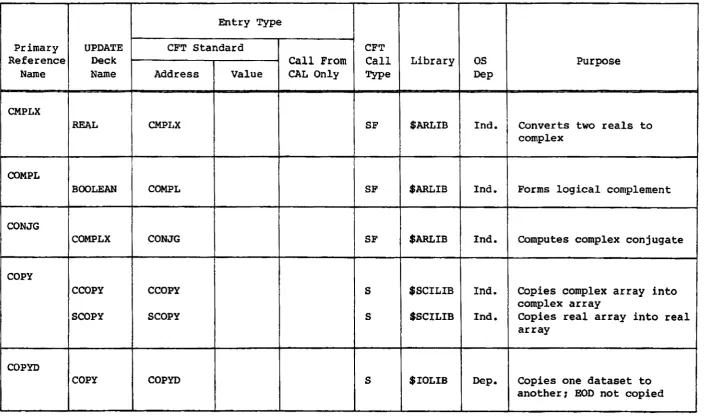
CMPLX
REAL CMPLX SF $ARLIB Ind. Converts two reals to
complex
COMPL
BOOLEAN COMPL SF $ARLIB Ind. Forms logical complement
CONJG
COMPLX CONJG SF $ARLIB Ind. Computes complex conjugate
COpy
CCOpy CCOpy 5 $SCILIB Ind. Copies complex array into
complex array
SCOpy SCOpy S $SCILIB Ind. Copies real array into real array
COPYD
COpy COPYD S $ IOLIB Dep. Copies one dataset to
another: EOD not copied
[image:34.848.75.784.58.476.2]Table 2-1. Subpro9ram summary (continued)
Entry Type
Primary UPDATE CFT Standard CFT
Reference Deck Call From Call Library OS Purpose Name Name Address Value CAL Only Type Dep
COPYF
I
COpy COPYF S $IOLIB Dep. dataset to another; EOD not Copies files from one writtenCOPYR
COpy COPYR S $IOLIB Dep. Copies records from one dataset to another~ EOF not written
I
COPYU
COPYU COPYU S $IOLIB Dep. Copies data to EOD in unblocked format
I
COS
COS COS COS% SF $ARLIB Ind. Computes cosine
COS V %COS% ¥I COS VF $ARLIB Ind. Computes vectorized cosine
COSH
COSH COSH COSH% SF $ARLIB Ind. Computes hyperbolic cosine COSHV %COSH% %COSH VF $ARLIB Ind. Computes vectorized
Table 2-1. Subprogram summary (continued)
Entry Type
Primary UPDATE CFT Standard CFT
Reference Deck Call
From
CallLibrary
OS Purpose Name Name Address Value CAL Only Type DepCOSS
COSS
cess
COSS% SF $ARLIB Ind. Computes cosine and sine COSSV %COSS VF $ARLIB Ind. Computes vectorized cosineand sine %cesS% VF $ARLIB Ind. Same as %CooS
COSSH
COSH COSSH COSSH% SF $ARLIB Ind. Computes hyperbolic cosine and sine
COSHV %CooSH VF $ARLIB Ind. Computes vectorized
hyperbolic cosine and sine COSHV %COSSH% VF $ARLIB Ind. Same as %COSSH
COT
COT COT COT% SF $ARLIB Ind. Computes cotangent COTV %COT% %COT VF SARLIB Ind. Computes vectorized
cotangent
CRACK
CRACK CRACK S $SYSLIB Dep. Reformats a user-supplied string into verb,
separators, keywords and values
SR-0014 2-16 I
Table 2-1. Subprogram summary (continued)
Entry Type
primary UPDATE CFT Standard CFT
Reference Deck Call From Call Library OS Purpose Name Name Address Value CAL Only Type Dep
CS
CCS CCS $CS S $SYSLIB Dep. Cracks control statement $CCS S $SYSLIB Dep. Cracks control statement
CSIN
CSIN CSIN CSIN% SF $ARLIB Ind. Computes complex sine
CSINV %CSIN% %CSIN VF $ARLIB Ind. Computes vectorized complex sine
CTOC
CTOCSS CTOC% SF $ARLIB Ind. Raises complex scalar to complex scalar power CTOCSV CTO%C% VF $ARLIB Ind. Raises complex scalar to
complex vector power CTOCVS %CTOC% VF $ARLIB Ind. Raises complex vector to
complex scalar power CTOCVV %CTO%C% VF $ARLIB Ind. Raises complex vector to
complex vector power
CTOI
Table 2-1. Subprogram summary (continued)
Entry Type
Primary UPDATE CFT Standard CFT
Reference Deck Call
From
Call Library OS PurposeName Name Address Value CAL Only Type Dep
CTOI CTOIVS %CTOn VF $ARLIB Ind. Raises complex vector to
continued integer scalar power
C'l'OIW %CTO%I% VF $ARLIB Ind. Raises complex vector to integer vector power
CTOR
CTORSS CroR% SF $ARLIB Ind. Raises complex scalar to real scalar power
CTORSV CTO%R% VF $ARLIB Ind. Raises complex scalar to real vector power
CTORVS %CTOR% VF $ARLIB Ind. Raises complex vector to real scalar power
CTORW %CTO%R% VF $ARLIB Ind. Raises complex vector to real vector power
DABS
DBLE DABS SA $ARLIB Ind. Determines double-precision
absolute value
DATAN
DATAN DATAN DATANt SF $ARLIB Ind. Computes double-precision arctangent
DATANV %DATANt %DATAN VF $ARLIB Incl. Computes vectorized
double-precision arctangent
Table 2-1. Subprogram summary (continued)
Entry Type
Primary UPDATE CFT Standard CFT
Reference Deck Call From call Library OS Purpose Name Name Address Value CAL Only Type Dep
DATAN2
DATAN DATAN2 DATAN2% SF $ARLIB Ind. Computes double-precision 2-argument arctangent DATANV %DATAN2% % DATAN 2 VF $ARLIB Ind. Computes vectorized
double-precision 2-argument arctangent
DATETIME
DATE DATE S/SF $UTLIB Dep. Returns current date in
mm:dd:yy
formatJDATE JDATE S/SF $UTLIB Dep. Returns current Julian date in
yyddd
formatTlMEF TlMEF SF $UTLIB Dep. Returns time since initial TIMEF call in milliseconds
DBLE
REAL DBLE SF $ARLIB Ind. Converts type real to
double precision
DCOS
DCOS DCOS DCOS% SF $ARLIB Ind. Computes double-precision cosine
Table 2-1. Subprogram summary (continued)
Entry Type
Primary UPDATE
eFT
Standard CFTReference Deck Call From Call Library OS Purpose Name Name Address Value CAL Only Type Dep
DDIM
DDIM DDIM DDIM% SF $ARLIB Ind. Double-precision positive DDIMV %DDIM% %DDIM VF $ARLIB Ind. real difference
DECODE
RFD $DFI $IOLIB Dep. Initializes for decode SDFV $DFA SIOLIB Dep. Cracks format1 decodes $DFV% input.
$DFF $IOLIB Dep. Terminates decode
DELETE
DELETE DELETE S $SYSLIB Dep. Removes a saved dataset from the Dataset Catalog
DELTSK
DELTSK $DELTSK% $UTLIB Ind. Deletes calling task
DIM
REAL DIM SF $ARLIB Ind. Computes positive real
difference
Table 2-1. Subprogram summary (continued)
Entry Type
Primary UPDATE CFT Standard CFT
Reference Deck Call From Call Library OS Purpose Name Name Address Value CAL Only Type Dep
DINT
DINT DINT SF $ARLIB Ind. Truncates double-precision DINTV VF $ARLIB Ind. numbers to integers
DISPOSE
DISPOSE DISPOSE S $SYSLIB Dep. Directs a dataset to the specified queue
DMOD
DMOD DMOD DMOD% SF $ARLIB Ind. Computes division remainder %DMOD %OMOD VF $ARLIB Ind.
DNINT
DNINT DNINT DNINT% SF $ARLIB Ind. Calculates nearest integer DNINTV %DNINT% %DNINT VF $ARLIB Ind.
DOT
COOT CDOTC SF $SCILIB Ind. Finds the conjugated dot product of two complex arrays
Table 2-1. Subprogram summary (continued)
Entry Type
Primary UPDATE eFT Standard eFT
Reference
Deck
CallFrom
Call Library OS PurposeName Name Address value CAL Only Type Dep
DOT SDOT SOOT SF $SCILIB Ind. Finds the dot product of
continued two real arrays
SPDOT SPOOT SF $SCILIB Ind. Finds the dot product of two real arrays, one array is referenced indirectly.
DPREC
DASS DASS% SF $ARLIB Ind. Performs double-precision
addition
DOSS DDSS% SF $ARLIB Ind. Performs double-precision
division
DMSS DMSS% SF $ARLIB Ind. Performs double-precision
multiplication
DSSS
DSSS%SF
$ARLIB Ind. Performs double-precisionsubtraction
DAVV DASV% VF $ARLIB Ind. Performs double-precision
addition, scalar+vector DAVS% VF $ARLIB Ind. Performs double-precision
addition, vector+scalar DAVV% VF $ARLIB Ind. Performs double-precision
addition, vector+vector DDSV% VF $ARLIB Ind. Performs double-precision
division, scalar/vector
DDW nDVS% VF $ARLIB Ind. Performs double-precision
division, vector/scalar DDVV% VF $ARLIB Ind. Performs double-precision
division, vector/vector
Table 2-1. Subprogram summary (continued)
Entry Type
Primary UPDATE CFT Standard eFT
Reference Deck Call From Call Library OS Purpose
Name Name Address Value CAL Only Type Dep
DPREC
continued DVVV DMSV% VF $ARLIB Ind. Performs double-precision multiplication, scalar x vector
DMVS% VF $ARLIB Ind. Performs double-precision multiplication, vector x scalar
DMVV% VF $ARLIB Ind. Performs double-precision multiplication, vector x vector
DSVV DSSV% VF $ARLIB Ind. Performs double-precision
subtraction, scalar-vector DSVS% VF $ARLIB Ind. Performs double-precision
subtraction, vector-scalar DSVV% VF $ARLIB Ind. Performs double-precision
subtraction, vector-vector
DPROD
DBLE DPROD SA $ARLIB Ind. Performs double-precision
product of two real arguments
I
DRIVERTable 2-1. Subprogram summary (continued)
Entry Type
primary UPDATE CFT Standard CFT
Reference Deck Call From Call Library OS Purpose Name Name Address Value CAL Only Type Dep
I
DSASeDSASC DSASC S $UTLIB Ind. Converts display code
character to ASCII character
DSIGN
DBLE DSIGN SA $ARLIB Ind. Transfers sign from one double-precision number to another
DSIN
DCOS DSIN DSIN% SF $ARLIB Ind. Computes double-precision sine
DCOSV %DSIN% %DSIN VF $ARLIB Ind. Computes vectorized double-precision sine
DSNDSP
DSNDSP $DSNDSP $SYSLIB Dep. Searches Logical File Table (LFT) in user's I/O area for dataset name
DTB
DTB DTB DTB% $DTB SF $UTLIB Ind. Converts ASCII decimal integer number to binary
SR-0014 2-24 I
Table 2-1. Subprogram summary (continued)
Entry Type
Primary UPDATE CFT Standard eFT
Reference
Deck
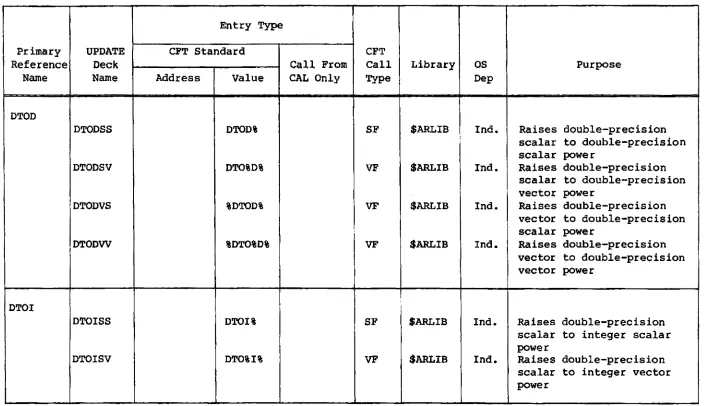
Call From Call Library OS Purpose Name Name Address Value CAL Only Type DepDTOD
DTODSS DTOD% SF $ARLIB Ind. Raises double-precision scalar to double-precision scalar power
DTODSV DTO%D% VF $ARLIB Ind. Raises double-precision scalar to double-precision vector power
DTODVS %DTOD% VF $ARLIB Ind. Raises double-precision vector to double-precision scalar power
DTODW %DTO%D% VF $ARLIB Ind. Raises double-precision vector to double-precision vector power
DTOI
DTOISS D'1'OI% SF $ARLIB Ind. Raises double-precision scalar to integer scalar power
[image:45.847.69.779.52.458.2]Table 2-1. Subprogram summary (continued)
Entry Type
Primary UPDATE CFT Standard CFT
Reference Deck Call From Call Library OS Purpose
Name Name Address Value CAL Only Type Dep
DTOI DTOIVS %DTOI% VF $ARLIB Ind. Raises double-precision
continued vector to integer scalar
power
DTOIW %DTO%I% VF $ARLIB Ind. Raises double-precision
vector to integer vector power
DTOR
DTODSS DTOR% SF $ARLIB Ind. Raises double-precision
scalar to real scalar power
DTODSV DTO%R% VF $ARLIB Ind. Raises double-precision
scalar to real vector power
OTODVS %DTOR% VF $ARLIB Ind. Raises double-precision
vector to real scalar power
DTODVV %DTO%R% VF $ARLIB Ind. Raises double-precision
vector to real vector power
DUMP
CRAYDUMP CRAYDUMP S $UTLIB Ind. Prints a memory dump to a specified dataset
PDUMP DUMP $DUMP S $UTLIB Dep. Dumps memory and aborts job PDUMP PDUMP $PDUMP S $UTLIB Dep. Dumps memory
[image:46.846.70.775.55.484.2]