S T U D Y P R O T O C O L
Open Access
Prevention of post-concussion-like
symptoms in patients presenting at the
emergency room, early single eye
movement desensitization, and
reprocessing intervention versus usual care:
study protocol for a two-center randomized
controlled trial
Cédric Gil-Jardiné
1,2,10,11*, Samantha Al Joboory
3, Juliane Tortes Saint Jammes
3, Guillaume Durand
4,5,
Régis Ribéreau-Gayon
2,6, Michel Galinski
1,2, Louis-Rachid Salmi
2,7, Philippe Revel
1,2, Cyril Alexandre Régis
3,
Guillaume Valdenaire
1,2, Emmanuel Poulet
5,8, Karim Tazarourte
4,9and Emmanuel Lagarde
2Abstract
Background:Recent data suggest that 10–20% of injury patients will suffer for several months after the event from diverse symptoms, generally referred to as post-concussion-like symptoms (PCLS), which will lead to a decline in quality of life. A preliminary randomized control trial suggested that this condition may be induced by the stress experienced during the event or emergency room (ER) stay and can be prevented in up to 75% of patients with a single, early, short eye movement desensitization and reprocessing (EMDR) psychotherapeutic session delivered in the ER.
The protocol of the SOFTER 3 study was designed to compare the impact on 3-month PCLS of early EMDR intervention and usual care in patients presenting at the ER. Secondary outcomes included 3-month post-traumatic stress disorder, 12-month PCLS, reported stress at the ER, assessed recovery expectation at discharge and 3 months, and self-reported chronic pain at discharge and 3 months.
(Continued on next page)
* Correspondence:[email protected]
1
University Hospital of Bordeaux, Pole of Emergency Medicine, Bordeaux, France
2INSERM, ISPED, Bordeaux Population Health research center INSERM U1219 -“Injury Epidemiology Transport Occupation”team, Bordeaux Cedex, France Full list of author information is available at the end of the article
(Continued from previous page)
Methods:This is a two-group, open-label, multicenter, comparative, randomized controlled trial with 3- and 12-month phone follow-up for reports of persisting symptoms (PCLS and post-traumatic stress disorder). Those eligible for inclusion were adults (≥18 years old) presenting at the ER departments of the University Hospital of Bordeaux and University Hospital of Lyon, assessed as being at high risk of PCLS using a three-item scoring rule. The intervention groups were a (1) EMDR Recent Traumatic Episode Protocol intervention performed by a trained psychologist during ER stay or (2) usual care. The number of patients to be enrolled in each group was 223 to evidence a 15% decrease in PCLS prevalence in the EMDR group.
Discussion:In 2012, the year of the last national survey in France, 10.6 million people attended the ER, some of whom did so several times since 18 million visits were recorded in the same year. The SOFTER 3 study therefore addresses a major public health challenge.
Trial registration:Clinical Trials.NCT03400813. Registered 17 January 2018–retrospectively registered.
Keywords:Stress, Emergency department, Eye movement desensitization and reprocessing, Post-concussion-like symptoms, Post-traumatic stress disorder, Clinical trial
Background
In 2012, when the latest national survey was conducted in France, 10.6 million people reported having attended the emergency room (ER), some of whom did so several times since 18 million ER visits were recorded in the same year [1]. In general, over 90% of those attending the ER will be discharged within hours, without hospitalization [2].
Recent consistent observations [3–6] that 10–20% of in-jury patients will suffer for several months after the event from diverse symptoms, with a subsequent decline in quality of life that can be significant and delay or prevent the resumption of school or work activities, as well as changing social and family relationships, are of major public health consequences. Approximately 2 million people each year in France are confronted by difficulties of varying degrees whose cause is often unidentified and unrelated to the traumatic event. This link is all the more difficult to make as these symptoms appear to be non-specific, and include headaches, concentration disorders, memory problems, stress intolerance, personal-ity change, and irritabilpersonal-ity. These symptoms have been described for more than 50 years in the context of head trauma, and were therefore referred to as post-concussion syndrome (PCS). Surprisingly, the most recent results show that these symptoms are not specific to brain injur-ies and can occur in other patients presenting to the ER [5,7,8], greatly expanding the size of the population con-cerned. In a cross-sectional, observational study of 31,958 high school athletes, Iverson et al. [9] also found that 19% of uninjured boys and 28% of uninjured girls reported having a symptom burden resembling an ICD-10 diagno-sis of PCS; thereafter, these symptoms were frequently described as post-concussion-like symptoms (PCLS).
Recognizing that brain damage is not the main cause of these symptoms, researchers have compared patients with
and without PCLS with two objectives, namely to predict their occurrence and to understand why they occur. This framework led to the major conclusion that psychological vulnerability, on the one hand, and stress experienced during and in the aftermath of the event, on the other, are the two best predictors of these lasting symptoms. This finding has been repeatedly observed in studies that assess the factors associated with PCLS [9–15].
The study of post-traumatic stress disorder (PTSD) has received renewed interest in view of the psychological pain of soldiers from Western countries returning from overseas following medical trauma, shedding light on this major public health phenomenon also affecting patients who have suffered an accident, physical assault, or an acute medical condition and whose general health remains precarious several months or years later. These studies have led to a better characterization of PTSD, including the individualization of four dimensional components, namely re-experiencing, avoidance, hyperactivation of the nervous system, and cognitive and emotional numbing [16]. Symptoms of PCLS are very similar and even some-times exactly the same as the last two dimensions of PTSD (hyperactivation of the nervous system and cogni-tive and emotional numbing). This led various authors to hypothesize that PCLS and PTSD partly share the same causal pathway, in which stress plays a key role. This would be particularly relevant for prevention of PCLS, in particular because, in contrast to PTSD studies, PCLS studies include insufficient numbers and are of low quality to identify credible modes of intervention [17].
patients recruited in the adult ER of Bordeaux University Hospital (Pericles project) [8, 10]. Follow-up to 12 months provided an unprecedented database allowing for in-depth comparisons of patient sub-groups. It was this study that showed that PCS, des-pite its name, was not specific to head trauma [8], and highlighted the importance of stress and the overlap between PCS and PTSD [8, 10]. The data ob-tained allows us today to compare the performance of risk assessment tools designed to select patients at increased risk of PCS from variables measured in the ER. This last point is of major importance in the preparation of this protocol.
Following the Pericles project, we conducted a pilot study to identify the factors explaining the persistence of symptoms 3 months after an injury event. The key result of this pilot study (manuscript submitted) was that the stress level reported by patients at the end of their ER stay was a powerful predictor of PCLS and PTSD, irre-spective of the stress level reported on entering the ER. This important result prompted us to consider testing the feasibility and then the effectiveness of stress man-agement interventions during an ER stay, in the hope of improving the outcomes of traumatized patients.
Results from the literature and these two studies led us to initiate a literature search for the best intervention candidates that would have the potential to lower stress levels during an ER stay.
One of the first ideas proposed for patients who experi-ence a stressful event was to initiate a stress management procedure before the consolidation of stressful memories. This is partly why the practice of psychological debriefing, which consists of debriefing sessions conducted 2–10 days after the critical incident, has been widely disseminated. However, several critical reviews [18] and a Cochrane re-view [19] have concluded that this form of intervention leads to an increased rate of PTSD.
More promisingly, early exposure therapy, which is based on the extinction of fear through engagement with traumatic memories and clues, appears to be an effective treatment of PTSD [20,21]. PTSD syndrome can be inter-preted as a failure of recovery caused, in part, by failure of the extinction of trauma [22]. This is supported by research conducted on animals showing that early extinction has the potential to alter the consolidation of memory of ori-ginal fear [23–25]. Rothbaum et al. [18] were the first to show the effectiveness of an extinction-type intervention (prolonged exposure) beginning in the ER in the preven-tion of PTSD in a sample of 137 patients randomized to three groups. The intervention also included two other ses-sions 1 and 2 weeks later. The same authors showed that such short-term intervention could also lower PTSD risk in patients with genes previously found to be associated with stress response [26]. Trauma-focused cognitive
behavioral therapy delivered within weeks of a potentially traumatic event for people showing signs of distress was also effective in the treatment of acute stress and early PTSD symptoms, and in the prevention of PTSD [27–31].
However, the psychotherapeutic intervention that has thus far proven superior to all other methods is eye move-ment desensitization and reprocessing (EMDR). Conceived by Francine Shapiro [32], EMDR is an empirically validated psychotherapeutic approach that can rapidly process dis-turbing experiences adaptively together with the aid of eye movements or other forms of bi-lateral stimulation. Several meta-analyses and Cochrane reviews have shown that this is one of the most effective treatments for PTSD [32–35]. Treatment may be started soon after the trauma, but most often after a complaint from the patient who is already suf-fering from PTSD symptoms. More recently, a study by Tarquinio et al. [36] showed the effectiveness of an EMDR-based intervention initiated in the first 48 h. The target population of this study was workers who have suffered professional violence (assaults, robberies, etc.).
A study conducted in Israel showed very promising re-sults with a single-session, early modified EMDR session provided in a general hospital inpatient and outpatient set-ting to 86 patients with acute stress syndrome suffering from intrusion distress following accidents and terrorist bombing attacks [37]. Half of the patients reported imme-diate fading of intrusive symptoms and general alleviation of distress, 27% described partial alleviation of their symp-toms and distress, while 23% reported no improvement. At the 4- and 6-month follow-up, the immediate responders in the terror victims group remained symptom free, while the non-responders endorsed more risk factors for PTSD. These results support other anecdotal reports on the rapid effects of brief EMDR intervention on intrusive symptoms in early uncomplicated post-traumatic cases.
Following the recognition of the failure of psycho-logical debriefing, the issue of difficult access to pa-tients with high levels of stress or dissociation was raised. This was all the more critical as it was known that dissociation at the time at which exposure ther-apy starts was associated with a poorer response [18]. In response to this challenge and to the increasing number of patients in need of care after manmade catastrophes such as bomb attacks, modified EMDR procedures and protocols adapted for early interven-tion have been developed to help victims and can be applied soon after trauma, including the emergency response procedure (ERP) [38] and the recent trau-matic episode protocol (R-TEP) [39, 40].
expected for patients in a ‘highly agitated’state (scor-ing 7–10/10 on the Subjective Units of Disturbance scale, where 0 = no disturbance and 10 = the highest disturbance possible) to those who have moved into a
‘silent terror’ (scoring 10+/10 on the Subjective Units of Disturbance scale).
The R-TEP is an early EMDR current trauma-focused intervention that incorporates and extends the main ideas of the original Recent Event Protocol guidelines first described by Shapiro and Laub in 2008 [42].
The ICD-10 established a set of diagnostic criteria for PCS. In order to meet these criteria, a patient must have had a head injury “usually sufficiently severe to result in
loss of consciousness” followed by the development, within 4 weeks, of at least three of the eight following symptoms: headache, dizziness, fatigue, irritability, sleep problems, concentration problems, memory problems, and problems tolerating stress. There is relatively little systematic research on the prevention and treatment of PCS [43–46]. A systematic review published in 2010 [45] suggested that cognitive behavioral therapy may be effective in the treatment of PCS. However, the authors found no quality studies and call for more rigorous trials of cognitive behavioral therapy for post-concussion symptoms. Other strategies include information, educa-tion and reassurance [47–49]. An emerging literature points to the independent impact of expectations and coping on chronic conditions following trauma, in par-ticular for patients with whiplash and low back pain [50–55]. Reassurance, as provided in the context of can-cer [50], low back pain [51, 52], and mild head trauma [47, 49], was found to help patients in their recovery process. It is therefore possible that at least a subgroup of patients who experienced a traumatic injury may benefit from such intervention.
Available research data, both from our studies and that available in the literature, led us to select the EMDR R-TEP procedure. This choice was based on the follow-ing considerations:
1) The absence of sufficient literature related to preventive interventions for PCLS
2) The partial overlap between PCLS and PTSD 3) The results of our preliminary studies strongly
suggesting that stress plays a major role in PCLS 4) The consensus for the use of EMDR in early
prevention of PTSD
5) The growing evidence of a significant psychological component to persistent complaints
6) The failure of early psychological debriefing to prevent PTSD
We then conducted a new pilot study [53], intended to examine the feasibility of stress management sessions
during the ER stay with candidate interventions as selected by our literature search. To this end, we conducted a randomized open-label, single-center study to assess the feasibility of psychologist-led interventions in the context of the ER and to compare the effect of EMDR with reassurance and usual care. Conducted in the ER of Bordeaux University Hospital, the study in-cluded patients with a high risk of PCLS randomized into three groups, as follows: (1) a 15-min reassurance session, (2) a 60-min session of EMDR, and (3) usual care. Main outcomes were the proportion of interven-tions that could be carried out and the prevalence of PCLS and PTSD 3 months after the ER visit.
A total of 130 patients with a high risk of PCLS were randomized. No logistic problem or patient re-fusal was observed. In the EMDR, reassurance and control groups, the proportions of patients with PCLS at 3 months were 18%, 37%, and 65% and those with PTSD were 3%, 16%, and 19%, respectively. The rela-tive risk for PCLS adjusted for the type of event (in-jury, non-injury) for the comparison between EMDR and control was 0.24 (95% CI 0.095–0.61). This first randomized controlled trial therefore shows that a short EMDR intervention is feasible and potentially effective in the context of the ER. The study was reg-istered at ClinicalTrials.gov (NCT03194386).
The present protocol aims to replicate the latter trial in order to confirm or reject our hypothesis of a benefi-cial impact of early R-TEP EMDR on PCLS and PTSD in two different ERs. SPIRIT Checklist for this trial is provided as an Additional file1.
Potential benefit
The trial is designed to test the impact of early EMDR intervention on PCLS and PTSD in patients presenting to the ER. In 2012, the year of the last national survey in France, 10.6 million people attended the ER, some of whom several times, since 18 million visits were re-corded that year. The SOFTER 3 study therefore ad-dresses a major public health challenge.
Methods/design
The main objective in our two-site, open-label, ran-domized controlled trial is to compare the impact on 3-month PCLS of early EMDR R-TEP intervention and usual care in patients presenting to the ER. Secondary objectives include the comparison between EMDR R-TEP and control of 3-month PTSD, 12-month PCLS, self-reported stress at ER discharge, self-assessed recov-ery expectation at discharge and 3 months, and self-reported pain at discharge and 3 months.
– 3-month PCLS as measured with the Rivermead
Post-Concussion Symptoms Questionnaire [54]
Secondary outcomes
– 12-month PCLS as measured with the Rivermead
Post-Concussion Symptoms Questionnaire
– 3-month PTSD as measured with PTSD Checklist-5
[55]
– Self-assessed recovery expectation at discharge and 3 months
– Self-reported chronic pain at 3 months
– Self-reported acute pain at discharge
– Psychotropic medicine use at 3 months as measured
by drug delivery data extracted from the Caisse national d’assurance maladie des travailleurs salariés (CNAM-TS) database, the French social insurance system
Randomization and blinding
Patients will be allocated to one of the two arms with block randomization by clinical center sites. Statistical analysis will be performed blinded to arm content, re-vealed only by the Data Safety Monitoring Board (DSMB) report. It is not possible to blind the partici-pants to their allocation due to the nature of the intervention.
Inclusion criteria
All patients attending the adult ER of one of the study sites following an event that led to an injury, or with a new acute medical condition, will be assessed for inclu-sion. The inclusion criteria are as follows:
Age 18 and above
Conscious, able to provide informed consent, able to
understand study procedures and to comply with them for the entire length of the study; French speaker
Injured, whatever the cause of injury (the event
causing the injury must have occurred in the past 12 h) or experiencing a medical event associated with an acute medical condition and presenting for the first time to the ER for this reason
Score resulting from the screening tool > 1: female: + 1, taking at least one anxiolytic treatment: + 1, perceived health status prior to admission: excellent, very good 0; good: + 1; poor: + 2; bad + 3
Affiliated to the French insurance system
Exclusion criteria
Any candidates to whom any of the exclusion criteria apply at baseline will be excluded from study participa-tion. The exclusion criteria are as follows:
Acute drug or alcohol use or dependence that, in
the opinion of the site investigator, would interfere with adherence to study requirements
Inability or unwillingness of individual or legal guardian/representative to give written informed consent
Inability or unwillingness to be contacted for 3- and 12-month follow-up interviews
Study enrollment procedures and randomization
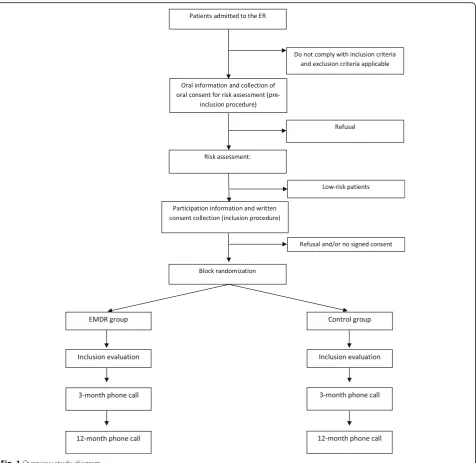
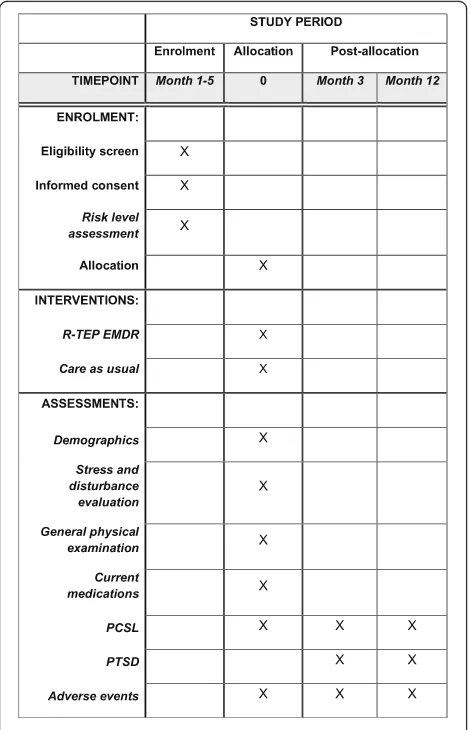
Study protocol and time of collection of outcomes are presented in Figs. 1 and 2. Participants will be re-cruited among patients presenting to the ERs of the University Hospital of Bordeaux (Groupe Hospitalier Pellegrin) and Lyon (Groupement Hospitalier Edouard Herriot) and assessed with a high risk of PCLS. The identification and recruitment of potential study par-ticipants will be carried out by emergency personnel under the supervision of the project manager as soon as the patient’s condition permits and in all cases after the initial clinical evaluation conducted in the framework of the usual care. First oral consent will then be sought for participation in the assessment stage, which consists in selecting patients with a high risk of PCLS.
A set of three items will be recorded for each injured patient, including sex (+ 1 for female), perceived health status prior to admission (excellent, very good: 0; good: + 1 poor: + 2; bad: + 3), current use of anxiolytics/antide-pressants (+ 1 if yes).
To be enrolled in the study, the patient will need to score above a pre-defined threshold of 2 on the scoring procedure based on the three items and designed to se-lect patients at risk for PCLS. The score has been devel-oped using data from the Pericles study and validated on data of the SOFTER Pilot 1 and 2 studies.
Patients fulfilling inclusion criteria and assessed as at risk for PCLS will be presented with the objective and procedures and invited to sign an informed con-sent form. A screening log will be filled in to describe reasons for ineligibility and for non-participation of eligible candidates.
The randomization procedure for assigning a partici-pant to an intervention group will then be performed and the results will be recorded in the Shared Study Monitoring System. Electronic block randomization will be stratified according to study center. Block sizes will be randomly modified and kept secret.
Intervention
EMDR intervention protocols [32] into an integrative and comprehensive intervention considering the frag-mented, unconsolidated nature of recent traumatic memories and the need for safety and containment. Fol-lowing the eight phases of the standard EMDR protocol, it introduces four new procedural concepts (Traumatic Episode, Episode Narrative, “Google Search/ Scan” for identifying disturbing fragments and Current Trauma Focused processing strategies). These sessions will be carried out by trained psychologists.
Patients in the treatment-as-usual group will be med-ically and psychologmed-ically attended to by ER staff with no intervention of the study psychologist.
Sample size
The study sample size is calculated using PCLS rates ex-pected at 3 months after an ER admission in a patient population assessed to be at high risk of PCLS.
Our pilot study showed that, using the criteria de-scribed above, the incidence of PCLS among patients se-lected and enrolled in the study will be of approximately 47%. Our aim is to design the present study to be able to evidence a 15% decrease in PCLS prevalence in the EMDR group. Assuming an alpha risk of 5% and a power of 80%, the required sample size will be 169 pa-tients in each group. We further assumed 20% loss to follow-up and 5% missing data for the main variables.
[image:6.595.62.539.86.549.2]Thus, we plan to include 223 patients in each group (112 per center in each group).
A study therapist will be available from 10 am to 6 pm, 5 days a week. Considering EMDR session duration and emergency care, patients will be assessed for eligibility from 8 am to 6 pm. Data from our ER registry and experi-ence from our pilot study show that, during this period, approximately 50 patients will be assessed for eligibility. The screening tool used in this study will select approxi-mately 10% of patients admitted to the ER. We also esti-mate that 10% of eligible patients will be missed in the ER and assume a 5% refusal rate. Consequently, we can ex-pect approximately four inclusions per day, corresponding to an inclusion period of 3 months.
Adherence assessment
Adherence to the study regimen will be defined as the extent to which participants comply with study interven-tion requirements. The SOFTER Pilot study 2 showed that over 95% adherence can be expected in the EMDR group. A log of intervention sessions will be kept for
each participant and will include duration, completeness, and patient satisfaction. This log will be regularly reviewed by the Steering Committee and used as part of the decision to continue or discontinue the study.
Interim analyses and stopping rules
No interim analysis of efficacy is planned. The study can be stopped by the DSMB for safety reasons or because of poor study performance (losses to follow-up > 25%), poor quality control, slow accrual (recruitment rate < 75% than expected), serious adverse events considered to be caused by the intervention, or increased frequency of adverse events. Such findings are presented to the DSMB for re-view of the events to determine whether there are statis-tical as well as clinical concerns. The statistician reports their findings to a closed session of the DSMB and these are used to determine what steps will be taken.
Data analyses
Descriptive and inferential statistical methods will be used to analyze the outcomes and other study data. Con-founding variables will include cause of admission (in-jury versus medical), age group, and sex. The analyses will be conducted as intent-to-treat for primary endpoint and per-protocol for secondary analyses. Randomization codes will only be revealed at the end of the analysis.
Primary analyses will be conducted using a Fisher exact test. A stratified analysis will be carried out considering study center and PCLS risk score. For other variables, Wilcoxon test will assess differences for continuous vari-ables and Fisher exact test for categorical varivari-ables.
Differences between patients who completed the study and those who were lost to follow-up will be assessed for all variables.
Dissemination
The results of the trial will be published regardless of the direction of effect. Communications will be pre-sented at specialized conferences and reports will be submitted to peer-reviewed medical journals.
Quality control
A clinical research associate mandated by the sponsor will regularly visit each study center, when the research is set up, once or several times during the course of research, according to the rhythm of the inclusions and at the end of the research. During these visits, and in accordance with the monitoring plan, the following will be reviewed:
Informed consent
– Respect of the research protocol and procedures
defined in it
[image:7.595.57.292.88.453.2]– Quality of the data collected in the report file: completeness, accuracy, missing data, consistency of data with source documents (medical records, appointment books, original laboratory results, etc.)
All visits will be subject to a written monitoring report.
Confidentiality of data
In accordance with the statutory provisions in place (the French Public Health Code), persons having direct ac-cess to source data will take every precaution required to ensure the confidentiality of information relating to investigational medicinal products, studies, and partici-pants, notably concerning their identity, as well as the results obtained. These persons, like the investigators themselves, are subject to professional confidentiality.
During the clinical study or at its conclusion, data regarding participants that is collected and sent to the sponsor by the investigators (or all other specialists in-volved) will be anonymized. At no point will the names of participants or their addresses appear unencrypted.
Only the first letters of the first name and full name of included patients will be recorded, followed by a specific research number indicating the rank of inclusion and the origin of the investigator site.
The sponsor will ensure that each study participant has given their consent for access to their personal data, which is strictly required for study quality control.
Data and Safety Monitoring Board (DSMB)
The DSMB is an independent group of experts that ad-vises the study investigators. The members of the DSMB serve in an individual capacity and provide their expert-ise and recommendations. The primary responsibilities of the DSMB are to (1) periodically review and evaluate the accumulated study data for participant safety, study conduct and progress, and, when appropriate, efficacy, and (2) make recommendations concerning the continu-ation, modificcontinu-ation, or termination of the trial. The DSMB considers study-specific data as well as relevant background knowledge about the patient population under study.
The DSMB is responsible for defining its deliberative processes, including event triggers that would call for an unscheduled review, stopping guidelines, unmasking, and voting procedures prior to initiating any data review.
The study DSMB consists of three independent experts, inclduing one expert in the clinical aspects of the stressed/ injured patient population; one biostatistician with expertise in current clinical trial conduct and methodology; and one expert in psychotherapeutic EMDR interventions.
The DSMB has been appointed prior to study initiation.
Premature withdrawal from the study and withdrawal of consent
The participant has the right to withdraw from the re-search at any time. If participants decide to withdraw from all components of the study, they are no longer followed up in the protocol. Premature withdrawal from the re-search strategy must be notified promptly to the Steering Committee. The reasons for and the date of withdrawal must be documented. The withdrawal of consent is a deci-sion by a participant to reconsider their decideci-sion to partici-pate in the research and to assert their right to withdraw consent at any time during follow-up, without resulting in any prejudice thereby and without having to justify it. When a participant withdraws consent for participation in the research, data already collected for this patient will be kept for analysis.
Protocol deviations
Deviations can affect all aspects of a research protocol such as inclusion, monitoring, measurement of end-points, and treatment process. All deviations must be documented by the investigator and discussed by the Steering Committee and Data Management Center.
Even in the event of deviation from the protocol, par-ticipants must be monitored until the date planned in the protocol.
Archiving study documents and study data
The protocol and any changes to the protocol, report files (copies), source files of participants who gave con-sent, and all other documents and correspondence re-lated to the research will be archived in accordance with good clinical practices for a period of 15 years following the end of the research. The original informed consent forms of participants will be archived for a period of 30 years following the end of the research.
Ethical approval
The sponsor and the investigator(s) undertake the re-sponsibility to ensure that the research is conducted in compliance with Law no. 2012–300 on research involv-ing human participants of 5 March 2012, in accordance with Good Clinical Practices (I.C.H. version 4 of 9 No-vember 2016 and Decision of 24 NoNo-vember 2006), and the Declaration of Helsinki.
The research will be conducted in accordance with the present protocol. Except in emergency situations requiring specific medical procedures, the investigator undertakes the responsibility to comply with the protocol in all respects, particularly with regard to the collection of consent, and the reporting and monitoring of serious adverse events.
Ouest II - Angers). N° RCB = 2017-A01462–51–N°CPP = 2017/36.
The University Hospital of Bordeaux, the sponsor of this research, has taken out a civil liability insurance contract with Gerling-Biomedicinsure in accordance with the provisions of the public health code.
The data recorded in the course of this research shall be subject to computer processing on behalf of INSERM U1219 Bordeaux Population Health Research Center in compliance with Law No. 78–17 of 6 January 1978 relat-ing to data processrelat-ing, files and freedoms, as amended by Law 2004–801 of 6 August 2004.
This research project falls within the framework of the
“Reference Methodology” (MR-001) in application of the provisions of article 54, paragraph 5 of the amended law of 6 January 1978 relating to information, files and free-doms. This change was approved by the decision of 5 January 2006, updated on 21 July 2016. The INSERM U1219 Bordeaux Population Health Research Center has signed a commitment to comply with this “Reference Methodology”.
A specific request for clearance will be submitted to the Commission Nationale Informatique et Liberté (CNIL) in order to obtain the authorization to use the national social security ID to retrieve medication data at 3 and 12 months.
Discussion
The trial is designed to test the impact of early EMDR intervention on PCLS and PTSD in patients presenting to the ER. In 2012, the year when the last national survey in France was undertaken, 10.6 million people attended the ER, some of whom several times, since 18 million visits were recorded that year. The SOFTER 3 study therefore addresses a major public health challenge.
We already described the feasibility of short EMDR sessions in the ED during the SOFTER 2 study [53], which also found a superiority of EMDR versus reassur-ance versus control. We need to confirm these results in a larger and more diverse population.
Trial status
The present publication refers to the 4.0 version of the SOFTER 3 protocol dates on 01/02/2018. Recruitment began on January 15, 2018, and is expected to be com-pleted by the June 15, 2018.
Additional file
Additional file 1:SPIRIT Checklist (DOC 121 kb)
Abbreviations
DSMB:Data Safety Monitoring Board; EMDR: eye movement desensitization and reprocessing; ER: emergency room; ERP: emergency response procedure; PCLS: post-concussion-like symptoms; PCS: post-concussion syndrome;
PTSD: post-traumatic stress disorder; R-TEP: recent traumatic episode protocol; SOFTER: SymptOms Following Trauma, Early Response
Acknowledgements
The authors are thankful for the ongoing support from all our site staff, in particular the psychologists and trial participants. We would also like to express our gratitude to those who reviewed the protocol, including the CPP and DSMB and the clinical research department staff of the University Hospital of Bordeaux.
Funding
The SOFTER 3 trial is fully funded by the Institut National de la Santé et de la Recherche Médicale (INSERM), the University Hospitals of Bordeaux and Lyon, and the Hospital of Cadillac.
Availability of data and materials
Requests for access to trial data will be considered, and approved in writing where appropriate, after formal application to CGJ, GV, KT and EL.
Authors’contributions
EL and CGJ drafted this paper. SAJ and JTSJ trained study psychologist. GD and CGJ followed study inclusions in both centers. CGJ, EL, KT, LRS, MG, GV, RRG, PR, EP, SAJ, and JTSJ contributed in study protocol. All authors contributed to revisions of the manuscript, and read and approved the final manuscript.
Ethics approval and consent to participate
The protocol was approved by the French data protection authority and the regional ethics committee. All participants gave written informed consent.
Consent for publication Not applicable.
Competing interests
The authors of this paper have no financial or other competing interests that impact on their responsibilities towards the scientific value or potential publishing activities associated with the trial.
Publisher’s Note
Springer Nature remains neutral with regard to jurisdictional claims in published maps and institutional affiliations.
Author details
1University Hospital of Bordeaux, Pole of Emergency Medicine, Bordeaux,
France.2INSERM, ISPED, Bordeaux Population Health research center INSERM
U1219 -“Injury Epidemiology Transport Occupation”team, Bordeaux Cedex, France.3CASPERTT, Hospital Center of Cadillac, Lormont, France.
4Department of Emergency Medicine, University Hospital Edouard Herriot,
Hospices civils de Lyon, Lyon, France.5University Hospital, Claude Bernard
University, Lyon, France.6University Hospital of Bordeaux, Pole of Medicine, Bordeaux, France.7University Hospital of Bordeaux, Pole of Public Health,
Bordeaux, France.8Department of Psychiatry, University Hospital Edouard
Herriot, Hospices civils de Lyon, Lyon, France.9EA 7425 Hesper University
Hospital, Claude Bernard University, Lyon, France.10Emergency Department, University Hospital of Bordeaux, Pellegrin Hospital, Place Amélie Raba-Léon, 33000 Bordeaux, France.11Bordeaux University Hospital, Centre Hospitalier
Universitaire de Bordeaux, 12 rue Dubernat, 33400 Talence, France.
Received: 5 March 2018 Accepted: 4 September 2018
References
1. Vuagnat A. Les urgences hospitalières, qu’en sait-on. Le Panorama des établissements de santé–édition; 2013.
2. Carrasco V, Baubeau D. Les usagers des urgences. Premiers résultats d’une enquête nationale. Etudes Résultats, vol. 8; 2003.
3. de Leon MB, Kirsch NL, Maio RF, Tan-Schriner CU, Millis SR, Frederiksen S, et al. Baseline predictors of fatigue 1 year after mild head injury. Arch Phys Med Rehabil. 2009;90:956–65.
5. McLean SA, Kirsch NL, Tan-Schriner CU, Sen A, Frederiksen S, Harris RE, et al. Health status, not head injury, predicts concussion symptoms after minor injury. Am J Emerg Med. 2009;27:182–90.
6. Stovner LJ, Schrader H, Mickeviciene D, Surkiene D, Sand T. Headache after concussion. Eur J Neurol. 2009;16:112–20.
7. Smith-Seemiller L, Fow NR, Kant R, Franzen MD. Presence of post-concussion syndrome symptoms in patients with chronic pain vs mild traumatic brain injury. Brain Inj. 2003;17:199–206.
8. Laborey M, Masson F, Ribéreau-Gayon R, Zongo D, Salmi LR, Lagarde E. Specificity of postconcussion symptoms at 3 months after mild traumatic brain injury: results from a comparative cohort study. J Head Trauma Rehabil. 2014;29:E28–36.
9. Iverson GL, Silverberg ND, Mannix R, Maxwell BA, Atkins JE, Zafonte R, et al. Factors associated with concussion-like symptom reporting in high school athletes. JAMA Pediatr. 2015;169:1132–40.
10. Lagarde E, Salmi L-R, Holm LW, Contrand B, Masson F, Ribéreau-Gayon R, et al. Association of symptoms following mild traumatic brain injury with posttraumatic stress disorder vs. postconcussion syndrome. JAMA Psychiatry. 2014;71:1032–40. 11. Balasundaram AP, Athens J, Schneiders AG, McCrory P, Sullivan SJ. Psychological
and lifestyle factors that influence the serial reporting of Postconcussion-like symptoms in a non-concussed population. PM&R. 2017;9(9):866–73. 12. Bernard CO, Ponsford JA, McKinlay A, McKenzie D, Krieser D. Predictors of
post-concussive symptoms in young children: injury versus non-injury related factors. J Int Neuropsychol Soc JINS. 2016;22:793–803. 13. Manners JL, Forsten RD, Kotwal RS, Elbin RJ, Collins MW, Kontos AP. Role of
pre-morbid factors and exposure to blast mild traumatic brain injury on post-traumatic stress in United States military personnel. J Neurotrauma. 2016;33:1796–801. 14. Stein MB, Ursano RJ, Campbell-Sills L, Colpe LJ, Fullerton CS, Heeringa SG, et
al. Prognostic indicators of persistent post-concussive symptoms after deployment-related mild traumatic brain injury: a prospective longitudinal study in U.S. Army soldiers. J Neurotrauma. 2016;33:2125–32.
15. Lee JEC, Garber B, Zamorski MA. Prospective analysis of premilitary mental health, somatic symptoms, and Postdeployment Postconcussive symptoms. Psychosom Med. 2015;77:1006–17.
16. Losoi H, Silverberg ND, Wäljas M, Turunen S, Rosti-Otajärvi E, Helminen M, et al. Recovery from mild traumatic brain injury in previously healthy adults. J Neurotrauma. 2016;33:766–76.
17. Bryant R. Post-traumatic stress disorder vs traumatic brain injury. Dialogues Clin Neurosci. 2011;13:251–62.
18. Price M, Kearns M, Houry D, Rothbaum BO. Emergency department predictors of posttraumatic stress reduction for trauma-exposed individuals with and without an early intervention. J Consult Clin Psychol. 2014;82:336–41. 19. Quinn G. Emergency response procedure (ERP). Implement EMDR early
Ment health Interv man-made Nat disasters models scripted Protoc Summ sheets. 1st ed. New York: Springer Publishing Company; 2013.
20. Rose S, Bisson J, Churchill R, Wessely S. Psychological debriefing for preventing post traumatic stress disorder (PTSD). Cochrane Database Syst Rev. 2002;2: CD000560.
21. Cahill S, Rothbaum B, Resik P, Follette V. Cognitive-behavioral therapy for adults. Eff Treat PTSD Second Ed Pract Guidel Int Soc Trauma Stress Stud. 2 edition. New York: The Guilford Press; 2010. p. 139–222.
22. Myskiw JC, Izquierdo I, Furini CRG. Modulation of the extinction of fear learning. Brain Res Bull. 2014;105:61–9.
23. Rothbaum BO, Davis M. Applying learning principles to the treatment of post-trauma reactions. Ann N Y Acad Sci. 2003;1008:112–21.
24. Myers KM, Ressler KJ, Davis M. Different mechanisms of fear extinction dependent on length of time since fear acquisition. Learn Mem Cold Spring Harb N. 2006;13:216–23.
25. Cain CK, Godsil BP, Jami S, Barad M. The L-type calcium channel blocker nifedipine impairs extinction, but not reduced contingency effects, in mice. Learn Mem Cold Spring Harb N. 2005;12:277–84.
26. Mao S-C, Hsiao Y-H, Gean P-W. Extinction training in conjunction with a partial agonist of the glycine site on the NMDA receptor erases memory trace. J Neurosci. 2006;26:8892–9.
27. Rothbaum BO, Kearns MC, Reiser E, Davis JS, Kerley KA, Rothbaum AO, et al. Early intervention following trauma may mitigate genetic risk for PTSD in civilians: a pilot prospective emergency department study. J Clin Psychiatry. 2014;75:1380–7.
28. Birur B, Moore NC, Davis LL. An evidence-based review of early intervention and prevention of posttraumatic stress disorder. Community Ment Health J. 2017;53:183–201.
29. Bisson JI, Shepherd JP, Joy D, Probert R, Newcombe RG. Early cognitive-behavioural therapy for post-traumatic stress symptoms after physical injury. Randomised controlled trial. Br J Psychiatry J Ment Sci. 2004;184:63–9. 30. Bryant RA, Harvey AG, Dang ST, Sackville T, Basten C. Treatment of acute
stress disorder: a comparison of cognitive-behavioral therapy and supportive counseling. J Consult Clin Psychol. 1998;66:862–6.
31. Bryant RA, Sackville T, Dang ST, Moulds M, Guthrie R. Treating acute stress disorder: an evaluation of cognitive behavior therapy and supportive counseling techniques. Am J Psychiatry. 1999;156:1780–6.
32. Shapiro F. Eye movement desensitization and reprocessing (EMDR): basic principles, protocols, and procedures. 2nd ed. New York: Guilford Press; 2001. 33. Bradley R, Greene J, Russ E, Dutra L, Westen D. A multidimensional
meta-analysis of psychotherapy for PTSD. Am J Psychiatry. 2005;162:214–27. 34. Seidler GH, Wagner FE. Comparing the efficacy of EMDR and trauma-focused cognitive-behavioral therapy in the treatment of PTSD: a meta-analytic study. Psychol Med. 2006;36:1515–22.
35. Bisson JI, Roberts NP, Andrew M, Cooper R, Lewis C. Psychological therapies for chronic post-traumatic stress disorder (PTSD) in adults. Cochrane Database Syst Rev. 2013;12:CD003388.
36. Tarquinio C, Rotonda C, Houllé WA, Montel S, Rydberg JA, Minary L, et al. Early psychological preventive intervention for workplace violence: a randomized controlled explorative and comparative study between EMDR-recent event and critical incident stress debriefing. Issues Ment Health Nurs. 2016;37:787–99. 37. Kutz I, Resnik V, Dekel R. The effect of single-session modified EMDR on
acute stress syndromes. J EMDR Pract Res. 2008;2:190–200. 38. Quinn G. EMDR immediate emergency treatment for man-made and
natural disasters - Emergency response procedure - (ERP). In EMDR clinical practice symposium (Joany Spierings, Chair). Edinburgh: Symposium presented at the 15th EMDR Europe Association Conference; 2014. 39. Shapiro E, Laub B. The recent traumatic episode protocol (R-TEP): an
integrative protocol for early EMDR intervention (EEI). Implement EMDR early Ment health Interv man-made Nat disasters models scripted Protoc Summ sheets. 1st ed. New York: Springer Publishing Company; 2013. 40. Shapiro E. EMDR and early psychological intervention following trauma. Rev
Eur Psychol AppliquéeEuropean Rev Appl Psychol. 2012;62:241–51. 41. Luber M, editor. Implementing EMDR early mental health interventions for
man-made and natural disasters: models, scripted protocols and summary sheets. 1st ed. New York: Springer Publishing Company; 2013.
42. Shapiro E, Laub B. Early EMDR intervention (EEI): a summary, a theoretical model, and the recent traumatic episode protocol (R-TEP). J EMDR Pract Res. 2008;2:79–96.
43. Baldwin DS, Anderson IM, Nutt DJ, Allgulander C, Bandelow B, den Boer JA, et al. Evidence-based pharmacological treatment of anxiety disorders, post-traumatic stress disorder and obsessive-compulsive disorder: a revision of the 2005 guidelines from the British Association for Psychopharmacology. J Psychopharmacol Oxf Engl. 2014;28:403–39.
44. Sijbrandij M, Kleiboer A, Bisson JI, Barbui C, Cuijpers P. Pharmacological prevention of post-traumatic stress disorder and acute stress disorder: a systematic review and meta-analysis. Lancet Psychiatry. 2015;2:413–21.
45. Al Sayegh A, Sandford D, Carson AJ. Psychological approaches to treatment of postconcussion syndrome: a systematic review. J Neurol Neurosurg Psychiatry. 2010;81:1128–34.
46. Nelson Sheese AL, Hammeke TA. Rehabilitation from postconcussion syndrome: nonpharmacological treatment. Prog Neurol Surg. 2014;28:149–60.
47. Silverberg ND, Hallam BJ, Rose A, Underwood H, Whitfield K, Thornton AE, et al. Cognitive-behavioral prevention of postconcussion syndrome in at-risk patients: a pilot randomized controlled trial. J Head Trauma Rehabil. 2013;28:313–22. 48. Gunstad J, Suhr JA.“Expectation as etiology”versus“the good old days”:
postconcussion syndrome symptom reporting in athletes, headache sufferers, and depressed individuals. J Int Neuropsychol Soc JINS. 2001;7:323–33. 49. Bell KR, Hoffman JM, Temkin NR, Powell JM, Fraser RT, Esselman PC, et al.
The effect of telephone counselling on reducing post-traumatic symptoms after mild traumatic brain injury: a randomised trial. J Neurol Neurosurg Psychiatry. 2008;79:1275–81.
50. Absolom K, Greenfield D, Ross R, Davies H, Hancock B, Eiser C. Reassurance following breast screening recall for female survivors of Hodgkin’s lymphoma. Breast Edinb Scotl. 2007;16:590–6.
usual work due to chronic low back pain: a systematic review. J Physiother. 2012;58:165–72.
52. Odeen M, Ihlebæk C, Indahl A, Wormgoor MEA, Lie SA, Eriksen HR. Effect of peer-based low back pain information and reassurance at the workplace on sick leave: a cluster randomized trial. J Occup Rehabil. 2013;23:209–19. 53. Gil-Jardiné C, Evrard G, Al Joboory S, Tortes Saint Jammes J, Masson F,
Ribéreau-Gayon R, et al. Emergency room intervention to prevent post concussion-like symptoms and post-traumatic stress disorder. A pilot randomized controlled study of a brief eye movement desensitization and reprocessing intervention versus reassurance or usual care. J Psychiatr Res. 2018;103:229–36. 54. King NS, Crawford S, Wenden FJ, Moss NE, Wade DT. The Rivermead Post
Concussion Symptoms Questionnaire: a measure of symptoms commonly experienced after head injury and its reliability. J Neurol. 1995;242(9):587–92. 55. Ashbaugh AR, Houle-Johnson S, Herbert C, El-Hage W, Brunet A. Psychometric