R E S E A R C H A R T I C L E
Open Access
Optimized extraction, composition,
antioxidant and antimicrobial activities of
exo and intracellular polysaccharides from
submerged culture of
Cordyceps cicadae
Sapan Kumar Sharma
1*, Nandini Gautam
2and Narender Singh Atri
3Abstract
Background:Cordyceps cicadaeis known as Jin Chan Hua in Traditional Chinese Medicine and known to possess different pharmacological activities. Presently, it was collected from the wild and isolated. Mycelial culture was optimized for extraction of polysaccharides under submerged culture conditions. Besides antioxidant, antibacterial activities of extracted polysaccharides were tested for first time.
Methods:Exo-polysaccharides (EPS) and intracellular polysaccharides (IPS) production was tested under different factors (medium capacity, rotation speed, pH, incubation time, temperature, carbon, nitrogen, minerals sources and carbon to nitrogen ratio) by orthogonal experiments using one-factor-at-a-time method. Monosaccharides
composition of polysaccharides produced byC. cicadaewas determined using high performance liquid
chromatography. Antioxidant and antimicrobial activities on eight bacterial strains were checked by different standard procedures.
Results:Factors viz., medium capacity, rotation speed, incubation time, pH and temperature affected the EPS and IPS production under submerged culture conditions. EPS and IPS production was observed to vary with different carbon and nitrogen sources as well as C/N ratio. Glucose was the major component of polysaccharides (63.10 ± 4.15 %). Extracted EPS and IPS showed higher antioxidant potential with significant DPPH radical scavenging activity, ABTS radical scavenging activity, reducing power and iron chelating activity. Antimicrobial activities of EPS and IPS varied among the tested bacterial strains. IPS showed slightly higher inhibition rate to all the tested bacterial strains as compared to EPS. Maximum inhibition zones of IPS (12.9 ± 0.2 mm) and EPS (12.5 ± 0.3 mm) was
observed againstPseudomonas aeruginosaat 10 % con. However, both EPS and IPS fractions showed broad
spectrum for all the pathogenic microbial strains tested. The MIC of both the extracts ranged from 60–100 mg/mL. Conclusions:EPS and IPS production from submerged culture ofC. cicadaewith significant antioxidant and antibacterial potential can be enhanced with the combination of several factors which can be used for large scale industrial fermentation ofC. cicadae.
Keywords:Cordyceps cicadae, EPS, IPS, Antioxidant, Monosaccharides, Antimicrobial activity
* Correspondence:[email protected]
1Department of Plant Pathology, CSK, Himachal Pradesh Agriculture
University, Palampur (176 062), India
Full list of author information is available at the end of the article
© 2015 Sharma et al.Open AccessThis article is distributed under the terms of the Creative Commons Attribution 4.0 International License (http://creativecommons.org/licenses/by/4.0/), which permits unrestricted use, distribution, and reproduction in any medium, provided you give appropriate credit to the original author(s) and the source, provide a link to the Creative Commons license, and indicate if changes were made. The Creative Commons Public Domain Dedication waiver (http://creativecommons.org/publicdomain/zero/1.0/) applies to the data made available in this article, unless otherwise stated.
RETRACTED
Background
Cordycepsis a widely distributed genus with more than 400 species worldwide [1–3]. Species of Cordyceps are known as the source of disease combating natural product with tremendous biological activities. Extracts from the fruit bodies and mycelium of this fungus exhibit different pharmacological activities [4]. Species likeCordyceps sinen-sishas been used extensively to cure various cancerous dis-eases and known to possess immunomodulatory activities [5–9]. The range of polysaccharides present in Cordyceps
mycelium ranges 3–8 % and are the main constituents [10– 12].Cordyceps species are the sources of several bioactive constituents like cordycepin and others which possess liver protective effects, antioxidative activities, enhances the T-cell and macrophages activity, reduce the level of Myc, c-Fos, and VEGF levels in the lungs and liver by exopolysac-charide fraction, and reduce the level of cholesterol and triglyceride [13–16]. Beside, some uncommon cyclic dipeptides, including co- cyclo-[Gly-Pro], cyclo-[Leu-Pro], [Val-Pro], [Ala-Leu], [Ala-Val], and cyclo-[Thr-Leu] and small amounts of polyamines, such as 1,3-diamino propane, cadaverine, spermidine, spermine, and putrescine are also extracted from these which exhibit mul-tiple pharmacological activities including antitumor, anti-inflammatory, mmunopotentiation, hypoglycemic, and hypocholesterolemic effects, protection of neuronal cells against the free radical-induced cellular toxicity, steroido-genesis, and antioxidant activities [17–20].
Cordyceps cicadaeis known as Jin Chan Hua in
Trad-itional Chienese Medicine and the extract from this spe-cies is used against kidney diseases, immune related diseases, and cancer [21–23]. Extracts from C. cicadae
exhibit immuno-regulatory effects on human T lympho-cytes and modulate the growth of mononuclear cells and also known to inhibit the growth of lung adeno-carcinoma and melanomain vivoandin vitro[24–27].
EPS as well as IPS extracted from submerged culture of many Cordyceps species exhibited significant antioxi-dant and antimicrobial activities [28]. The productivity of polysaccharides has been found to vary with environ-mental conditions and medium composition, including carbon source, nitrogen source, and pH [29]. To add the medicinal potential and large scale industrial fermenta-tion of C. cicadae, present studies were conducted to optimize the antioxidant EPS and IPS production by one-factor-at-a-time method and orthogonal matrix de-sign. Monosaccharide composition, antioxidant and anti-microbial activities of EPS and IPS were also evaluated under present experiments.
Methods
Culturing and optimized extraction of polysaccharides
Cordyceps cicadae was collected from the
sub-Himalayan forest at Macleodgang (Dharamshala, India)
geographically located at 32.238602°N 76.323878°E, and identified through microscopical taxonomy, and ITS re-gion sequencing and deposited at Herbarium, Depart-ment of Botany, Punjabi University, Patiala (PUN 7194) (Fig. 1a, b). Isolation was done on potato dextrose agar (PDA) slants. The slants were incubated at 25 °C for 10 days. Sub-culturing was done in every 30-days inter-val to maintain the viability. Submerged culturing was done in a standard basal medium (sucrose 30.0 g/L, yeast powder 5.0 g/L, peptone 5.0 g/L, MgSO4. 7H2O 1.0 g/L, and KH2PO4 0.5 g/L) [30–32]. Effect of medium capacity (50, 100, 150, 200, and 250 mL), rota-tion speed (50, 100, 125, 150, 175, and 200 rpm) of cul-ture medium, incubation time (2–10 days), pH (3.0–8.0), temperature (20, 23, 25, 27, 30, and 33 °C), carbon sources (glucose, galactose, sucrose, mannitol, maltose, and fructose), nitrogen sources (yeast extract, peptone, NaNO2 (NH4)2SO4, and L-arginine HCL), mineral sources (CaCl2, CoCl2.6H2O, FeSO4.7H2O, KH2PO4, K2HPO4, MnCl2.6H2O) and C/N (1 : 5, 1 : 10, 1 : 20, 1 : 30, and 1 : 40) ratio on EPS and IPS production was stud-ied by orthogonal experiments using one-factor-at-a-time method.
Extraction of polysaccharides
Exo-polysaccharides (EPS) were extracted by the stand-ard method with some modifications [33]. For this, my-celial biomass in the medium was centrifuged at 10,000 × g for 10 min. The supernatant obtained was mixed with three volumes of pure ethanol and left for 24 h at 4 °C. The resulting precipitate was then sepa-rated by centrifugation at 8000 × g for 10 min. The pre-cipitate (EPS) was washed with ultrapure water and subsequently lyophilized for quantitative assessment and analysis.
For intracellular polysaccharides, mycelial biomass was subjected to extraction with boiling water for an hour and the mixture was filtered through Whatman number 1 filter paper. The filtrate was allowed to precipitate with four volumes of 95 % (v/v) ethanol and left overnight at 4 °C. Precipitates obtained were separated by centrifuga-tion at 8000 × g for 10 min. The precipitates (IPS) were washed with ultrapure water and subsequently lyophi-lized for quantitative assessment and analysis [34].
Monosaccharide composition
Monosaccharide composition of polysaccharides was de-termined by high performance liquid chromatography coupled to an evaporative light scattering detector [35]. Polysaccharide fraction (0.1 g) was extracted with 2.5 mL of 70 % aqueous methanol followed by 1.5 mL of 70 % aqueous methanol and then 1 mL of 70 % aqueous methanol. This extract was centrifuged at 4000 rpm at 4 °C for 10 min. Supernatant was collected and volume
RETRACTED
made up to 5 mL with 70 % methanol. The extract was passed through Millipore filter (0.45 m) prior to injec-tion on the HPLC.
DPPH radical scavenging activity
The DPPH scavenging activity was measured by the standard method described by Emanuel [36]. Briefly, DPPH (200μm) solution at different concentrations (2– 10 mg/mL) was added to 0.05 mL of the samples dis-solved in ethanol. An equal amount of ethanol was added to the control. Ascorbic acid was used as the con-trol. The absorbance was read after 20 min., at 517 nm and the inhibition was calculated using the formula:
DPPH scavenging effect (%) = A0-AP/A0 × 100, where A0 was the absorbance of the control and AP was the absorbance in the presence of the sample.
ABTS radical scavenging assay
ABTS radical scavenging activity was measured by method described by [37]. For this, 10μL of the sample was added to 4 mL of the diluted ABTS•+solution (pre-pared by adding 7 mM of the ABTS stock solution to 2.45 mM potassium persulfate, kept in the dark, at room temperature, for 12–16 h before use). The solution was then diluted with 5 mM phosphate-buffered saline (pH 7.4). The absorbance was measured after 30 min at
Fig. 1aWild fruitbody ofC. cicadae,b6 days old mycelium,cDPPH scavenging activity of EPS and IPS,dABTS radical scavenging activity of EPS and IPS,eReducing power of EPS and IPS,fIron chelating activity of EPS and IPS
RETRACTED
730 nm. Ascorbic acid was used as control. The ABTS radical-scavenging activity was calculated as
Scavenging activity Sð %Þ
¼ðAcontrol−Asample=AcontrolÞ 100
Reducing power
Reducing power was estimated by standard method [38]. Briefly, 200 μL of the samples were mixed with sodium phosphate buffer (pH 6.6), 1 mM FeSO4, and 1 % potas-sium ferricyanide and incubated for 20 min at 50°C after that trichloroacetic acid was added and the mixtures were centrifuged. Supernatant (2.5 mL) was mixed with an equal volume of water and 0.5 mL 0.1 % FeCl3. The absorbance was measured at 700 nm.
Ferrous ion chelating assay
For this, 1 mL of the sample (2–10 mg/mL) was mixed with 3.7 mL of ultrapure water, following which the mix-ture was reacted with ferrous chloride (2 mmol/L, 0.1 mL) and ferrozine (5 mmol/L, 0.2 mL) for 20 min. and the absorbance was read at 562 nm. EDTA was used as positive control. The chelating activity on the ferrous ion was calculated using the formula: chelating activity (%)=[(Ab– As)/Ab]×100, where Ab is the absorbance of the blank and As is the absorbance in the presence of the extract [39].
Antimicrobial activities
EPS and IPS fractions were obtained as the method de-scribed above. Minimal inhibitory concentration (MIC) of the polysaccharide fractions were tested for Escheri-chia coli,Klebsiella pneumonia, Vivrio cholerae, Pseudo-monas aeruginosa, Vibrio alginolyticus, Staphylococcus aureus,Vibrio parahaemolyticusandStreptococcus pneu-monia. For this, bacterial strains were individually inocu-lated in the nutrient broth and incubated at 37 °C for 24 h. Mueller Hinton agar (MHA) is prepared and auto-claved and poured in petriplates and incubated at 37 °C for 24 h. The 24 h old bacterial broth cultures were in-oculated in the petridishes. The stock solution of poly-saccharides was prepared at a concentration of 100 mg/mL. Sterile antimicrobial disc was impregnated with poly-saccharide of the four concentrations tested. Positive control disc containing tetracycline (1 mg/mL) and negative control as EDTA. These impregnated discs were allowed to dry at laminar air flow chamber for 2 h, and were placed at the respective bacterial plates and incubated at 37 °C for 24 h. The diameter (mm) of the growth inhibition halos produced by the polysac-charides was examined. Result was calculated by meas-uring the zone of inhibition in millimetres (mm). All the tests were performed in triplicate [40].
Experimental design
For optimized extraction, different factors considered for the design were carbon sources, nitrogen sources, and ratio of carbon to nitrogen sources, temperature, pH value, medium capacities, rotation speed and culture time. According to the results of the single factor experi-ment, the orthogonal L9 (34) was used for optimal cul-ture conditions in submerged culcul-tures.
The data were analyzed by one-way analysis of vari-ance (ANOVA) using SPSS-16 version software.pvalues at <0.05 were considered for describing the significant levels.
Results and discussion
Optimized extraction of polysaccharide and monosaccharide composition
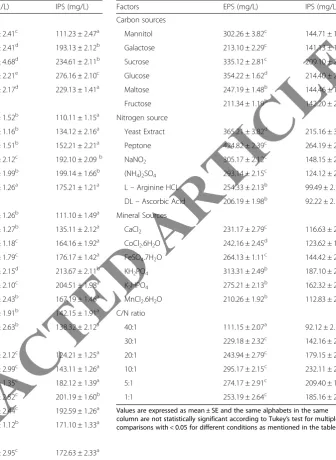
For optimized extraction of EPS and IPS,Cordyceps cica-dae culture was grown in media with different medium capacities. The maximum EPS (455.19 ± 2.21 mg/L) and IPS (276.16 ± 2.10 mg/L) production was observed in 200 mL of the liquid medium, while least values of EPS (312.14 ± 2.41 mg/L) and IPS (111.23 ± 2.47 mg/mL) production were obtained in 50 mL of the medium. However, no significant difference (p< 0.05 %) were ob-served in EPS and IPS production in the medium capaci-ties from 150 to 250 mL. Rotation speed showed direct relation with EPS and IPS production. Results obtained for effect of rotation speed on polysaccharide production showed maximum EPS (282.10 ± 1.99 mg/mL) and IPS (199.14 ± 1.66 mg/L) production in culture rotation speed 175 rpm. These results obtained showed variation in polysaccharide production. This variation is due to the fact of low oxygen requirement by the culture as shown inC. ophioglossoides and other ascomycetes [31, 41]. However, in the submerged culture of C. ophioglos-soidesmaximum values for IPS production was obtained in 150 mL of medium with rotation speed 150 rpm [31]. Culture incubation time and pH range showed signifi-cant effect on EPS and IPS production. Mycelial culture
of C. cicadae incubated for 6 days and pH 6.0 showed
maximum EPS and IPS production (Table 1). In other medicinal species viz.,C. ophioglossoidesandC. sinensis, in-cubation period of 5–6 days and slightly acidic pH 5.0–6.0 promoted maximum IPS production [31, 42]. Favourable temperature for the production of EPS and IPS was found to be 23 °C. The findings obtained for the production of EPS and IPS are similar as obtained forC. gracilisculture [32]. However, this temperature for C. sinensis was ob-served as 20 °C and 25 °C forC. ophioglossoides[43].
Six different carbon sources were studies to find the suitable medium source for the production of EPS and IPS inCordyceps cicadae. Although, all the tested carbon sources yielded EPS and IPS, but maximum EPS (354.22 ± 1.62 mg/L) and IPS (214.40 ± 2.18 mg/L) production
RETRACTED
took place in the medium supplemented with glucose. Glucose was found to be the best carbon source for my-celial culture growth in many medicinal Cordyceps sp. Table 1Effect of different factors on polysaccharides (EPS and IPS) yield in submerged culture ofC. cicadae
Sources EPS (mg/L) IPS (mg/L)
Medium capacity/ml
50 312.14 ± 2.41c 111.23 ± 2.47a
100 350.18 ± 2.41d 193.13 ± 2.12b
150 410.11 ± 4.68d 234.61 ± 2.11b
200 455.19 ± 2.21e 276.16 ± 2.10c
250 413.14 ± 2.17d 229.13 ± 1.41a
Rotation speed (rpm)
50 211.14 ± 1.52b 110.11 ± 1.15a
100 239.12 ± 1.16b 134.12 ± 2.16a
125 268.15 ± 1.51b 152.21 ± 2.21a
150 274.11 ± 2.12c 192.10 ± 2.09b
175 282.10 ± 1.99b 199.14 ± 1.66b
200 172.19 ± 1.26a 175.21 ± 1.21a
Incubation time/d
2 187.12 ± 1.26b 111.10 ± 1.49a
3 215.21 ± 1.27b 135.11 ± 2.12a
4 234.10 ± 1.18c 164.16 ± 1.92a
5 265.12 ± 1.79c 176.17 ± 1.42a
6 315.20 ± 2.15d 213.67 ± 2.11b
7 301.17 ± 2.10c 204.51 ± 1.98a
8 213.11 ± 2.43b 167.19 ± 1.46a
9 215.26 ± 1.91b 142.15 ± 1.91a
10 192.11 ± 2.63b 138.32 ± 2.12a
pH
3.0 221.13 ± 2.12c 124.21 ± 1.25a
4.0 243.24 ± 2.99c 143.11 ± 1.26a
5.0 257.22 ± 1.35c 182.12 ± 1.39a
6.0 274.11 ± 2.52c 201.19 ± 1.60b
7.0 253.31 ± 2.44c 192.59 ± 1.26a
8.0 231.10 ± 1.12b 171.10 ± 1.33a
Temperature
20 312.18 ± 2.95c 172.63 ± 2.33a
23 395.29 ± 2.16d 215.60 ± 1.71b
25 390.81 ± 2.55c 162.42 ± 2.62a
27 243.23 ± 3.41b 159.49 ± 1.46a
30 212.20 ± 2.90b 147.22 ± 1.91a
33 93.19 ± 2.61a 063.10 ± 2.46a
[image:5.595.306.539.621.732.2]Values are expressed as mean ± SE and the same alphabets in the same column are not statistically significant according to Tukey’s test for multiple comparisons with < 0.05 for different conditions as mentioned in the table
Table 2Effect of different carbon and nitrogen sources on EPS
and IPS yield in submerged culture ofC. cicadae
Factors EPS (mg/L) IPS (mg/L)
Carbon sources
Mannitol 302.26 ± 3.82c 144.71 ± 1.92a
Galactose 213.10 ± 2.29c 141.13 ± 1.46a
Sucrose 335.12 ± 2.81c 209.10 ± 2.11b
Glucose 354.22 ± 1.62d 214.40 ± 2.18b
Maltose 247.19 ± 1.48b 144.46 ± 1.46a
Fructose 211.34 ± 1.19b 142.20 ± 2.31a
Nitrogen source
Yeast Extract 365.21 ± 3.82d 215.16 ± 3.74b
Peptone 424.82 ± 2.39c 264.19 ± 2.92a
NaNO2 305.17 ± 2.12c 148.15 ± 2.79a
(NH4)2SO4 293.14 ± 2.15c 124.12 ± 2.65a
L–Arginine HCL 254.33 ± 2.13b 99.49 ± 2.16a
DL–Ascorbic Acid 206.19 ± 1.98b 92.22 ± 2.11a
Mineral Sources
CaCl2 231.17 ± 2.79c 116.63 ± 2.12a
CoCl2.6H2O 242.16 ± 2.45d 123.62 ± 1.98b
FeSO4.7H2O 264.13 ± 1.11c 144.42 ± 2.09a
KH2PO4 313.31 ± 2.49b 187.10 ± 2.36a
K2HPO4 275.21 ± 2.13b 162.32 ± 2.18a
MnCl2.6H2O 210.26 ± 1.92b 112.83 ± 2.90a
C/N ratio
40:1 111.15 ± 2.07a 92.12 ± 2.13a
30:1 229.18 ± 2.32c 142.16 ± 2.57a
20:1 243.94 ± 2.79c 179.15 ± 2.36a
10:1 295.17 ± 2.15c 232.11 ± 2.45b
5:1 274.17 ± 2.91c 209.40 ± 1.99b
1:1 253.19 ± 2.64c 185.16 ± 2.37a
Values are expressed as mean ± SE and the same alphabets in the same column are not statistically significant according to Tukey’s test for multiple comparisons with < 0.05 for different conditions as mentioned in the table
Table 3Monosaccharide composition of polysaccharides inC. cicadae
Monosaccharides (%)
Xylose 20.12 ± 2.29
Glucose 63.10 ± 4.15
Rhamnose 39.11 ± 3.57
Mannose 15.16 ± 1.34
Arabinose 2.05 ± 0.37
Galacturonic acid 0.06 ± 0.0
Galactose 0.12 ± 0.0
RETRACTED
viz., C. gracilis [32], C. ophioglossoides, C. militaris and
C. sinensis [44, 45]. Six different nitrogen sources were tested for maximum EPS and IPS production. Amongst them, peptone promoted maximum EPS (424.82 ± 2.39 mg/L) and IPS (264.19 ± 2.92 mg/L) production. Ni-trogen requirement for mycelial growth is different in different species. Yeast extract was observed as the best nitrogen source for biologically active EPS and IPS ofC. gracilis and other species of this genus [32, 43]. Six dif-ferent mineral sources were tested to obtain maximum EPS and IPS production. Submerged culture of this me-dicinal fungus promoted maximum EPS (313.31 ± 2.49 mg/mL) and IPS (187.10 ± 2.36 mg/mL) production with KH2PO4 as mineral source. This mineral source also observed as the best mineral source for two medicinal Cordyceps sp. viz,C. militaris and C. sinensis
[43]. C/N ratio 10:1 promoted maximum EPS (295.17 ± 2.15 mg/L) and IPS (232.11 ± 2.45 mg/L) production for
C. cicadae (Table 2). Present results are in conformity with previous reports on C. gracilis and C.
ophiogllosoides, as C/N ratio 10:1 provided maximum
IPS (653.79 ± 5.24 mg/L) production [31, 32] [Table 2]. Glucose was observed as the major monosaccharide in
[image:6.595.58.538.643.723.2]C. cicadae(63.10 ± 4.15 %) followed by rhamnose (39.11 ± 3.57 %), xylose (20.12 ± 2.29 %), mannose (15.16 ± 1.34 %), arabinose (2.05 ± 0.37 %), galactose (0.12 ± 0.0 %) and galacturonic acid (0.06 ± 0.0 %) (Table 3). Similar re-sults were obtained for polysaccharide composition ofC. gracilis, C. militaris and other medicinal basidiomycetes, in which glucose was found to be the major monosacchar-ide along with sucrose and galactose [32, 36, 46]. Results obtained for effect of different factors on yield of EPS and IPS showed a significant effect. Results revealed the effect on EPS and IPS production in the order as: temperature > incubation time > pH > rotary speed > medium capacity (Table 4).
Antioxidant and antimicrobial activities of EPS and IPS
The DPPH scavenging activity of EPS and IPS extracted from the mycelium ofC. cicadae showed positive direct Table 4Results obtained for orthogonal design by one factor at a time method
Experimental group Temperature (°C) pH Rotary speed/r · min−1 Culture time/d EPS (mg/L) IPS (mg/L)
1 1 1 1 1 312.13 ± 1.75 262.81 ± 2.60
2 1 2 2 2 367.10 ± 12.19 310.12 ± 11.26
3 1 3 3 3 377.15 ± 12.19 334.21 ± 12.29
4 2 1 2 3 598.41 ± 22.10 378.12 ± 24.10
5 2 2 3 1 564.68 ± 13.19 401.56 ± 12.19
6 2 3 1 2 648.69 ± 9.18 421.60 ± 6.77
7 3 1 3 2 238.15 ± 42.17 188.10 ± 12.27
8 3 2 1 3 364.15 ± 3.79 250.10 ± 2.70
9 3 3 2 1 209.16 ± 28.11 166.16 ± 15.7
K1 10.16 9.18 14.84 14.65
K2 22.11 13.91 13.78 14.98
K3 11.15 9.02 14.06 14.39
R 12.10 4.15 0.82 2.19
K1* 452.16 343.80 422.13 317.46
K2* 572.19 516.12 542.14 378.16
K3* 312.18 318.10 362.18 412.21
R* 382.11 82.18 23.18 97.75
K1=ΣEPS at culture factor level1/3., K1* =ΣIPS yield at culture factor level1/3
Table 5EC50value of EPS and IPS
Antioxidant assays EC50
EPS (mg/mL) IPS (mg/mL) Ascorbic Acid EDTA
DPPH radical scavenging activity 7.32 ± 0.00 6.79 ± 0.04 24.42 ± 2.15
-ABTS radical scavenging activity 6.38 ± 0.12 5.23 ± 0.25 0.28 ± 0.02
-Reducing power 6.19 ± 0.22 5.55 ± 0.32 0. 29 ± 0.01
-Iron chelating activity 1.45 ± 0.32 1.29 ± 0.11 - 0.06 ± 0.0
Different letters represent the significant difference in each column and row (p≤0.05)
RETRACTED
Table 6Antibacterial activity of EPS and IPS fromC. cicadae
Bacterial Strains Inhibition Zone EPS (mm) Inhibition Zone IPS (mm) Positive control
(tetra cycline)
Negative Control
(EDTA)-25 % (con.) 50 % (con.) 75 % (con.) 100 % (con.) 25 % (con.) 50 % (con.) 75 % (con.) 100 % (con.)
Escherichia coli 7.1 ± 0.5 9.2 ± 0.3 10.2 ± 0.4 11.1 ± 02 8.0 ± 0.2 10.8 ± 0.2 11.8 ± 0.9 11.9 ± 0.1 21 ± 1.52
-Klebsiella pneumonia - - 8.2 ± 0.5 9.3 ± 0.6 - - 8.9 ± 0.3 10.8 ± 0.3 23 ± 2.35
-Vivrio cholerae - 7.2 ± 0.2 9.3 ± 02 10.5 ± 0.8 - 7.8 ± 0.7 9.9 ± 0.2 10.9 ± 0.6 19 ± 1.50
-Pseudomonas aeruginosa 8.2 ± 0.3 9.4 ± 0.6 11.3 ± 0.7 12.5 ± 0.3 8.6 ± 0.5 9.9 ± 0.5 11.5 ± 0.6 12.9 ± 0.2 18 ± 1.21
-Vibrio alginolyticus - 6.2 ± 0.8 10.5 ± 0.2 10.9 ± 0.3 - 6.8 ± 0.1 10.9 ± 0.3 11.2 ± 0.7 18 ± 2.15
-Staphylococcus aureus - - 9.2 ± 0.8 10.1 ± 0.2 - - 9.5 ± 0.8 10.9 ± 0.3 15 ± 2.33
-Vibrio parahaemolyticus 7.3 ± 0.6 9.2 ± 0.4 10.4 ± 0.5 11.1 ± 0.9 7.6 ± 0.6 9.7 ± 0.4 10.9 ± 0.2 11.5 ± 0.8 16 ± 1.92
-Streptococcus pneumonia - - 7.5 ± 0.1 9.2 ± 0.5 - - 8.2 ± 0.1 9.9 ± 0.9 15 ± 1.88
-con.–concentration,p values< 0.05
BMC
Complementa
ry
and
Alternative
Medicine
(2015) 15:446
Page
7
of
10
RETRACTED
correlation with the concentration of the sample (Fig. 1c). EPS and IPS extracted from C. cicadae showed high DPPH scavenging activity. The results are also supported by EC50 values, which were found to 7.32 ± 0.09 mg/mL for EPS and 6.79 ± 0.04 mg/mL for IPS (Table 5). High DPPH scavenging activities of EPS and IPS are similar to other medicinal species like C. gracilis,C. militaris and
C. sinensis [32, 47, 48]. The inhibition percentage of the ABTS radical by EPS and IPS ofC. cicadaewas found to be directly depended upon the concentration of the sam-ple. The scavenging effect of all the extracts increased with increasing concentration as shown in the figure. At a concentration of 8.0 mg/mL, the percentage inhibition of EPS and IPS were found to be the maximum. High concentrations of the EPS and IPS are able to quench the free radicals in the system. The results indicated that the EPS and IPS ofC. cicadaepossessed significant scav-enging power for the ABTS radicals (Fig. 1d). The re-sults obtained for reducing power abilities of EPS and IPS in submerged culture ofC. cicadaeshowed that both types of polysaccharides possessed the reducing capacity. The reducing powers of EPS and IPS increased as the concentration increased (Fig. 1e). The reducing power of IPS was found to be higher than reducing power of EPS and at concentration 8 mg/mL maximum difference in the reducing power of IPS (0.53 ± 0.02 mg/mL) and EPS (0.42 ± 0.00 mg/mL) was observed. The reducing power of polysaccharides is due to presence of reductones and present results showed that EPS and IPS of C. cicadae
contained reductones which react with precursors of per-oxides to prevent peroxide formation [32]. The iron che-lating ability of the EPS and IPS was found to be related with the concentration of sample. However, at higher sam-ple concentrations EPS and IPS showed almost same iron chelating activities (Fig. 1f). Both EPS (66 %) and IPS (68 %) showed maximum iron chelating activity as con-centration 8 mg/mL. The results are further supported by EC50 values (Table 5). EPS and IPS extracted from sub-merged culture of C. cicadae have shown significant
antioxidant activities similar toC. gracilis[32],C. sinensis
[49] and C. militaris [50]. Since antioxidants are well known for playing important roles in the human meta-bolic system and for protecting against cardiovascular and neurodegenerative disease, hence showing the medicinal value of submerged culture ofC. cicadae[51, 52].
Both EPS and IPS fractions showed significant anti-microbial activities against all pathogenic microorganism tested (Table 6; Table 7). The screening of antibacterial activity indicates that there were no significant differ-ences in the power of activity between the EPS and IPS fractions. However, IPS showed slightly higher spectrum as compared to EPS. As evident from the tables, the antimicrobial spectrum was found to be directly linked with concentrations of EPS and IPS fractions. Polysac-charides fromC. cicadaeshowed broad spectrum against all the pathogenic microorganisms. Maximum activities were observed against Vibrio parahaemolyticus. The re-sults are similar as obtained for polysaccharides from other medicinal species of fungi [53–55]. Polysaccharides fromC. cicadaeshowed activity against both gram positive and gram negative strains. The sensitivity of Gram-positive bacteria to polysaccharides extracts is in conformity with the previous studies [56, 57]. This is due to the membrane composition of the bacterial stains [58].
Several factors are required for the production of EPS and IPS inC. cicadaeunder submerged culture condition. Factors affecting the polysaccharides production are temperature, rotation speed, pH, incubation time, carbon, nitrogen, mineral sources and carbon to nitrogen ratio. As revealed from the studies EPS and IPS exhibited excellent DPPH radical scavenging activity, ABTS radical scaven-ging activity, reducing power and Iron chelating activities. Present studies have revealed that the EPS and IPS ofC. cicadaewere capable to inhibit pathogenic microbes.
Conclusion
These findings will lead the way for large scale industrial fermentations and commercial uses of EPS and IPS from Table 7MIC of polysaccharides extracts against tested microorganism
Species EPS extract (mg/mL) IPS extract (mg/mL)
100 80 60 40 20 100 80 60 40 20
Escherichia coli ++ ++ +++ +++ +++ + ++ ++ +++ +++
Klebsiella pneumonia + + ++ ++ +++ + ++ ++ ++ +++
Vivrio cholera + ++ +++ +++ +++ - + + ++ +++
Pseudomonas aeruginosa - + ++ ++ +++ - + ++ ++ +++
Vibrio alginolyticus - + ++ ++ +++ - + ++ ++ +++
Staphylococcus aureus - + ++ ++ +++ - + ++ ++ +++
Vibrio parahaemolyticus * + ++ ++ +++ + ++ ++ +++ +++
Streptococcus pneumonia + + ++ ++ +++ + ++ ++ ++ +++
*MIC concentration;−No growth; + Cloudy solution (slight growth); ++ Turbid solution (strong growth); +++ Highly turbid solution (dense growth)
RETRACTED
C. cicadaeas antibacterial and antioxidants constituents. Present studies will open up the scope for large scale in-dustrial fermentation of C. cicadae culture for the production of biologically active polysaccharides and clinical trials of exo and intracellular on animal models Clinical trials of the polysaccharides extracted ofC. cica-dae like other commercially used Cordyceps species namelyC. sinensis, C. militarisandC. ophioglossoides, C. gracilisetc.
Competing interests
The authors declare that they have no competing interests.
Authors’contributions
SKS carried out the work on collection, taxonomic identification, optimization studies, antioxidant and antimicrobial studies. NG carried out the work on experimental setting and statistical analysis. NSA worked on experimental design, manuscript preparation and checking to final form. All authors read and approved the final manuscript.
Acknowledgements
First author wish to thank Science and Engineering Board, Department of Science and Technology, New Delhi for research grant under Young Scientist Scheme (SB/FT/LS-04/2013) to carry out present studies.
Author details
1Department of Plant Pathology, CSK, Himachal Pradesh Agriculture
University, Palampur (176 062), India.2Centre for Environment Science and Technology, School of Environmental and Earth Sciences, Central University of Punjab, Bathinda (151 001), India.3Department of Botany, Punjabi University Patiala, Punjab (147 002), India.
Received: 8 September 2015 Accepted: 9 December 2015
References
1. Kobayasi Y. Keys to the taxa of the generaCordycepsandTorrubiella. Trans Mycol Soci Jpn. 1982;23:329–64.
2. Kirk PM, Cannon P, David JC, Stalpers JA. Ainsworth and Bisby’s dictionary of the fungi. 10th ed. Wallingford, Oxon: CAB International; 2008.
3. Stensrud Ø, Hywel-Jones NL, Schumache T. Towards a phylogenetic classification ofCordyceps: ITS nrDNA sequence data confirm divergent lineages and paraphyly. Mycol Res. 2005;109:41–56.
4. Ji DB, Ye J, Li CL, Wang YH, Zhao J, Cai S. Antiaging effect ofCordyceps sinensisextract. Phytother Res. 2009;23:116–22.
5. Kiho T, Yamane A, Hui J, Usui S, Ukai S, Polysaccharides in fungi, XXXVI. Hypoglycemic activity of a polysaccharide (CS-F30) from the cultural mycelium ofCordyceps sinensisand its effect on glucose metabolism in mouse liver. Biol Pharm Bull. 1996;19:294–6.
6. Chen YJ, Shiao MS, Lee SS, Wang SY. Effect ofCordyceps sinensison the proliferation and differentiation of human leukemic U937 cells. Life Sci. 1997;60:2349–59.
7. Mizuno T. Medicinal effects and utilization ofCordyceps(Fr.) Link (Ascomycetes) andIsariaFr. (Mitosporic fungi) Chinese caterpillar fungi,
“Tochukaso,”. Int J Med Mushrooms. 1999;1:251–62.
8. Kim SW, Hwang HJ, Xu CP, Na YS, Song SK, Yun JW. Influence of nutritional conditions on the mycelia growth and exopolysaccharide production in Paecilomyces sinclairii. Lett Appl Microbiol. 2002;34:389–93.
9. Zhao CS, Yin WT, Wang JY, Zhang Y, Hong Y, Cooper R, et al. CordyMax™ Cs-4 improves glucose metabolism and increases insulin sensitivity in normal rats. J Altern Complement Med. 2002;8:309–14.
10. Ma X, Qiu DK, Xu J, Li JQ, Zeng MD. Effect ofCordyceps polysaccharide-liposome on transforming growth factor b-1 in the experimental liver fibrotic rats. Chinese J Gastroenterol. 1999;4:205–6.
11. Smith JE, Rowan NJ, Sullivan R. Medicinal mushrooms: a rapidly developing area of biotechnology for cancer therapy and other bioactivities. Biotechnol Lett. 2002;24:1839–45.
12. Lu C. Preventive activity ofCordycepspolysaccharides on non alcoholic steatohepatitis and their partial mechanisms of action, MSc Thesis. Anhui, PR China: Anhui Medical University; 2005. p. 1–56.
13. Liu JL, Fei Y. Enhancement ofCordyceps taiipolysaccharide andCordyceps pruinosapolysaccharide on cellular immune functionin vitro. Immunol J. 2001;17:189–91.
14. Kim HO, Yun JW. A comparative study of the production of exopolysaccharides by two entomopathogenic fungiCordyceps militarisandCordyceps sinensisin submerged mycelial cultures. J Appl Microbiol. 2005;99:728–38.
15. Li P, Huo L, Su W, et al. Free radical-scavenging capacity, antioxidant activity and phenolic content ofPouzolzia zeylanica. J Serb Chem Soc. 2006;76:709–17.
16. Hsu TH, Shiao LH, Hsieh C, Chang DM. A comparison of the chemical composition and bioactive ingredients of the Chinese medicinal mushroom Dong Chong Xia Cao, its counterfeit and mimic, and fermented mycelium ofCordyceps sinensis. Food Chem. 2002;78:463–9.
17. Zhang DW, Wang ZL, Qi W, Zhao GY. The effects ofCordyceps sinensis phytoestrogen on estrogen deficiency-induced osteoporosis in ovariectomized rats. BMC Complement Altern Med. 2014;14:484.
18. Koh JH, Kim JM, Chang UJ, Suh HJ. Hypocholesterolemic effect of hot-water extract from mycelia ofCordyceps sinensis. Biol Pharm Bull. 2003;26:84–7. 19. Yu R, Song L, Zhao Y, Bin W, Wang L, Zhang H, et al. Isolation and
biological properties of polysaccharide CPS-1 from culturedCordyceps militaris. Fitoterapia. 2004;75:465–72.
20. Liu RM, Zhang XJ, Liang GY, Yang YF, Zhong JJ, Xiao JH. Antitumor and antimetastatic activities of chloroform extract of medicinal mushroom Cordyceps taiiin mouse models. BMC Complement Altern Med. 2015;15:1–13. 21. Ukai S, Kiho T, Hara C, Morita M, Goto A, Imaizumi N, et al. Antitumor
activity of various polysaccharides isolated fromDictyophora indusiata, Ganoderma japonicum,Cordyceps cicadae,Auricularia auricula-judae, and Auriculariaspecies. Chem Pharm Bull. 1983;31:741–4.
22. Yang JZ, Zhuo J, Chen BK, Jin LQ, Lv JX, Li LJ. Regulating effects of Paecilomyces cicadaepolysaccharides on immunity of aged rats. Zhongguo Zhong Yao Za Zhi. 2008;33:292–5.
23. Zhu R, Chen YP, Deng YY, Zheng R, Zhong YF, Wang L, et al.Cordyceps cicadaeextracts ameliorate renal malfunction in a remnant kidney model. J Zhejiang Univ Sci B. 2011;12:1024–33.
24. Weng SC, Chou CJ, Lin LC, Tsai WJ, Kuo YC. Immunomodulatory functions of extracts from the Chinese medicinal fungusCordyceps cicadae. J Ethnopharmacol. 2002;83:79–85.
25. Kuo YC, Weng SC, Chou CJ, Chang TT, Tsai WJ. Activation and proliferation signals in primary human T lymphocytes inhibited by ergosterol peroxide isolated fromCordyceps cicadae. Br J Pharmacol. 2003;140:895–906. 26. Kim HS, Kim JY, Ryu HS, Shin BR, Kang JS, Kim HM, et al. Phenotypic and
functional maturation of dendritic cells induced by polysaccharide isolated fromPaecilomyces cicadae. J Med Food. 2011;14:847–56.
27. Zhu R, Zheng R, Deng Y, Chen Y, Zhang S. Ergosterol peroxide from Cordyceps cicadaeameliorates TGF-beta1-induced activation of kidney fibroblasts. Phytomedicine. 2013;21(3):372–8.
28. Kim DH, Yang BK, Jeong SC, Park JB, Cho SP, et al. Production of a hineseeric, extracellular polysaccharide from the submerged culture of the mushroom,Phellinus linteus. Biotechnol Lett. 2001;23:513–7.
29. Papagianni M. Fungal morphology and metabolite production in submerged mycelial processes. Biotechnol Adv. 2004;22:189–259. 30. Xu Q, Lü L, Chen S, Zheng G, Zheng J, Li Y. Isolation ofCordyceps
ophioglossoidesL2 from fruit body and optimization of fermentation conditions for its mycelial growth. Chinese J Chem Eng. 2009;17:278–85. 31. Qinqin XU, Zhenhua LIU, Yisheng SUN, Zhongjie DING, Longxian LÜ,
Yongquan LI. Optimization for Production of Intracellular Polysaccharide fromCordyceps ophioglossoidesL2 in submerged culture and its antioxidant activitiesin vitro. Biotechnoland Bioeng. 2012;20:294–301.
32. Shrama SK, Gautam N, Atri NS. Optimization, composition and antioxidant activities of exo and intracellular polysaccharides in submerged culture of Cordyceps gracilis(Grev.) Durieu & Mont. Evid Based Complement Alternat Med. 2015;2015:1–8.
33. Fang QH, Zhong JJ. Submerged fermentation of higher fungusGanoderma lucidumfor production of valuable bioactive metabolites-anoderic acid and polysaccharide. J Bioch Eng. 2002;10:61–5.
34. Lung MY, Chang YC.In vitroantioxidant properties of polysaccharides fromArmillaria melleain batch fermentation. Afric J Biotechnol. 2011;10:7048–57.
RETRACTED
35. Atri NS, Sharma SK, Joshi R, Gulati A, Gulati A. Nutritional and neutraceutical composition of five wild culinary-medicinal species of genusPleurotus(higher basidiomycetes) from northwest India. Int J Med Mushrooms. 2013;15:49–56. 36. Emanuel V. Biological activities of the polysaccharides produced in
submerged culture of two ediblePleurotus ostreatusmushrooms. J Biomed Biotechnol. 2012;2012:1–8.
37. Li SP, Zhao KJ, Ji ZN, Song ZH, Dong TTX, Lo CK, et al. A polysaccharide isolated fromCordyceps sinensis, a traditional Chinese medicine, protects PC12 cells against hydrogen peroxide-induced injury. Life Sci. 2003;73:2503–13. 38. Papuc C, Crivineanu M, Goran G, Nicorescu V, Durdun N. Free radicals
scavenging and antioxidant activity of European mistletoe (Viscum album) and European birthwort (Aristolochia clematitis). Rev Chim. 2010;61:619–22. 39. Oyetayo VO, Dong CH, Yao YJ. Antioxidant and antimicrobial properties of aqueous extract fromDictyophora indusiata. Open Mycol J. 2009;3:20–6. 40. Rajendran NK, Ramakrishnan J. In vitro evaluation of antimicrobial activity of
crude extracts of medicinal plants against multi drug resistant pathogens. Biyoloji Bilimleri Arastirma Dergisi. 2009;2:97–101.
41. Ji YB. Pharmacological actions and applications of anitcancer traditional chinese medicines (150.Cordyceps sinensis(Berk) Sacc). Ha’erbin, China: Heilongjiang Science and Technology Press (in Chinese); 1999. p. 494-501. 42. Hsieh C, Tsai MJ, Hsu TH, Chang DM, Lo CT. Medium optimization for
polysaccharide production ofCordyceps sinensis. Appl Biochem Biotechnol. 2005;120:145–57.
43. Dong CH, Yao YJ. Nutritional requirements of mycelial growth ofCordyceps sinensisin submerged culture. J Appl Microbiol. 2005;99:483–92.
44. Kim SY, Park SK, Park HK, Kim SW. Compositional sugar analysis of antitumor polysaccharides by high performance liquid chromatography and gas chromatography. Arch Pharm Res. 1994;17:337–42.
45. Yu KW, Suh HJ, Bae SH, Lee CS, Kim SH, Yoon CS. Chemical properties and physiological activities of stromata ofCordyceps militaris. J Microbiol Biotechnol. 2001;11:266–74.
46. Yan H, Zhu D, Xu D, Wu J, Bian X. A study onCordyceps militaris polysaccharide purification, composition and activity analysis. Afric J Biotechnol. 2008;7:4004–9.
47. Gu YX, Song YW, Fan LQ, Yuan QS. Antioxidant activity of natural and culturedCordycepssp. Zhongguo Zhong Yao Za Zhi. 2007;32:1028–31. 48. Yuan X, Sun H, Liu Y, Shiroshita T, Kawano S, Takeshi S, et al. Anti-cancer
activity comparisons of aqueous extracts fromInonotus obliquus,Cordyceps militarisandUncaria tomentosa in vitroandin vivo. J Pharmacogn Phytochem. 2014;2:19–25.
49. Leung PH, Shuna Z, Ping HK, Wu JY. Chemical properties and antioxidant activity of exopolysaccharides from mycelial culture ofCordyceps sinensis fungus Cs-HK1. Food Chem. 2009;114:1251–6.
50. Dong CH, Yang T, Lian T. A comparative study of the antimicrobial, antioxidant, and cytotoxic activities of methanol extracts from fruit bodies and fermented mycelia of caterpillar medicinal mushroomCordyceps militaris(Ascomycetes). Int J Med Mushrooms. 2014;16:485–95.
51. Vinson JA, Hao Y, Su X, Zubik L. Phenol antioxidant quantity and quality in foods: vegetables. J Agric Food Chem. 1998;46:3630–4.
52. Enayat S, Banerjee S. Comparative antioxidant activity of extracts from leaves, bark and catkins ofSalix aegyptiacasp. Food Chem. 2009;116:23–8. 53. Yoon SY, Eo SK, Kim YS, Lee CK, Han SS. Antimicrobial activity ofGanoderma
lucidumextract alone and in combination with some antibiotics. Arch Pharm Res. 1994;17:438–42.
54. Klaus A, Niksic M. Influence of the extracts isolated fromGanoderma lucidummushroom on some microorganisms. Zbornik Matice srpske za prirodne nauke. 2007;113:219–26.
55. Keypour S, Riahi H, Moradali MF, Rafati H. Investigation of the antibacterial activity of a chloroform extract of Ling Zhi or Reishi medicinal mushroom, Ganoderma lucidum(W. Curt.: Fr.) P. Karst. (Aphyllophoromycetideae), from Iran. Int J Med Mushrooms. 2008;10:345–9.
56. Venturini ME, Rivera CS, Gonzalez C, Blanco D. Antimicrobial activity of extracts of edible wild and cultivated mushrooms against food borne bacterial strains. J Food Protect. 2008;71:1701–6.
57. Yamac M, Bilgili F. Antimicrobial activities of fruit bodies and/or mycelial cultures of some mushroom isolates. Pharm Biol. 2006;44:660–7. 58. Holst O, M ller-Loennies S. Microbial polysaccharides structures. In:
Kamerling JP, Boons GJ, Lee YC, Suzuki A, Taniguchi N, Voragen AGJ, editors. Comprehensive glycoscience. From chemistry to systems biology. Amsterdam: Elsevier Inc; 2007. p. 123–79.
• We accept pre-submission inquiries
• Our selector tool helps you to find the most relevant journal • We provide round the clock customer support
• Convenient online submission • Thorough peer review
• Inclusion in PubMed and all major indexing services • Maximum visibility for your research
Submit your manuscript at www.biomedcentral.com/submit