Early Childhood and Elementary Education Dissertations
Early Childhood and Elementary Education Department
Fall 12-12-2010
A Dichotomy Examined: Beginning Teach for
America Educators Navigate Culturally Relevant
Teaching and a Scripted Literacy Program in their
Urban Classrooms
Kara M. Kavanagh
Georgia State University
Follow this and additional works at:https://scholarworks.gsu.edu/ece_diss
This Dissertation is brought to you for free and open access by the Early Childhood and Elementary Education Department at ScholarWorks @ Georgia State University. It has been accepted for inclusion in Early Childhood and Elementary Education Dissertations by an authorized administrator of ScholarWorks @ Georgia State University. For more information, please [email protected].
Recommended Citation
Kavanagh, Kara M., "A Dichotomy Examined: Beginning Teach for America Educators Navigate Culturally Relevant Teaching and a Scripted Literacy Program in their Urban Classrooms." Dissertation, Georgia State University, 2010.
ACCEPTANCE
This dissertation, A DICHOTOMY EXAMINED: BEGINNING TEACH FOR
AMERICA EDUCATORS NAVIGATE CULTURALLY RELEVANT TEACHING AND A SCRIPTED LITERACY PROGRAM IN THEIR URBAN CLASSROOMS, by KARA MAURA KAVANAGH, was prepared under the direction of the candidate’s Dissertation Advisory Committee. It is accepted by the committee members in partial fulfillment of the requirements for the degree Doctor of Philosophy in the College of Education, Georgia State University.
The Dissertation Advisory Committee and the student’s Department Chair, as representatives of the faculty, certify that this dissertation has met all standards of excellence and scholarship as determined by the faculty. The Dean of the College of Education concurs.
Julie Rainer Dangel, Ph.D. Committee Chair
Barbara Meyers, Ed.D. Committee Member
Joyce E. King, Ph.D. Committee Member
Rhina Fernandes Williams, Ph.D. Committee Member
Date
Barbara Meyers, Ed.D. Chair, Department of Early Childhood Education
R. W. Kamphaus, Ph.D.
AUTHOR’S STATEMENT
By presenting this dissertation as a partial fulfillment of the requirements for the
advanced degree from Georgia State University, I agree that the library of Georgia State University shall make it available for inspection and circulation in accordance with its regulations governing materials of this type. I agree that permission to quote, to copy from, or to publish this dissertation may be granted by the professor under whose direction it was written, by the College of Education’s director of graduate studies and research, or by me. Such quoting, copying or publishing must be solely for scholarly purposes and will not involved potential financial gain. It is understood that any copying from or publication of this dissertation which involves potential financial gain will not be allowed without my written permission.
NOTICE TO BORROWERS
All dissertations deposited in the Georgia State University library must be used in
accordance with the stipulations prescribed by the author in the preceding statement. The author of this dissertation is
Kara Maura Kavanagh 200 Renaissance Pkwy NE #310
Atlanta, GA 30308
The director of this dissertation is
Dr. Julie Rainer Dangel
Department of Early Childhood Education College of Education
CURRICULUM VITAE
Kara Maura Kavanagh
ADDRESS: 200 Renaissance Pkwy NE #310 Atlanta, GA 30308
EDUCATION:
Ph.D. 2010 Georgia State University Early Childhood Education
M.Ed. 2006 Armstrong Atlantic State University Early Childhood Education
B.A. 1998 George Mason University Psychology
1996 Gonzaga University
Florence, Italy Study Abroad
PROFESSIONAL EXPERIENCE:
2007-present Research and Teaching Doctoral Fellow Georgia State University, Atlanta 2004-2007 Third Grade Teacher/Grade Level Chair
E.F. Garrison Elementary School, Savannah, GA
PUBLICATIONS
Kavanagh, K.(2009). Review of the book, Teaching the levees: A curriculum for
democratic dialogue and civic engagement. International Journal of Multicultural Education, 11(2).
Roach, A., Meyers, B., Wixson, C., Kavanagh, K., Czaplicki, K., & Kramb, D. (2008). Including students with disabilities in multiage classrooms: Perceptions of special educators. Journal of Multiage Education, 3 (2), 22-27.
PRESENTATIONS
Schafer, N. J., Meyers, B., Swars, S. L., Kavanagh, K., Haardoerfer, R., & Czaplicki, K. (2009, February). Affordances and constraints of critical friends groups: Year two data of a longitudinal comparative study and virtual demonstration. Paper
Swars, S., Meyers, B., Schafer, N.J., Kavanagh, K. & Haardoerfer, R.(2009, April). Making it beyond the start-up enthusiasm: A case study of the process, content, impact and sustainability of a Critical Friends Group. Paper presented at the annual meeting of the American Educational Research Association, San Diego.
Schafer, N.J., Meyers, B., Swars, S., Kavanagh, K. & Haardoerfer, R.(2009, April). Virtual Critical Friends Groups: A vehicle for professional development and supporting beginning teachers. Paper presented at the annual meeting of the American Educational Research Association, San Diego.
Rainer-Dangel, J., Kavanagh, K. & Matthews, L. (2008, October). Taking a stand for children. Paper presented at the annual Georgia Association of Teacher Educators Conference, Atlanta, GA.
.
Roach, A., Meyers, B., Kavanagh, K. , Kramb, D., Czaplicki, K., & Wixson, C. (2008). An examination of the influence of standards-based reforms and accountability on multiage classrooms. Paper presented at the annual meeting of the American Educational Research Association, New York.
Meyers, B., Schafer, N., Swars, S., Kavanagh, K., Haardoerfer , R. Czaplicki, K., Parrish, C.Z., & Taylor, S.W (2008). Themes and variations of Critical Friends Groups: A contextual look and virtual demonstration. Paper presented at the annual meeting of the Association of Teacher Educators, New Orleans, LA.
Kramb, D., Czaplicki, K., Kavanagh, K., Roach, A., Meyers, B., & Wixson, C. (2007). “It’s not the path of least resistance!” Teaching and learning in multiage
classrooms. Presented at the annual meeting of the Georgia Educational Research Association, Savannah, GA.
ACADEMIC AWARDS
2009 Graduate Student Peer Mentoring Award, Georgia State University Department of Early Childhood Education
PROFESSIONAL ORGANIZATIONS
2007-present American Educational Research Association 2007-present Association of Teacher Educators
2007-present National Association of Multicultural Educators 2007-present Georgia Association of Multicultural Educators 2004- present Kappa Delta Pi
PROFESSIONAL SERVICE
2009-2010 Student representative to the Professional Education Faculty Council
ABSTRACT
A DICHOTOMY EXAMINED: NOVICE TEACH FOR AMERICA EDUCATORS NEGOTIATE THEIR CULTURALLY RELEVANT BELIEFS
AND A SCRIPTED LITERACY PROGRAM IN URBAN ELEMENTARY CLASSROOMS
by
Kara Maura Kavanagh
In contrast to the increasing diversity of students, the implementation and
consequences of federal and state policies such as No Child Left Behind (NCLB) and the
Comprehensive School Reform Act, have created a push for standardization in pedagogy
and curriculum that serve culturally and linguistically diverse students. Effects of NCLB
policies include narrowing of curriculum and pedagogy, proliferation of prescriptive
literacy programs, increased high-stakes testing, and negative effects on teachers’
identity, autonomy, and desire to teach (Achinstein, Ogawa, & Speiglman, 2004;
Cochran-Smith & Lytle, 2009; MacGillivray, Ardell, Curwen, & Palma, 2004;
Smagorinsky, Lakly & Johnson, 2002). Simultaneously, teaching prospective teachers
how to construct culturally relevant curriculum and pedagogy that meets the needs of our
diverse students is emphasized as a vital part of teacher preparation (Cochran-Smith,
2004; Gay, 2000; Irvine & Armento, 2001; Ladson- Billings, 1999). However, research
shows that even when teachers leave teacher preparation programs with preparation for
culturally relevant teaching, initial jobs and local contexts shape and constrain teachers’
ideologies, agency, goals, and practice connected to teaching diverse students (Athanases
this study was designed to investigate how novice Teach For America teachers with an
espoused culturally relevant pedagogy ideology implement a scripted literacy program in
their urban classrooms.
A multiple case study design guided the data collection and analysis. Data
collection took place over three months and included interviews, observations,
observation debriefs, visual representations, documents, and teaching artifacts. The data
were analyzed using a constant comparative approach (Merriam, 1998) and Grounded
Theory techniques (Strauss & Corbin, 1998) using within-case analysis followed by
cross-case analysis.
These alternatively certified, beginning teachers were constrained by several
institutional and contextual factors, yet were able to actively negotiate their culturally
relevant beliefs with the requirements of their mandated scripted literacy program to
enact tenets of culturally relevant teaching. These findings suggest teacher preparation
programs need to have a conceptual framework embedded in coursework and field
experiences that empowers beginning teachers to negotiate the sociopolitical constraints
A DICHOTOMY EXAMINED: NOVICE TEACH FOR AMERICA EDUCATORS NEGOTIATE THEIR CULTURALLY RELEVANT BELIEFS
AND A SCRIPTED LITERACY PROGRAM IN URBAN ELEMENTARY CLASSROOMS
by
Kara Maura Kavanagh A Dissertation
Presented in Partial Fulfillment of Requirements for the Degree of
Doctor of Philosophy in
Early Childhood Education in
the Department of Early Childhood Education in
the College of Education Georgia State University
Copyright by Kara Maura Kavanagh
ii
ACKNOWLEDGMENTS
It takes a village (and lots of trees and La Croix) to write a dissertation. I could not have completed this academic journey without the help, support, encouragement, love, and guidance of so many family, friends, mentors, and colleagues. Thank you!
I wish to thank my committee, Dr. Julie Dangel, Dr. Barbara Meyers, Dr. Joyce King, and Dr. Rhina Fernandes Williams, who have guided, cheered, and challenged me on this journey. I am very honored to have each one of you on my committee. I admire your personal and professional commitment to educational equity, multicultural education, and teacher development. Julie, THANK YOU for your infinite amount of patience and words of wisdom along the way.
To my amazing parents, a sincere thank you for being the most incredible support system a girl could have. I am so grateful that I was “raised with malice and forethought to be a pushy broad.” Thank you for understanding me, supporting me, and believing in me. You nurtured my mind, heart, spirit (and sometimes my bank account) throughout my life, so that I could dream big and achieve bigger. I hope to be to my children, what you are to me. Thank you for being my first multicultural educators. You are appreciated.
To my future wife, Laura~ how did I get so lucky? Thank you for supporting me on this rollercoaster ride. I know it was not easy being the HD or “chief cook and bottle washer” during this process, and I’m grateful that you stood by me through the piles, nests, twirls, and hanging charts. I cannot wait to write Chapter 6 with you because “You and me together can do anything....the two of us together…”
Vincent and Lisanne, thank you for believing in me and cheering me on.Vincent (and Dave)The typical situation for an American baby is to 2 step through the educational system like ants marching into a warehouse to learn rhymes and reasons whereupon their last stop is 1 of 41 satellite locations waiting for when the world ends. You’re a Genius! Alison Happel, thank you for being the most amazing friend, colleague, peer coder, peer debriefer, and all around beautiful human being. You were an important part of these past four years and have taught me so much. Let’s never stop learning, growing, and thinking!
Thank you to all of my colleagues and friends who have been an essential part of my learning and growing, especially, the GSU ECE staff, Christi Moore, Dr. Terry Fisher, Dr. Caitlin Dooley, Dr. Lydia Mays, Dr. Tonia Durden, Dr. Vera Stenhouse, Dr. Katie
iii
way. You are a truly special human being and educator. I have been so lucky to learn from your teaching, research, and leadership. Thank you for all of the opportunities!
Dee /Fiona thank you for being amazing educators who persevere through these
iv
TABLE OF CONTENTS
Page
List of Tables ... vi
List of Figures ... vii
List of Abbreviations ... viii
Chapter 1 INTRODUCTION ... 1
Statement of the Problem ... 2
Significance ... 13
Research Questions ... 15
Theoretical Framework ... 16
Defining of Terms ... 22
2 REVIEW OF LITERATURE ... 24
Multicultural Education... 25
Teacher Preparation for a Multicultural Society ... 28
Teachers’ Beliefs, Attitudes, and Practice ... 32
Novice Teachers ... 34
Literacy... 37
School Reforms and Policies... 39
Competing Theories of Learning ... 45
Summary ... 47
3 METHODOLOGY ... 49
Context ... 52
Participants ... 54
Setting... 62
Data Collection ... 66
Data Analysis... 77
Trustworthiness ... 83
Considerations and Limitations ... 87
Summary ... 89
4 FINDINGS: CROSS-CASE SIMILARITIES AND DIFFERENCES ... 90
Summary of Findings ... 99
Institutional and Contextual Influences... 101
Negotiations: Beliefs, Curriculum, and Identity ... 112
Manifestations of Culturally Relevant Teaching ... 123
v
Cross-Case Differences ... 152
Summary ... 162
5 DISCUSSION………. ... 164
Summary of Findings……….. ... 165
Contextual Influences and Constraints……… ... 167
Negotiations……… ... 176
Constrained Culturally Relevant Teaching... 179
Implications and Recommendations for Policymakers ... 183
Implications and Recommendations for Teacher Education ... 185
Implications and Recommendations for Parents, Guardians, and Schools ... 188
Recommendations for Future Research ... 189
Conclusion ... 190
References ... 193
vi
LIST OF TABLES
Table Page
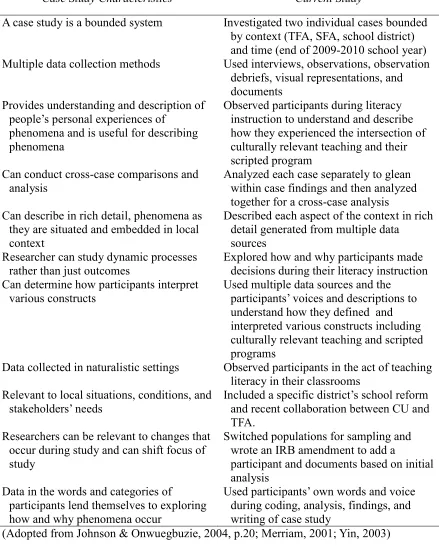
1 Case Study Design and Current Study ... 51
vii
LIST OF FIGURES
Figure Page
1 Literature Review Constructs and Relationships ... 48
2 Visual Display and Roadmap for Cross-Case Similarities ... 92
3 Visual Representation: Fiona’s Beliefs and Attitudes about SFA ... 116
4 Visual Representation: Dee’s Beliefs and Attitudes about SFA ... 116
5 Visual Representation: Fiona’s Attitudes and Beliefs about CRP during Literacy Instruction ... 126
viii
ABBREVIATIONS
CRP Culturally Relevant Pedagogy
CRT Culturally Relevant Teaching
CSR Comprehensive School Reform
CU Carter University
ELL English Language Learner
NCLB No Child Left Behind
SFA Success for All
1 CHAPTER 1
INTRODUCTION
Why is it, in spite of the fact that teaching by pouring in, learning by a passive absorption, are universally condemned, that they are still so entrenched in practice? (Dewey, 1916, p.38)
The goal of this qualitative investigation is to examine how two, novice, Teach
For America teachers with an espoused culturally relevant teaching ideology implement
the scripted literacy program, Success for All, in their urban elementary classrooms. A
holistic multiple-case study design guides me in examining these participants’
educational beliefs, attitudes, identities, and instructional practices regarding the
implementation of the two competing ideologies of culturally relevant pedagogy from
their alternative certification program and the mandated scripted curriculum of their
initial teaching placement.
This chapter provides the conceptual and theoretical framework that undergirds
every aspect of this study. While extensive, this framework is necessary for
understanding the researcher, purpose, and design of the current study. The first section
highlights the current educational and sociocultural climate that demonstrates the
relevance, necessity, and timeliness of this study. The subsequent sections demonstrate
the motivation underlying this investigation, the significance and relevance of the study
to the current literature, and the subjectivities of the researcher. The second chapter
synthesizes the necessary literature relevant to this study, so that readers can understand
enormous role in how and why I researched this study. In addition, each aspect of this
study requires a brief sociohistorical context because of the complex role each variable
plays on the other factors studied. The third chapter provides details of how the
investigation unfolded, including method, data sources, data collection, and analysis. A
detailed methodological plan outlines the steps taken to ensure the trustworthiness and
rigor of this study. Chapter four provides participant vignettes, cross-case similarities and
cross-case differences. Chapter five discusses the findings, implications,
recommendations, and suggestions for future research.
Statement of the Problem
Disparate Educational Access
Educational inequities and their societal and educational effects must be a major
concern and focus for contemporary teachers, teacher education programs, policymakers,
administrators, and educational researchers (Cochran-Smith, 2004). While many
educators, researchers, and politicians point to the achievement gap between students of
color and White students as measured by standardized test scores, others suggest this is
an incomplete and problematic discourse because it doesn’t take into account that (a)
testing is culturally biased (b) there is a “quality-of-service-gap” (Perry, Steele, &
Hilliard, 2003) and an “education debt” (Ladson-Billings, 2006) that is lacking within
that educational rhetoric. For instance, some suggest the gap is more of an opportunity
gap because these students often attend schools with fewer resources (Darling-Hammond,
2007; Ladson-Billings, 2006; Perry, Steele, & Hilliard, 2003). For example, students of
color and lower-income students in urban areas likely encounter severe shortages of
Furthermore, the Education Trust found that: (a) most school districts across the country
have the most experienced and highly paid teachers in the most affluent schools; (b) the
least qualified and least paid teachers are in schools with the highest population of
students of color and in poverty; and (c) districts tend to assign a larger sum of
unrestricted funds to their lower poverty schools (Roza, 2006). Therefore,
Ladson-Billings refers to the “education debt” (p.3), which constitutes a host of historical,
economic, sociopolitical, and moral decisions, policies, and practices that have
accumulated over time for marginalized groups. These include, (a) disparate funding for
schools with high populations of students of color and lower socioeconomic students,
(b) the exclusion of many communities of color in legislation, voting, and decision
making, (c) segregation and desegregation policies, and other aspects of history and
present day that effect the educational opportunities of historically marginalized students
and their communities. The participants in this study are African American, novice,
Teach For America teachers working in a high poverty, Title I school serving 100%
African American students. which is why this study is relevant, necessary, and timely.
Increasing Diversity of Nation’s Students
To illustrate the growing diversity and changing faces of our society, the U.S
Census Bureau projects that by the year 2042, Whites will no longer be the majority of
the U.S. population (U.S. Census Bureau, 2008). Today, 44 percent of children are
members of racial or ethnic minorities, with a projection that by 2050 62% of our nation’s
children will be considered “minority”, with 39% of these students being Hispanic (U.S.
Census Bureau, 2008). According to the National Center for Education Statistics (2008),
public schools was 58 percent non-Hispanic White, 20 percent Hispanic (regardless of
race), 16 percent non-Hispanic Black, 4 percent Asian/Pacific Islander, and 1 percent
American Indian/Alaska Native. In contrast to the increasing diversity of the student
populations, there is a push for standardization in the pedagogy and curriculum in the
schools that serve these culturally and linguistically diverse students (Cochran-Smith &
Lytle, 2009). These trends toward uniformity and one size fits all education (Kohn, 2001)
ignores the changes in our schools’ demographics as well as the students’ experiences,
cultures, and linguistic backgrounds (Schultz, Jones-Walker, and Chikkatur, 2008).
Examining teachers implementing a decontextualized scripted literacy program in a
100% African American, lower socioeconomic school is necessary, timely, and relevant.
Teacher Education Programs
One avenue to drastically improve the educational opportunities and outcomes for
students of color, low-income students, and English language learners (ELLs), is for
teacher education programs (TEPs) to dramatically rethink and envision their role in
preparing novice teachers for today’s multifaceted educational milieu (Cochran-Smith,
2004; Cochran-Smith et. al, 2003; Zeichner, 2005; Zeichner & Conklin, 2008). To
continue preparing teachers for monocultural and monolingual classrooms ignores the
“funds of knowledge” (Moll, Amanti, Neff, & González, 1992), cultures, languages, and
experiences of students, while potentially perpetuating the stratification and status quo
resulting from traditional teacher preparation (Cochran-Smith, 2004; Cochran-Smith et.
al. 2003; Ladson-Billings, 1995, 1999; Sleeter, 2005). The alternative certification
program that these participants are attending is one such university program that has
and be able to do to meet the needs of today’s diverse students. This aspect of the study’s
context is especially important as these participants are espousing to translate the
culturally relevant theory of their preparation program into their classroom practice.
Multicultural Teacher Education
Policy, theory, and practice intersect to influence and shape multicultural teacher
education (Cochran-Smith, et. al., 2003). Teacher preparation programs across the nation
have tried in various ways to meet standards and requirements set out by the National
Council for the Accreditation of Teacher Education (NCATE) regarding multicultural
guidelines by revising or adding diversity courses, curriculum, field experiences, and
policies that address multicultural education and diversity (Gollnick, 1995; Irvine, 2008;
Ladson-Billings, 1995; Zeichner & Hoeft, 1996). Despite these guidelines and reforms,
some researchers critique these efforts as disconnected and usually voluntary rather than
authentic and conceptually sound multicultural curriculum (Cochran-Smith, 2004;
Villegas & Lucas, 2002; Sleeter, 2005; Zeichner & Conklin, 2008; Zeichner & Hoeft,
1996). Cochran-Smith, Davis, and Fries (2003) explain that the demographic imperative
for teacher education is “the recognition that bridging the chasm between the school and
life experiences of those with and without social, cultural, racial, and economic
advantages requires fundamental changes in the ways teachers are educated” (p. 935).
Ladson-Billings’ (1999) review of preparing teachers for diversity argues that
multicultural teacher preparation continues to view diverse students from a deficit
perspective, so the addition of singular classes is a far cry from the necessary paradigm
shift that need to take place to radically reframe the theory and practice of teacher
model that dominates teacher preparation programs, the urban, alternative certification
program at Carter University (pseudonym) that prepares these TFA participants is
actively working to meet the needs of teacher education students by using a culturally
relevant conceptual framework for teaching and learning that specifically highlights the
educational inequities for urban youth. Considering the context, ideology, and methods
the participants are educated with juxtapose to the context of their initial placements is
essential to investigating how their beliefs, attitudes, identity, and context intersect,
influence, and shape classroom practice.
While not the silver bullet for addressing inequities in our society and schools,
quality teacher education that prepares teachers to work in diverse schools is a key area
for research and reform (Banks, Cochran-Smith, Moll, Richert, Zeichner, LePage,
Darling-Hammond, Duffy & McDonald, 2005; Cochran-Smith, 2004; Irvine, 2003, 2008;
Ladson-Billings, 1995a, 1999; Sleeter, 2008; Zeichner, 2005). Startling attrition rates
show that roughly 46% of all new teachers leave within five years, while teachers in
urban, high poverty districts leave at a rate of 50% greater than teachers in low poverty
schools (Ingersoll, 2003). There is limited research about how to prepare teachers for
teaching and staying in urban, public schools (Wilson, Floden, & Ferrini-Mundy, 2002).
Schultz, Jones-Walker, & Chikkatur (2008) explain that the “task of urban-focused
teacher preparation programs is to prepare prospective teachers to learn and enact
practices that enable them to teach successfully in urban contexts” (p.156).
Preparing Teachers of Color
In response to the demographic gap between White teachers and students of color,
pool of preservice teachers. This includes Teach For America, which actively attempts to
diversify their teaching force, which for 2009 was 68% White, 11% Black, 7%
Latino/Hispanic, 6% Asian, 5% multi-ethnic, and .5% Native American. They state, they
want leaders “who share the racial and/or socioeconomic backgrounds of the students we
teach, 90 percent of whom are African-American or Hispanic children living in
low-income communities.” (www.TeachForAmerica.org, 2010). Furthermore, they suggest
that students from underrepresented racial and socioeconomic groups can have a greater
potential impact on their students, since they can serve as role models for their students.
This assertion aligns with educational scholars who suggest teachers of color: (a) can
serve as professional and academic role models (Stewart, Meier, & England, 1989); (b)
tend to have higher expectations for students of color than White teachers (Irvine, 1990);
and they know more about the life challenges and barriers that students of color will face
(Irvine & Armento, 2001; Villegas & Lucas, 2002). This is particularly germane to this
study because both participants are Black, Teach For America educators.
Alternative Teacher Certification Programs
“Alternative teacher certification program” is commonly used in reference to a
variety of programs designed to train and credential individuals holding a bachelor’s
degree in an expedited approach. These programs vary considerably in their recruitment,
coursework, length, mentoring, internship, and practices (Humphrey, Weschler, & Hough,
2008). The rising demand for ‘‘highly qualified’’ teachers under the No Child Left Behind
Act has catapulted alternative routes to teacher certification as a considerable source of
“highly qualified” teachers for urban schools especially. Discourse surrounding
advocates of Teach For America, one of the most controversial and popular streamlined
routes, that couches their two-year program in educational reform- for- equity rhetoric.
Opponents of alternative certification are critical of these programs, by highlighting the
propensity for alternative certification to place unqualified and unprepared teachers in the
classrooms of the neediest students (Darling-Hammond, 2007). Alternatively prepared
teachers, especially teachers of color, are initially more likely to teach in urban schools
(Natriello & Zumwalt, 1993; Zumwalt & Craig, 2008). Humphrey and Wechsler (2005),
found that “teacher development in alternative certification appears to be a function of
the interaction between the program as implemented, the school context in which the
on-the-job training occurs, and the career trajectory of the individual participant” (p.5). With
the participants in this study enrolled in the Teach For America alternative certification
program at a university, it is necessary to critically examine the unique roles the
university’s coursework and mission coupled with TFA’s mission, play in their identity
development, practice, beliefs, and attitudes.
Comprehensive School Reform
The context for these participants, who are alternatively prepared Teach For
America teachers, is heavily influenced by Comprehensive School Reform models that
guide the participants’ instruction and curriculum. The No Child Left Behind Act (NCLB)
was signed into law by George W. Bush in January, 2002, with the bipartisan mission of
eliminating the “achievement gap” that exists when Black, Hispanic, and students living
in poverty are compared to White and more affluent students in reading and math (U.S.
Department of Education, 2002). The standardization and accountability underpinnings
which millions of students across the country are educated in our public schools
(Cochran-Smith & Lytle, 2009). Title I schools are encouraged to adopt a
“scientifically-proven” reform program to improve reading instruction and outcomes (Slavin, Madden,
Cheung, Chamberlain, Chambers, & Borman, 2005; U.S. Department of Education,
2002). There are over 100 different Comprehensive School Reform (CSR) designs in
schools all over the country, due to the Comprehensive School Reform Program
legislation that provides Title I funds to support school-wide programs (Datnow, Borman,
Stringfield, Overman & Castellano, 2003). Currently there is a paucity of independent,
empirical research that investigates the effects of CSRs on student achievement and
instruction. Because these reforms are mostly found in schools with highly diverse
populations, it is important to examine this neglected line of research. Hundreds of
teachers in urban schools are implementing these Comprehensive School Reforms, so it
is important and timely to examine how they influence teachers’ autonomy, beliefs,
attitudes, identity, and instruction.
Literacy and the Purpose of Schooling
While few educational researchers or teachers would argue the importance of
literacy in schools and society, the views regarding the purpose for developing literacy
ranges from developing a productive citizenry and a literate workforce to seeing literacy
as a tool for transforming the world and affirming diverse perspectives, experiences, and
histories (Freire, 1972). The former purpose of learning literacy is most aligned with the
industrial model of schooling that is meant to develop a uniform, efficient, and
competitive workforce. This model of schooling assumes that the content and knowledge
Kasten, 2002). In addition, the basic skills, knowledge, and perspectives taught are not to
be questioned or challenged. An inquiry model of education proposes schools should
represent one’s real life (Dewey, 1916), and contradicts the notion of a standardized
curriculum or knowledge to be learned. This type of schooling affirms and recognizes
diversity and multiple ways of thinking and knowing (Flint, 2008). A third model of
schooling is the critical model, which critiques and questions the role of power, gender,
and social structures. In this type of schooling, dialog is centered on understanding the
various ways literacy and cultural practices or perspectives silence, privilege, or
marginalizes people (Flint, 2008). These competing models of schooling are undergirded
by two distinct and antithetical views of learning known as sociocultural theory
(Vygotsky, 1978, 1981) and behaviorism (Skinner, 1938; Watson, 1928). Behaviorism,
which is the foundational perspective on child development for industrial model views
and scripted curriculum, see children as passive, blank slates or empty vessels that will be
filled and shaped mostly by stimuli in their environment. Vygotsky (1978, 1981) suggests
social context and culture influence attitudes, beliefs, and thoughts including how and
what we think. It is within these underlying assumptions and theories about knowledge,
schooling, and learning that I locate current trends in policy, prescriptive curriculum, and
teacher preparation that all influence teachers’ beliefs, attitudes, identities, practices, and
knowledge.
Teachers’ Beliefs, Attitudes, and Identity.
Teachers’ pedagogical beliefs are essential to investigate because they are a major
determinant of teachers’ decisions (Clark & Peterson, 1986; Fang, 1996; Kagan, 1992;
important and necessary to tease out the constructs of “beliefs”, “attitudes”, and
“identity” before attempting to discuss, measure, or parse their role in instruction. For this
thesis, attitudes will be discussed in terms of “manners of acting, feeling, or thinking that
show one’s disposition or opinion” (Philipp, 2007, p. 259). They are more cognitive than
emotions, yet not as cognitive as beliefs. Beliefs are understood as “psychologically held
understandings, premises, or propositions about the world that are thought to be true”
(Philipp, 2007, p. 259) and can vary in terms of conviction and consensus (Richardson,
1996). These beliefs can be likened to lenses that affect an individual’s view of the world
or as dispositions toward action. Identity is viewedas the “embodiment of an individual’s
knowledge, beliefs, values, commitments, intentions, and affect as they relate to one’s
participation within a particular community of practice; the ways one has learned to
think, act, and interact” (Philipp, 2007, p. 259). These three constructs are inextricably
linked as new teachers balance their identity, beliefs, and attitudes related to being
culturally relevant pedagogues with socialization and curricular mandates that may
challenge and influence their existing beliefs, attitudes, identities, and ultimately their
practice.
New Teachers and Socialization
There is often a dichotomy between pedagogical beliefs often learned from
teacher preparation, and what is expected for teachers to do in their classroom based on a
school’s administration, curricular approaches, and testing or policy pressure
(Cochran-Smith, 2004; Achinstein, Ogawa, & Speiglman, 2004). Researchers have found that
socialization is a reality; new teachers espouse beliefs and enact practices that reflect
Thompson, 2002). A dichotomy between teachers’ educational beliefs and their mandated
practice has multiple implications for the novice teacher and their teaching identity as
well as a variety of stakeholders. Research has shown that even when teachers leave
teacher preparation programs with preparation to teach in culturally responsive ways,
initial jobs and local contexts shape and constrain teachers’ ideologies, agency, goals, and
practice connected to teaching diverse students (Athanases & DeOliveira, 2008; Causey,
Thomas, & Armento, 2000; Cochran-Smith, 2004; Shultz, et. al., 2008). When
prospective teachers are not explicitly prepared to connect content taught in the academy
and the practices mandated by educational policies, neophytes are conflicted and
unprepared for the realities of teaching in today’s standardized milieu (Cochran-Smith &
Lytle, 2009).
The lack of explicit theory-practice connection and critical engagement with
scripted curricula may lead many culturally relevant pedagogues to feel a pressure to
conform to prescribed programs and completely abandon their culturally relevant
practices. Other teachers may find ways to supplement various aspects of culturally
relevant teaching while still adhering to the scripted teaching that is required of them.
Understanding how new teachers negotiate a balance between these two learning
paradigms benefits teachers, students, and teacher educators as first or second year
curricular decisions and teacher preparation are addressed. The preceding paragraphs
illuminate the multifaceted sociopolitical and educational context and variables that
influence and shape teacher preparation and novice teachers’ beliefs, attitudes, identity,
Significance
This study adds to the current literature in several ways. First, the participants are
a part of Teach For America, a controversial, yet popular alternative certification program
that focuses specifically on culturally relevant teaching and practice. As part of TFA, they
are enrolled in a particular university program which has course and program goals that
are aligned with the perspectives of Ladson-Billings’ culturally relevant characteristics,
so participants are fully immersed in a culturally relevant teaching paradigm. This study
provides a unique look at how new teachers are translating this paradigm into their
elementary literacy practice. Second, while several studies focus on veteran teachers and
culturally relevant practices, this study focuses on the experiences and practice of novice
teachers implementing culturally relevant instruction. Researchers lament the limited
research examining whether neophyte teachers engage in acts and practice related to
culturally relevant teaching, empowering school cultures for marginalized students
(Banks, 1995), or developing the commitment and skills to act as change agents (Oakes,
Franke, Quarts, and Rogers, 2002; Villegas & Lucas, 2002). Third, this study specifically
looks at culturally relevant practices during literacy instruction within the context of the
highly scripted program, Success for All, which is unique to the extant literature. A fourth
aspect that adds to the distinctiveness of this study is specifically examining the influence
of high-stakes testing and other contextual factors stemming from No Child Left Behind
on implementing culturally relevant teaching during scripted literacy instruction.
These unique aspects and the findings specifically address the needs of several
stakeholders. For example, teacher educators can see where the specific struggles are
programs and reformers can be informed about culturally relevant program designs like
the one in this study, and how they affect new teachers’ beliefs, identity, and practices.
New teachers, who are interested in culturally relevant teaching, yet feeling restrained by
mandated programs, can see how other teachers negotiate a balance between the two
paradigms. For example, Athanases and DeOliveira (2008) found that the novice teachers
in their study were able to grapple with ethical and political issues by advocating for their
diverse learners because of preparation in a program that emphasizes equity for
marginalized students. Scripted program designers, administrators, and faculty can see
how to negotiate a balance that acknowledges the need for central tenets of both
programs, while compromising on other aspects that are not congruent with culturally
relevant teaching and learning. The growing sub-field of culturally relevant teaching
needs findings from this study to fill a current gap within the extant literature base. The
timeliness of this study is emphasized with (a) the NCLB legislation being revisited, (b)
the recent commentary by the Secretary of Education, Arne Duncan calling for reforms of
teacher preparation programs, and (c) the increasing diversity of the United States. With
over 15 percent of new teachers entering through nontraditional paths
(Darling-Hammond, 2007), it is important to examine how new, Teach For America teachers,
prepared in an alternative preparation program that focuses on culturally relevant
teaching for urban classrooms, navigate this pedagogy and practice within the realities of
urban school contexts typically constrained by testing pressure and scripted programs.
The findings and implications for multiple stakeholders, including teacher preparation
Research Questions
The research questions that guided this inquiry are as follows:
1. How do novice teachers prepared with a culturally relevant teaching
framework implement a scripted literacy program?
2. What culturally relevant strategies, resources, activities, and assignments
do novice teachers implement during scripted literacy instruction?
3. What are the teachers’ attitudes and beliefs regarding culturally relevant
teaching during literacy instruction?
4. What are the teachers’ attitudes and beliefs regarding the use of scripted
programs during literacy instruction?
5. How does a scripted curriculum influence the identity of a novice teacher?
6. How does high stakes testing influence culturally relevant literacy
instruction?
As this qualitative investigation evolved, it became clear that the last question should
actually be broader than just high stakes testing. The larger sociopolitical context of
federal policies like No Child Left Behind that influenced the adoption of Comprehensive
School Reform models, Teach For America, alternative teacher preparation programs, and
definitions and measures of knowledge and success, were a separate yet intersecting and
comprehensive context that influenced culturally relevant literacy instruction. I adjusted
this question to respond to this realization and instead asked,
Theoretical Framework
This section reveals my researcher positionality, subjectivities, and views of
education and research. It illustrates my worldviews, motivations, and theoretical
framework that locate me in a very specific and contested place in educational research.
In addition, this theoretical framework guides this study’s literature review, research
design, methods, and discussion.
Social Constructionism
Inevitably, no matter their research paradigm, researchers bring assumptions and
a theoretical lens with which they view the world, knowledge, and the purpose of
research (Crotty, 1998). Epistemology concerns the nature of knowledge, its potential,
and capacity (Maynard, 1994). The epistemological stance that undergirds this research
study is most closely aligned with constructionism. Crotty (1998) explains
constructionism as the perspective that “all knowledge, and therefore all meaningful
reality as such, is contingent upon human practices, being constructed in and out of
interaction between human beings and their world, and developed and transmitted within
an essentially social context” (p.42). Furthermore, social constructionism emphasizes the
powerful influence our culture and society has on how individuals make meaning. In
essence, human beings construct meaning by engaging and interacting with objects
whose meanings are derived from our own cultural systems of knowing and viewing the
world that have been collectively created by previous members and institutions within
our culture (Crotty, 1998). By aligning more with a social constructionist versus a
constructivist view of knowledge and meaning creation, I am explicitly suggesting that
by multiple sociocultural forces that influence what and how we know and construct
meaning. For example, a novice teacher constructs meaning about her students and
curriculum based on external meanings developed by systems such as her teacher
preparation program, educational policies, and curriculum developers.
Critical Inquiry
Because culturally bestowed meaning informs individuals’ present day meaning
often without question, I align with critical theorists who question and critique this social
constructionist process, which reproduces and perpetuates “meanings that support
particular power structures, resists moves towards greater equity, and harbors oppression,
manipulation, and other modes of justice and unfreedom” (Crotty, 1998, p.60). Crotty
(1998) suggests the world of the critical theorist is a “battleground of hegemonic
interests. In this world there are striking disparities in the distribution of power: some
people have dominant power; others have far less power; most have no power at all.” (p.
63). My research and academic interests are situated within a critical inquiry theoretical
perspective that “challenges…that reads the situation in terms of conflict and
oppression…and seeks to bring about change” (Crotty, 1998, p. 113). In the case of this
study, the critical theorist in me asks, why are scripted programs such as Success for All
in predominately urban, high poverty schools with large numbers of students of color?
Freire’s (1972) concept of praxis in which “reflection and action upon the world
in order to transform it” (p. 28) speaks to the role that I as an educational researcher and
educator have in mind for my research and pedagogy. Mere critical reflection or
investigation does not lead to the goals of critical inquiry and praxis. It must involve
1972). Freire emphasizes this dual process, “…reflection without action as sheer
verbalism, ‘armchair revolution’, whereas action without reflection is ‘pure activism’,
that is action for action’s sake” (1972, p. 41). This necessary dual process is iterative,
simultaneous, and continuous (Freire, 1972). By reflecting on the question above, I am
led to more questions about the role of teacher education and educational research. What
responsibilities do teacher education programs have in preparing teachers to negotiate the
pedagogies they teach and espouse with the realities of pedagogies and programs that
transpire in today’s standardized milieu?
My research pursuit is purposeful and seeks to capture the necessary reflection
and action link between theory and practice and the voice of the neophyte teacher who is
negotiating this balance. The findings, implications, and discussions can be disseminated
in forums that contribute to all stakeholders’ knowledge, including PreK-12 teachers,
administrators, policymakers, teacher educators, parents, and community activists. The
very groups I target constitute an overall type of checks and balance system that could
and should use praxis to inform, analyze and critique their decision–making, actions, and
pedagogy. This leads me to Freire’s movement towards critical consciousness in which
“human beings are meant to be Subjects and not merely objects of their history...the
world is to be seen as not some kind of static reality but as a reality in process. They are
called to transform it- and thereby transform themselves” (Freire, 1972, p. 56). This
critical consciousness concept asks us to see ourselves as change agents that can
challenge the status quo, engage in dialogue/debate, and acknowledge our role and
Critical Pedagogy
Critical Pedagogy is a micro theory that draws heavily from Freire, Giroux,
McLaren, Shor, Apple, Kinchloe, and other critical theorists. It informs and challenges
my research, interests, activism, and thinking. While no one definition of Critical
Pedagogy exists currently, Giroux (2006) is worth quoting at length:
Critical pedagogy makes clear that schools and other educational spheres cannot be viewed merely as instructional sites but must be seen as places where culture, power, and knowledge come together to produce particular identities, narratives, and social practices. Critical Pedagogy points to redefining the role of the school as a democratic public sphere, educating teachers to be publicly engaged intellectuals who address the most
pressing problems of their society as part of a wider politics and pedagogy of solidarity and democratic struggle, and rewriting the curriculum in order to address the lived experiences that different students bring to the school while not being limited to such knowledge. It illuminates the primacy of the ethical in defining the language that teachers and others use to produce particular cultural practices. (p. 5)
By associating the current role of schooling as a tool for perpetuating further stratification
of our society, I am revealing my subjectivities that certain schools and students are
provided opportunities to engage in critical thinking to prepare them for middle class
status and careers, while others, constrained by scripted programs. are limited to lower
thinking skills that will prepare them for the lower echelons of society.
Culturally Relevant Pedagogy
Critical pedagogy and culturally relevant pedagogy (Ladson-Billings, 1994, 1995)
are micro theories that overlap, extend, compliment, and frame this research study on
“How do novice teachers prepared with a culturally relevant paradigm implement a
scripted literacy program?” because it problematizes the use of prescribed materials that
dictate what is taught, when it is taught, and how it is taught. Scripted programs do not
pedagogy and culturally relevant teaching are often viewed as antithesis to scripted
curricula, which are being implemented in schools all over the country. Ladson-Billings
describes culturally relevant pedagogy (CRP) as following these philosophies: (a)
Teaching is an art and the teacher is the artist; (b) The teacher is part of the community
and gives something back to the community; (c) The teacher believes all students can be
successful; (d) The teacher facilitates students making connections between community,
national, and global identities; (e) The teacher sees knowledge as coming from the
students; (f) The teacher-student relationships are equitable and fluid; (g) The teacher
demonstrates a connectedness with all students, not just a few; (h) The teacher builds and
facilitates a community of learners where learning is collaborative; (i) Knowledge is
continuously critiqued, shared, recycled, and recreated; (j) The teacher is passionate
about content; (k) The teacher helps students develop necessary skills; and (l) Excellence
is a multifaceted standard which takes diversity and individual differences into account.
This study views culturally relevant teaching as a lens and approach to teaching and
learning. With a scripted curriculum seemingly the antithesis to culturally relevant
teaching, we should examine how new teachers negotiate among the school mandates of
their initial teaching context and the educational theories, ideologies, attitudes, and
beliefs that guide their teacher education programs.
The framework of Social Constructionism, Critical Inquiry, Critical Pedagogy,
and Culturally Relevant Pedagogy requires me as a researcher and educator to reflect,
analyze, question, problematize, and act in terms of moving towards critical
consciousness and transforming schools, society, and myself. My research must question,
education, and teacher preparation (Cochran-Smith, 2004). This framework allows me to
challenge, reflect, and act in regards to standards, testing, teacher education, school
segregation, tracking, textbooks, policies like NCLB, school funding, and other
oppressive institutional structures that are currently in place. It allows me to explore and
question the role of power, race, class, gender, language, ability, religion, and sexual
orientation in the classroom, texts, research, teacher preparation, policies and practices. It
determines my research interests in terms of the “so what” aspect of researching. What
change could and should come out of my research? Why is it important to study this
particular question? How does it add to the dialogue of what constitutes education? For
this study, I am interested in examining how novice teachers negotiate their culturally
relevant pedagogy beliefs with the mandated practices of their initial placements.
Specifically, how are new teachers’ literacy instruction, pedagogical beliefs, attitudes and
identities affected by current policies and practices including scripted curriculum and
high-stakes testing? It is important to study this question, so teacher preparation programs
can meet the needs of prospective teachers who then can meet the needs of their students.
The teachers’ voices are heard through observations, observation debriefs, and interviews.
This framework and the research conducted within it is concerned with educational
disparities based on hierarchical categories that mimic and reproduce society’s inequities.
It is my job as an educational researcher to question and publicize this replication, so that
teachers, students, and communities can question, challenge, critique, and act on these
disparities to transform themselves, their schools, and ultimately—society. The next
chapter will highlight the relevant extant literature on the constructs and context
Defining of Terms
Alternative teacher certification program: refers to programs designed to train
and credential individuals holding a bachelor’s degree in an expedited approach. They
vary considerably in their recruitment, coursework, length, mentoring, internship, and
practices (Humphrey, Weschler, & Hough, 2008).
Attitudes: manners of acting, feeling, or thinking that show one’s disposition or
opinion” (Philipp, 2007, p. 259).
Beliefs: “psychologically held understandings, premises, or propositions about the
world that are thought to be true” (Philipp, 2007, p. 259)
Comprehensive School Reform Act – federal legislation that aims to “raise student
achievement by assisting public schools across the country to implement effective,
comprehensive school reforms that are based upon scientifically based research and
effective practices” (http://www.centerforcsri.org/)
Culturally and linguistically diverse (CLD) students: descriptive of students
whose culture and/or language are assets for learning, but are nonetheless different from
that of the dominant culture and/or language
Culturally relevant pedagogy: a comprehensive and multidimensional lens of
teaching and learning that includes the curriculum, learning context, student-teacher
relationships, instructional strategies, and performance assessments that address the
whole child. It involves developing students academically and affirming their cultural
competencies, while developing their critical, sociopolitical consciousness
Identity: “embodiment of an individual’s knowledge, beliefs, values,
commitments, intentions, and affect as they relate to one’s participation within a
particular community of practice; the ways one has learned to think, act, and interact”
(Philipp, 2007, p. 259).
Success for All: is a highly scripted comprehensive whole school reform program
that is found predominately in Title I schools. For this study, the SFA literacy component
was observed
Teach For America: is the “national corps of outstanding recent college graduates
of all academic majors and career interests who commit two years to teaching in urban
and rural public schools” while attending an alternative certification program
(http://www.teachforamerica.org/)
Urban: all territory, population, and housing units located within an urbanized
area or an urban cluster, which consists of core census block groups or blocks that have a
population density of at least 1,000 people per square mile and surrounding census blocks
that have an overall density of at least 500 people per square mile (U.S. Census, 2000).
Urban school districts: are characterized by a large highly diverse population,
centralized decision making, underfunding, and standardized measures of teaching,
learning, and intelligence “urban teachers must be able to accommodate the greatest
diversity of student needs under conditions that continually subvert their efforts to
24 CHAPTER 2
LITERATURE REVIEW
This section provides a synthesis of scholarship necessary to understand the
complexities of this investigation, including a brief historical overview of multicultural
education, culturally relevant teaching, teacher education, Teach For America, teachers’
beliefs, attitudes, and identity, novice teachers and socialization, Comprehensive School
Reform, and Success for All (SFA). Each of these topics and constructs has a vast body of
literature that is beyond the scope of this section to review. However, I include the
necessary literature that directly relates to intersections of the particular constructs that
are relevant to this investigation. While impossible to include the decades of all related
research, it is equally impossible to ignore the multifaceted layers and context of these
constructs in understanding the sociopolitical context and variables that play a vital role
in shaping how, why, and what culturally relevant teachers teach during their beginning
years of teaching.
While not inclusive of all conceptual or empirical literature surrounding this topic,
for this review I highlight the work of well-respected scholars in the various fields (i.e.
Banks, Cochran-Smith, Darling-Hammond, Feiman-Nemser, Hilliard, Irvine, King,
Ladson-Billings, Nieto, Sleeter, Zeichner). These educational researchers have written
watershed books, articles, and chapters that have been peer reviewed, critiqued, and cited
by countless authors, researchers, and academics. In addition, the majority of those I
Association for their excellence in scholarship and research. Smaller relevant studies are
included to show the dearth of related rigorous research, illuminating the relevance,
necessity, and importance of this study.
Multicultural Education
Educational researchers, theorists, curriculum developers, and educators vary
considerably in their ways of defining, conceptualizing, researching, and discussing
multicultural education over the past fifty years of this emerging field (Banks, 1992,
1995, 1999; Grant and Sleeter, 1985, 1989; Gay, 2000, 2002; Nieto, 1992; Nieto & Bode,
2008; Sleeter & Grant, 1987). Sonia Nieto’s work as a critical multiculturalist is most
closely aligned with my conceptualizations and practice of multicultural education and
critical pedagogy. Nieto (Nieto, 1992; Nieto & Bode, 2008) places multicultural
education in a sociopolitical context and extends previous definitions by proclaiming:
Multicultural education is a process of comprehensive school reform and basic education for all students. It challenges and rejects racism and other forms of discrimination in schools and society and accepts, and affirms the pluralism (ethnic, racial, linguistic, religious, economic, and gender, among others) that students, their communities, and teachers reflect. Multicultural education permeates schools’ curriculum and instructional strategies as well as the interactions among teachers, students, and families and the very way that schools conceptualize the nature of teaching and learning. Because it uses critical pedagogy as its underlying philosophy and focuses on knowledge, reflection, and action (praxis) as the basis for social change, multicultural education promotes democratic principles of social justice. (p. 44)
Nieto summarizes her definition by underscoring seven central characteristics of
multicultural education as being: (a) antiracist education, (b) basic education, (c)
important for all students, (d) pervasive, (e) for social justice, (d) a process, and (e)
critical pedagogy (Nieto & Bode, 2008). Her definition illuminates the sociopolitical
education as a necessary and comprehensive model of school reform and societal change
in the United States. Interestingly, it does not explicitly include all groups, and we can see
how individuals of varying sexual orientation and disability have been lumped into the
category of “among others” (Nieto & Bode, 2008, p. 44). Her definition, like others,
points to the lack of a common definition and consensus that is inclusive of all. The
discourse surrounding the need for multicultural education in K-12 classrooms and
teacher preparation is complicated by this lack of a consensus. It also highlights the
significance of this study as I investigated how novice teachers implemented the theories
and purpose of multicultural education into their scripted literacy instruction.
As discussed in Chapter 1, Gloria Ladson-Billings (1994, 1995b) outlines
pedagogical and philosophical underpinnings that she identifies as the central
characteristics to effectively teach students of color in order to address the aspects of the
achievement gap and demographic divide that K-12 teachers and teacher educators can
impact (Banks, 1995; Cochran-Smith, Davis, & Fries, 2003; Gay & Howard, 2001;
Hollins & Guzman, 2005; Irvine & Armento, 2001; Zeichner & Hoeft, 1996; Sleeter,
2005). This pedagogical and content related perspective is often used as a conceptual
framework for teacher preparation programs, research studies, and discussions of K-12
multicultural education. Culturally relevant pedagogy (CRP) builds upon the previous
goals, theories, scholars, and philosophies developed in the field over the past fifty years.
It advocates for developing students academically while affirming and nurturing their
cultural competencies, cultural identities and developing a sociopolitical and critical
consciousness that challenges the status quo (Ladson-Billings, 1994). In this study, I use
analysis. Because the participants in this study are prepared with this culturally relevant
teaching framework, it is important to identify what helps or hinders their use of
culturally relevant teaching during their first two years of teaching. This understanding
can inform teacher preparation programs looking to implement this conceptual
framework as well as new teachers whose preparation and knowledge gained from
preparation are challenged and constrained by curriculum and policy.
As mentioned, the “operationalizing” of culturally relevant teaching and
multicultural education in the K-12 classroom is problematic and can be challenging to
find relevant empirical literature. However, Morrison, Robbins, and Rose (2008)
conducted a synthesis of classroom-based research (n=45) using the tenets of
Ladson-Billings’ culturally relevant pedagogy framework of high academic expectations, cultural
competence, and critical consciousness. They found dozens of ways that classroom
teachers were defining and enacting culturally relevant resources, instruction, and
activities including but not limited to, (a) altering and reshaping the traditional curricula
(Arce, 2004; Hicklin-Hudson & Ahlquist, 2003); (b) building on students’ funds of
knowledge and language (Hollie, 2001; Howard, 2001); and (c) developing relationships
between schools and communities (Hicklin-Hudson & Ahlquist, 2003; Hyland, 2005).
This study adds to this small but important base of literature that demonstrates how
teachers are implementing culturally relevant teaching within their classrooms despite the
mandated institutional policies and curricula that constrain this type of teaching and
Teacher Preparation for a Multicultural Society
Almost 30 years ago, the National Council for the Accreditation of Teacher
Education issued the Standards for the Accreditation of Teacher Education, which
required teacher education programs to incorporate multicultural education curriculum
(Gollnick, 1995). In the 1970s and 1980s, multicultural education initially focused on
race, ethnicity, and culture specifically. It has since evolved and expanded over the years
to include research and theory on social class, gender, abilities, and sexual orientation
with a more recent focus on the multiple intersections of several of these identities
(Banks, 1995; Grant & Sleeter, 1985; Grant, Elsbree, & Fondrie, 2004; Sleeter, 2005) on
education. During this time, most of the multicultural programs and curriculum guides
focused on celebrating cultural differences and human or intergroup relations (Grant &
Sleeter, 1985), which ignored exposing the inequities of power, money, and curriculum
that was the initial purpose of multicultural education. The integration of critical
pedagogy, which sees education as a political movement that can liberate people from
oppression by challenging societal, economic, and political structures that maintain status
quo (Giroux, 1988; Nieto, 1992; Nieto & Bode, 2008; Sleeter & Bernal-Delgado, 2004)
with multicultural education helped to refocus multicultural education on its purpose and
goals of challenging inequities. The next trend in multicultural education appeared in the
late 1990s when individuals like Howard (1999) and Sleeter (2008) noticed how White
teachers often subconsciously used their racial privileges, assumptions, and bias to
interfere with learning to teach with a multicultural philosophy. The more recent trend of
multicultural education and the use of culturally relevant teaching, which is most relevant
Typical teacher preparation approaches that addressed the multicultural education
NCATE requirement have usually focused on changing teachers’ beliefs and attitudes,
providing teachers with content and curricular knowledge on the histories and
experiences of different cultural groups, and supporting them to learn specific practices
for working with diverse students (Banks, 1995; Cochran-Smith, 2004; Gay, 2000, 2002;
Gollnick, 1995; Grant, 1994; Ladson-Billings, 1995a). Often these efforts have not
occurred as part of a programmatic commitment to address the preparation of teachers for
diversity (Cochran-Smith, 2004; Cochran-Smith et. al, 2003; Zeichner & Hoeft, 1996),
but were instead an add-on or isolated diversity class. Despite this trend, multicultural
education scholars continued to highlight the importance of the need for teacher
education programs to explicitly address issues of diversity and multicultural education
by infusing it throughout all of their courses, coursework, and placements
(Cochran-Smith et al., 2003; Ladson-Billings, 1995a, 1999; Sleeter, 2005; Villegas & Lucas, 2002).
Teaching prospective teachers to construct culturally relevant curriculum and pedagogy is
emphasized in the literature as a vital part of teacher preparation (Cochran-Smith, 2004;
Gay, 2000; Irvine & Armento, 2001; Ladson Billings, 1994, 1995a, 1999). Schultz,
Jones-Walker, and Chikkatur (2008) stated, “The task of urban-focused teacher education
programs is to prepare prospective teachers to learn and enact practices that enable them
to teach successfully in under-resourced districts that offer both opportunities and
constraints” (p. 155). With this understanding in mind, the Carter University urban
alternative preparation program included the appropriate courses, assignments, and