Hydrol. Earth Syst. Sci., 16, 1349–1363, 2012 www.hydrol-earth-syst-sci.net/16/1349/2012/ doi:10.5194/hess-16-1349-2012
© Author(s) 2012. CC Attribution 3.0 License.
Hydrology and
Earth System
Sciences
Spatial horizontal correlation characteristics in the land data
assimilation of soil moisture
X. Han1,2, X. Li1, H. J. Hendricks Franssen2, H. Vereecken2, and C. Montzka2
1Cold and Arid Regions Environmental and Engineering Research Institute, Chinese Academy of Sciences, Lanzhou, Gansu, 730000, China
2Forschungszentrum J¨ulich, Agrosphere (IBG 3), Leo-Brandt-Strasse, 52425 J¨ulich, Germany
Correspondence to: X. Li ([email protected])
Received: 12 September 2011 – Published in Hydrol. Earth Syst. Sci. Discuss.: 27 September 2011 Revised: 12 April 2012 – Accepted: 27 April 2012 – Published: 10 May 2012
Abstract. Remote sensing images deliver important infor-mation about soil moisture, but often cover only part of an area, for example due to the presence of clouds or vegeta-tion. This paper examines the potential of incorporating the spatial horizontal correlation characteristics of surface soil moisture observations in land data assimilation in order to obtain improved estimates of soil moisture at uncovered grid cells (i.e. grid cells without observations). Observing sys-tem simulation experiments were carried out to assimilate the synthetic surface soil moisture observations into the Commu-nity Land Model for the Babaohe River Basin in northwest-ern China. The estimation of soil moisture at the uncovered grid cells was improved when information about surrounding observations and their spatial correlation structure was in-cluded. Including an increasing number of observations for covered and uncovered grid cells in the assimilation proce-dure led to a better prediction of soil moisture with an upper limit of five observations. A further increase of the number of observations did not further improve the results for this specific case. High observational coverage resulted in a bet-ter assimilation performance, depending also on the spatial distribution of observation data. In summary, the spatial hor-izontal correlation structure of soil moisture was found to be helpful for improving the surface soil moisture data charac-terization, especially for uncovered grid cells.
1 Introduction
These studies showed that remotely sensed surface soil moisture and surface temperature have become the impor-tant data sources in regional land data assimilation applica-tions. Examples are the surface soil moisture products of the microwave sensors AMSR-E (Advanced Microwave Scan-ning Radiometer for EOS) (Njoku and Chan, 2006), ASCAT (Advanced Scatterometer) (Naeimi et al., 2009), SMOS (Soil Moisture and Ocean Salinity) (Kerr et al., 2010), the up-coming SMAP mission (Soil Moisture Active Passive) (En-tekhabi et al., 2010), and the land surface temperature of thermal infrared sensor MODIS (Moderate Resolution Imag-ing Spectroradiometer) (Wan and Li, 2008). However, soil moisture retrieval based on microwave measurements is of-ten hampered by the presence of vegetation cover (Dorigo et al., 2010; Njoku and Chan, 2006) or topography (Flores et al., 2009; Matzler and Standley, 2000; Pellenq et al., 2003). Moreover, passive microwave sensor records can be contam-inated by radio frequency interferences and accordant pixels have to be excluded from the analysis (Anterrieu, 2011; Skou et al., 2010). The land surface temperature retrievals can also be influenced by the cloud cover (Coll et al., 2009; Wan and Li, 2008). All these effects may lead to incomplete spatial coverage of the soil moisture and surface temperature fields from remotely sensed measurements for the study area of in-terest leading to an exclusion of these areas for data assimi-lation purposes as no data are available. However, land sur-face variables like soil moisture or sursur-face temperature show a spatial horizontal correlation (we will use “spatial correla-tion” as a synonym for “spatial horizontal correlacorrela-tion”). The presence of such correlations implies that land surface vari-ables at the uncovered area can be related to land surface variables at the covered area. Brocca et al. (2010a) and Ryu and Famiglietti (2006) studied the spatial correlation of soil moisture at different spatial scales. The results showed that the spatial correlation pattern of soil moisture could be mod-eled with the help of geostatistical approaches and the re-gional soil moisture content could be estimated using a fixed number of samples. This provides the opportunity to improve the estimation of land surface variables by propagating the information of observations from covered areas to uncovered areas. De Lannoy et al. (2009) and Reichle and Koster (2003) have studied the impact of horizontal error correlation in the model forecast covariance matrix for soil moisture assimila-tion. On the other hand, due to the inaccuracies in the spa-tial registration of remote sensing products (Townshend et al., 1992), and the difference between the spatial resolution of remote sensing platforms and the land surface model, re-motely sensed observations cannot be mapped directly onto the model grid cell. This means it is difficult to find the obser-vation data located at the same spatial location as the model grid cell. There are offsets between the observation location and the model location.
In land data assimilation, these two common problems should be considered jointly: uncovered model grid cells be-cause of the observational spatial coverage and the distance
between the observation location and model location because of the inaccuracies in the spatial registration of remote sens-ing products. We need to assess whether the neighborsens-ing sur-rounding observations can be used to improve model esti-mations or not. In order to incorporate the spatial correla-tion pattern of observacorrela-tions into a data assimilacorrela-tion system, we chose the local observation selection technique (Grey-bush et al., 2010; Houtekamer and Mitchell, 1998; Hunt et al., 2007; Whitaker et al., 2008), in which the observations near a model grid cell can be used for updating with data assimilation.
The local observation selection limits the impact of ob-servations further away from the grid cell by filtering out the small correlations associated with these observations. The benefits and performance of the local observation se-lection were discussed by Greybush et al. (2010) and Hunt et al. (2007) in the framework of Local Ensemble Trans-form Kalman Filter (LETKF). Presently, geostatistical meth-ods which can characterize the spatial correlation structure of state variables such as soil moisture have not yet been used in the local observation selection technique of data assimilation. In particular, the geostatistical semivariogram model can be used to model the horizontal spatial depen-dence among observations (Chiles and Delfiner, 1999; De Lannoy et al., 2006; Lakhankar et al., 2010).
The objective of this study is to evaluate the potential of in-corporating the spatial correlation characteristics of observa-tions into LETKF in order to improve the soil moisture pro-file estimation. The organization of this paper is as follows. Section 2 presents a review of the study area, the Commu-nity Land Model, as well as the details of model input data. Section 3 presents the experimental design and the explana-tion of the methodologies used. Results in Sect. 4 are derived from the observing system simulation experiments. Section 5 provides a brief summary and discussion of the key results.
2 Study area, model and data
2.1 Study area
X. Han et al.: Spatial horizontal correlation characteristics in the land data assimilation of soil moisture 1351
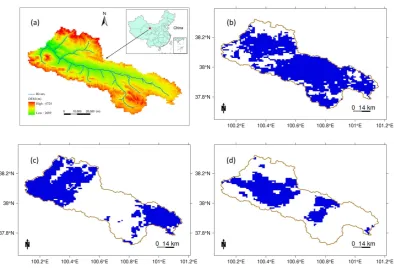
Fig. 1. Babaohe digital elevation model (DEM) (a) and the masks with 70 % (b), 47 % (c) and 31 % (d) observational coverages used in data
assimilation.
2.2 Model and input data
The new developed Community Land Model 4 (CLM) (Ole-son et al., 2010) was used to describe the soil-vegetation-atmosphere transfer of water, energy and matter. CLM rep-resents several aspects of the land surface including surface heterogeneity and consists of components or submodels re-lated to land biogeophysics, hydrologic cycle, biogeochem-istry and ecosystem dynamics (Oleson et al., 2010). The model of the Babaohe River Basin consists of 15 soil layers, and the model grid resolution is 1 km. There are 3640 active grid columns.
The 25 km and 3 hourly atmospheric forcing data from the Global Land Data Assimilation System (GLDAS) project (Rodell et al., 2004), in which several forcing products from the model reanalysis and remote sensing were combined to-gether, were interpolated on a 1 km grid with a temporal res-olution of 1 h. Precipitation was interpolated in time using a linear disaggregation method provided by the Global Soil Wetness Project 2 (GSWP2). The temporal interpolations of incident solar radiation, incident longwave radiation, wind speed, relative humidity, air pressure and air temperature were based on the cubic spline method (Dai et al., 2003). The quasi-physically based high resolution meteorological inter-polation model MicroMet, in which the spatial interinter-polations are performed using the Barnes objective analysis scheme (Liston and Elder, 2006) and the 1 km SRTM Digital Ele-vation Model were used in the spatial interpolation of the forcing data.
We used the MODIS 500 m Plant Functional Type (PFT) scheme of product MCD12Q1 to replace the CLM 0.5◦ PFT data. The MODIS PFT was projected into Longitude-Latitude Projection and resampled to 1 km using MRT (MODIS Reprojection Tool). Next, the MODIS PFT (12 types) was translated to CLM PFT (17 types) using the 1 km global climate data WorldClim (Hijmans et al., 2005) and the methods proposed by Bonan et al. (2002). The mean temperature for the warmest and coldest season of the year, the annual precipitation, the precipitation of the driest, warmest and coldest seasons are necessary input data for the PFT translation and were taken from the WorldClim database. Additionally, the growing-degree days above 5◦C, calculated from the GLDAS forcing data, are necessary input to reclassify MODIS PFT to CLM PFT (Bonan et al., 2002). The 4-day MODIS leaf area index (LAI) data (MCD15A3) at 1 km resolution was used to calculate the monthly LAI, and the stem area index (SAI) was estimated based on the methods proposed by Lawrence and Chase (2007).
2010). The HWSD is a 30 arc-second raster database with over 16 000 different soil mapping units that combines exist-ing regional and national updates of soil information world-wide (SOTER, ESD, Soil Map of China, WISE), with the information contained within the 1:5 000 000 scale FAO-UNESCO Soil Map of the World.
The maximum fractional saturated area, which is defined as the cumulative distribution function of the topographic index when the grid cell mean water table depth is zero, was calculated based on the methods proposed by Niu et al. (2007) using the 100 m GDEM (GDEM is a product of METI and NASA) and 1 km SRTM DEM (Jarvis et al., 2008).
3 Methodology
3.1 Experiment design
The proposed methods were evaluated with help of an Ob-serving System Simulation Experiment (OSSE). A reference run of CLM (single CLM) was driven by the unperturbed forcing and soil parameters from 1 June 2007 to 31 Au-gust 2008. The soil moisture profile results from 1 June 2008 to 31 August 2008, calculated by the reference CLM run, were selected as the ground truth. The daily surface soil moisture (5 cm depth) results from 1 June 2008 to 31 Au-gust 2008 at 07:00 Z were selected to be used as the model values that will be updated by data assimilation. There are 92 soil moisture observation data in the time series used for the assimilation. Through the correlation analysis of the soil moisture, we find that the correlation lengths range from several kilometers to hundreds of kilometers. In this synthetic study, the corrupted observations were generated by adding spatially correlated noise to the synthetic truth. The spatially correlated noises were generated using a range value of 10 km. To be more precise, a spatially correlated Gaussian random field with mean 0.0 and an exponential semivariogram model with nugget 0.0 (m3m−3)2, variance 0.0016 (m3m−3)2 (i.e. the standard deviation of soil mois-ture observation is 0.04 m3m−3, which is the volumetric ac-curacy of the SMOS mission; Kerr et al., 2010 as well as the upcoming SMAP mission; Entekhabi et al., 2010), and range 10 km was added to the surface soil moisture fields from the reference run in order to obtain the synthetic sur-face soil moisture observation data. The random fields of spa-tially correlated noise were generated using the geoR pack-age (Ribeiro Jr. and Diggle, 2001) of the statistical data anal-ysis software R (http://www.r-project.org/).
The spin up period of CLM for the 10 ensemble mem-bers was from 1 June 2007 to 31 May 2008 using a temporal resolution of one hour. The open loop run for the 10 ensem-ble members was from 1 June 2008 to 31 August 2008. The 10 ensemble members had different perturbed forcing data and soil parameters (details will be provided in Sect. 3.4).
3.2 Spatial correlation and geostatistics
The presence of horizontal spatial dependence of land sur-face properties is typically identified with help of a semi-variogram analysis (Goovaerts, 1997; Ryu and Famiglietti, 2006). Several semivariogram models are often used to char-acterize the spatial dependence such as the Gaussian model, the exponential model, the spherical model and the Matern model (Goovaerts, 1997; Minasny and McBratney, 2005). In this paper, we only considered these semivariogram models to characterize the spatial dependence of surface soil mois-ture. These models are defined as follows:
γ (h)=c0+c
h/a∗1.5−0.5∗(h/a)2 spherical (1) γ (h)=c0+c (1−exp(−3h/a)) exponential (2) γ (h)=c0+c
1−exp−3h2/a2 Gaussian (3) γ (h)=c0+c
1 2v−10 (v)
2v1/2h a
!v
Kv 2v 1/2h
a !!
Matern (4) wherec0is nugget,cis equal to sill minus nugget,his the separation distance,ais the (effective) range parameter,Kv
is a modified Bessel function of second order v, 0 is the gamma function andv(kappa) is called “smoothness param-eter” (v >0). The normalized semivariogramγ (h)Noris de-fined asγ (h)Nor=γ (h)/(c0+c)and the correlogram is then given by 1−γ (h)Nor. The nugget value describes the unre-solved variance at the scale smaller than the smallest lag dis-tance whereas the sill describes the variance of the observed data as they become spatially independent. The calculated correlogram is normalized using the maximum correlogram value, which means that the correlogram value is equal to one at the observation locations. It gradually reduces towards 0.0 as the distance from the analysis grid cell increases, and is null beyond the specified correlation range. The observation selection scheme in LETKF is as follows: spatial correlations between the model location and the observation locations are calculated according to the fitted semivariogram; the ob-servations whose correlograms are larger than a predefined threshold are selected for each model grid cell.
X. Han et al.: Spatial horizontal correlation characteristics in the land data assimilation of soil moisture 1353
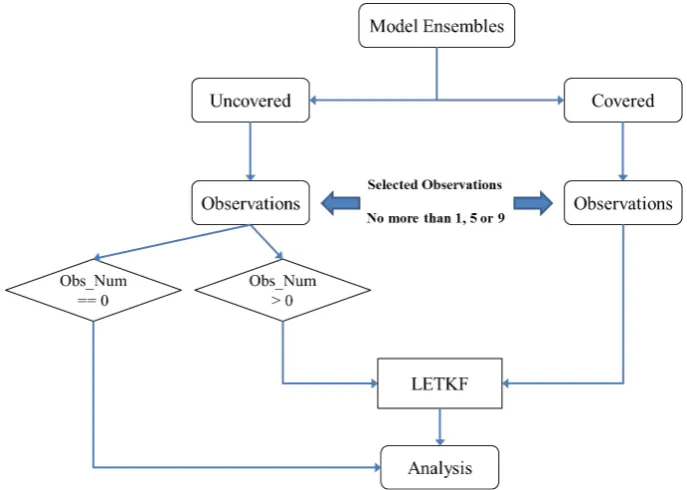
Fig. 2. Flow chart of data assimilation procedure for covered and uncovered grid cells, “Obs Num” is the number of observations.
cells were selected covering 70, 47 and 31 % of the model ac-tive grid cells of this study area. The maximum distance con-sidered when fitting the semivariogram of observation data was set as 10 km and pairs of locations with separation dis-tances larger than this value were ignored. Isotropic semi-variograms of surface soil moisture observations were fitted using the geoR package in R.
3.3 Local ensemble transform Kalman filter
The local ensemble transform Kalman filter proposed by Hunt et al. (2007) is a new variant of the ensemble Kalman filter (EnKF). The main difference compared to the vari-ous kinds of implementations of EnKF, such as the stochas-tic EnKF (Burgers et al., 1998), the determinisstochas-tic meth-ods (Whitaker and Hamill, 2002), the ensemble adjustment Kalman filter (EAKF) (Anderson, 2001), the ensemble trans-form Kalman filter (ETKF) (Bishop et al., 2001) and the Ensemble Square Root Filter (EnSRF) by Whitaker and Hamill (2002), is the local analysis scheme used by LETKF (Houtekamer and Mitchell, 1998; Hunt et al., 2007; Kalnay et al., 2007; Miyoshi and Yamane, 2007; Whitaker et al., 2008). Here, the spatial correlation characteristics of the observa-tions were considered in the framework of the LETKF local analysis scheme. It only considers the observations located in a local region surrounding the analysis model grid cell. The observations were selected for each grid cell before data as-similation. The grid cell by grid cell analysis method can eas-ily be parallelized and is useful to decrease the computational burden for the large scale data assimilation. For the detailed introduction of LETKF, please refer to Hunt et al. (2007).
3.4 Ensemble generation
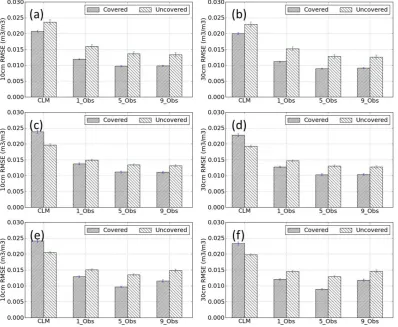
Fig. 3. Mean RMSE values of soil moisture (including 95 % confidence intervals) for open loop simulations (CLM) and three assimilation
strategies of 1 observation used (1 Obs), 5 observations used (5 Obs) and 9 observations used (9 Obs) for 10 cm and 30 cm depth. Results are shown for 70 % – 10 cm (a), 30 cm (b) – 47 % – 10 cm (c), 30 cm (d) – and 31 % – 10 cm (e), 30 cm (f) – observational coverages.
3.5 Data assimilation strategies
Three assimilation strategies were evaluated, in which dif-ferent local observation selection options were used to in-clude the spatially correlated observations into the analysis scheme: (1) only one observation was used for each grid cell (1 Obs); only the closest observation was included; (2) no more than five observations were used for each grid cell (5 Obs); in addition to the closest observation the next clos-est four observations were included; (3) no more than nine observations were used for each grid cell (9 Obs), eight ad-ditional observations were included in the data assimilation procedure. Figure 2 summarizes the data assimilation proce-dure for the covered and uncovered grid cells.
The above three strategies were used for both covered grid cells and uncovered grid cells. All uncovered grid cells with sufficient correlated observations in the neighborhood were updated, and the model grid cells without sufficiently correlated observations were not updated. The impacts of three different observational coverages (as represented by the three different masks) on the assimilation results were also analyzed.
The soil moisture assimilation was only concerned with updating the liquid soil moisture content and the synthetic observations were also generated from the liquid soil mois-ture. The update of soil moisture content was constrained such that the sum of liquid soil moisture content and ice con-tent was never larger than the soil porosity. The soil mois-ture of the surface soil layer (5 cm depth) was updated using the corresponding observations. The soil moisture contents of the other nine unobserved lower soil layers were updated based on the cross correlation between the observed upper soil layer and the unobserved layer.
X. Han et al.: Spatial horizontal correlation characteristics in the land data assimilation of soil moisture 1355
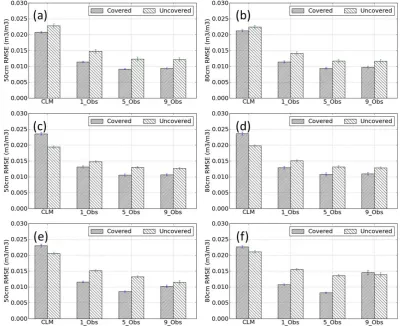
Fig. 4. Mean RMSE values of soil moisture (including 95 % confidence intervals) for open loop simulations (CLM) and three assimilation
strategies of 1 observation used (1 Obs), 5 observations used (5 Obs) and 9 observations used (9 Obs) for 50 cm and 80 cm depth. Results are shown for 70 % – 50 cm (a), 80 cm (b) – 47 % – 50 cm (c), 80 cm (d) – and 31 % – 50 cm (e), 80 cm (f) – observational coverages.
from 0.5 to 1.0. Of course in case of only weak correla-tions, the correcting influence of observations is limited and those weakly correlated observations hardly will reduce the variance.
4 Results and discussion
In order to evaluate the quality of the obtained results, the Root Mean Square Error (RMSE) and the Nash-Sutcliffe model efficiency (NSE) coefficient were calculated. Because RMSE values are usually affected by the mean bias or the mean variation differences, we added the NSE as another measure (Reichle et al., 2010). NSE values represent the cor-relation between the estimation and the observation. RMSE and NSE values for each grid cell were calculated according to:
RMSE= v u u u t
N
P
n=1
(Estimated−Truth)2
N (5)
NSE=1−
N
P
n=1
(Estimated−Truth)
N
P
n=1
[Truth−mean(Truth)]2
(6)
where “Estimated” is the ensemble mean of open loop run or the ensemble mean after assimilation.N is the number of time steps, it is 2208 for this study. The smaller the RMSE value and the larger the NSE value are, the better the assimi-lation results will be.
First we calculated the RMSE and NSE values of each grid cell in the whole time window. Then the mean RMSE and mean NSE for the covered and uncovered grid cells were calculated separately. The 95 % confidence intervals of the mean RMSE (NSE) were also calculated on the basis of the RMSE (NSE) values at individual grid cells using the Bayesian methods (Oliphant, 2006).
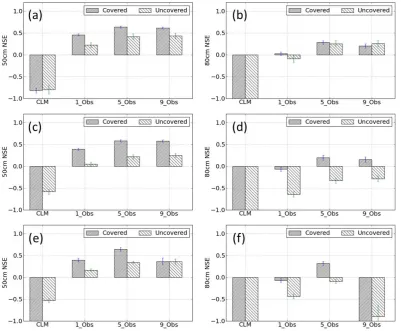
Fig. 5. Mean NSE values of soil moisture (including 95 % confidence intervals) for open loop simulations (CLM) and three assimilation
strategies of 1 observation used (1 Obs), 5 observations used (5 Obs) and 9 observations used (9 Obs) for 10 cm and 30 cm depth. Results are shown for 70 % – 10 cm (a), 30 cm (b) – 47 % – 10 cm (c), 30 cm (d) – and 31 % – 10 cm (e), 30 cm (f) – observational coverages.
and 30 cm (Fig. 3b, d and f) depth. These results are given for 70 %, 47 % and 31 % observational coverage and include the 95 % confidence intervals. Figure 4 shows the corresponding results at 50 cm depth and 80 cm depth.
Figures 5 and 6 present results for the same simulation set-ups, observational coverages and soil depths as Figs. 3 and 4, respectively, but now the mean soil moisture NSE values are given.
The results of Figs. 3 and 4 illustrate that the characteriza-tion of soil moisture contents both at the covered and uncov-ered grid cells were improved with data assimilation. The de-crease of RMSE at the covered grid cells is larger than that at the uncovered grid cells. Comparing the results for different observation strategies shows that 5 Obs and 9 Obs perform better than 1 Obs for 70 % observational coverage and 47 % observational coverage. 5 Obs performs better than 1 Obs and 9 Obs for 31 % observational coverage. 5 Obs is always the best strategy for all cases. The NSE values reported in Figs. 5 and 6 also demonstrate that the 5 Obs strategy yields the best results.
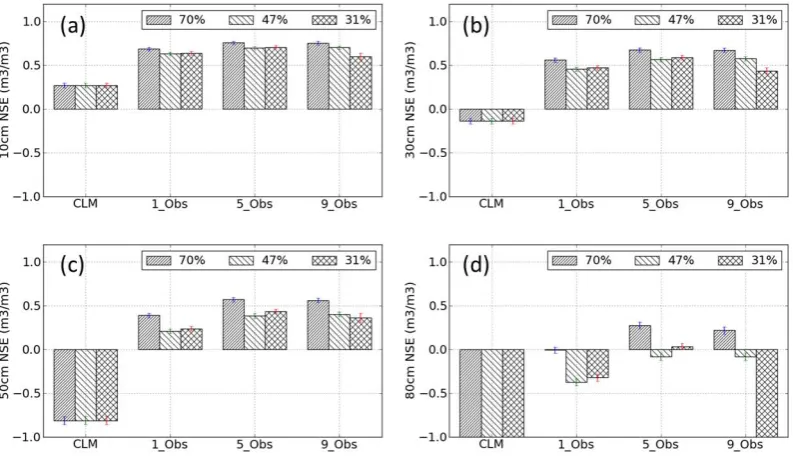
The basin scale mean RMSE values and mean NSE values for all grid cells (including all covered and uncovered grid cells) can give us additional insight in the performance of the different assimilation strategies. Figure 7 shows the mean basin scale soil moisture RMSE values for open loop simu-lations and the other three assimilation results of 1, 5 and 9 local observations used at all grid cells for 10 cm (Fig. 7a), 30 cm (Fig. 7b), 50 cm (Fig. 7c) and 80 cm depth (Fig. 7d). These results are presented for 70 %, 47 % and 31 % obser-vational coverages. Figure 8 shows the corresponding mean basin scale soil moisture NSE values.
The RMSE values reported in Fig. 7 illustrate again that 5 Obs is the best assimilation strategy. A comparison of the results for the 5 Obs strategy for different observational erages illustrates that the results for 70 % observational cov-erage are superior to the other ones. Surprisingly, the results for 31 % observational coverage are slightly better than the ones for 47 % observational coverage. The results for the NSE values (Fig. 8) are consistent with the ones for Fig. 7.
X. Han et al.: Spatial horizontal correlation characteristics in the land data assimilation of soil moisture 1357
Fig. 6. Mean NSE values of soil moisture (including 95 % confidence intervals) for open loop simulations (CLM) and three assimilation
strategies of 1 observation used (1 Obs), 5 observations used (5 Obs) and 9 observations used (9 Obs) for 50 cm and 80 cm depth. Results are shown for 70 % – 50 cm (a), 80 cm (b) – 47 % – 50 cm (c), 80 cm (d) – and 31 % – 50 cm (e), 80 cm (f) – observational coverages.
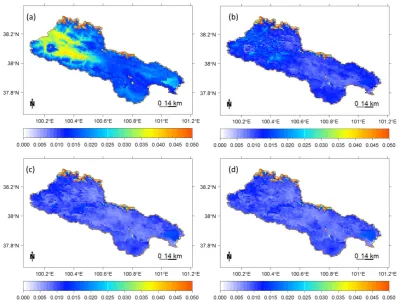
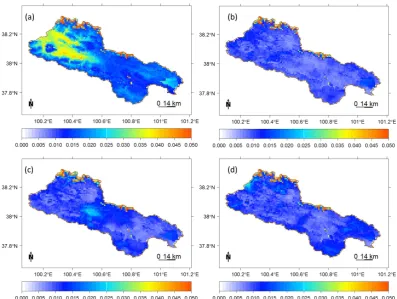
moisture RMSE values from the open loop simulations and the other three assimilation results for 1, 5 and 9 local ob-servations at 70 % observational coverage (Fig. 9). Figure 10 shows the spatial distribution of 10 cm soil moisture RMSE values from the open loop simulations and the other three as-similation results for 5 observations at 70 %, 47 % and 31 % observational coverages. In Fig. 9, there are still some re-gions with increased RMSE-values for the 1 Obs strategy (Fig. 9b), but these regions disappear when 5 or 9 observa-tions were used in the data assimilation. Results for 5 Obs and 9 Obs are very similar. Figure 10 shows high RMSE re-gions at the uncovered grid cells for 47 % and 31 % observa-tional coverage. Nevertheless, the RMSE values are smaller than those of the open loop simulations (Fig. 10a).
The results for the surface soil moisture characterization illustrate that the estimations for covered and uncovered grid cells can be improved when for a certain grid cell surround-ing observations were included in the estimation. The estima-tions at the uncovered grid cells were also improved when the surrounding correlated observations were used. Results are better if more observations were included in the data
assimilation, but more than five observations of surface soil moisture did not much improve the estimations in this case.
The lower soil layers (10 cm, 30 cm, 50 cm and 80 cm) were also updated based on the cross correlation between the surface soil layer and lower soil layer in the LETKF. The improved results in the lower layers prove that the vertical correlations among the soil layers can be useful to transfer the surface observation to the lower layers. The improved results at the uncovered grid cells also prove that the hori-zontal correlations among the observation data can be useful to transfer the observation data from the observed grid cells to the unobserved grid cells. Therefore, the combination of the vertical correlations and the horizontal correlations in the soil moisture data assimilation is helpful for improving the characterization of soil moisture heterogeneity.
Fig. 7. This figure shows the mean basin scale soil moisture RMSE values (including 95 % confidence intervals) for open loop simulations
(CLM) and three assimilation strategies of 1 observation used (1 Obs), 5 observations used (5 Obs), 9 observations used (9 Obs) at all grid cells for 10 cm (a), 30 cm (b), 50 cm (c) and 80 cm (d) depth and 70 %, 47 % and 31 % observational coverages.
Fig. 8. This figure shows the mean basin scale soil moisture NSE values (including 95 % confidence intervals) for open loop simulations
(CLM) and three assimilation strategies of 1 observation used (1 Obs), 5 observations used (5 Obs), 9 observations used (9 Obs) at all grid cells for 10 cm (a), 30 cm (b), 50 cm (c) and 80 cm (d) depth and 70 %, 47 % and 31 % observational coverages.
in time. Temporal stability of soil moisture (Brocca et al., 2010a; De Lannoy et al., 2006) has been extensively studied. Dunne and Entekhabi (2005) studied the ensemble Kalman smoother in the soil moisture assimilation, but the poten-tial of temporal correlation has probably not yet been fully explored in the framework of data assimilation schemes.
Moreover, land cover and soil type-dependent spatial corre-lations may improve the findings of this study.
[image:10.595.100.497.348.578.2]X. Han et al.: Spatial horizontal correlation characteristics in the land data assimilation of soil moisture 1359
Fig. 9. This figure shows the basin scale 10 cm soil moisture RMSE values for open loop simulations (a) and three assimilation strategies of
1 observation used (1 Obs) (b), 5 observations used (5 Obs) (c) and 9 observations used (9 Obs) (d) in case of 70 % observational coverage.
spatial correlation used in the land data assimilation. The re-sults of this work rely on the specific spatial correlation char-acteristics of input data. The spatial correlation range of high resolution data is shorter than that of coarse spatial resolution data. It is necessary to study what could be the contribution of spatial correlation for soil moisture assimilation in (very) high resolution land surface models. The synthetic experi-ment typically overestimates the performance of the method because conceptual uncertainty and model uncertainty are neglected from the analysis (Kumar et al., 2009). Therefore, a real-world case study with more data is desirable.
The masks used in this study cannot represent the true spatial coverage of microwave sensors, which is easily in-fluenced by the spatial distribution of vegetation. More than 90 % of the grid cells in this study area are covered by short grass and we think that the masks used in this work are more suitable for representing the proposed idea to evaluate the impacts of spatial correlations.
An operational application of the presented spatial corre-lation patterns may be feasible for the assimicorre-lation of surface soil moisture in weather forecast models like the ECMWF Integrated Forecast System (Drusch et al., 2009). However, the computational issue for the large scale high resolution data assimilation will be challenging, because we have to fit
the semivariograms for soil moisture at each time step. The fitting algorithm will increase the computation remarkably.
5 Summary
Fig. 10. This figure shows the basin scale 10 cm depth soil moisture RMSE values for open loop simulations (a) and three assimilation
strategies of 70 % observational coverage (b), 47 % observational coverage (c) and 31 % observational coverage (d) for the 5 Obs strategy.
Our study showed that including the horizontal spatial de-pendence of surface soil moisture observations in the data assimilation scheme improved the estimation. The model es-timations at the grid cells without observations can be im-proved using the geostatistical model and LETKF. In this particular case, best results were obtained by assimilating five observations. The best assimilation performance was achieved for a high observational coverage, but the results also depend on the spatial distribution of the observation data. For example, the results for 47 % observational erage are worse than the results for 31 % observational cov-erage, because the spatial distribution for the 31 % observa-tional coverage is more uniform than the one for the 47 % observational coverage: for the 47 % observational coverage we can find a large gap between the patches of observations (Fig. 1c). Therefore, the lower observational coverage can be offset by the horizontal spatial correlation.
In summary, the proposed spatial correlation method will be helpful to the soil moisture data assimilation in two ways: increasing the spatial availability of observations and off-setting the impact of spatial registration error in the remote sensing data processing. Since the spatial correlations are the intrinsic characteristics of many land surface variables, it is worth extending the proposed methods to the land data as-similation of other observation data.
Acknowledgements. This work was supported by the Na-tional High-tech Program (863) of China (grant number: 2009AA122104), the Knowledge Innovation Program of the Chi-nese Academy of Sciences (grant number: KZCX2-EW-312) and the NSFC (National Science Foundation of China) project (grant number: 40901160, 40925004). Carsten Montzka received financial support from the DFG (German Science foundation) by means of the project TR-32 “Patterns in Soil-Vegetation-Atmosphere systems: Monitoring, modeling and data assimilation”, which is gratefully acknowledged. The data used in this study were acquired as part of the mission of NASA’s Earth Science Division and archived and distributed by the Goddard Earth Sciences (GES) Data and Information Services Center (DISC).
Edited by: Y. Li
References
Anderson, J. L.: An ensemble adjustment Kalman filter for data as-similation, Mon. Weather Rev., 129, 2884–2903, 2001.
Anterrieu, E.: On the Detection and Quantification of RFI in L1a Signals Provided by SMOS, IEEE T. Geosci. Remote, 49, 3986– 3992, doi:10.1109/Tgrs.2011.2136350, 2011.
X. Han et al.: Spatial horizontal correlation characteristics in the land data assimilation of soil moisture 1361
Bonan, G. B., Levis, S., Kergoat, L., and Oleson, K. W.: Land-scapes as patches of plant functional types: An integrating con-cept for climate and ecosystem models, Global Biogeochem. Cy., 16, 1021, doi:10.1029/2000gb001360, 2002.
Brocca, L., Melone, F., Moramarco, T., and Morbidelli, R.: Spatial-temporal variability of soil moisture and its esti-mation across scales, Water Resour. Res., 46, W02516, doi:10.1029/2009wr008016, 2010a.
Brocca, L., Melone, F., Moramarco, T., Wagner, W., Naeimi, V., Bartalis, Z., and Hasenauer, S.: Improving runoff prediction through the assimilation of the ASCAT soil moisture product, Hydrol. Earth Syst. Sci., 14, 1881–1893, doi:10.5194/hess-14-1881-2010, 2010b.
Burgers, G., van Leeuwen, P. J., and Evensen, G.: Analysis scheme in the ensemble Kalman filter, Mon. Weather Rev., 126, 1719– 1724, 1998.
Chiles, J. P. and Delfiner, P.: Geostatistics: modeling spatial uncer-tainty, Wiley-Interscience, 1999.
Coll, C., Wan, Z. M., and Galve, J. M.: Temperature-based and radiance-based validations of the V5 MODIS land surface temperature product, J. Geophys. Res.-Atmos., 114, D20102, doi:10.1029/2009jd012038, 2009.
Dai, Y. J., Zeng, X. B., Dickinson, R. E., Baker, I., Bonan, G. B., Bosilovich, M. G., Denning, A. S., Dirmeyer, P. A., Houser, P. R., Niu, G. Y., Oleson, K. W., Schlosser, C. A., and Yang, Z. L.: The Common Land Model, B. Am. Meteorol. Soc., 84, 1013–1023, doi:10.1175/Bams-84-8-1013, 2003.
De Lannoy, G. J. M., Verhoest, N. E. C., Houser, P. R., Gish, T. J., and Van Meirvenne, M.: Spatial and temporal characteris-tics of soil moisture in an intensively monitored agricultural field (OPE(3)), J. Hydrol., 331, 719–730, 2006.
De Lannoy, G. J. M., Houser, P. R., Verhoest, N. E. C., and Pauwels, V. R. N.: Adaptive Soil Moisture Profile Filter-ing for Horizontal Information Propagation in the Indepen-dent Column-Based CLM2.0, J. Hydrometeorol., 10, 766–779, doi:10.1175/2008jhm1037.1, 2009.
Dharssi, I., Bovis, K. J., Macpherson, B., and Jones, C. P.: Opera-tional assimilation of ASCAT surface soil wetness at the Met Of-fice, Hydrol. Earth Syst. Sci., 15, 2729–2746, doi:10.5194/hess-15-2729-2011, 2011.
Dorigo, W. A., Scipal, K., Parinussa, R. M., Liu, Y. Y., Wagner, W., de Jeu, R. A. M., and Naeimi, V.: Error characterisation of global active and passive microwave soil moisture datasets, Hy-drol. Earth Syst. Sci., 14, 2605–2616, doi:10.5194/hess-14-2605-2010, 2010.
Drusch, M., Scipal, K., de Rosnay, P., Balsamo, G., Andersson, E., Bougeault, P., and Viterbo, P.: Towards a Kalman Filter based soil moisture analysis system for the operational ECMWF Integrated Forecast System, Geophys. Res. Lett., 36, L10401, L10401, doi:10.1029/2009gl037716, 2009.
Dunne, S. and Entekhabi, D.: An ensemble-based reanalysis ap-proach to land data assimilation, Water Resour. Res., 41, W02013, doi:10.1029/2004wr003449, 2005.
Entekhabi, D., Njoku, E. G., O’Neill, P. E., Kellogg, K. H., Crow, W. T., Edelstein, W. N., Entin, J. K., Goodman, S. D., Jackson, T. J., Johnson, J., Kimball, J., Piepmeier, J. R., Koster, R. D., Mar-tin, N., McDonald, K. C., Moghaddam, M., Moran, S., Reichle, R., Shi, J. C., Spencer, M. W., Thurman, S. W., Tsang, L., and Van Zyl, J.: The Soil Moisture Active Passive (SMAP) Mission,
Proc. IEEE, 98, 704–716, 2010.
FAO, Iiasa,: Harmonized World Soil Database (version 1.1), FAO, Rome, Italy and IIASA, Laxenburg, Austria, 2010.
Flores, A. N., Ivanov, V. Y., Entekhabi, D., and Bras, R. L.: Im-pact of Hillslope-Scale Organization of Topography, Soil Mois-ture, Soil TemperaMois-ture, and Vegetation on Modeling Surface Microwave Radiation Emission, IEEE T. Geosci. Remote, 47, 2557–2571, doi:10.1109/Tgrs.2009.2014743, 2009.
Ghent, D., Kaduk, J., Remedios, J., Ardo, J., and Balzter, H.: Assimilation of land surface temperature into the land surface model JULES with an ensemble Kalman filter, J. Geophys. Res.-Atmos., 115, D19112, doi:10.1029/2010jd014392, 2010. Goovaerts, P.: Geostatistics for natural resources evaluation, Oxford
University Press, USA, 1997.
Greybush, S. J., Kalnay, E., Miyoshi, T., Ide, K., and Hunt, B. R.: Balance and Ensemble Kalman Filter Lo-calization Techniques, Mon. Weather Rev., 139, 511–522, doi:10.1175/2010MWR3328.1, 2010.
Hijmans, R. J., Cameron, S. E., Parra, J. L., Jones, P. G., and Jarvis, A.: Very high resolution interpolated climate sur-faces for global land areas, Int. J. Climatol., 25, 1965–1978, doi:10.1002/Joc.1276, 2005.
Houtekamer, P. L. and Mitchell, H. L.: Data assimi-lation using an ensemble Kalman filter technique, Mon. Weather Rev., 126, 796–811, doi:10.1175/1520-0493(1998)126<0796:DAUAEK>2.0.CO;2, 1998.
Hunt, B. R., Kostelich, E. J., and Szunyogh, I.: Efficient data assimilation for spatiotemporal chaos: A local en-semble transform Kalman filter, Physica D, 230, 112–126, doi:10.1016/j.physd.2006.11.008, 2007.
Jarvis, A., Reuter, H. I., Nelson, A., and Guevara, E.: Hole-filled seamless SRTM data V4, International Centre for Tropical Agriculture, available from: http://srtm.csi.cgiar.org (last access: May 2012), 2008.
Kalnay, E., Li, H., Miyoshi, T., Yang, S. C., and Ballabrera-Poy, J.: 4-D-Var or ensemble Kalman filter?, Tellus A, 59, 758–773, doi:10.1111/j.1600-0870.2007.00261.x, 2007.
Kerr, Y. H., Waldteufel, P., Wigneron, J. P., Delwart, S., Cabot, F., Boutin, J., Escorihuela, M. J., Font, J., Reul, N., Gruhier, C., and Others: The SMOS Mission: New Tool for Monitoring Key Ele-ments ofthe Global Water Cycle, Proc. IEEE, 98, 666–687, 2010. Kumar, S. V., Reichle, R. H., Koster, R. D., Crow, W. T., and Peters-Lidard, C. D.: Role of Subsurface Physics in the Assimilation of Surface Soil Moisture Observations, J. Hydrometeorol., 10, 1534–1547, doi:10.1175/2009jhm1134.1, 2009.
Lakhankar, T., Jones, A. S., Combs, C. L., Sengupta, M., Haar, T. H. V., and Khanbilvardi, R.: Analysis of Large Scale Spatial Vari-ability of Soil Moisture Using a Geostatistical Method, Sensors, 10, 913–932, doi:10.3390/S100100913, 2010.
Lawrence, P. J. and Chase, T. N.: Representing a new MODIS consistent land surface in the Community Land Model (CLM 3.0), J. Geophys. Res.-Biogeo., 112, G01023, doi:10.1029/2006jg000168, 2007.
Li, X., Huang, C. L., Che, T., Jin, R., Wang, S. G., Wang, J. M., Gao, F., Zhang, S. W., Qiu, C. J., and Wang, C. H.: Develop-ment of a Chinese land data assimilation system: its progress and prospects, Prog. Nat. Sci., 17, 881–892, 2007.
Li, X., Li, X. W., Li, Z. Y., Ma, M. G., Wang, J., Xiao, Q., Liu, Q., Che, T., Chen, E. X., Yan, G. J., Hu, Z. Y., Zhang, L. X., Chu, R. Z., Su, P. X., Liu, Q. H., Liu, S. M., Wang, J. D., Niu, Z., Chen, Y., Jin, R., Wang, W. Z., Ran, Y. H., Xin, X. Z., and Ren, H. Z.: Watershed Allied Telemetry Experimental Research, J. Geophys. Res.-Atmos., 114, D22103, doi:10.1029/2008jd011590, 2009. Liston, G. E. and Elder, K.: A meteorological distribution system
for high-resolution terrestrial modeling (MicroMet), J. Hydrom-eteorol., 7, 217–234, 2006.
Liu, Q., Reichle, R. H., Bindlish, R., Cosh, M. H., Crow, W. T., de Jeu, R., De Lannoy, G. J. M., Huffman, G. J., and Jack-son, T. J.: The Contributions of Precipitation and Soil Mois-ture Observations to the Skill of Soil MoisMois-ture Estimates in a Land Data Assimilation System, J. Hydrometeorol., 12, 750– 765, doi:10.1175/Jhm-D-10-05000.1, 2011.
Mahfouf, J. F.: Assimilation of satellite-derived soil moisture from ASCAT in a limited-area NWP model, Q. J. Roy. Meteorol. Soc., 136, 784–798, doi:10.1002/Qj.602, 2010.
Matzler, C. and Standley, A.: Relief effects for passive microwave remote sensing, Int. J. Remote Sens., 21, 2403–2412, 2000. Minasny, B. and McBratney, A. B.: The Matern function as a
general model for soil variograms, Geoderma, 128, 192–207, doi:10.1016/j.geoderma.2005.04.003, 2005.
Miyoshi, T. and Yamane, S.: Local ensemble transform Kalman fil-tering with an AGCM at a T159/L48 resolution, Mon. Weather Rev., 135, 3841–3861, doi:10.1175/2007mwr1873.1, 2007. Montzka, C., Moradkhani, H., Weihermuller, L., Franssen, H.
J. H., Canty, M., and Vereecken, H.: Hydraulic parame-ter estimation by remotely-sensed top soil moisture obser-vations with the particle filter, J. Hydrol., 399, 410–421, doi:10.1016/j.jhydrol.2011.01.020, 2011.
Moradkhani, H.: Hydrologic remote sensing and land surface data assimilation, Sensors, 8, 2986–3004, doi:10.3390/S8052986, 2008.
Naeimi, V., Scipal, K., Bartalis, Z., Hasenauer, S., and Wagner, W.: An Improved Soil Moisture Retrieval Algorithm for ERS and METOP Scatterometer Observations, IEEE T. Geosci. Remote, 47, 1999–2013, doi:10.1109/Tgrs.2009.2011617, 2009. Nie, S., Zhu, J., and Luo, Y.: Simultaneous estimation of land
sur-face scheme states and parameters using the ensemble Kalman filter: identical twin experiments, Hydrol. Earth Syst. Sci., 15, 2437–2457, doi:10.5194/hess-15-2437-2011, 2011.
Niu, G. Y., Yang, Z. L., Dickinson, R. E., Gulden, L. E., and Su, H.: Development of a simple groundwater model for use in cli-mate models and evaluation with Gravity Recovery and Cli-mate Experiment data, J. Geophys. Res.-Atmos., 112, D07103, doi:10.1029/2006jd007522, 2007.
Njoku, E. G. and Chan, S. K.: Vegetation and surface roughness effects on AMSR-E land observations, Remote Sens. Environ., 100, 190–199, doi:10.1016/j.rse.2005.10.017, 2006.
Oleson, K. W., Lawrence, D. M., Gordon, B., Flanner, M. G., Kluzek, E., Peter, J., Levis, S., Swenson, S. C., Thornton, E., Feddema, J., and Others: Technical description of ver-sion 4.0 of the Community Land Model (CLM), NCAR Techni-cal Note NCAR/TN-478+STR, National Center for Atmospheric
Research, Boulder, CO, 257 pp., 2010.
Oliphant, T.: A Bayesian perspective on estimating mean, variance, and standard-deviation from data, http://hdl.handle.net/1877/438 (last access: May 2012), 2006.
Pan, M. and Wood, E. F.: Impact of Accuracy, Spatial Availability, and Revisit Time of Satellite-Derived Surface Soil Moisture in a Multiscale Ensemble Data Assimilation System, IEEE J.-Stars, 3, 49–56, doi:10.1109/Jstars.2010.2040585, 2010.
Pellenq, J., Kalma, J., Boulet, G., Saulnier, G. M., Wooldridge, S., Kerr, Y., and Chehbouni, A.: A disaggregation scheme for soil moisture based on topography and soil depth, J. Hydrol., 276, 112–127, doi:10.1016/S0022-1694(03)00066-0, 2003.
Reichle, R. H. and Koster, R. D.: Assessing the impact of horizontal error correlations in background fields on soil moisture estima-tion, J. Hydrometeorol., 4, 1229–1242, 2003.
Reichle, R. H., Koster, R. D., Liu, P., Mahanama, S. P. P., Njoku, E. G., and Owe, M.: Comparison and assimilation of global soil moisture retrievals from the Advanced Mi-crowave Scanning Radiometer for the Earth Observing Sys-tem (AMSR-E) and the Scanning Multichannel Microwave Ra-diometer (SMMR), J. Geophys. Res.-Atmos., 112, D09108, doi:10.1029/2006jd008033, 2007.
Reichle, R. H., Crow, W. T., Koster, R. D., Sharif, H. O., and Mahanama, S. P. P.: Contribution of soil moisture retrievals to land data assimilation products, Geophys. Res. Lett., 35, L01404, doi:10.1029/2007gl031986, 2008.
Reichle, R. H., Kumar, S. V., Mahanama, S. P. P., Koster, R. D., and Liu, Q.: Assimilation of Satellite-Derived Skin Temperature Observations into Land Surface Models, J. Hydrometeorol., 11, 1103–1122, doi:10.1175/2010jhm1262.1, 2010.
Ribeiro Jr., P. J. and Diggle, P. J.: geoR: A package for geostatistical analysis, R. News, 1, 14–18, 2001.
Rodell, M., Houser, P. R., Jambor, U., Gottschalck, J., Mitchell, K., Meng, C. J., Arsenault, K., Cosgrove, B., Radakovich, J., Bosilovich, M., Entin, J. K., Walker, J. P., Lohmann, D., and Toll, D.: The global land data assimilation system, B. Am. Meteorol. Soc., 85, 381–394, doi:10.1175/Bams-85-3-381, 2004.
Ryu, D. and Famiglietti, J. S.: Multi-scale spatial correlation and scaling behavior of surface soil moisture, Geophys. Res. Lett., 33, L08404, doi:10.1029/2006gl025831, 2006.
Skou, N., Misra, S., Balling, J. E., Kristensen, S. S., and Sobjaerg, S. S.: L-Band RFI as Experienced During Airborne Campaigns in Preparation for SMOS, IEEE T. Geosci. Remote, 48, 1398–1407, doi:10.1109/Tgrs.2009.2031637, 2010.
Tian, X. J., Xie, Z. H., Dai, A. G., Jia, B. H., and Shi, C. X.: A mi-crowave land data assimilation system: Scheme and preliminary evaluation over China, J. Geophys. Res.-Atmos., 115, D21113, doi:10.1029/2010jd014370, 2010.
Townshend, J. R. G., Justice, C. O., Gurney, C., and McManus, J.: The impact of misregistration on change detection, IEEE T. Geosci. Remote, 30, 1054–1060, doi:10.1109/36.175340, 1992. Wan, Z. and Li, Z. L.: Radiance-based validation of the V5 MODIS
land-surface temperature product, Int. J. Remote Sens., 29, 5373–5395, doi:10.1080/01431160802036565, 2008.
X. Han et al.: Spatial horizontal correlation characteristics in the land data assimilation of soil moisture 1363
Whitaker, J. S., Hamill, T. M., Wei, X., Song, Y. C., and Toth, Z.: Ensemble data assimilation with the NCEP Global Forecast System, Mon. Weather Rev., 136, 463–482, doi:10.1175/2007mwr2018.1, 2008.
Xu, T. R., Liang, S. L., and Liu, S. M.: Estimating turbulent fluxes through assimilation of geostationary operational environmental satellites data using ensemble Kalman filter, J. Geophys. Res.-Atmos., 116, D09109, doi:10.1029/2010jd015150, 2011.
Yang, K., Koike, T., Kaihotsu, I., and Qin, J.: Validation of a Dual-Pass Microwave Land Data Assimilation System for Estimating Surface Soil Moisture in Semiarid Regions, J. Hydrometeorol., 10, 780–793, doi:10.1175/2008jhm1065.1, 2009.