ScholarWorks @ Georgia State University
ScholarWorks @ Georgia State University
Middle-Secondary Education and Instructional Technology Dissertations
Department of Middle-Secondary Education and Instructional Technology (no new uploads as of Jan. 2015) Fall 1-10-2014
Wordsmith: Examining the role hip-hop texts play in viewing the
Wordsmith: Examining the role hip-hop texts play in viewing the
world
world
Crystal LaVoulle
Follow this and additional works at: https://scholarworks.gsu.edu/msit_diss
Recommended Citation Recommended Citation
LaVoulle, Crystal, "Wordsmith: Examining the role hip-hop texts play in viewing the world." Dissertation, Georgia State University, 2014.
https://scholarworks.gsu.edu/msit_diss/119
This Dissertation is brought to you for free and open access by the Department of Middle-Secondary Education and Instructional Technology (no new uploads as of Jan. 2015) at ScholarWorks @ Georgia State University. It has been accepted for inclusion in Middle-Secondary Education and Instructional Technology Dissertations by an authorized administrator of ScholarWorks @ Georgia State University. For more information, please contact
ACCEPTANCE
This dissertation, WORDSMITH: EXAMINING THE ROLE HIP-HOP TEXTS PLAY IN VIEWING THE WORLD, by CRYSTAL LAVOULLE, was prepared under the direction of the candidate’s Dissertation Advisory Committee. It is accepted by the committee members in partial fulfillment of the requirements for the degree, Doctor of Philosophy, in the College of Education, Georgia State University. The Dissertation Advisory Committee and the student’s Department Chairperson, as representatives of the faculty, certify that this dissertation has met all standards of excellence and scholarship as determined by the faculty. The Dean of the College of Education concurs.
_________________________________ _________________________________ Peggy Albers, Ph.D. Tisha Y. Lewis, Ph.D.
Committee Chair Committee Member
_________________________________ _________________________________ Kimberly Glenn, Ph.D. Jodi Kaufman, Ph.D.
Committee Member Committee Member
_________________________________ Date
_________________________________ Dana L. Fox, Ph.D.
Chairperson, Middle-Secondary Education
_________________________________ Paul A. Alberto, Ph.D.
Interim Dean
AUTHOR’S STATEMENT
By presenting this dissertation as a partial fulfillment of the requirements for the
advanced degree from Georgia State University, I agree that the library of Georgia State University shall make it available for inspection and circulation in accordance with its regulations governing materials of this type. I agree that permission to quote, to copy from, or to publish this dissertation may be granted by the professor under whose direction it was written, by the College of Education’s Director of Graduate Studies, or by me. Such quoting, copying, or publishing must be solely for scholarly purposes and will not involve potential financial gain. It is understood that any copying from or
publication of this dissertation which involves potential financial gain will not be allowed without my written permission.
_________________________________
NOTICE TO BORROWERS
All dissertations deposited in the Georgia State University Library must be used in
accordance with the stipulations prescribed by the author in the preceding statement. The author of this dissertation is:
Crystal LaVoulle 3645 Marketplace Boulevard
Suite 45 Atlanta, GA 30344
The director of this dissertation is:
Dr. Peggy Albers Professor College of Education Georgia State University Middle and Secondary Education
CURRICULUM VITAE
Crystal LaVoulle
ADDRESS: 3635 Marketplace Boulevard Atlanta, Georgia 30344
EDUCATION:
Ph.D. 2013 Georgia State University Teaching and Learning MPA 1997 University of West Georgia
Urban Economic Development
B.A. 1994 State University of New York at Stony Brook Urban Sociology
PROFESSIONAL EXPERIENCE: 2004-2013 Assistant Principal
DeKalb County School District, Tucker, Georgia 2010-2012 Adjunct Professor
Mercer University
2007-2013 Executive Director and Literacy Consultant Precious Cargo Educational Services, LLC. 2005-2008 Staff Development Instructor
DeKalb County School District
2003-2004 Reading Specialist, Alternative Education Programs DeKalb County School District
2000-2003 Reading Specialist, Avondale Middle School DeKalb County School District
1999-2000 Reading Specialist, Stephenson Middle School DeKalb County School District
1997-1999 Reading Specialist, Stone Mountain Middle School DeKalb County School District
PRESENTATIONS AND PUBLICATIONS
LaVoulle, C. (2013, January). Co-Teaching Matrix. Professional Learning Workshop, Martin Luther King, Jr. High School, Lithonia, GA.
Robinson, C. (2007, March). Troubled Waters: The Art of Teaching At-Risk Youth in the Suburban Classroom. National Youth-At-Risk Conference, Savannah, GA.
Robinson, C. (2007, February). Troubled Waters: The Art of Teaching At-Risk Youth in the Suburban Classroom. Georgia Council of Teachers of English, Jekyll Island, GA.
Robinson, C. (2005, January). Hip Hop to Rap: Connecting With Today’s Youth. Georgia Read Write Now Conference, Atlanta, GA.
PROFESSIONAL SOCIETIES AND ORGANIZATIONS 2011-2013 Georgia ASCD, President
2009-2013 ASCD
ABSTRACT
WORDSMITH: EXAMINING THE ROLE HIP-HOP TEXTS PLAY IN VIEWING THE WORLD
by
Crystal LaVoulle
Originally the voice of a silenced group of inner city Black males, hip-hop culture
contains a historical road map that chronicles the experiences of its members. This study
attempted to examine hip-hop through the stories of adults who incorporateaspects of hip-hop
culture into their daily lives. Specifically, this study investigated, “How is hip-hop a critical
element in the lives of poets, artists, and educators who are actively and intimately involved in its
music and culture?” Additionally, this study will explore the following sub-questions: (1) What
does it mean to be a member of the hip-hop community? (2) How does hip-hop inform the view
of the world for participants in this study?
This qualitative research study, framed by critical literacy, attempted to fill the void in the
scholarship of hip-hop texts. Data collection included in-depth individual interviews,
photo-elicited interviews and music-photo-elicited interviews, a group interview, and cultural artifacts.
Narrative inquiry and analysis served as both the process and product used to describe the
participants’ lives as members of the hip-hop community. Narrative analysis allowed the
construction of cipher-styled presentation of the data collected. Using participants’ lived
experiences, their individual stories are molded into a concise narrative. This narrative, told by
members of the hip-hop community, may provide a context for other researchers seeking to
WORDSMITH: EXAMINING THE ROLE HIP-HOP TEXTS PLAY IN VIEWING THE WORLD
by
Crystal LaVoulle
A Dissertation
Presented in Partial Fulfillment of Requirements for the Degree of
Doctor of Philosophy in
Teaching and Learning in
the Department of Middle and Secondary Education in
the College of Education Georgia State University
ACKNOWLEDGEMENT
This dissertation is dedicated to my mentor, Dr. Bill Hammond. Through his words, and continuous encouragement I began to believe that I could endure this educational journey. I would like to thank my children, Summer and Jordan for allowing me the time to pursue a dream. I am most appreciative for my grandmother Ruby Jordan and my parents, Lucy LaVoulle and Monty Hinds for encouraging me throughout this process. I must thank the members of the hip-hop community who agreed to share their story with me, especially my brother Jason Geter for sharing his expertise and helping to make my research unique. Thank you Wendell Robinson for providing the foundation that I needed to attempt to walk this long, hard path. I want to thank the members of my committee Dr. Peggy Albers, Dr. Tisha L. Lewis, Dr. Jodi Kaufmann and Dr. Kimberly Glenn who dedicated their time and patience to me.
TABLE OF CONTENTS
Page
List of Tables ...v
List of Figures ... vi
Chapter 1. INTRODUCTION ...1
Culturally Relevant ...1
A Historical Overview of Hip-Hop Culture...3
Significance and Influence of Hip-Hop ...7
Statement of the Problem ...13
Purpose of Study ...13
Research Questions ...15
Theoretical Perspective ...16
Significance of Critical Literacy ...16
Mainstream Politics ...18
Multiple Perspectives ...20
Social Justice ...22
Transformation ...24
Summary ...25
2. REVIEW OF THE LITERATURE ...26
History of Hip-Hop Language ...26
Connecting Black Language and Hip-Hop ...26
Rapping as a Form of Storytelling ...28
Socially Conscious Rap . ...31
Language Used to Sway Opinion ...33
Authenticity: Language Manipulation ...34
Bagging and Boasting: Using Words as Weapons ...38
Graffiti as Counter-Literacy ...39
Language of Wider Communication ...41
The Use of Hip-Hop Language in School ...42
Hip-hop as Culturally Responsive Teaching ...43
The Language of the 21st Century ...43
Instructional Application of Hip-hop ...44
Critical Hip-Hop Language Pedagogies ...46
Summary ...48
3. METHODOLOGY ...50
Qualitative Research and the Phenomenological Study Design ...50
The Process and Product of Narrative Inquiry ...52
Role of Researcher ...56
Research Site…. ...57
Participant Selection ...58
Descriptions of Study Participants ...60
Sources and Data Collection ...70
Data Analysis ...85
Study Write Up ...92
Summary ...94
4. FINDINGS ...96
Theme 1: Hip-Hop is a Culture ...98
Theme 2: Hip-Hop’s Relationship to the Larger Black Community ...114
Theme 3: The Corporate Influence on Hip-Hop ...129
Review of Findings ...136
Conclusion ...153
5. DISCUSSION ...157
Implications for Practice ...158
Key Learning ...166
Contribution to Educational Research ...167
Limitations ...169
Conclusion ...170
References ...173
Appendixes ...201
LIST OF TABLES
Table Page
1 Details of the Study ...72
2 Musical Timeline ...81
3 Examples of Data Collection ...85
4 Use of Narrative for Data Analysis ...87
5 Chart of Data Analysis ...89
LIST OF FIGURES
Figure Page
1 Photo Elicitation ...79
CHAPTER 1 INTRODUCTION
Hip-hop is a prevalent culture in urban, suburban, and rural environments. The hip-hop
movement has influenced the ways people speak, dress, dance, and view the world. Television
shows like “So You Think You Can Dance” and several others incorporate some element of
hip-hop and its many variations. Hip-hip-hop’s music, dance, and lifestyle are often situated alongside
ballroom dancing and are all part of American society tradition. Hip-hop is often used as cultural
capital, a set of skills acquired through social interaction over time to protest against racism
against members of the black community (Chang, 2005). To a large extent, hip-hop content
exposes issues of power of the wealthy over the poor in society. Perkins (1996) and Kitwana
(2005) identified hip-hop culture as an art form containing the rich, instructive stories of how
Black youth living in abject poverty developed strategies for adapting to their situation, carving
out a space to be heard. Thus, the rise of the hip-hop culture marked the emergence of a social
and political forum for Black youth to voice their real-life experiences. Through rap music,
which is a form of hip-hop, youth could address things that were relevant to their culture.
Hip-hop provided an avenue for these youth to critically view their realities in relationship to
dominant mainstream culture. Subsequently, hip-hop culture has become one of the most
effective single forms of communication for many people with varying languages, nationalities,
and racial boundaries.
Culturally Relevant
For many people, hip-hop culture has become a way of life that influences how students
think, act, and speak (Alexander-Smith, 1993; Asante, 2008; Baker, 1993; Baker, 2012);
therefore, it is “culturally relevant” to many students’ lives. Hip-hop’s appeal to all youth makes
Culture, which is vital to learning (Ladson-Billings, 1995), plays a critical role in
interconnecting and receiving information and shaping an individual’s thought process. The role
of culture in the development of thinking and learning makes it significant to classroom teachers.
When teachers acknowledge cultural differences in the classroom and recognize the importance
of including students’ cultural references in all aspects of learning, culturally-relevant
(responsive) teaching occurs (Ladson-Billings, 1994). Capitalizing on hip-hop’s significance in
students’ daily lives, teachers have an opportunity to utilize instructional material that embraces
an aspect of culture that students deem relevant (Ferdman, 1990). For example, the Flocabulary
program (Rappaport & Harrison, 2012) is an instructional program that integrates hip-hop music
into English, math, and social studies content. Flocabulary connects hip-hop to content that
teachers must teach. The language arts series “Word Up!” by Flocabulary is used by middle
schools in the Jersey City Public School district and at 10,000 schools nationwide. Therefore,
Flocabulary is a culturally-relevant resource. To be culturally relevant to students who are part of
the hip-hop culture is to acknowledge the skills and values of hip-hop and utilize them as
instructional tools in the classroom (Akintunde, 1997; Alim, 2006; Asselin, 2001;
Costello-Dougherty, 2009).
Using aspects of hip-hop culture to increase understanding of content presented in class
makes learning more effective and transforms students’ understanding; therefore, using hip-hop
music in the classroom is an example of culturally relevant teaching. Notwithstanding, hip-hop
music has the potential to provide sociopolitical consciousness and increase comprehension of
concepts introduced in class when integrated into the curriculum as an instructional strategy
(Akintunde, 1997; Alexanders-Smith, 1993; Anwar, 2007; Asselin, 2001), yet its use is often
A Historical Overview of the Four Tenets of Hip-Hop Culture
In educational settings, hip-hop is most visible in the physical speech and attitudes of
students. Students, despite socioeconomic status, often have similar appearances, wearing the
same limited number of name-brand clothing labels and styles and often using the same slang
terminology. Hip-hop culture, originating as the voice of a silenced group of inner city African
Americans, contains a historical roadmap that chronicles the experiences of Black people. The
Bronx, in New York City, is the birthplace of American hip-hop culture (Chang, 2005). As an art
form, hip-hop music boldly protests governmental procedures and policies that foster a culture of
abject poverty in Black and Hispanic communities in urban American cities (Giroux, 1988;
Carter, 2003; Chang, 2005). Chang (2005) identified four recognized and widely accepted tenets
that converged to create the original hip-hop culture: (1) deejaying, (2) rapping, (3)
breakdancing, and (4) graffiti writing. To understand hip-hop culture, it is essential to understand
these four original components and how they develop, intersect, and influence the construction
of a hip-hop identity.
Deejaying
The role of the “deejay” is significant in the hip-hop culture (Chang, 2005). A deejay
influences the mood of a hip-hop audience with the type of music he or she plays. The most
popular deejays mix unexpected songs to produce a new sound that will impress their audiences.
Using two turntables, the deejay would spin two or more records at the same time, playing a
mixture of rhythm and blues and pop records that encourage dancing. A successful deejay found
harmony with the two songs, blending them together at appropriate times to extend the beat.
dancing. As a teenager, I attended parties where deejays played records that were popular on the
radio along with other less familiar records with good beats for dancing.
Rapping
Rap is one of the original tenets of hip-hop, along with deejaying, graffiti, and
breakdancing. Rapping developed from the West Indian style of toasting, which a form of
boasting or bragging typically is done in Jamaica, West Indies (Chang, 2005). Clive Campbell,
New York City deejay (from the Bronx) known as “Kool Herc,” supported this direct connection
between rap music and the West Indian musical form of toasting Rap music gained notoriety by
serving as additional entertainment or support for deejays playing music for specific audiences
(Hill, 2009). Individuals often make statements such as “I like hip-hop but not rap” as though
both are types of music; people also make the mistake of assuming that aggressive and violent
rap lyrics, such as gangster rap, represents all rap music. Likewise, people state that they listen to
rap but not hip-hop, thinking that hip-hop emerged from rap music. From the beginning of rap,
rappers rapped over a musical beat provided by the deejay. Initially, rappers were used to support
the deejay, rhyming or using poetic expressions over a musical beat that the deejay provided
(Harper, 2000; Miller, 2004). Rappers would rap alone, in pairs, in small groups, and sometimes
even in larger groups, taking turns saying a rhyme. In every instance, the role of the rapper was
to interact with the audience and get the crowd hyped or excited. Rappers used their stories as
vehicles to respond creatively and powerfully to a society that viewed them as inert masses and
menaces to society that deserved the impoverished conditions in which they lived (Asante, 2008;
Chang, 2005). Rappers often used clubs and street corners as forums to express both social
commentary and the realities of their personal lives (Forman & Neal, 2004). For instance, in
You’d rather see me in the pen
Than me and Lorenzo rollin in the Benzo Beat tha police outta shape
And when I’m finished, bring the yellow tape To tape off the scene of the slaughter
Still can’t swallow bread and water. (Jackson, Wright, & Patterson, 1988)
The rap lyrics above described a young male’s frustration with the treatment he received
from local police officers. The author of this rap is expressing role reversal with police, directing
the violence that the police displayed to him back toward the police with his statement “...beat
tha police outta shape and when I’m finished, bring the yellow tape.” The rapper demonstrated
his belief that the police do not want to see him enjoy life, “rollin in the Benz” with his friend
Lorenzo. Through his lyrics, the rapper released the shackles that he perceived holds him in an
impoverished condition. These rappers used rap music to demonstrate what the human spirit,
liberated from the shackles of tradition and oppressive authority, could do to affect the course of
American popular culture.
Breakdancing
Similar to rappers, breakdancers also use their bodies as a form of unconventional
expression. Breakdancing, also called “breaking,” refers to the style of dancing associated with
rap music (Watkins, 2005) and communicates meaning through physical expressions. Banes
(2004) acknowledged that breakdancing illustrates all of the pleasures, frustrations, hopes, and
fears that the dancer experiences. Banes (2004) describe techniques such as “the entry,”
“footwork,” and “the exit,” which are all significant features of the competition between dancers.
“The entry” consists of moves that breakdancers do as they enter the circle of breakdancers and
spectators. “The footwork” refers to the spins and hand-to-foot movements performed in the
center of the circle (Holman, 2004). “The exit” describes the moves a dancer makes as he or she
as dramatic if viewed in isolation without a musical accompaniment. Chang (2005) indicated that
it is impossible to describe the talent of breakdancers without considering a visual image and
accompanying audio that reconstruct the sound of the street vibrations.
Graffiti Art
Just as breakdancers use their bodies as vehicles for expression, graffiti artists use their
artistic talents to express their thoughts (Ley & Cybriwsky, 1974). Graffiti writing, the fourth
tenet of hip-hop, is a type of art in which images, words, and phrases are often displayed in
public spaces (Conquergood, 1997; Ley & Cybriwsky, 1974). Graffiti often contains
sophisticated messages that are understood by members of the hip-hop culture. Conquergood
(1997) argued that graffiti, although considered distasteful by many property owners and illegal
in many cities, transforms mainstream public spaces into an open display of street culture.
Graffiti writing allows the inner thoughts, fears, and desires of a marginalized group to be
expressed, read, and recognized. Graffiti involves a sophisticated level of literacy application
demonstrated by the way graffiti writers use word manipulation and pictures to convey meaning
(Castleman, 2004). Conquergood (1997) called graffiti a type of street literacy that embraces
alphabetic, iconographic, and corporeal signifying modes. To support this analysis, Conquergood
illustrated how graffiti-writing gang members “double dip” word meanings as they utilize
well-known advertising products, such as using the crown from Corona beer to represent the royalty
of the Latin Kings, a gang in Chicago. Conquergood (1997) adamantly presented graffiti as
visual displays shared as acts of rebellion and demonstrated how the subordinate nature of
marginalized youth supports their desire to be seen, heard, and recognized by the masses.
Concurrently, the four tenets—deejaying, rapping, breakdancing, and graffiti writing—
deejays, rappers, breakdancers, and graffiti writers has transcended into mainstream culture,
gaining a wide assortment of supporters over the last 30 years (Chang, 2005; Forman & Neal,
2004). Developing a contextual understanding of hip-hop is essential to comprehending the goals
of the current study. I began this journey, seeking to determine the ways that hip-hop culture
functions as a lens for viewing the world and constructing identity, with an autobiographical
reflection on the significance and influence of hip-hop on both a personal and a professional
level.
Significance and Influence of Hip-Hop: A Brief Autobiography
Hip-hop music has helped define and give voice to a silenced group of teenagers who,
like me, desperately wanted to express themselves. Rap lyrics have procured power to a
generation previously perceived as powerless. The rap music that I grew up listening to was an
artistic representation of talented teenagers such as Leaders of the New School, De la Soul, and
A Tribe Called Quest, who all simply wanted a forum to express the joys and pains of being
young and Black in the inner city.
As a child of the early hip-hop generation of the 1970s, I viewed the world through an
urban-colored lens. I jumped “double-dutch” rope, played jacks, and sat on cars parked in front
of the building I lived in while listening to rap music; these things were the typical urban
experience for a girl growing up in Brooklyn. As I became more mature, my positionality was
constructed and restructured through social interactions (Sandstrom, Martin, & Fine, 2001) to
help solidify my identity as a “round-the-way girl” as an adolescent and eventually an African
American female scholar. The term “round-the-way-girl” was made popular by the rapper LL
Cool J in his song with the same title (Smith, 1990). In the song is about a neighborhood girl,
“girl-next-door,” a round-the-way girl is distinguished by her urban style of dress, attitude, and
language use.
Urban Style of Dress
Although not all youth living in urban areas dress exactly alike, the style of dress that was
influenced by hip-hop culture of the 1980s and 1990s was distinguishable by street wear
produced by a select few designers such as Tommy Hilfiger, Nautica, Karl Kani, Fila, FUBU,
and Timberland. These designers created clothing and footwear that appealed to the hip-hop
community’s sense of style and fulfilled a necessity, which was the need for warmth during cold
New York winters. It is important to note that because hip-hop originated in New York City, the
members of the hip-hop community had to endure extreme cold weather, and their fashion
choices included clothing that were considered fashionable, yet designed for cold weather. The
females in the hip-hop community, those round-the-way-girls, often wore long denim skirts,
which were functional considering the knee-length boots or Timberland-brand work boots that
they wore. Round-the-way-girls also wore gold jewelry, such as large hoop or bamboo earrings
and necklaces with their names on them.
Language Use
When I was growing up, African American Vernacular English (AAVE) influenced my
language use just as hip-hop culture influenced my identity. The term AAVE refers to a variation
of standard American English influenced by speech patterns originating in the southern region of
the United States and some language dialects from western Africa (Smithermann, 1977; Wheeler
& Swords, 2004). This form of English is sometimes referred to as Black English, Black
Vernacular, or Ebonics. Within my home and the larger multicultural neighborhood, AAVE was
everyday speech. Lippi-Green (2000) suggested that the methodical structure of words and
sentences of AAVE confirm it as a multifaceted Black discourse. Words, phrases, and
expressions known to be rooted in hip-hop culture often live within a trajectory of Black
discourses (Richardson, 2006; Smitherman, 1997). Smitherman (1997) and Alim (2006) agreed
that hip-hop discourse is “embodied in the communicative practices of the larger black speech
community” and can be identified by classic aspects of Black vernacular, such as the habitual
“be” (Smitherman, 1997, p. 7). According to Alim (2002), the often-used term “be” is illustrated
in AAVE, a Black discourse, and the language of hip-hop in terms such as “You be trippin,”
which is an accusation of exaggeration or overreacting to a situation. Expressions like “word,”
“word up,” and “Yo word is yo bond” (Cutler, 2007) all derive from older expressions found
within Black vernacular English (Cukor-Avila, 1995). Hip-hop discourse is riddled with stylistic
breaks from Standard English, such as “sista” for sister, “brotha” for brother, “boyz” instead of
boys, and the controversial “nigga” in place of nigger. Each of these deviations is used to denote
close, intimate relationships (Alim, 2006; Cutler, 2007; Lippi-Green, 2000; Smitherman, 1997).
Considering the prevalence of AAVE and the language of hip-hop in the community
where I grew up, it is not surprising that as a round-the-way-girl, my language developed from a
mixture of AAVE and hip-hop terminology. The hip-hop culture of the Bronx, New York,
influenced the way I spoke to my friends and the way I dressed. The words “Ah, yo” were often
exchanged between my friends and I when we wanted to get each other’s attention. We were “fly
girls,” which is a term used to describe girls who were not only beautiful but were also respected
in the hip-hop community. The fly girl attitude resulted from having the right clothes and shoes,
using the right words at the right times, and being respected within the hip-hop community. My
made popular by female rappers in New York City) and a black leather “bomber jacket” while I
was in high school. These items, along with the “name-chain” necklace that my mother
purchased for me, supported my entrance into the “fly girl” community. Poet Robert Wilson uses
the ancient Japanese poetic form known as “Tanka” to illustrate the significance of a “fly girl.” A
Tanka is a 5-line poem containing the syllable configuration “5-7-5-7” and ending with what is
called a “Mora.” A Mora contains “a vowel followed by a consonant, or a nasal consonant that is
not accompanied by a following vowel, or the first part of a long consonant” (Alim, 2009).
Wilson illustrates the influence of a “fly girl” in his poem “Sista”:
She da bomb, in her
Foxy threads and stylin’ shades Got flava and ‘tude
I be sippin’ cristal and Git busy wit’ da fly girl
This poem captures the essence of a fly girl as one who is current with hip-hop style. She is well
respected, admired, and desired, yet somewhat unattainable. Fly girls represented the feminine
side of hip-hop, which is a male-dominated arena. The fly girl used the right terms and phrases,
wore the right clothes and accessories, and complemented her hip-hop male counterparts.
“Round-the-Way Girl” turned Educator
The burgeoning culture of the late 1970s and early 1980s helped shape my early identity
and remains a part of who I am as an educator. As a teenager, my love for rap music was a key
element of my worldview. Rap music continues to be a part of my life as an adult; however, its
role has significantly changed. I now view music through a more critical lens, giving me the
opportunity to analyze lyrics for content and meaning in addition to beat and sound. Resulting
from the impact of hip-hop (as a music genre) on my life as a student, I recognize hip-hop’s
and engagement by providing both culturally relevant text and meaningful connections to
students’ cultures (Alexander-Smith, 1993; Harper, 2000 ). I have taught in the classroom and
served as a reading specialist; currently, I am a secondary school administrator who maintains
my membership in the hip-hop community.
As a reading specialist, I used various aspects of hip-hop culture to pique my students’
interest in reading a new book. I incorporated hip-hop terminology, such as “Get crunk” or “You
better recognize,” into my instructional conversations in the classroom. “Get crunk” was used as
a signal for my students to get excited. I overheard students use the phrase “You better
recognize” as a warning to someone who doubted their abilities. For example, if a student stated
that he or she was a good chess player and another student made a snide or derogatory remark or
responded in disbelief, “You better recognize” would be a logical retort to inform the doubter
that he or she is indeed a good chess player.
In the classroom, I used a variety of instructional strategies to connect with students, and
I related topics or themes from academic readings to real-life situations that the students
understood (as long as they had the background knowledge to make these real-world
connections). I utilized storytelling to make academic concepts less abstract and more concrete.
For example, I created a six-week interdisciplinary unit on hip-hop culture, where I told the story
of hip-hop from my personal perspective as a teenager living in the Bronx, New York. I took a
New York City Metropolitan Transit Authority (MTA) train map to class and highlighted the
areas discussed in several rap songs and in articles about early hip-hop artists. Using old album
covers and posters of rap artists such as Big Daddy Kane, Heavy D and the Boyz, Salt-n-Pepper,
and Run DMC, I provided visual connections to rap music of the previous generation. My
movie Krush Grove. I shared some of my high school photos, showing the students hairstyles
and fashion trends of that time. My students were able to ascertain that current styles were often
adaptations of styles from previous generations. This shift in my instructional practice to include
more real-world connections using hip-hop culture was met with increased enthusiasm and
yielded higher academic performance (Alim, 2009) from my middle-school students, who were
mostly African American males. In these small ways, I was able to link my personal interests,
prior knowledge, and experiences with my role of educator. Although the students in my
classroom were members of the hip-hop community, their membership was from the culture’s
second generation. The hip-hop artists that they listened to were newer, younger, and often not
recognized by members from my generation.
From my personal role, a member of the hip-hop community, and my professional role,
an educator, I have access to an assortment of resources that I have drawn from for the current
study. For example, my younger brother maintains membership with the hip-hop community of
my generation as well as with the generation of students today. He is professionally involved in
the business aspect of hip-hop, working with rap artists as their manager, running an
entertainment company with several artists, and starting a clothing line. Through his connections,
I have access to hip-hop artists, managers, entertainment attorneys, and musical engineers. These
associations have provided varying perspectives of prominent members of the hip-hop
The Problem
Hip-hop is a racialized cultural production plagued with pluralities. Despite the diversity
found among members of the hip-hop community—which includes doctors, lawyers, and many
other successful individuals who grew up not only listening to hip-hop but also living
it—hip-hop is continuously maligned (Ogbar, 2007; Schoss, 2009). The violence, degradation, and
sexism within hip-hop make it challenging for intellectuals wishing to examine hip-hop in
scholarly pursuit. The struggle to advance hip-hop through mounting criticism is a national
problem identified by numerous hip-hop scholars (Alim, 2006; Anwar, 2007; Asante, 2008).
Purpose of the Study
Notwithstanding social class, race, and gender, members of the hip-hop community speak
the same language (Alim, 2006). Expression, whether it is spoken (rap) or written (graffiti),
presented though spoken word, demonstrated through dance, or depicted in dress, allow the
ideas, attitudes, and beliefs of people, often relegated to the sidelines, to be openly conveyed.
Richardson (2006) contended that participants of hip-hop discourse have the aptitude to present
multifaceted meaning to hip-hop texts. In the current study, I attempt to examine hip-hop via the
stories of poets, artists, and creators who incorporate hip-hop culture into their daily lives.
Understanding the sights, sounds, and meanings embedded in hip-hop texts offers insight into the
reasons that innovative and inventive poets, artists, and creators in the hip-hop community are as
powerful and influential as the poets, artists, and creators that are discussed in traditional
classrooms (Alim, 2006). This insight, such as the perceptions of what real hip-hop is and the
understanding of who is in control in the hip-hop community, is expressed in hip-hop texts such
Jay Z’s “Decoded” (Carter, 2010). In the excerpt below, Shakur (2010) expressed the resilient
nature of hip-hop as he decribed a rose that grew from concrete:
Did you hear about the rose that grew from a crack in the concrete?
Proving nature's law is wrong it learned to walk without having feet. Funny it seems, but by keeping its dreams, it learned to breathe fresh air.
Long live the rose that grew from concrete when no one else ever cared.
In this poem, this rose that Tupac describes, which defies the laws of nature, is similar to an
inner-city youth’s use of hip-hop to create a better life despite the odds. Sean Carter (better
known in the hip-hop community as Jay Z) expressed several secrets of street life and his
personal rise to hip-hop dominance in “Decoded”, sharing information that is rarely discussed.
On the cover of his book, Jay Z used an Andy Warhol Rorschach print to express his status as a
complex, cutting-edge, polished adult; he used the book to accomplish three goals: (a) establish
hop as poetic expression, (b) set a context for adults who emerged from the first wave of
hip-hop, and (c) describe how the explicit, powerful experiences associated with living in
poverty-stricken inner-city areas in America can be relatable to people worldwide. The hip-hop text
Decoded demonstrated an example of the numerous ways that hip-hop educates people.
The experience of hip-hop culture provides education as people learn about social
injustices and racial realities within a cultural context. Although rap songs with direct messages
about social injustices have decreased, many hip-hop and pop artists embed cryptic messages
within their lyrics. For example, Black Eye Peas, Queen Latifah, Lauryn Hill, TuPac, and The
Roots, use rap to express social justice.
Through hip-hop, individuals educate society about the process of transforming a natural
researchers, as well as textbooks incorporate elements of hip-hop culture as a strategy to educate
in the classroom (Akintunde, 1997; Asante, 2008; Baker H. , 1993; Dotree, 2007; Jeremiah,
1992; Love, 2012; Ogbar, 2007; and Watkins, 2005).
Research Questions
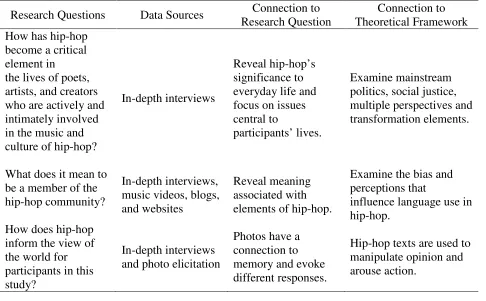
The primary research question guiding the current investigation is: “How has hip-hop
become a critical element in the lives of poets, artists, and creators who are actively and
intimately involved in its music and culture?” Additionally, the following sub questions will
direct this inquiry: (1) “What does it mean to be a member of the hip-hop community?” and (2)
In what way does hip-hop inform the participants’ view of the world?”
These research questions offered an opportunity to investigate the elements of hip-hop
that were central to members’ lives. They were designed to generate rich discussion of the ways
participants have experienced hip-hop from childhood into adulthood. The answers to these
research questions will provide insight into the significance of hip-hop in shaping the opinions
and influencing the actions of people inspired by this culture.
The current study of successful poets, artists, and creators who associate themselves
closely with hip-hop is significant. I refer to these particpants as “educators” because in their
roles, they educate formally as teachers in school environments and also work with youth in
informal settings. Although Alim (2007) defined an educator as a specialist in educational theory
and methods who help youth make sense of their social worlds and communties, the educators in
the current study are “individuals who give support to others as they learn to achieve a goal.”
Educators are considered wise, trusted, and knowledgable, often known as a gurus on a particular
subject (Chang, 2005; Delpit, 1995). As educators, the poets, artists, and creators who closely
world. Examining hip-hop through these educators’ stories may have been the first step toward
the challenge of advancing hip-hop scholarship through mounting criticism.
Theoretical Perspective
Critical literacy is an instructional approach to reading text that unearths the way
language is used to inform, entertain, persuade, and manipulate (Alim, 2006; Bartlett, 2008).
Language, as a social construct that is never neutral, shapes the representation of realities in texts
(Siegel & Fernandez, 2000). Texts can include television, movies, web pages, music (Callahan &
Low, 2004), and art (Alvermann & Hagood, 2000). The ways that individuals discuss the
meanings embedded in text, particularly negotiation of power, are key elements to critical
literacy (Haygood, 2002).
Significance of Critical Literacy
Critical literacy was chosen to study the language of hip-hop because it affords an
opportunity to critically question and examine the resulting data. Hip-hop, created as a resistant,
defiant expression of thought, presents critical views of mainstream opinions and interpretations
just as critical literacy analyzes the way that language manipulates, persuades, informs, and
entertains. When someone attempts to control and manipulate the thoughts of others, people
naturally resist; hip-hop is a manifestation of the resistance to socioeconomic status that many
African Americans in urban environments experience. Critical literacy is the frame used to
examine and read the world from a critical perspective, allowing real-world issues to surface for
investigation. Hip-hop music attempts to accomplish this same goal. Hip-hop lyrics are artistic
expressions of real-world problems, addressing socioeconomic status, race, class, and gender
culture, which is essential because “the media reproduces structural power relations based on
race, gender, class and sexual orientation” (Tisdell & Thompson, 2007, p. 654).
Currently, most studies examining the use of hip-hop in the classroom are either
theoretical or examine the practices of those who attempt to bring in the practice of hip-hop
without personally embracing the culture. The current body of literature addressing an analysis
of hip-hop culture incorporates various aspects of hip-hop culture, including its origin as a social
movement (Rose, 1991, 2008), analyzes the lyrical content of rap songs (Henderson, 1996), or
provides an argument for use in the classroom (Akintunde, 1997; Harper, 2000; Morrell &
Duncan-Andrade, 2002). Several researchers (Alim, 2002; Lippi-Green, 2000; Harper, 2000;
Watkins, 2005) have examined hip-hop’s usefulness as a means of poetic expression. Yet, absent
from the literature is a qualitative study of the different ways that hip-hop is experienced in daily
life, hearing the voices of adults who simultaneously identify with the hip-hop culture and with
mainstream society. The absence of qualitative research hightlighiting the voices of adults within
the hip-hop community is problematic because hip-hop is only becoming a more dominating part
of school environments. Hip-hop may give insight to educators with students that are heavily
influenced by the nuances of hip-hop. Critical literacy involves asking complicated questions
about language use and power, morality and ethics, and advantage and disadvantage (Comber,
2001). Critical literacy, which is informed by social justice pedagogy and influenced by the view
of Brazilian educator Paulo Freire, is essential to analyzing the meanings generated from
participants in the current study. Examining the ways that study participants view hip-hop will
allow me to see the influence of language, experience, and perspective on the meaning.
The goals of critical literacy are to empower students to read texts to understand the
multiple meanings of texts. Although some voices or discourses are excluded from texts, critical
literacy affords the reader an opportunity to question an author’s intent, perspective, and
position. Within critical literacy, the reader considers the author’s worldview and questions why
an author may choose to leave out or silence particular points of view. The current study is
guided by four components of critical literacy: (1) mainstream politics, (2) social justice, (3)
multiple perspectives, and (4) transformation.
Mainstream Politics
The term “mainstream politics” refers to a dimension of critical literacy that is divided
into two critical components: disrupting the commonplace by seeing the everyday through new
lens (Lewison, Flint, & van Sluys, 2002) and access orientation, which is granting access to the
dominant form of language (Janks, 2000).
Disrupting the Commonplace
Seeing the everyday through new lens, producing and examining bias and perceptions
that influence language use are seen as a way to disrupt the commonplace. This dimension of
critical literacy is essential to an examination of hip-hop texts and may assist individuals who are
outsiders to hip-hop by providing them with details of everyday experiences through the lens of
hip-hop artists. The rap song “Today was a Good Day by Ice Cube (1992) is an example of
disrupting the commonplace. This song presents the everyday life in south-central Los Angeles
from hip-hop artist Ice Cube’s perspective as Ice Cube shares his story through rhyme and details
an ordinary day for him. Throughout the song, he talks about smoking, drinking, having sexual
relations, hanging out with his friends, and not being harassed by local police. The listener can
examine bias and perceptions of these activities displaced into the text (song). Examining these
invites the listener into the everyday realities of the rapper. In reference to the Los Angeles
police, the rapper stated: “Saw the police and they rolled right past me. No flexin, didn't even
look in a niggaz direction” (Jackson, 1992). This quote refers to a situation where young males
are frequently and randomly stopped and questioned by police.
Incorporating popular culture in this manner is an example of disrupting the
commonplace because it imparts a new perspective. While it is important to examine every day
experiences through a critical lens, it is also imperative to view the power structures that control
and influence the media that people experience on a daily basis. In Ice Cube’s song, the rapper
questions the power structures in his Los Angeles neighborhood. The lyrics featured above
reveals the rapper’s belief that the Los Angeles police are in a position of power and “flex” this
power by stopping Black drivers with no probable cause. The term “driving while Black” is now
commonly used to refer to police harassment of Black drivers (Kowalski & Lundman, 2007).
The large number of Black drivers stopped for minor traffic offenses has fueled beliefs in racial
profiling exists because these Black drivers are more likely to receive traffic citations than their
White counterparts are. Ice Cube cleverly refers to the notion of driving while black in his song
by stating that during this “good day” Los Angeles police rode right past him, an unusual
occurrence in 1990s south-central Los Angeles. Listeners are exposed to the power structure that
exists between the Los Angeles police department and Black drivers; therefore, this is an
example of critical literacy that gives students the opportunity to question who has access and the
authority to make decisions.
Access Orientation
Access orientation (Janks, 2000) within critical literacy is a struggle to grant individuals
English through formal education. When educators assume an access orientation, they focus on
providing access to dominant forms of language without compromising the integrity of
non-dominant forms (Janks, 2000). Teachers who use and teach standard English but acknowledge
nonstandard forms that students may bring to school, such as creating meaning through
storytelling, demonstrate the access orientation element of critical literacy. Popular culture texts
offer a storytelling element and alternative viewpoints and therefore serve as a good tool to
permit individuals access to the dominant form of language without compromising the intergity
of non-dominant forms of language. Popular culture texts such as music lyrics, websites, blogs,
music videos, magazines, and film sometimes lead to controversial topics or genres that may be
unfamiliar to the classroom teacher. Teachers who feel tension when incorporating a new aspect
of curriculum can find support in study groups and through online resources provided by
teachers with more experience using popular culture in their classroom instruction as a method of
critical literacy. Popular culture studies, hip-hop texts, or alternative forms of texts provide an
excellent view of the ways language is used to manipulate public opinion. Incorporating
alternative forms of text (e.g., video, music, and film) begins the process of critical literacy
through integrating multiple perspectives (Alim, 2007; Asselin, 2001; Callahan & Low, 2004).
Multiple Perspectives
Critical literacy allows an examination of perspective, specifically those with
perspectives that are advanced and deemed valid, using multiple voices to interrogate texts by
asking questions such as “Whose voices are heard and whose are silenced?” (Luke & Freebody,
1997). Incorporating multiple texts on the same topic (Behrman, 2006) encouraged students to
question whose values are advanced in a text (Spires, 1999). Reading a range of texts on the
text. When educators adopt a multiple perspective (Janks, 2000) stance, attention is given to the
way language use creates social identities. As novice teachers become familiar with hip-hop
texts, they may interrogate multiple viewpoints by examining competing or counter-narratives.
Comparing and contrasting two hip-hop artists from two different rap genres (i.e., gangster rap
and conscious rap) (Hagerdorn, 1991) demonstrates the use of hip-hop texts to interrogate
multiple viewpoints. Students can attempt to understand both perspectives and critically read the
text (lyrics). Gangster rap (also referred to as gangsta rap) is a subset of hip-hop music that
evolved from hard-core hip-hop music closely associated with artists from the western coast of
the United States (Chang, 2005). Gangsta rap contains violent lyrics about crime and gang
affiliation. Examples of gangsta rappers are Too Short, NWA, Bone Thugs-n-Harmony,
C-Murder, Capone-N-Noreaga, The Criminalz, Da Lynch Mob, and Ghetto Boys (Hagerdorn,
1991). Conscious rap music consists of lyrics that focus on positivity, knowledge, and learning
(Chang, 2005). Conscious rappers habitually create lyrics about social change and
self-awareness, often embracing an element of political rhetoric. Rappers such as Talib Kweli,
Rakim, Nas, Mos Def, and Common are known as conscious rappers. Conscious rap music has a
high level of social consciousness.
Using the multiple perspective element of critical literacy, students are able to formulate
new ideas and meanings using various modes such as hip-hop because of its relevance to their
daily lives. For example, Akintunde (1997) argued that using popular culture values and
students’ life experiences lends itself to in-depth discussions of the sociopolitical context that is
sometimes hidden within texts. Lloyd (2003) demonstrated how song lyrics could encourage
students to deconstruct gender roles, racist practices, and governmental policies. Using songs
discussion about man’s role in protecting the environment. Guiding students through a careful
critique of the lyrics reveals Gaye’s depiction of pollution, devastation caused by oil spills due to
human carelessness, and disregard for animal and plant life.
Teachers who employ a critical literacy perspective recognize that language is not neutral
and teach students to seek out the bias depicted in language (Alvermann & Hagood, 2000; Luke
& Freebody, 1999). All texts created from a particular perspective are intended to convey a
certain message. Adopting a critical literacy perspective demands that the reader interrogate
multiple perspectives with the understanding that texts are designed to influence the readers’
thinking. Behrman (2006) maintained that identifying multiple voices in texts, engaging in dialog
about dominant culture, and recognizing sources of authority in texts are all activities that
support the uncovering of social-justice dynamics in critical literacy.
Social Justice
The social justice tenet focuses on the belief that the world is a socially constructed text
(Siegel & Fernandez, 2000). Language and literacy are essential to social reconstruction and the
eradication of economic exploitation (McLaren, 1999). In this tenet, critical literacy involves
reading the world to uncover power relationships (Behrman, 2006; Green, 2001; Janks, 2000;
Siegel & Fernandez, 2000). Knowledge is power, and power is not equally distributed among all
groups. Delpit (1995) pointed out that access to knowledge and consequently power is
unbalanced among cultural and economic groups. This imbalance of power led to one social or
economic group exhibiting dominance over the others, and that domination is perpetuated by
language. Nonfiction texts offer exposure to the power of language to influence opinion and
motivate action (Sisk, 2002). Those that are granted access to the language of power maintain
“domination perspective” and uses it to analyze the ways that language equates to power. Noting
the way standard English (the language used in schools) helps individuals navigate through
mainstream society, educators who adopt the domination perspective use texts that consider how
language maintains positions of social and political domination. Unconventional instructional
texts like those found in popular culture help demonstrate the connection between language and
power. Lloyd (2003) suggested that lyrics from certain popular artists provide students with
real-world, socially constructed content in a format that students can comprehend.
Critical literacy in popular culture (e.g., hip-hop texts) can extrapolate theories of
language reveal that word meanings are fluid, can lose their historical baggage, and can be
restructured for new purposes (Callahan & Low, 2004). Subtle changes can transform the
meaning of words, at least for the user, and communicate a completely different context. For
example, the term “get busy” has a different meaning in the hip-hop community depending on
the context (Chang, 2005). When referring to a group of students, “get busy,” meant having a
good time or socializing. However, the term also had a sexual reference when used to describe
interaction between a male and a female. In addition to these two meanings, “get busy” was used
to describe a physical altercation, such as a fight. This term demonstrates the subtle changes that
transform meaning, allowing the user to reclaim power by dictating the meaning associated with
the term. The term was restructured for a new purpose. Callahan and Low (2004) demonstrated
this same language transformation examining use of the word “nigger” by replacing the –er with
–a by members of the hip-hop community. Despite centuries of negative connotation, the
spelling and pronunciation of the word nigger was changed for a new purpose. The er was
demonstrates an eradication of the socially constructed historical baggage previously associated
with the word and therefore is an example of social justice.
Transformation
Restructuring a word, term, or phrase to influence the socially constructed meaning it is
associated with is also an example of transformation. Taking action and promoting social justice
(Lewison, Flint, & van Sluys, 2002) is an indispensable element of critical literacy that allows
students to read text critically and then move toward changing unjust and oppressive situations.
Hall (1999) confirmed that this element of critical consciousness leads to students’ remaking
their own identities and sociopolitical realities. To be critically literate, individuals imagine
multiple perspectives and possibilities. Nevertheless, critical literacy does not stop with
recognizing multiple perspectives; it also incorporates taking action and effecting social change
(Green, 2001). Freire (1972) argued that the goal of critical literacy is to transform the world by
first reflecting and then taking action. A multitude of hip-hop songs embody this social
transformation element of critical literacy. When hip-hop artists choose to produce authentic
music rather than be controlled by large record companies, it exemplifies the essence of taking
action. The connection between critical literacy and hip-hop was demonstrated when students
protested hip-hop artist Nelly’s appearance at Spelman College (a historically Black college in
Atlanta, GA) for a charity event to raise awareness of bone marrow registry (Carpenter, 2006).
Female students at Spelman College planned to protest the rapper because of the misogyny
demonstrated in his rap videos. The protest drew considerable media attention and negative
publicity for the rapper; it also renewed the focus on video vixens and women’s objectification in
hip-hop culture. Spelman students were critically examining hip-hop videos (texts) as
through their protest. These students demonstrated the transformative element of critical literacy
by understanding that language shapes understanding of social issues such as race, class, and
gender (Janks, 2000) as well as how we use language to talk about those issues. These students’
voices, in protest, influenced the public’s opinion of female images in hip-hop as well as the
language used to describe the female body.
Summary
In this chapter, I provided a historical overview of hop culture, explaining what
hip-hop is and how it began. Just as it is important to address the history of hip-hip-hop, it is important to
address the significance of hip-hop’s influence on my personal and professional life. In the brief
autobiography section, I attempted to explain how hip-hop influenced my styles of dress,
language usage, and ultimately the method of instructional delivery I used as a classroom
teacher. The purpose of this study is to examine hip-hop through the stories of adults who
incorporate it into their daily lives. I have described critical literacy as a theoretical perspective
to examine the stories shared by participants. Critical literacy demonstrates the power of
CHAPTER 2
REVIEW OF LITERATURE
In the current examination of hip-hop culture, I argue that hip-hop is born out of a larger
urban black experience that incorporates language in various ways. In this chapter, I will focus
on the historical connection between the language of hip-hop and Black discourse with special
emphasis on the importance of the ways language is manipulated to sway opinion, resist
authority and take action, and promote social justice.
History of Hip-Hop Language
The study of Black language dates back to Abrahams (1964), who examined Black
speech and incorporated aspects of Black discourse. Abrahams, studying the speech patterns of
African Americans living in South Philadelphia in the 1950s, attempted to include social
considerations. Attempting to completely integrate into the working-class Black neighborhood
where his participants lived and worked, Abrahams recorded the stories of local Black people.
Abrahams presented this folklore to include stories, jokes, and songs that had been passed down
for generations in the Black community. Abrahams focused on the insight that could be
generated from the stories the participants told as opposed to the stories themselves; however,
those stories were generated primarily from male participants. The view of Black language
depicted in Abrahams (1964) was overwhelmingly male-dominated, just as the views and
opinions presented within hip-hop culture are male-dominated.
Connecting Black Language and Hip-Hop
The study of Black language is also a study of hip-hop, which is deeply rooted in the
Black language community. Cutler (2007) maintained that hip-hop has a long history in the
ordered supports the idea that Black discourse is exceedingly complex (Lippi-Green, 2000; Orr,
2000). Words, phrases, and expressions rooted in hip-hop culture often live within a trajectory of
Black discourses (Richardson, 2006; Smitherman, 1997). Smitherman (1997) and Alim (2006)
agreed that hip-hop discourse is “embodied in the communicative practices of the larger black
speech community” (Smitherman, 1997, p. 7) and can be identified by classic aspects of Black
vernacular, such as the habitual “be.” According to Alim (2002), this “be” is illustrated in Black
discourse and the language of hip-hop, via terms such as “you be trippin,” meaning that one
speaker is accusing another of exaggerating or overreacting to a situation. Expressions like
“word,” “word up,” and “Yo word is Yo bond” (Cutler, 2007) are all derivatives of older
expressions found within Black vernacular English.
The term we know today as “rap” refers to the lyrical aspect of hip-hop music.
Smitherman (1997) suggested that the word rap was initially coined in the African American
speech community to describe the romantic interactions between a man and a woman. With
continued usage, the term began to take on a more inclusive meaning, representing any
dominating verbal exchange. This definition of rap is akin to the definition of “rap” in rap music.
When artists use conversation to transfer a message over a musical beat, it is called “rapping.”
Rose (1994) contended that many rappers use aspects of ‘versioning’ and sampling in
their music. Versioning refers to the process of creating a new version of a popular song.
Versioning is a musical tradition used heavily in Caribbean Reggae music. Additionally, hip-hop
is influenced by the Caribbean tradition of Toasting where a deejay talks to the audience while a
song is played (Chang, 2005). Sampling in hip-hop refers to an artist using a sample or small
portion of an existing record as part of his or her new song (Asante, 2008). Unlike versioning,
that hip-hop music’s incorporation of pre-recorded sound, through sampling, has challenged
copyright laws and demanded reexamination of musical property.
As an art form, rap music tells stories, analyzes social situations, and makes statements
from an artist’s point of view (Akintunde, 1997; Alim, 2006; Baker, 1993). A rap must be
rational and provide information in addition to entertaining. Rappers gain power and prestige
when they display a clever and articulate command of the English language. Therefore, a rapper
must be able to condense a situation into a three-minute soliloquy and set it to a rhythmic beat,
which requires higher level thinking skills and execution (Alexander-Smith, 1993; Chang, 2005).
Rapping as a Form of Storytelling
Rapper as Griots
Storytelling, an oral tradition, is one of the most distinctive forms of literacy that exists in
the African American community. The African ritual of call and response is used to capture an
audience and enhance the performance aspect of storytelling. Smitherman (1997) classified the
rapper as a “postmodern African griot” or a verbally gifted storyteller. Richardson (2006)
supported Smitherman’s (1997) claim, arguing that African language practices employed in rap
lyrics include mimicry, boasting, image-making, punning, and call and response. The art of
rapping exemplifies the oral tradition of storytelling, particularly the practice of call and
response. The song “Children’s Story” by rapper Slick Rick, as seen in Walters (1988) illustrates
one of the many ways that rappers use the literacy practice of storytelling to communicate with
their audience:
Here we go,
Once upon a time not long ago,
when people wore pajamas and lived life slow, When laws were stern and justice stood,
by anotha lil' boy and this is what he said: Me, Ya, Ty, we gonna make sum cash, robbin' old folks and makin' tha dash..
This excerpt warns children to avoid criminal activity and negative peer pressure. The song
vividly describes events that lead to a young boy’s death during a crime spree that included
robbery and kidnapping. Ironically, this cautionary tale is told as a bedtime story and ends with a
vibrant lyrical twist, depicting how the young boy meets his fate.
Deep in his heart he knew he was wrong, so he let the lady go and he starts to run on, Sirens sounded, he seemed astounded, before long the lil' boy got surrounded, He dropped the gun, so went the glory, and this is the way I must end this story, He was only seventeen, in a madman's dream, the cops shot the kid, I still hear him scream, This ain't funny so don't ya dare laugh, just another case 'bout the wrong path, Straight 'n narrow or yo' soul gets cast. Good night. (Slick Rick, 1988).
This song is significant for its depiction of the misfortune that falls upon youth who are “misled”
and participate in illegal activities. Slick Rick’s song “Children’s Story” remains an influential
piece of old-school hip-hop music, inspiring a children’s story written by rappers Mos Def and
Talib Kweli. Unlike Slick Rick’s cautionary tale regarding illegal activity, Mos Def and Talib
Kweli’s version of “Children’s Story” depicts the wrong path that hip-hop music has traveled.
With the use of personification, Mos Def and Talib Kweli (1998) gave human characteristics to
hip-hop music in the following excerpt that portrays how some hip-hop artists allow the business
aspect of hip-hop to overshadow the creative aspect:
Once upon a time not long ago
When people wore Adidas and lived life slow When laws were stern and justice stood
By a little Sha-tan and this is what he said "Me and you kid we gonna make some cash, Jackin' old beats and makin' the dash..." They jacked the beats, money came wit' ease But son, he couldn't stop, it's like he had a disease
He jacked another and another, Michael Jackson, Stevie Wonder Set some R & B over the track for 'Deep Cover' (187!).
The line “Me and you kid we gonna make some cash, Jackin’ old beats and makin’ a
dash…” illustrates the practices that some rappers use to gain fame in the hip-hop music
industry. The song’s tone and references to “Jackin beats” and “makin’ a dash” refer to sampling
other artists’ music without proper authorization from or compensation to the original
composers. Mos Def and Talib Kweli’s version of Children’s Story is a harsh critique of what
happens when hip-hop artists, void of creative ability, fall victim to dishonorable practices within
the hip-hop industry of record executives in lieu of maintaining the authenticity found within in
hip-hop community of rappers, deejays, graffiti artists, and breakdancers. Both of the
aforementioned versions of Children’s Story illustrate the deliberate and premeditated
storytelling aspect of rapping.
Rap Cipher
When rap artists join together to create impromptu, freestyle raps, it is known as a rap
“cipher.” Newman (2005) explored the rap cipher or freestyle rap, an oral communication
practice deeply rooted in old school hip-hop culture. The rap cipher is impromptu rapping about
various subjects, utilizing a debate style known as battling. Newman attempted to analyze rap
lyrics, presented orally in response to different stimuli, as literacy, and observed young males’
ability to freestyle. Rap ciphers emphasize the diverse ways that rappers manipulate words to get
their points across. Using an ethnographic approach, Newman found equivalence between the